def moe_accounting(name, d, width, num_experts, num_active, num_layers,
                   shared=0, unit=1e9):
    """Expert parameters stored, and expert and router parameters active
    per token, in a stack of SwiGLU expert layers."""
    per_expert = 3 * d * width          # SwiGLU: three d x width matrices
    store = num_layers * (num_experts + shared) * per_expert
    active = num_layers * ((num_active + shared) * per_expert
                           + d * num_experts)      # + the router
    tag = 'B' if unit == 1e9 else 'M'
    print(f'{name:>12}: {store/unit:5.3g}{tag} in experts, '
          f'{active/unit:5.3g}{tag} active per token, '
          f'ratio {store/active:4.1f}x')
    return store, active

moe_accounting('ours', 128, 341, 8, 1, 2, unit=1e6)
moe_accounting('DeepSeek-V3', 7168, 2048, 256, 8, 58, shared=1)
store, active = moe_accounting('Mixtral 8x7B', 4096, 14336, 8, 2, 32)
attn = 32 * (2 * 4096 * 4096 + 2 * 4096 * 1024)  # GQA: 32 Q, 8 KV heads
emb = 2 * 32000 * 4096                           # embedding + output head
print(f'{"":>12}  with attention and embeddings: '
      f'{(store + attn + emb)/1e9:.1f}B stored, '
f'{(active + attn + emb)/1e9:.1f}B active')11.7 Mixture of Experts (MoE)
In a dense Transformer (Section 11.6), every token uses every parameter: doubling model capacity \(N \approx 12 L d^2\) doubles the training cost (\(6 N\) FLOPs/token) and doubles the inference compute (\(2 N\) FLOPs/token). Can we grow a model’s stored parameter capacity \(N_{\textrm{total}}\) without growing the active parameters \(N_{\textrm{active}}\) executed per token?
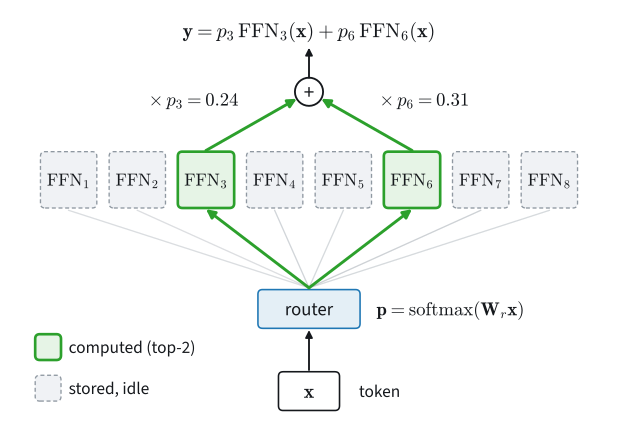
Recall from Section 11.1 that the feed-forward network holds two-thirds of a dense block’s parameters (\(8 d^2\) out of \(12 d^2\)) and acts position-wise on each token vector \(\mathbf{x} \in \mathbb{R}^d\) independently. A Sparse Mixture-of-Experts (MoE) layer (Jacobs et al. 1991; Shazeer et al. 2017; Lepikhin et al. 2021; Fedus et al. 2022) exploits this independence (Figure 11.7.1): it replaces a block’s single FFN with a bank of \(E\) parallel FFN experts \(\{\textrm{FFN}_1, \dots, \textrm{FFN}_E\}\) and uses a lightweight linear router \(\mathbf{W}_r \in \mathbb{R}^{d \times E}\) to dispatch each token \(\mathbf{x}\) to only its top-\(k\) experts (\(1 \le k \ll E\)).
11.7.1 Conditional Computation: Stored vs. Active Parameters
In an \(L\)-layer MoE Transformer where each block has attention parameters \(P_{\textrm{attn}}\), \(E\) routed SwiGLU experts of intermediate width \(w\) (\(P_{\textrm{exp}} = 3 d w\) parameters per expert), and \(E_{\textrm{shared}}\) always-active shared experts (Dai et al. 2024), all \(E + E_{\textrm{shared}}\) experts must be stored in memory (\(N_{\textrm{total}}\)), but each token executes only \(k + E_{\textrm{shared}}\) experts (\(N_{\textrm{active}}\)):
        ours:   2.1M in experts, 0.264M active per token, ratio  7.9x
 DeepSeek-V3:   656B in experts,  23.1B active per token, ratio 28.4x
Mixtral 8x7B:  45.1B in experts,  11.3B active per token, ratio  4.0x
              with attention and embeddings: 46.7B stored, 12.9B active
def moe_accounting(name, d, width, num_experts, num_active, num_layers,
shared=0, unit=1e9):
"""Expert parameters stored, and expert and router parameters active
per token, in a stack of SwiGLU expert layers."""
per_expert = 3 * d * width # SwiGLU: three d x width matrices
store = num_layers * (num_experts + shared) * per_expert
active = num_layers * ((num_active + shared) * per_expert
+ d * num_experts) # + the router
tag = 'B' if unit == 1e9 else 'M'
print(f'{name:>12}: {store/unit:5.3g}{tag} in experts, '
f'{active/unit:5.3g}{tag} active per token, '
f'ratio {store/active:4.1f}x')
return store, active
moe_accounting('ours', 128, 341, 8, 1, 2, unit=1e6)
moe_accounting('DeepSeek-V3', 7168, 2048, 256, 8, 58, shared=1)
store, active = moe_accounting('Mixtral 8x7B', 4096, 14336, 8, 2, 32)
attn = 32 * (2 * 4096 * 4096 + 2 * 4096 * 1024) # GQA: 32 Q, 8 KV heads
emb = 2 * 32000 * 4096 # embedding + output head
print(f'{"":>12} with attention and embeddings: '
f'{(store + attn + emb)/1e9:.1f}B stored, '
f'{(active + attn + emb)/1e9:.1f}B active') ours: 2.1M in experts, 0.264M active per token, ratio 7.9x
DeepSeek-V3: 656B in experts, 23.1B active per token, ratio 28.4x
Mixtral 8x7B: 45.1B in experts, 11.3B active per token, ratio 4.0x
with attention and embeddings: 46.7B stored, 12.9B activeNotice how \(N_{\textrm{total}}\) and \(N_{\textrm{active}}\) govern different system resources:
- Per-token FLOPs (training and prefill) scale with \(N_{\textrm{active}}\) (\(C_{\textrm{train}} \approx 6 N_{\textrm{active}} D\)).
- VRAM capacity scales with \(N_{\textrm{total}}\), because all \(E\) experts must reside in device memory.
- Batched decode bandwidth: At batch size \(B = 1\), a token streams only \(k\) experts from HBM (\(N_{\textrm{active}}\) weight bytes). Across a batch of \(B\) tokens, however, different tokens activate different experts: once \(B \gg E / k\), almost all \(E\) experts are touched by at least one token in the batch, so each decode step streams nearly \(N_{\textrm{total}}\) weight bytes from HBM while performing \(2 B N_{\textrm{active}}\) FLOPs.
11.7.2 A Mixture-of-Experts Layer
11.7.2.1 Top-\(k\) Routing
For each token \(\mathbf{x} \in \mathbb{R}^d\), the router computes probabilities \(\mathbf{p}(\mathbf{x}) = \textrm{softmax}(\mathbf{x}\mathbf{W}_r) \in \Delta^{E-1}\), selects the set \(T(\mathbf{x}) \subset \{1, \dots, E\}\) of \(k\) highest-scoring experts, keeps their raw probabilities as weights, \(g_e(\mathbf{x}) = p_e(\mathbf{x})\) (renormalizing them over \(T(\mathbf{x})\) would leave a top-1 router without a gradient; Exercise 1), and forms the weighted sum:
\[ \textrm{MoE}(\mathbf{x}) \;=\; \sum_{e \in T(\mathbf{x})} g_e(\mathbf{x}) \, \textrm{FFN}_e(\mathbf{x}). \tag{11.7.1}\]
11.7.2.2 Dispatching Tokens to Fixed-Capacity Expert Buffers
In compiled or distributed training, each expert \(e \in \{1, \dots, E\}\) pre-allocates a fixed buffer of capacity \(S = \lceil \gamma \cdot n k / E \rceil\) slots for a batch of \(n\) tokens, where \(n k / E\) is the perfectly balanced load per expert and \(\gamma \ge 1\) is the capacity factor (\(\gamma = E\) disables dropping by setting \(S = n k\)). If more than \(S\) token–expert assignments target expert \(e\), the excess assignments are dropped (contributing zero to Equation 11.7.1, so those tokens pass through the surrounding block’s residual skip connection). Figure 11.7.2 follows six tokens through this dispatch.
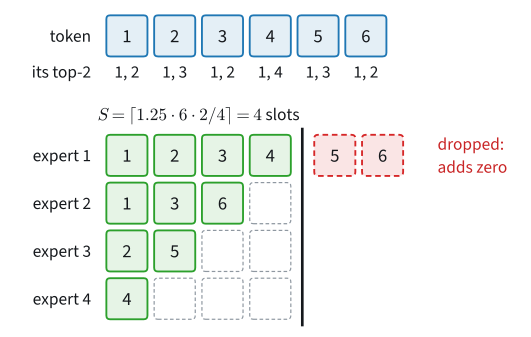
MoELayer implements the router, the dispatch into buffers of \(S\) slots, and the drop rule:
class MoELayer(nn.Module):
    """Token-choice top-k mixture of SwiGLU d2l.FeedForward experts, each
    with a buffer of S = capacity_factor * n k / E slots for n tokens."""
    def __init__(self, num_hiddens, num_experts, num_active,
                 capacity_factor=1.25):
        super().__init__()
        self.num_experts, self.num_active = num_experts, num_active
        self.capacity_factor = capacity_factor
        self.router = nn.Linear(num_hiddens, num_experts, bias=False)
        self.experts = nn.ModuleList([d2l.FeedForward(num_hiddens)
                                      for _ in range(num_experts)])
        # Added to the probabilities for the selection only; zero until a
        # balancing method moves it
        self.register_buffer('expert_bias', torch.zeros(num_experts))
        # Assignments per expert, dropped or not, and the dropped ones,
        # counted by record() until reset_stats()
        self.register_buffer('load', torch.zeros(num_experts))
        self.register_buffer('dropped', torch.zeros(()))

    def forward(self, X):
        x = X.reshape(-1, X.shape[-1])                 # (n, d): the tokens
        (n, d), E, k = x.shape, self.num_experts, self.num_active
        S = math.ceil(self.capacity_factor * n * k / E)  # slots per expert
        P = F.softmax(self.router(x), -1)              # (n, E)
        idx = (P + self.expert_bias).topk(k).indices   # (n, k)
        e = idx.flatten()                              # expert of each pair
        onehot = F.one_hot(e, E)                       # (n k, E)
        rank = (onehot.cumsum(0) * onehot).sum(1) - 1  # place in its queue
        slot = torch.where(rank < S, e * S + rank, E * S)  # E S: dropped
        buf = x.new_zeros(E * S + 1, d)                # + an overflow row
        buf[slot] = x.repeat_interleave(k, 0)
        Y = self.run_experts(buf[:-1].reshape(E, S, d)).reshape(E * S, d)
        Y = torch.cat([Y, Y.new_zeros(1, d)])[slot]    # dropped: zeros
        weights = P.gather(-1, idx)                    # (n, k): the p_i
        out = (weights[..., None] * Y.reshape(n, k, d)).sum(1)
        self.record(onehot.sum(0), (rank >= S).sum(), P)
        return out.reshape(X.shape)

    def run_experts(self, H):
        """Each expert's SwiGLU on its own buffer: (E, S, d) -> (E, S, d)."""
        W = lambda name: torch.stack(  # (E, d_in, d_out): one per expert
            [getattr(e, name).weight for e in self.experts]).mT
        return (F.silu(H @ W('W_g')) * (H @ W('W_1'))) @ W('W_2')

    def record(self, counts, num_dropped, P):
        """Add a batch's assignments per expert and drops to the totals,
        and keep its balancing loss, a measure of imbalance."""
        self.load += counts
        self.dropped += num_dropped
        f = counts / counts.sum()                      # this batch's shares
        self.aux_loss = self.num_experts * (f * P.mean(0)).sum()

    def reset_stats(self):
        self.load.zero_()
        self.dropped.zero_()
class MoELayer(nnx.Module):
"""Token-choice top-k mixture of SwiGLU d2l.FeedForward experts, each
with a buffer of S = capacity_factor * n k / E slots for n tokens."""
def __init__(self, num_hiddens, num_experts, num_active,
capacity_factor=1.25, *, rngs):
self.num_experts, self.num_active = num_experts, num_active
self.capacity_factor = capacity_factor
self.router = d2l.Linear(num_hiddens, num_experts, use_bias=False,
rngs=rngs)
self.experts = nnx.List([d2l.FeedForward(num_hiddens, rngs=rngs)
for _ in range(num_experts)])
# Added to the probabilities for the selection only; zero until a
# balancing method moves it
self.expert_bias = nnx.Variable(jnp.zeros(num_experts))
# Assignments per expert, dropped or not, and the dropped ones,
# counted by record() until reset_stats(); the last batch's
# balancing loss
self.load = nnx.Variable(jnp.zeros(num_experts))
self.dropped = nnx.Variable(jnp.zeros(()))
self.aux_loss = nnx.Variable(jnp.zeros(()))
def __call__(self, X):
x = X.reshape(-1, X.shape[-1]) # (n, d): the tokens
(n, d), E, k = x.shape, self.num_experts, self.num_active
S = math.ceil(self.capacity_factor * n * k / E) # slots per expert
P = jax.nn.softmax(self.router(x), -1) # (n, E)
_, idx = jax.lax.top_k(P + self.expert_bias[...], k) # (n, k)
e = idx.ravel() # expert of each pair
onehot = jax.nn.one_hot(e, E, dtype=jnp.int32) # (n k, E)
rank = (onehot.cumsum(0) * onehot).sum(1) - 1 # place in its queue
slot = jnp.where(rank < S, e * S + rank, E * S) # E S: dropped
buf = jnp.zeros((E * S, d), x.dtype).at[slot].set(
jnp.repeat(x, k, 0), mode='drop')
Y = self.run_experts(buf.reshape(E, S, d)).reshape(E * S, d)
Y = Y.at[slot].get(mode='fill', fill_value=0) # dropped: zeros
weights = jnp.take_along_axis(P, idx, -1) # (n, k): the p_i
out = (weights[..., None] * Y.reshape(n, k, d)).sum(1)
self.record(onehot.sum(0), (rank >= S).sum(), P)
return out.reshape(X.shape)
def run_experts(self, H):
"""Each expert's SwiGLU on its own buffer: (E, S, d) -> (E, S, d)."""
W = lambda name: jnp.stack( # (E, d_in, d_out): one per expert
[getattr(e, name).kernel[...] for e in self.experts])
return (jax.nn.silu(H @ W('W_g')) * (H @ W('W_1'))) @ W('W_2')
def record(self, counts, num_dropped, P):
"""Add a batch's assignments per expert and drops to the totals,
and keep its balancing loss, a measure of imbalance."""
self.load[...] += counts
self.dropped[...] += num_dropped
f = counts / counts.sum() # this batch's shares
self.aux_loss[...] = self.num_experts * (f * P.mean(0)).sum()
def reset_stats(self):
self.load[...] = jnp.zeros_like(self.load[...])
self.dropped[...] = jnp.zeros(())Two small utilities, moe_layers(model) and active_params(model), collect all MoELayer submodules in a network and tally how many parameters participate in the forward pass of a single token (\(k / E\) of the expert bank plus all shared parameters):
def moe_layers(model):
    """The MoELayer modules of a model."""
    return [m for m in model.modules() if isinstance(m, MoELayer)]

def active_params(model):
    """Parameters used per token: all but the unselected experts."""
    return d2l.num_params(model) - sum(
        d2l.num_params(l.experts) * (l.num_experts - l.num_active)
        // l.num_experts for l in moe_layers(model))
def moe_layers(model):
"""The MoELayer modules of a model."""
return [m for _, m in nnx.iter_graph(model) if isinstance(m, MoELayer)]
def active_params(model):
"""Parameters used per token: all but the unselected experts."""
return d2l.num_params(model) - sum(
d2l.num_params(l.experts) * (l.num_experts - l.num_active)
// l.num_experts for l in moe_layers(model))Because d2l.TransformerBlock (Section 11.1) accepts an ffn_factory hook, replacing the dense FFN with an 8-expert Top-2 MoELayer requires passing a single lambda:
blk = d2l.TransformerBlock(256, num_heads=8,
                           ffn_factory=lambda: MoELayer(256, 8, 2))
X = torch.randn(4, 100, 256)
d2l.check_shape(blk(X), X.shape)  # The expert layer fits into the block
moe = MoELayer(256, num_experts=8, num_active=2)
print(f'{d2l.num_params(moe)} parameters stored, '
      f'{active_params(moe)} active per token')
4198400 parameters stored, 1051136 active per tokenblk = d2l.TransformerBlock(
256, num_heads=8, rngs=nnx.Rngs(d2l.get_key()),
ffn_factory=lambda rngs: MoELayer(256, 8, 2, rngs=rngs))
X = jax.random.normal(d2l.get_key(), (4, 100, 256))
d2l.check_shape(blk(X), X.shape) # The expert layer fits into the block
moe = MoELayer(256, num_experts=8, num_active=2,
rngs=nnx.Rngs(d2l.get_key()))
print(f'{d2l.num_params(moe)} parameters stored, '
f'{active_params(moe)} active per token')4198400 parameters stored, 1051136 active per token11.7.3 Routing Collapse and Load Balancing
11.7.3.1 Uneven Load and Positive Feedback
Even at initialization, random router weights send more tokens to some experts than others. During training without a load-balancing mechanism, a positive-feedback loop amplifies this asymmetry into routing collapse (Shazeer et al. 2017): whichever experts receive more tokens at step 1 receive larger gradient updates, reduce the language-modeling loss faster on step 2, get rewarded by \(\nabla_{\mathbf{W}_r}\mathcal{L}\) with higher router logits on step 3. Left unchecked, the loop can end with a few experts holding most of the top-\(k\) slots while the others receive too few tokens to learn anything.
11.7.3.2 Two Solutions: Auxiliary Balancing Loss vs. Loss-Free Bias Controller
Switch auxiliary load-balancing loss (Fedus et al. 2022): Let \(f_e = \frac{1}{n k} \sum_{t=1}^n \mathbb{I}[e \in T(\mathbf{x}_t)]\) be the empirical fraction of routed slots dispatched to expert \(e\) in a batch of \(n\) tokens, and let \(\bar{p}_e = \frac{1}{n}\sum_{t=1}^n p_e(\mathbf{x}_t)\) be the mean router probability assigned to expert \(e\). Adding \(\alpha \mathcal{L}_{\textrm{aux}}\) to the training loss, where
\[ \mathcal{L}_{\textrm{aux}} \;=\; E \sum_{e=1}^{E} f_e \, \bar{p}_e, \tag{11.7.2}\]
penalizes high probability \(\bar{p}_e\) on heavily loaded experts (large \(f_e\)) and achieves its minimum \(\mathcal{L}_{\textrm{aux}} = 1\) when \(f_e = 1/E\) for all \(e\).
Loss-free dynamic router bias control (Wang et al. (2024), used in DeepSeek-V3 (DeepSeek-AI et al. 2024)): Because \(\nabla \mathcal{L}_{\textrm{aux}}\) pushes token representations toward uniform routing even when specialization would lower language-modeling loss, this method balances the load without an auxiliary gradient (DeepSeek-V3 keeps only a very small sequence-wise balance loss next to it). Instead, each expert maintains a non-differentiable selection bias \(b_e\) added only inside top-\(k\) selection (\(T(\mathbf{x}) = \textrm{argtop}_k(\mathbf{p}(\mathbf{x}) + \mathbf{b})\), leaving the gating weights \(g_e(\mathbf{x})\) unbiased), updated after each step by a sign controller with rate \(\eta_b\):
\[ b_e \;\leftarrow\; b_e \;+\; \eta_b \, \textrm{sign}\!\left(\frac{1}{E} - f_e\right). \tag{11.7.3}\]
11.7.3.3 Load-Balancing Methods Compared
We add balance(rate) to MoELayer and compare five configurations on a 2-block byte-level GPT (\(E = 8, k = 1\), each expert a full-width FFN so the 1 active expert equals 1 dense FFN) over 800 steps on WikiText-103: (1) initialization, (2) no balancing, (3) a frozen router control (testing whether collapse requires router–expert feedback), (4) Switch auxiliary loss (\(\alpha = 0.01\)), and (5) loss-free bias control (\(\eta_b = 10^{-2}\)):
@d2l.add_to_class(MoELayer)
@torch.no_grad()  # Not a gradient step
def balance(self, rate):
    """The controller: move each bias one step toward the even load, then
    count the next batch's assignments afresh."""
    self.expert_bias += rate * torch.sign(self.load.mean() - self.load)
    self.load.zero_()

def train_moe_lm(model, data, optimizer, num_steps, aux_weight=0.0,
                 bias_rate=0.0):
    """d2l.train_steps with a balancing loss and the bias controller."""
    device = d2l.try_gpu()
    model.to(device)
    layers, losses = moe_layers(model), []
    for l in layers:
        l.reset_stats()
    while len(losses) < num_steps:
        for X, Y in data.train_dataloader():
            ce = F.cross_entropy(model(X.to(device)).flatten(0, 1),
                                 Y.to(device).flatten())
            optimizer.zero_grad()
            (ce + aux_weight * sum(l.aux_loss for l in layers)).backward()
            optimizer.step()
            for l in layers:
                l.balance(bias_rate)
            losses.append(ce.detach())
            if len(losses) == num_steps:
return torch.stack(losses).tolist()@d2l.add_to_class(MoELayer)
def balance(self, rate):
"""The controller: move each bias one step toward the even load, then
count the next batch's assignments afresh."""
load = self.load[...]
self.expert_bias[...] += rate * jnp.sign(load.mean() - load)
self.load[...] = jnp.zeros_like(load)
@nnx.jit # aux_weight and bias_rate are traced: one compilation for all
def moe_train_step(model, optimizer, X, Y, aux_weight, bias_rate):
def loss_fn(model):
ce = optax.softmax_cross_entropy_with_integer_labels(
model(X), Y).mean()
aux = sum(l.aux_loss[...] for l in moe_layers(model))
return ce + aux_weight * aux, ce
(_, ce), grads = nnx.value_and_grad(loss_fn, has_aux=True)(model)
optimizer.update(model, grads)
for l in moe_layers(model): # The controller: not a gradient step
l.balance(bias_rate)
return ce
def train_moe_lm(model, data, optimizer, num_steps, aux_weight=0.0,
bias_rate=0.0):
"""d2l.train_steps with a balancing loss and the bias controller."""
for l in moe_layers(model):
l.reset_stats()
losses = []
while len(losses) < num_steps:
for X, Y in data.train_dataloader():
losses.append(moe_train_step(model, optimizer, jnp.asarray(X),
jnp.asarray(Y), aux_weight,
bias_rate))
if len(losses) == num_steps:
return [float(l) for l in jax.device_get(losses)]To inspect routing balance on the validation set, evaluate_moe records the validation cross-entropy, the sorted per-expert token shares, and the fraction of dropped assignments, while measure compares the validation loss at the configured capacity factor against an unclipped buffer (\(S = n k\), zero drops):
def evaluate_moe(model, data):
    """Validation loss; each expert layer's shares of the validation
    tokens, busiest expert first; and the fraction of assignments dropped."""
    layers = moe_layers(model)
    for l in layers:
        l.reset_stats()
    loss = math.log(d2l.lm_perplexity(model, data.val_dataloader()))
    shares = [sorted((l.load / l.load.sum()).tolist(), reverse=True)
              for l in layers]
    dropped = sum(float(l.dropped) for l in layers) / sum(
        float(l.load.sum()) for l in layers)
    return loss, shares, dropped

def measure(model, data):
    """The validation loss, the same with buffers that drop nothing, the
    busiest expert's load in units of the even share, and the fraction
    dropped; and the shares."""
    layers = moe_layers(model)
    val, shares, dropped = evaluate_moe(model, data)
    peak = max(l.num_experts * s[0] for l, s in zip(layers, shares))
    capacity = [l.capacity_factor for l in layers]
    for l in layers:  # S = n k slots: room for every assignment
        l.capacity_factor = l.num_experts
    val_all = evaluate_moe(model, data)[0]
    for l, c in zip(layers, capacity):
        l.capacity_factor = c
    return (val, val_all, peak, dropped), shares
def evaluate_moe(model, data):
"""Validation loss; each expert layer's shares of the validation
tokens, busiest expert first; and the fraction of assignments dropped."""
layers = moe_layers(model)
for l in layers:
l.reset_stats()
loss = math.log(d2l.lm_perplexity(model, data.val_dataloader()))
shares = [sorted((l.load / l.load.sum()).tolist(), reverse=True)
for l in layers]
dropped = sum(float(l.dropped) for l in layers) / sum(
float(l.load.sum()) for l in layers)
return loss, shares, dropped
def measure(model, data):
"""The validation loss, the same with buffers that drop nothing, the
busiest expert's load in units of the even share, and the fraction
dropped; and the shares."""
layers = moe_layers(model)
val, shares, dropped = evaluate_moe(model, data)
peak = max(l.num_experts * s[0] for l, s in zip(layers, shares))
capacity = [l.capacity_factor for l in layers]
for l in layers: # S = n k slots: room for every assignment
l.capacity_factor = l.num_experts
val_all = evaluate_moe(model, data)[0]
for l, c in zip(layers, capacity):
l.capacity_factor = c
return (val, val_all, peak, dropped), sharesNext, we load WikiText103 and define small_gpt, a 2-block byte-level GPT of width \(d = 128\) that uses a dense FFN when capacity_factor=None and an 8-expert Top-1 MoELayer otherwise, along with freeze_router for our frozen-router control arm:
data = d2l.WikiText103(batch_size=64, num_steps=128)

def small_gpt(vocab_size, capacity_factor=None):
    """Two blocks of width 128; with a capacity factor, each feed-forward
    network becomes eight experts with one active per token."""
    experts = lambda: MoELayer(128, 8, 1, capacity_factor=capacity_factor)
    model = d2l.GPT(vocab_size, num_hiddens=128, num_heads=4, num_blks=2,
                    ffn_factory=None if capacity_factor is None else experts)
    return model.to(d2l.try_gpu())

def freeze_router(model):
    """Keep every router at its initial weights: no gradient, no update."""
    for l in moe_layers(model):
        l.router.weight.requires_grad_(False)
data = d2l.WikiText103(batch_size=64, num_steps=128)
def small_gpt(vocab_size, capacity_factor=None):
"""Two blocks of width 128; with a capacity factor, each feed-forward
network becomes eight experts with one active per token."""
experts = lambda rngs: MoELayer(128, 8, 1,
capacity_factor=capacity_factor, rngs=rngs)
return d2l.GPT(vocab_size, num_hiddens=128, num_heads=4, num_blks=2,
ffn_factory=None if capacity_factor is None else experts,
rngs=nnx.Rngs(d2l.get_key()))
def freeze_router(model):
"""Keep every router at its initial weights: a Variable that is not a
Param gets no gradient and no update."""
for l in moe_layers(model):
l.router.kernel = nnx.Variable(l.router.kernel[...])The driver balancing_run trains a fresh small_gpt with capacity factor \(\gamma = 1.25\) for num_steps=800 under a chosen balancing regime and returns the measure summary:
def balancing_run(data, num_steps=800, frozen=False, aux_weight=0.0,
                  bias_rate=0.0):
    """Measure a fresh small MoE GPT after num_steps steps of training with
    one balancing setting."""
    model = small_gpt(len(data.vocab), capacity_factor=1.25)
    if frozen:
        freeze_router(model)
    if num_steps:
        optimizer = d2l.LMOptimizer(model, lr=2e-3, num_steps=num_steps,
                                    warmup=100)
        train_moe_lm(model, data, optimizer, num_steps, aux_weight,
                     bias_rate)
    return measure(model, data)
def balancing_run(data, num_steps=800, frozen=False, aux_weight=0.0,
bias_rate=0.0):
"""Measure a fresh small MoE GPT after num_steps steps of training with
one balancing setting."""
model = small_gpt(len(data.vocab), capacity_factor=1.25)
if frozen:
freeze_router(model)
if num_steps:
optimizer = d2l.LMOptimizer(model, lr=2e-3, num_steps=num_steps,
warmup=100)
train_moe_lm(model, data, optimizer, num_steps, aux_weight,
bias_rate)
return measure(model, data)Running two independent seeds of each of the five balancing arms tabulates their validation losses (with and without buffer drops), peak expert load, and drop rates:
arms = {'initialization': dict(num_steps=0), 'no balancing': {},
        'frozen router': dict(frozen=True),
        'auxiliary loss': dict(aux_weight=0.01),
        'bias controller': dict(bias_rate=0.01)}
print(f'spaces: {(data.val == ord(" ")).mean():.1%} of the validation bytes')
print(f'{"two runs each":>15}  {"loss":^9}  {"no drops":^9}  '
      f'{"busiest":^9}  {"dropped":^7}')
shares = {}  # The first run's shares
for name, kwargs in arms.items():
    (a, shares[name]), (b, _) = [balancing_run(data, **kwargs)
                                 for _ in range(2)]
    print(f'{name:>15}  {a[0]:.2f} {b[0]:.2f}  {a[1]:.2f} {b[1]:.2f}  '
          f'{a[2]:3.1f}x {b[2]:3.1f}x  {a[3]:3.0%} {b[3]:3.0%}')
spaces: 18.9% of the validation bytes
two runs each loss no drops busiest dropped
initialization 5.63 5.49 5.63 5.49 2.5x 2.8x 22% 20%
no balancing 1.75 1.81 1.70 1.73 3.3x 3.9x 24% 36%
frozen router 1.71 1.72 1.67 1.67 2.8x 2.1x 14% 17%
auxiliary loss 1.59 1.54 1.59 1.54 1.3x 1.2x 0% 0%
bias controller 1.58 1.56 1.57 1.55 1.3x 1.5x 0% 2%arms = {'initialization': dict(num_steps=0), 'no balancing': {},
'frozen router': dict(frozen=True),
'auxiliary loss': dict(aux_weight=0.01),
'bias controller': dict(bias_rate=0.01)}
print(f'spaces: {(data.val == ord(" ")).mean():.1%} of the validation bytes')
print(f'{"two runs each":>15} {"loss":^9} {"no drops":^9} '
f'{"busiest":^9} {"dropped":^7}')
shares = {} # The first run's shares
for name, kwargs in arms.items():
(a, shares[name]), (b, _) = [balancing_run(data, **kwargs)
for _ in range(2)]
print(f'{name:>15} {a[0]:.2f} {b[0]:.2f} {a[1]:.2f} {b[1]:.2f} '
f'{a[2]:3.1f}x {b[2]:3.1f}x {a[3]:3.0%} {b[3]:3.0%}')spaces: 18.9% of the validation bytes
two runs each loss no drops busiest dropped
initialization 5.49 5.53 5.49 5.53 3.4x 3.1x 22% 29%
no balancing 1.71 1.76 1.66 1.69 2.4x 2.7x 24% 29%
frozen router 1.74 1.78 1.68 1.72 1.8x 2.7x 17% 23%
auxiliary loss 1.57 1.56 1.57 1.56 1.1x 1.2x 0% 0%
bias controller 1.60 1.56 1.59 1.55 1.8x 1.5x 3% 2%Plotting the ranked expert token shares averaged across both MoE layers against the uniform \(1/8 = 12.5\%\) reference line visualizes how both balancing mechanisms prevent routing collapse:
ranks = list(range(1, 9))
mean_shares = [[sum(rank) / len(rank) for rank in zip(*s)]
               for s in shares.values()]  # Mean over the layers
d2l.plot(ranks, mean_shares + [[1 / 8] * 8], 'expert, busiest first',
         'share of tokens', legend=list(shares) + ['even share'],
         fmts=('C7x:', 'C0o-', 'C4v:', 'C1s--', 'C2^-.', 'k-'),
         legend_loc='outside')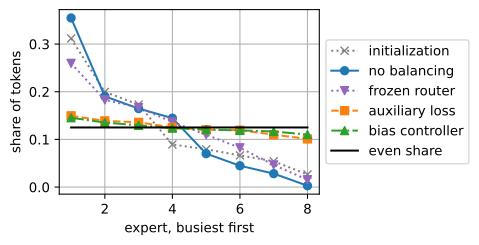
ranks = list(range(1, 9))
mean_shares = [[sum(rank) / len(rank) for rank in zip(*s)]
               for s in shares.values()]  # Mean over the layers
d2l.plot(ranks, mean_shares + [[1 / 8] * 8], 'expert, busiest first',
         'share of tokens', legend=list(shares) + ['even share'],
         fmts=('C7x:', 'C0o-', 'C4v:', 'C1s--', 'C2^-.', 'k-'),
         legend_loc='outside')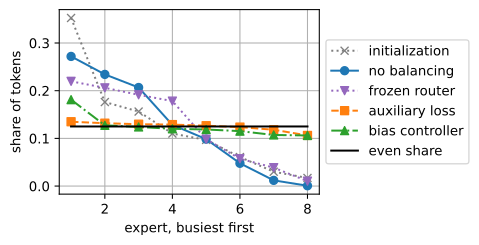
Without balancing (no balancing), the 3 busiest experts capture about \(70\%\) of all routed tokens while the idlest receives almost none, and under a capacity factor \(\gamma = 1.25\) a quarter to a third of all assignments are dropped. Freezing the router (frozen router) ends somewhat less skewed, but the fresh model (initialization) is already about as lopsided as the unbalanced one, so at this scale much of the skew comes from the inputs rather than from feedback between expert learning and router updates; two runs per row cannot separate the two (Exercise 3). Both the Switch auxiliary loss and the loss-free bias controller hold every expert near the ideal \(1/E = 12.5\%\) share (the busiest below twice it, with at most a few percent dropped at \(\gamma = 1.25\)).
11.7.4 Mixture-of-Experts Language Models
11.7.4.1 MoE GPT vs. Dense GPT at Matched Active Parameters
Comparing our balanced 8-expert Top-1 MoE GPT (\(N_{\textrm{active}} = 0.43\textrm{M}\), \(N_{\textrm{total}} = 2.26\textrm{M}\)) against a dense GPT with the exact same active parameters and per-token FLOPs (\(N_{\textrm{active}} = N_{\textrm{total}} = 0.43\textrm{M}\)) across 6,000 training steps on WikiText-103 demonstrates the IsoFLOP advantage of sparse conditional capacity:
capacity = {'dense': None, 'MoE': 2}  # The dense model has no buffers
models = {name: small_gpt(len(data.vocab), capacity_factor=c)
          for name, c in capacity.items()}
for name, model in models.items():
    print(f'{name:>5}: {d2l.num_params(model) / 1e6:5.2f}M parameters, '
          f'{active_params(model) / 1e6:.2f}M active per token')
dense: 0.43M parameters, 0.43M active per token
MoE: 2.26M parameters, 0.43M active per tokencapacity = {'dense': None, 'MoE': 2} # The dense model has no buffers
models = {name: small_gpt(len(data.vocab), capacity_factor=c)
for name, c in capacity.items()}
for name, model in models.items():
print(f'{name:>5}: {d2l.num_params(model) / 1e6:5.2f}M parameters, '
f'{active_params(model) / 1e6:.2f}M active per token')dense: 0.43M parameters, 0.43M active per token
MoE: 2.26M parameters, 0.43M active per tokenTraining two independent runs of both models for \(6{,}000\) steps with the Switch auxiliary loss (\(\alpha = 0.01\)) and evaluating validation loss every \(250\) steps tracks when the sparse model overtakes the dense baseline:
num_steps, every = 6000, 250
curves = {name: [] for name in capacity}  # Validation loss every 250 steps
for run in range(2):
    for name, c in capacity.items():  # Dense first, then MoE
        model = small_gpt(len(data.vocab), capacity_factor=c)
        optimizer = d2l.LMOptimizer(model, lr=2e-3, num_steps=num_steps,
                                    warmup=100)
        curve = []
        for _ in range(num_steps // every):  # Dense: no aux loss to add
            train_moe_lm(model, data, optimizer, every, aux_weight=0.01)
            curve.append(
                math.log(d2l.lm_perplexity(model, data.val_dataloader())))
        curves[name].append(curve)
    dense, moe = curves['dense'][-1], curves['MoE'][-1]
    ahead = next((every * (i + 1) for i, (m, d) in enumerate(zip(moe, dense))
                  if m < d), None)
    print(f'run {run + 1}: dense {dense[-1]:.3f}, MoE {moe[-1]:.3f}; '
          + (f'MoE ahead from step {ahead}, ' if ahead else 'MoE never ahead, ')
          + f'{evaluate_moe(model, data)[2]:.1%} dropped at the end')
d2l.plot(list(range(every, num_steps + 1, every)),
         [curves['dense'][0], curves['MoE'][0]], 'step',
         'validation loss (nats)', legend=['dense', 'MoE'], fmts=('-', '--'))
run 1: dense 1.321, MoE 1.277; MoE ahead from step 2000, 0.0% dropped at the end
run 2: dense 1.327, MoE 1.265; MoE ahead from step 750, 0.0% dropped at the end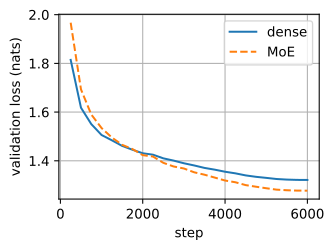
num_steps, every = 6000, 250
curves = {name: [] for name in capacity}  # Validation loss every 250 steps
for run in range(2):
    for name, c in capacity.items():  # Dense first, then MoE
        model = small_gpt(len(data.vocab), capacity_factor=c)
        optimizer = d2l.LMOptimizer(model, lr=2e-3, num_steps=num_steps,
                                    warmup=100)
        curve = []
        for _ in range(num_steps // every):  # Dense: no aux loss to add
            train_moe_lm(model, data, optimizer, every, aux_weight=0.01)
            curve.append(
                math.log(d2l.lm_perplexity(model, data.val_dataloader())))
        curves[name].append(curve)
    dense, moe = curves['dense'][-1], curves['MoE'][-1]
    ahead = next((every * (i + 1) for i, (m, d) in enumerate(zip(moe, dense))
                  if m < d), None)
    print(f'run {run + 1}: dense {dense[-1]:.3f}, MoE {moe[-1]:.3f}; '
          + (f'MoE ahead from step {ahead}, ' if ahead else 'MoE never ahead, ')
          + f'{evaluate_moe(model, data)[2]:.1%} dropped at the end')
d2l.plot(list(range(every, num_steps + 1, every)),
         [curves['dense'][0], curves['MoE'][0]], 'step',
         'validation loss (nats)', legend=['dense', 'MoE'], fmts=('-', '--'))
run 1: dense 1.331, MoE 1.268; MoE ahead from step 1250, 0.0% dropped at the end
run 2: dense 1.322, MoE 1.266; MoE ahead from step 1500, 0.0% dropped at the end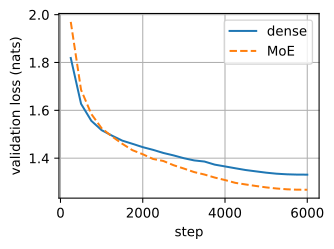
The MoE model starts behind the dense model, overtakes it within the first 2,000 steps, and ends about 0.05 nats lower in validation cross-entropy at the same per-token FLOP cost.
11.7.4.2 Fine-Grained and Shared Experts in Released Models
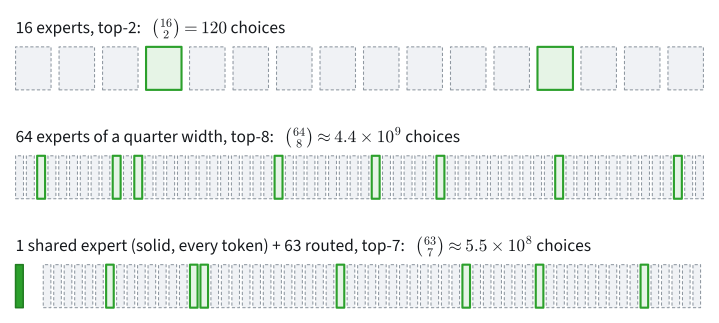
Recent frontier MoE families (Table 11.7.1) refine the coarse 8-expert Top-2 recipe of Mixtral 8x7B in two ways (Figure 11.7.3):
- Fine-grained expert segmentation: Splitting each full-width expert into \(m\) narrower experts of width \(w / m\) while scaling total experts to \(m E \in [128, 256]\) and active experts to \(m k \in [4, 8]\) leaves both stored and active parameter counts unchanged, while expanding the number of distinct active expert combinations from \(\binom{8}{2} = 28\) to \(\binom{256}{8} \approx 4 \times 10^{14}\).
- Shared experts (Dai et al. 2024): Dedicating \(E_{\textrm{shared}} \ge 1\) narrow experts that execute on every token without routing lets shared experts absorb common grammatical and formatting transformations so routed experts can specialize without redundancy.
| Model | Experts per layer (\(E\)) | Active \(k\) | Expert width / \(d\) | Shared expert | Stored / active parameters |
|---|---|---|---|---|---|
| Mixtral 8x7B (Jiang et al. 2024) | 8 | 2 | 3.5 | none | 46.7B / 12.9B = 3.6 |
| DeepSeek-V3 (DeepSeek-AI et al. 2024) | 256 | 8 | 0.29 | 1 | 671B / 37B = 18 |
| Qwen3-235B (Yang et al. 2025) | 128 | 8 | 0.38 | none | 235B / 22B = 11 |
| gpt-oss-120b (OpenAI 2025) | 128 | 4 | 1.0 | none | 117B / 5.1B = 23 |
11.7.5 Summary
Mixture-of-Experts (MoE) layers (Equation 11.7.1) replace a dense FFN with \(E\) routed expert FFNs and activate only the top \(k \ll E\) experts per token, decoupling stored parameters \(N_{\textrm{total}}\) (memory capacity) from active parameters \(N_{\textrm{active}}\) (per-token FLOPs). Without load balancing, expert utilization is heavily skewed: much of this skew is already present at initialization, and positive feedback between router and experts can amplify it into routing collapse, whereas both the Switch auxiliary loss \(\mathcal{L}_{\textrm{aux}} = E \sum_e f_e \bar{p}_e\) (Equation 11.7.2) and loss-free dynamic router biases \(b_e \leftarrow b_e + \eta_b \textrm{sign}(1/E - f_e)\) (Equation 11.7.3) hold expert loads near \(1/E\). At matched active parameters and training FLOPs, a balanced MoE language model reaches lower validation cross-entropy than a dense GPT. Recent open-weights MoE architectures (Table 11.7.1) further segment experts into fine-grained banks (\(E \in [128, 256], k \in [4, 8]\)) to expand combinatorial specialization, often alongside an always-active shared expert (Figure 11.7.3).
11.7.6 Exercises
Router gradient under \(k = 1\) vs. \(k > 1\) renormalization. Many MoE layers renormalize the selected probabilities by their sum: \(g_e(\mathbf{x}) = p_e(\mathbf{x}) / \sum_{j \in T(\mathbf{x})} p_j(\mathbf{x})\).
- Show that if you apply this same renormalization when \(k = 1\), then \(g_{e^*}(\mathbf{x}) = p_e(\mathbf{x}) / p_e(\mathbf{x}) \equiv 1\) is constant, so \(\partial \textrm{MoE}(\mathbf{x}) / \partial \mathbf{W}_r = \mathbf{0}\) and the router never receives a task-loss gradient.
- Verify in code that our
MoELayeravoids this by weighting each selected expert by its raw probability (so \(g_{e^*}(\mathbf{x}) = p_{e^*}(\mathbf{x})\) as in Switch Transformer (Fedus et al. 2022)).
Minimum and gradient of the Switch auxiliary loss. Consider \(\mathcal{L}_{\textrm{aux}} = E \sum_{e=1}^E f_e \bar{p}_e\) (Equation 11.7.2), where \(f_e\) is treated as a stop-gradient constant and \(\sum_e \bar{p}_e = 1\).
- Compute \(\partial \mathcal{L}_{\textrm{aux}} / \partial s_{t,e}\) with respect to token \(t\)’s router logit \(s_{t,e} = (\mathbf{x}_t \mathbf{W}_r)_e\), and show that it vanishes if and only if all empirical loads are equal (\(f_1 = \dots = f_E = 1/E\)).
- Prove via Cauchy–Schwarz that when \(\bar{p}_e = f_e\), \(\mathcal{L}_{\textrm{aux}} \ge 1\) with equality if and only if \(f_e = 1/E\), and find its maximum value \(E\) under complete single-expert collapse (\(f_1 = \bar{p}_1 = 1\)).
Disentangling positive feedback from input distribution skew. In
balancing_run, compare thefrozen routerarm againstno balancingat steps \(100, 200, 400, 800\). Starting from the fresh model’s top-expert share (already about a third in our byte-level model), does the trainable router’s top-expert share move further from it than the frozen router’s, over enough seeds to tell, and what happens if you initialize all expert output projectionsW_2to zero so all experts produce identical outputs on early steps?Step-size dynamics of the loss-free bias controller. Run
balancing_runwithbias_rate\(\eta_b \in \{10^{-4}, 10^{-3}, 10^{-2}, 10^{-1}\}\) and plot the top-expert share and validation loss across training steps. Why does an overly large controller step size (\(\eta_b = 10^{-1}\)) cause expert loads to oscillate from step to step?Overfitting of MoE in the tiny-data regime. Repeat the 6,000-step
densevs.MoEcomparison (Section 11.7.4.1), but restrictdata.trainto only its first \(65{,}536\) bytes (\(64\textrm{ KB}\)) so the models pass over the same text hundreds of times. Plot both training loss and validation loss fordenseandMoE: why does the \(2.26\textrm{M}\)-parameter MoE memorize the small corpus much faster and start overfitting earlier than the \(0.43\textrm{M}\)-parameter dense model even though both use the exact same FLOPs per token?Shared experts and fine-grained granularity at fixed budget. Implement a
SharedMoELayerthat runs 1 always-active shared expert of width \(w\) plus Top-\(k\) of \(E\) routed experts of width \(w\), and compare three FFN configurations insidesmall_gptat matched stored and active expert width (\(16 \times 170\) stored, \(2 \times 170\) active per block): (a) coarse \(E = 8, k = 1, w = 340\), (b) medium \(E = 16, k = 2, w = 170\), and (c) fine + shared \(E_{\textrm{shared}} = 1, E = 15, k = 1, w = 170\). Compare their validation losses after 800 steps.