from collections import deque
requests = deque([5, 2, 7, 3]) # output tokens requested
capacity = 2
active, timeline = [], []
while requests or active:
while requests and len(active) < capacity:
active.append(requests.popleft())
timeline.append(tuple(active))
active = [remaining - 1 for remaining in active if remaining > 1]
timeline39.7 Model Serving
The language models in this book generated text in a notebook, one prompt at a time, for the person who ran the cell. Suppose instead that a hundred colleagues send requests to the same language model whenever they like. If the GPU answers them one after another at two seconds each, the last colleague waits more than three minutes. What has to change between calling a model and serving it?
Serving makes one accelerator work on many requests at once. Generating a token reads the weights and the key–value cache from memory (Section 39.4). All requests share the weights, so an engine that advances many requests in the same step reads the weights once for all of them, provided memory holds the cache of every active request. We start with the latency numbers that users notice, survey local and server engines as of November 2026, and explain the techniques that make the engines fast.
39.7.1 Workloads and Latency Metrics
A user of a chat assistant notices two delays: the wait before the first word appears, and the pace of the words that follow. The first is the time to first token (TTFT), counted from the arrival of the request. On an idle server it is dominated by prefill, which processes all prompt tokens in parallel and is bound by compute. The second is the time per output token (TPOT), dominated by decode, which produces one token per sequence and step and is bound by memory bandwidth. Throughput, the tokens per second summed over all users, trades against both.
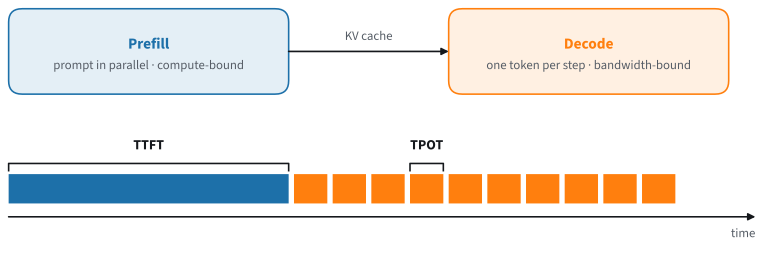
Which numbers matter depends on the workload, and the workload picks the tool:
| Workload | Optimize for | Start with |
|---|---|---|
| Personal assistant on your machine | simplicity, privacy | Ollama / LM Studio (llama.cpp), MLX on Macs |
| Offline batch scoring | throughput per dollar | vLLM offline mode |
| One application’s API | operability | vLLM behind a small authenticated proxy |
| Multi-user / agentic service | goodput under an SLO | vLLM or SGLang, then NVIDIA Dynamo at scale |
| Max throughput on fixed NVIDIA fleet | throughput per GPU | TensorRT-LLM |
A service level objective (SLO) sets a latency target, such as a TTFT below 1 s. Goodput, the rate of completed requests that also met their target, is the production metric. Overload can raise raw throughput while goodput collapses, because requests queue until they miss their targets.
39.7.2 Local Serving
On a laptop or a workstation with one user, the questions are whether a model fits and how fast it answers. Many local inference tools use llama.cpp and its GGUF file format, and community repositories commonly publish GGUF conversions of open-weight models. Users often reach llama.cpp through a wrapper:
- Ollama builds on llama.cpp and, on Apple silicon, also on MLX.
ollama run qwen3:8bdownloads, caches, and serves a model, with an OpenAI-compatible API athttp://localhost:11434/v1. - LM Studio offers the same engines behind a graphical interface, with control over how much of the model is offloaded to the GPU.
- MLX is Apple’s array framework. Its package
mlx-lmruns and fine-tunes models on Apple silicon, and themlx-communityorganization on Hugging Face publishes thousands of converted models.
Common GGUF quantizations include Q4_K_M (about 4.9 bits per weight), Q5_K_M (about 5.7), and Q8_0 (about 8.5). For the 8.2 billion parameters of Qwen3-8B, Q4_K_M gives \(8.2 \times 10^9 \times 4.9 / 8
\approx 5.0\) GB, close to the 5.2 GB of Ollama’s qwen3:8b download. The 4.9 bits were measured on Llama 3.1 8B, and Q4_K_M keeps a model-dependent share of tensors at higher precision. The cache of a full 32,768-token context in bf16 adds almost as much again. Higher-bit formats usually retain quality better; measure the effect on your own task. Decode speed is at most the memory bandwidth divided by the bytes read per token, so every extra bit costs speed as well as memory. A common rule is to pick the largest model whose quantized weights fit in memory with room for the cache, then the highest-bit format that still fits.
39.7.3 Server Engines
39.7.3.1 Open-Source and NVIDIA Engines
A shared server needs an engine that schedules requests together. For an open-source GPU server, vLLM provides continuous batching, paged KV-cache management, prefix caching, tensor parallelism, quantized-model support, and an OpenAI-compatible server in one command:
vllm serve Qwen/Qwen3-8B --max-model-len 32768SGLang is its closest peer. Its RadixAttention (Zheng et al. 2024) keeps cached keys and values in a radix tree shared across requests, which helps when many requests share long prefixes: chat with a system prompt, retrieval over the same documents, or trees of agent calls. Both projects evolve quickly and support several accelerator backends; benchmark both on your distributions of prompt length and concurrency before selecting one.
NVIDIA’s tools trade portability for hardware-specific optimization. TensorRT-LLM runs models on PyTorch with NVIDIA-tuned kernels, which can improve steady-state throughput at the cost of more setup. Dynamo coordinates many GPUs and nodes, with vLLM, SGLang, or TensorRT-LLM as backends. It runs prefill and decode on separate pools of GPUs and routes each request by worker load and by how much of its prefix a worker already caches. These tools matter at datacenter scale; on a few GPUs, vLLM or SGLang alone is simpler.
39.7.3.2 A Common Client API
An application should not need rewriting when it moves from a laptop to a server. Many of these tools implement the OpenAI chat-completions API, so the same client code targets a local Ollama, your vLLM server, or a commercial provider after a change of the base URL and the model name:
from openai import OpenAI

client = OpenAI(base_url="http://127.0.0.1:8000/v1", api_key="local")
response = client.chat.completions.create(
    model="Qwen/Qwen3-8B",
    messages=[{"role": "user", "content": "Explain KV caching briefly."}],
    temperature=0,
)
print(response.choices[0].message.content)
Servers that accept the same requests can still answer them differently: tokenization, sampling defaults, structured-output support, streaming behavior, and token accounting all vary. Keep a small conformance test and rerun it before swapping engines.
39.7.4 Engine Techniques
Four composable techniques explain much of the speed of these engines.
Continuous batching. A static batch waits for its slowest member. Continuous batching admits new requests and retires finished ones between decode steps, keeping the batch nearly full:
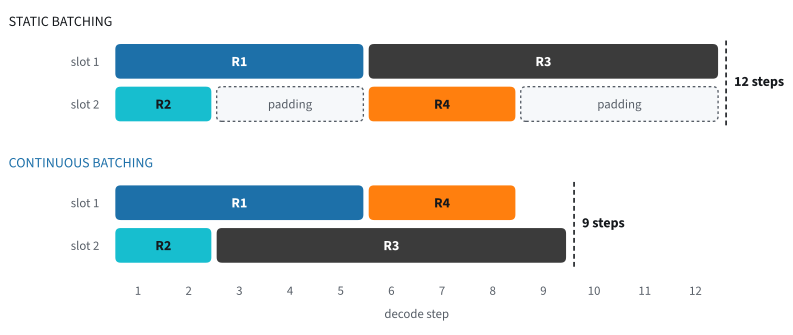
The toy scheduler below captures the idea in a few lines. Exercise 4 extends it with arrival times and a memory budget:
[(5, 2), (4, 1), (3, 7), (2, 6), (1, 5), (4, 3), (3, 2), (2, 1), (1,)]Paged KV cache. Each active sequence’s key–value cache grows with its length. vLLM’s PagedAttention (Kwon et al. 2023) allocates it in fixed-size blocks, like virtual memory, and so nearly eliminates the fragmentation that once capped batch sizes. Capacity planning follows: GPU memory must hold the weights plus the cache of every concurrent sequence. A model that fits for one request may therefore exceed memory under high concurrency.
Prefix caching. When two requests share a tokenized prefix (the same system prompt, the same document), its cached keys and values can be computed once and reused:
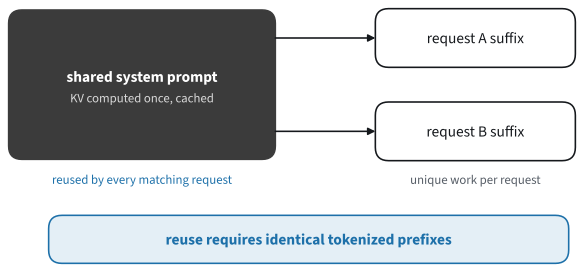
Some commercial APIs charge less for cached input tokens, under rules that differ by provider. Placing shared, stable content before the variable part of a prompt then saves money as well as prefill time.
Speculative decoding and quantization. A small draft model proposes several tokens, and the target model verifies them in one parallel pass. This speeds up decoding when most proposals are accepted and preserves the target distribution. Quantization reduces the bytes read during decode: fewer bytes per weight give more tokens per second, until quality degrades at the lowest bit widths. Recent NVIDIA tensor cores support FP8 (from the Hopper and Ada generations on) and NVFP4 (from Blackwell on), and vLLM and SGLang also load 4-bit AWQ weights. GGUF formats play the same role locally.
39.7.5 Operations
An engine listening on a port still lacks the controls that a shared service needs. Put authentication, TLS, and rate limits in a proxy in front of the engine, and do not expose the engine’s own port. Admission control should reject or queue requests before memory runs out, not after an out-of-memory error. Propagate client cancellations so that abandoned generations stop consuming compute. Measure TTFT, TPOT, and end-to-end latency as p50 and p95 under realistic arrival patterns, not as averages under a closed loop of clients. Avoid logging raw prompts by default. Pin the model, tokenizer, quantization, and engine versions together: a faster server that answers differently is a different system, so gate rollouts on task quality as well as on latency.
You can now estimate whether a model and the caches of its users fit on a card, and which engine to try first. How a server should admit and order requests under load remains open; the simulators of the exercises explore it.
39.7.6 Summary
Serving latency splits into compute-bound prefill, which sets the time to first token (TTFT), and bandwidth-bound decode, which sets the time per output token (TPOT); choose engines to match the workload, from Ollama, LM Studio, or MLX locally to vLLM or SGLang for shared services and TensorRT-LLM with Dynamo across large NVIDIA fleets. Quantization in GGUF formats locally and AWQ, FP8, or NVFP4 on servers turns saved weight bytes directly into faster token generation until quality degrades at the lowest bit widths. Modern engines combine continuous batching, paged KV caches, prefix caching, and speculative decoding, while client prompt ordering determines how much prefix state can be reused. Although the OpenAI-compatible chat-completions API keeps client code portable across local and cloud servers, subtle behavioral differences still warrant a small conformance test before switching engines. Finally, memory capacity must hold the model weights alongside every concurrent user’s KV cache, and production deployments require admission control, client cancellation propagation, tail-latency monitoring, and co-pinned model and engine versions.
39.7.7 Exercises
Batch size limits. The command
vllm serve Qwen/Qwen3-8Bserves a model with \(L = 36\) layers and \(H_\textrm{kv} = 8\) key–value heads of dimension \(d_h = 128\), whose bf16 weights occupy \(B_w = 16.4\) GB. Its cache is stored in bf16 as well. Serve it on an H100 SXM, whose memory bandwidth is \(\beta = 3.35\) TB/s and whose dense bf16 rate is 989 TFLOP/s (Table 13.2.1). A decode step reads the weights once for the whole batch and the cache of every active sequence. For \(b\) sequences that each hold \(n\) cached tokens, the step, and hence the time per output token of every sequence, takes about\[t(b) = \frac{B_w + b\, n\, B_\textrm{kv}}{\beta}, \tag{39.7.1}\]
where \(B_\textrm{kv}\) is the cache size per token.
- Every layer stores one key and one value vector per key–value head and token, so \(B_\textrm{kv} = 2 \cdot L \cdot H_\textrm{kv} \cdot d_h \cdot (\textrm{bytes per element})\) (Section 11.3). Compute \(B_\textrm{kv}\). Evaluate the TPOT and the throughput \(b / t(b)\) at \(n = 2048\) for \(b \in \{1, 8, 64, 256\}\). Which value does the throughput approach as \(b\) grows, and which term of \(t(b)\) sets it? Count 2 FLOPs per parameter and token for the 8.2 billion parameters, and check with the bf16 rate that the step at \(b = 256\) is still bound by memory traffic.
- An interactive service promises a TPOT of at most 20 ms. What is the largest batch it can run? Which batch would an offline scoring job of Table 39.7.1 choose instead, and why?
- Let the engine use 72 GB of the card for weights and cache, and let the sequences hold 2,048 tokens on average. Before paged caches, servers reserved one contiguous region per request for its maximum length. How many sequences fit when each one reserves the
--max-model-lenof 32,768 tokens? What fraction of the reserved cache then holds token states? Kwon et al. (2023) measured 20.4% to 38.2% in such systems. Why is your fraction lower? How many sequences fit when the cache is allocated in blocks of 16 tokens? Bound the memory that partly filled blocks waste. - Which limit sets the batch of the interactive service under each of the two allocation schemes: memory or the TPOT target?
[code] Conformance test. Section 39.7.3.2 recommends a small conformance test before swapping engines.
- Write a function
conformance(base_url, model)with theopenaiclient of Section 39.7.3.2 that runs four checks and reports which of them pass. Every check also requires a nonemptycontent. First, two identical requests at temperature 0 return the same text. Second, a request withmax_tokens=8ends withfinish_reasonequal to"length"and reports at most 8 completion tokens inusage. Third, a request that asks the model to count from 1 to 20 withstop=["7"]returns text without the digit 7. Fourth, a streamed request at temperature 0 withstream_options={"include_usage": True}yields chunks whose concatenated content and finalusageequal those of the same request without streaming. Run the test against Ollama with a small model such asqwen3:0.6b, which runs on a CPU, and against a second OpenAI-compatible server of your choice. Which checks fail, and why? - On a vLLM server, the first check passes while the server is idle and fails occasionally while other clients send requests to it. No sampling takes place at temperature 0. Explain the failure.
- Both servers load the same model with the same tokenizer and receive the same messages, yet they report values of
usage.prompt_tokensthat differ by a few tokens. Name two possible causes. Why does such a difference matter to a client beyond billing?
- Write a function
[code] Prefix cache for an agent. A coding agent calls a model 30 times. The first prompt holds a system prompt and repository context of 20,000 tokens. Every later prompt repeats the previous prompt and appends 1,000 tokens: the model’s previous answer and a tool result.
- How many prompt tokens must the engine prefill over the 30 calls without prefix caching, and how many with a cache that keeps every earlier prompt? A provider charges a tenth of its input price for cached tokens. What fraction of the uncached input bill remains?
- vLLM caches only full blocks, and it keys each block by a hash of the key of the preceding block and of the block’s own token ids. Implement this scheme with blocks of 16 tokens as a function
prefill_tokens(cache, tokens)that returns the number of tokens to compute and adds the new full blocks to the setcache. Simulate the agent with random token ids, and compare the result with your count from the first sub-problem. Why does the key of a block include the key of the preceding block? - The agent framework writes the current time, to the second, into the first line of the system prompt. Rerun the simulation. Where should the timestamp go instead?
- A retrieval application places three of 50 documents after a shared system prompt, in order of relevance. Two requests retrieve the same three documents in different orders. Which blocks does the second request reuse? Propose an ordering that raises reuse, and state what it gives up.
[code] Arrivals and a memory budget. ● Extend the cell that builds
timelineinto a simulator in which time advances in decode steps. Request \(i\) arrives at step \(a_i\), has a prompt of \(P_i\) tokens, and generates \(T_i\) tokens, one per step from the step of its admission on. The server runs at most 64 sequences and holds at most 32,768 tokens of cache, and a sequence holds its prompt plus the tokens generated so far. Draw the arrivals from a Poisson process with \(\lambda\) requests per step, draw \(P_i\) uniformly from 100 to 1,000, and let \(T_i\) be one plus an exponential variable with mean 200, rounded down and capped atmax_tokens = 1024. Measure the time to first token in steps, from the arrival to the first generated token.- Admit requests first come, first served when the cache can hold the prompt plus
max_tokens, the most that a request can ever need. Reject an arriving request when 50 requests already wait. For \(\lambda \in \{0.05, 0.1, 0.15, 0.2\}\), report the tokens generated per step, the p50 and p95 TTFT, and the rejected fraction. - Admit a request instead whenever the cache can hold its prompt plus one token. When the active sequences outgrow the cache, preempt the most recently admitted one, free its cache, and put it back at the head of the queue, so that it recomputes its cache on readmission. Repeat the measurements. The simulator charges no time for prefill. Which resource does recomputation spend on a real server, and which would swapping the cache to CPU memory spend instead? How would charging for prefill change your comparison with the first sub-problem?
- Order the queue by the number of remaining tokens, shortest first, and run both admission rules at \(\lambda = 0.2\). Compare this order with first come, first served on the p95 TTFT of all requests and on that of the 5% of requests with the longest outputs.
- A server knows
max_tokensbut not \(T_i\). What could it order the queue by instead, and how much of the gain of the third sub-problem would you expect it to keep?
- Admit requests first come, first served when the cache can hold the prompt plus
Speculative sampling. ● In the speculative decoding of Leviathan et al. (2023), a draft model with next-token distribution \(q\) proposes a token \(x \sim q\), and the target model, with next-token distribution \(p\), accepts it with probability \(\min(1, p(x) / q(x))\). After a rejection, the token is drawn instead from the residual distribution
\[p'(x) = \frac{\max(0, p(x) - q(x))}{\sum_{x'} \max(0, p(x') - q(x'))}. \tag{39.7.2}\]
- Show that the emitted token is distributed according to \(p\), and that the probability of acceptance is \(\beta = \sum_x \min(p(x), q(x))\).
- In every round, the draft proposes \(\gamma\) tokens one after another, and one pass of the target scores all of them. The target emits the accepted tokens up to the first rejection and then one token of its own, drawn from \(p'\) after a rejection or from \(p\) when all \(\gamma\) tokens were accepted. Let \(\alpha\) be the mean of the acceptance probability \(\beta\) of the first sub-problem over the positions of a sequence, and assume that every draft token is accepted independently with probability \(\alpha\). Show that a round emits \((1 - \alpha^{\gamma + 1}) / (1 - \alpha)\) tokens in expectation. A draft step takes a fraction \(c\) of the time of a target step, and the scoring pass takes one target step. Derive the expected speedup over plain decoding, and find the best \(\gamma\) for \(c = 0.05\) and \(\alpha \in \{0.6, 0.8, 0.9\}\).
- The scoring pass takes one target step only while it is bound by memory traffic. A server decodes \(b\) sequences together, and each sequence scores \(\gamma + 1\) positions per round. Ignore the cache, store the weights in bf16, and count 2 FLOPs per parameter and token. Above which \(b\) does the pass become compute-bound on the H100 of exercise 1 for \(\gamma = 4\)? What does this imply for speculative decoding on a busy server compared with a single user?
[extended] Goodput under load. ●● Turn your simulator of exercise 4 into one whose clock runs in seconds instead of decode steps, for Qwen3-8B on the H100 of exercise 1 with 72 GB for weights and a paged cache. A step processes \(p\) prompt tokens and one token for each of \(b\) decoding sequences, which together hold \(K\) cached tokens. With \(N\) parameters, the dense bf16 rate \(F\), and the notation of exercise 1, the step takes
\[t_\textrm{step} = \max\left(\frac{2N(p + b)}{F}, \frac{B_w + K B_\textrm{kv}}{\beta}\right), \tag{39.7.3}\]
which ignores the FLOPs of the attention scores. Requests arrive as a Poisson process at \(\lambda\) requests per second, with prompts uniform between 500 and 4,000 tokens, and output lengths of one plus an exponential variable with mean 250, rounded down and capped at 2,048. A request counts toward goodput when its TTFT is at most 1 s and its TPOT, the mean time between its output tokens, is at most 50 ms.
- Prefill every admitted prompt in full within one step. Estimate the saturation rate from \(t_\textrm{step}\) before you simulate. Then sweep \(\lambda\) from light load to well beyond saturation, and plot the throughput and the goodput in requests per second. At which rate does goodput peak, and how does it compare with your estimate?
- A full prefill of a long prompt delays the next token of every decoding sequence. Implement chunked prefill (Agrawal et al. 2024), which caps the tokens of a step, decode tokens included, at a budget and spreads a prompt over several steps. Repeat the sweep for budgets of 512, 2,048, and 8,192 tokens. Which budget maximizes goodput? How does the answer depend on the two SLOs?
- Add admission control that rejects a request as soon as its TTFT target can no longer be met. How does it change goodput beyond saturation? Explain why goodput collapses without it while throughput stays high.
- Let every client abandon its request after 10 s and send it once more. Compare goodput when the server keeps generating abandoned requests and when it cancels them.
- State the largest request rate at which at least 90% of all arriving requests meet both SLOs, counting rejected requests as misses, and the configuration that achieves it.