import collections
import concurrent.futures
import json
import os
import pandas as pd
import random
import re
import shutil
import textwrap
import time
import transformers
import zipfile19.5 Retrieval-Augmented Generation
In Section 19.4 we built a retriever that finds, for nearly every question about this book, a passage that answers it. Nobody asks a question in order to receive a ranked list, however. The obvious next step is to hand the passages to a language model and read its answer. So let us wire the retriever to a generator, Qwen3.5-9B, and ask it what happens to PyTorch modules kept in a plain Python list instead of nn.Sequential. The passage that answers comes back first, and its last sentence reads “Modules in a plain list stay unregistered, without any warning.” The model writes four fluent sentences about registration, cites the second and third passages, and leaves out the one fact that the first passage adds: no warning is raised. So the passage was there, at the top. Did the model skip it, or did the passages it cited lead it elsewhere? Had the passage been ranked tenth and left out of the prompt, the answer might read just the same. How are we to tell these cases apart?
Systems of this kind are called retrieval-augmented generation (RAG), after a 2020 paper that trained a retriever’s query encoder together with a generator (Lewis et al. 2020). Today the name covers any pipeline that retrieves passages and places them in a prompt. Such a pipeline is a chain of stages: a query is formed, passages are retrieved, reordered, packed into a context and read by the generator. When the answer is wrong, any stage may be at fault, and each stage needs a different repair. One accuracy number cannot say which. The idea of this section and the next is to locate a failure by measuring each stage on its own.
The pipeline itself is quickly built. Most of the work, and most of this section, goes into the instruments: questions whose answers and source passages we know, and a grader we have reason to trust. With both in hand we measure a baseline between two bounds, a floor without passages and a ceiling with only the passages that answer. Section 19.6 then changes one stage at a time and sorts the failures by the stage that caused them.
The two cells that follow are setup, and a reader can pass over them. They pin the models: Qwen3.5-9B generates, the embedder and reranker of Section 19.4 retrieve, and a larger Qwen model, introduced with the judge below, grades. Generating and judging every answer takes GPU hours, so the answers and verdicts were recorded once. A normal run replays them and generates a few again as a live check; the environment variable D2L_RERUN regenerates them.
# Pinned in this notebook, not in the library: adding it to the saved
# HF_REVISIONS would change the fingerprint of every chapter-18 notebook
d2l.HF_REVISIONS['Qwen/Qwen3.5-9B'] = (
    'c202236235762e1c871ad0ccb60c8ee5ba337b9a')
GEN, RERANKER = d2l.RAG_GENERATOR, d2l.RAG_RERANKER
EMB, JUDGE = d2l.DEFAULT_EMBEDDER, d2l.RAG_JUDGE_LOCAL
REV = {GEN: d2l.HF_REVISIONS[GEN],
**{m: d2l.HF_ENCODER_REVISIONS[m] for m in (EMB, RERANKER)}}
GPU = torch.cuda.is_available()
T0 = time.time() # a judging run stops JUDGE_MINUTES after this
ARTIFACTS, CONFIGS = d2l.RAG_ARTIFACTS, d2l.RAG_CONFIGS
QA_KEY = 'lm-book-qa-v2' # the question set
RERUN = d2l._rag_rerun() # D2L_RERUN, checked against the run order
assert GPU or not RERUN - {'rag-cards'}, 'answers and judgments need GPUs'
MAX_NEW = d2l.RAG_BASE['max_new_tokens'] # new tokens per answer
BATCH, DEPTH = d2l.RAG_BASE['batch'], 50 # prompts per batch; ranking kept
QUICK = False # True: 80 stratified dev and test items (development only)
assert not (QUICK and RERUN), 'QUICK results are never saved'
N_LIVE = 8 if GPU else 2 # base answers generated again in a normal run
JUDGE_MINUTES, CHUNK = 50, 512 # a judging run's minutes; answers per save
CONCURRENCY = 8 # judge requests in flight per server (one server per GPU)
N_REPEAT = 60 # base answers judged twice
CARD_GIB = 21.5 # estimates; measured peaks add 0.4-1.5 (23.6 GiB usable)
print(pd.DataFrame({'model': [GEN, EMB, RERANKER, JUDGE['model']],
'revision': [REV[GEN][:12], REV[EMB][:12],
REV[RERANKER][:12], JUDGE['revision'][:12]]},
index=['generator', 'embedder', 'reranker', 'judge']))
print(f'judge: thinking {"on" if JUDGE["thinking"] else "off"}, greedy, at '
f'most {JUDGE["max_new_tokens"]:,} new tokens (no separate budget for '
f'the reasoning),\n 4-bit weights (W4A16), one copy per GPU, served by '
f'vLLM {JUDGE["vllm"]}')
print(f'GPU: {GPU}; regenerating: {", ".join(sorted(RERUN)) or "none"}') model revision
generator Qwen/Qwen3.5-9B c20223623576
embedder Qwen/Qwen3-Embedding-0.6B 97b0c614be4d
reranker Qwen/Qwen3-Reranker-0.6B e61197ed4502
judge RedHatAI/Qwen3.8-27B-INT4 71dface38d4c
judge: thinking on, greedy, at most 12,000 new tokens (no separate budget for the reasoning),
4-bit weights (W4A16), one copy per GPU, served by vLLM 0.33.0
GPU: True; regenerating: none19.5.1 A Question Set over the Book
To measure a RAG system we need questions whose answers we know, and we need to know where in the corpus each answer is written. Public benchmarks give the first but not the second for our corpus, and any of them may have been in the training data of every model we use. So we build a set over the book: we know its content, every answerable question has a gold span, the stretch of book text that answers it, and we decide how it is split. The recorded model responses the set was built from are published with it (lm-book-qa-api-cache-v1), so its construction can be checked without any API call. The next cell registers the set and, with it, every recorded artifact of this section and the next; for now only the question set matters.
d2l.DATA_HUB['lm-book-qa-v1'] = (  # corpus r3.1; 5,865 train, 240 dev, 240 test
    d2l.LM_DATA_URL + 'lm-book-qa-v1.zip',
    '3b8dba5ceae43c88274e52ce6ae7525884ea4168')
d2l.DATA_HUB['lm-book-qa-api-cache-v1'] = (  # its drafts, checks, verdicts
    d2l.LM_DATA_URL + 'lm-book-qa-api-cache-v1.zip',
    '962322fd53b3573daeaa50a92d3f53f25a25572d')
d2l.DATA_HUB['lm-book-qa-v2'] = (  # v1, closed-book flag by the 27B judge
    d2l.LM_DATA_URL + 'lm-book-qa-v2.zip',
    '65a524857b50dfdffa4e75f217b5af66256bd025')
d2l.DATA_HUB['lm-rag-judge-labels-v1'] = (  # 200 pairs, frontier labels
    d2l.LM_DATA_URL + 'lm-rag-judge-labels-v1.zip',
    '2f10e6f4314644e7ebdf7ac7a8c1b3e7182f98d8')
d2l.DATA_HUB['lm-rag-gen-base-v1'] = (  # closed, base, oracle, base-repeat
    d2l.LM_DATA_URL + 'lm-rag-gen-base-v1.jsonl',
    '78065bff472577631de5d7cac287323e77427e7f')
d2l.DATA_HUB['lm-rag-gen-base-v2'] = (  # v1 with the model card's task
    d2l.LM_DATA_URL + 'lm-rag-gen-base-v2.jsonl',
    '9701221a6ec07e4c524b1ebd063af3dbdf5101f4')
d2l.DATA_HUB['lm-rag-gen-stages-v1'] = (  # the five stage changes, dev
    d2l.LM_DATA_URL + 'lm-rag-gen-stages-v1.jsonl',
    '7c08b175e12fe3138742f46e14720df1ab45e277')
d2l.DATA_HUB['lm-rag-gen-stages-v2'] = (  # v1 and the control fixed-over
    d2l.LM_DATA_URL + 'lm-rag-gen-stages-v2.jsonl',
    'bfd5ba324efcc683b06ded6d96c04b56ca806cb0')
d2l.DATA_HUB['lm-rag-gen-stages-v3'] = (  # v2 with the model card's task
    d2l.LM_DATA_URL + 'lm-rag-gen-stages-v3.jsonl',
    '350230216f0f4a43c34b55bf6af720e537392b61')
d2l.DATA_HUB['lm-rag-gen-fix-v1'] = (  # dev: fix; test: base, fix, stage
    d2l.LM_DATA_URL + 'lm-rag-gen-fix-v1.jsonl',
    'd94ed6b1f942ea5ca0df0292c5e7cc81bd834d50')
d2l.DATA_HUB['lm-rag-gen-fix-v2'] = (  # card's task: fix-unsupported
    d2l.LM_DATA_URL + 'lm-rag-gen-fix-v2.jsonl',
    '2a980b4961883ecdd3eac2a4a31b8de2d621f004')
d2l.DATA_HUB['lm-rag-gen-fix-v3'] = (  # v2 and the fix the rule picks with
    d2l.LM_DATA_URL + 'lm-rag-gen-fix-v3.jsonl',  # the 4-bit judge, dev only
    '7ffa13c3cf4b5d28a7f420c6b247dda1d176b379')
d2l.DATA_HUB['lm-rag-cards-v1'] = (  # 31 base failures, labelled by a model
    d2l.LM_DATA_URL + 'lm-rag-cards-v1.jsonl',
    'dd66f91cc44070f7e2256c63d5e5caf912c4054e')
d2l.DATA_HUB['lm-rag-cards-v2'] = (  # 26 base failures with the card's task
    d2l.LM_DATA_URL + 'lm-rag-cards-v2.jsonl',
    'ed510addb6e39fe5c54cab40a6283be4d908a80d')
d2l.DATA_HUB['lm-rag-cards-v3'] = (  # 21 base failures by the 4-bit judge
    d2l.LM_DATA_URL + 'lm-rag-cards-v3.jsonl',
    '75b61c6e9ddf0563d9f4bda766dbee22f7b9f2ab')
d2l.DATA_HUB['lm-rag-judge-v1'] = (  # verdicts on the base and stage answers
    d2l.LM_DATA_URL + 'lm-rag-judge-v1.jsonl',
    '8e128dbe149cf3f22b3d0979368c679c5d43c371')
d2l.DATA_HUB['lm-rag-judge-cache-v1'] = (  # the judge's recorded replies
    d2l.LM_DATA_URL + 'lm-rag-judge-cache-v1.zip',
    '12402e3f6d7675bcd3f2667743607677129abd4e')
d2l.DATA_HUB['lm-rag-judge-v2'] = (  # v1 and the verdicts on the fix run
    d2l.LM_DATA_URL + 'lm-rag-judge-v2.jsonl',
    '8e8ad8b9f63e000005e40f060c4e926e66c3312f')
d2l.DATA_HUB['lm-rag-judge-cache-v2'] = (  # every recorded reply
    d2l.LM_DATA_URL + 'lm-rag-judge-cache-v2.zip',
    '9b68fb8b52733e7909000165121512892f4b022c')
d2l.DATA_HUB['lm-rag-judge-v3'] = (  # v2, missing verdicts judged again
    d2l.LM_DATA_URL + 'lm-rag-judge-v3.jsonl',  # with 6,000 new tokens
    '28d257ee9b9545e7035917e6612d978faf8d259d')
d2l.DATA_HUB['lm-rag-judge-cache-v3'] = (  # v2 and those longer replies
    d2l.LM_DATA_URL + 'lm-rag-judge-cache-v3.zip',
    '8711571c3c94646d17215c522aec15d7a3cd269c')
d2l.DATA_HUB['lm-rag-judge-v4'] = (  # v3 and the verdicts on fixed-over
    d2l.LM_DATA_URL + 'lm-rag-judge-v4.jsonl',
    '0169be597e978728e6559cd191c91cb8e30281c5')
d2l.DATA_HUB['lm-rag-judge-cache-v4'] = (  # v3 and those replies
    d2l.LM_DATA_URL + 'lm-rag-judge-cache-v4.zip',
    'cf57712b285710ee87c0a7c56aab0600d13dac7a')
d2l.DATA_HUB['lm-rag-judge-v5'] = (  # card's task: base and stages
    d2l.LM_DATA_URL + 'lm-rag-judge-v5.jsonl',
    '664337072badcb67b147684cd7935c77b4169ab0')
d2l.DATA_HUB['lm-rag-judge-v6'] = (  # v5 and the verdicts on the fix run
    d2l.LM_DATA_URL + 'lm-rag-judge-v6.jsonl',
    '16fe5b4040697906e84fc99476e42c151fc93dd7')
d2l.DATA_HUB['lm-rag-judge-cache-v6'] = (  # every reply with the card's task
    d2l.LM_DATA_URL + 'lm-rag-judge-cache-v6.zip',
    '3f6a32485e092cb233ab4fc5dec761843c8ba68a')
d2l.DATA_HUB['lm-rag-judge-labels-v2'] = (  # 100 pairs of Qwen3.5-9B,
    d2l.LM_DATA_URL + 'lm-rag-judge-labels-v2.zip',  # frontier labels
    'c798cfd7faa27664a77c0ec895ec6d3ab7608166')
d2l.DATA_HUB['lm-rag-judge-v7'] = (  # the 4-bit judge, 12,000 new tokens:
    d2l.LM_DATA_URL + 'lm-rag-judge-v7.jsonl',  # every arm judged again
    '3305609e58fbce4dea8a302cb038f653d6edd503')
d2l.DATA_HUB['lm-rag-judge-cache-v7'] = (  # its replies, one file per GPU
    d2l.LM_DATA_URL + 'lm-rag-judge-cache-v7.zip',
    '09cd4f7b0e363d60528ddb0ff1bb33416fd9fb66')
d2l.DATA_HUB['lm-rag-judge-v8'] = (  # v7 and the verdicts on fix-ignored
    d2l.LM_DATA_URL + 'lm-rag-judge-v8.jsonl',
    '41b154d29b97ebc8394108fc71812f2998aa8965')
d2l.DATA_HUB['lm-rag-judge-cache-v8'] = (  # v7 and those replies
    d2l.LM_DATA_URL + 'lm-rag-judge-cache-v8.zip',
    '1894f3cced3bacc29bfe38cf45b92a3dce9eca8f')
d2l.DATA_HUB['lm-rag-judge-v1cal-v1'] = (  # the 4-bit judge on the 198
    d2l.LM_DATA_URL + 'lm-rag-judge-v1cal-v1.zip',  # labeled Qwen3-4B answers
    'dd6f34de4b95b45e43bea58a03b769a30badd6d3')
Each item holds
- a question and a reference answer;
- its key facts, the short statements a correct answer must contain;
- gold spans, as character ranges in the cleaned documents of Section 19.4;
- alternative spans, other passages of the book that answer it too;
- flags such as
identifier(the question or reference names a function or variable of the book’s code) orgeneral_knowledge(answerable without the book).
Which chunks are relevant depends on how the corpus is cut, so items store spans, and gold_chunk_ids computes the chunks for any chunking.
def book_qa(split='dev', answerable=None, types=None, n=None, seed=0,
            root=os.path.join('..', 'data', 'lm')):
    """The book's question set (artifact lm-book-qa-v2), one split: a
    BookQA (a list of item dicts), optionally only answerable (or only
    unanswerable) items, only some question types, and a stratified
    sample of n items."""
    items = d2l._book_qa_read(split, root)
    if answerable is not None:
        items = [q for q in items if q['answerable'] == answerable]
    if types is not None:
        items = [q for q in items if q['type'] in types]
    qa = d2l.BookQA(items, split)
    return qa if n is None else qa.subset(n, seed)

def gold_chunk_ids(item, corpus, min_overlap=0.5, include_alt=True):
    """Ids of the chunks of corpus relevant to a question: those that
    overlap one of its gold spans (and, with include_alt, the passages
    judged to answer it as well) by at least min_overlap of the span's or
    of the chunk's characters."""
    spans = item['gold_spans'] + (item.get('alt_spans', []) if include_alt
                                  else [])
    return {i for s in spans for i in corpus.span_to_chunk_ids(
        s['doc_id'], s['char_start'], s['char_end'], min_overlap)}
The set was written and checked by models, in four steps:
- A drafter, DeepSeek-V4.1-Flash, wrote two candidate questions per anchor chunk, a passage drawn from the book, each with a reference, key facts and verbatim evidence. It comes from outside the Qwen family of our generator and judge.
- Rules removed a candidate whose evidence is not a substring of the book, whose wording assumes a context the reader lacks (“in the passage above”), that copies a run of the anchor’s words (word overlap alone would then find the answer and make retrieval look easy), or that nearly repeats another.
- A checker, Qwen3.8-27B, tested that each question stands alone and that its reference is supported, complete and unique. A search of neighboring passages collected other passages that answer it.
- A frontier model, Claude Opus 5.5, verified every
devandtestitem in a fresh context.
The items were checked by models, not by people, and the choice is deliberate. Model checks are fast, cheap and recorded, so anyone can replay them. The verifier’s 620 calls cost about $7, and the whole set, drafts and checks included, about $15; a person checking 480 items against their passages would need many hours. What the checks can miss is what the models share. A reference that drafter, checker and verifier misread in the same way passes every check, and the verifier may have read this public book and accept a question it can answer from memory. The checker is also the judge we use below, so a wrong reference that it passes is later used to grade answers. The protection against shared blind spots is agreement with models of other families, and Exercise 5 compares hand labels with the verifier’s.
QA = {s: d2l.book_qa(s) for s in ('train', 'dev', 'test')}  # test: once
DEV, TEST = (QA[s].subset(80) if QUICK else QA[s] for s in ('dev', 'test'))
ITEMS = {q['qid']: q for qa in QA.values() for q in qa}
with zipfile.ZipFile(d2l.download_keyed(QA_KEY)) as z:
    MANIFEST = json.loads(z.read('manifest.json'))
VERIFIER = MANIFEST['snapshots'][MANIFEST['models']['verifier']['requested']]
assert all(q['verified_by'] == VERIFIER for s in ('dev', 'test')
           for q in QA[s]) and all(q['verified_by'] is None
                                   for q in QA['train'])
print(pd.DataFrame({s: qa.stats()['items'] for s, qa in QA.items()})
      .to_string())
served = lambda role: sorted({f'{q[role]["served"]} ({q[role]["provider"]})'
                              for qa in QA.values() for q in qa})
print(f'drafter: {served("drafter")}\nchecker: {served("checker")}\n'
      f'every dev and test item verified by {VERIFIER}')
print(pd.DataFrame({s: {
    'answerable': sum(q['answerable'] for q in qa),
    'book-specific': sum('general_knowledge' not in q['flags'] for q in qa),
    'closed-book correct (Qwen3-4B)': sum(bool(q['closed_book_correct'])
                                          for q in qa),
    'with alternative spans': sum(bool(q['alt_spans']) for q in qa),
    'identifier': sum('identifier' in q['flags'] for q in qa)}
    for s, qa in QA.items()}))
STAGE_ROWS = {'s3_reject_evidence': 'evidence not verbatim',
              's3_reject_context_phrase': 'context phrase',
              's3_reject_lexical': 'lexical copy', 's3_reject_near_duplicate':
              'near duplicate', 's4_reject': 'checker (Qwen3.8-27B)',
              's5_reject_answers_better': 'a neighbour answers better',
              's5_reject_contradicts': 'a neighbour contradicts',
              's5_reject_answered': 'unanswerable, but answered',
              's5_cross_split_alt': 'alternative in another split',
              's8_reject': 'verifier (frontier)'}
stats = MANIFEST['stats']
print(pd.DataFrame({v: stats.get(k, {}) for k, v in STAGE_ROWS.items()}).T
      .fillna(0).astype(int).loc[:, list(MANIFEST['quota'])].to_string())
print(f'alternative spans: {sum(stats["s5_alt_spans"].values())} in '
      f'{sum(stats["s5_alt_items"].values())} candidates')
print('frontier verifier against the checker, per check (dev and test pool):')
print(pd.DataFrame(MANIFEST['verifier_vs_checker']).T[['n', 'agree', 'kappa']]
      .astype(float).round(2))
spend = MANIFEST['spend_usd']  # recorded by the build, per call
print('API spend in US$ per model:\n' + pd.Series(spend['per_model']).round(2)
      .to_string() + f'\n  total {sum(spend["per_model"].values()):.2f}; '
      f'the verifier\'s check of dev and test: '
      f'{spend["per_stage"]["s8-verify"]["calls"]} calls, '
      f'{spend["per_stage"]["s8-verify"]["usd"]:.2f}')
train dev test
type
single 3251 120 120
explain 1093 40 40
numeric 460 20 20
code 582 20 20
multihop 228 20 20
unanswerable 251 20 20
total 5865 240 240
drafter: ['deepseek/deepseek-v4.1-flash-1017 (Novita)']
checker: ['qwen/qwen3.8-27b (DeepInfra)']
every dev and test item verified by anthropic/claude-opus-5.5-20260921
train dev test
answerable 5614 220 220
book-specific 3618 160 170
closed-book correct (Qwen3-4B) 1197 38 45
with alternative spans 0 45 41
identifier 2529 85 99
single explain numeric code multihop unanswerable
evidence not verbatim 35 15 4 2 8 0
context phrase 56 24 19 5 20 13
lexical copy 983 316 215 30 176 68
near duplicate 94 23 23 12 7 5
checker (Qwen3.8-27B) 146 44 72 133 24 165
a neighbour answers better 9 8 0 0 2 0
a neighbour contradicts 1 0 1 1 1 0
unanswerable, but answered 0 0 0 0 0 42
alternative in another split 71 8 17 4 4 0
verifier (frontier) 22 13 4 6 11 11
alternative spans: 410 in 252 candidates
frontier verifier against the checker, per check (dev and test pool):
n agree kappa
self_contained 587.0 0.92 0.23
reference_supported 536.0 0.98 0.23
key_facts_complete 536.0 0.93 0.05
unique_answer 536.0 0.96 0.00
general_knowledge 587.0 0.61 0.32
overall_pass 536.0 0.84 0.12
API spend in US$ per model:
deepseek/deepseek-v4.1-flash-1017 4.93
qwen/qwen3.8-27b 3.02
anthropic/claude-opus-5.5 7.06
total 15.02; the verifier's check of dev and test: 620 calls, 6.98In dev and test the quotas are 120 questions answered by one passage, 40 that ask for an explanation, and 20 each of numeric, code, multi-passage (multihop) and unanswerable questions. train passed only the rules and the checker, and it carries no alternative spans, which are kept only where answers are scored. The column closed-book correct records whether Qwen3-4B, a smaller model than our generator, answered correctly without passages, as graded by the judge introduced below; for our own generator we measure this later.
Copying the anchor’s words was the most common reason for rejection, more common than all the others together. The checker rejected 165 unanswerable and 133 code candidates but only 146 single-passage ones, although dev and test hold six times as many single-passage questions as either: a question the book does not answer, or one about its code, is the hardest kind to write well. Another 42 candidates meant to be unanswerable were answered by a neighboring passage.
On whether an item passes, verifier and checker agree on 84% of the 536 dev and test candidates that both of them checked. That sounds like agreement, but both pass most items, so they agree by default. Cohen’s κ corrects for this. It compares the observed agreement \(p_o\) with the agreement \(p_e\) that two raters with the same pass rates would reach by chance:
\[\kappa = \frac{p_o - p_e}{1 - p_e}. \tag{19.5.1}\]
It is 1 for perfect agreement and 0 for agreement at chance level. Two raters who each pass about nine items in ten, independently of each other, agree on \(p_e = 0.9^2 + 0.1^2 = 0.82\) of them. Two coins that each land heads nine times in ten would do as well. Against that, 84% is barely better, and κ is \((0.84 - 0.82)/0.18 \approx 0.1\); the measured value is 0.12. The per-check table shows the extreme case. On whether the answer is unique, the two agree on 96% of the items, and κ is 0.00: both call almost every answer unique, and the few that one of them doubts are not the ones the other doubts. So the items each model rejects are mostly different ones, and the set very likely still holds items that a third check would reject: the verifier alone rejected 67 items after every earlier step had passed them. Here or anywhere else, an agreement rate means little until it is set against the rate that chance alone would give, and we will hold the judge of our answers to the same test.
Here is the first dev item of each type with its gold span.
CORPUS = d2l.book_corpus()  # structure-aware chunks of at most 512 tokens

def span_text(s, width=240):
    """The text of a span, shortened for printing."""
    text = CORPUS.docs[s['doc_id']]['text'][s['char_start']:s['char_end']]
    text = ' '.join(text.split())
    return text if len(text) <= width else text[:width] + ' ...'

for t in MANIFEST['quota']:
    q = next(q for q in QA['dev'] if q['type'] == t)
    for line in (f'[{t}] {q["qid"]}: {q["question"]}',
                 f'  reference: {q["reference"]}',
                 f'  key facts: {q["key_facts"]}',
                 *(f'  gold span in {s["doc_id"]}: {span_text(s)}'
                   for s in q['gold_spans'])):
        print(textwrap.fill(line, 96, subsequent_indent='    '))
[single] dev-0000: On unified-memory machines, how does the book say large mixture-of-experts
models compare in fitting and decoding speed to dense models with about the same total size?
reference: Large mixture-of-experts models fit and decode faster than dense models of similar
total size.
key facts: ['large MoE models fit and decode faster than dense models of similar total size']
gold span in chapter_appendix-tools-for-deep-learning/hardware: Large MoE models fit and
decode faster than dense models of similar total size, and prefill speed separates machines
with similar bandwidth. * The RTX PRO 6000 class (96 GB at full bandwidth, no NVLink)
bridges the two families at five figu ...
[explain] dev-0120: In the book's `training_memory_gib` helper, why is the per-parameter state
term divided by 2**30 before the activation and workspace allowances are added to it?
reference: The per-parameter state is accumulated in bytes, so dividing by 2**30 converts it
to gibibytes, matching the units in which the activation and workspace allowances are
already expressed, so the parts can be summed into one memory figure.
key facts: ['the division converts bytes into GiB', 'the activation and workspace allowances
are already given in GiB']
gold span in chapter_appendix-tools-for-deep-learning/hardware: ```python def
training_memory_gib(parameters_billion, weight_bytes=2, gradient_bytes=2, optimizer_bytes=8,
activation_gib=6, workspace_gib=2): parameters = parameters_billion * 1e9 state = parameters
* (weight_bytes + gradient_bytes + optim ...
[numeric] dev-0160: According to the book, what total system power does NVIDIA specify for a
computer built around an RTX 5090 GPU?
reference: NVIDIA specifies 1000 W of system power for an RTX 5090 system.
key facts: ['1000 W']
gold span in chapter_appendix-tools-for-deep-learning/hardware: NVIDIA specifies 1000 W of
system power for it, the chassis must remove 575 W of heat, and the circuit must carry the
whole system.
[code] dev-0180: In the book's `softmax_weights` function used to study attention score
variance, what does the function return after multiplying dot-product scores by `scale`?
reference: It returns the log-softmax over the keys of the scaled scores, giving one row of
log-weights per query.
key facts: ['log-softmax of the scaled scores', 'over the keys']
gold span in chapter_attention/attention-scoring: ```python def softmax_weights(d, scale,
num_keys=64, num_queries=256): """Log-weights of random queries over random keys, scores
scaled.""" q = torch.randn(num_queries, d) keys = torch.randn(num_queries, num_keys, d)
scores = (keys @ q[..., ...
[multihop] dev-0200: Why does capturing a model's computation graph before its forward pass, so
that a compiler can rewrite the program, not make an 8-billion-parameter model trainable on
a GPU that cannot hold the training state in memory?
reference: Graph capture only gives a compiler the whole program early enough to rewrite or
fuse operations; it does not reduce how much state must be stored. Training keeps the
weights, their gradients, and the optimizer state in memory at several times the model's
size, so if those do not fit, the model cannot run regardless of graph capture.
key facts: ['graph capture is for obtaining the whole program early so a compiler can rewrite
it', 'training stores weights, gradients, and optimizer state at several times the model
size', 'a model that does not fit in memory cannot run']
gold span in chapter_computational-performance/compilation: A compiler must see a program
whole before it can rewrite it, but Python executes a program one line at a time.
gold span in chapter_appendix-tools-for-deep-learning/hardware: **Capacity decides what runs
at all.** Training keeps the weights, their gradients, and the optimizer state in memory,
several times the size of the model (Section "Distributed Model Training").
[unanswerable] dev-0220: What initialization scheme for the query and key projection matrices is
commonly used to prevent softmax attention weights from saturating early in Transformer
training?
reference: The book does not answer this.
key facts: []The questions name what they ask about (“the book’s training_memory_gib helper”), and most need the book: the 1000 W that NVIDIA specifies for an RTX 5090 system is not common knowledge. The unanswerable question is a plausible question about attention that the book does not answer. The rule against copying is narrower than it may sound. It rejects a question that repeats a run of five words of its passage, or whose vocabulary mostly coincides with the passage’s; the first item reuses the passage’s words in another order and passes. We will meet the consequence when we measure retrieval.
The split is made over documents, not questions: if two questions drafted from one passage landed in train and dev, a system tuned on train would have seen the passage of a dev answer. The cell checks on every item that its anchors and spans lie in documents of its own split and that each anchor chunk serves at most one answerable evaluation item.
split_of = CORPUS.split_of
anchor_doc = lambda cid: CORPUS[cid]['doc_id']
for s, qa in QA.items():
    for q in qa:
        docs = ({anchor_doc(a) for a in q['anchor_ids']} |
                {x['doc_id'] for x in q['gold_spans'] + q['alt_spans']})
        assert {split_of(d) for d in docs} == {s}, q['qid']
train_docs = {anchor_doc(a) for q in QA['train'] for a in q['anchor_ids']}
eval_docs = {x['doc_id'] for s in ('dev', 'test') for q in QA[s]
             for x in q['gold_spans']}
assert not train_docs & eval_docs  # no dev or test span meets a train anchor
uses = collections.Counter(a for s in ('dev', 'test') for q in QA[s]
                           if q['answerable'] for a in q['anchor_ids'])
assert max(uses.values()) == 1  # one answerable item per anchor chunk
for s in ('dev', 'test'):
    counts = collections.Counter(q['type'] for q in QA[s])
    fills = sum('type_shortfall_fill' in q['flags'] for q in QA[s])
    assert all(counts[t] == n for t, n in MANIFEST['quota'].items()) or fills
print(pd.DataFrame({s: {
    'documents': len({x['doc_id'] for q in qa for x in q['gold_spans']}),
    'anchor chunks': len({a for q in qa for a in q['anchor_ids']}),
    'shortfall fills': sum('type_shortfall_fill' in q['flags'] for q in qa)}
    for s, qa in QA.items()}))
print('every anchor and span lies in a document of its split; quotas met')
train dev test
documents 166 32 32
anchor chunks 3436 287 274
shortfall fills 0 0 0
every anchor and span lies in a document of its split; quotas metWhether a question has a relevant chunk depends on how the book is cut. gold_chunk_ids calls a chunk relevant if it overlaps a gold or alternative span by at least half of the span’s characters or half of the chunk’s, the rule of Section 19.4. We need it for two ways of cutting, since the next section compares them: the section chunks of Section 19.4 (sec512: at most 512 tokens, cut at headings), and fixed windows of 256 tokens, cut without regard to the text, either without overlap (fix256o0) or overlapping by 64 tokens (fix256o64), so that a sentence cut at one boundary appears whole in the next.
The next cell checks that every answerable item has a relevant chunk under each chunking, and shows how differently two chunkings cut one gold span.
CHUNKINGS = {'sec512': CORPUS,
             'fix256o0': d2l.book_corpus('fixed', size=256, overlap=0),
             'fix256o64': d2l.book_corpus('fixed', size=256, overlap=64)}
FIXED = CHUNKINGS['fix256o64']
answerable = {s: [q for q in QA[s] if q['answerable']]
              for s in ('dev', 'test')}
print(pd.DataFrame({s: {tag: np.mean([bool(d2l.gold_chunk_ids(q, c))
                                      for q in qs])
                        for tag, c in CHUNKINGS.items()}
                    for s, qs in answerable.items()}).round(3))
q = next(q for q in answerable['dev'] if len(d2l.gold_chunk_ids(
    q, CORPUS, include_alt=False)) != len(d2l.gold_chunk_ids(
        q, FIXED, include_alt=False)))
print(f'\n{q["qid"]} ({q["type"]}): gold span(s) ' + ', '.join(
    f'{s["doc_id"]} [{s["char_start"]}, {s["char_end"]})'
    for s in q['gold_spans']))
for tag in ('sec512', 'fix256o64'):
    c = CHUNKINGS[tag]
    d2l.print_wrapped(f'  {tag}: ' + ', '.join(
        f'{i.split("#")[-1]} [{c[i]["char_start"]}, {c[i]["char_end"]})'
        for i in sorted(d2l.gold_chunk_ids(q, c, include_alt=False))),
        width=96)
dev test
sec512 1.0 1.0
fix256o0 1.0 1.0
fix256o64 1.0 1.0
dev-0001 (single): gold span(s) chapter_appendix-tools-for-deep-learning/utils [20355, 24337)
sec512: 018 [20275, 22549), 019 [22550, 24337)
fix256o64: 029 [19860, 20910), 030 [20630, 21860), 031 [21481, 22629), 032 [22406, 23384), 033
[23140, 24150)Every answerable item has a relevant chunk under all three chunkings, as the rules demanded. The gold span of dev-0001, the load_array question of the chapter’s introduction, lies in two section chunks but in five overlapping windows, so “a relevant chunk among the first five” means very different amounts of text under the two chunkings.
19.5.2 The Pipeline and Its Measurements
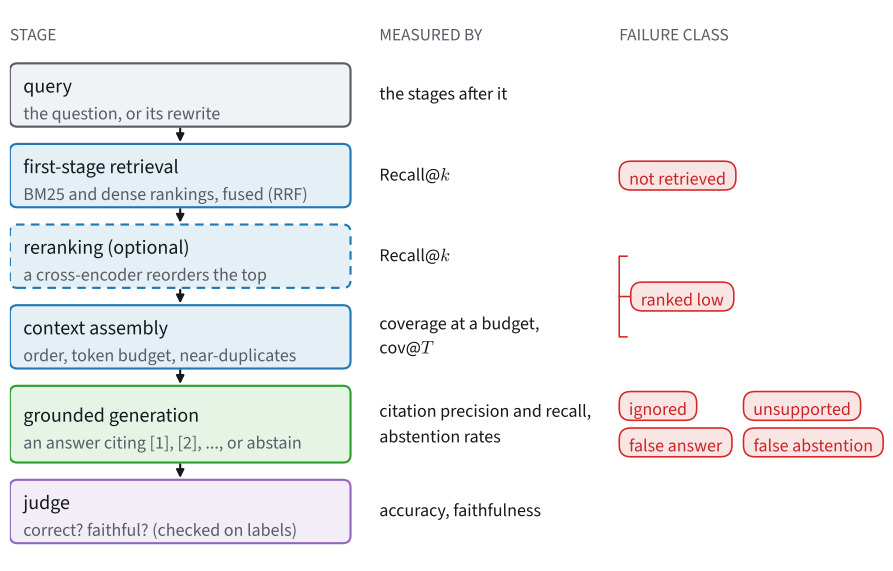
A pipeline over this set has five stages (Figure 19.5.1). The query is the question, or a rewrite of it. First-stage retrieval and the optional reranking come from Section 19.4: BM25 and dense rankings fused by reciprocal ranks, then perhaps reordered by a cross-encoder. Context assembly decides which chunks enter the prompt, in what order, within a token budget, and the generator writes an answer with numbered citations or declines. Every stage but the first can be measured without the stages after it; the query shows itself only in what retrieval does with it. That property is what will let us locate a failure.
19.5.2.1 Context Assembly and the Prompt
Recall@\(k\), the share of questions with a relevant chunk among the first \(k\), cannot compare chunkings, since five section chunks hold more text than five windows. Coverage at a budget of \(T\) tokens, cov@T, fixes the amount of text instead: take chunks in rank order until the next would pass \(T\) tokens, and ask whether they hold at least half of one gold span.
assemble_context builds the real context the same way. It skips a chunk whose embedding has a cosine above 0.95 with one already taken, since a near duplicate adds tokens and no information. It then orders the chunks by rank, in reverse (the best next to the question), or with the best at both ends (edges). The last order is there because language models use the start and the end of a long context better than its middle (Liu et al. 2024).
def cov_at_budget(ranked_chunk_ids, item, corpus, budget_tokens):
    """Whether the chunks of corpus taken in rank order until the next one
    would pass budget_tokens tokens cover at least half the characters of
    one of the item's gold spans (or alternative spans)."""
    taken, used = collections.defaultdict(list), 0
    for cid in ranked_chunk_ids:
        c = corpus[cid]
        if used + c['n_tokens'] > budget_tokens:
            break
        used += c['n_tokens']
        taken[c['doc_id']].append((c['char_start'], c['char_end']))
    for s in item['gold_spans'] + item.get('alt_spans', []):
        a, b = s['char_start'], s['char_end']
        covered = np.zeros(b - a, dtype=bool)
        for lo, hi in taken.get(s['doc_id'], ()):
            covered[max(lo, a) - a:max(min(hi, b) - a, 0)] = True
        if b > a and covered.mean() >= 0.5:
            return True
    return False

def assemble_context(hits, budget_tokens=3000, order='rank', dedup_cos=0.95,
                     embed=None, k=None):
    """The passages for the prompt: hits (chunk dicts with n_tokens, best
    first) taken in rank order, skipping a near duplicate of one already
    taken (cosine above dedup_cos between the unit vectors that embed(hits)
    returns; no check without embed), until k are taken or the next would
    pass budget_tokens; then ordered 'rank' (best first), 'reverse' (best
    last, next to the question) or 'edges' (the best at both ends, the
    weakest in the middle). Returns (passages, tokens used)."""
    if order not in ('rank', 'reverse', 'edges'):
        raise ValueError(f'unknown order {order!r}')
    hits = list(hits)
    V = (torch.as_tensor(embed(hits)).float()
         if embed is not None and hits else None)
    keep, used = [], 0
    for i, h in enumerate(hits):
        if (k is not None and len(keep) == k
                or used + h['n_tokens'] > budget_tokens):
            break
        if V is not None and keep and (V[keep] @ V[i]).max() > dedup_cos:
            continue  # a near duplicate of a passage already taken
        keep.append(i)
        used += h['n_tokens']
    out = [hits[i] for i in keep]
    if order == 'reverse':
        out = out[::-1]
    elif order == 'edges':  # ranks 1, 3, 5, ..., then ..., 4, 2
        out = out[0::2] + out[1::2][::-1]
    return out, used
The prompt is fixed. It asks for an answer from the numbered passages, each shown under its heading path, a citation after each statement, and, if the passages lack the answer, exactly the sentence “I cannot answer this from the provided passages.” Without passages it becomes the closed-book prompt. The stage changes of the next section alter the context or the query and leave this prompt alone. Of all the details in this subsection, the abstention sentence matters most for the scores: it alone decides every unanswerable question.
ABSTAIN = 'I cannot answer this from the provided passages.'


def rag_prompt(question, hits, abstain=ABSTAIN):
    """Chat messages asking for an answer from numbered passages (hits: Hit
    records or dicts with heading_path and text), each statement citing
    them as [n], or the abstention string; hits=None gives the closed-book
    prompt (no passages, no citations)."""
    if hits is None:
        system = ('You answer questions about the textbook Dive into Deep '
                  'Learning. If you do not know the answer, reply exactly: '
                  + abstain)
        user = f'Question: {question}\nAnswer in at most four sentences.'
    else:
        system = ('You answer questions about the textbook Dive into Deep '
                  'Learning using only the numbered passages. After each '
                  'statement, cite the passage numbers that support it, for '
                  'example [2]. If the passages do not contain the answer, '
                  'reply exactly: ' + abstain)
        get = lambda h, k: h[k] if isinstance(h, dict) else getattr(h, k)
        passages = '\n\n'.join(
            f'[{n}] {" > ".join(get(h, "heading_path"))}\n{get(h, "text")}'
            for n, h in enumerate(hits, start=1))
        user = (f'Passages:\n{passages}\n\nQuestion: {question}\n'
                f'Answer in at most four sentences.')
    return [{'role': 'system', 'content': system},
            {'role': 'user', 'content': user}]

def parse_citations(answer, n_chunks):
    """The passage numbers an answer cites ([1], [1][3], [1, 3]), in order
    of first mention, without numbers outside 1..n_chunks."""
    out = []
    for group in re.findall(r'\[(\d+(?:\s*,\s*\d+)*)\]', answer):
        for n in map(int, group.split(',')):
            if 1 <= n <= n_chunks and n not in out:
                out.append(n)
    return out
RAGPipeline puts the pieces together. It is long because it carries every option that the next section switches on, and a first reading needs only prepare and answer. They run in three phases, so that the generator never generates while the embedder and reranker share its GPU. The generator writes a rewritten query if one is asked for. The retriever searches, reranks and assembles while the generator waits. Then the retriever’s models leave the GPU, and the generator answers greedily, in left-padded batches of eight. Two query options, hyde and decompose, are never switched on in this chapter and can be skipped; Section 19.7 describes both.
RAGResult = collections.namedtuple('RAGResult', [
    'qid', 'question', 'query_used', 'ranked_ids', 'context_ids', 'answer',
    'cited_ids', 'abstained', 'n_prompt_tokens', 'n_new_tokens',
    'latency_s'])


class RAGPipeline:
    """Retrieval-augmented generation over the book corpus. The question,
    or a query the generator writes (rewrite='generator'), goes to the
    retriever; rewrite='fuse' adds the query's ranking to the question's
    in RRF, hyde embeds a passage the generator writes on the dense side,
    decompose fuses the rankings of up to two sub-questions. The reranker
    may reorder the first rerank_k chunks; assemble_context packs at most
    k of them (k=None: as many as fit) into budget_tokens; the generator
    answers with the fixed grounded prompt (or a variant of a
    pre-registered fix), greedily, in batches. verify drops sentences
    whose citations the generator finds unsupportive; abstain_below
    abstains when the reranker's best score for the context is lower."""
    def __init__(self, retriever, model, tokenizer, k=5, budget_tokens=3000,
                 order='rank', rewrite=None, hyde=False, decompose=False,
                 rerank_k=None, max_new_tokens=300, *, depth=50,
                 dedup_cos=0.95, prompt='fixed', verify=False,
                 abstain_below=None):
        if rewrite not in (None, 'generator', 'fuse'):
            raise ValueError(f'unknown rewrite {rewrite!r}')
        if (rerank_k or abstain_below is not None) and not retriever.reranker:
            raise ValueError('reranking needs a retriever with a reranker')
        self.retriever, self.model, self.tokenizer = (retriever, model,
                                                      tokenizer)
        self.k, self.budget_tokens, self.order = k, budget_tokens, order
        self.rewrite, self.hyde, self.decompose = rewrite, hyde, decompose
        self.rerank_k, self.max_new_tokens = rerank_k, max_new_tokens
        self.depth, self.dedup_cos, self.prompt = depth, dedup_cos, prompt
        self.verify, self.abstain_below = verify, abstain_below
        self._dense = self._pos = None

    def prepare(self, questions, budgets=None):
        """Phases 1 and 2. Per question (a string or an item dict): the
        query used, the first-stage ranking (depth chunk ids), the context
        (chunk dicts in prompt order) and its tokens, the reranker's best
        score (None without one) and whether to abstain unasked."""
        R, t0 = self.retriever, time.time()
        qs = [self._question(q) for q in questions]
        query = qs  # phase 1: the generator writes queries
        if self.rewrite:
            query = self._write([d2l._rag_rewrite_prompt(q) for q in qs], 20)
        dense = (self._write([d2l._rag_hyde_prompt(q) for q in qs], 120)
                 if self.hyde else qs)
        extra = [[r] if self.rewrite == 'fuse' else [] for r in query]
        if self.decompose:
            subs = self._write([d2l._rag_decompose_prompt(q) for q in qs], 60)
            extra = [e + [l.strip() for l in s.splitlines() if l.strip()][:2]
                     for e, s in zip(extra, subs)]
        main = query if self.rewrite == 'generator' else qs
        ids = lambda H: [[h.chunk_id for h in hs] for hs in H]
        pool = max(100, self.depth, self.rerank_k or 0)  # phase 2
        if not (self.hyde or any(extra)):  # the retriever's own fusion
            ranked = ids(R.search_batch(main, k=pool))
        else:  # BM25 of the question, dense of `dense`, more rankings: RRF
            bm = ids(R.search_batch(main, k=pool, mode='bm25'))
            de = (ids(R.search_batch(dense, k=pool, mode='dense'))
                  if R.dense else [[] for _ in qs])
            flat = [e for es in extra for e in es]
            more = iter(ids(R.search_batch(flat, k=pool)) if flat else [])
            ranked = [[i for i, _ in d2l.rrf_fuse(
                [b, d] + [next(more) for _ in es], k=R.rrf_k)][:pool]
                for b, d, es in zip(bm, de, extra)]
        cand, top = ranked, [None] * len(qs)
        if self.rerank_k:
            rr = self._rerank(qs, [r[:self.rerank_k] for r in ranked])
            cand = [[c for c, _ in r] for r in rr]
            top = [r[0][1] if r else None for r in rr]
        budgets = budgets or [self.budget_tokens] * len(qs)
        embed = self._embed if self.dedup_cos and R.dense else None
        out = []
        for j in range(len(qs)):
            ctx, used = d2l.assemble_context(
                [R.corpus[c] for c in cand[j]], budgets[j], self.order,
                self.dedup_cos, embed, self.k)
            out.append(dict(query_used=query[j], context=ctx,
                            ranked_ids=ranked[j][:self.depth],
                            n_context_tokens=used, top_score=top[j],
                            abstain=False))
        if self.abstain_below is not None:
            need = [j for j, o in enumerate(out)
                    if o['top_score'] is None and o['context']]
            rr = self._rerank([qs[j] for j in need], [
                [c['id'] for c in out[j]['context']] for j in need])
            for j, r in zip(need, rr):
                out[j]['top_score'] = r[0][1]
            for o in out:
                o['abstain'] = (o['top_score'] is not None and
                                o['top_score'] < self.abstain_below)
        for o in out:
            o['seconds'] = (time.time() - t0) / max(len(qs), 1)
        return out

    def answer(self, questions, batch_size=8, contexts=None):
        """Phase 3 after prepare (or with the contexts given; a context of
        None is the closed-book prompt): the retriever's models leave the
        GPU, then batched greedy generation. One RAGResult per question."""
        prep = self.prepare(questions) if contexts is None else contexts
        self.retriever.release()
        go = [j for j, p in enumerate(prep) if not p.get('abstain')]
        gen = dict(zip(go, self._generate(
            [d2l._rag_fix_prompt(self._question(questions[j]),
                                 prep[j]['context'], self.prompt)
             for j in go], self.max_new_tokens, batch_size) if go else []))
        answers = {j: (d2l._rag_quoted_answer(g[0]) if self.prompt == 'quote'
                       else g[0]) for j, g in gen.items()}
        if self.verify:
            answers = self._verified(answers, prep, batch_size)
        out = []
        for j, q in enumerate(questions):
            ctx = prep[j]['context'] or []
            text = answers.get(j, d2l.ABSTAIN)
            _, n_prompt, n_new, secs = gen.get(j, ('', 0, 0, 0.0))
            out.append(d2l.RAGResult(
                q.get('qid') if isinstance(q, dict) else None,
                self._question(q), prep[j].get('query_used'),
                list(prep[j].get('ranked_ids') or []),
                [c['id'] for c in ctx], text,
                d2l.parse_citations(text, len(ctx)), d2l._rag_abstained(text),
                n_prompt, n_new, round(prep[j].get('seconds', 0) + secs, 4)))
        return out

    @staticmethod
    def _question(q):
        return q['question'] if isinstance(q, dict) else q

    def _generate(self, messages, max_new_tokens, batch_size):
        """(text, prompt tokens, new tokens, seconds) per chat: greedy,
        thinking off, left padding; Transformers' generate keeps only the
        last position's logits at the prefill (logits_to_keep=1)."""
        tok, model = self.tokenizer, self.model
        texts = [tok.apply_chat_template(m, tokenize=False,
                                         add_generation_prompt=True,
                                         enable_thinking=False)
                 for m in messages]
        eos = model.generation_config.eos_token_id
        eos = set(eos if isinstance(eos, (list, tuple)) else [eos])
        out = []
        for b in range(0, len(texts), batch_size):
            enc = tok(texts[b:b + batch_size], return_tensors='pt',
                      padding=True, padding_side='left',
                      add_special_tokens=False).to(model.device)
            t = time.time()
            with torch.no_grad():
                ids = model.generate(
                    **enc, max_new_tokens=max_new_tokens, do_sample=False,
                    temperature=None, top_p=None, top_k=None,
                    pad_token_id=tok.pad_token_id)
            secs = (time.time() - t) / len(enc['input_ids'])
            new = ids[:, enc['input_ids'].shape[1]:].tolist()
            for row, n_prompt in zip(new, enc['attention_mask'].sum(1)):
                n = next((i + 1 for i, x in enumerate(row) if x in eos),
                         len(row))
                out.append((tok.decode(row[:n], skip_special_tokens=True)
                            .strip(), int(n_prompt), n, secs))
        return out

    def _write(self, messages, max_new_tokens):
        """The generator's short replies (queries, passages)."""
        return [t for t, *_ in self._generate(messages, max_new_tokens, 8)]

    def _rerank(self, queries, id_lists):
        """Per query, (chunk id, P(yes)) pairs of its chunks, best first."""
        R = self.retriever
        if self._dense is None:
            self._dense = dict(zip(R.corpus.ids, R.corpus.texts('dense')))
        model, tok = R._reranker()
        out = []
        for q, ids in zip(queries, id_lists):
            p = (d2l.rerank_yes_no(model, tok, q, [self._dense[i] for i in
                                                   ids],
                                   instruction=d2l.BOOK_TASK)
                 if ids else np.zeros(0))
            out.append([(ids[i], float(p[i]))
                        for i in np.argsort(-p, kind='stable')])
        return out

    def _embed(self, hits):
        """Unit vectors of chunk dicts, from the retriever's chunk vectors."""
        R = self.retriever
        if self._pos is None:
            self._pos = {c: i for i, c in enumerate(R.corpus.ids)}
        return R.chunk_vectors()[[self._pos[h['id']] for h in hits]].float(
            ).cpu()

    def _verified(self, answers, prep, batch_size):
        """answers without the sentences whose cited passages the generator
        says do not support them (P(yes) below P(no)); a sentence without
        a citation goes too, and an answer left empty abstains."""
        jobs, sents = [], {}
        for j, a in answers.items():
            ctx = prep[j]['context'] or []
            sents[j] = re.split(r'(?<=[.!?])\s+', a.strip())
            for i, s in enumerate(sents[j]):
                cited = d2l.parse_citations(s, len(ctx))
                if cited and not d2l._rag_abstained(a):
                    jobs.append((j, i, d2l._rag_verify_prompt(
                        s, [ctx[c - 1] for c in cited])))
        keep = set()
        if jobs:
            lp = d2l.label_logprobs(self.model, self.tokenizer,
                                    [m for *_, m in jobs], ['yes', 'no'],
                                    chat=True, enable_thinking=False,
                                    batch_size=batch_size)
            keep = {(j, i) for (j, i, _), l in zip(jobs, lp) if l[0] > l[1]}
        return {j: a if d2l._rag_abstained(a) else ' '.join(
            s for i, s in enumerate(sents[j]) if (j, i) in keep) or d2l.ABSTAIN
                for j, a in answers.items()}
19.5.2.2 A Judge for Free-Text Answers
Answers in free text cannot be graded by string match: “is_train is passed as shuffle” and “the data are shuffled exactly when is_train is true” give the same answer in different words. They need a grader that reads. rag_judge shows a second model, Qwen3.8-27B with thinking on, the question, the reference, the key facts, the passages and which of them the answer cites, and asks for verdicts. The first is the one accuracy rests on: an answer is correct if it states every key fact and nothing that contradicts the reference.
Two more verdicts ask where the answer came from, which is what a user who wants to check it relies on. An answer is faithful if every factual statement in it is supported by the passages in its context, whatever the reference says, and supported if the passages it cites suffice on their own. The three can disagree in every direction. An answer from memory can be correct and unfaithful; one that faithfully repeats an incomplete passage, faithful and wrong. The subtle case is the third: an answer that draws on passage [1] but cites only [2] is faithful and unsupported, since the support is in the context but the citation points elsewhere.
Some scores need no judge. Answers to unanswerable questions are decided by string match: a reply that contains the abstention sentence is correct, alone or after an explanation, and any reply without it, however politely it declines, counts as an answer and is incorrect. A reply with the abstention sentence to an answerable question is incorrect too. Citation precision is the share of cited passages that are relevant, and citation recall the share of relevant passages in the context that the answer cites.
def rag_judge(judge, tokenizer, item, result, context_texts, batch_size=8,
              thinking=None, max_new_tokens=None):
    """The judge's verdicts on an answer: 'correct' (every key fact stated,
    nothing contradicting the reference), 'faithful' (every statement
    supported by the passages given) and 'supported' (the cited passages
    alone support it). result is a RAGResult or a dict with answer and
    cited_ids (1-based passage numbers). An abstention (the abstention
    sentence in the answer, d2l._rag_abstained) is decided without the
    judge: it is correct exactly for an unanswerable item.
    Without passages only 'correct' is judged. item, result and
    context_texts may also be lists (a list of verdicts comes back, judged
    in batches). judge is a d2l.ChatAPI (tokenizer None; batch_size
    requests in flight; its client sets the thinking switch, records and
    replays) or a Transformers model with its tokenizer. With thinking
    (default: on for a d2l.ChatAPI, off for a model) the judge reasons
    first and its verdict is read after the reasoning; a reply cut off at
    max_new_tokens (default 3,000 with thinking, 64 without) counts as
    malformed. A verdict missing from the judge's JSON after one retry is
    None. A request that fails in transport twice (the server is down, an
    error status) is not a verdict: rag_judge raises, and a recording
    client keeps the replies that did arrive."""
    single = isinstance(item, dict)
    items, results, contexts = (([item], [result], [context_texts])
                                if single else (item, result, context_texts))
    api = hasattr(judge, 'achat')
    thinking = api if thinking is None else thinking
    max_new_tokens = max_new_tokens or (3000 if thinking else 64)
    verdicts, jobs = [], []
    for i, (q, r, ctx) in enumerate(zip(items, results, contexts)):
        r = r._asdict() if hasattr(r, '_asdict') else r
        answer, ctx = r['answer'].strip(), list(ctx or [])
        abstained = d2l._rag_abstained(answer)
        v = {'correct': None, 'faithful': None, 'supported': None}
        if abstained or not q['answerable']:
            v['correct'] = abstained and not q['answerable']
        if abstained:
            v['faithful'] = True  # an abstention states nothing
        verdicts.append(v)
        keys = [] if abstained else [
            k for k in ('correct', 'faithful', 'supported')
            if v[k] is None and (k == 'correct' or ctx)]
        if keys:
            cited = r.get('cited_ids') or []
            jobs.append((i, keys, d2l._rag_judge_messages(
                q, answer, ctx, cited)))
    failed = []
    for attempt in range(2):  # one retry, with the malformed reply shown
        if not jobs:
            break
        replies = d2l._rag_judge_replies(
            judge, tokenizer, [m for _, _, m in jobs], thinking,
            max_new_tokens, batch_size)
        retry = []
        for (i, keys, messages), reply in zip(jobs, replies):
            if isinstance(reply, BaseException):  # no reply: ask again
                if attempt == 0:
                    retry.append((i, keys, messages))
                else:
                    failed.append(reply)
                continue
            parsed = (None if reply is None else
                      d2l._rag_parse_json(reply, keys))
            if parsed is None and attempt == 0:
                retry.append((i, keys, messages + [
                    {'role': 'assistant', 'content': reply or ''},
                    {'role': 'user', 'content': d2l.RAG_JUDGE_V1['retry']}]))
            for k in keys:
                verdicts[i][k] = None if parsed is None else parsed[k]
        jobs = retry
    if failed:
        raise RuntimeError(f'{len(failed)} judge requests failed twice, '
                           f'first: {failed[0]!r}') from failed[0]
    return verdicts[0] if single else verdicts

def citation_metrics(results, items, corpus):
    """Per item, from gold ids: precision (the share of the cited passages
    that are relevant), recall (the share of the relevant passages in the
    context that are cited) and n_cited; NaN where a share has nothing to
    divide by. results are RAGResults or mappings with context_ids and
    cited_ids (1-based passage numbers)."""
    rows = []
    for r, q in zip(results, items):
        r = r._asdict() if hasattr(r, '_asdict') else r
        rel, ctx = d2l.gold_chunk_ids(q, corpus), list(r['context_ids'])
        cited = [ctx[n - 1] for n in r['cited_ids'] if 1 <= n <= len(ctx)]
        found = [c for c in ctx if c in rel]
        rows.append(dict(
            qid=q['qid'], n_cited=len(cited),
            precision=np.mean([c in rel for c in cited]) if cited else np.nan,
            recall=np.mean([c in cited for c in found]) if found else np.nan))
    return pd.DataFrame(rows)
19.5.3 Baseline Answers
The baseline uses section chunks, hybrid retrieval, the first five chunks in rank order within 3,000 tokens, and the fixed prompt. We answer the 240 dev questions with it and with three other configurations. We call each such run an arm, borrowing the word for the groups of a clinical trial. The closed-book arm gives no passages: a floor. The oracle arm gives only the chunks of the gold spans, as a perfect retriever would: a ceiling for retrieval. (An unanswerable question has no gold span, so there the oracle keeps the retrieved passages.) And base-repeat answers the same questions with the same settings in other batches, which will tell us how large a difference noise alone produces.
Generator and judge each need whole GPUs. Before loading anything we estimate what fits with d2l.config_memory of Section 18.1.5: generation at eight prompts of 3,300 tokens, and at four of 6,300 tokens, about the length of the largest context of the next section; the retrieval phase, with the generator idle on its GPU; and the judge.
CFG = {m: transformers.AutoConfig.from_pretrained(m, revision=r)
       for m, r in [(GEN, REV[GEN]), (EMB, REV[EMB]),
                    (RERANKER, REV[RERANKER]),
                    (JUDGE['model'], JUDGE['revision'])]}
mem = lambda m, n, b, **kw: {k: v / 2**30 for k, v in d2l.config_memory(
    CFG[m], n, b, **kw).items()}
B6 = CONFIGS['budget-6000']['batch']
g8, g4 = mem(GEN, 3300, BATCH), mem(GEN, 6300, B6)
e, r = mem(EMB, 512, 16), mem(RERANKER, 1024, 16)
j = mem(JUDGE['model'], 5000, CONCURRENCY,  # judgments in flight per card,
        dtype_bytes=1, conv_bytes=2)  # keys and values in FP8
jt = getattr(CFG[JUDGE['model']], 'text_config', CFG[JUDGE['model']])
emb = 2 * jt.vocab_size * jt.hidden_size / 2**30  # input and output (Gi)
w4 = (j['params'] - emb) * (4 + 16 / 128) / 8  # GiB: 4 bits, and a bf16
# scale per 128 weights; the embeddings stay in bf16, two bytes per weight
table = pd.DataFrame({  # GiB
    f'generation, 3,300 x {BATCH}': (g8['weights'], g8['kv_cache'] +
                                     g8['recurrent_state'],
                                     g8['activations']),
    f'generation, 6,300 x {B6}': (g4['weights'], g4['kv_cache'] +
                                  g4['recurrent_state'], g4['activations']),
    'retrieval phase': (g8['weights'] + e['weights'] + r['weights'], 0.0,
                        max(e['activations'], r['activations'])),
    'judge, 4-bit weights': (w4 + 2 * emb, j['kv_cache'] +
                             j['recurrent_state'], 0.0)},
    index=['weights', 'KV and state', 'activations']).T
table['total'] = table.sum(axis=1)
table['limit'] = ['one 24 GB GPU'] * 4
print(table.to_string(float_format='{:.1f}'.format))
print(f'GiB; the judge stores four bits per weight, with a bf16 scale per '
      f'128 weights (W4A16),\nexcept its input and output embeddings, which '
      f'stay in bf16 ({2 * emb:.1f} GiB of the '
      f'{table.weights.iloc[-1]:.1f});\none copy runs on each card, and vLLM '
      f'reserves 95% of the card for weights, cache and activations')
assert table.total.iloc[:2].max() < CARD_GIB  # generation fits one card
KEEP_GEN = table.total.iloc[2] < CARD_GIB  # the generator idles on the card
print('retrieval phase: the generator stays on the card' if KEEP_GEN else
      'retrieval phase: the generator leaves the card and comes back')
weights KV and state activations total limit
generation, 3,300 x 8 16.7 1.2 3.4 21.3 one 24 GB GPU
generation, 6,300 x 4 16.7 1.0 3.3 20.9 one 24 GB GPU
retrieval phase 18.9 0.0 0.4 19.3 one 24 GB GPU
judge, 4-bit weights 16.4 2.4 0.0 18.8 one 24 GB GPU
GiB; the judge stores four bits per weight, with a bf16 scale per 128 weights (W4A16),
except its input and output embeddings, which stay in bf16 (4.7 GiB of the 16.4);
one copy runs on each card, and vLLM reserves 95% of the card for weights, cache and activations
retrieval phase: the generator stays on the cardThe generator’s weights take 16.7 GiB, so it gets a whole 24 GB GPU. Its cache is small. Qwen3.5-9B is a hybrid of the kind described in Section 18.1.4: only 8 of its 32 layers store keys and values, and the others carry a state of fixed size, so eight prompts of 3,300 tokens need 1.2 GiB for cache and state together. The estimate of 21.3 GiB leaves out the allocator’s slack. The peaks measured in the full runs, 21.7 GiB for these batches and 22.4 GiB for the four long prompts, still fit, so the batch stays at eight. The judge, a 27B model, fits on one card because its checkpoint stores four bits per weight, with a bf16 scale for every 128 weights (W4A16: 4-bit weights, 16-bit activations), except the input embeddings and the output matrix, which stay in bf16. Those two matrices, each a vocabulary wide, take 4.7 GiB of the judge’s 16.4, more than a quarter. With the cache for eight requests in flight the estimate reaches 18.8 GiB. Each 24 GB GPU therefore holds a copy of its own, and the answers are split among the copies.
The next cell loads the recorded answers and lists the four arms of this section. A normal run also generates the first recorded batch again and compares the pipeline’s batched generation with the plain decoding loop d2l.generate of Section 18.2; a difference would mean a padding bug.
RET = {'sections': d2l.BookRetriever(CORPUS, reranker=RERANKER),
       'fixed': d2l.BookRetriever(FIXED, reranker=RERANKER)}
CHUNKS = {c['id']: c for R in RET.values() for c in R.corpus.chunks}
if 'rag-gen-base' in RERUN:
    d2l._rag_save_gens('rag-gen-base', d2l._rag_run_configs(
        ['closed', 'base', 'oracle', 'base-repeat'], DEV, RET, KEEP_GEN,
        DEPTH))
GENS = d2l._rag_load_gens(RERUN)  # every arm of this section and the next
ARMS = ['closed', 'base', 'oracle', 'base-repeat']  # this section's arms
G = GENS[(GENS.split == 'dev') & GENS.config.isin(ARMS)]
print(G.assign(context_tokens=[sum(CHUNKS[i]['n_tokens'] for i in c)
                               for c in G.context_ids])
      .groupby('config').agg(
          answers=('qid', 'size'), context_tokens=('context_tokens', 'mean'),
          prompt_tokens=('n_prompt_tokens', 'mean'),
          new_tokens=('n_new_tokens', 'mean')).reindex(ARMS).round(0)
      .astype(int))

LIVE = d2l.BookQA(list(DEV)[:N_LIVE], 'dev')  # the recorded run's first
live = d2l._rag_run_config('base', LIVE, RET, KEEP_GEN, DEPTH)  # batch, rerun
print(f'live generation: {d2l.lm_peak()}')
ref = GENS[GENS.config == 'base'].set_index('qid')
tok = d2l._rag_generator()[1]  # only the tokenizer: freeing frees the model

def prefix_share(a, b):
    """The share of tokens before the first difference of two texts."""
    x, y = (tok(s, add_special_tokens=False)['input_ids'] for s in (a, b))
    n = next((i for i, (u, v) in enumerate(zip(x, y)) if u != v),
             min(len(x), len(y)))
    return n / max(len(x), len(y), 1)

same = [prefix_share(r['answer'], ref.answer[r['qid']]) for r in live]
ctx = sum(r['context_ids'] == list(ref.context_ids[r['qid']]) for r in live)
print(f'{N_LIVE} base answers generated again: {ctx} with the recorded '
      f'context, {sum(s == 1 for s in same)} identical answers\n  tokens '
      f'agreeing before the first difference: {np.mean(same):.3f}')
oracle = d2l.generate(*d2l._rag_generator(), [d2l.rag_prompt(
    q['question'], [CHUNKS[i] for i in r['context_ids']])
    for q, r in zip(LIVE, live)], chat=True, enable_thinking=False,
    max_new_tokens=MAX_NEW, batch_size=BATCH)
same = [prefix_share(r['answer'], g.text.strip())
        for r, g in zip(live, oracle)]
agree = sum(s == 1 for s in same) >= N_LIVE - 1 and np.mean(same) >= 0.95
print(f'the same prompts through d2l.generate: {sum(s == 1 for s in same)} '
      f'of {N_LIVE} identical\n  tokens agreeing before the first '
      f'difference: {np.mean(same):.3f}: ' + (
          'the two loops agree' if agree else
          'a padding or logits_to_keep bug'))
assert agree, 'batched generation differs from the plain decoding loop'
d2l._rag_free_generator()  # the card goes to the retriever and the judge
answers context_tokens prompt_tokens new_tokens
config
closed 240 0 90 100
base 240 1701 1937 111
oracle 240 479 630 102
base-repeat 240 1701 1937 111
Qwen/Qwen3-Embedding-0.6B@97b0c614be4d: Qwen3Model
torch.bfloat16, cuda, attention sdpa
Qwen/Qwen3.5-9B@c20223623576: Qwen3_5ForCausalLM, stop tokens [248044, 248046]
0 missing keys; unexpected keys: none
kernels: attention sdpa, delta rule fla, short convolution PyTorch
live generation: peak 20.7 GiB (20.8 GiB reserved)
8 base answers generated again: 8 with the recorded context, 8 identical answers
tokens agreeing before the first difference: 1.000
the same prompts through d2l.generate: 8 of 8 identical
tokens agreeing before the first difference: 1.000: the two loops agreeFive section chunks hold about 1,700 tokens and never reach the budget, since five chunks of at most 512 tokens hold at most 2,560. The limit of five chunks, not the budget, bounds the baseline’s context. (Budgets count tokens of the corpus’s tokenizer, which differ from the generator’s prompt tokens.) Answers run to about 110 tokens. The live batch reproduces the recorded answers, and the two decoding loops agree token for token.
19.5.3.1 Checking the Judge
Every accuracy from here on rests on a model’s verdicts. Why should we believe them? We answer in two steps: first we look at the verdicts themselves, then we check them against labels made without the judge.
The next cell loads the recorded verdicts on every answer of this section and the next, and judges twelve of them again from the judge’s recorded replies, which needs neither a GPU nor a key. Thinking has a drawback here: a judge that reasons at length can run out of tokens before it gives a verdict. We therefore allow up to 12,000 new tokens, reasoning included, and ask once more, showing the reply, when a verdict comes back malformed. An answer still without a verdict is unjudged. It is left out of accuracy and of the failure counts, rather than blamed on the generator.
LABELS = d2l.api_unpack('lm-rag-judge-labels-v1')  # the judge's selection
REC_DIR = os.path.join('..', 'data', 'lm-api', 'record',
                       ARTIFACTS['rag-judge-cache'][0])
VERDICTS = ['correct', 'faithful', 'supported']
ANSWERS = {(r['config'], r['qid']): r for r in GENS.to_dict('records')}
JUDGE_ID = f'{JUDGE["model"]}@{JUDGE["revision"]}'

def passage(cid):
    c = CHUNKS[cid]
    return ' > '.join(c['heading_path']) + '\n' + c['text']

def judge_client(backend, cache, mode='replay', url='http://127.0.0.1/v1'):
    """The judge through a local vLLM server or OpenRouter (same weights,
    BF16), recording to or replaying from cache."""
    if backend == 'local':
        return d2l.rag_judge_client(url, cache=cache, mode=mode)
    with open(os.path.join(LABELS, 'listing.json')) as f:
        listing = json.load(f)
    client = d2l.openrouter_api(
        'qwen/qwen3.8-27b', 'deepinfra/bf16', listing=listing, cache=cache,
        mode=mode, cost_cap_usd=15.0, reasoning={'enabled': True})
    client.timeout = 3600.0  # a request may take minutes
    return client

def judge_records(clients, recs, concurrency, backend, first=0):
    """Judgment records of answer records (dicts). clients: one judge
    client per server; an answer goes to the server its key picks, so a
    request that repeats meets the same server and cache; concurrency:
    requests in flight per server. first: the index of clients[0]."""
    part = [int(d2l._rag_answer_key(r), 16) % len(clients) for r in recs]
    out = [None] * len(recs)

    def work(k):
        idx = [i for i, p in enumerate(part) if p == k]
        v = d2l.rag_judge(clients[k], None, [ITEMS[recs[i]['qid']]
                                             for i in idx],
                          [recs[i] for i in idx],
                          [[passage(c) for c in recs[i]['context_ids']]
                           for i in idx], batch_size=concurrency,
                          max_new_tokens=JUDGE['max_new_tokens'])
        for i, x in zip(idx, v):
            out[i] = dict(x, server=first + k)

    with concurrent.futures.ThreadPoolExecutor(len(clients)) as ex:
        list(ex.map(work, range(len(clients))))  # raises what work raised
    return [dict(config=r['config'], qid=r['qid'], concurrency=concurrency,
                 backend=backend, judge=JUDGE_ID,
                 answer_sha=d2l._rag_answer_key(r),
                 max_new_tokens=JUDGE['max_new_tokens'], **x)
            for r, x in zip(recs, out)]

def no_verdict(v, rec):
    """Whether the judge left out a verdict it was asked for on answer
    record rec (its reply cut off or malformed, twice)."""
    if d2l._rag_abstained(rec['answer']):
        return False  # decided by rule
    keys = VERDICTS if len(rec['context_ids']) else ['correct']
    return any(v[k] is None for k in keys)

JUD_FILE = d2l._rag_run_path('rag-judge', RERUN)
if 'rag-judge' in RERUN:
    d2l._rag_free_generator()
    for R in RET.values():
        R.release()
    big = sum(torch.cuda.get_device_properties(i).total_memory > 22 * 2**30
              for i in range(torch.cuda.device_count()))
    vllm = os.environ.get('D2L_VLLM') or shutil.which('vllm')
    backend = ('local' if vllm and big else 'openrouter'
               if os.environ.get('OPENROUTER_API_KEY') else None)
    assert backend, ('judging needs vLLM (D2L_VLLM) and a 24 GB GPU, or '
                     'OPENROUTER_API_KEY for the same model on OpenRouter')
    old = d2l._rag_load_judgments(JUD_FILE if os.path.exists(JUD_FILE) else
                                  d2l.lm_registered(ARTIFACTS['rag-judge'][0]))
    key = dict(zip(zip(GENS.config, GENS.qid), GENS.answer_sha))
    rule = set(zip(GENS.config[GENS.abstained], GENS.qid[GENS.abstained]))
    rows = [r for r in old.to_dict('records')  # this judge, these answers
            if r['judge'] == JUDGE_ID and
            key.get((r['config'], r['qid'])) == r.get('answer_sha')]
    print(f'{len(old) - len(rows)} verdicts of another judge or on answers '
          'no longer present')
    rows = [r for r in rows  # abstentions: decided again, by rule (no call)
            if (r['config'], r['qid']) not in rule]
    done = {(r['config'], r['qid']) for r in rows
            if r['concurrency'] == CONCURRENCY}
    todo = [r for r in GENS.to_dict('records')
            if (r['config'], r['qid']) not in done]
    os.makedirs(REC_DIR, exist_ok=True)
    servers = d2l.rag_judge_servers() if backend == 'local' else []
    try:
        with concurrent.futures.ThreadPoolExecutor(max(1, len(servers))) as ex:
            urls = (list(ex.map(lambda s: s.start(), servers)) if servers
                    else ['http://127.0.0.1/v1'])
        print(f'judge backend: {backend}, {len(urls)} server(s), ready '
              f'{(time.time() - T0) / 60:.1f} min after the start')
        clients = [judge_client(backend, os.path.join(
            REC_DIR, f'judge-{k}.jsonl'), 'record', u)
            for k, u in enumerate(urls)]
        last = 0.0  # a chunk starts only if it should end within budget
        # a request that fails twice raises: the chunks saved so far stay,
        # the recorded replies too, and the next run resumes
        while todo and time.time() - T0 + last < 60 * JUDGE_MINUTES:
            t = time.time()
            rows += judge_records(clients, todo[:CHUNK], CONCURRENCY, backend)
            todo, last = todo[CHUNK:], time.time() - t
            d2l.write_jsonl(JUD_FILE, rows)  # a stopped run resumes here
            print(f'{len(rows)} judged, {len(todo)} to go, '
                  f'{(time.time() - T0) / 60:.1f} min')
        base = sorted(r['qid'] for r in rows if r['config'] == 'base' and
                      r['concurrency'] == CONCURRENCY and
                      r['qid'].startswith('dev'))
        if (not todo and not any(r['concurrency'] != CONCURRENCY
                                 for r in rows)
                and len(base) >= N_REPEAT
                and time.time() - T0 + last < 60 * JUDGE_MINUTES):
            pick = set(random.Random('repeat|0').sample(base, N_REPEAT))
            rows += judge_records(  # one server, twice the requests in flight
                [judge_client(backend, os.path.join(
                    REC_DIR, 'judge-rep16.jsonl'), 'record', urls[0])],
                [r for r in GENS.to_dict('records') if r['config'] == 'base'
                 and r['qid'] in pick and not r['abstained']],  # by rule
                2 * CONCURRENCY, backend)
    finally:
        for server in servers:
            server.stop()
    print(f'{len(todo)} answers still to judge: run D2L_RERUN=rag-judge '
          'again' if todo else 'every answer is judged')
    d2l.lm_save_table(ARTIFACTS['rag-judge'][1], pd.DataFrame(rows),
                      on=['config', 'qid', 'concurrency'],
                      key=ARTIFACTS['rag-judge'][0])
    members = {f: open(os.path.join(REC_DIR, f), 'rb').read()
               for f in sorted(os.listdir(REC_DIR))}
    members['manifest.json'] = json.dumps(dict(
        judge=JUDGE, prompt='RAG_JUDGE_V1', backends=sorted(
            {r['backend'] for r in rows}), concurrency=CONCURRENCY,
        repeat_concurrency=2 * CONCURRENCY, n=len(rows)), indent=1).encode()
    d2l.lm_save_rerun(ARTIFACTS['rag-judge-cache'][1],
                      lambda p: d2l.lm_write_zip(p, members))
    print(f'rag-judge: {(time.time() - T0) / 60:.1f} min since the start')
JUD = d2l._rag_load_judgments(JUD_FILE)
assert (JUD.judge == JUDGE_ID).all(), 'verdicts of another judge'
judged = JUD[JUD.concurrency == CONCURRENCY].merge(  # on these answers
    GENS[['config', 'qid', 'answer_sha']], on=['config', 'qid',
                                               'answer_sha'])
cache = (REC_DIR if 'rag-judge' in RERUN else
         d2l.lm_registered(ARTIFACTS['rag-judge-cache'][0]) and
         d2l.api_unpack(ARTIFACTS['rag-judge-cache'][0]))
first = (judged[(judged.config == 'base') & ~judged.qid.map(  # judged by
    lambda q: ANSWERS['base', q]['abstained'])]  # the model, not by rule
    .sort_values('qid').head(12))
if cache and len(first):  # replayed from the cache: no server, no GPU
    again = pd.concat([pd.DataFrame(judge_records(
        [judge_client(g.backend.iloc[0], os.path.join(
            cache, f'judge-{int(k)}.jsonl'))],
        [ANSWERS[c] for c in zip(g.config, g.qid)], CONCURRENCY,
        g.backend.iloc[0], first=int(k)))
        for k, g in first.groupby('server')]).sort_values('qid')
    assert (again[VERDICTS].astype(str).values ==
            first[VERDICTS].astype(str).values).all()
    print(f'{len(first)} base judgments replayed from the judge cache: '
          'identical')
here = judged.merge(G[['config', 'qid']])  # this section's dev arms
print(pd.DataFrame({
    'answers': G.groupby('config').size(),
    'judged': here.groupby('config').size(),
    'unjudged': here.assign(none=here.correct.isna()).groupby(
        'config').none.sum()}).reindex(ARMS).fillna(0).astype(int).to_string())
print('unjudged: no verdict on correctness after the one retry (left out '
      'of accuracy)')
12 base judgments replayed from the judge cache: identical
answers judged unjudged
config
closed 240 240 0
base 240 240 0
oracle 240 240 0
base-repeat 240 240 0
unjudged: no verdict on correctness after the one retry (left out of accuracy)The replayed verdicts match the recorded ones, and every answer of the four arms has a verdict.
The judge itself was chosen by measurement. Two frontier models from other families, Claude Opus 5.5 and Gemini 4 Argon, labeled 200 answers of an earlier, smaller generator, Qwen3-4B, and nine Qwen candidates of three sizes judged the same answers, with thinking on and off. With thinking off every candidate was lenient, passing many answers that both labelers call wrong. With thinking on, a judge works through the key facts before it decides, which is what catches a missing fact; the smaller candidates, however, often reasoned until their replies were cut off, and agreed less with the labelers. Half of the 200 answers served this choice, and the other 100 tested it. The chosen judge then ran with 8-bit weights; with 4-bit weights it must pass the test again. That set has a second flaw: our generator is stronger than Qwen3-4B, and its mistakes may be subtler. The same two labelers therefore also labeled 100 base answers of Qwen3.5-9B on dev, the calibration set. The next cell compares the judge, on both sets, with each labeler and with their consensus, the answers on which both agree. On correct, ten of the hundred verdicts of the calibration set are the rule’s rather than the judge’s, because the answers abstain.
CAL_LABELS = d2l.api_unpack('lm-rag-judge-labels-v2')  # this generator's
V1_VERDICTS = d2l.api_unpack('lm-rag-judge-v1cal-v1')  # this judge on v1
read = lambda d, f: [json.loads(l) for l in open(os.path.join(d, f))]

def by_rule(p, v):
    """Verdicts v (dict) with correct decided by rule as rag_judge does:
    an abstention is correct exactly for an unanswerable question, and an
    answer to an unanswerable question is wrong."""
    v = dict(v)
    if d2l._rag_abstained(p['answer']):
        v.update(correct=not ITEMS[p['qid']]['answerable'], faithful=True)
    elif not ITEMS[p['qid']]['answerable']:
        v['correct'] = False
    return v

def kappa(a, b):
    """Cohen's kappa of two 0/1 arrays."""
    a, b = np.asarray(a, float), np.asarray(b, float)
    pe = a.mean() * b.mean() + (1 - a.mean()) * (1 - b.mean())
    return ((a == b).mean() - pe) / (1 - pe) if pe < 1 else 1.0

def agreement(a, b, n_boot=2000, seed=0):
    """Agreement and kappa with 95% intervals, pairs resampled."""
    a, b = np.asarray(a, float), np.asarray(b, float)
    rng = np.random.default_rng(seed)
    boot = [(a[i] == b[i]).mean() for i in rng.integers(0, len(a), (
        n_boot, len(a)))]
    rng = np.random.default_rng(seed)
    kb = [kappa(a[i], b[i]) for i in rng.integers(0, len(a), (
        n_boot, len(a)))]
    q = lambda x: np.quantile(x, [0.025, 0.975])
    return ((a == b).mean(), *q(boot)), (kappa(a, b), *q(kb))

def calibrate(cal, v, lab, name):
    """Print the judge's agreement with each labeler and their consensus,
    the labelers' with each other and the rule's decision on acceptance;
    cal: the labeled answers, v: the judge's verdicts on them (dicts),
    lab: qid -> labels."""
    rows = []
    for k in ('correct', 'faithful'):
        for who, field in (('frontier', f'{k}_frontier'),
                           ('second', f'{k}_second'), ('consensus', k)):
            keep = [(x[k], lab[p['qid']][field]) for p, x in zip(cal, v)
                    if None not in (x[k], lab[p['qid']][field])]
            (acc, alo, ahi), (kap, klo, khi) = agreement(*zip(*keep))
            rows.append({'verdict': k, 'against': who, 'pairs': len(keep),
                         'agreement': f'{acc:.2f} [{alo:.2f}, {ahi:.2f}]',
                         'kappa': f'{kap:.2f} [{klo:.2f}, {khi:.2f}]'})
    print(f'{name}:\n' + pd.DataFrame(rows).to_string(index=False))
    for k in ('correct', 'faithful'):
        pairs = [(lab[p['qid']][f'{k}_frontier'],
                  lab[p['qid']][f'{k}_second']) for p in cal]
        print(f'the two labelers on {k}: kappa '
              f'{kappa(*zip(*[t for t in pairs if None not in t])):.2f}')
    wrong = [x['correct'] for p, x in zip(cal, v)
             if lab[p['qid']]['correct'] is False]  # both labelers: wrong
    print(f'the judge passes {sum(w is True for w in wrong)} of the '
          f'{len(wrong)} answers both labelers call wrong')
    for k in ('correct', 'faithful'):  # the rule, written down beforehand
        (acc, _, _), (_, klo, _) = agreement(*zip(*[
            (x[k], lab[p['qid']][k]) for p, x in zip(cal, v)
            if None not in (x[k], lab[p['qid']][k])]))
        print(f'judge against the consensus on {k}: agreement {acc:.2f}, '
              f'kappa interval from {klo:.2f}:\n  ' + (
                  'accepted (agreement >= 0.8, kappa interval above 0.4)'
                  if acc >= 0.8 and klo > 0.4 else 'not accepted: claims '
                  'that rest on it carry the agreement'))

cal = read(CAL_LABELS, 'pairs.jsonl')  # base answers on dev, as recorded
lab = {r['qid']: r for r in read(CAL_LABELS, 'dev_judge_labels.jsonl')}
jb = judged[judged.config == 'base'].set_index('qid')
assert all(jb.answer_sha[p['qid']] == d2l._rag_answer_key(p)
           for p in cal), 'labels on other answers than the judged ones'
v = [{k: None if (x := jb.loc[p['qid'], k]) is None else bool(x)
      for k in VERDICTS} for p in cal]  # Python bools
graded = [not d2l._rag_abstained(p['answer']) for p in cal]
unans = [not ITEMS[p['qid']]['answerable'] for p in cal]
print(f'{len(cal)} calibration answers of {GEN}, base on dev; '
      f'{sum(not g or u for g, u in zip(graded, unans))} are decided by '
      f'rule on correct\n  ({len(cal) - sum(graded)} abstain, '
      f'{sum(g and u for g, u in zip(graded, unans))} answer an '
      'unanswerable question); unjudged (left out): '
      f'{sum(x["correct"] is None for x in v)}')
calibrate(cal, v, lab, 'this generator\'s answers (labels-v2)')

# The earlier set: 100 answers of Qwen3-4B, the half of labels-v1 that
# did not serve the judge's selection, judged by this judge
old_cal = [p for p in read(LABELS, 'pairs.jsonl') if p['set'] ==
           'calibration']
v1 = {r['qid']: r for r in read(V1_VERDICTS, 'verdicts.jsonl')}
assert {r['judge'] for r in v1.values()} == {JUDGE_ID}
old_cal = [p for p in old_cal if p['qid'] in v1]  # those it was asked
lab1 = {r['qid']: r for r in read(LABELS, 'dev_judge_labels.jsonl')}
print()
calibrate(old_cal, [by_rule(p, {k: v1[p['qid']][k] for k in VERDICTS})
                    for p in old_cal], lab1,
          f'the earlier set: {len(old_cal)} answers of Qwen3-4B (labels-v1)')
old = next(c for c in json.load(open(os.path.join(
    LABELS, 'candidates', 'table.json'))) if c['name'] == 'qwen35-4b-off')
oc = old['calibration']['correct']
print(f'the old judge (Qwen3.5-4B, thinking off) there on correct: '
      f'agreement {oc["acc"]:.2f}, kappa {oc["kappa"]:.2f} '
      f'[{oc["k_lo"]:.2f}, {oc["k_hi"]:.2f}];\n  it passes '
      f'{old["calibration"]["false_correct"][0]} of the '
      f'{old["calibration"]["false_correct"][1]} answers the labelers call '
      'wrong')
if len(JUD) and 2 * CONCURRENCY in JUD.concurrency.values:
    J = JUD[JUD.config == 'base']
    n16 = (J.concurrency == 2 * CONCURRENCY).sum()
    both = J.groupby('qid').filter(lambda g: g.concurrency.nunique() == 2)
    changed = both.groupby('qid').apply(lambda g: (g[VERDICTS].astype(
        str).nunique() > 1).any(), include_groups=False)
    print(f'judged again on one server at concurrency {2 * CONCURRENCY} '
          f'(first run {CONCURRENCY} per server):\n  {changed.sum()} of '
          f'{len(changed)} answers changed a verdict (of {N_REPEAT} drawn, '
          f'{N_REPEAT - n16} abstentions are decided by rule)')
100 calibration answers of Qwen/Qwen3.5-9B, base on dev; 10 are decided by rule on correct
(10 abstain, 0 answer an unanswerable question); unjudged (left out): 0
this generator's answers (labels-v2):
verdict against pairs agreement kappa
correct frontier 99 0.92 [0.86, 0.97] -0.04 [-0.07, 0.00]
correct second 100 0.95 [0.90, 0.99] 0.52 [-0.02, 0.85]
correct consensus 93 0.97 [0.92, 1.00] 0.00 [0.00, 1.00]
faithful frontier 99 0.93 [0.88, 0.98] 0.55 [0.21, 0.82]
faithful second 100 0.97 [0.93, 1.00] 0.78 [0.48, 1.00]
faithful consensus 93 0.98 [0.95, 1.00] 0.79 [0.32, 1.00]
the two labelers on correct: kappa 0.47
the two labelers on faithful: kappa 0.64
the judge passes 3 of the 3 answers both labelers call wrong
judge against the consensus on correct: agreement 0.97, kappa interval from 0.00:
not accepted: claims that rest on it carry the agreement
judge against the consensus on faithful: agreement 0.98, kappa interval from 0.32:
not accepted: claims that rest on it carry the agreement
the earlier set: 99 answers of Qwen3-4B (labels-v1):
verdict against pairs agreement kappa
correct frontier 99 0.96 [0.92, 0.99] 0.89 [0.78, 0.97]
correct second 99 0.91 [0.85, 0.96] 0.77 [0.61, 0.90]
correct consensus 92 0.97 [0.92, 1.00] 0.91 [0.80, 1.00]
faithful frontier 99 0.92 [0.87, 0.97] 0.75 [0.56, 0.89]
faithful second 99 0.91 [0.85, 0.96] 0.72 [0.54, 0.87]
faithful consensus 94 0.94 [0.88, 0.98] 0.80 [0.63, 0.94]
the two labelers on correct: kappa 0.81
the two labelers on faithful: kappa 0.85
the judge passes 0 of the 21 answers both labelers call wrong
judge against the consensus on correct: agreement 0.97, kappa interval from 0.80:
accepted (agreement >= 0.8, kappa interval above 0.4)
judge against the consensus on faithful: agreement 0.94, kappa interval from 0.63:
accepted (agreement >= 0.8, kappa interval above 0.4)
the old judge (Qwen3.5-4B, thinking off) there on correct: agreement 0.81, kappa 0.33 [0.11, 0.56];
it passes 14 of the 21 answers the labelers call wrong
judged again on one server at concurrency 16 (first run 8 per server):
5 of 54 answers changed a verdict (of 60 drawn, 6 abstentions are decided by rule)We accept a judge whose agreement with the consensus is at least 0.8 and whose κ interval stays above 0.4, well clear of chance. On the earlier set the judge passes easily. It agrees with the consensus on 97% of the correct verdicts and on 94% of the faithful ones, with κ of 0.91 and 0.80, and it passes none of the 21 answers that both labelers call wrong. These numbers flatter, because the consensus leaves out the hard answers on which the labelers disagree. The fair comparison is with each labeler alone. There the judge reaches κ 0.89 and 0.77 on correct, and the labelers reach 0.81 with each other: the judge is about as reliable as a third labeler. The judge it replaced, a 4B model with thinking off, passed 14 of those 21 wrong answers, which is the leniency the selection was meant to remove.
On the answers of our own generator the same rule rejects the judge, and κ tells us little about why. The judge agrees with the consensus on 97% of the correct verdicts and on 98% of the faithful ones, yet κ on correct is 0.00, with an interval from 0.00 to 1.00. This is the effect we met with the checker and the verifier: Qwen3.5-9B answers well, and of the 93 answers on which the labelers agree they call only 3 wrong. With so few wrong answers, nearly all of the agreement is the agreement that the shares alone predict, and the interval says that κ could be anything. The three answers do tell us something, though. Each leaves out one key fact, and the judge passes all three: it is lenient about an omitted fact, the generator’s most common mistake. The labelers agree with each other less than on the earlier set, with κ 0.47 on correct and 0.64 on faithful. As the rule prescribes, claims that rest on the judge carry its agreement rather than κ. The leniency also sets a direction. On these answers the judge errs toward passing, so the accuracies it reports are, if anything, too high. A last limit no calibration on these labels removes: the labels come from models, not from people.
A practical note for readers who want to regenerate the verdicts. This takes vLLM, an inference server that batches many requests on the GPU, here one copy of the judge’s 4-bit weights on each 24 GB GPU. vLLM pins its own PyTorch, so it lives in an environment of its own (uv venv, then uv pip install vllm==0.33.0), whose vllm executable the variable D2L_VLLM names. Without such a GPU the same model, in bf16, can be called on OpenRouter for about $3 per 1,000 judgments. Other weights give other verdicts on some answers, however: on the 198 labeled answers of Qwen3-4B, the judge’s 8-bit and 4-bit builds disagree on correct for about one answer in fifteen.
19.5.3.2 The Baseline Report
Before the averages, one answer. The chapter began by asking how the book’s old load_array helper decides whether to shuffle its data, and the retriever of Section 19.4 ranks the passage that says so first. The next cell prints what the generator replies to that question without passages and with the baseline’s five, each with the judge’s verdicts.
# The question of the chapter's introduction, about load_array (dev-0001),
# answered without passages and by the baseline, with the judge's verdicts
item = ITEMS['dev-0001']
wrap = lambda t, first='': textwrap.fill(t, 96, initial_indent=first,
                                         subsequent_indent='    ')
print(wrap(f'question: {item["question"]}'))
print(wrap(f'reference: {item["reference"]}'))
for c in ('closed', 'base'):
    rec = ANSWERS[c, item['qid']]
    jv = judged[(judged.config == c) & (judged.qid == item['qid'])]
    verdicts = ', '.join(f'{k} {jv[k].iloc[0]}' for k in VERDICTS
                         if len(jv) and pd.notna(jv[k].iloc[0]))
    print(f'\n{c}, {len(rec["context_ids"])} passages; judge: '
          f'{verdicts or "no verdict"}')
    print(wrap(rec['answer'], '    '))
question: In the book's legacy PyTorch helper `load_array`, how does the returned `DataLoader`
decide whether to shuffle the data?
reference: It passes `shuffle=is_train`, so shuffling is enabled exactly when `is_train` is
true.
closed, 0 passages; judge: correct False
The `load_array` function in the legacy PyTorch helper does not automatically shuffle the
data by default. Instead, it relies on the `shuffle` argument passed to the
`torch.utils.data.DataLoader` constructor when the dataset is created. If the `shuffle`
parameter is set to `True`, the returned `DataLoader` will randomize the order of the data
batches during each epoch. Otherwise, if `shuffle` is `False` or not specified, the data
will be returned in the original order defined by the dataset.
base, 5 passages; judge: correct True, faithful True, supported True
The `load_array` function accepts an optional argument `is_train` which defaults to `True`.
It passes this `is_train` value directly to the `DataLoader` constructor as the `shuffle`
parameter. Consequently, the data is shuffled if `is_train` is `True` and remains in its
original order if `is_train` is `False`. This behavior is defined in the function signature
and implementation within the provided code [1].Without passages the generator invents a plausible mechanism, a shuffle argument that the caller sets, and never mentions is_train; the judge marks the answer wrong. With the five retrieved chunks it says that is_train is passed to the DataLoader as shuffle, which is the book’s answer, and it cites the passage it took this from. This is the system doing what it was built for: the judge calls the answer correct, faithful and supported.
In the report each rate carries a 95% interval that resamples documents, since questions drafted from one document share its difficulty, and each difference between arms is paired over the same questions (Section 18.5, Section 36.5.2.6).
One row of the report is worth predicting before it is read. base-repeat sends the same 240 prompts to the same model with greedy decoding, and only the neighbors in each batch of eight differ. How many of its answers will change?
CLUSTER = d2l._rag_clusters(ITEMS.values(), CORPUS)  # qid: its document
boot, paired = d2l._rag_boot, d2l._rag_paired  # 'mean [95% interval]'
scores = lambda c, split='dev': d2l._rag_scores(  # per-question scores
    c, split, GENS, JUD, RET, ITEMS, CLUSTER, CONCURRENCY)
ready = lambda *c, split='dev': d2l._rag_ready(  # are all of c's verdicts in?
    c, split, GENS, JUD, RERUN, CONCURRENCY)
S = {c: scores(c) for c in ('closed', 'base', 'oracle', 'base-repeat')
     if ready(c)}
METRICS = ['recall@5', 'cov@3000', 'accuracy', 'faithful', 'cite_precision',
           'cite_recall', 'supported']
if len(S) == 4:
    rows = {c: {m: boot(S[c][m], cluster=S[c].cluster) for m in METRICS}
            for c in ('closed', 'base', 'oracle')}
    for m in ('recall@5', 'cov@3000'):  # the oracle bypasses retrieval
        rows['oracle'][m] = 'n/a'
    for c in rows:
        s = S[c]
        rows[c]['abstain, unanswerable'] = boot(
            s.abstained[~s.answerable], cluster=s.cluster[~s.answerable])
        rows[c]['abstain, answerable'] = boot(
            s.abstained[s.answerable], cluster=s.cluster[s.answerable])
    print(pd.DataFrame(rows).to_string())
    print('unjudged, left out of accuracy: ' + ', '.join(
        f'{c} {S[c].accuracy.isna().sum()}' for c in S))
    B = S['base']
    ans = lambda m: m.answerable_a
    spec = lambda m: m.answerable_a & m.book_specific_a
    print(pd.DataFrame([
        ('base - closed', 'all', paired(B, S['closed'], 'accuracy')),
        ('oracle - base', 'all', paired(S['oracle'], B, 'accuracy')),
        ('oracle - base', 'answerable', paired(S['oracle'], B, 'accuracy',
                                               ans)),
        ('base - closed', 'book-specific, answerable',
         paired(B, S['closed'], 'accuracy', spec)),
        ('base-repeat - base', 'all (other batches only)',
         paired(S['base-repeat'], B, 'accuracy'))],
        columns=['difference', 'questions', 'accuracy [95% CI]'])
          .to_string(index=False))
    print(f'oracle - base on faithful: {paired(S["oracle"], B, "faithful")}')
    C = S['closed'][S['closed'].answerable & S['closed'].book_specific]
    Bs = B[B.answerable & B.book_specific]
    print(f'book-specific answerable questions ({len(C)}): closed book '
          f'{boot(C.accuracy, cluster=C.cluster)},\n  '
          f'base {boot(Bs.accuracy, cluster=Bs.cluster)}')
    A = B[B.answerable].merge(S['closed'][['qid', 'accuracy']], on='qid',
                              suffixes=('', '_closed'))
    for name, m in (('a relevant chunk in the context', A.hit == 1),
                    ('no relevant chunk in the context', A.hit == 0),
                    ('closed-book arm correct', A.accuracy_closed == 1),
                    ('closed-book arm wrong', A.accuracy_closed == 0)):
        print(f'base accuracy, {name} ({m.sum()}): '
              f'{boot(A.accuracy[m], cluster=A.cluster[m])}')
if {'base', 'base-repeat'} <= set(GENS.config):  # answers, not verdicts
    b, r = (GENS[(GENS.config == c) & (GENS.split == 'dev')].set_index('qid')
            for c in ('base', 'base-repeat'))
    r = r.loc[b.index]
    same_ctx = b.context_ids.map(tuple) == r.context_ids.map(tuple)
    differ = b.answer != r.answer
    print(f'base and base-repeat (same questions, other batches): '
          f'{(~same_ctx).sum()} of {len(b)} contexts differ\n  (the query '
          f'embeddings were batched differently too);\n  with the same '
          f'context {differ[same_ctx].sum()} of {same_ctx.sum()} answers '
          f'differ')
print('* fewer than 100 questions (documents resampled)\n+ fewer than 30 '
      'documents: questions resampled, an interval that is likely too '
      'narrow')
closed base oracle
recall@5 n/a 0.968 [0.942, 0.990] n/a
cov@3000 n/a 0.986 [0.969, 1.000] n/a
accuracy 0.317 [0.251, 0.381] 0.912 [0.870, 0.949] 0.925 [0.897, 0.951]
faithful n/a 0.932 [0.894, 0.965] 0.937 [0.911, 0.962]
cite_precision n/a 0.716 [0.663, 0.766] 1.000 [1.000, 1.000]
cite_recall n/a 0.879 [0.841, 0.913] 0.914 [0.874, 0.950]
supported n/a 0.868 [0.821, 0.911] 0.878 [0.832, 0.923]
abstain, unanswerable 0.500 [0.300, 0.700]+ 0.950 [0.850, 1.000]+ 0.900 [0.750, 1.000]+
abstain, answerable 0.145 [0.095, 0.202] 0.009 [0.000, 0.024] 0.000 [0.000, 0.000]
unjudged, left out of accuracy: closed 0, base 0, oracle 0, base-repeat 0
difference questions accuracy [95% CI]
base - closed all +0.596 [+0.529, +0.663]
oracle - base all +0.013 [-0.032, +0.057]
oracle - base answerable +0.018 [-0.030, +0.067]
base - closed book-specific, answerable +0.766 [+0.697, +0.832]
base-repeat - base all (other batches only) -0.017 [-0.041, +0.005]
oracle - base on faithful: +0.005 [-0.028, +0.039]
book-specific answerable questions (145): closed book 0.145 [0.088, 0.209],
base 0.910 [0.868, 0.951]
base accuracy, a relevant chunk in the context (213): 0.930 [0.888, 0.964]
base accuracy, no relevant chunk in the context (7): 0.286 [0.000, 0.571]+
base accuracy, closed-book arm correct (66): 0.924 [0.848, 0.985]+
base accuracy, closed-book arm wrong (154): 0.903 [0.857, 0.945]
base and base-repeat (same questions, other batches): 0 of 240 contexts differ
(the query embeddings were batched differently too);
with the same context 95 of 240 answers differ
* fewer than 100 questions (documents resampled)
+ fewer than 30 documents: questions resampled, an interval that is likely too narrowNot one of the 240 contexts changed, yet 95 of the 240 answers did: 40%. Accuracy moved by less than its noise: the difference is \(-0.017\), with an interval from \(-0.04\) to +0.01 that includes zero. Nothing is broken. When the padding of a prompt’s batch changes, so does the shape of every matrix product, and the GPU may add the same bf16 numbers in another order; the logits move by a few rounding steps. Wherever the two likeliest tokens are nearly tied, that flips the greedy choice, and from that token on the answer takes another path. Section 18.1.5.3 met the same near-ties when it changed a batch from one prompt to two.
Greedy decoding is therefore deterministic only for a fixed batch, precision and kernel. An evaluation must batch the configurations it compares alike, or count re-batching as noise (Section 18.4). Here re-batching moves accuracy by up to about 0.04, and a change to the pipeline has to do better than that before we believe it. The judge’s server batches its requests too, so the same effect reaches the verdicts: judged again with twice as many requests in flight, 5 of 54 answers changed a verdict. Every arm was judged at the same concurrency, so this noise widens the paired intervals rather than favoring one arm.
With the size of the noise known, the rest of the report reads quickly. A relevant chunk is among the first five for 97% of the answerable questions: retrieval is nearly solved here. That should not surprise us. The questions were drafted from the book’s passages and, like the first example, often reuse their words, and Lee et al. (2019) observed that when the people asking already know the answer, BM25 alone retrieves well. With those chunks the generator answers 0.91 of all dev questions correctly, and without them 0.32, a gain of about 0.6. The closed-book score is not zero, nor should it be: the book is public, and some questions ask for general knowledge. On the 145 answerable questions that the checker marked as specific to the book, closed-book accuracy falls to 0.15, against 0.91 with retrieval. That pair of numbers is the case for retrieval. Nor do the passages merely jog the generator’s memory: the baseline answers about nine in ten answerable questions correctly, both where the closed-book arm was right and where it was wrong.
The answers mostly come from their passages. The judge calls 0.93 of them faithful and finds the cited passages sufficient for 0.87. Citation precision is 0.72 and recall 0.88; precision from gold spans is strict, since a citation of a supporting passage that is not gold counts against it. The baseline abstains on 19 of the 20 unanswerable questions and on 1% of the answerable ones.
The oracle arm answers 0.93 of all questions. Its context holds a relevant chunk for every answerable question, which is why its citation precision is 1.00 by construction, and its Recall@5 and coverage are n/a: it bypasses the retriever. Nor are its answers more faithful: 0.94 against the baseline’s 0.93, a difference whose interval runs from \(-0.03\) to +0.04. On the answerable questions its gain over the baseline is +0.02, with an interval from \(-0.03\) to +0.07, and cannot be told from zero. Why so little? Call a question a hit when its context holds a relevant chunk. Let \(h\) be the share of hits among the answerable questions, and \(a_1\) and \(a_0\) the accuracy on hits and on misses. Then the accuracy on the answerable questions is
\[\textrm{accuracy} = h\, a_1 + (1 - h)\, a_0. \tag{19.5.2}\]
Accuracy is a mixture of how often retrieval succeeds and how well the generator does in each case. Here 213 of 220 contexts hold a relevant chunk, \(h = 213/220\), with \(a_1 = 0.93\), and \(a_0 = 0.29\) on the seven misses. A perfect retriever can only turn those seven misses into hits. If the accuracy on hits stayed at \(a_1\), it would add \((1 - h)(a_1 - a_0) \approx 0.032 \times 0.64 \approx 0.02\): there is no room left for retrieval to show a gain, and the oracle’s +0.02 matches that estimate. The bold step is the assumption that \(a_1\) stays put. The oracle passes only the gold chunks, about 480 context tokens against the baseline’s 1,700, and so also removes passages that might distract the generator. Whether that raises the accuracy on hits, 240 questions cannot tell.
Of everything in this section, the decomposition Equation 19.5.2 is the result to remember. Before a single change has been tried, it says which stage to improve first, and here it points at the generator: of the 20 errors on answerable questions, 15 were made with a relevant passage in the context.
The wrong answer that opened this section is one of those fifteen: its passage was in the context, ranked first. Which stage lost each of them, and would another chunking, query or context have saved some? Section 19.6 changes one stage at a time and sorts the failures by stage.
19.5.4 Summary
When a retrieval-augmented generator answers wrongly, one accuracy number cannot say which of its stages failed, although each stage needs a different repair. Locating the failure takes instruments: questions over the corpus with known answers and gold spans, here drafted and checked by models rather than people; a judge checked against independent labels before any accuracy is read; and a measurement of each stage on its own, between a floor without passages and a ceiling with only the right ones. On this book the baseline answers 0.91 of the dev questions against 0.32 without passages. Retrieval is nearly solved, the decomposition \(h\,a_1 + (1-h)\,a_0\) leaves a perfect retriever almost nothing to add, and most wrong answers had a relevant passage in the context: the generator limits accuracy. Greedy decoding in bf16 also depends on the batch, which changed 40% of the answers and not accuracy.
19.5.5 Exercises
- [code] The position of the answering passage. Take the answerable
devquestions whose baseline context holds exactly one relevant chunk. Build contexts of five chunks with the relevant chunk at positions 1 to 5 and the other four in rank order.- Predict how accuracy depends on the position, then measure it, with paired intervals against position 1. Judging needs the judge server on a 24 GB GPU of its own. With one GPU, measure instead how often the answer cites the relevant passage at each position, which needs no judge.
- Does the result show the dip in the middle that Liu et al. (2024) found in long contexts? Build longer contexts from more chunks of the book until it does, or until 6,000 tokens, and report the length at which the middle positions fall behind, if any. With one GPU, again count citations of the relevant passage instead of judging.
- [code] Citation precision against support. Citation precision from gold spans counts every cited passage that is not gold as a mistake.
- Collect the baseline answers that cite at least one passage outside the gold chunks. Read 20 of them with their passages and count the citations that do support their sentence.
- Compare citation precision with the judge’s
supportedverdict per answer. On how many answers do they disagree, and on your 20, which of the two is right more often?
- Which stage to improve first. A colleague’s pipeline puts a relevant chunk in the context for 90% of the questions, and its accuracy is 0.7 with one and 0.2 without.
- Use Equation 19.5.2 to compute its accuracy, and its accuracy with an oracle context, assuming that the accuracy given a hit stays at 0.7. Which gains more: a perfect retriever, or raising the accuracy given a hit to 0.8?
- Why is “the accuracy given a hit stays at 0.7” an assumption? Name a way in which a perfect retriever would also change the accuracy given a hit, and say why the oracle arm of this section cannot tell whether it does.
- Suppose two configurations disagree on 10% of 240 questions. Estimate the standard error of the paired difference in accuracy, and the smallest gain a 95% interval would separate from zero. Which of the two improvements could 240 questions detect?
- Agreement without information. On whether an item’s answer is unique, the verifier and the checker agree on 96% of 536 items, with κ = 0.00.
- Write down a table of counts over the 536 items (both pass, only the verifier passes, only the checker passes, both reject) with agreement 0.96 and κ = 0. What must one of the two raters do?
- Show that κ = 0 exactly when the share of items that both reject equals the product of the two raters’ rejection rates.
- A judge passes 95% of the answers, and a labeler 90%. What is the largest κ the two can reach, whatever the answers? What does this mean for comparing κ across sets of answers that a generator gets right at different rates?
- [code] Hand labels against the verifier. Draw 20
devitems and 10 candidates that the frontier verifier rejected (from the recorded responses oflm-book-qa-api-cache-v1), with seed 0, and hide which is which.- For each, read the question, the reference and the gold span, and decide yourself whether it stands alone, whether the reference is supported and complete, and whether the answer is unique.
- Compute your agreement with the verifier and Cohen’s κ, with a bootstrap interval. What can 30 items show, and what can they not?
- Read the items on which you disagree. Are they errors of the model, or of yours?