import collections
import gzip
import hashlib
import io
import concurrent.futures
import itertools
import json
import os
import pathlib
import re
import shutil
import tarfile
import textwrap
import time
import pandas as pd
from scipy import sparse20.5 Synthetic and Rephrased Data
The previous sections took text as the web offers it and decided what to keep, how to remove its copies and how often to read each kind. At the end of Section 20.4 the supply ran short: a small source read many times is worth far less than as many fresh sources of the same size. A language model offers a way out that would have sounded odd a few years ago. It can write more text.
Here is the smallest version of the idea, which we run later in this section. A model of two billion parameters reads a paragraph from an educational web page about a mouthwash for oral pain and rewrites it in the style of an encyclopedia. The rewrite is cleaner than its source, it keeps every fact, and it costs the model a few seconds. If one paragraph can be rewritten, so can a million, and a pretraining run could read each source once as written and once rephrased instead of twice as written. Maini and colleagues (2024) did this with the C4 web crawl and report that their models reached the same perplexity about three times faster. Whole crawls have since been rewritten the same way.
Generated text has costs, and they are hard to see in any single example. A rewrite can change a number or add a claim and still read perfectly well. Samples from one prompt resemble each other far more than documents written by different people. And a model that learns from a model’s text learns the generator’s habits along with its content. This section measures these costs. It builds a rephrasing pipeline and checks what comes out, then trains small models on an equal budget of real text, rewritten text and mixtures of the two, and evaluates each on both kinds of text. Two questions close it: what happens when models learn from models generation after generation, and who may train on generated text at all.
The rewrites shown in the text, about 150 of them, are generated live by Qwen3.5-2B in bf16 on a GPU in a few minutes. Everything larger was computed once and registered: a corpus of 4.7 million tokens of source chunks with their rewrites, the verdicts of a judge model on sixty of them, and the fifteen training runs of the comparison. A normal build reads these files and repeats the start of one training run as a check; setting D2L_RERUN to a name in ARTIFACTS regenerates that file instead. The runs use the wider proxies of Section 20.4 at that section’s smaller scale, T1, so every result of the comparison is stated at T1 scale (8.1M-parameter proxies, \(2^{24}\) tokens).
REPHRASER = 'Qwen/Qwen3.5-2B'  # writes the rephrasings (non-thinking)
JUDGE = d2l.EDU_LABELLER_LOCAL['model']  # checks them: Qwen3.8-27B (vLLM)
JUDGE_MAX_TOKENS = 12_000  # the judge reasons first: no thinking budget
JUDGE_PER_SERVER = 1  # requests in flight per judge server: repeatable
PROXY_SMALL = d2l.ProxyCfg(num_hiddens=192, num_heads=3, num_blks=4,
                           warmup_frac=0.1)  # 26 of 256 steps: see below
TOKENS, U, VAL_U = 2**24, 2**21, 2**19  # per run; S1 and S2; validation
SEEDS, EPOCHS = (0, 1, 2), 8  # data-order seeds; arm A's passes over S1
CHUNK_TOKENS = 400            # the bound of chunk_doc
LEN_RATIO = (0.5, 1.5)  # a rewrite outside is dropped (cut short, padded)
FLAGS = dict(copy_rate=0.8, num_fidelity=1.0)  # past these: flagged, kept
SAMPLING = dict(temperature=0.7, top_p=0.9, seed=0)  # every rephrasing
GPU = torch.cuda.is_available()
SMALL = not GPU  # the CPU path: fewer, shorter live generations
DTYPE = torch.bfloat16 if GPU else torch.float32
N_LIVE = 4 if SMALL else 60          # live chunks per style
LIVE_MAX_SRC = 100 if SMALL else CHUNK_TOKENS  # their longest source
N_SAMPLES = 3 if SMALL else 9        # samples of one prompt (opening)
OPEN_MAX_SRC = 200                   # the opening chunk's longest source
NEW_TOKENS = 192 if SMALL else 512   # max_new_tokens of a live rephrase
SEED_TOKENS = 96 if SMALL else 300   # max_new_tokens from a seed
MIN_WORDS = 50                       # the seed comparison's shortest output
LIVE_BATCH, REGEN_BATCH, N_JUDGE = 32, 96, 60  # 96: a part in < 30 min
REGEN_TOKENS = 512                   # max_new_tokens of the corpus
EVAL_AT, LOG_EVERY, LIVE_TOKENS = (0.25, 0.5, 0.75, 1.0), 4, 2**20
ARTIFACTS = {  # name: (registered key, file a regeneration writes)
    'reph-s1': ('lm-rephrase-fwedu-5m-v1', 'reph-s1.jsonl.gz'),
    'reph-s2': ('lm-rephrase-fwedu-5m-v1', 'reph-s2.jsonl.gz'),
    'reph-val': ('lm-rephrase-fwedu-5m-v1', 'reph-val.jsonl.gz'),
    'reph-judge': ('lm-data-synth-results-v1', 'reph-judge.json'),
    'synth-arms': ('lm-data-synth-results-v1', 'synth-arms.json')}
RERUN = d2l.lm_rerun(ARTIFACTS)
assert GPU or not RERUN, 'the regenerations generate text and train on a GPU'
assert GPU or not os.environ.get('CUDA_VISIBLE_DEVICES'), (
    'a GPU slot without CUDA: the small CPU path must not be captured')
RERUN_DIR = os.path.join('..', 'data', 'lm', 'rerun')
with torch.device('meta'):
    N_PARAMS = d2l.num_params(d2l._proxy_model(PROXY_SMALL))
TIER = (f'at T1 scale ({N_PARAMS / 1e6:.1f}M-parameter proxies, '
        f'2^{round(math.log2(TOKENS))} tokens per run)')
TAG = f'[{TIER}]'

def say(*args, sep=' '):
    """print, each line wrapped to the page's 100 columns."""
    print('\n'.join(l if len(l) <= 100 else textwrap.fill(
        l, 100, subsequent_indent='    ', break_long_words=False,
        break_on_hyphens=False) for l in sep.join(map(str, args)).split('\n')))

say(f'proxy comparison {TIER.replace(" scale", "")}; GPU={GPU}, '
    f'SMALL={SMALL}, regenerating: {", ".join(sorted(RERUN)) or "none"}')
PINS = {REPHRASER: d2l.HF_REVISIONS[REPHRASER],
        JUDGE: d2l.EDU_LABELLER_LOCAL['revision']}
for m, rev in PINS.items():
    say(f'  {m}@{rev[:8]}')
proxy comparison at T1 (8.1M-parameter proxies, 2^24 tokens per run); GPU=True, SMALL=False,
regenerating: none
Qwen/Qwen3.5-2B@15852e8c
RedHatAI/Qwen3.8-27B-INT4@71dface3Two files are registered. The corpus is FineWeb-Edu text (ODC-By) rewritten by an Apache-2.0 model, so it ships as text with the attribution that ODC-By asks for, and every printed example carries it. The results file holds the judge’s verdicts, the logs of the fifteen runs and three Cosmopedia rows.
d2l.DATA_HUB['lm-rephrase-fwedu-5m-v1'] = (  # FineWeb-Edu chunks and their
    # wiki-style rewrites by Qwen3.5-2B, 4.7M tokens (20.5); ODC-By
    d2l.LM_DATA_URL + 'lm-rephrase-fwedu-5m-v1.tar',
    '1b8598668e0959eeef5f4b0045cc7ed6574880e1')
d2l.DATA_HUB['lm-data-synth-results-v1'] = (  # the judge's verdicts, the 15
    # proxy runs of the five arms and three Cosmopedia rows (20.5)
    d2l.LM_DATA_URL + 'lm-data-synth-results-v1.json',
    'd27e4094b3936e83efc89b6ccc69760f538c49fd')

TAR_KEY, TAR_FILE = 'lm-rephrase-fwedu-5m-v1', 'lm-rephrase-fwedu-5m-v1.tar'
RES_KEY = 'lm-data-synth-results-v1'
UPSTREAM = ('lm-mix-web-20m-v1', 'lm-mix-val-1m-v1', 'lm-mix-runs-t1-v1',
            'lm-r2-tokenizer-v1')
for name, keys in (('this section', (TAR_KEY, RES_KEY)),
                   ('upstream', UPSTREAM)):
    say(f'{name}: registered', ', '.join(
      k for k in keys if k in d2l.DATA_HUB) or 'none', '| pending:',
        ', '.join(k for k in keys if k not in d2l.DATA_HUB) or 'none')
RESULTS = None  # the registered results: judge verdicts, runs, Cosmopedia

def write_json(path, obj):
    with open(path, 'w') as f:  # strict JSON: a missing value is null
        json.dump(obj, f, sort_keys=True, default=float, allow_nan=False)

if RES_KEY in d2l.DATA_HUB:
    with open(d2l.lm_artifact(RES_KEY)) as f:
        RESULTS = json.load(f)
this section: registered lm-rephrase-fwedu-5m-v1, lm-data-synth-results-v1 | pending: none
upstream: registered lm-mix-web-20m-v1, lm-mix-val-1m-v1, lm-mix-runs-t1-v1, lm-r2-tokenizer-v1 |
pending: none20.5.1 Kinds of Synthetic Data
Text written by a model enters training in four ways. A model can write new documents from a seed, such as a topic, an outline or a web page: a textbook chapter, a story, an exercise with its solution. It can rewrite existing documents, as in that example. It can write demonstrations for post-training, the requests and answers that teach a pretrained model to follow instructions. And it can label data: the educational scores of Section 20.2 were assigned by Qwen3.8-27B, so the classifier of that section learned from synthetic labels. This section treats the first two kinds as pretraining data.
The two differ in what they can add. A rewrite that does its job changes the form of a text but not its content, since the facts are those of the source. A generation from a seed can add content, which is both its promise and its risk, because the content comes from the generator’s memory, errors included.
Fluency proves nothing here; a fluent paragraph can carry a wrong number. Generated data must be judged by its effect: how much a model trained with it improves on held-out data, compared with a model trained without it at the same cost. The best-known demonstration that generated text can help is phi-1 (Gunasekar and colleagues, 2023), a code model of 1.3 billion parameters trained on about 6 billion tokens of filtered web code and about 1 billion tokens of textbooks and exercises written by GPT-3.5. It reached 50.6% pass@1 on HumanEval, a strong score for its size. The result is real and also narrow. It concerns short Python functions of the kind HumanEval tests, the paper itself examines whether its generated exercises resemble the benchmark, and it does not show that generated textbooks teach a general language model more per token than good real text does. That question needs a controlled comparison at equal cost, which we run below on a small scale.
20.5.2 Rephrasing the Web
Maini and colleagues (2024) call their recipe WRAP, for web rephrase augmented pretraining. An off-the-shelf instruction-tuned model rewrites chunks of web text in a few styles, among them “like Wikipedia” and as questions and answers, and the language model trains on real and rephrased text in equal parts. On C4, a crawl with plenty of noise left in it, they report pretraining about three times faster, and at equal compute a perplexity more than 10% lower on average over subsets of the Pile. They explain the gain in two parts: the rewrites are cleaner than the web, and their styles are closer to the text that evaluations use. The second part makes a prediction that we can test, and we return to it when we evaluate.
Rephrasing has since reached the scale of whole crawls. Nemotron-CC (Su and colleagues, 2024) sorts Common Crawl with quality classifiers, rewrites low-quality documents into cleaner text and turns high-quality ones into question-answer pairs and other forms. Its current release, Nemotron-CC-v2, adds crawls from 2024 and 2025, and by its dataset card about 2.5 trillion of its tokens were written by Mistral-NeMo-12B-Instruct and Qwen3-30B-A3B; the card also lists DeepSeek and other Qwen models among its generators. It is released under the NVIDIA Data Agreement for Model Training, so this book cites it and ships none of it. FinePhrase (Niklaus and colleagues, 2026) rewrites FineWeb-Edu, the source we use, into 486 billion tokens of FAQs, tutorials, tables and mathematical word problems, generated by SmolLM2-1.7B-Instruct and released under ODC-By. Its authors compare prompts, generators and sources over more than a trillion generated tokens. They find that generators larger than about a billion parameters add nothing and report generation costs up to thirty times lower than earlier synthetic datasets. That finding is why a rephraser of two billion parameters is a reasonable choice here and not only a cheap one.
Our pipeline is the same in miniature. Rephrasing has four steps: cut a document into chunks, wrap each chunk in a prompt, generate, and filter the replies. The two prompts follow two of the styles of Maini and colleagues, an encyclopedia passage and a conversation of questions and answers. Both end with the same instruction, to preserve every fact, name and number and to add nothing. Both also forbid Markdown. Small instruction-tuned models like to answer with bold headings and bullet lists, and an encyclopedia article has neither.
Chunks hold at most 400 tokens and end where a sentence ends, so the model rewrites a passage it can keep in view and never half a sentence. rephrase_docs sends batches of prompts of similar length through Transformers’ generate and records for each reply whether the model ended its turn or ran out of tokens. A reply that ran out stops mid-sentence and is dropped. One more detail matters for a Qwen model. Its chat template, not its weights, decides whether the model first reasons in a <think> block (Section 18.1). Reasoning text has no place in a pretraining corpus, so the template is called with enable_thinking=False, and the function asserts that no reply contains a thinking tag.
REPHRASE_PROMPTS = {  # style -> user prompt; {text} is the source chunk
    'wiki': (
        'Rewrite the following text as a clear, well-organized passage in '
        'the style of an encyclopedia article, in plain prose paragraphs '
        'without Markdown, headings or lists. Preserve every fact, name and '
        'number; add nothing that the text does not say. Reply with the '
        'passage only.\n\nText:\n{text}'),
    'qa': (
        'Rewrite the following text as a conversation of questions and '
        'answers in plain text without Markdown: each question on its own '
        'line starting with "Question:", each answer on its own line '
        'starting with "Answer:". Preserve every fact, name and number; add '
        'nothing that the text does not say. Reply with the conversation '
        'only.\n\nText:\n{text}')}


def _token_pieces(tokenizer):
    """The text of every token id decoded on its own, cached on the
    tokenizer (a byte of a multi-byte character decodes to U+FFFD)."""
    pieces = getattr(tokenizer, '_d2l_pieces', None)
    if pieces is None:
        pieces = tokenizer.batch_decode([[i] for i in range(len(tokenizer))])
        tokenizer._d2l_pieces = pieces
    return pieces


def chunk_doc(token_ids, tokenizer, max_tokens=400):
    """Split a document's token ids into chunks of at most max_tokens ids:
    sentences end at a line break or at ., ? or ! (closing quotes and
    brackets allowed) before white space; each chunk takes whole sentences
    while they fit, and a sentence longer than max_tokens is cut into
    pieces of max_tokens. The chunks concatenate to the document."""
    ids, pieces = [int(t) for t in token_ids], d2l._token_pieces(tokenizer)
    ends = []  # positions after which a sentence ends
    for k, t in enumerate(ids):
        p = pieces[t]
        after = pieces[ids[k + 1]] if k + 1 < len(ids) else ' '
        core = p.rstrip().rstrip('"\')]”’»')
        if k + 1 == len(ids) or '\n' in p or (core[-1:] in ('.', '?', '!')
                                              and (p[-1:].isspace() or
                                                   after[:1].isspace())):
            ends.append(k + 1)
    chunks, cur, start = [], [], 0
    for end in ends:
        sentence, start = ids[start:end], end
        if len(cur) + len(sentence) <= max_tokens:
            cur += sentence
            continue
        if cur:
            chunks.append(cur)
        while len(sentence) > max_tokens:  # an over-long sentence
            chunks.append(sentence[:max_tokens])
            sentence = sentence[max_tokens:]
        cur = sentence
    return chunks + [cur] if cur else chunks


def _synth_generate(model, tokenizer, prompts, max_new_tokens, batch,
                    temperature, top_p, seed, progress=None):
    """Generate a chat reply to every prompt (non-thinking template) in
    batches of similar length with left padding; batch k samples under the
    seed (seed, k). Returns (text, n_out, finish) per prompt in input
    order: finish is 'stop' when the model ended its turn and 'length'
    when max_new_tokens ran out first. progress: seconds between lines."""
    import transformers
    chat = [tokenizer.apply_chat_template(
        [{'role': 'user', 'content': p}], tokenize=False,
        add_generation_prompt=True, enable_thinking=False) for p in prompts]
    ids = tokenizer(chat, add_special_tokens=False)['input_ids']
    stop = model.generation_config.eos_token_id
    stop = [stop] if isinstance(stop, int) else list(stop)
    pad = (tokenizer.pad_token_id if tokenizer.pad_token_id is not None
           else stop[0])
    sample = temperature > 0
    cfg = transformers.GenerationConfig(  # nothing from the model's config
        max_new_tokens=max_new_tokens, do_sample=sample,
        temperature=temperature if sample else None,
        top_p=top_p if sample else None, top_k=0 if sample else None,
        eos_token_id=stop, pad_token_id=pad)
    device = next(model.parameters()).device
    order = sorted(range(len(ids)), key=lambda i: -len(ids[i]))
    out, t0, shown, n_new = [None] * len(ids), time.time(), time.time(), 0
    for k, a in enumerate(range(0, len(order), batch)):
        rows = order[a:a + batch]
        T = max(len(ids[i]) for i in rows)
        X = torch.tensor([[pad] * (T - len(ids[i])) + ids[i] for i in rows],
                         device=device)
        mask = torch.tensor([[0] * (T - len(ids[i])) + [1] * len(ids[i])
                             for i in rows], device=device)
        torch.manual_seed(int(np.random.SeedSequence(
            [seed, k]).generate_state(1)[0]))
        with torch.inference_mode():
            G = model.generate(input_ids=X, attention_mask=mask,
                               generation_config=cfg)
        for i, new in zip(rows, G[:, T:].tolist()):
            n = next((j for j, t in enumerate(new) if t in stop), None)
            new = new if n is None else new[:n]
            out[i] = (tokenizer.decode(new).strip(), len(new),
                      'length' if n is None else 'stop')
            n_new += len(new)
        if progress and time.time() - shown > progress:
            shown = time.time()
            print(f'  {a + len(rows):,} of {len(ids):,} prompts, '
                  f'{n_new / (shown - t0):,.0f} new tokens/s')
    return out


class _SynthRows(list):
    """The rows rephrase_docs keeps; .dropped holds the rows it dropped."""
    dropped = ()


def rephrase_docs(chunks, style, model_id='Qwen/Qwen3.5-2B',
                  max_new_tokens=512, batch=32, temperature=0.7, top_p=0.9,
                  seed=0, backend='hf', *, model=None, progress=None):
    """Rewrite each text of chunks in a style: a key of REPHRASE_PROMPTS,
    a prompt template with {text}, or a list of either, one per chunk.
    Non-thinking chat generation by model_id, or by model=(model,
    tokenizer) loaded once by the caller; backend='vllm' generates with
    vLLM instead (model: a vllm.LLM; request i samples under seed + i).
    Returns dict(index, src, out, n_out, finish) rows in
    input order; rows that ran out of tokens (finish 'length') are dropped
    and kept in .dropped. A reply with thinking text fails an assertion."""
    styles = style if isinstance(style, (list, tuple)) else [style] * len(
        chunks)
    prompts = [d2l.REPHRASE_PROMPTS.get(s, s).format(text=c)
               for s, c in zip(styles, chunks)]
    if backend == 'hf':
        m, tok = model or d2l.load_hf(model_id)
        outs = d2l._synth_generate(m, tok, prompts, max_new_tokens, batch,
                                   temperature, top_p, seed, progress)
    elif backend == 'vllm':  # the serving path, if vLLM is installed
        from vllm import LLM, SamplingParams
        rev = d2l.HF_REVISIONS.get(model_id)
        llm = model or LLM(model_id, revision=rev, tokenizer_revision=rev,
                           dtype='bfloat16', seed=seed,
                           gpu_memory_utilization=0.5)  # a shared card
        replies = llm.chat(
            [[{'role': 'user', 'content': p}] for p in prompts],
            [SamplingParams(temperature=temperature, top_p=top_p,
                            max_tokens=max_new_tokens, seed=seed + i)
             for i in range(len(prompts))],
            chat_template_kwargs=dict(enable_thinking=False))
        outs = [(r.outputs[0].text.strip(), len(r.outputs[0].token_ids),
                 'length' if r.outputs[0].finish_reason == 'length'
                 else 'stop') for r in replies]
    else:
        raise ValueError(f'unknown backend {backend!r}')
    rows = d2l._SynthRows()
    rows.dropped = []
    for i, (c, (text, n, finish)) in enumerate(zip(chunks, outs)):
        assert '<think>' not in text and '</think>' not in text, (
            f'chunk {i}: thinking text in the reply')
        (rows.dropped if finish == 'length' else rows).append(dict(
            index=i, src=c, out=text, n_out=n, finish=finish))
    return rows
How can we tell a good rewrite from a bad one without reading it? Three numbers are cheap. The copy rate is the Jaccard similarity of the two texts’ sets of character 5-grams: 1 for a copy, near 0 for a text that shares no phrasing with its source. A copy adds nothing, so a high copy rate is a warning. Number fidelity is the share of the source’s digit strings that reappear in the rewrite, a crude test of whether the facts survived. The length ratio divides the length of the rewrite by that of the source, in characters, and catches replies that were cut short or padded. For the diversity of a set of texts we count the share of distinct word 4-grams among all their 4-grams: 1 when no four-word phrase repeats, small when the texts say the same thing in the same words.
def synth_metrics(src, out):
    """Fidelity of a rewrite out of src: copy_rate, the Jaccard similarity
    of their sets of character 5-grams (1 for a copy); num_fidelity, the
    share of src's distinct digit strings (7, 1,300, 3.14) that are digit
    strings of out (1 if src has none); len_ratio, len(out) / len(src) in
    characters."""
    grams = lambda t: {t[i:i + 5] for i in range(len(t) - 4)}
    nums = lambda t: set(re.findall(r'\d+(?:[.,]\d+)*', t))
    a, b, s = grams(src), grams(out), nums(src)
    return dict(copy_rate=len(a & b) / len(a | b) if a | b else float(
        src == out), num_fidelity=len(s & nums(out)) / len(s) if s else 1.0,
                len_ratio=len(out) / max(len(src), 1))


def distinct_n(texts, n=4):
    """The share of distinct word n-grams among all word n-grams of texts
    (NFC, lowercase, \\w+ words, as d2l.shingles); 0.0 without n-grams."""
    grams = [g for t in texts for g in d2l.shingles(t, n)]
    return len(set(grams)) / len(grams) if grams else 0.0
Now the example of the opening. The source is the first chunk of the training split S1 with at least three numbers and at most 200 tokens. The splits are cut from the FineWeb-Edu web pool of Section 20.4: S1 and S2 hold \(2^{21}\) tokens of chunks each for training, and a third split holds \(2^{19}\) tokens of chunks from the pool’s separate validation documents. After one rewrite we sample the same prompt nine more times at temperature 0.7, the setting of every rewrite in this section.
ATTRIBUTION = ('Source text: FineWeb-Edu (HuggingFaceFW/fineweb-edu, '
               f'sample-10BT, ODC-By 1.0); rewrites by {REPHRASER} '
               '(Apache-2.0)')
KEYS = d2l.MIX_CONFIGS['t1']['keys']
WEB = d2l.load_pool(KEYS['web-20m'])
VAL = d2l.load_pool(KEYS['web-val-1m'], 'web-val-1m')
TOK = d2l.r2_tokenizer()
EOS = WEB.meta['eos_id']
for P in (WEB, VAL):  # the reference tokenizer made both pools
    assert P.meta['tokenizer_sha256'] == d2l.R2_TOKENIZER_SHA256

def documents(pool):
    """(doc_id, token ids without the EOS) of every document of a pool."""
    root = pathlib.Path(pool.ids.filename).parent
    with gzip.open(root / pool.meta['docs'], 'rt') as f:
        ids = [json.loads(line)['doc_id'] for line in f]
    ends = np.flatnonzero(np.asarray(pool.ids) == EOS)
    assert len(ends) == len(ids) == pool.meta['n_docs']
    return [(i, pool.ids[a:b]) for i, a, b in zip(ids, np.r_[0, ends[:-1]
                                                               + 1], ends)]

def take_chunks(docs, budgets):
    """Consecutive runs of the documents' chunks, in order, one run per
    (split, budget): a run ends with the first chunk at which its chunks,
    each with its EOS, hold more than budget tokens, so a pool of them
    has budget // seq_len windows."""
    runs, cur, n = {}, [], 0
    for doc_id, ids in docs:
        for c in d2l.chunk_doc(ids, TOK, CHUNK_TOKENS):
            split, budget = budgets[len(runs)]
            cur.append(dict(chunk_id=f'{split}-{len(cur):05d}',
                            doc_id=doc_id, ids=c))
            n += len(c) + 1
            if n > budget:
                runs[split], cur, n = cur, [], 0
                if len(runs) == len(budgets):
                    return runs
    raise ValueError(f'fewer than {budgets} tokens in the pool')

DOCS = documents(WEB)
SPLITS = {**take_chunks(DOCS, [('S1', U), ('S2', U)]),
          **take_chunks(documents(VAL), [('val', VAL_U)])}
S1, S2, SV = SPLITS.values()
N_DOCS = {k: len({c['doc_id'] for c in v}) for k, v in SPLITS.items()}
print(pd.DataFrame([dict(split=k, pool='web val' if k == 'val' else 'web',
                         documents=N_DOCS[k], chunks=len(v),
                         tokens=sum(len(c['ids']) + 1 for c in v))
                    for k, v in SPLITS.items()]).to_string(index=False))

def side_by_side(a, b, width=46, head=('source', 'rewrite')):
    """Two texts in two columns, lines broken at width characters."""
    A, B = (textwrap.wrap(t.replace('\n', ' '), width) for t in (a, b))
    print(f'{head[0]:{width}} | {head[1]}')
    for x, y in itertools.zip_longest(A, B, fillvalue=''):
        print(f'{x:{width}} | {y}')

numbers = lambda t: set(re.findall(r'\d+(?:[.,]\d+)*', t))
OPEN = next(c for c in S1 if len(c['ids']) <= OPEN_MAX_SRC and len(
    numbers(TOK.decode(c['ids']))) >= 3)
OPEN_SRC = TOK.decode(OPEN['ids'])
GEN_MODEL = d2l.load_hf(REPHRASER, dtype=DTYPE)
one = d2l.rephrase_docs([OPEN_SRC], 'wiki', model=GEN_MODEL,
                        max_new_tokens=NEW_TOKENS, **SAMPLING)
OPEN_ROW = (list(one) + one.dropped)[0]
say(f'\n{OPEN["chunk_id"]} ({len(OPEN["ids"])} tokens), finish '
    f'{OPEN_ROW["finish"]}:')
side_by_side(OPEN_SRC, OPEN_ROW['out'])
say({k: round(v, 3) for k, v in d2l.synth_metrics(
  OPEN_SRC, OPEN_ROW['out']).items()})
many = d2l.rephrase_docs([OPEN_SRC] * N_SAMPLES, 'wiki', model=GEN_MODEL,
                         max_new_tokens=NEW_TOKENS, batch=N_SAMPLES,
                         **SAMPLING)
SAMPLES = [r['out'] for r in sorted(list(many) + many.dropped,
                                    key=lambda r: r['index'])]
say(f'\n{N_SAMPLES} samples of the same prompt at temperature '
    f'{SAMPLING["temperature"]}: distinct 4-grams '
    f'{d2l.distinct_n(SAMPLES, 4):.3f} (one sample alone: '
    f'{d2l.distinct_n(SAMPLES[:1], 4):.3f}); their first words:')
for s in SAMPLES[:3]:
    say('  ', textwrap.shorten(s, 100))
say(ATTRIBUTION)
split pool documents chunks tokens
S1 web 2033 6376 2097182
S2 web 1993 6345 2097442
val web val 502 1584 524661
Qwen/Qwen3.5-2B@15852e8c1636: Qwen3_5ForCausalLM, stop tokens [248044, 248046]
0 missing keys; unexpected keys: none
kernels: attention sdpa, delta rule fla, short convolution PyTorch
S1-00008 (105 tokens), finish stop:
source | rewrite
The doctors chose to concoct a tetracaine- | Doctors selected a tetracaine-based mouthwash
based mouthwash instead of a lidocaine-based | over a lidocaine-based version because the
version because it was found to be four times | former was found to be four times more
more effective, worked faster and produced a | effective, acted faster, and provided a
prolonged relief. The tetracaine was | prolonged period of relief. The tetracaine was
administered by a mouthwash approximately 30 | administered via mouthwash approximately
minutes before and after meals, or roughly six | thirty minutes before and after each meal, or
times a day. Relief of oral pain was reported | roughly six times daily. Reports of relief of
in 48 of the 50 patients. Sixteen patients | oral pain were recorded in 48 out of the 50
reported that the mouthwash had an unpleasant | patients. Additionally, sixteen patients
taste or altered the taste of their food. | reported that the mouthwash had an unpleasant
| taste or altered the taste of their food.
{'copy_rate': 0.535, 'num_fidelity': 0.667, 'len_ratio': 1.074}
9 samples of the same prompt at temperature 0.7: distinct 4-grams 0.425 (one sample alone: 1.000);
their first words:
Doctors selected a tetracaine-based mouthwash over a lidocaine-based version because it [...]
Doctors selected a tetracaine-based mouthwash over a lidocaine-based version because the [...]
Doctors selected a tetracaine-based mouthwash over a lidocaine-based version because the [...]
Source text: FineWeb-Edu (HuggingFaceFW/fineweb-edu, sample-10BT, ODC-By 1.0); rewrites by
Qwen/Qwen3.5-2B (Apache-2.0)The rewrite is what one hopes for. It keeps the fourfold effectiveness, the 48 of 50 patients and the sixteen complaints about the taste, and it reads more like an encyclopedia than its source does. Yet its number fidelity is 0.67, because the model wrote “approximately 30 minutes” as “approximately thirty minutes” and a check on digit strings counts that as a lost number. The cheap check is wrong here, in the harmless direction. We will meet rewrites where it is wrong in the other one.
The nine samples show the second cost. They differ in a word here and there, but the three printed open with the same ten words, and fewer than half of the nine samples’ 4-grams are distinct. Temperature 0.7 gives the model enough freedom to vary a word and not enough to vary a text. An instruction-tuned model has one preferred answer to a prompt, and sampling explores the neighbourhood of that answer.
Before generating at scale, we check the chunker on twenty documents of the pool.
rng = np.random.default_rng(0)
lengths, full = [], 0
for i in rng.choice(len(DOCS), 20, replace=False):
    ids = DOCS[i][1].tolist()
    chunks = d2l.chunk_doc(ids, TOK, CHUNK_TOKENS)
    assert sum(chunks, []) == ids  # the chunks are the document
    assert TOK.decode(sum(chunks, [])) == TOK.decode(ids)
    lengths += [len(c) for c in chunks]
    full += sum(len(c) == CHUNK_TOKENS for c in chunks)
assert max(lengths) <= CHUNK_TOKENS
assert all(len(c['ids']) <= CHUNK_TOKENS for v in SPLITS.values() for c in v)
say(f'20 pool documents (seed 0) -> {len(lengths)} chunks, each the '
    f'document\'s tokens in order; median {np.median(lengths):.0f} tokens, '
    f'longest {max(lengths)}; {full} of exactly {CHUNK_TOKENS} (a cut '
    'inside an over-long sentence, or a sentence that fit exactly)')
20 pool documents (seed 0) -> 59 chunks, each the document's tokens in order; median 382 tokens,
longest 400; 2 of exactly 400 (a cut inside an over-long sentence, or a sentence that fit
exactly)Every document is recovered exactly from its chunks, so chunking loses nothing, and the median chunk holds 382 of the 400 tokens allowed.
Now sixty chunks of S1 are rewritten in each style, in batches of 32 with up to 512 new tokens. Two rules decide which replies are kept: a reply that ran out of tokens is dropped, and so is one whose length ratio lies outside \([0.5, 1.5]\), which catches refusals, replies cut short and padded ones. Copy rate and number fidelity only flag a reply. They are reported and not used to select, because we have just seen number fidelity misjudge a good rewrite, and a corpus selected by a misjudging metric inherits its errors. Every threshold is a parameter of the pipeline, recorded in its manifest, not a claim about what makes a good rewrite.
pool = [c for c in S1 if len(c['ids']) <= LIVE_MAX_SRC]
LIVE = [pool[i] for i in sorted(np.random.default_rng(0).choice(
    len(pool), N_LIVE, replace=False))]
texts, rows = [TOK.decode(c['ids']) for c in LIVE], []
for style in d2l.REPHRASE_PROMPTS:
    t0 = time.time()
    got = d2l.rephrase_docs(texts, style, model=GEN_MODEL, batch=LIVE_BATCH,
                            max_new_tokens=NEW_TOKENS, **SAMPLING)
    say(f'{style}: {len(texts)} chunks in {time.time() - t0:.0f} s, '
        f'{len(got.dropped)} dropped (out of tokens)')
    rows += [dict(style=style, chunk_id=LIVE[r['index']]['chunk_id'],
                  finish=r['finish'], n_out=r['n_out'], src=r['src'],
                  out=r['out'], **d2l.synth_metrics(r['src'], r['out']))
             for r in list(got) + got.dropped]
say(d2l.lm_peak(), '| no thinking text in any of the', len(rows),
    'replies (asserted)')

def drop_reason(df):
    """Why a row is dropped: 'length' (out of tokens), 'len_ratio' (its
    length ratio is outside LEN_RATIO) or '' (kept)."""
    inside = df.len_ratio.between(*LEN_RATIO)
    return pd.Series(np.where(df.finish == 'length', 'length', np.where(
        inside, '', 'len_ratio')), index=df.index)

def flags(df):
    """The flags of FLAGS as boolean columns (flagged rows are kept)."""
    return pd.DataFrame(dict(
        copy=df.copy_rate > FLAGS['copy_rate'],
        numbers=df.num_fidelity < FLAGS['num_fidelity']), index=df.index)

LIVE_ROWS = pd.DataFrame(rows)
LIVE_ROWS['drop'] = drop_reason(LIVE_ROWS)
KEPT = LIVE_ROWS[LIVE_ROWS['drop'] == '']
assert (KEPT.out != '').all()
F_LIVE = flags(KEPT)
STYLE_TABLE = pd.DataFrame([dict(
    style=s, prompt_sha256=hashlib.sha256(
        d2l.REPHRASE_PROMPTS[s].encode()).hexdigest()[:12],
    kept=int((g['drop'] == '').sum()),
    out_of_tokens=int((g['drop'] == 'length').sum()),
    len_ratio_out=int((g['drop'] == 'len_ratio').sum()),
    len_ratio=KEPT.loc[g.index[g['drop'] == '']].len_ratio.mean(),
    copy_rate=KEPT.loc[g.index[g['drop'] == '']].copy_rate.mean(),
    all_numbers=(KEPT.loc[g.index[g['drop'] == '']].num_fidelity == 1
                 ).mean(),
    flagged=F_LIVE.loc[g.index[g['drop'] == '']].any(axis=1).mean())
    for s, g in LIVE_ROWS.groupby('style', sort=False)])
print(STYLE_TABLE.round(3).to_string(index=False))
fig, axes = d2l.plt.subplots(1, 2, figsize=(7, 2.6))
for ax, col, thr, lab in zip(axes, ('copy_rate', 'num_fidelity'),
                             (FLAGS['copy_rate'], FLAGS['num_fidelity']),
                             ('copy rate', 'number fidelity')):
    for style, g in KEPT.groupby('style', sort=False):
        ax.hist(g[col], bins=np.linspace(0, 1, 21), alpha=0.6, label=style)
    ax.axvline(thr, color='black', linestyle=':', linewidth=1)
    ax.set_xlabel(lab)
axes[0].set_ylabel('rewrites')
axes[0].legend()
fig.tight_layout()
pick = {'worst number fidelity': KEPT.num_fidelity.idxmin(),
        'highest copy rate': KEPT.copy_rate.idxmax(),
        'lowest copy rate': KEPT.copy_rate.idxmin()}
rest = [i for i in KEPT.index if i not in pick.values()]
for k, i in enumerate(np.random.default_rng(1).choice(
        rest, min(2, len(rest)), replace=False)):
    pick[f'random {k + 1}'] = i
for name, i in pick.items():
    r = KEPT.loc[i]
    say(f'\n{name}: {r.chunk_id}, {r["style"]}, copy {r.copy_rate:.2f}, '
        f'numbers {r.num_fidelity:.2f}, length ratio {r.len_ratio:.2f}')
    side_by_side(textwrap.shorten(r.src, 420), textwrap.shorten(r.out, 420))
say(ATTRIBUTION)
wiki: 60 chunks in 27 s, 0 dropped (out of tokens)
qa: 60 chunks in 34 s, 16 dropped (out of tokens)
peak 5.4 GiB (6.7 GiB reserved) | no thinking text in any of the 120 replies (asserted)
style prompt_sha256 kept out_of_tokens len_ratio_out len_ratio copy_rate all_numbers flagged
wiki d81cca47fc41 59 0 1 1.014 0.533 0.627 0.492
qa 128e10d6b531 34 16 10 1.048 0.472 0.500 0.500
worst number fidelity: S1-00017, wiki, copy 0.29, numbers 0.00, length ratio 1.08
source | rewrite
I tell them, ‘No, we want you stop and think | McClelland advises parents to instruct
about what you’re doing first.’” Another | children to pause and consider their actions
simple activity to help build the | before proceeding. A specific activity
concentration muscle is a dance game in which | designed to strengthen concentration involves
children are told they have to dance slowly | a dance game where children are required to
when the music is fast, and dance quickly when | dance slowly when the music is fast and dance
the music is slow. “When kids have to control | quickly when the music is slow. McClelland
their bodies, it’s more challenging for them,” | noted that when children must control their
McClelland said. “They actually have to stop | bodies, the task becomes more challenging
their movements and [...] | because they have to stop [...]
highest copy rate: S1-00213, wiki, copy 0.99, numbers 1.00, length ratio 0.99
source | rewrite
If you have a medical concern or issue, please | If you have a medical concern or issue, please
consult your personal physician immediately. | consult your personal physician immediately.
lowest copy rate: S1-00510, wiki, copy 0.17, numbers 0.00, length ratio 0.71
source | rewrite
How and Why You Should be Making Ghee This | Ghee is the Sanskrit name for clarified
post may contain Affiliate Links. Thank you | butter, defined as butter in which all milk
for your support! What is this mysterious ghee | solids have been removed through a process of
or clarified butter? First, Ghee is the | simmering and straining. This method leaves
Sanskrit name for clarified butter. It is | behind a pure combination of fats. Benefits of
simply butter that has had all of the milk | Eating Ghee include suitability for
solids removed. It is simmered until all that | individuals with dairy intolerance or allergy,
remains after straining is a pure combination | as the removal of milk proteins eliminates
of fats. Benefits of Eating Ghee 1. Ghee is | potential allergens. For instance, the
great for those [...] | author's niece, who cannot [...]
random 1: S1-04864, wiki, copy 0.48, numbers 0.67, length ratio 1.08
source | rewrite
In a report to the admirals on budget | In a report to the admirals regarding budget
developments, Burke provided some of the | developments, Admiral Burke offered insights
flavor of inter-service rivalries over nuclear | into inter-service rivalries concerning
weapons systems. For the Navy, the key items | nuclear weapons systems. The Navy's key items
in the proposed add-on to the fiscal year 1959 | in the proposed addition to the fiscal year
budget were acceleration of the Polaris | 1959 budget included the acceleration of the
program and augmentation of anti-submarine | Polaris program and the augmentation of anti-
warfare capabilities. With the Secretary of | submarine warfare capabilities. In response,
Defense giving the services an opportunity to | the Secretary of Defense provided the services
comment on each other's [...] | with an [...]
random 2: S1-05373, wiki, copy 0.39, numbers 1.00, length ratio 1.17
source | rewrite
Alguno can function as either an adjective or | Alguno functions as either an adjective or a
pronoun. As a pronoun alguno (and alguna) | pronoun. As a pronoun, alguno means someone or
means someone/somebody/one, and as a pronoun | somebody, while algunos means some. Examples
algunos (and algunas) means some. For example, | of usage include hay alguno aquí, which
hay alguno aquí means there is someone/one | indicates that there is someone here, and hay
here, and hay algunos aquí means there are | algunos aquí, which indicates that there are
some here. In this sentence, Fue alguno de | some people here. In the sentence Fue alguno
ustedes, alguno is a pronoun meaning one (of | de ustedes, the word alguno functions as a
you). As an adjective, algún, alguna, algunos, | pronoun referring to one of the listeners. As
algunas mean [...] | an [...]
Source text: FineWeb-Edu (HuggingFaceFW/fineweb-edu, sample-10BT, ODC-By 1.0); rewrites by
Qwen/Qwen3.5-2B (Apache-2.0)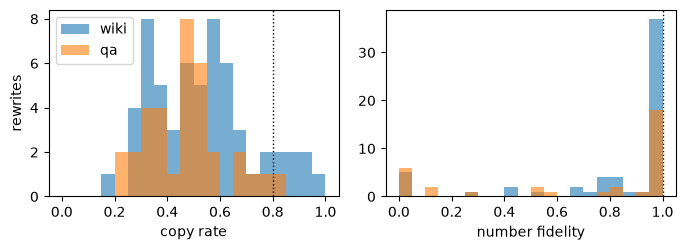
The two styles behave differently. The encyclopedia style is well behaved: all but about one of the 60 replies are kept, and the rewrites are about as long as their sources. The conversations are longer than their sources. About a quarter of them ran out of the 512 new tokens before they ended, and with those that fell outside the length range, only a little over half survive. These counts come from one sampled run, and on other hardware they move by a few. A style that expands its source needs a larger budget than one that restates it, and no prompt can change that.
The histograms show what the flags see. Copy rates spread from about 0.2 to 1. The near-copies above 0.8 include chunks with little to rewrite, such as the one-sentence medical disclaimer printed above. Number fidelity is 1 for about three in five of the encyclopedia rewrites and for about half of the conversations. The rewrite with the lowest copy rate turns a blog post about ghee into an encyclopedia entry and drops its notice about affiliate links, which is what we want from a rewrite. It also scores 0 on number fidelity, and only reading it can tell whether a fact was lost. Cheap checks are alarms, not verdicts.
20.5.2.1 Generating from Seeds
Rewriting is bound to its source. Generation from a seed is its freer relative: the source only supplies a topic, and the model writes a new text about it. Cosmopedia, over 25 billion tokens written by Mixtral-8x7B-Instruct and released under Apache-2.0, is the best-documented example. Its prompts turn three knobs: a seed text (a web page, a course outline, a textbook passage), a format (a textbook, a blog post, a story) and an audience (young children, college students, researchers). Its dataset card states the reason: varying the audience and the style of the prompt raises the diversity of the output. We print three of its rows and then test the claim on a small scale. From the opening’s chunk as seed we generate nine texts with one plain prompt and nine with three formats times three audiences, and compare both with the nine rephrasings of the opening. Each output is cut to the length of the shortest, because the share of distinct n-grams falls as texts grow longer. Diversity is measured twice, by distinct 4-grams and by the mean Jaccard similarity of the word 5-gram sets of all pairs, which is the measure of near-duplication of Section 20.3.
COSMO_FILES = {  # first file of each configuration, at the pinned revision
    'web_samples_v2': 'data/web_samples_v2/train-00000-of-00118.parquet',
    'stanford': 'data/stanford/train-00000-of-00013.parquet',
    'stories': 'data/stories/train-00000-of-00043.parquet'}
COSMO_ROWS = None if RESULTS is None else RESULTS['cosmopedia']
if 'synth-arms' in RERUN:  # registered with the results of the runs
    _, repo, rev, _ = d2l.LM_DATA_SOURCES['cosmopedia']
    COSMO_ROWS = [dict(config=c, row=0, **{
        col: d2l.lm_hub_rows(repo, path, rev, 0, 1, col)[0][0]
        for col in ('format', 'audience', 'seed_data', 'text_token_length')},
                       text=d2l.lm_hub_rows(repo, path, rev, 0, 1)[0][0][:200])
                  for c, path in COSMO_FILES.items()]
if COSMO_ROWS is None:
    say(f'Cosmopedia rows: registered with {RES_KEY} (pending)')
else:
    for r in COSMO_ROWS:
        say(f'cosmopedia/{r["config"]} row {r["row"]}: format '
            f'{r["format"]!r}, audience {r["audience"]!r}, seed data '
            f'{r["seed_data"]!r}, {r["text_token_length"]} tokens:')
        say('  ', repr(r['text'][:200]))
    say('Cosmopedia (HuggingFaceTB/cosmopedia, Apache-2.0)')
FORMATS = ('textbook section', 'blog post', 'short story')
AUDIENCES = ('young children', 'high-school students', 'professionals')
COSMO_STYLE = ('Write a {fmt} for {aud} about the topic of the extract '
               'below. Use your own words and examples; do not copy the '
               'extract.\n\nExtract:\n{{text}}')
PLAIN = ('Write a text about the topic of the extract below. Use your own '
         'words and examples; do not copy the extract.\n\nExtract:\n{text}')
styled = [COSMO_STYLE.format(fmt=f, aud=a) for f in FORMATS
          for a in AUDIENCES]
outs = {}
for name, style in (('one plain prompt', [PLAIN] * 9),
                    ('3 formats x 3 audiences', styled)):
    got = d2l.rephrase_docs([OPEN_SRC] * 9, style, model=GEN_MODEL, batch=9,
                            max_new_tokens=SEED_TOKENS, **SAMPLING)
    outs[name] = [r['out'] for r in sorted(list(got) + got.dropped,
                                           key=lambda r: r['index'])]
outs['rephrasings (opening)'] = SAMPLES
K = min(len(d2l.shingles(t, 1)) for v in outs.values() for t in v)
assert K >= MIN_WORDS, f'an output of {K} words: a refusal or an empty reply'
cut = {k: [' '.join(d2l.shingles(t, 1)[:K]) for t in v]
       for k, v in outs.items()}

def mean_jaccard(texts):
    """Mean Jaccard similarity of the word 5-gram sets of all pairs."""
    sets = [set(d2l.shingles(t, 5)) for t in texts]
    return np.mean([d2l.jaccard_exact(a, b)
                    for a, b in itertools.combinations(sets, 2)])

DIVERSITY = pd.DataFrame([dict(setting=k, outputs=len(v),
                               distinct_4=d2l.distinct_n(v, 4),
                               jaccard_5=mean_jaccard(v))
                          for k, v in cut.items()])
say(f'\none seed ({OPEN["chunk_id"]}), every output cut to its first {K} '
    f'words, temperature {SAMPLING["temperature"]}:')
print(DIVERSITY.round(3).to_string(index=False))
gain = DIVERSITY.distinct_4[1] - DIVERSITY.distinct_4[0]
say('conditioning on format and audience', 'raises distinct 4-grams by '
    f'{gain:.3f}' if gain >= 0.02 else 'lowers distinct 4-grams by '
    f'{-gain:.3f}' if gain <= -0.02 else
    f'leaves distinct 4-grams about equal ({gain:+.3f})')
for k in ('one plain prompt', '3 formats x 3 audiences'):
    say(f'{k}, first output:', textwrap.shorten(outs[k][0], 160))
cosmopedia/web_samples_v2 row 0: format 'textbook_academic_tone', audience 'college_students', seed
data 'web_samples_v2', 726 tokens:
' Behavior Change Communication (BCC) is a strategic approach that uses various forms of
communication to bring about positive changes in knowledge, attitudes, and practices among
individuals and commu'
cosmopedia/stanford row 0: format 'textbook_narrative', audience 'researchers', seed data
'stanford', 527 tokens:
' 1.1 Overview of the Course\n\nIn this comprehensive textbook, we delve into the lives and
achievements of ten influential French women who left indelible marks on history. Our focus
extends beyond mere'
cosmopedia/stories row 0: format 'story_children', audience 'young_children', seed data 'ultrachat',
520 tokens:
' Once upon a time, in a village called Kiwiland, there lived two best friends named Kiwi and
Koala. They loved exploring the world around them and learning new things every day! One day,
they stumbled'
Cosmopedia (HuggingFaceTB/cosmopedia, Apache-2.0)
one seed (S1-00008), every output cut to its first 70 words, temperature 0.7:
setting outputs distinct_4 jaccard_5
one plain prompt 9 0.756 0.051
3 formats x 3 audiences 9 0.995 0.000
rephrasings (opening) 9 0.444 0.194
conditioning on format and audience raises distinct 4-grams by 0.239
one plain prompt, first output: To manage severe oral pain, the medical team opted for a
tetracaine-based mouthwash rather than one containing lidocaine. This decision was driven by
[...]
3 formats x 3 audiences, first output: ### **The Magic of Mouthwash for Stomach Pain** Imagine
having a special spray that makes your stomach feel like it's floating on clouds, even when you
[...]The prompt knobs work. Cut to 70 words each, the nine conditioned texts share almost no 4-gram (0.995 distinct, against about 0.76 for the plain prompt), and the mean Jaccard similarity of their pairs is zero to three decimals. All three settings sample at the same temperature, so the gain comes from the prompt alone. The plain prompt already varies more than the rephrasings (about 0.44), because a request to write about a topic leaves the model room that a request to rewrite does not. That room is the point of generation and also its risk. The first conditioned output is a textbook section for young children about “the magic of mouthwash for stomach pain”; the mouthwash of the source treated pain in the mouth. Diversity from the prompt is diversity of form. Whether the content stays true is a separate question, and the generator answers it from its own memory.
20.5.2.2 Checking Generated Text
Sixty live rewrites are too few to train on. The registered corpus holds the encyclopedia-style rewrites of every chunk of S1, S2 and the validation split, generated once with the same prompt, model and sampling settings (the next cell shows how). We load it, verify that its files are what this notebook would write, and ask it the questions that matter at scale. How many rewrites were dropped, and why? How often are numbers kept? Do the rewrites repeat each other more than their sources do? Generators are known to fall back on the same phrasings, and the MinHash of Section 20.3 finds pairs of chunks whose shingle sets have Jaccard similarity above 0.8; we use the bands and rows that suit that threshold for 128 hash values, \((b, r) = (9, 13)\). And did the generator reproduce benchmark items it saw in its own training? A rewrite could bring in contamination that its source never had, so we search sources and rewrites alike for 13-gram hits in the index of GSM8K, ARC-Challenge and MMLU built in the same section.
GEN_ID = dict(  # how the corpus is generated; every row records it
    model_id=REPHRASER, model_revision=d2l.HF_REVISIONS[REPHRASER],
    style='wiki', prompt_sha256=hashlib.sha256(
        d2l.REPHRASE_PROMPTS['wiki'].encode()).hexdigest(),
    max_new_tokens=REGEN_TOKENS, chunk_tokens=CHUNK_TOKENS,
    batch=REGEN_BATCH, **SAMPLING)
NAMES = {('S1', 'src'): 'train_src_S1', ('S1', 'reph'): 'train_reph_S1',
         ('S2', 'src'): 'train_src_S2', ('S2', 'reph'): 'train_reph_S2',
         ('val', 'src'): 'val_src', ('val', 'reph'): 'val_reph'}

def open_corpus(tar):
    """The extracted corpus: its folder, meta.json and rephrase.jsonl;
    extracted afresh whenever the archive's sha1 changed."""
    root, stamp = pathlib.Path(tar).with_suffix(''), None
    with open(tar, 'rb') as f:
        sha1 = hashlib.file_digest(f, 'sha1').hexdigest()
    if (root / '.extracted').exists():
        stamp = (root / '.extracted').read_text()
    if stamp != sha1:  # never extracted, or another archive at this path
        shutil.rmtree(root, ignore_errors=True)
        root.mkdir()
        d2l.extract(str(tar), str(root))
        (root / '.extracted').write_text(sha1)
    with open(root / 'meta.json') as f:
        meta = json.load(f)
    with open(root / 'rephrase.jsonl', encoding='utf-8') as f:
        rows = pd.DataFrame([json.loads(line) for line in f])
    return root, meta, rows

def chunk_tokens(texts):
    """The token file of chunks: each chunk's ids, then the EOS."""
    return np.array([t for ids in d2l._doc_token_ids(TOK, texts)
                     for t in ids + [EOS]], dtype=np.uint16)

def corpus_report(root, meta, rows):
    """Checks and summaries of a rephrased corpus (asserts its files)."""
    kept = rows[rows.kept]
    for k, v in GEN_ID.items():  # made by this notebook's generation
        assert (rows[k] == v).all(), f'the corpus has another {k}'
    assert not rows.out_text.str.contains('<think>|</think>').any()
    assert (rows['drop'] == drop_reason(rows)).all()  # the length rules
    assert (rows.kept == (rows['drop'] == '')).all()
    assert (kept.out_text != '').all()
    table = []
    for (split, kind), name in NAMES.items():
        P = d2l.load_pool(root, name)
        ids = np.asarray(P.ids)
        if kind == 'src':  # the chunks of this notebook's pools, exactly
            want = np.array([t for c in SPLITS[split] for t in c['ids']
                             + [EOS]], dtype=np.uint16)
        else:  # the kept rewrites, tokenized as text
            want = chunk_tokens(kept[kept.split == split].out_text.tolist())
        assert np.array_equal(ids, want), name
        assert int((ids < 32).sum()) == int((ids == EOS).sum()) == P.meta[
            'n_docs']  # no special id inside a chunk
        table.append(dict(file=name, chunks=P.meta['n_docs'],
                          tokens=P.meta['n_tokens'],
                          bytes=P.meta['n_bytes_nfc'],
                          bytes_per_token=round(P.meta['n_bytes_nfc']
                                                / P.meta['n_tokens'], 2)))
    print(pd.DataFrame(table).to_string(index=False))
    for split in SPLITS:
        src, reph = (meta[f'{NAMES[split, k]}.bin']['n_tokens']
                     for k in ('src', 'reph'))
        say(f'{split}: rewrites / sources = {reph / src:.3f} in tokens')
    say(f'kept and dropped of {len(rows):,} chunks (length: out of '
        f'tokens; len_ratio: outside {LEN_RATIO}):')
    print(pd.crosstab(rows['split'], rows['drop'].replace('', 'kept'))
          .reindex(list(SPLITS)).to_string())
    fl = flags(kept)
    print(pd.DataFrame([dict(
        split=s, kept=len(g), copy_rate=g.copy_rate.mean(),
        all_numbers=(g.num_fidelity == 1).mean(),
        len_ratio_median=g.len_ratio.median(), **{
            f'flag_{k}': fl.loc[g.index, k].mean() for k in fl})
        for s, g in kept.groupby('split', sort=False)]).round(3).to_string(
            index=False))
    br = d2l.best_br(128, 0.8)
    assert br == (9, 13)
    dup = {}
    for kind, texts in (('sources', kept.src_text), ('rewrites',
                                                     kept.out_text)):
        sh = [d2l.shingles(t, 5) for t in texts]
        sigs = [d2l.minhash_signature(s) for s in sh]
        pairs, _ = d2l.lsh_candidates(sigs, *br)
        near = [(i, j) for i, j in pairs
                if d2l.jaccard_exact(sh[i], sh[j]) >= 0.8]
        dup[kind] = (len({i for p in near for i in p}) / len(texts),
                     len(near))
    say('near-duplicates (MinHash at (b, r) = (9, 13), verified Jaccard '
        '>= 0.8): ' + '; '.join(f'{k} {r:.2%} of chunks ({n} pairs)'
                                for k, (r, n) in dup.items()))
    index = d2l.NgramIndex(13)
    for it in d2l.benchmark_items():
        index.add(it['text'], it['benchmark'])
    hits = {k: [index.query(t) for t in texts] for k, texts in (
        ('sources', kept.src_text), ('rewrites', kept.out_text))}
    new = [h for h, s in zip(hits['rewrites'], hits['sources'])
           if h and not s]
    say('13-gram hits on GSM8K, ARC-Challenge, MMLU: ' + ', '.join(
      f'{k} {sum(map(bool, v))} chunks' for k, v in hits.items())
        + f'; rewrites with a hit their source lacks: {len(new)} '
        f'{collections.Counter(b for h in new for b, _ in h)}')
    return dict(dup=dup, hits={k: sum(map(bool, v))
                               for k, v in hits.items()})

CORPUS = None  # (folder, meta, rows) of the rephrased corpus
if TAR_KEY in d2l.DATA_HUB:
    CORPUS = open_corpus(d2l.download_keyed(TAR_KEY))
    REPORT = corpus_report(*CORPUS)
    say(ATTRIBUTION)
else:
    say(f'{TAR_KEY} is not registered yet: the regeneration below writes '
        'it')
file chunks tokens bytes bytes_per_token
train_src_S1 6376 2097182 9479945 4.52
train_reph_S1 6165 1921340 9235499 4.81
train_src_S2 6345 2097442 9489100 4.52
train_reph_S2 6116 1913970 9219468 4.82
val_src 1584 524661 2371105 4.52
val_reph 1528 470466 2277176 4.84
S1: rewrites / sources = 0.916 in tokens
S2: rewrites / sources = 0.913 in tokens
val: rewrites / sources = 0.897 in tokens
kept and dropped of 14,305 chunks (length: out of tokens; len_ratio: outside (0.5, 1.5)):
drop kept len_ratio length
split
S1 6165 180 31
S2 6116 192 37
val 1528 47 9
split kept copy_rate all_numbers len_ratio_median flag_copy flag_numbers
S1 6165 0.607 0.700 1.000 0.246 0.300
S2 6116 0.605 0.701 1.000 0.241 0.299
val 1528 0.587 0.690 0.998 0.223 0.310
near-duplicates (MinHash at (b, r) = (9, 13), verified Jaccard >= 0.8): sources 0.03% of chunks (2
pairs); rewrites 0.00% of chunks (0 pairs)
13-gram hits on GSM8K, ARC-Challenge, MMLU: sources 1 chunks, rewrites 0 chunks; rewrites with a hit
their source lacks: 0 Counter()
Source text: FineWeb-Edu (HuggingFaceFW/fineweb-edu, sample-10BT, ODC-By 1.0); rewrites by
Qwen/Qwen3.5-2B (Apache-2.0)Of the 14,305 chunks, 13,809 rewrites are kept: 77 ran out of tokens and 419 fell outside the length range. In characters the median rewrite is as long as its source, yet the rewrites take about 9% fewer tokens. A token of a rewrite covers about 4.8 bytes against 4.5 for the source, a sign of plainer, more common words, which the tokenizer encodes in larger pieces. About 70% of the kept rewrites keep every number, in all three splits alike, and about a quarter have a copy rate above 0.8.
The generator does not repeat itself across chunks. Two pairs of sources are near-duplicates and no pair of rewrites is: at temperature 0.7 with a different source each time, the rewrites stay as distinct as their sources. The repetition of the opening came from nine samples of one prompt, not from one sample each of many prompts. One source chunk hits a benchmark 13-gram and no rewrite does, so the generator added no contamination to this corpus. That has to be checked for every corpus, not assumed.
The corpus was generated by setting D2L_RERUN to reph-s1, reph-s2 and reph-val, at batch 96 on one RTX 4090: about twenty minutes for each training split and six for validation. S1 holds the chunks of the first documents of the pool up to \(2^{21}\) tokens, S2 the next \(2^{21}\), and the validation chunks come from the pool’s validation documents. Each part writes its own rows, and the last one assembles token files, rows and dataset card into one archive.
PARTS = {'reph-s1': 'S1', 'reph-s2': 'S2', 'reph-val': 'val'}
for name in (n for n in PARTS if n in RERUN):
    split = PARTS[name]
    texts, t0 = [TOK.decode(c['ids']) for c in SPLITS[split]], time.time()
    got = d2l.rephrase_docs(texts, 'wiki', model=GEN_MODEL,
                            batch=REGEN_BATCH, max_new_tokens=REGEN_TOKENS,
                            progress=60, **SAMPLING)
    secs = time.time() - t0
    part = sorted(list(got) + got.dropped, key=lambda r: r['index'])
    recs = [dict(chunk_id=SPLITS[split][r['index']]['chunk_id'], split=split,
                 src_doc_id=SPLITS[split][r['index']]['doc_id'],
                 n_src=len(SPLITS[split][r['index']]['ids']),
                 n_out=r['n_out'], finish=r['finish'], src_text=r['src'],
                 out_text=r['out'], **d2l.synth_metrics(r['src'], r['out']),
                 **GEN_ID) for r in part]
    for rec, why in zip(recs, drop_reason(pd.DataFrame(recs))):
        rec.update(drop=str(why), kept=str(why) == '')

    def write_part(path, recs=recs):
        with gzip.GzipFile(path, 'wb', mtime=0) as f:
            f.write(''.join(json.dumps(r, sort_keys=True, ensure_ascii=False)
                            + '\n' for r in recs).encode('utf-8'))

    d2l.lm_save_rerun(ARTIFACTS[name][1], write_part)
    say(f'{name}: {len(texts):,} chunks in {secs / 60:.1f} min, '
        f'{sum(r["n_out"] for r in part) / secs:,.0f} new tokens/s, '
        f'{len(got.dropped)} dropped; {d2l.lm_peak()}')
del GEN_MODEL
d2l.lm_free()

def read_part(name):
    with gzip.open(os.path.join(RERUN_DIR, ARTIFACTS[name][1]), 'rt',
                   encoding='utf-8') as f:
        return [json.loads(line) for line in f]

def write_tar(path):
    """The archive: six token files, meta.json, rephrase.jsonl, README.md;
    byte-identical for identical contents."""
    rows = [r for name in PARTS for r in read_part(name)]
    for r in rows:  # all three parts come from this generation
        assert all(r[k] == v for k, v in GEN_ID.items()), r['chunk_id']
    members, meta = {}, {}
    for (split, kind), name in NAMES.items():
        part = [r for r in rows if r['split'] == split]
        assert len(part) == len(SPLITS[split]), (split, len(part))
        if kind == 'src':
            for r, c in zip(part, SPLITS[split]):
                assert r['chunk_id'] == c['chunk_id']
            ids = np.array([t for c in SPLITS[split] for t in c['ids']
                            + [EOS]], dtype=np.uint16)
            texts = [r['src_text'] for r in part]
        else:
            texts = [r['out_text'] for r in part if r['kept']]
            ids = chunk_tokens(texts)
        data = ids.astype('<u2').tobytes()
        members[f'{name}.bin'] = data
        meta[f'{name}.bin'] = dict(
            split=split, kind=kind, n_tokens=len(ids), n_docs=len(texts),
            n_bytes_nfc=sum(len(t.encode('utf-8')) for t in texts),
            dtype='uint16', eos_id=EOS, vocab_size=len(TOK),
            tokenizer_sha256=d2l.R2_TOKENIZER_SHA256,
            sha256=hashlib.sha256(data).hexdigest(),
            source=WEB.meta['source'], revision=WEB.meta['revision'],
            license='odc-by', generator=None if kind == 'src' else
            f'{REPHRASER}@{d2l.HF_REVISIONS[REPHRASER]}')
    members['meta.json'] = json.dumps(meta, indent=1, sort_keys=True).encode()
    members['rephrase.jsonl'] = ''.join(
        json.dumps(r, sort_keys=True, ensure_ascii=False) + '\n'
        for r in rows).encode('utf-8')
    members['README.md'] = (
        f'# {TAR_KEY}\n\nFineWeb-Edu chunks (HuggingFaceFW/fineweb-edu, '
        f'sample-10BT @ {WEB.meta["revision"][:12]}, ODC-By 1.0) and their '
        f'wiki-style rewrites by {REPHRASER} @ '
        f'{d2l.HF_REVISIONS[REPHRASER][:12]} (Apache-2.0), generated for '
        'Dive into Deep Learning, sec_lm_synthetic_data. Rewrites are '
        'synthetic text; their rights follow the source and the '
        'generator. As the FineWeb-Edu card states, the use of the source '
        "is also subject to Common Crawl's Terms of Use "
        '(https://commoncrawl.org/terms-of-use). Rewrites that ran out of '
        f'tokens or whose length ratio is outside {LEN_RATIO} are kept in '
        'rephrase.jsonl (kept: false, drop: the reason) and left out of '
        'the token files.\n').encode()
    with tarfile.open(path, 'w', format=tarfile.USTAR_FORMAT) as t:
        for name, data in sorted(members.items()):
            info = tarfile.TarInfo(name)
            info.size, info.mtime, info.mode = len(data), 0, 0o644
            t.addfile(info, io.BytesIO(data))

TAR_BUILT = bool(RERUN & set(PARTS)) and all(os.path.exists(os.path.join(
    RERUN_DIR, ARTIFACTS[n][1])) for n in PARTS)
if TAR_BUILT:
    tar = d2l.lm_save_rerun(TAR_FILE, write_tar)
    CORPUS = open_corpus(tar)
    REPORT = corpus_report(*CORPUS)
elif RERUN & set(PARTS):
    say('the archive is assembled once all three parts are written')
Number fidelity catches lost numbers and nothing else. A rewrite can keep every digit and still change a name or add a claim that its source never made, and no string check sees that. A second model can, at a price. Our judge is Qwen3.8-27B, the model that labelled documents in Section 20.2, in a 4-bit build served by vLLM, one server per GPU. It is a much larger model than the rephraser and a different one, so it does not grade its own writing; it is of the same family, though, which is worth keeping in mind. For sixty pairs of S1 it reads source and rewrite and answers one question: does the rewrite state a claim that the source does not support? The answer is a line of JSON that also quotes the first such claim, so that a reader can check every verdict.
The judge reasons before it answers, and we let it. Its replies are greedy, limited to 12,000 new tokens within a context of 16,384, with no separate budget for the reasoning. The verdicts are registered; setting D2L_RERUN to reph-judge regenerates them, with one judge server per GPU.
SYNTH_JUDGE_V2 = (
    'Below are a source text and a rewrite of it.\n\nSource:\n{src}\n\n'
    'Rewrite:\n{out}\n\nDoes the rewrite state any claim (a fact, name, '
    'number, date or relation) that the source does not support? Answer '
    'with one line of JSON and nothing else: {{"answer": "Yes" or "No", '
    '"claim": "<the first unsupported claim, quoted from the rewrite, or '
    'empty>"}}')
JUDGE_SHA = hashlib.sha256(SYNTH_JUDGE_V2.encode()).hexdigest()
JUDGE_PROTOCOL = dict(thinking=True, temperature=0, seed=0,
                      max_tokens=JUDGE_MAX_TOKENS, thinking_budget=None,
                      per_server=JUDGE_PER_SERVER,
                      vllm=d2l.EDU_LABELLER_LOCAL['vllm'])

def judge_pairs(rows):
    """The N_JUDGE kept (source, rewrite) pairs of S1 the judge reads."""
    s1 = rows[(rows.split == 'S1') & rows.kept].reset_index(drop=True)
    return s1.iloc[np.sort(np.random.default_rng(0).choice(
        len(s1), min(N_JUDGE, len(s1)), replace=False))]

def judge_id(pairs):
    """What verdicts on these pairs record: judge, prompt, protocol, pairs."""
    return dict(model=JUDGE, revision=PINS[JUDGE], prompt_sha256=JUDGE_SHA,
                protocol=JUDGE_PROTOCOL, chunk_ids=pairs.chunk_id.tolist(),
                pairs_sha256=d2l.docs_hash(list(zip(
                    pairs.chunk_id, pairs.src_text + '\0' + pairs.out_text))))

def judged(part, pairs):
    """Whether a judge part holds verdicts on exactly these pairs."""
    return part is not None and all(part.get(k) == v
                                    for k, v in judge_id(pairs).items())

S1_PART = os.path.join(RERUN_DIR, ARTIFACTS['reph-s1'][1])
if CORPUS is not None and (TAR_BUILT or not RERUN & set(PARTS)):
    PAIRS = judge_pairs(CORPUS[2])  # the registered or just-built corpus
elif os.path.exists(S1_PART):  # S1 regenerated, the archive not yet built
    PAIRS = judge_pairs(pd.DataFrame(read_part('reph-s1')))
else:
    PAIRS = None
JUDGE_PART = None

def judge_claims(urls, pairs):
    """The judge's answer ('Yes', 'No', or None without a verdict) and the
    claim it names for each (source, rewrite) pair: chat completions with
    thinking on, greedy, at most JUDGE_MAX_TOKENS new tokens and no
    thinking budget. Server k judges pairs k, k + len(urls), ... one at a
    time, so a pair's reply does not depend on the others'."""
    def one(i, url):
        src, out = pairs[i]
        d = d2l._vllm_post(url, '/chat/completions', dict(
            model=JUDGE, temperature=0, seed=0, max_tokens=JUDGE_MAX_TOKENS,
            messages=[{'role': 'user', 'content': SYNTH_JUDGE_V2.format(
                src=src, out=out)}],
            chat_template_kwargs={'enable_thinking': True}), timeout=3600.0)
        c = d['choices'][0]
        text = (c['message'].get('content') or '').split('</think>')[-1]
        try:
            v = json.loads(re.findall(r'\{[^{}]*\}', text)[-1])
            assert v['answer'] in ('Yes', 'No')
        except (IndexError, ValueError, KeyError, TypeError, AssertionError):
            v = dict(answer=None, claim=text[-300:])
        return dict(answer=v['answer'], claim=str(v.get('claim') or ''),
                    finish=c['finish_reason'],
                    tokens=d['usage']['completion_tokens'])

    def serve(k):
        return [(i, one(i, urls[k])) for i in range(k, len(pairs),
                                                    len(urls))]

    with concurrent.futures.ThreadPoolExecutor(len(urls)) as ex:
        got = dict(r for rs in ex.map(serve, range(len(urls))) for r in rs)
    return pd.DataFrame([got[i] for i in range(len(pairs))])

if 'reph-judge' in RERUN:
    assert PAIRS is not None, 'the judge reads the S1 rewrites: reph-s1 first'
    servers, t0 = d2l.edu_label_servers(), time.time()
    try:  # one judge server per GPU of this run
        with concurrent.futures.ThreadPoolExecutor(len(servers)) as ex:
            urls = list(ex.map(lambda s: s.start(), servers))
        say(f'{len(urls)} judge servers ready in {time.time() - t0:.0f} s')
        t0 = time.time()
        got = judge_claims(urls, list(zip(PAIRS.src_text, PAIRS.out_text)))
    finally:
        for s in servers:
            s.stop()
    say(f'judged {len(PAIRS)} pairs in {time.time() - t0:.0f} s; reply '
        f'tokens median {got.tokens.median():.0f}, largest '
        f'{got.tokens.max()}; cut off {(got.finish == "length").sum()}, '
        f'without a verdict {got.answer.isna().sum()}')
    JUDGE_PART = dict(**judge_id(PAIRS), **{  # None for a missing answer
        k: json.loads(got[k].to_json(orient='values')) for k in (
            'answer', 'claim', 'finish', 'tokens')})
    d2l.lm_save_rerun(ARTIFACTS['reph-judge'][1],
                      lambda p: write_json(p, JUDGE_PART))
elif PAIRS is not None:  # a regeneration prefers its own newer file
    found = [('registered results', RESULTS and RESULTS['judge'])]
    path = os.path.join(RERUN_DIR, ARTIFACTS['reph-judge'][1])
    if os.path.exists(path):
        with open(path) as f:
            found.insert(len(found) if not RERUN else 0,
                         ('rerun file', json.load(f)))
    for where, part in found:
        if judged(part, PAIRS):
            JUDGE_PART = part
            break
        if part is not None:
            say(f'the verdicts of the {where} judged other pairs: ignored')
    assert RERUN or RESULTS is None or JUDGE_PART is RESULTS['judge'], (
        'the registered verdicts do not belong to the registered corpus')
if JUDGE_PART is None:
    say(f'judge verdicts: registered with {RES_KEY} (pending)')
else:
    V = PAIRS.assign(answer=JUDGE_PART['answer'], claim=JUDGE_PART['claim'],
                     tokens=JUDGE_PART['tokens']).reset_index(drop=True)
    ok = V.answer.notna().to_numpy()  # the judge gave a verdict
    assert ok.sum() >= len(V) // 2, 'most replies without a verdict'
    say(f'{JUDGE}, thinking, greedy, up to {JUDGE_MAX_TOKENS:,} new tokens '
        f'on {len(V)} S1 pairs: reply tokens median '
        f'{V.tokens.median():,.0f}, largest {V.tokens.max():,}; '
        f'{(~ok).sum()} replies reached the limit before a verdict and are '
        'left out')
    V = V[ok]
    says, lost = (V.answer == 'Yes').to_numpy(), (V.num_fidelity < 1
                                                  ).to_numpy()
    k, n = int(says.sum()), len(says)
    lo, hi = d2l.wilson_ci(k, n)
    say(f'the rewrite adds a claim in {k} of {n} ({k / n:.0%}, Wilson 95% '
        f'[{lo:.0%}, {hi:.0%}])')
    print(pd.crosstab(pd.Series(says, name='judge: adds a claim'),
                      pd.Series(lost, name='a number lost')).to_string())
    say(f'agreement with the number flags: {(says == lost).mean():.0%}')
    named = V[says & ~lost]
    say(f'claims the judge names where every number was kept '
        f'({len(named)} pairs; up to three):')
    for _, r in named.head(3).iterrows():
        say(f'  {r.chunk_id}:', textwrap.shorten(r.claim, 150))
RedHatAI/Qwen3.8-27B-INT4, thinking, greedy, up to 12,000 new tokens on 60 S1 pairs: reply tokens
median 2,778, largest 12,000; 4 replies reached the limit before a verdict and are left out
the rewrite adds a claim in 39 of 56 (70%, Wilson 95% [57%, 80%])
a number lost False True
judge: adds a claim
False 14 3
True 25 14
agreement with the number flags: 50%
claims the judge names where every number was kept (25 pairs; up to three):
S1-00034: The CMS Web Guide is an article
S1-00053: which had been known for years
S1-00106: The United States is increasingly involved in supporting the Sunni revolt in Syria and
the Shia revolt in BahrainThe judge needs that room. Its median reply is about 2,800 tokens, most of them reasoning, so a budget of a thousand reasoning tokens would have stopped most of them part way through the argument. Even at 12,000 tokens, 4 of the 60 replies ended without a verdict. They are left out, and the rate is computed on the other 56.
By the judge, the rewrite adds a claim in 39 of 56 pairs: 70%, with a 95% interval from 57% to 80%. Many of the added claims are small. One rewrite calls the CMS Web Guide “an article”, another says that something “had been known for years”. Others are not small, such as a sentence about the United States supporting a revolt in Syria and another in Bahrain. The judge reads strictly, and no person has checked its verdicts, so 70% is the rate that one strict reader with one prompt reports, not a measured error rate. By that reading, a rephraser of two billion parameters, told to add nothing, adds something most of the time.
The judge and the number check agree on only half of the pairs. In 25 pairs every number was kept and the judge still found an added claim; in 3, a number was lost and the judge found nothing to object to. These are not contradictions. The number check asks what was lost, the judge what was added, and the lost numbers include harmless rewritings such as “thirty”. Neither check is the truth. A pipeline at scale would run the cheap one on every row and the expensive one on a sample, and publish both rates with the data.
20.5.3 Equal Budgets and Fair Accounting
Now the question of the opening: what does rephrased text do to a model trained on it? To answer it we fix the budget and vary only the data. Every run trains the same proxy model for \(2^{24}\) tokens, and five arms fill those tokens differently:
- A, real text repeated: S1 read eight times;
- B, S1 and its rewrites, each read about four times, which is the WRAP recipe applied to a fixed source;
- C, the rewrites of S1 alone, read for the whole budget (they are shorter than S1, so almost nine times);
- D, fresh real text: \(2^{24}\) tokens of the pool read once, the reference for what more real data would give;
- E, S1 and the rewrites of the other split S2, each read about four times: new information, but in rephrased form.
Every pool, D’s included, consists of chunks with an end-of-text token after each, so all arms see text cut the same way.
Before any run, the law of repeated data of Section 20.4.1.1 limits what B can gain over A. For \(U\) unique tokens read for \(E\) epochs it counts
\[ D'(U, E) = U + U R^* \bigl(1 - e^{-(E - 1)/R^*}\bigr), \qquad R^* \approx 15.4, \]
effective tokens: repeats count almost fully for a few epochs and less and less after that. If the rewrites teach nothing beyond their source, B is worth A’s eight epochs of \(U\). If they were as good as fresh text, B would be worth two sources of size \(U\) read four times each. So
\[ D'(U, 8) \le D'_B \le D'(2U, 4). \tag{20.5.1}\]
The lower bound assumes that a varied surface never hurts. The upper bound says that a rewrite can be no better than a new document of the same size, since it adds no facts. Both use a constant that Muennighoff and colleagues fitted in another setting (Muennighoff et al. 2023), so they are a reference line, not a prediction.
lo, hi = float(d2l.effective_tokens(1, 8)), 2 * float(
    d2l.effective_tokens(1, 4))
assert abs(lo - 6.62) < 0.01 and abs(hi - 7.45) < 0.01
say(f"D'(U, 8) = {lo:.3f} U <= D'_B <= D'(2U, 4) = {hi:.3f} U: B can gain "
    f'at most {hi / lo - 1:.1%} effective tokens over A')
if CORPUS is not None:
    m = CORPUS[1]
    u_s, u_r = (m[f'{NAMES["S1", k]}.bin']['n_tokens'] for k in ('src',
                                                                  'reph'))
    lo_m = float(d2l.effective_tokens(u_s, TOKENS / u_s))
    hi_m = float(d2l.effective_tokens(u_s, TOKENS / 2 / u_s)
                 + d2l.effective_tokens(u_r, TOKENS / 2 / u_r))
    say(f'measured: S1 {u_s:,} tokens, its rewrites {u_r:,}; in units of '
        f"S1: D'_A = {lo_m / u_s:.2f}, the upper bound for B "
        f'{hi_m / u_s:.2f} ({hi_m / lo_m - 1:.1%})')
D'(U, 8) = 6.625 U <= D'_B <= D'(2U, 4) = 7.452 U: B can gain at most 12.5% effective tokens over A
measured: S1 2,097,182 tokens, its rewrites 1,921,340; in units of S1: D'_A = 6.62, the upper bound
for B 7.41 (11.9%)Eight epochs of \(U\) are worth \(6.62\,U\) and the upper bound is \(7.45\,U\), so B can gain at most 12.5% in effective tokens over A; with the measured size of the rewrites, 8% shorter than S1, the margin is 11.9%. How large a difference in loss is that? Arm D will give a scale. It holds about a fifth more effective tokens than A, and B’s best case is a little over half of that. Three seeds per arm may well not resolve a gain of this size, and we say so before training rather than after. A design with a smaller source read more often leaves B far more room at the same cost, and exercise 8 works it out.
20.5.3.1 The Five Arms
The arms become inputs of train_proxy_lm: a dictionary of pools and their weights. The training stream reads each pool’s windows in epochs, one after another, each a fresh permutation (Section 20.4), which is the reading that the law assumes. Rewriting changes length, so arms with equal tokens differ slightly in epochs. The table prints for each pool its unique tokens, its windows per epoch, the epochs read and the effective tokens.
ARM_DESC = {'A': 'real S1, repeated', 'B': 'S1 + rewrites of S1',
            'C': 'rewrites of S1 only', 'D': 'fresh real text',
            'E': 'S1 + rewrites of S2'}
ROOT = CORPUS[0]
POOL = {n: d2l.load_pool(ROOT, n) for n in (
    'train_src_S1', 'train_reph_S1', 'train_reph_S2', 'val_reph')}
S1P, R1P, R2P = (POOL[n] for n in ('train_src_S1', 'train_reph_S1',
                                   'train_reph_S2'))

def chunked(docs, n):
    """The first n tokens of the documents' chunks, each chunk followed by
    its EOS, as in S1's pool and the rewrites' pools."""
    out, total = [], 0
    for _, ids in docs:
        for c in d2l.chunk_doc(ids, TOK, CHUNK_TOKENS):
            out.append(np.array(c + [EOS], dtype=np.uint16))
            total += len(c) + 1
            if total >= n:
                return np.concatenate(out)[:n]
    raise ValueError(f'fewer than {n} tokens in the pool')

FRESH_IDS = chunked(DOCS, TOKENS + 1)  # one epoch, EOS placed as in A-C, E
assert np.array_equal(FRESH_IDS[:len(S1P.ids)], S1P.ids)  # D starts with S1
FRESH = d2l.TokenPool(FRESH_IDS, dict(WEB.meta, n_tokens=TOKENS + 1))
ARM_POOLS = {'A': {'real': S1P}, 'B': {'real': S1P, 'reph': R1P},
             'C': {'reph': R1P}, 'D': {'real': FRESH},
             'E': {'real': S1P, 'reph': R2P}}
ARM_WEIGHTS = {a: {d: 1 / len(p) for d in p} for a, p in ARM_POOLS.items()}
cfg, rows, MAX_EPOCHS = PROXY_SMALL, [], {}
for a, pools in ARM_POOLS.items():
    s = d2l._ProxyStream(pools, ARM_WEIGHTS[a], TOKENS, cfg.seq_len,
                         cfg.batch, 0, None, max_epochs=10**6)
    assert s.steps * cfg.batch * cfg.seq_len == TOKENS  # equal budgets
    MAX_EPOCHS[a] = math.ceil(max(s.epochs.values()) - 1e-9)
    assert MAX_EPOCHS[a] <= 2 * EPOCHS, f'{a}: a pool is far too short'
    for d, P in pools.items():
        n = len(P.ids)
        rows.append(dict(arm=a, arm_is=ARM_DESC[a], pool=d,
                         unique_tokens=n, windows=s.windows[s.names.index(d)],
                         epochs=s.epochs[d],
                         effective=float(d2l.effective_tokens(n, s.epochs[
                             d]))))
ARM_BUILD = pd.DataFrame(rows)
steps = TOKENS // (cfg.batch * cfg.seq_len)
say(f'{TAG} {TOKENS:,} trained tokens per arm ({steps} steps of '
    f'{cfg.batch} x {cfg.seq_len}):')
print(ARM_BUILD.round(3).to_string(index=False))
assert abs(ARM_BUILD.epochs[0] - EPOCHS) < 0.01  # A reads S1 eight times
[at T1 scale (8.1M-parameter proxies, 2^24 tokens per run)] 16,777,216 trained tokens per arm (256
steps of 64 x 1024):
arm arm_is pool unique_tokens windows epochs effective
A real S1, repeated real 2097182 2048 8.000 13893954.795
B S1 + rewrites of S1 real 2097182 2048 4.000 7813843.272
B S1 + rewrites of S1 reph 1921340 1876 4.367 7731732.239
C rewrites of S1 only reph 1921340 1876 8.733 13602529.423
D fresh real text real 16777217 16384 1.000 16777217.000
E S1 + rewrites of S2 real 2097182 2048 4.000 7813843.272
E S1 + rewrites of S2 reph 1913970 1869 4.383 7727216.673All arms train on 16,777,216 tokens. A reads S1 exactly eight times, C reads the shorter rewrites 8.7 times, and B and E read rewrites 4.4 times beside four passes over S1. Counted by the law, B and E hold about 15.5 million effective tokens against A’s 13.9 million. That is the upper bound of Equation 20.5.1, since the table counts rewrites as if they were fresh text.
Each arm trains with three data-order seeds. The recipe is that of Section 20.4, with its peak learning rate and a cosine schedule, and with two changes. The model is the wider proxy of 8.1 million parameters, 6.3 million of them in its embedding table. And the warmup lasts 10% of the steps instead of 2%, because at the learning rate chosen in that section the wider model trains less steadily with only five warmup steps. The warmup was fixed before any arm was compared, all five arms share it, and exercise 9 measures what it changes. Each run is evaluated in bits per byte on two sets, the held-out real documents of the pool and the rewrites of the same documents, at a quarter, half, three quarters and the end of training. A normal build reads the registered runs and retrains the first million tokens of arm A as a live check; training all fifteen runs (D2L_RERUN=synth-arms) takes ten to fifteen minutes on one GPU.
with open(d2l.lm_artifact('lm-mix-runs-t1-v1')) as f:
    LR = json.load(f)['lr_choice']['chosen']
CFG = PROXY_SMALL._replace(lr=LR)
EVAL_SETS = {'real': VAL, 'reph': POOL['val_reph']}
BYTE_LEN = d2l.token_byte_lengths(TOK)
CONFIG = json.loads(json.dumps(dict(
    proxy=CFG._asdict(), tokens=TOKENS, U=U, val_U=VAL_U, seeds=SEEDS,
    eval_at=EVAL_AT, log_every=LOG_EVERY, weights=ARM_WEIGHTS,
    max_epochs=MAX_EPOCHS, lr_from='lm-mix-runs-t1-v1',
    fresh='chunks of the web pool, EOS per chunk')))
CORPUS_SHA = {k: v['sha256'] for k, v in CORPUS[1].items()}

def run_arm(arm, seed, **kw):
    return d2l.train_proxy_lm(
        ARM_POOLS[arm], ARM_WEIGHTS[arm], TOKENS, CFG, seed=seed,
        eval_sets=EVAL_SETS, log_every=LOG_EVERY,
        max_epochs=MAX_EPOCHS[arm], eval_at=EVAL_AT, byte_lengths=BYTE_LEN,
        **kw)

if 'synth-arms' in RERUN:
    assert judged(JUDGE_PART, judge_pairs(CORPUS[2])), (
        'the results hold the verdicts on this corpus: reph-judge first')
    assert COSMO_ROWS is not None
    runs, t0 = [], time.time()
    for arm in ARM_POOLS:
        for seed in SEEDS:
            out = run_arm(arm, seed)
            runs.append(dict(run_id=f'{arm}-s{seed}', arm=arm, seed=seed,
                             **out))
            say(f'{arm}-s{seed}: real {out["final"]["real"]["bpb"]:.4f}, '
                f'rephrased {out["final"]["reph"]["bpb"]:.4f} bits per '
                f'byte, {out["throughput"]:,.0f} tokens/s, '
                f'{(time.time() - t0) / 60:.1f} min in all')
    res = dict(schema='d2l-synth-results/1', tier=TIER, config=CONFIG,
               corpus=CORPUS_SHA, pools=dict(web=WEB.meta['sha256'],
                                             val=VAL.meta['sha256']),
               runs=runs, judge=JUDGE_PART, cosmopedia=COSMO_ROWS,
               environment=dict(torch=torch.__version__, device=(
                   torch.cuda.get_device_name() if torch.cuda.is_available()
                   else 'cpu')))
    d2l.lm_save_rerun(ARTIFACTS['synth-arms'][1],
                      lambda p: write_json(p, res))
RES_PATH = d2l.lm_artifact(RES_KEY, ARTIFACTS['synth-arms'][1]
                           if 'synth-arms' in RERUN else None)
with open(RES_PATH) as f:
    RESULTS = json.load(f)
assert RESULTS['config'] == CONFIG, 'the runs had another configuration'
assert RESULTS['corpus'] == CORPUS_SHA and RESULTS['pools'] == dict(
    web=WEB.meta['sha256'], val=VAL.meta['sha256'])
assert judged(RESULTS['judge'], judge_pairs(CORPUS[2]))
REC = {r['run_id']: r for r in RESULTS['runs']}
assert list(REC) == [f'{a}-s{s}' for a in ARM_POOLS for s in SEEDS]
if GPU and not RERUN:
    live = run_arm('A', 0, stop_tokens=LIVE_TOKENS)
    logged = {s: l for s, _, l, _ in REC['A-s0']['log']}
    diff = max(abs(l - logged[s]) for s, _, l, _ in live['log'])
    say(TAG, f'arm A, seed 0, steps {LOG_EVERY}-{live["log"][-1][0]}: '
        f'largest difference from the registered losses {diff:.4f} nats '
        '(bf16; tolerance 0.02)')
    assert diff <= 0.02
else:
    say('live check skipped:', 'no GPU' if not GPU else
        'this run regenerates')
[at T1 scale (8.1M-parameter proxies, 2^24 tokens per run)] arm A, seed 0, steps 4-16: largest
difference from the registered losses 0.0002 nats (bf16; tolerance 0.02)20.5.3.2 Real and Rephrased Validation
The live check matches the registered losses to within 0.001 nats. A difference between two arms counts only if all three seed-paired differences have the same sign and their mean exceeds twice the pooled standard deviation of the seeds, estimated from all fifteen runs with ten degrees of freedom. Otherwise we write “no difference detected at this scale”. The plot below shows the three runs of each arm and their mean on both validation sets, with a band of two standard deviations around arm A, and in its third panel the real-validation curves of A, B and D with the boundaries of A’s epochs.
ARMS = list(ARM_POOLS)
BPB = {v: {a: np.array([REC[f'{a}-s{s}']['final'][v]['bpb'] for s in SEEDS])
           for a in ARMS} for v in EVAL_SETS}
SIGMA = {v: math.sqrt(np.mean([b[a].var(ddof=1) for a in ARMS]))
         for v, b in BPB.items()}  # pooled within-arm seed SD, 10 df

def verdict(x, y, v):
    """Seed-paired y - x on validation set v, and whether it is real."""
    d = BPB[v][y] - BPB[v][x]
    real = len(set(np.sign(d))) == 1 and abs(d.mean()) > 2 * SIGMA[v]
    return d, real

rows = []  # (x, y, validation set, claim, the sign of y - x it claims)
for x, y, v, claim, sign in (
        ('A', 'B', 'real', 'C3: B beats A', -1),
        ('C', 'B', 'real', 'C3b: B beats C', -1),
        ('B', 'E', 'real', 'C5: E beats B', -1),
        ('A', 'C', 'real', 'C4: C loses to A', 1),
        ('A', 'C', 'reph', 'C4: C wins on rewrites', -1)):
    d, real = verdict(x, y, v)
    rows.append(dict(claim=claim, difference=f'{y} - {x}', val=v,
                     diffs=np.round(d, 4).tolist(), mean=d.mean(),
                     real=real, holds=real and np.sign(d.mean()) == sign))
VERDICTS = pd.DataFrame(rows)
say(TAG, 'pooled seed SD of bits per byte: real '
    f'{SIGMA["real"]:.4f}, rephrased {SIGMA["reph"]:.4f} (10 df)')
print(VERDICTS.round(4).to_string(index=False))
for _, r in VERDICTS.iterrows():
    say(f'  {r.claim}: ' + ('holds' if r.holds else
                            'no difference detected at this scale'
                            if not r.real else 'the opposite holds'))
best = min(ARMS, key=lambda a: BPB['real'][a].mean())
say('lowest real-validation bits per byte: arm', best, '(D, fresh text, '
    'is the reference bound)' if best == 'D' else
    '(not D: a bug to look for, not a result)')
assert best == 'D' or RERUN, 'D is not best on real validation: a bug'
fig, axes = d2l.plt.subplots(1, 3, figsize=(11, 3))
for ax, v, name in zip(axes, EVAL_SETS, ('real validation',
                                         'rephrased validation')):
    m = [BPB[v][a].mean() for a in ARMS]
    d2l.plot_intervals(ARMS, {'mean': (m, m, m)}, 'arm',
                       f'{name}, bits per byte', axes=ax,
                       reference=BPB[v]['A'].mean(), marks={'seeds': (
                           '.', {'mean': (np.repeat(np.arange(len(ARMS)),
                                                    len(SEEDS)),
                                          np.concatenate([BPB[v][a] for a
                                                          in ARMS]))})})
    ax.axhspan(BPB[v]['A'].mean() - 2 * SIGMA[v],
               BPB[v]['A'].mean() + 2 * SIGMA[v], color='0.85', zorder=0)
curve = lambda a: np.mean([[e['domains']['real']['bpb'] for e in REC[
    f'{a}-s{s}']['evals']] for s in SEEDS], 0)
x = [e['tokens'] for e in REC['A-s0']['evals']]
d2l.plot(x, [curve(a) for a in 'ABD'], 'tokens',
         'real validation, bits per byte', legend=[
             f'{a}: {ARM_DESC[a]}' for a in 'ABD'], axes=axes[2])
per_step = CFG.batch * CFG.seq_len
for s in REC['A-s0']['epoch_starts']['real'][1:]:  # A's repeats begin
    axes[2].axvline(s * per_step, color='black', linestyle=':', linewidth=1)
fig.tight_layout()
ARM_TABLE = pd.DataFrame([dict(  # tokens in millions
    arm=a, unique_M=ARM_BUILD[ARM_BUILD.arm == a].unique_tokens.sum() / 1e6,
    effective_M=ARM_BUILD[ARM_BUILD.arm == a].effective.sum() / 1e6,
    real=BPB['real'][a].mean(), real_seeds=np.round(BPB['real'][a], 4)
    .tolist(), reph=BPB['reph'][a].mean(),
    reph_seeds=np.round(BPB['reph'][a], 4).tolist()) for a in ARMS])
say(TAG, 'bits per byte (mean and the three seeds; arms as above):')
print(ARM_TABLE.round(4).to_string(index=False))
[at T1 scale (8.1M-parameter proxies, 2^24 tokens per run)] pooled seed SD of bits per byte: real
0.0069, rephrased 0.0070 (10 df)
claim difference val diffs mean real holds
C3: B beats A B - A real [0.013, -0.0011, -0.0063] 0.0019 False False
C3b: B beats C B - C real [-0.0589, -0.0739, -0.0587] -0.0638 True True
C5: E beats B E - B real [-0.011, -0.0101, -0.007] -0.0094 False False
C4: C loses to A C - A real [0.072, 0.0728, 0.0524] 0.0657 True True
C4: C wins on rewrites C - A reph [-0.0562, -0.0545, -0.0769] -0.0625 True True
C3: B beats A: no difference detected at this scale
C3b: B beats C: holds
C5: E beats B: no difference detected at this scale
C4: C loses to A: holds
C4: C wins on rewrites: holds
lowest real-validation bits per byte: arm D (D, fresh text, is the reference bound)
[at T1 scale (8.1M-parameter proxies, 2^24 tokens per run)] bits per byte (mean and the three seeds;
arms as above):
arm unique_M effective_M real real_seeds reph reph_seeds
A 2.0972 13.8940 1.9235 [1.9173, 1.927, 1.9261] 1.8043 [1.7978, 1.808, 1.8069]
B 4.0185 15.5456 1.9254 [1.9304, 1.926, 1.9198] 1.7582 [1.7622, 1.7602, 1.7521]
C 1.9213 13.6025 1.9892 [1.9893, 1.9999, 1.9785] 1.7417 [1.7416, 1.7535, 1.7301]
D 16.7772 16.7772 1.8899 [1.89, 1.8823, 1.8975] 1.7739 [1.7744, 1.7676, 1.7797]
E 4.0112 15.5411 1.9160 [1.9193, 1.9159, 1.9128] 1.7506 [1.754, 1.7503, 1.7475]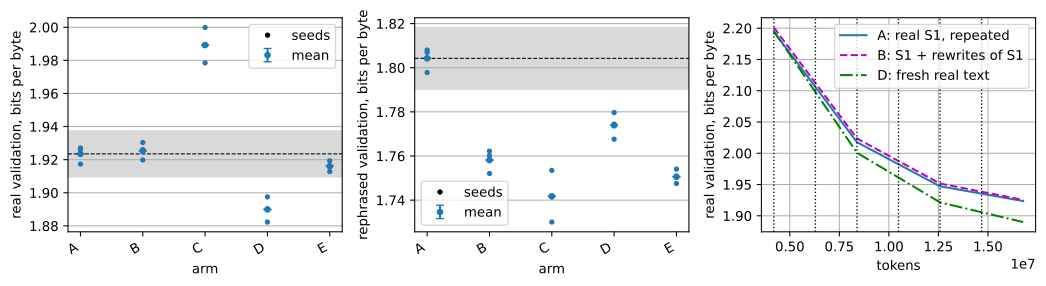
The seeds agree closely, to about 0.007 bits per byte on both sets, so differences above 0.014 are resolved. Read the first panel first. At T1 scale (8.1M-parameter proxies, \(2^{24}\) tokens), fresh text is best, as it must be: arm D is lower than A by about 0.03. Arm B is not lower than A at all. The mean difference is 0.002, and the seeds disagree on its sign: no difference detected at this scale. The rewrites of the same chunks added nothing measurable. A null result was what the bound made likely, but even its best case, a little over half of D’s gain, would have been near the edge of what three seeds resolve, and we did not see it.
The rewrites alone are a different matter. At T1 scale (8.1M-parameter proxies, \(2^{24}\) tokens), arm C loses to A on real validation by about 0.07 bits per byte, and on rephrased validation it wins by about 0.06. The second panel shows the reversal: on rewrites every arm beats A, those that read rewrites (B, C and E) by more than fresh text does, and C most of all. Recall from Section 3.6 that a model trained on samples of one distribution and tested on another is subject to distribution shift. Training on a generator’s output moves the training distribution toward the generator’s: a model that has read the rephraser’s style finds that style easy, and a model that has read nothing else is worse at the web. Had we evaluated only on rewrites, C would be the best arm in the table. This is the second half of WRAP’s explanation at work: style that matches the evaluation helps the evaluation, whatever it does for other text.
Mixing repairs most of the damage. At T1 scale (8.1M-parameter proxies, \(2^{24}\) tokens), B beats C on real validation by about 0.06, in every seed. Arm E, new information in rephrased form, ends below B in the table but by less than the threshold: no difference detected at this scale.
Did rephrasing behave as WRAP reports? On the kind of text where WRAP measured, it did. Arm B gains on rephrased validation, text in a style other than the source’s, where it beats A by about 0.05 bits per byte, more than fresh text does. WRAP’s perplexity result is likewise reported on text other than its C4 source, subsets of the Pile, and its own explanation, that the rewrites’ styles are closer to the evaluation text, predicts this pattern. On held-out text of the source distribution, where WRAP made no claim, the rewrites of the same chunks added nothing measurable. There was also little to gain at our scale: the bound allows 12% more effective tokens, and the curves of A and B in the third panel lie on top of each other from the first evaluation to the last, while D pulls away. Whether rewrites help more on a noisier source than FineWeb-Edu, the first half of WRAP’s explanation, this comparison does not test. What carries over to any scale is the protocol: equal tokens, both validation sets, a noise threshold fixed in advance and a bound computed before the runs. A claim that synthetic data helps should come with all four.
20.5.4 Recursive Training and Collapse
So far a generator trained on human text wrote data for a model that also read human text. As generated text spreads over the web, future crawls will contain the output of earlier models, and future models will learn from it. Shumailov and colleagues (2023) asked what happens when this repeats, each model trained on the output of its predecessor, and called the result the curse of recursion. The rare events of the original distribution vanish first, and the models converge to something narrower than the data they started from.
The smallest model of the process is a Gaussian. Generation 0 is the true distribution \(\mathcal{N}(\mu, \sigma^2)\). Fit \(t\) draws \(n\) points from fit \(t - 1\) and estimates their mean \(\hat\mu_t\) and variance \(\hat\sigma_t^2\) by maximum likelihood. In replace mode it uses only those \(n\) points; in accumulate mode it uses all points drawn so far. With \(q = (n - 1)/n\), the two modes give
\[ \begin{aligned} \textrm{replace:}\quad & \mathbb{E}[\hat\sigma_T^2] = q^T \sigma^2, \qquad \operatorname{Var}(\hat\mu_T) = \sigma^2 (1 - q^T),\\ \textrm{accumulate:}\quad & \operatorname{Var}(\hat\mu_T) \approx \frac{\sigma^2}{n} \sum_{t=1}^{T} \frac{1}{t^2} < \frac{\pi^2}{6}\,\frac{\sigma^2}{n}. \end{aligned} \tag{20.5.2}\]
The derivation takes three steps. First, the maximum-likelihood variance of \(n\) points is biased low by the factor \(q\), \(\mathbb{E}[\hat\sigma_t^2 \mid \hat\sigma_{t-1}^2] = q\, \hat\sigma_{t-1}^2\), and the factors multiply over the generations. Second, the mean takes a random step at each generation, \(\hat\mu_t = \hat\mu_{t-1} + \hat\sigma_{t-1} z_t / \sqrt{n}\) with \(z_t\) standard normal and independent of the past, so its variance is the sum of the step variances, \(\sum_{t=1}^{T} q^{t-1} \sigma^2 / n = \sigma^2 (1 - q^T)\). Third, under accumulation the \(n\) new points are only a share \(1/t\) of the \(nt\) points behind fit \(t\), so the step shrinks to \(\hat\sigma_{t-1} z_t / (t \sqrt{n})\); with \(\hat\sigma_{t-1} \approx \sigma\) the step variances \(\sigma^2 / (n t^2)\) have a finite sum.
The formulas describe two different fates. Under replacement the fitted spread shrinks by 1% per generation for \(n = 100\) while the mean wanders, so after many generations the model is a narrow distribution around a point drawn at random from the original one. Under accumulation the mean stays within the error of the first fit, and the spread stays near the truth. The simulator below fits by maximum likelihood exactly as described.
def collapse_sim(n, generations, mode='replace', reps=1000, seed=0, mu=0.0,
                 sigma=1.0):
    """The Gaussian refit: generation 0 is N(mu, sigma^2); fit t (t >= 1)
    fits (mu, sigma^2) by maximum likelihood to the n points just sampled
    from fit t - 1 ('replace') or to all points sampled so far
    ('accumulate'). Returns, per generation 0..generations over reps
    repetitions, the mean of mu_t, its variance var_mu, the mean of
    sigma_t^2 and the Monte-Carlo standard errors se_var_mu, se_sigma2."""
    if mode not in ('replace', 'accumulate'):
        raise ValueError(f'unknown mode {mode!r}')
    rng = np.random.default_rng(seed)
    M, S = np.zeros((generations + 1, reps)), np.zeros((generations + 1,
                                                        reps))
    M[0], S[0] = mu, sigma**2
    total = np.zeros(reps), np.zeros(reps), 0  # sum, sum of squares, count
    for t in range(1, generations + 1):
        x = rng.normal(M[t - 1][:, None], np.sqrt(S[t - 1])[:, None],
                       (reps, n))
        s1, s2, k = x.sum(1), (x**2).sum(1), n
        if mode == 'accumulate':
            total = total[0] + s1, total[1] + s2, total[2] + n
            s1, s2, k = total
        M[t] = s1 / k
        S[t] = np.maximum(s2 / k - M[t]**2, 0)
    dev = M - M.mean(1, keepdims=True)
    var = (dev**2).mean(1) * reps / (reps - 1)
    m4 = (dev**4).mean(1)
    return dict(mean=M.mean(1), var_mu=var, mean_sigma2=S.mean(1),
                se_var_mu=np.sqrt(np.maximum(m4 - var**2, 0) / reps),
                se_sigma2=S.std(1, ddof=1) / math.sqrt(reps))
We check the closed forms at \(n = 100\) over 20 generations and 1,000 repetitions, and then move to text. The discrete toy takes 200,000 words of the web pool and fits a bigram model over the 20,000 most frequent words plus a token for all others. Each generation samples a corpus of the same size from the fitted model and refits, on that corpus alone (replace) or on all corpora so far (accumulate). We track the word types that the fitted model can still emit, and what happens to the rarest tenth of the original types: how many survive and how much probability they hold.
n, T, reps = 100, 20, 1000
SIM = {mode: d2l.collapse_sim(n, T, mode, reps, seed=0)
       for mode in ('replace', 'accumulate')}
q, t = (n - 1) / n, np.arange(T + 1)
r, acc = SIM['replace'], SIM['accumulate']
z_s = abs(r['mean_sigma2'][T] - q**T) / r['se_sigma2'][T]
z_m = abs(r['var_mu'][T] - (1 - q**T)) / r['se_var_mu'][T]
partial = np.r_[0, np.cumsum(1 / np.arange(1, T + 1)**2)] / n
bound = math.pi**2 / 6 / n
assert z_s < 3 and z_m < 3
assert acc['var_mu'][T] < bound + 3 * acc['se_var_mu'][T]
say(f'replace, T = {T}: E[sigma^2] {r["mean_sigma2"][T]:.4f} (closed form '
    f'q^T = {q**T:.4f}, {z_s:.1f} SE), Var(mu) {r["var_mu"][T]:.4f} '
    f'(1 - q^T = {1 - q**T:.4f}, {z_m:.1f} SE)')
say(f'accumulate, T = {T}: E[sigma^2] {acc["mean_sigma2"][T]:.4f}, '
    f'Var(mu) {acc["var_mu"][T]:.5f} (sum of 1/t^2 over n: '
    f'{partial[T]:.5f}; the bound pi^2 / (6n) = {bound:.5f})')

def corpus_words(n_words):
    words = []
    for _, ids in DOCS:
        words += d2l.shingles(TOK.decode(ids), 1)
        if len(words) >= n_words:
            return words[:n_words]

WORDS = corpus_words(200_000)
counts = collections.Counter(WORDS)
VOCAB = {w: i for i, (w, _) in enumerate(counts.most_common(20_000))}
V = len(VOCAB) + 1  # the last id is <unk>
seq0 = np.array([VOCAB.get(w, V - 1) for w in WORDS])
freq0 = np.bincount(seq0, minlength=V)[:V - 1]
TAIL = np.argsort(freq0, kind='stable')[:len(freq0) // 10]  # rarest 10%

def bigram_counts(seq):
    return sparse.csr_matrix((np.ones(len(seq) - 1), (seq[:-1], seq[1:])),
                             shape=(V, V))

def sample_bigram(C, uni, size, rng, length=200):
    """size words from the bigram counts C: chains of length words, each
    started from the unigram counts uni (also used after a dead end)."""
    C = C.tocsr()
    cum, start = np.cumsum(C.data), np.r_[0.0, np.cumsum(C.data)][C.indptr]
    rows = np.asarray(C.sum(1)).ravel()
    p_uni = uni / uni.sum()
    w = rng.choice(V, size // length, p=p_uni)
    out = [w]
    for _ in range(length - 1):
        dead = rows[w] == 0
        j = np.searchsorted(cum, start[w[~dead]] + rng.random(
            (~dead).sum()) * rows[w[~dead]], side='right')
        w = w.copy()
        w[~dead] = C.indices[j]
        w[dead] = rng.choice(V, dead.sum(), p=p_uni)
        out.append(w)
    return np.stack(out, 1).ravel()

TOY = {}
for mode in ('replace', 'accumulate'):
    rng, seq = np.random.default_rng(0), seq0
    C, uni = bigram_counts(seq0), np.bincount(seq0, minlength=V).astype(float)
    stats = []
    for g in range(11):  # the model fitted at generation g
        stats.append(dict(generation=g, types=int((uni[:-1] > 0).sum()),
                          tail_alive=(uni[TAIL] > 0).mean(),
                          tail_mass=uni[TAIL].sum() / uni.sum()))
        seq = sample_bigram(C, uni, len(seq0), rng)
        c, u = bigram_counts(seq), np.bincount(seq, minlength=V)
        C, uni = (c, u.astype(float)) if mode == 'replace' else (C + c,
                                                                 uni + u)
    TOY[mode] = pd.DataFrame(stats)
say(f'bigram toy: {len(WORDS):,} words, {V - 1:,} types plus <unk>; the '
    f'rarest 10% ({len(TAIL):,} types) hold '
    f'{np.isin(seq0, TAIL).mean():.2%} of the words. Per generation: types '
    'the model can still emit, the share of the rarest types still among '
    'them, and their probability mass:')
print(pd.concat({m: d.set_index('generation') for m, d in TOY.items()},
                axis=1).iloc[[0, 1, 2, 5, 10]].round(5).to_string())
fig, axes = d2l.plt.subplots(1, 2, figsize=(10, 3.6))
g = t[1:]  # the fitted generations (Var(mu) is 0 at generation 0)
d2l.plot(g, [r['mean_sigma2'][1:], q**g, acc['mean_sigma2'][1:],
             r['var_mu'][1:], 1 - q**g, acc['var_mu'][1:]], 'generation',
         'variance', fmts=('C0-', 'C0:', 'C1-', 'C2-', 'C2:', 'C3-'),
         yscale='log', axes=axes[0])
axes[0].axhline(bound, color='black', linestyle='--', linewidth=0.8)
axes[0].legend([r'$E[\hat\sigma^2]$, replace', '$q^t$',
                r'$E[\hat\sigma^2]$, accumulate', r'Var$(\hat\mu)$, replace',
                '$1 - q^t$', r'Var$(\hat\mu)$, accumulate',
                r'$\pi^2 / (6n)$'], loc='upper center', ncol=3, fontsize=8,
               bbox_to_anchor=(0.5, -0.22))
d2l.plot(TOY['replace'].generation, [TOY[m].types for m in TOY],
         'generation', 'word types the model emits', legend=list(TOY),
         axes=axes[1])
fig.tight_layout()
replace, T = 20: E[sigma^2] 0.8036 (closed form q^T = 0.8179, 0.8 SE), Var(mu) 0.1700 (1 - q^T =
0.1821, 1.5 SE)
accumulate, T = 20: E[sigma^2] 0.9859, Var(mu) 0.01573 (sum of 1/t^2 over n: 0.01596; the bound pi^2
/ (6n) = 0.01645)
bigram toy: 200,000 words, 20,000 types plus <unk>; the rarest 10% (2,000 types) hold 1.00% of the
words. Per generation: types the model can still emit, the share of the rarest types still among
them, and their probability mass:
replace accumulate
types tail_alive tail_mass types tail_alive tail_mass
generation
0 20000 1.0000 0.01000 20000 1.0 0.01000
1 16001 0.6165 0.00971 20000 1.0 0.00985
2 13761 0.4625 0.01000 20000 1.0 0.00990
5 10238 0.2725 0.01042 20000 1.0 0.00994
10 7655 0.1665 0.01086 20000 1.0 0.00991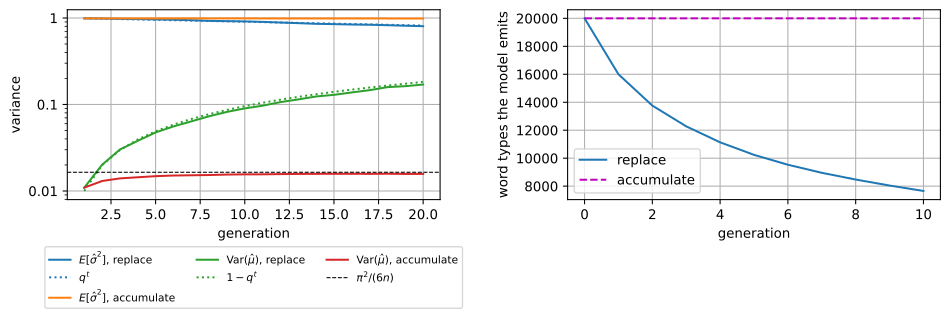
The closed forms hold. After 20 generations of replacement the mean fitted variance is 0.80 against \(q^{20} = 0.82\), and the variance of the mean is 0.17 against 0.18, both within two Monte-Carlo standard errors. Under accumulation the variance of the mean is 0.0157, below the bound \(\pi^2/(6n) \approx 0.0164\), and the fitted variance stays at 0.99.
The bigram model loses words. Under replacement it can emit 16,001 of its 20,000 types after one generation, 10,238 after five and 7,655 after ten; under accumulation all 20,000 remain. The rarest tenth are 2,000 words that occur exactly once, 1% of the 200,000. A word seen once appears in a resampled corpus of the same size about once on average, and with probability about \(e^{-1}\) not at all. A type that is not drawn gets count zero, and the refitted model can never emit it again. The survival after one generation, 62%, is close to \(1 - e^{-1} \approx 0.63\), and after ten generations 17% of these words remain. Curiously, their total probability does not shrink: it stays near 1%, because the survivors inherit the counts of the lost. The tail is lost type by type, not as a falling share.
The toy shows a mechanism under a stated protocol, in which every generation learns only from the previous model’s output, with no fresh data and no filter. Real pipelines keep real data, as accumulation does, and they filter what they generate. Gerstgrasser and colleagues (2024) prove for linear models that accumulating data keeps the test error bounded however many generations pass, and find the same in experiments with language models. The collapse is therefore not a forecast for the field. It is a forecast for one practice, replacing real data with generated data again and again, which nobody should follow.
20.5.5 Licences and Disclosure
Who may train on generated text? The question has two halves. A rewrite does not shed the licence of its source. Our rewrites of FineWeb-Edu remain FineWeb-Edu text under ODC-By and, as the FineWeb-Edu card says, also subject to Common Crawl’s terms of use. And the generator has terms of its own. Qwen3.5-2B is released under Apache-2.0, which places no condition on its outputs, so our corpus carries the source’s attribution and the generator’s name. Other licences do set conditions. The Llama 3 licence, for example, asks that a model trained with the help of Llama outputs carry “Llama” at the start of its name, and the card of Nemotron-CC-v2 warns that models trained on it may be subject to the terms of the Qwen and DeepSeek models that wrote parts of it. Hosted models add a second document. As Section 18.7 found, the licence of the weights can permit training on outputs while the terms of the service that ran them forbid it, so both are read before an API model writes a single training example. These statements describe licences and are not legal advice; the legal status of model outputs is unsettled in several jurisdictions.
The practical rule is to record everything needed to answer the question later. The manifest stage rephrase holds the generator and its revision, the hash of the prompt, the sampling settings and seed, the documents and chunks of each split, the flags and the drops with their reasons, and hashes of the input and output texts. The dataset card states the synthetic share in one line.
_, meta, rows = CORPUS
MAN = d2l.CorpusManifest(TAR_KEY)
read = {c['doc_id'] for v in SPLITS.values() for c in v}  # source documents
MAN.add_source('fineweb-edu', 'hf://datasets/HuggingFaceFW/fineweb-edu/'
               'sample/10BT', revision=WEB.meta['revision'],
               license='odc-by', n_docs=len(read),
               bytes=sum(meta[f'{NAMES[s, "src"]}.bin']['n_bytes_nfc']
                         for s in SPLITS))
kept = rows[rows.kept]
fl = flags(kept)
gen = json.loads(rows[list(GEN_ID)].iloc[0].to_json())  # as recorded
assert all((rows[k] == v).all() for k, v in gen.items())  # one generation
MAN.add_stage(
    'rephrase', dict(generator=f'{gen["model_id"]}@{gen["model_revision"]}',
                     **{k: gen[k] for k in GEN_ID if k not in (
                         'model_id', 'model_revision')},
                     splits={s: dict(documents=N_DOCS[s],
                                     chunks=len(SPLITS[s])) for s in SPLITS},
                     flags={k: int(fl[k].sum()) for k in fl},
                     flag_thresholds=FLAGS, drop_len_ratio=LEN_RATIO,
                     order='length'),
    n_in=len(rows), n_out=len(kept),
    drops={k: int((rows['drop'] == k).sum()) for k in ('length',
                                                        'len_ratio')},
    in_hash=d2l.docs_hash(list(zip(rows.chunk_id, rows.src_text))),
    out_hash=d2l.docs_hash(list(zip(kept.chunk_id, kept.out_text))),
    impl='d2l.rephrase_docs', tokens_out=sum(
        meta[f'{NAMES[s, "reph"]}.bin']['n_tokens'] for s in SPLITS))
print(json.dumps(MAN.stages[-1], indent=1, sort_keys=True))
synth = sum(m['n_tokens'] for m in meta.values() if m['kind'] == 'reph')
share = synth / sum(m['n_tokens'] for m in meta.values())
print(MAN.to_card())  # a Markdown table: printed unwrapped
say(f'Contains synthetic text: {share:.0%} of its tokens were written by '
  f'{REPHRASER} from the FineWeb-Edu sources above.')
{
"drops": {
"len_ratio": 419,
"length": 77
},
"impl": "d2l.rephrase_docs",
"in_hash": "187db47cd3d640dd57b9f93c25ace9516d2c43a40a6a1b99a61c1c90463a0075",
"n_in": 14305,
"n_out": 13809,
"name": "rephrase",
"out_hash": "4824bf7169889f3fc7f0a9b3006214b0a91acc29e80e7cddd402e00218a8717e",
"params": {
"batch": 96,
"chunk_tokens": 400,
"drop_len_ratio": [
0.5,
1.5
],
"flag_thresholds": {
"copy_rate": 0.8,
"num_fidelity": 1.0
},
"flags": {
"copy": 3330,
"numbers": 4150
},
"generator": "Qwen/Qwen3.5-2B@15852e8c16360a2fea060d615a32b45270f8a8fc",
"max_new_tokens": 512,
"order": "length",
"prompt_sha256": "d81cca47fc4159c0c6087ee2d4d5dde9a72c402c247e7725f723c6a446ea1635",
"seed": 0,
"splits": {
"S1": {
"chunks": 6376,
"documents": 2033
},
"S2": {
"chunks": 6345,
"documents": 1993
},
"val": {
"chunks": 1584,
"documents": 502
}
},
"style": "wiki",
"temperature": 0.7,
"top_p": 0.9
},
"tokens_out": 4305776,
"version": null
}
# Dataset card: lm-rephrase-fwedu-5m-v1
Schema `d2l-corpus/1`, manifest SHA-256 `152ee87c5edab4c8…`.
## Sources
| id | uri | revision | license | documents | bytes |
|---|---|---|---|---|---|
| fineweb-edu | hf://datasets/HuggingFaceFW/fineweb-edu/sample/10BT | 87f09149ef4734204d70ed1d046ddc9ca3f2b8f9 | odc-by | 4527 | 21340150 |
## Processing stages
| stage | implementation | in | out | dropped (reason: count) |
|---|---|---|---|---|
| rephrase | d2l.rephrase_docs | 14305 | 13809 | length: 77, len_ratio: 419 |
Contains synthetic text: 48% of its tokens were written by Qwen/Qwen3.5-2B from the FineWeb-Edu
sources above.Of the archive’s tokens, 48% were written by the model, the rewrites of the three splits beside their sources. The card carries that number so that anyone who trains on the data knows it. The same checks return in Section 24.3, where a model writes the instructions and answers for post-training and generated text becomes the main ingredient rather than a supplement. For pretraining one question stays open at our scale: whether a stronger rephraser, or a style that adds structure rather than polish, turns the null result of arm B on real text into a gain.
20.5.6 Summary
Language models can rewrite existing documents or write new ones from a seed, and both kinds of text now enter pretraining at the scale of whole crawls. Rewrites have to be checked. Cheap string measures catch lost numbers and near-copies. A strict judge model finds the added claims they miss, and by its reading about 70% of the rewrites of a two-billion-parameter model add one. The two checks see different failures, losses and additions. At one temperature, conditioning the prompt on format and audience raised distinct 4-grams from about 0.76 to 0.995. At T1 scale (8.1M-parameter proxies, \(2^{24}\) tokens), rewrites mixed with their own source changed nothing measurable on real text, within the 12% that the law of repeated data allowed, and helped on rewritten text. Rewrites alone made the model better on rewrites and worse on real text, so a claim about synthetic data needs both validation sets. Training each generation only on the previous model’s output loses variance and rare words, and accumulating real data prevents it. The rights to generated text follow both its source and its generator.
20.5.7 Exercises
Two flagged rewrites. One rewrite has copy rate 0.95 and number fidelity 1.0; another has copy rate 0.05 and number fidelity 0.5.
- Is either of them good training data? What would you check before deciding?
- Write a rewrite of the opening’s chunk that scores copy rate below 0.3 and number fidelity 1.0 and is still wrong. Which of this section’s checks would catch it?
[code] The corpus keeps its promises. Using only the registered archive, check that no rewrite contains a thinking tag, that every row whose
finishislengthor whose length ratio lies outside \([0.5, 1.5]\) is marked as dropped and is absent from the token files, and that the token files decode to the kept texts. Which of these properties would a change of chat template break first?The rephrasing budget. A generator of \(N_g\) parameters rewrites a chunk of \(L\) tokens into about \(L\) tokens, and a student of \(N_s\) parameters trains on the rewrite.
- Count the forward FLOPs of the generation (the prefill of the prompt and the decoding of the reply, at about \(2N_g\) per token each) and the training FLOPs of one pass over the rewrite (about \(6N_s\) per token). At which ratio \(N_g / N_s\) do the two costs match?
- Evaluate the ratio for this section (Qwen3.5-2B, about 1.9 billion parameters in its language model, and the 8.1-million-parameter proxy) and for a 1.7-billion-parameter generator writing data for a student of 8 billion parameters trained for several epochs.
- Decoding is limited by memory bandwidth, not arithmetic (Section 11.3). Does that make FLOPs an underestimate or an overestimate of the generation’s cost in GPU time?
How fast replacement collapses. In replace mode with \(n\) points per generation:
- Show that \(\log \hat\sigma_t^2\) is a random walk whose steps have negative mean, and conclude that \(P(\hat\sigma_T^2 < \epsilon \sigma^2) \to 1\) as \(T \to \infty\) for every \(\epsilon > 0\).
- Find the number of generations after which \(\mathbb{E}[\hat\sigma_T^2] = \sigma^2/2\) for \(n = 100\), and compare it with the median of \(\hat\sigma_T^2\) in a simulation (extend
collapse_simto return it). Why do the two differ? - Show that \(\operatorname{Var}(\hat\mu_T) \to \sigma^2\). What is the limiting model, and how much does it know about the original distribution?
[code] Temperature and diversity. Rewrite the 60 live chunks in the encyclopedia style at temperatures 0.3, 0.7 and 1.0. Before running, predict how distinct 4-grams across the rewrites, the near-duplicate rate among them and number fidelity will move. Measure all three. Is there a temperature that raises diversity without lowering fidelity, and how does the gain compare with the prompt conditioning of Section 20.5.2.1?
[code] Omissions. The judge asks only whether a rewrite adds a claim. Write a second prompt that asks whether the rewrite leaves out a fact of the source, run it on the same 60 pairs, and tabulate it against the number check and against the first verdict. Do omissions or additions explain more of the lost numbers?
[code] A stronger rephraser. Rewrite S1 with
Qwen/Qwen3.5-4Binstead of Qwen3.5-2B, keeping prompt, sampling and filters. Before running, predict whether the copy rate, the number fidelity and the difference between arms B and A will change. Then measure the fidelity statistics and train arm B on the new rewrites with the three seeds. Compare with the original B by the section’s rule and say what a null result would mean here.[code] Room to gain. Arm B of this section could gain at most 11.9% in effective tokens over A. Keep the budget of \(2^{24}\) tokens, but let A read a source of \(U = 2^{19}\) tokens 32 times and B read that source and its rewrites 16 times each.
- Compute both sides of Equation 20.5.1 for this design. How much more room does B have?
- Run A, B and D at this size with three seeds each, and apply the section’s rule on both validation sets. Before running, predict which of the differences it will resolve.
- A smaller source read more often also costs A more. Which of the two designs answers the question of the opening better, and why?
[code] Warmup and seed spread. The arms warm up over 10% of their steps; the proxies of Section 20.4 warm up over 2%. Train arm A with both warmups at the same peak learning rate, three seeds each, and compare the standard deviation of the final real-validation bits per byte. Plot the training losses of the first 40 steps. Where does the difference come from, and how small a difference between two arms could the section’s rule resolve under each warmup?
[code] Fresh data against collapse. Extend
collapse_simso that a fraction \(\phi\) of the \(n\) points of each generation is drawn from the true distribution and the rest from the previous fit, in replace mode. Find the smallest \(\phi\) for which \(\mathbb{E}[\hat\sigma_T^2]\) stays above \(0.9\,\sigma^2\) for all \(T\), first by simulation and then from the recursion for the expected variance. Do the same for the bigram toy, and find the fraction at which the rarest tenth of the types stops disappearing. Are the two fractions alike, and should they be?