class TransformerEncoder(nn.Module):
    """Bidirectional encoder: embeddings plus unmasked pre-norm blocks."""
    def __init__(self, vocab_size, num_hiddens=128, num_heads=4, num_blks=4,
                 max_len=64):
        super().__init__()
        self.token_emb = nn.Embedding(vocab_size, num_hiddens)
        self.pos_emb = nn.Embedding(max_len, num_hiddens)
        for emb in (self.token_emb, self.pos_emb):
            nn.init.normal_(emb.weight, std=0.02)
        self.blks = nn.ModuleList([
            d2l.TransformerBlock(num_hiddens, num_heads)
            for _ in range(num_blks)])
        self.norm = nn.RMSNorm(num_hiddens, eps=1e-5)

    def forward(self, X, mask=None):
        H = self.token_emb(X) + self.pos_emb(
            torch.arange(X.shape[1], device=X.device))
        for blk in self.blks:
            H = blk(H, mask)  # by default no mask: all tokens see all
return self.norm(H)11.4 Encoders, Decoders, and Cross-Attention
Every Transformer stack we have built so far has been a causal decoder (Section 11.2): a triangular mask restricts token \(i\) to attending to prefix positions \(j \le i\), turning a single forward pass into \(T\) parallel next-token predictions. Causal masking is essential when generating tokens one by one, since future tokens do not yet exist at inference time. When the entire input sequence is already available, as when embedding a document for retrieval, classifying tokens, encoding a source sentence for translation, or encoding an image patch grid (Section 11.5), forbidding position \(i\) from reading positions \(j > i\) discards half of the surrounding context.
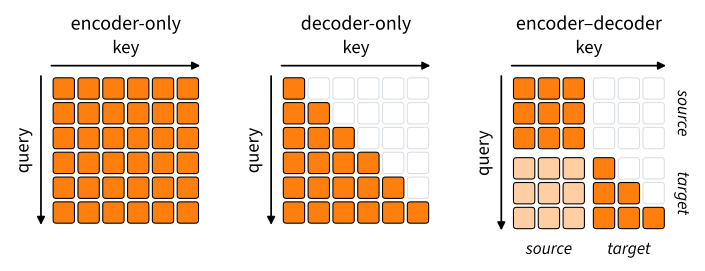
Depending on which tokens are available at the start of the computation and whether the input and output belong to the same sequence, the same TransformerBlock (Section 11.1) supports three canonical wirings (Figure 11.4.1):
- Encoder-only (bidirectional self-attention): Every token attends to every token (
is_causal=False), computing a context-aware representation of a complete input sequence in one pass (BERT (Devlin et al. 2018), RoBERTa (Liu et al. 2019), ViT (Dosovitskiy et al. 2021)). - Decoder-only (causal self-attention): Each token attends only to itself and earlier positions (
is_causal=True), supporting both prompt reading and autoregressive generation in a single homogeneous stack (GPT, Llama 3, Qwen3). - Encoder–decoder (bidirectional encoder + causal decoder with cross-attention): A bidirectional encoder maps a source sequence \(\mathbf{X}_{\textrm{src}}\) to contextual representations \(\mathbf{H}_{\textrm{enc}}\), and a causal decoder generates the target sequence \(\mathbf{Y}_{\textrm{tgt}}\) one token at a time while querying \(\mathbf{H}_{\textrm{enc}}\) through cross-attention (the original 2017 Transformer (Vaswani et al. 2017), T5 (Raffel et al. 2020), Whisper (Radford et al. 2023)).
11.4.1 Encoder, Decoder, and Encoder–Decoder Architectures
11.4.2 Bidirectional Context and Masked-Token Prediction
11.4.2.1 A Bidirectional Encoder
Removing the causal mask from d2l.TransformerBlock turns a causal stack into a bidirectional Transformer encoder (TransformerEncoder), mapping an input batch of token IDs (and an optional padding mask) to contextual representations of shape \((B, n, d)\):
class TransformerEncoder(nnx.Module):
    """Bidirectional encoder: embeddings plus unmasked pre-norm blocks."""
    def __init__(self, vocab_size, num_hiddens=128, num_heads=4, num_blks=4,
                 max_len=64, *, rngs):
        init = nnx.initializers.normal(0.02)
        self.token_emb = nnx.Embed(vocab_size, num_hiddens,
                                   embedding_init=init, rngs=rngs)
        self.pos_emb = nnx.Embed(max_len, num_hiddens, embedding_init=init,
                                 rngs=rngs)
        self.blks = nnx.List([
            d2l.TransformerBlock(num_hiddens, num_heads, rngs=rngs)
            for _ in range(num_blks)])
        self.norm = nnx.RMSNorm(num_hiddens, epsilon=1e-5, rngs=rngs)

    def __call__(self, X, mask=None):
        H = self.token_emb(X) + self.pos_emb(jnp.arange(X.shape[1]))
        for blk in self.blks:
            H = blk(H, mask)  # by default no mask: all tokens see all
        return self.norm(H)
11.4.2.2 The Masked Language Modeling (MLM) Objective
Why can a bidirectional stack not be trained with the next-token prediction objective of Section 11.2? The target of position \(t\) is the token \(x_{t+1}\), and that token is the input at position \(t+1\). Without a mask, a single block already lets position \(t\) attend to position \(t+1\) and read its own target there (Figure 11.4.2), which collapses next-token prediction to a trivial copy.
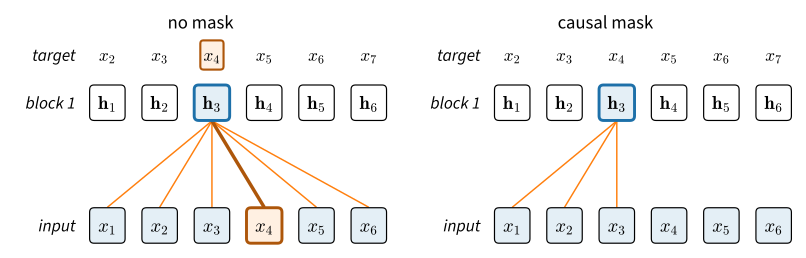
Masked Language Modeling (MLM), introduced in BERT (Devlin et al. 2018), replaces next-token prediction with a cloze task: randomly select a subset of positions \(M \subset \{1, \dots, n\}\) (typically \(p = 15\%\) of tokens), replace each \(x_i\) (\(i \in M\)) with a dedicated <mask> token ID in the corrupted input \(\tilde{\mathbf{x}}\), and minimize the cross-entropy of reconstructing the original tokens only at the masked positions \(i \in M\):
\[ \mathcal{L}_{\textrm{MLM}}(\boldsymbol{\theta}) \;=\; -\frac{1}{|M|} \sum_{i \in M} \log P_{\boldsymbol{\theta}}(x_i \mid \tilde{\mathbf{x}}). \tag{11.4.1}\]
We train a 4-block byte-level MaskedLM (\(d = 128, H = 4, L = 4\)) on the exact same WikiText-103 byte stream as in Section 11.2, reserving token ID MASK = len(data.vocab) (\(256\)) for <mask>:
data = d2l.WikiText103(batch_size=64, num_steps=64)
MASK = len(data.vocab)  # id of the extra <mask> embedding row

def mask_tokens(X, p=0.15):
    mask = torch.rand(X.shape, device=X.device) < p
    return torch.where(mask, MASK, X), mask

class MaskedBytes:
    """The windows of data with masked bytes; labels -100 add no loss."""
    def __init__(self, data):
        self.data = data

    def train_dataloader(self):
        return self.masked(self.data.train_dataloader())

    def val_dataloader(self):
        return self.masked(self.data.val_dataloader())

    def masked(self, batches):
        for X, _ in batches:
            Xm, mask = mask_tokens(X)
            yield Xm, torch.where(mask, X, -100)

class MaskedLM(nn.Module):
    """An encoder with an output head tied to its token embedding."""
    def __init__(self, encoder):
        super().__init__()
        self.encoder = encoder

    def forward(self, X):
        return F.linear(self.encoder(X), self.encoder.token_emb.weight)

device = d2l.try_gpu()
model = MaskedLM(TransformerEncoder(len(data.vocab) + 1)).to(device)
optimizer = torch.optim.AdamW(model.parameters(), lr=1e-3,
                              weight_decay=0.0)
losses = d2l.train_steps(model, MaskedBytes(data), optimizer, 2000)
print('masked loss at step 500/1000/2000: ' + '/'.join(
    f'{sum(losses[k-50:k]) / 50:.2f}' for k in (500, 1000, 2000)))
masked loss at step 500/1000/2000: 3.12/2.28/1.60data = d2l.WikiText103(batch_size=64, num_steps=64)
MASK = len(data.vocab) # id of the extra <mask> embedding row
def mask_tokens(X, key, p=0.15):
mask = jax.random.uniform(key, X.shape) < p
return jnp.where(mask, MASK, X), mask
class MaskedBytes:
"""The windows of data with masked bytes; labels -100 add no loss."""
def __init__(self, data):
self.data = data
def train_dataloader(self):
return self.masked(self.data.train_dataloader())
def val_dataloader(self):
return self.masked(self.data.val_dataloader())
def masked(self, batches):
key = d2l.get_key()
for X, _ in batches:
key, sub = jax.random.split(key)
Xm, mask = mask_tokens(jnp.asarray(X), sub)
yield Xm, jnp.where(mask, X, -100)
class MaskedLM(nnx.Module):
"""An encoder with an output head tied to its token embedding."""
def __init__(self, encoder):
self.encoder = encoder
def __call__(self, X):
return self.encoder.token_emb.attend(self.encoder(X))
model = MaskedLM(TransformerEncoder(len(data.vocab) + 1,
rngs=nnx.Rngs(d2l.get_key())))
optimizer = nnx.Optimizer(model, optax.adamw(1e-3, weight_decay=0.0),
wrt=nnx.Param)
losses = d2l.train_steps(model, MaskedBytes(data), optimizer, 2000)
print('masked loss at step 500/1000/2000: ' + '/'.join(
f'{sum(losses[k-50:k]) / 50:.2f}' for k in (500, 1000, 2000)))masked loss at step 500/1000/2000: 3.14/2.11/1.6311.4.2.3 Loss by Available Context
In Section 11.2.3.2, a causal language model’s per-position validation loss decreased monotonically from left (\(t = 1\), no context) to right (\(t = T\), full prefix context). What does loss_by_position look like for a bidirectional MaskedLM when we evaluate reconstruction loss at each window position \(t \in \{0, \dots, n-1\}\)?
def loss_by_position(model, batches):
    """Mean loss at each window position over the labels that are not -100,
    and the fraction of those labels predicted exactly."""
    device = next(model.parameters()).device
    model.eval()
    total = count = correct = 0
    with torch.no_grad():
        for X, Y in batches:
            X, Y = X.to(device), Y.to(device)
            logits, scored = model(X), Y != -100
            total += F.cross_entropy(logits.transpose(1, 2), Y,
                                     reduction='none').sum(0)  # 0 at -100
            count += scored.sum(0)
            correct += ((logits.argmax(-1) == Y) & scored).sum()
    return (total / count).cpu(), float(correct / count.sum())

def show(losses):
    return ' '.join(f'{float(v):.2f}' for v in losses)

masked = MaskedBytes(data)
pos_loss, accuracy = loss_by_position(model, masked.val_dataloader())
interior = slice(16, 48)  # positions 16 to 47 of the 64
print(f'masked accuracy {accuracy:.2f}')
print(f'loss at positions 0-3: {show(pos_loss[:4])}; 60-63: '
      f'{show(pos_loss[-4:])}; interior mean {pos_loss[interior].mean():.2f}')
masked accuracy 0.53
loss at positions 0-3: 2.36 1.78 1.54 1.52; 60-63: 1.56 1.56 1.76 2.37; interior mean 1.54@nnx.jit
def scored_losses(model, X, Y):
logits = model(X)
losses = optax.softmax_cross_entropy_with_integer_labels(
logits, jnp.maximum(Y, 0))
return losses, logits.argmax(-1) == Y
def loss_by_position(model, batches):
"""Mean loss at each window position over the labels that are not -100,
and the fraction of those labels predicted exactly."""
model.eval()
total = count = correct = 0
for X, Y in batches:
Y = jnp.asarray(Y)
losses, hit = scored_losses(model, jnp.asarray(X), Y)
scored = Y != -100
total += (losses * scored).sum(0)
count += scored.sum(0)
correct += (hit & scored).sum()
return total / count, float(correct / count.sum())
def show(losses):
return ' '.join(f'{float(v):.2f}' for v in losses)
masked = MaskedBytes(data)
pos_loss, accuracy = loss_by_position(model, masked.val_dataloader())
interior = slice(16, 48) # positions 16 to 47 of the 64
print(f'masked accuracy {accuracy:.2f}')
print(f'loss at positions 0-3: {show(pos_loss[:4])}; 60-63: '
f'{show(pos_loss[-4:])}; interior mean {pos_loss[interior].mean():.2f}')masked accuracy 0.52
loss at positions 0-3: 2.42 1.76 1.56 1.55; 60-63: 1.57 1.56 1.79 2.44; interior mean 1.56The bidirectional encoder traces a symmetric bathtub (U-shaped) curve: every interior position enjoys both left and right context (about 1.5–1.6 nats/byte), and loss rises only at the two window edges (\(t \approx 0\) and \(t \approx n-1\), about 2.4 nats/byte) where one side of the context is cut off by the window boundary. Evaluating model on a masked sentence shows how right context disambiguates missing interior bytes:
snippet = 'Homarus gammarus , known as the European lobster or common '
ids = torch.tensor(data.vocab.encode(snippet), device=device)[None]
for pos in (11, 22, 28):
    Xm = ids.clone()
    Xm[0, pos] = MASK
    with torch.no_grad():
        logits = model(Xm)
    probs = F.softmax(logits[0, pos], -1)
    top = probs.topk(3)
    shown = snippet[:pos] + '_' + snippet[pos + 1:]
    print(f'{shown[:40]!r}... -> '
          + ', '.join(f'{data.vocab.decode([int(i)])!r} {p:.2f}'
                      for p, i in zip(top.values, top.indices)))
'Homarus gam_arus , known as the European'... -> 'p' 0.44, 'b' 0.17, ' ' 0.12
'Homarus gammarus , kno_n as the European'... -> 'w' 0.47, 'i' 0.24, 'o' 0.10
'Homarus gammarus , known as _he European'... -> 't' 0.96, 'T' 0.02, 's' 0.01snippet = 'Homarus gammarus , known as the European lobster or common '
ids = jnp.asarray(data.vocab.encode(snippet))[None]
for pos in (11, 22, 28):
Xm = ids.at[0, pos].set(MASK)
probs = jax.nn.softmax(model(Xm)[0, pos])
top = jnp.argsort(probs)[::-1][:3]
shown = snippet[:pos] + '_' + snippet[pos + 1:]
print(f'{shown[:40]!r}... -> '
+ ', '.join(f'{data.vocab.decode([int(i)])!r} {probs[i]:.2f}'
for i in top))'Homarus gam_arus , known as the European'... -> 'p' 0.63, ' ' 0.08, 'm' 0.06
'Homarus gammarus , kno_n as the European'... -> 'w' 0.66, 'h' 0.18, 'r' 0.04
'Homarus gammarus , known as _he European'... -> 't' 0.97, 'T' 0.02, 'w' 0.0011.4.3 Cross-Attention in an Encoder–Decoder
11.4.3.1 A Sequence-to-Sequence Task with Known Alignment
To study an encoder–decoder (Figure 11.4.1, right) on a clean sequence-to-sequence alignment problem, we train on string reversal over an alphabet of \(V = 16\) letters (a–p) and length \(T = 12\): given source string \(\mathbf{x} = (x_1, \dots, x_T)\), the decoder receives \(\textrm{dec\_in} = (\texttt{<bos>}, x_T, x_{T-1}, \dots, x_2)\) and predicts the reversed string \(\mathbf{y} = (x_T, x_{T-1}, \dots, x_1)\):
V, T = 16, 12   # 16 letters, strings of length 12
BOS = V         # decoder start token

def sample_batch(batch_size, device):
    src = torch.randint(0, V, (batch_size, T), device=device)
    tgt = src.flip(1)
    dec_in = torch.cat([torch.full((batch_size, 1), BOS, device=device),
                        tgt[:, :-1]], 1)
    return src, dec_in, tgt

def to_str(ids):
    return ''.join(chr(ord('a') + int(i)) for i in ids)

src, dec_in, tgt = sample_batch(1, device)
print(f'source {to_str(src[0])!r} -> target {to_str(tgt[0])!r}')
source 'hhkmdnbmelgi' -> target 'iglembndmkhh'V, T = 16, 12 # 16 letters, strings of length 12
BOS = V # decoder start token
def sample_batch(batch_size, key):
src = jax.random.randint(key, (batch_size, T), 0, V)
tgt = src[:, ::-1]
dec_in = jnp.concatenate(
[jnp.full((batch_size, 1), BOS), tgt[:, :-1]], 1)
return src, dec_in, tgt
def to_str(ids):
return ''.join(chr(ord('a') + int(i)) for i in ids)
src, dec_in, tgt = sample_batch(1, d2l.get_key())
print(f'source {to_str(src[0])!r} -> target {to_str(tgt[0])!r}')source 'mcikbijmbcah' -> target 'hacbmjibkicm'11.4.3.2 The Decoder Block and EncoderDecoder
A DecoderBlock inserts a cross-attention sublayer (d2l.MultiHeadAttention) between causal self-attention and the SwiGLU FFN. In cross-attention, queries come from the decoder (\(\mathbf{Q} = \textrm{Norm}(\mathbf{Y})\mathbf{W}_q \in \mathbb{R}^{B \times T_{\textrm{dec}} \times d}\)) while keys and values come from the top of the encoder (\(\mathbf{K} = \mathbf{H}_{\textrm{enc}}\mathbf{W}_k \in \mathbb{R}^{B \times T_{\textrm{src}} \times d}\), \(\mathbf{V} = \mathbf{H}_{\textrm{enc}}\mathbf{W}_v \in \mathbb{R}^{B \times T_{\textrm{src}} \times d}\)). Because the entire encoded source \(\mathbf{H}_{\textrm{enc}}\) exists before decoding begins, cross-attention uses no causal mask:
class DecoderBlock(nn.Module):
    """Pre-norm decoder block: causal self-attention, cross-attention,
    FFN."""
    def __init__(self, num_hiddens, num_heads):
        super().__init__()
        self.norm1 = nn.RMSNorm(num_hiddens, eps=1e-5)
        self.norm2 = nn.RMSNorm(num_hiddens, eps=1e-5)
        self.norm3 = nn.RMSNorm(num_hiddens, eps=1e-5)
        self.self_attention = d2l.MultiHeadAttention(num_hiddens, num_heads)
        self.cross_attention = d2l.MultiHeadAttention(num_hiddens, num_heads)
        self.ffn = d2l.FeedForward(num_hiddens)

    def forward(self, X, enc, mask=None, cross_mask=None):
        if mask is None:  # causal self-attention
            mask = d2l.causal_mask(X.shape[1], device=X.device)
        Y = self.norm1(X)
        X = X + self.self_attention(Y, Y, Y, mask)
        X = X + self.cross_attention(self.norm2(X), enc, enc, cross_mask)
        return X + self.ffn(self.norm3(X))
class DecoderBlock(nnx.Module):
"""Pre-norm decoder block: causal self-attention, cross-attention,
FFN."""
def __init__(self, num_hiddens, num_heads, *, rngs):
self.norm1 = nnx.RMSNorm(num_hiddens, epsilon=1e-5, rngs=rngs)
self.norm2 = nnx.RMSNorm(num_hiddens, epsilon=1e-5, rngs=rngs)
self.norm3 = nnx.RMSNorm(num_hiddens, epsilon=1e-5, rngs=rngs)
self.self_attention = d2l.MultiHeadAttention(num_hiddens, num_heads,
rngs=rngs)
self.cross_attention = d2l.MultiHeadAttention(num_hiddens, num_heads,
rngs=rngs)
self.ffn = d2l.FeedForward(num_hiddens, rngs=rngs)
def __call__(self, X, enc, mask=None, cross_mask=None):
if mask is None: # causal self-attention
mask = d2l.causal_mask(X.shape[1])
Y = self.norm1(X)
X = X + self.self_attention(Y, Y, Y, mask)
X = X + self.cross_attention(self.norm2(X), enc, enc, cross_mask)
return X + self.ffn(self.norm3(X))EncoderDecoder pairs a TransformerEncoder with a stack of DecoderBlock layers and a linear output head. Notice that decode(dec_in, enc) takes the precomputed encoder output enc, so during autoregressive generation the encoder runs only once on the source sequence while decode steps through the target tokens:
class EncoderDecoder(nn.Module):
    """A causal decoder cross-attending into a bidirectional encoder."""
    def __init__(self, vocab_size, num_hiddens=128, num_heads=4,
                 num_blks=1, max_len=64):
        super().__init__()
        self.encoder = TransformerEncoder(vocab_size, num_hiddens,
                                          num_heads, num_blks, max_len)
        self.tgt_emb = nn.Embedding(vocab_size, num_hiddens)
        self.pos_emb = nn.Embedding(max_len, num_hiddens)
        for emb in (self.tgt_emb, self.pos_emb):
            nn.init.normal_(emb.weight, std=0.02)
        self.blks = nn.ModuleList([DecoderBlock(num_hiddens, num_heads)
                                   for _ in range(num_blks)])
        self.norm = nn.RMSNorm(num_hiddens, eps=1e-5)
        self.head = nn.Linear(num_hiddens, vocab_size, bias=False)

    def decode(self, dec_in, enc):
        H = self.tgt_emb(dec_in) + self.pos_emb(
            torch.arange(dec_in.shape[1], device=dec_in.device))
        for blk in self.blks:
            H = blk(H, enc)
        return self.head(self.norm(H))

    def forward(self, src, dec_in):
        return self.decode(dec_in, self.encoder(src))
class EncoderDecoder(nnx.Module):
"""A causal decoder cross-attending into a bidirectional encoder."""
def __init__(self, vocab_size, num_hiddens=128, num_heads=4,
num_blks=1, max_len=64, *, rngs):
init = nnx.initializers.normal(0.02)
self.encoder = TransformerEncoder(vocab_size, num_hiddens,
num_heads, num_blks, max_len,
rngs=rngs)
self.tgt_emb = nnx.Embed(vocab_size, num_hiddens,
embedding_init=init, rngs=rngs)
self.pos_emb = nnx.Embed(max_len, num_hiddens, embedding_init=init,
rngs=rngs)
self.blks = nnx.List([DecoderBlock(num_hiddens, num_heads,
rngs=rngs)
for _ in range(num_blks)])
self.norm = nnx.RMSNorm(num_hiddens, epsilon=1e-5, rngs=rngs)
self.head = d2l.Linear(num_hiddens, vocab_size, use_bias=False,
rngs=rngs)
def decode(self, dec_in, enc):
H = self.tgt_emb(dec_in) + self.pos_emb(jnp.arange(dec_in.shape[1]))
for blk in self.blks:
H = blk(H, enc)
return self.head(self.norm(H))
def __call__(self, src, dec_in):
return self.decode(dec_in, self.encoder(src))11.4.3.3 Training and Autoregressive Decoding
Training EncoderDecoder for 300 steps on random batches of 128 strings and running greedy autoregressive decoding (reverse) achieves near-perfect exact-string reversal:
def train_reversal(model, num_steps=300):
    """Train on fresh batches of 128 strings; return the loss of each step."""
    optimizer = d2l.LMOptimizer(model, lr=1e-3, num_steps=num_steps,
                                warmup=0, weight_decay=0.0)
    losses = []
    for step in range(num_steps):
        src, dec_in, tgt = sample_batch(128, device)
        logits = model(src, dec_in)
        loss = F.cross_entropy(logits.flatten(0, 1), tgt.flatten())
        optimizer.zero_grad()
        loss.backward()
        optimizer.step()
        losses.append(loss.detach())  # Stays on the device
    return torch.stack(losses).tolist()  # One transfer at the end

seq2seq = EncoderDecoder(V + 1).to(device)
losses = train_reversal(seq2seq)
print('loss at step 25/50/100/200/300: ' + '/'.join(
    f'{sum(losses[k-10:k]) / 10:.3f}' for k in (25, 50, 100, 200, 300)))
loss at step 25/50/100/200/300: 2.077/0.948/0.108/0.004/0.002@nnx.jit
def s2s_step(model, optimizer, src, dec_in, tgt):
def loss_fn(model):
logits = model(src, dec_in)
return optax.softmax_cross_entropy_with_integer_labels(
logits.reshape(-1, logits.shape[-1]), tgt.reshape(-1)).mean()
loss, grads = nnx.value_and_grad(loss_fn)(model)
optimizer.update(model, grads)
return loss
def train_reversal(model, num_steps=300):
"""Train on fresh batches of 128 strings; return the loss of each step."""
optimizer = d2l.LMOptimizer(model, lr=1e-3, num_steps=num_steps,
warmup=0, weight_decay=0.0)
key, losses = d2l.get_key(), []
for step in range(num_steps):
key, sub = jax.random.split(key)
src, dec_in, tgt = sample_batch(128, sub)
losses.append(s2s_step(model, optimizer, src, dec_in, tgt))
return jax.device_get(losses) # One transfer at the end
seq2seq = EncoderDecoder(V + 1, rngs=nnx.Rngs(d2l.get_key()))
losses = train_reversal(seq2seq)
print('loss at step 25/50/100/200/300: ' + '/'.join(
f'{sum(losses[k-10:k]) / 10:.3f}' for k in (25, 50, 100, 200, 300)))loss at step 25/50/100/200/300: 2.090/1.126/0.120/0.004/0.001At inference time, reverse(model, src) encodes the source sequence once and greedily decodes one target token per step from <bos>, achieving near-perfect exact-string match on \(1{,}000\) held-out random strings:
def reverse(model, src):
    """Greedy decoding: the encoder runs once, the decoder once per token."""
    model.eval()
    with torch.no_grad():
        enc = model.encoder(src)
        out = torch.full((len(src), T + 1), BOS, device=src.device)
        for t in range(T):
            logits = model.decode(out[:, :t + 1], enc)
            out[:, t + 1] = logits[:, -1].argmax(-1)
    return out[:, 1:]

src, _, tgt = sample_batch(1000, device)
pred = reverse(seq2seq, src)
print(f'exact match on 1000 fresh strings: '
      f'{(pred == tgt).all(-1).float().mean():.3f}')
print(f'source {to_str(src[0])!r} -> predicted {to_str(pred[0])!r}')
exact match on 1000 fresh strings: 1.000
source 'gjapkpfkolmp' -> predicted 'pmlokfpkpajg'@nnx.jit
def next_token(model, enc, buf, t):
return model.decode(buf, enc)[:, t].argmax(-1)
def reverse(model, src):
"""Greedy decoding: the encoder runs once, the decoder once per token."""
model.eval()
enc = model.encoder(src)
buf = jnp.full((len(src), T + 1), BOS)
for t in range(T):
buf = buf.at[:, t + 1].set(next_token(model, enc, buf, t))
return buf[:, 1:]
src, _, tgt = sample_batch(1000, d2l.get_key())
pred = reverse(seq2seq, src)
print(f'exact match on 1000 fresh strings: '
f'{(pred == tgt).all(-1).mean():.3f}')
print(f'source {to_str(src[0])!r} -> predicted {to_str(pred[0])!r}')exact match on 1000 fresh strings: 1.000
source 'mmodhakcikni' -> predicted 'inkickahdomm'11.4.3.4 Reading Cross-Attention Alignment
In string reversal, target step \(t\) outputs source token \(T - 1 - t\). Does the cross-attention weight matrix therefore have to concentrate on the anti-diagonal \((t, T - 1 - t)\)? Let us compare our trained EncoderDecoder, with one encoder block and one decoder block (with encoder self-attention), against an otherwise identical model whose encoder has no blocks, only its embeddings (without, so encoder position \(j\) can only hold information about source token \(j\)):
def reversal_model(self_attention=True):
    model = EncoderDecoder(V + 1).to(device)
    if not self_attention:  # the encoder keeps embeddings and positions
        model.encoder = TransformerEncoder(V + 1, num_blks=0).to(device)
    train_reversal(model)
    return model

def alignment(model):
    """Exact match on 1000 fresh strings; the head-averaged cross-attention
    of 256 strings, and how often its largest weight in a row falls on the
    true source position."""
    src, _, tgt = sample_batch(1000, device)
    match = (reverse(model, src) == tgt).all(-1).float().mean()
    with torch.no_grad():
        src, dec_in, _ = sample_batch(256, device)
        model(src, dec_in)
    maps = model.blks[0].cross_attention.attention_weights.mean(1)
    want = torch.arange(T - 1, -1, -1, device=device)  # row t: column T-1-t
    return match, (maps.argmax(-1) == want).float().mean(), maps[0].cpu()
def reversal_model(self_attention=True):
model = EncoderDecoder(V + 1, rngs=nnx.Rngs(d2l.get_key()))
if not self_attention: # the encoder keeps embeddings and positions
model.encoder = TransformerEncoder(V + 1, num_blks=0,
rngs=nnx.Rngs(d2l.get_key()))
train_reversal(model)
return model
def alignment(model):
"""Exact match on 1000 fresh strings; the head-averaged cross-attention
of 256 strings, and how often its largest weight in a row falls on the
true source position."""
src, _, tgt = sample_batch(1000, d2l.get_key())
match = (reverse(model, src) == tgt).all(-1).mean()
src, dec_in, _ = sample_batch(256, d2l.get_key())
model(src, dec_in)
maps = model.blks[0].cross_attention.attention_weights.mean(1)
want = jnp.arange(T - 1, -1, -1) # row t: column T-1-t
return match, (maps.argmax(-1) == want).mean(), maps[0]Running six independent seeds of both with and without encoder self-attention and plotting the least anti-diagonally aligned cross-attention heatmap from each group contrasts direct positional lookup against multi-layer routing:
encoders = {'with': [seq2seq] + [reversal_model() for _ in range(5)],
            'without': [reversal_model(False) for _ in range(6)]}
maps, titles = [], []
for name, models in encoders.items():
    runs = [alignment(m) for m in models]
    print(f'encoder {name} self-attention, six runs')
    print('  exact match:', ' '.join(f'{m:.3f}' for m, _, _ in runs))
    print('  rows on the true source position:',
          ' '.join(f'{100 * h:.0f}%' for _, h, _ in runs))
    _, hit, least = min(runs, key=lambda run: run[1])  # the least aligned
    maps.append(least)
    titles.append(f'{name}: {100 * hit:.0f}% of rows')
d2l.show_heatmaps(d2l.stack(maps)[None], xlabel='source position',
                  ylabel='target position', titles=titles, figsize=(6, 3),
                  cmap='Blues')
encoder with self-attention, six runs
exact match: 1.000 1.000 1.000 1.000 1.000 1.000
rows on the true source position: 31% 92% 100% 45% 17% 100%
encoder without self-attention, six runs
exact match: 1.000 1.000 1.000 1.000 1.000 1.000
rows on the true source position: 100% 100% 100% 100% 100% 100%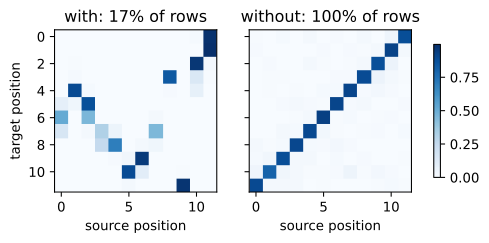
encoders = {'with': [seq2seq] + [reversal_model() for _ in range(5)],
            'without': [reversal_model(False) for _ in range(6)]}
maps, titles = [], []
for name, models in encoders.items():
    runs = [alignment(m) for m in models]
    print(f'encoder {name} self-attention, six runs')
    print('  exact match:', ' '.join(f'{m:.3f}' for m, _, _ in runs))
    print('  rows on the true source position:',
          ' '.join(f'{100 * h:.0f}%' for _, h, _ in runs))
    _, hit, least = min(runs, key=lambda run: run[1])  # the least aligned
    maps.append(least)
    titles.append(f'{name}: {100 * hit:.0f}% of rows')
d2l.show_heatmaps(d2l.stack(maps)[None], xlabel='source position',
                  ylabel='target position', titles=titles, figsize=(6, 3),
                  cmap='Blues')
encoder with self-attention, six runs
exact match: 0.999 1.000 1.000 1.000 1.000 0.999
rows on the true source position: 15% 73% 31% 100% 90% 88%
encoder without self-attention, six runs
exact match: 1.000 1.000 1.000 1.000 1.000 1.000
rows on the true source position: 100% 100% 100% 100% 100% 100%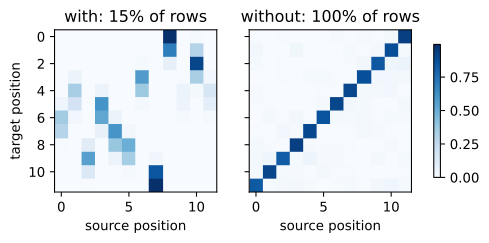
When the encoder has no self-attention (without), cross-attention must look directly at the anti-diagonal \((t, T - 1 - t)\) to retrieve source token \(T - 1 - t\). When the encoder includes bidirectional self-attention (with), the encoder layers can already route or reorganize source information across positions before cross-attention reads \(\mathbf{H}_{\textrm{enc}}\)—a classic reminder (Jain and Wallace 2019) that raw attention weights in a multi-layer network reflect inter-layer routing rather than a direct token-to-token attribution map.
11.4.4 Cross-Attention as an Interface: Fixed-Size Latent Bottlenecks
Because cross-attention requires only that queries \(\mathbf{Q} \in \mathbb{R}^{B \times M \times d}\) and key–values \(\mathbf{K}, \mathbf{V} \in \mathbb{R}^{B \times N \times d}\) share feature width \(d\), it can decouple internal processing length \(M\) from raw input length \(N\) (Figure 11.4.3).
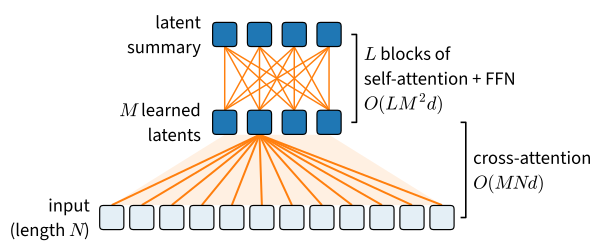
In Perceiver (Jaegle et al. 2021) (and multimodal vision–language resamplers (Alayrac et al. 2022)), a learned array of \(M \ll N\) latent query vectors \(\mathbf{Z}_0 \in \mathbb{R}^{M \times d}\) cross-attends to an \(N\)-token input \(\mathbf{X} \in \mathbb{R}^{B \times N \times d}\) in \(O(M N d)\) operations, after which \(L\) self-attention blocks process the compact latent array of length \(M\) in \(O(L M^2 d)\) operations instead of \(O(L N^2 d)\):
class PerceiverEncoder(nn.Module):
    """M learned latents cross-attend into the input, then process among
    themselves."""
    def __init__(self, num_latents, num_hiddens, num_heads=4, num_blks=2):
        super().__init__()
        self.latents = nn.Parameter(
            0.02 * torch.randn(num_latents, num_hiddens))
        self.norm_q = nn.RMSNorm(num_hiddens, eps=1e-5)
        self.cross_attention = d2l.MultiHeadAttention(num_hiddens, num_heads)
        self.blks = nn.ModuleList([
            d2l.TransformerBlock(num_hiddens, num_heads)
            for _ in range(num_blks)])
        self.norm = nn.RMSNorm(num_hiddens, eps=1e-5)

    def forward(self, X):
        Z = self.latents.expand(X.shape[0], -1, -1)
        Z = Z + self.cross_attention(self.norm_q(Z), X, X)  # O(MN)
        for blk in self.blks:
            Z = blk(Z)                                       # O(M^2)
        return self.norm(Z)
class PerceiverEncoder(nnx.Module):
"""M learned latents cross-attend into the input, then process among
themselves."""
def __init__(self, num_latents, num_hiddens, num_heads=4, num_blks=2,
*, rngs):
self.latents = nnx.Param(
0.02 * jax.random.normal(rngs.params(),
(num_latents, num_hiddens)))
self.norm_q = nnx.RMSNorm(num_hiddens, epsilon=1e-5, rngs=rngs)
self.cross_attention = d2l.MultiHeadAttention(num_hiddens, num_heads,
rngs=rngs)
self.blks = nnx.List([
d2l.TransformerBlock(num_hiddens, num_heads, rngs=rngs)
for _ in range(num_blks)])
self.norm = nnx.RMSNorm(num_hiddens, epsilon=1e-5, rngs=rngs)
def __call__(self, X):
Z = jnp.broadcast_to(self.latents[...],
(X.shape[0],) + self.latents.shape)
Z = Z + self.cross_attention(self.norm_q(Z), X, X) # O(MN)
for blk in self.blks:
Z = blk(Z) # O(M^2)
return self.norm(Z)11.4.5 Choosing Among the Three Wirings
- Encoder-only (
is_causal=False) gives every token full bidirectional context in a single pass, making it the standard backbone for dense text embeddings, reranking, token classification, and non-autoregressive vision backbones (Section 11.5). - Decoder-only (
is_causal=True) trains on \(100\%\) of sequence tokens via next-token prediction (versus \(15\%\) in MLM) and processes prompts and generated continuations in a single unified parameter stack and KV cache (Section 11.3), making it the dominant architecture for general-purpose language models. - Encoder–decoder (with cross-attention) shines when the input and output have different modalities or lengths—such as speech spectrograms to text in Whisper (Radford et al. 2023), or high-resolution visual/sensor arrays compressed through a fixed-size latent cross-attention interface (Figure 11.4.3).
11.4.6 Summary
The same TransformerBlock can be wired as a bidirectional encoder (is_causal=False), a causal decoder (is_causal=True), or a cross-attending encoder–decoder (Figure 11.4.1). Because unmasked self-attention lets every position read its own target under next-token prediction, bidirectional encoders are trained with Masked Language Modeling (MLM) (Equation 11.4.1), producing a symmetric U-shaped loss_by_position curve across the window. In an encoder–decoder, each DecoderBlock interleaves causal target self-attention with cross-attention (decoder queries attending to encoder keys and values) and a position-wise FFN, so the encoder runs once on the source while the decoder steps autoregressively. More generally, cross-attention with \(M \ll N\) learned query vectors (PerceiverEncoder) compresses an \(N\)-token input into an \(M\)-token latent bottleneck in \(O(M N d + L M^2 d)\) time (Figure 11.4.3).
11.4.7 Exercises
BERT’s 80 / 10 / 10 masking recipe.
mask_tokensreplaces every selected position (\(15\%\) of bytes) with<mask>. Because<mask>never appears at fine-tuning or inference time, Devlin et al. (2018) replace selected tokens with<mask>\(80\%\) of the time, with a uniformly random vocabulary token \(10\%\) of the time, and leave the original token unchanged \(10\%\) of the time. Implement this 80 / 10 / 10 rule inmask_tokensand explain why keeping \(10\%\) unmasked and \(10\%\) random forces the encoder to maintain accurate representations at unmasked tokens as well as<mask>tokens.Padding masks on ragged sequence-to-sequence batches. When a batch contains variable-length source strings of lengths \((s_1, \dots, s_B) \le S\) and target strings of lengths \((t_1, \dots, t_B) \le T_{\textrm{dec}}\), three boolean masks are needed: (a) a \((B, 1, S, S)\) encoder padding mask, (b) a \((B, 1, T_{\textrm{dec}}, T_{\textrm{dec}})\) decoder causal + padding mask, and (c) a \((B, 1, T_{\textrm{dec}}, S)\) rectangular cross-attention source-padding mask. Write a helper
make_seq2seq_masks(src_len, tgt_len, S, T_dec)that constructs all three masks and verify that appending padded tokens tosrcinEncoderDecoderdoes not alter the non-padded decoder logits.Varying the MLM masking fraction \(p\). Train
MaskedLMfor 2,000 steps at masking fractions \(p \in \{0.05, 0.15, 0.30, 0.50\}\) and evaluate all four models on the same \(p = 0.15\) validation setmasked.val_dataloader(). How does \(p\) trade off the number of supervised gradient signals per batch against the amount of uncorrupted context available around each mask?Forward vs. backward direction of time in causal and bidirectional models. A causal language model processes text left-to-right (\(x_1 \to x_n\)). Reverse every byte window in
WikiText103so a causal model predicts right-to-left (\(x_n \to x_1\)), train for 1,000 steps, and compare its average per-byte validation loss and itsloss_by_positioncurve against the left-to-right causal model and the bidirectionalMaskedLM. Why is the total joint log-likelihood \(\sum_{t=1}^n \log P(x_t \mid \textrm{past})\) theoretically invariant to time reversal, and where does the bidirectional model gain its advantage over both one-sided directions?Content-addressed vs. position-addressed cross-attention alignment. In our string reversal experiment, every letter in a random string can repeat, so position is required to distinguish duplicate letters. Modify
sample_batchso each length-12 string is a random permutation of 12 distinct letters, and trainEncoderDecoderwith the position term removed from the encoder’s forward pass. Why does a 1-layer encoder without position embeddings fail on string reversal even when all 12 letters are distinct, whereas a sorting task (outputting the input letters in alphabetical ordera..p) succeeds without any encoder positional embeddings?Perceiver IO for sequence-to-sequence reversal. Perceiver IO (Jaegle et al. 2022) pairs a
PerceiverEncoder(\(M\) learned latent queries attending to the \(N\)-token input) with a cross-attention decoder in which \(N_{\textrm{out}}\) target position embeddings \(\mathbf{Q}_{\textrm{out}} \in \mathbb{R}^{N_{\textrm{out}} \times d}\) cross-attend to the \(M\) latent vectors \(\mathbf{Z}^{(L)} \in \mathbb{R}^{B \times M \times d}\). Build aPerceiverAutoencoderthat encodes a 12-letter string into \(M \in \{2, 4, 8, 12\}\) latents (\(d = 128\)) and decodes the reversed string in one parallel cross-attention readout pass. How does reversal accuracy vary with the bottleneck size \(M\)?