import collections
import concurrent.futures
import gzip
import hashlib
import io
import json
import multiprocessing
import os
import pathlib
import re
import textwrap
import time
import zlib
import pandas as pd
import transformers
from sentence_transformers import SentenceTransformer20.2 Quality Filtering
The previous section turned a quarter of one Common Crawl archive file into 3,288 English documents and ended on a puzzle: about seven in ten of them are not in FineWeb, although FineWeb was built from the same file. Something judged them not worth keeping. Anyone who has looked through a crawl will not need convincing that such a judgment is necessary. Next to manuals and news articles sit product catalogues, lists of links, pages of keywords written for search engines, articles run through a program that swaps words for synonyms, and advertisements for love spells. A model trained on all of it learns all of it.
Two kinds of filter make the judgment. The older kind is a set of rules, written by people who had read many bad pages: too few words, too many repeated lines, too few lines that end in a full stop. The newer kind is a classifier. A large language model reads a sample of a few hundred thousand pages and scores each one under a written rubric, a small model learns to predict the score, and a threshold on the prediction decides for the billions of pages that no large model will ever read. FineWeb-Edu (Penedo et al. 2024) was built this way, with a rubric that asks how useful a page would be for teaching at school. Other open corpora of the same years also select with a cheap classifier, though not always one trained on a large model’s scores: DCLM’s learns to tell instruction data from random web pages, and Nemotron-CC combines several.
Both kinds of filter remove most of the web, and both apply a definition of quality that somebody wrote down. The rules define it by surface statistics. The classifier inherits it from a rubric and from the model that applied the rubric, that model’s taste included. The two pages printed below show both definitions at work. One advertises “death spells” and passes every rule we implement. The other is a software company’s guide to hiring engineers, plain and informative, and our classifier removes it. Faced with the second page, the natural instinct is to adjust the threshold. The better question is what the filter means by quality, and whose pages it removes.
This section builds both kinds of filter, trains a classifier on labels written by Qwen3.8-27B, chooses its threshold, and audits what it removes by country, kind of site and language. It ends where the audit points: a filter keeps what its annotator likes, and only training runs, of the kind that Section 20.4 sets up, can say whether that is what a model needs.
Most of what this notebook computes is cheap: the rules run on eight CPU processes, a 0.6B-parameter model scores perplexity, an embedder encodes the crawl documents, and linear classifiers train in seconds, so a build takes a few minutes on one GPU. Two steps are expensive, and a build reads their results from registered files: labelling 22,000 documents with Qwen3.8-27B took about an hour on four GPUs, and the review of 200 removed documents a few minutes more. The vectors of the labelled documents and of the audit stream are registered too, with the released FineWeb-Edu classifier’s scores. Without a GPU the notebook reads every registered result and scores perplexity on a small sample only. Setting D2L_RERUN to names from ARTIFACTS regenerates those files under new names, and the last cell compares whatever this run computed with the registered results.
def say(*args, sep=' '):
    """print, each line wrapped to the page's 100 columns."""
    print('\n'.join(l if len(l) <= 100 else textwrap.fill(
        l, 100, subsequent_indent='    ', break_long_words=False,
        break_on_hyphens=False) for l in sep.join(map(str, args)).split('\n')))


LABELLER = d2l.EDU_LABELLER_LOCAL['model']  # the rubric's scores (vLLM)
EMBEDDER = 'Qwen/Qwen3-Embedding-0.6B'
PPL_MODEL = 'Qwen/Qwen3-0.6B-Base'   # the perplexity filter's reference
RELEASED = 'HuggingFaceFW/fineweb-edu-classifier'
MAX_LEN = 512             # tokens of a document that every model reads
THRESH_LABEL = 3          # "educational": a score of 3 or more
SCORE_PREFIX = 'Educational score: '  # the labeller's own spacing (pilot)
EXTRA_SPACE = True  # also count a second space before the digit
LABEL_CONCURRENCY = 1  # requests in flight per labeller server: see below
JUDGE_MAX_TOKENS = 12_000  # the review's reasoning judge: no thinking cap
GPU = torch.cuda.is_available()
SMALL = not GPU  # the CPU path: registered labels, vectors and scores
DTYPE = torch.bfloat16 if GPU else torch.float32
ARTIFACTS = {  # name: (registered key, file a regeneration writes)
    'edu-label-pilot': ('lm-edu-annot-22k-v1', 'edu-label-pilot.parquet'),
    'edu-label-0': ('lm-edu-annot-22k-v1', 'edu-label-0.parquet'),
    'edu-label-1': ('lm-edu-annot-22k-v1', 'edu-label-1.parquet'),
    'quality-emb': ('lm-data-emb-qwen3emb-v1', 'lm-data-emb-qwen3emb-v1.npz'),
    'quality-results': ('lm-data-quality-results-v1',
                        'lm-data-quality-results-v1.json'),
    'quality-flags': ('lm-c1-docs-v1', 'lm-c1-docs-v1.jsonl.gz'),
    'removal-labels': ('lm-data-removal-labels-v1',
                       'lm-data-removal-labels-v1.jsonl')}
RERUN = d2l.lm_rerun(ARTIFACTS)
GPU_NAMES = {'edu-label-pilot', 'edu-label-0', 'edu-label-1', 'quality-emb',
             'removal-labels'}
assert GPU or not RERUN & GPU_NAMES, 'these regenerations need a GPU'
RERUN_DIR = os.path.join('..', 'data', 'lm', 'rerun')
R = {}  # what this run measures; written or compared in the last cell
pins = {m: d2l.HF_REVISIONS.get(m) or d2l.HF_ENCODER_REVISIONS.get(m)
        for m in (EMBEDDER, PPL_MODEL)}
pins[LABELLER] = d2l.EDU_LABELLER_LOCAL['revision']
pins[RELEASED] = d2l.LM_DATA_SOURCES['fineweb-edu-classifier'][2]
print(f'GPU={GPU}, SMALL={SMALL}, regenerating: '
      f'{", ".join(sorted(RERUN)) or "none"}')
for m, rev in pins.items():
    print(f'  {m}@{rev[:8]}')
GPU=True, SMALL=False, regenerating: none
Qwen/Qwen3-Embedding-0.6B@97b0c614
Qwen/Qwen3-0.6B-Base@da87bfb6
RedHatAI/Qwen3.8-27B-INT4@71dface3
HuggingFaceFW/fineweb-edu-classifier@284663cbThe registry adds seven files. The 22,000 labelled documents and the audit stream are FineWeb text, which its ODC-By licence lets us host with attribution, and every cell that prints their text prints the attribution too. Nothing derived from our own crawl text is hosted. The flags of the crawl documents hold ids, reason codes and scores; their vectors, computed from text we may not redistribute, are cached on the machine that computed them; and the review file holds document ids and the judge’s one-sentence rationales.
d2l.DATA_HUB['lm-data-audit-stream-v1'] = (  # FineWeb text, ODC-By: the
    # audit stream, six FineWeb-2 slices, same-host documents (20.3);
    # tools/build_lm_data_sources.py audit-stream
    d2l.LM_DATA_URL + 'lm-data-audit-stream-v1.parquet',
    '231fc997824464048a579b133d235f6103dbf957')
d2l.DATA_HUB['lm-edu-annot-22k-v1'] = (  # FineWeb text, ODC-By: 22,000
    # documents with Llama-3-70B's and Qwen3.8-27B's scores (20.2)
    d2l.LM_DATA_URL + 'lm-edu-annot-22k-v1.parquet',
    '4a1c7d61d13569c381eacf0421c9be071c06b201')
d2l.DATA_HUB['lm-data-emb-qwen3emb-v1'] = (  # embeddings and released
    # classifier scores of the annotations and the stream (20.2)
    d2l.LM_DATA_URL + 'lm-data-emb-qwen3emb-v1.npz',
    'dbd67d20099a04c590c1cfaaa7f19a9ea2256550')
d2l.DATA_HUB['lm-data-quality-results-v1'] = (  # 20.2's numbers
    d2l.LM_DATA_URL + 'lm-data-quality-results-v1.json',
    'e7bb769dcf59c793d5a45b586fa4fcd7c798bef2')
d2l.DATA_HUB['lm-quality-head-v1'] = (  # the regression head (20.2)
    d2l.LM_DATA_URL + 'lm-quality-head-v1.npz',
    '4f646fc8adb2503267b2904ecdff2521604e06fd')
d2l.DATA_HUB['lm-c1-docs-v1'] = (  # c0 ids with rule codes and edu_score,
    # no text (20.2)
    d2l.LM_DATA_URL + 'lm-c1-docs-v1.jsonl.gz',
    'd820ecb7bebfbcc9ca5e88e4e7f9edca8a4432de')
d2l.DATA_HUB['lm-data-removal-labels-v1'] = (  # Qwen3.8-27B's keep or drop
    # on 200 removed stream documents, ids and rationales (20.2)
    d2l.LM_DATA_URL + 'lm-data-removal-labels-v1.jsonl',
    '5d9dcdb686c6747538cbd512f2e1dfb881805f1c')

QUALITY_KEYS = ('lm-edu-annot-22k-v1', 'lm-data-audit-stream-v1',
                'lm-data-emb-qwen3emb-v1', 'lm-quality-head-v1',
                'lm-c1-docs-v1', 'lm-data-quality-results-v1',
                'lm-data-removal-labels-v1')
say('registered:', ', '.join(k for k in QUALITY_KEYS if k in d2l.DATA_HUB)
    or 'none', '| pending:', ', '.join(
        k for k in QUALITY_KEYS if k not in d2l.DATA_HUB) or 'none')
registered: lm-edu-annot-22k-v1, lm-data-audit-stream-v1, lm-data-emb-qwen3emb-v1,
lm-quality-head-v1, lm-c1-docs-v1, lm-data-quality-results-v1, lm-data-removal-labels-v1 |
pending: noneThe first cell computes how much of this dump FineWeb-Edu keeps, from the row counts of the two datasets, and prints the two pages. Both come from the audit stream, a sample of FineWeb’s output introduced below, and both are chosen by rule, not by us. The first is the page with the lowest score from our classifier among the pages that pass every rule and have at least 1,500 characters. The second is the page with the lowest score among those our classifier removes and the review at the end of the section would keep.
ATTRIBUTION = ('Text: FineWeb, HuggingFaceFW/fineweb, CC-MAIN-2025-05 '
               '(ODC-By 1.0)')
kept, total = 19_287_119, 265_662_695  # the two dataset cards' row counts
print(f'FineWeb-Edu keeps {kept:,} of FineWeb\'s {total:,} documents of '
      f'CC-MAIN-2025-05: {kept / total:.2%}')
STREAM = pd.read_parquet(d2l.lm_artifact('lm-data-audit-stream-v1'))
S = STREAM[STREAM.role == 'stream'].reset_index(drop=True)
REG = d2l.lm_registered('lm-data-quality-results-v1')
REG = None if REG is None else json.load(open(REG))
if REG is None:
    print('the two excerpts are chosen by rules later in this notebook; '
          'they appear once its results are registered')
else:
    by_id = S.set_index('id').text
    phone = re.compile(r'\+?\d[\d ()./-]{7,}\d')  # spam prints numbers
    for title, key in (
            ('passes every rule, at least 1,500 characters, lowest score '
             'of our classifier', 'low_score_id'),
            ('removed by our classifier, labelled "keep" in the review, '
             'lowest score', 'kept_label_id')):
        doc = REG['opening'].get(key)
        if doc is None:
            continue
        say(f'\n{title} ({doc}):')
        text = phone.sub(lambda m: '<PHONE>' if sum(map(str.isdigit, m[0]))
                         >= 9 else m[0], d2l.scrub_pii(by_id[doc][:600])[0])
        print(textwrap.fill(text.replace('\n', ' ') + ' …',
                            100, initial_indent='  ',
                            subsequent_indent='  '))
    print('\n' + ATTRIBUTION)
FineWeb-Edu keeps 19,287,119 of FineWeb's 265,662,695 documents of CC-MAIN-2025-05: 7.26%
passes every rule, at least 1,500 characters, lowest score of our classifier
(<urn:uuid:adce31f7-4963-45dd-89f8-19e3b3a8eb17>):
I NEED REVENGE DEATH SPELL TO KILL <PHONE> INSTANT LOVE SPELLS THAT WORK FAST, NO SIDE EFFECTS AND
IT DOESN’T BACKFIRE, My name is Dr ITSOKWI Spells caster. Call/WhatsApp <PHONE> Specializing in
helping you to achieve your goals. Trusted lost love spells in the world. Love spells that really
work, spell to return ex lover with effective results GET BACK LOST LOVER AFTER DIVORCE, get my
EX-LOVER back, Instant Divorce Spell, Fertility/Pregnancy Spell, Marriage Spell, Love spells, lost
love spells, breakup spells, love spell casters that work,online love spell caster,psychic love sp
…
removed by our classifier, labelled "keep" in the review, lowest score
(<urn:uuid:e69fd49e-7746-4495-8e31-9486b75854eb>):
By recording live interviews, our platform harnesses the power of artificial intelligence to help
teams run a faster, better interview process. Request a DemoFinding the right software engineer
can make all the difference in the success of your team, the quality of your code, and the success
of your platform. With technology constantly evolving, it's important to hire someone who is not
only technically skilled but also adaptable, collaborative, and innovative. It's equally important
that you hire someone who fits your company's mission and culture. This guide will provide you
with a comprehen …
Text: FineWeb, HuggingFaceFW/fineweb, CC-MAIN-2025-05 (ODC-By 1.0)FineWeb-Edu keeps about one FineWeb document in fourteen. The first page shows why rules alone cannot make that cut. It is long, its sentences end in full stops, it uses enough common English words and repeats no line, so it passes every rule; only a reader, human or model, notices that it sells spells and prints a phone number twice (masked here). The second page shows the opposite failure. It opens with a sales pitch for an interview platform and then turns into a guide to hiring software engineers, coherent and useful to the right reader. A rubric that asks for material to teach schoolchildren gives it almost nothing, and the classifier that learned the rubric removes it. Keep both pages in mind. Everything below is a way of deciding between pages like these, at the scale of billions.
20.2.1 Filters Without Labels
The oldest filters need no labelled data at all. Either people write down what a bad page looks like, or a language model of clean text says how surprising a page is.
20.2.1.1 Heuristic Rules
Rules came first because they cost almost nothing and say why they fired. DeepMind’s Gopher models were trained on text filtered by two families of them (Rae et al. 2021). The quality rules bound simple statistics of a document: between 50 and 100,000 words, a mean word length between 3 and 10 characters, few # symbols and ellipses, at most 90% of lines starting with a bullet and at most 30% ending with an ellipsis, at least 80% of words containing a letter, and at least two of eight common English words such as the, of and with. The repetition rules catch pages that say the same thing many times: duplicated lines and paragraphs, and too many characters inside the most frequent 2-, 3- and 4-grams or inside 5- to 10-grams that occur more than once. C4 (Raffel et al. 2020) added a rule about sentences: once short lines, JavaScript warnings and cookie notices are set aside, a document needs at least five sentences, and none of its lines may contain “lorem ipsum” or a curly brace.
FineWeb (Penedo et al. 2024) kept both families and added rules of its own, chosen by training small models on the output of each candidate filter: too few lines ending in terminal punctuation, too many lines under 30 characters, too many characters in duplicated lines, and too many line breaks per word. Its paper reports that the first three together remove about 22% of the tokens and that it dropped C4’s rule that removes every line without terminal punctuation, which alone removed about 30%. Our thresholds are those of datatrove, the code that produced the corpus, and Table 20.2.1 lists the fifteen rules with their reason codes.
heuristic_filters applies them. The thresholds are those of datatrove 0.10.1, the code FineWeb ran.
| family | source | reason codes | what it catches |
|---|---|---|---|
| Gopher repetition | Rae et al. (2021), Table A1 | gopher_dup_text, gopher_top_ngram, gopher_dup_ngram |
repeated lines and paragraphs; text dominated by one phrase or by repeated 5- to 10-grams |
| Gopher quality | Rae et al. (2021) | gopher_words, gopher_word_len, gopher_symbols, gopher_bullets, gopher_ellipsis, gopher_alpha, gopher_stop_words |
fragments and walls of text, keyword lists, tables of numbers, hashtag clouds, text without English function words |
| C4 | Raffel et al. (2020), as FineWeb ran it | c4_quality |
fewer than five sentences, placeholder text, code |
| FineWeb | Penedo et al. (2024) | fw_line_punct, fw_short_lines, fw_dup_chars, fw_list_ratio |
menus, lists of links, navigation, repeated lines |
Each rule has a stable reason code, and heuristic_filters returns, in this order, the codes of every rule that fires; an empty list keeps the document. A stage that removes documents charges each one to the first rule that fires, the charging rule of Section 20.1, so the manifest can say how many documents each rule removed while the cells can still count every rule that fired.
GOPHER_CFG = {  # reason code: thresholds, in the order FineWeb applies them
    # Gopher repetition (Rae et al., 2021, Table A1)
    'gopher_dup_text': dict(para=0.3, para_chars=0.2, line=0.3,
                            line_chars=0.2),
    'gopher_top_ngram': dict(top={2: 0.2, 3: 0.18, 4: 0.16}),
    'gopher_dup_ngram': dict(dup={5: 0.15, 6: 0.14, 7: 0.13, 8: 0.12,
                                  9: 0.11, 10: 0.10}),
    # Gopher quality
    'gopher_words': dict(min=50, max=100_000),  # words with a letter or digit
    'gopher_word_len': dict(min=3, max=10),     # their mean length
    'gopher_symbols': dict(max=0.1),     # '#' or ellipses per token
    'gopher_bullets': dict(max=0.9),     # lines starting with a bullet
    'gopher_ellipsis': dict(max=0.3),    # lines ending with an ellipsis
    'gopher_alpha': dict(min=0.8),       # tokens with a letter
    'gopher_stop_words': dict(min=2, words=('the', 'be', 'to', 'of', 'and',
                                            'that', 'have', 'with')),
    # C4 (Raffel et al., 2020) as FineWeb ran it: no line-punctuation rule
    'c4_quality': dict(min_sentences=5, min_line_words=3, max_word_len=1000),
    # FineWeb's own rules (Penedo et al., 2024; datatrove 0.10.1 values)
    'fw_line_punct': dict(min=0.12),     # lines ending in . ! ? (and CJK)
    'fw_short_lines': dict(max=0.67, chars=30),
    'fw_dup_chars': dict(max=0.01),      # characters in repeated lines
    'fw_list_ratio': dict(max=0.3)}      # newlines per token


def heuristic_filters(text, cfg=None):
    """The reason codes of the rules in cfg (default GOPHER_CFG) that fire
    on text, in cfg's order; an empty list keeps the document. Thresholds
    and their direction follow datatrove's filters; words are word and
    punctuation tokens (d2l._rule_words), so an unspaced script has few,
    very long words."""
    cfg = d2l.GOPHER_CFG if cfg is None else cfg
    words = d2l._rule_words(text)
    alnum = [w for w in words if not d2l._rule_is_symbol(w)]
    n_tok, n_chr = max(len(words), 1), max(len(text), 1)
    all_lines = text.splitlines() or ['']
    lines = [l for l in text.split('\n') if l.strip()] or ['']
    paras = re.split(r'\n{2,}', text.strip())
    breaks = re.split(r'\n+', text)
    stops = lambda c: len(set(words) & set(c['words']))
    checks = {
        'gopher_dup_text': lambda c: (
            d2l._rule_dups(paras)[0] / len(paras) > c['para'] or
            d2l._rule_dups(paras)[1] / n_chr > c['para_chars'] or
            d2l._rule_dups(breaks)[0] / len(breaks) > c['line'] or
            d2l._rule_dups(breaks)[1] / n_chr > c['line_chars']),
        'gopher_top_ngram': lambda c: any(
            d2l._rule_top_ngram(words, n) / n_chr > f
            for n, f in c['top'].items()),
        'gopher_dup_ngram': lambda c: any(
            d2l._rule_dup_ngram(words, n) / n_chr > f
            for n, f in c['dup'].items()),
        'gopher_words': lambda c: not c['min'] <= len(alnum) <= c['max'],
        'gopher_word_len': lambda c: bool(alnum) and not (
            c['min'] <= np.mean([len(w) for w in alnum]) <= c['max']),
        'gopher_symbols': lambda c: max(
            text.count('#'), text.count('...') + text.count('…')
        ) / n_tok > c['max'],
        'gopher_bullets': lambda c: np.mean([
            l.lstrip().startswith(('•', '-')) for l in all_lines]) > c['max'],
        'gopher_ellipsis': lambda c: np.mean([
            l.rstrip().endswith(('...', '…')) for l in all_lines]) > c['max'],
        'gopher_alpha': lambda c: np.mean([
            any(ch.isalpha() for ch in w) for w in words or ['']]) < c['min'],
        'gopher_stop_words': lambda c: stops(c) < c['min'],
        'c4_quality': lambda c: d2l._rule_c4(text, c),
        'fw_line_punct': lambda c: np.mean([
            l.endswith(d2l._TERMINAL_PUNCT) for l in lines]) < c['min'],
        'fw_short_lines': lambda c: np.mean([
            len(l) <= c['chars'] for l in lines]) > c['max'],
        'fw_dup_chars': lambda c: d2l._rule_dups(lines)[1] / max(
            len(text.replace('\n', '')), 1) > c['max'],
        'fw_list_ratio': lambda c: text.count('\n') / n_tok > c['max']}
    return [code for code, c in cfg.items() if checks[code](c)]
Each rule comes with a fixture, a short hand-written document that fires that rule and no other. A plain paragraph about a river valley fires nothing, and each fixture changes it just enough to break one rule: a sentence repeated four times, every sentence turned into a bullet, a run of year numbers inserted. A threshold that drifts, or a new rule that overlaps an old one, fails this table at once.
_FIXTURE_BASE = (  # a plain paragraph that every rule keeps
    'The river rises in the hills to the north and flows south through '
    'the valley for about forty kilometres.\nFarmers along its banks have '
    'used the water to irrigate their fields of wheat and barley for '
    'centuries.\nIn spring the snow melts and the river floods the low '
    'meadows, which is why the old villages stand on higher ground.\nToday '
    'a small dam near the town holds back some of that water, and the lake '
    'behind it is popular with anglers and families with children.\nThe '
    'local museum has a fine exhibition that explains how the valley '
    'changed over the last two hundred years.')


QUALITY_FIXTURES = {  # reason code: a document that fires exactly that code
    'keep': _FIXTURE_BASE,
    'gopher_dup_text': '\n\n*\n\n'.join(_FIXTURE_BASE.split('\n')),
    'gopher_top_ngram': _FIXTURE_BASE.replace(
        'about forty kilometres.', 'about forty kilometres. ' +
        'cheap flights cheap flights cheap flights cheap flights '
        'cheap flights to the coast.'),
    'gopher_dup_ngram': _FIXTURE_BASE.replace(
        'centuries.', 'centuries. ' + ' '.join(
            ['Each autumn they store the grain in wooden barns near the '
             'mill.'] * 4)),
    'gopher_words': (
        'Rain fell on the hills overnight.\nThe river rose by morning.\n'
        'Farmers moved their sheep uphill.\nSchools stayed open as usual.\nBy '
        'noon the water began to drop.'),
    'gopher_word_len': (
        'Telecommunications infrastructure modernization necessitates '
        'comprehensive interdisciplinary collaboration.\nInternationalization '
        'requirements complicate straightforward implementation strategies '
        'considerably.\nSophisticated electromechanical instrumentation '
        'guarantees extraordinarily reproducible measurements.\nUnprecedented '
        'computational capabilities revolutionized pharmaceutical development '
        'methodologies.\nEnvironmental sustainability considerations '
        'increasingly influence architectural decisionmaking.\nParliamentary '
        'representatives overwhelmingly supported comprehensive '
        'transportation legislation.\nMicroelectronics manufacturers '
        'anticipate extraordinary semiconductor shortages throughout '
        'Southeast Asia.\nThe '
        'characteristically understated documentation and the '
        'multidisciplinary acknowledgements impressed reviewers.'),
    'gopher_symbols': _FIXTURE_BASE.replace(
        'centuries.', 'centuries. ' + ' '.join(
            '#' + t for t in ('farm wheat barley water valley river spring '
                              'snow flood dam lake museum anglers families '
                              'meadows villages hills history fishing').split()
        ) + '.'),
    'gopher_bullets': '\n'.join(
        '- ' + s.strip() + '.' for s in _FIXTURE_BASE.split('.') if s.strip()),
    'gopher_ellipsis': _FIXTURE_BASE.replace('.\n', ' and more...\n'),
    'gopher_alpha': _FIXTURE_BASE.replace(
        'centuries.', 'centuries. Yearly yields were ' +
        ' '.join(str(v) for v in range(1903, 1990, 2)) + '.'),
    'gopher_stop_words': (
        'Fresh bread comes out from our ovens every morning at six.\nOur '
        'bakers use stone mills for whole grain rye flour.\nCustomers love '
        'almond croissants filled from pastry cream made in house.\nWe bake '
        'wedding cakes for small or large parties on request.\nGluten free '
        'loaves are available on Fridays at both shops.\nGift vouchers make '
        'great presents for friends who enjoy good food.\nPlease ask staff '
        'about seasonal specials before you order online.'),
    'c4_quality': _FIXTURE_BASE.replace(
        'centuries.', 'centuries. Lorem ipsum dolor sit amet, consectetur.'),
    'fw_line_punct': _FIXTURE_BASE.replace('.\n', '\n').replace(
        'years.', 'years'),
    'fw_short_lines': (
        'The river rises in the hills\nto the north and flows south\nthrough '
        'the valley for about\nforty kilometres.\nFarmers along its banks '
        'have\nused the water to irrigate\ntheir fields of wheat and\nbarley '
        'for centuries.\nIn spring the snow melts and\nthe river floods the '
        'low\nmeadows, which is why the\nold villages stand on higher\n'
        'ground.\nToday a small dam near the\ntown holds back some of that\n'
        'water, and the lake behind\nit is popular with anglers\nand '
        'families with children.\nThe local museum has a fine\nexhibition '
        'that explains how\nthe valley changed over the\nlast two hundred '
        'years.'),
    'fw_dup_chars': _FIXTURE_BASE + '\nRead more about the valley.\n'
                    'Read more about the valley.',
    'fw_list_ratio': (
        'Blacksmiths tapestries fishermen\nOld town\nCathedrals architects '
        'musicians\nWaterfalls farmhouses sculptors\nNew bridge\nCarpenters '
        'woodcarvers gardeners\nStorytellers travellers lanterns.\nQuiet '
        'lanes\nMonasteries shepherdess chestnuts\nInnkeepers fishermen '
        'surveyors\nRiver mills\nTapestries musicians engineers\nArchitects '
        'sculptors vineyards\nStone walls\nFarmhouses gardeners orchards.\n'
        'Woodcarvers lanterns pilgrims\nOver the hills and\nTravellers '
        'chestnuts blacksmiths\nShepherdess surveyors cathedrals\nGreen '
        'fields\nFishermen engineers waterfalls\nMusicians vineyards '
        'carpenters.\nBright mornings\nSculptors orchards storytellers\n'
        'Gardeners pilgrims monasteries\nCold winters\nLanterns blacksmiths '
        'innkeepers\nChestnuts cathedrals tapestries\nLong summers\nSurveyors '
        'waterfalls architects.')}

rows = []
for code, text in d2l.QUALITY_FIXTURES.items():
    fired = d2l.heuristic_filters(text)
    rows.append(dict(fixture=code, fired=', '.join(fired) or '(keep)',
                     ok=fired == ([] if code == 'keep' else [code])))
print(pd.DataFrame(rows).to_string(index=False))
assert all(r['ok'] for r in rows), 'a fixture fires another rule'
assert set(d2l.QUALITY_FIXTURES) - {'keep'} == set(d2l.GOPHER_CFG)
fixture fired ok
keep (keep) True
gopher_dup_text gopher_dup_text True
gopher_top_ngram gopher_top_ngram True
gopher_dup_ngram gopher_dup_ngram True
gopher_words gopher_words True
gopher_word_len gopher_word_len True
gopher_symbols gopher_symbols True
gopher_bullets gopher_bullets True
gopher_ellipsis gopher_ellipsis True
gopher_alpha gopher_alpha True
gopher_stop_words gopher_stop_words True
c4_quality c4_quality True
fw_line_punct fw_line_punct True
fw_short_lines fw_short_lines True
fw_dup_chars fw_dup_chars True
fw_list_ratio fw_list_ratio TrueOur rules are a reimplementation, and the code FineWeb actually ran is datatrove’s. A table computed once with datatrove 0.10.1, in an environment of its own, compares the two on 2,000 of our crawl documents, for each family of filters and for the whole sequence as FineWeb ran it.
PARITY_FILE = os.path.join('..', 'data', 'lm', 'datatrove-parity-v1.json')
if 'quality-results' in RERUN:  # computed once by the sources builder
    assert os.path.exists(PARITY_FILE), (
        f'{PARITY_FILE} is missing: run tools/build_lm_data_sources.py '
        'before regenerating quality-results')
    PARITY = json.load(open(PARITY_FILE))
else:
    PARITY = REG.get('parity') if REG else None
R['parity'] = PARITY
if PARITY is None:  # results registered before the table existed
    print('datatrove parity table pending (tools/build_lm_data_sources.py '
          f'writes {PARITY_FILE})')
else:
    say(f'{PARITY["n_docs"]:,} c0 documents, datatrove '
        f'{PARITY["datatrove_version"]}; per filter, the share of '
        'documents on which both implementations decide alike:')
    print(pd.DataFrame(PARITY['filters']).to_string(index=False))
    for reason, count in PARITY['disagreements'].items():
        print(f'  {count:4d}  {reason}')
2,000 c0 documents, datatrove 0.10.1; per filter, the share of documents on which both
implementations decide alike:
agree datatrove_only filter ours_only
0.9910 8 gopher_repetition 10
0.9615 60 gopher_quality 17
0.9930 11 c4 3
0.9990 1 fineweb 1
0.9555 34 pipeline 55
3 c4: ours c4_quality, datatrove keep
11 c4: ours keep, datatrove too_few_sentences
14 gopher_quality: ours gopher_alpha, datatrove keep
3 gopher_quality: ours gopher_words, datatrove keep
58 gopher_quality: ours keep, datatrove gopher_below_alpha_threshold
2 gopher_quality: ours keep, datatrove gopher_short_doc
9 gopher_repetition: ours gopher_top_ngram, datatrove keep
3 gopher_repetition: ours keep, datatrove top_3_gram
4 gopher_repetition: ours keep, datatrove top_4_gram
6 pipeline: ours fw_dup_chars, datatrove keep
27 pipeline: ours fw_line_punct, datatrove keep
15 pipeline: ours fw_short_lines, datatrove keep
7 pipeline: ours gopher_alpha, datatrove keep
7 pipeline: ours keep, datatrove fineweb
25 pipeline: ours keep, datatrove gopher_qualityThe two implementations decide alike on more than 99% of the documents for the repetition, C4 and FineWeb families, and on about 96% for the Gopher quality rules and for the whole sequence. The disagreements have ordinary causes. The largest, 58 documents that datatrove removes for too few alphabetic words and we keep, comes from the word tokenizer: datatrove and our regular expression split text into words differently, so a document near the 80% threshold can fall on either side. C4’s 11 come from sentence splitting, which datatrove does with NLTK’s sentence splitter and we do at a full stop followed by a space. In the sequence, 27 documents fail our line-punctuation rule and pass datatrove’s, because datatrove’s C4 filter deletes lines before FineWeb’s rules see the text, and because datatrove accepts many more characters as terminal punctuation. We keep our implementation, which is short enough to read, and the table records where it departs from FineWeb’s.
Now the rules on two corpora. The first is c0, the crawl documents of Section 20.1, which no quality filter has touched. The second is the audit stream: 20,000 documents of FineWeb’s output for the same dump, every 45th row of one of its files, without the rows of our archive file. FineWeb has already applied these rules to the stream, so a rule that still fires there marks a place where our implementation and FineWeb’s disagree. The cell also applies the rules to 500 documents in each of six languages from FineWeb-2, FineWeb’s multilingual successor, which filtered each language with rules adapted to it.
def run_rules(texts):
    with concurrent.futures.ProcessPoolExecutor(
            min(8, os.cpu_count()),
            mp_context=multiprocessing.get_context('spawn')) as ex:
        return list(ex.map(d2l.heuristic_filters, texts, chunksize=100))

t0 = time.time()
C0 = d2l.c0_documents()  # rebuilt from the pinned range (cached)
C0_CODES = dict(zip([d.id for d in C0], run_rules([d.text for d in C0])))
STREAM['codes'] = run_rules(STREAM.text.tolist())
S['codes'] = STREAM.codes[STREAM.role == 'stream'].to_list()
print(f'rules on {len(C0):,} c0 and {len(STREAM):,} stream documents: '
      f'{time.time() - t0:.0f} s')

def histogram(codes):
    first = collections.Counter(c[0] for c in codes if c)
    fired = collections.Counter(x for c in codes for x in c)
    return first, fired

rows = []
for name, codes in (('c0', list(C0_CODES.values())), ('stream', S.codes)):
    first, fired = histogram(codes)
    for code in d2l.GOPHER_CFG:
        rows.append(dict(corpus=name, code=code, first=first[code],
                         fired=fired[code]))
hist = pd.DataFrame(rows).pivot(index='code', columns='corpus',
                                values=['first', 'fired'])
hist = hist.reindex(list(d2l.GOPHER_CFG)).fillna(0).astype(int)
print(hist.to_string())
for name, codes in (('c0', list(C0_CODES.values())), ('stream', S.codes)):
    n_drop = sum(bool(c) for c in codes)
    print(f'{name}: {len(codes):,} in, {n_drop:,} removed '
          f'({n_drop / len(codes):.1%}), {len(codes) - n_drop:,} kept')
pairs = collections.Counter(
    (a, b) for c in C0_CODES.values() for i, a in enumerate(c)
    for b in c[i + 1:])
say('c0, rules that fire together most often:',
    '; '.join(f'{a} + {b} ({n:,})' for (a, b), n in pairs.most_common(3)))

FW2_LANGS = ('deu_Latn', 'swh_Latn', 'hin_Deva', 'cmn_Hani', 'jpn_Jpan',
             'tha_Thai')
rows = []
for lang in FW2_LANGS:
    codes = STREAM.codes[STREAM.role == f'fw2_{lang}']
    k, n = sum(bool(c) for c in codes), len(codes)
    lo, hi = d2l.wilson_ci(k, n)
    first = collections.Counter(c[0] for c in codes if c).most_common(1)
    other = sum(bool(set(c) - {'gopher_stop_words'}) for c in codes)
    rows.append(dict(language=lang, n=n, removed=k, rate=k / n, lo=lo,
                     hi=hi, top_rule=first[0][0] if first else '-',
                     rate_without_stop_words=other / n))
LANG_TABLE = pd.DataFrame(rows)
print('FineWeb-2 (each already filtered with its own language rules), '
      'under these English rules:')
print(LANG_TABLE.round(3).to_string(index=False))
R['rules'] = dict(hist=hist.reset_index().to_dict('list'),
                  c0_removed=sum(bool(c) for c in C0_CODES.values()),
                  stream_removed=int(S.codes.map(bool).sum()),
                  pairs=[[a, b, n] for (a, b), n in pairs.most_common(3)],
                  languages=LANG_TABLE.to_dict('records'))
rules on 3,288 c0 and 29,000 stream documents: 25 s
first fired
corpus c0 stream c0 stream
code
gopher_dup_text 571 0 571 0
gopher_top_ngram 247 10 319 10
gopher_dup_ngram 176 12 571 13
gopher_words 322 104 601 109
gopher_word_len 7 1 14 1
gopher_symbols 2 0 25 0
gopher_bullets 15 11 22 11
gopher_ellipsis 52 42 156 43
gopher_alpha 403 108 958 125
gopher_stop_words 21 2 463 6
c4_quality 123 27 704 28
fw_line_punct 195 0 1150 0
fw_short_lines 33 0 719 0
fw_dup_chars 89 0 937 0
fw_list_ratio 0 0 444 0
c0: 3,288 in, 2,256 removed (68.6%), 1,032 kept
stream: 20,000 in, 317 removed (1.6%), 19,683 kept
c0, rules that fire together most often: gopher_alpha + fw_line_punct (560); fw_line_punct +
fw_short_lines (558); fw_line_punct + fw_dup_chars (557)
FineWeb-2 (each already filtered with its own language rules), under these English rules:
language n removed rate lo hi top_rule rate_without_stop_words
deu_Latn 500 479 0.958 0.937 0.972 gopher_stop_words 0.276
swh_Latn 500 467 0.934 0.909 0.953 gopher_stop_words 0.164
hin_Deva 500 500 1.000 0.992 1.000 gopher_word_len 1.000
cmn_Hani 500 500 1.000 0.992 1.000 gopher_alpha 1.000
jpn_Jpan 500 500 1.000 0.992 1.000 gopher_words 1.000
tha_Thai 500 500 1.000 0.992 1.000 gopher_alpha 1.000On c0 the rules remove 2,256 of 3,288 documents, about 69%; on the stream they remove 317 of 20,000, or 1.6%. The column first says which rule each removal is charged to: duplicated text leads with 571 documents, followed by too few alphabetic words (403) and too few words (322). The column fired tells a different story. The line-punctuation rule fires on 1,150 documents and the duplicated-character rule on 937, but both come late in the order, so their documents are usually charged to an earlier rule. The pairs that fire together most often, alphabetic words with line punctuation and line punctuation with short lines, describe one kind of page: a column of short lines without full stops, such as a menu, a list of links or a table of products. The drop counts of a manifest therefore depend on the order of the rules, while the set of documents kept does not.
On the stream, FineWeb’s four rules never fire, which is what a faithful reimplementation should give. What does fire are the word-based Gopher rules (alphabetic words 108 times, word count 104), the same rules on which the parity table found differences: most of the stream’s 1.6% are documents near a word-count threshold that the two tokenizers count differently.
The six languages show what English rules do elsewhere. German and Swahili lose 96% and 93% of their documents, almost all to the stop-word rule, which asks for two of eight English function words; without that rule they would lose 28% and 16%. Chinese, Japanese and Thai lose every document. These scripts do not separate words with spaces, so a run of characters between two punctuation marks counts as one “word”, a page has few long words and many punctuation tokens, and the word-count or alphabetic-word rule fires on every page. Hindi does put spaces between words and loses every document too, but the cause lies in our code, not in the rules. Our word pattern uses Python’s \w, which does not count the vowel signs of Devanagari as word characters, so each word breaks into fragments of one or two letters and the mean word length falls below 3. Datatrove’s word tokenizer keeps the signs with their letters, so the 100% for Hindi measures our reimplementation, not the rules as FineWeb ran them. Every one of these documents had already passed FineWeb-2’s own filters for its language. A removal rate of 100% on Thai measures the rules, not the Thai web.
20.2.1.2 Perplexity Filters
A different cheap filter replaces the rules by a language model. CCNet (Wenzek et al., 2020) trained a small n-gram model on Wikipedia in each language, scored every crawled paragraph with it, and split the crawl into thirds of low, medium and high perplexity; the low third resembles Wikipedia most. The idea is appealing: a model of clean text should find clean text predictable. We test it with a small released decoder, Qwen3-0.6B-Base, as the model of clean text. The cell computes each document’s mean negative log-likelihood per token over its first 512 tokens, for 3,000 stream documents, and prints the ten most and the ten least predictable.
N_PPL = 60 if SMALL else 3000  # stream documents scored
model, tok = d2l.load_hf(PPL_MODEL, dtype=DTYPE)
dev = next(model.parameters()).device
sample = S.sample(n=N_PPL, random_state=0).reset_index(drop=True)
ids = tok(sample.text.tolist(), truncation=True, max_length=MAX_LEN,
          add_special_tokens=False)['input_ids']
nll, t0 = np.empty(len(ids)), time.time()
for b in d2l._edu_batches([len(r) for r in ids], 8, 8 * MAX_LEN):
    T = len(ids[b[0]])  # right padding: the mask hides the tail
    X = torch.tensor([ids[i] + [0] * (T - len(ids[i])) for i in b],
                     device=dev)
    mask = torch.tensor([[1] * len(ids[i]) + [0] * (T - len(ids[i]))
                         for i in b], device=dev)
    with torch.inference_mode():
        z = model(input_ids=X, attention_mask=mask).logits[:, :-1].float()
        ce = F.cross_entropy(z.transpose(1, 2), X[:, 1:], reduction='none')
        nll[b] = ((ce * mask[:, 1:]).sum(1) / mask[:, 1:].sum(1)).cpu()
print(f'{len(ids):,} documents in {time.time() - t0:.0f} s, {d2l.lm_peak()}')
del model
d2l.lm_free()
sample['nll'] = nll
q = np.quantile(nll, [0.05, 0.25, 0.5, 0.75, 0.95])
print('NLL per token (nats), 5/25/50/75/95th percentiles:',
      ' '.join(f'{v:.2f}' for v in q))
order = sample.sort_values('nll')
for title, part in (('lowest', order.head(10)), ('highest', order.tail(10))):
    print(f'\n10 {title}:')
    for _, r in part.iterrows():
        print(f'  {r.nll:5.2f}  {r.text[:80]!r}')
print('\n' + ATTRIBUTION)
if not SMALL:
    R['ppl'] = dict(n=len(ids), quantiles=q.tolist(),
                    lowest=order.id.head(10).tolist(),
                    highest=order.id.tail(10).tolist())
Qwen/Qwen3-0.6B-Base@da87bfb608c1: Qwen3ForCausalLM, stop tokens [151643]
0 missing keys; unexpected keys: none
kernels: attention sdpa
3,000 documents in 67 s, peak 8.1 GiB (9.9 GiB reserved)
NLL per token (nats), 5/25/50/75/95th percentiles: 1.81 2.56 2.91 3.28 3.94
10 lowest:
0.82 'More articles from Noriko Ishii\nPlease be mindful of our community standards.\nYo'
0.89 'Operating systems are the software that manages the hardware and software resour'
1.02 'Why Investing in Property is a Smart Financial Move.\nInvesting in property has l'
1.08 '- This topic is empty.\n26/10/2023 at 14:42 #4028\nToday, I’d like to delve into a'
1.08 'Pediatric care is a specialized branch of medicine dedicated to the health and w'
1.10 'In this guide we will show you how you can learn to code with the help of ChatGP'
1.12 'In today’s digital age, a strong online presence is crucial for any business. A '
1.15 'Gas turbines have become an essential component of modern power generation, avia'
1.17 'Dubai Fulfillment Services\nDubai, a global hub for trade and commerce, has rapid'
1.18 'Greetings, readers! I am excited to delve into the topic of sustainable transpor'
10 highest:
5.01 'Your garden looks fantastic. That sweat tooth auto looks really good! Never trie'
5.04 'As have a peek at these guys you can see regarding the a lot more than pokies pa'
5.04 'To your Discord server they likewise have usage of a private #Alpha route. Which'
5.05 'Well a lot of the blog challenges seem to be centred on "Christmas in July" at t'
5.05 'On the internet breaks appear for those that should have an urgent funds treatme'
5.09 'A Selection of Railway Photos and Videos, mostly from the Midlands\nJust my photo'
5.17 'The new artists made use of an appealing palette away from hues when taking care'
5.53 'view it However, they may be comparatively current, for the reason that brag sup'
6.05 "a realtor Is really a short sale investor's Greatest buddie Since they're Given "
6.61 'And unending person, cellular background services same population, that, to onli'
Text: FineWeb, HuggingFaceFW/fineweb, CC-MAIN-2025-05 (ODC-By 1.0)The median document costs about 2.9 nats per token. The most predictable documents are not the best ones. They are a forum’s boilerplate (“Please be mindful of our community standards”) and a run of fluent, generic explainers: “Operating systems are the software that manages …”, “In today’s digital age, a strong online presence is crucial …”, “Greetings, readers! I am excited to delve into the topic of …”. Much of this reads as if a language model had written it, and a language model finds such text predictable for the obvious reason. The least predictable documents are mostly spun text (“As have a peek at these guys you can see regarding the a lot more than pokies”), together with a few honest informal pages, such as a comment on a garden blog and a site of railway photographs. Perplexity measures resemblance to the reference model’s training data. Very low values flag boilerplate and machine-written prose, very high values flag spun text and also unusual but genuine writing, and neither end is a definition of quality.
20.2.2 Classifiers on Model Labels
The rules and the perplexity filter define quality by statistics that are easy to compute and far from what we care about. The classifier recipe moves the definition into words. Somebody writes a rubric, a large model applies it to a sample of documents, a small model learns to predict the large model’s score from a document, and a threshold on the small model’s prediction selects the corpus. The large model reads perhaps half a million documents; the small one reads billions. FineWeb-Edu is the best-known instance. Llama-3-70B-Instruct scored 450,000 FineWeb documents under an additive rubric, a regression head on a frozen encoder of 109M parameters learned the scores, and the corpus keeps the documents whose rounded prediction is at least 3. DCLM (Li et al., 2024) instead trained a fastText classifier to separate instruction-style text and well-rated answers from a forum of explanations from random web pages, and kept the top tenth of its pool by that classifier’s score. Nemotron-CC (Su et al., 2024) combines several classifiers and sorts documents into quality buckets, which a mixture can weight separately instead of cutting at one threshold.
The rubric is the definition. FineWeb-Edu’s asks whether “the page has a high educational value and could be useful in an educational setting for teaching from primary school to grade school levels”, and awards points one at a time: a first for “some basic information relevant to educational topics”, a third if the extract “is appropriate for educational use and introduces key concepts relevant to school curricula”, a fifth only if it “is outstanding in its educational value”. A page about hiring engineers earns at most the first point, however well it is written. EDU_RUBRIC holds the released prompt word for word; the extract it scores is a document’s first 1,500 characters.
EDU_RUBRIC = (  # the released annotation prompt (HuggingFaceFW/fineweb-edu-
    # llama3-annotations, ODC-By); the extract is the text's first 1,500
    # characters (the released prompts hold such a cut)
    'Below is an extract from a web page. Evaluate whether the page has a '
    'high educational value and could be useful in an educational setting '
    'for teaching from primary school to grade school levels using the '
    'additive 5-point scoring system described below. Points are '
    'accumulated based on the satisfaction of each criterion:\n\n'
    '- Add 1 point if the extract provides some basic information relevant '
    'to educational topics, even if it includes some irrelevant or '
    'non-academic content like advertisements and promotional material.\n'
    '- Add another point if the extract addresses certain elements '
    'pertinent to education but does not align closely with educational '
    'standards. It might mix educational content with non-educational '
    'material, offering a superficial overview of potentially useful '
    'topics, or presenting information in a disorganized manner and '
    'incoherent writing style.\n'
    '- Award a third point if the extract is appropriate for educational '
    'use and introduces key concepts relevant to school curricula. It is '
    'coherent though it may not be comprehensive or could include some '
    'extraneous information. It may resemble an introductory section of a '
    'textbook or a basic tutorial that is suitable for learning but has '
    'notable limitations like treating concepts that are too complex for '
    'grade school students. \n'
    '- Grant a fourth point if the extract highly relevant and beneficial '
    'for educational purposes for a level not higher than grade school, '
    'exhibiting a clear and consistent writing style. It could be similar '
    'to a chapter from a textbook or a tutorial, offering substantial '
    'educational content, including exercises and solutions, with minimal '
    'irrelevant information, and the concepts aren\'t too advanced for '
    'grade school students. The content is coherent, focused, and valuable '
    'for structured learning.\n'
    '- Bestow a fifth point if the extract is outstanding in its '
    'educational value, perfectly suited for teaching either at primary '
    'school or grade school. It follows detailed reasoning, the writing '
    'style is easy to follow and offers profound and thorough insights '
    'into the subject matter, devoid of any non-educational or complex '
    'content.\n\nThe extract:\n{extract}\n\nAfter examining the extract: \n'
    '- Briefly justify your total score, up to 100 words.\n'
    '- Conclude with the score using the format: “Educational score:  '
    '<total points>”\n\nRemember to assess from the AI Assistant '
    'perspective, utilizing web search knowledge as necessary. To evaluate '
    'the response in alignment with this additive scoring model, we’ll '
    'systematically attribute points based on the outlined criteria.')


def edu_label_scores(model, tokenizer, prompts, batch_size=16, *,
                     max_batch_tokens=24_576, prefix='Educational score: ',
                     extra_space=False):
    """(len(prompts), 6) float64: the probabilities of the next tokens
    '0' ... '5' after each prompt as a user turn of the chat template
    (non-thinking), the assistant's answer started with prefix. Prompts are
    sorted by length and left-padded into batches of at most batch_size
    rows and max_batch_tokens tokens with padding (a longer prompt runs
    alone); only the last position's logits are computed; rows come back
    in input order. The prompt is tokenized as if the digit followed the
    prefix, so a prefix ending in spaces splits as in the model's own text.
    With extra_space, the probability of digit d also counts the answers
    that write one more space first: p(d) + p(space) p(d | space). The six
    probabilities need not sum to one: the rest is what the model puts on
    other tokens."""
    ids, digits, space = d2l._edu_label_ids(tokenizer, prompts, prefix,
                                            extra_space)
    want = digits + ([space] if extra_space else [])
    pad = tokenizer.pad_token_id
    pad = tokenizer.eos_token_id if pad is None else pad
    device = next(model.parameters()).device

    def last_probs(ids):
        out = np.empty((len(ids), len(want)))
        for b in d2l._edu_batches([len(r) for r in ids], batch_size,
                                  max_batch_tokens):
            T = len(ids[b[0]])
            X = torch.tensor([[pad] * (T - len(ids[i])) + ids[i] for i in b],
                             device=device)
            mask = torch.tensor([[0] * (T - len(ids[i])) + [1] * len(ids[i])
                                 for i in b], device=device)
            pos = (mask.cumsum(-1) - 1).clamp(min=0)
            with torch.inference_mode():
                z = model(input_ids=X, attention_mask=mask, position_ids=pos,
                          use_cache=False, logits_to_keep=1).logits[:, -1]
                out[b] = z.float().log_softmax(-1)[:, want].exp().cpu().numpy()
        return out

    P = last_probs(ids)
    if not extra_space:
        return P
    Q = last_probs([x + [space] for x in ids])
    return P[:, :6] + P[:, 6:7] * Q[:, :6]
The released protocol asks the model to write a justification of up to 100 words and then “Educational score: N”. Generating a hundred words per document is the slow part, and parsing them is fragile, so we skip it. edu_label_scores starts the model’s answer with the text Educational score: and reads, from one forward pass, the probabilities of the six digits as the next token. The label is the most probable digit, and the expected score \(\sum_d d\,p(d) / \sum_d p(d)\) keeps the model’s uncertainty as a number between 0 and 5. One detail matters more than it looks. The released format puts two spaces before the digit, so a model may write a second space and then the digit. With extra_space the probability of digit \(d\) is \(p(d) + p(\textrm{space})\, p(d \mid \textrm{space})\); for Qwen3.8-27B that second path holds about 15% of the probability, and ignoring it would change about one label in a hundred.
The labeller is Qwen3.8-27B in RedHat’s W4A16 build, with weights stored in 4 bits and activations computed in 16 (Section 28.3), which fits on one 24 GB RTX 4090 where the 54 GB of its bf16 weights would not. A vLLM server holds one copy per GPU, and edu_label_scores_served sends it the same token ids that edu_label_scores would feed a local model. Each server takes one request at a time. That is slower than it needs to be, and it is deliberate. A server that batches concurrent requests changes the order of its floating-point additions with the batch, so the probabilities of a prompt depend on which other prompts share its batch, and a near tie can flip its label. One request at a time, every server returns the same bits for the same prompt (Section 29.3 explains why). A build reads the labels, checks the provenance stored with them, and prints the pilot’s check: 32 prompts scored again on another server, in reverse order.
LABEL_KEY = 'lm-edu-annot-22k-v1'
PROVENANCE = dict(labeller=f'{LABELLER}@{pins[LABELLER]}',
                  server=f'vLLM {d2l.EDU_LABELLER_LOCAL["vllm"]}',
                  score_prefix=SCORE_PREFIX, extra_space=EXTRA_SPACE)
if LABEL_KEY not in d2l.DATA_HUB:
    print(f'{LABEL_KEY} is not registered yet')
else:  # the labeller runs on four GPUs: a build reads its labels
    reg = pd.read_parquet(d2l.lm_artifact(LABEL_KEY))
    for k, v in PROVENANCE.items():
        assert (reg[k] == v).all(), f'the labels were made with another {k}'
    say('labels by', ', '.join(f'{k} {v!r}' for k, v in PROVENANCE.items()))
    one = reg[reg.qwen_probs_one.notna()]  # the pilot's check, stored
    P1, P = (np.stack(one[c].to_numpy()) for c in ('qwen_probs_one',
                                                    'qwen_probs'))
    print(f'{len(one)} prompts scored twice (another server, another '
          f'order): largest |dp| {np.abs(P1 - P).max():.4f}, same label '
          f'{np.mean(P1.argmax(1) == P.argmax(1)):.3f}')
labels by labeller 'RedHatAI/Qwen3.8-27B-INT4@71dface38d4cbfa34121f1d446d4a0fa1025f13c', server
'vLLM 0.33.0', score_prefix 'Educational score: ', extra_space True
32 prompts scored twice (another server, another order): largest |dp| 0.0000, same label 1.000The check agrees to the last printed digit. The labels were made once, in three parts that D2L_RERUN can regenerate: edu-label-pilot labels the 2,000 test rows, and edu-label-0 and edu-label-1 the 18,000 training and 2,000 validation rows. Four servers, one per RTX 4090, labelled all 22,000 rows in about an hour. The pilot does one more thing. It asks the model for a justification-first answer on each test row, under the released protocol, and counts what the model writes between the colon and the digit: 1,970 of the 2,000 answers use one space and 30 use two, which fixed SCORE_PREFIX with one space and kept the correction for a second. The same answers are a second annotation of the test rows by the same model, which the label-noise ceiling below needs.
ANNOT_FILE = os.path.join(RERUN_DIR, 'lm-edu-annot-22k-v1.parquet')
LABEL_PARTS = {  # name: (splits, positions in the sample's order)
    'edu-label-pilot': ('test', range(20000, 22000)),
    'edu-label-0': ('train', range(0, 9000)),
    'edu-label-1': ('train+val', range(9000, 20000))}
# the released format "Educational score:  N", and the markdown forms that
# instruction models write ("**Educational score:** 3", "...: **3**")
SCORE_RE = re.compile(r'Educational score:([\s*]*)(\d)', re.IGNORECASE)
MERGED = False  # whether this run wrote ANNOT_FILE

def with_servers(work):
    """work(urls) with one labeller server per visible GPU, stopped after."""
    servers = d2l.edu_label_servers()
    try:
        t0 = time.time()
        with concurrent.futures.ThreadPoolExecutor(len(servers)) as ex:
            urls = list(ex.map(lambda s: s.start(), servers))
        print(f'{len(urls)} labeller servers ready in '
              f'{time.time() - t0:.0f} s')
        return work(urls)
    finally:
        for s in servers:
            s.stop()

def label_part(name, base, urls, tok):
    splits, positions = LABEL_PARTS[name]
    rows = base.iloc[list(positions)]
    assert rows.split.isin(splits.split('+')).all(), f'{name}: other rows'
    t0 = time.time()
    P = d2l.edu_label_scores_served(urls, tok, rows.prompt.tolist(),
                                    model=LABELLER, prefix=SCORE_PREFIX,
                                    extra_space=EXTRA_SPACE,
                                    concurrency=LABEL_CONCURRENCY)
    print(f'{name}: {len(rows):,} rows in {time.time() - t0:.0f} s on '
          f'{len(urls)} servers')
    part = pd.DataFrame(dict(row=rows.row.to_numpy(), qwen_probs=list(P)))
    part = part.assign(**PROVENANCE)  # checked when the parts are merged
    if name == 'edu-label-pilot':
        # a server batches concurrent requests, which changes the order of
        # the additions and so the bits, so each server takes one at a
        # time; then 32 prompts across the length range give the same bits
        # on the last server, in reverse order
        order = np.argsort(rows.prompt.str.len().to_numpy(), kind='stable')
        pick = order[np.linspace(0, len(rows) - 1, 32).astype(int)]
        one = d2l.edu_label_scores_served(
            urls[-1:], tok, rows.prompt.iloc[pick[::-1]].tolist(),
            model=LABELLER, prefix=SCORE_PREFIX, extra_space=EXTRA_SPACE,
            concurrency=1)[::-1]
        dp = np.abs(one - P[pick]).max()
        same = np.mean(one.argmax(1) == P[pick].argmax(1))
        print(f'32 prompts again, on one server in reverse order: largest '
              f'|dp| {dp:.4f}, same label {same:.3f}')
        assert dp <= 1e-6, 'the scores depend on the server or the order'
        alone = [None] * len(part)
        for j, i in enumerate(pick):
            alone[i] = one[j]
        part['qwen_probs_one'] = alone
        # the released protocol on every pilot row (justify, then score):
        # the second annotation of the test rows
        just = rows
        t0 = time.time()
        with concurrent.futures.ThreadPoolExecutor(16 * len(urls)) as ex:
            gens = list(ex.map(lambda i: d2l._vllm_post(
                urls[i % len(urls)], '/chat/completions', dict(
                    model=LABELLER, temperature=0, seed=0, max_tokens=512,
                    messages=[{'role': 'user',
                               'content': just.prompt.iloc[i]}],
                    chat_template_kwargs={'enable_thinking': False})),
                range(len(just))))
        gens = [g['choices'][0]['message'] for g in gens]
        gens = [g.get('content') or g.get('reasoning_content') or ''
                for g in gens]
        found = [SCORE_RE.search(g) for g in gens]
        seps = collections.Counter(m.group(1) for m in found if m)
        print(f'{len(gens):,} justification-first answers in '
              f'{time.time() - t0:.0f} '
              f's; unparsable {sum(m is None for m in found)}; text between '
              'the colon and the digit: ' + ', '.join(
                  f'{k!r} {n}' for k, n in seps.most_common()))
        part['qwen_just_score'] = pd.array(
            [int(m.group(2)) if m else None for m in found], dtype='Int64')
        part['qwen_just_sep'] = [m.group(1) if m else None for m in found]
        part['qwen_just_text'] = gens
    # a temporary name, then a rename: a part written by another process
    # (the parts may run at once) is either absent or complete
    path = d2l.lm_save_table(f'{name}.{os.getpid()}.tmp.parquet', part,
                             on='row', key=LABEL_KEY)
    os.replace(path, os.path.join(RERUN_DIR, ARTIFACTS[name][1]))

if RERUN & set(LABEL_PARTS):
    base = d2l._edu_annot_sample()  # the 22,000 sampled rows, unlabelled
    tok = transformers.AutoTokenizer.from_pretrained(
        LABELLER, revision=pins[LABELLER])
    with_servers(lambda urls: [label_part(name, base, urls, tok) for name
                               in sorted(RERUN & set(LABEL_PARTS))])
    parts = [os.path.join(RERUN_DIR, ARTIFACTS[n][1]) for n in LABEL_PARTS]
    if all(map(os.path.exists, parts)):  # merge; the same bytes from any run
        lab = pd.concat([pd.read_parquet(p) for p in parts],
                        ignore_index=True)
        for k, v in PROVENANCE.items():  # all parts under this protocol
            assert (lab[k] == v).all(), f'a part has another {k}: rerun it'
        assert lab.row.is_unique and len(lab) == len(base)
        lab['qwen_probs_one'] = [x if isinstance(x, np.ndarray) else None
                                 for x in lab.qwen_probs_one]
        full = base.merge(lab, on='row', validate='1:1')
        P = np.stack(full.qwen_probs.to_numpy())
        full['qwen_score'] = P.argmax(1)
        full['qwen_expected'] = (P * np.arange(6)).sum(1) / P.sum(1)
        tmp = ANNOT_FILE + f'.{os.getpid()}.tmp'
        full.sort_values('row').to_parquet(tmp, index=False,
                                           compression='zstd')
        os.replace(tmp, ANNOT_FILE)
        MERGED = True
        print(f'merged {len(full):,} rows into {ANNOT_FILE}, sha1 '
              f'{hashlib.sha1(open(ANNOT_FILE, "rb").read()).hexdigest()}')
Our labels come from a newer model than FineWeb-Edu’s. The 22,000 documents are a sample of the released annotations, so each one also carries the score that Llama-3-70B-Instruct gave it in 2024 under the same prompt. Comparing the two is easy and easy to misread. Agreement with one labeller cannot show which labels are better: where two labellers disagree, either may be wrong, and a third model would only add a third opinion. Here the comparison is descriptive. It tells us how the two models use the scale, and whether they order documents alike; exercise 5 compares the filters that the two labellers produce.
def load_annotations():
    """The labelled rows, sorted by row: this run's merge, else the
    registered file, else (a pilot run) the sample with the pilot's labels
    only."""
    if MERGED:
        print('labels: this run\'s merge')
        return pd.read_parquet(ANNOT_FILE)
    if LABEL_KEY in d2l.DATA_HUB:
        print(f'labels: {LABEL_KEY}')
        return pd.read_parquet(d2l.lm_artifact(LABEL_KEY))
    print('labels: the pilot\'s rows only')
    lab = pd.read_parquet(os.path.join(RERUN_DIR,
                                       ARTIFACTS['edu-label-pilot'][1]))
    df = d2l._edu_annot_sample().sort_values('row', ignore_index=True)
    df = df.merge(lab, on='row', how='left')
    P = np.stack([p if isinstance(p, np.ndarray) else np.full(6, np.nan)
                  for p in df.qwen_probs])
    df['qwen_score'] = pd.array(np.where(np.isnan(P[:, 0]), np.nan,
                                         np.nan_to_num(P).argmax(1)),
                                dtype='Int64')
    df['qwen_expected'] = (P * np.arange(6)).sum(1) / P.sum(1)
    return df

def boot_ci(stat, n, n_boot=1000, seed=0):
    """stat(rows) and its 95% percentile bootstrap interval over n rows."""
    rng = np.random.default_rng(seed)
    reps = [stat(rng.integers(n, size=n)) for _ in range(n_boot)]
    return stat(np.arange(n)), np.nanquantile(reps, [0.025, 0.975])

def kappa_ci(a, b, n_boot=1000, seed=0):
    """Binary kappa and its percentile bootstrap interval over rows."""
    a, b = np.asarray(a, dtype=bool), np.asarray(b, dtype=bool)
    return boot_ci(lambda i: d2l.cohen_kappa(a[i], b[i]), len(a), n_boot,
                   seed)

def spearman(x, y):
    return pd.Series(x).rank().corr(pd.Series(y).rank())

ANNOT = load_annotations()
lab = ANNOT[ANNOT.qwen_score.notna()]
q, l = lab.qwen_score.astype(int).to_numpy(), lab.llama_score.to_numpy()
e = lab.qwen_expected.to_numpy()
mass = np.stack(lab.qwen_probs.to_numpy()).sum(1)
say(f'{len(lab):,} rows; probability on the six digits (a second space '
    f'counted): median {np.median(mass):.3f}, 1st percentile '
    f'{np.quantile(mass, 0.01):.3f}')
assert np.median(mass) >= 0.9, 'the label is an argmax over little mass'
SHARES = pd.DataFrame({'score >=': range(1, 6),
                       'Qwen3.8-27B': [np.mean(q >= k) for k in range(1, 6)],
                       'Llama-3-70B': [np.mean(l >= k) for k in range(1, 6)]})
print('share of the rows at or above each score:')
print(SHARES.round(4).to_string(index=False))
rho, (rho_lo, rho_hi) = boot_ci(lambda i: spearman(e[i], l[i]), len(e))
kb, (kb_lo, kb_hi) = kappa_ci(q >= THRESH_LABEL, l >= THRESH_LABEL)
qwk = d2l.quadratic_kappa(q, l)
share_l = np.mean(l >= THRESH_LABEL)  # Qwen cut at Llama's share
km = d2l.cohen_kappa(e >= np.quantile(e, 1 - share_l), l >= THRESH_LABEL)
print(f'ranking: Spearman of the expected score against Llama-3-70B\'s '
      f'score {rho:.3f} [{rho_lo:.3f}, {rho_hi:.3f}]')
say(f'labels: exact agreement {np.mean(q == l):.3f}; quadratic-weighted '
    f'kappa {qwk:.3f}; binary (score >= {THRESH_LABEL}) kappa {kb:.3f} '
    f'[{kb_lo:.3f}, {kb_hi:.3f}]; with Qwen cut at Llama\'s share '
    f'({share_l:.3f}) {km:.3f}')
print('rows: Llama-3-70B score, columns: Qwen3.8-27B score')
print(pd.crosstab(pd.Series(l, name='llama'), pd.Series(q, name='qwen'))
      .reindex(index=range(6), columns=range(6), fill_value=0).to_string())

just = []
if 'qwen_just_text' in lab:  # the pilot's justification-first answers
    n_gen = int(lab.qwen_just_text.notna().sum())
    just = lab[lab.qwen_just_score.notna()]
    print(f'\n{n_gen:,} justification-first answers, {n_gen - len(just)} '
          'without a parsable score')
    assert n_gen - len(just) <= 0.1 * n_gen, 'the score format changed'
if len(just):
    jq = just.qwen_just_score.astype(int).to_numpy()
    dq = just.qwen_score.astype(int).to_numpy()
    jk, (jk_lo, jk_hi) = kappa_ci(jq >= THRESH_LABEL, dq >= THRESH_LABEL)
    say(f'the two protocols of Qwen3.8-27B on {len(jq):,} rows: '
        f'exact agreement {np.mean(jq == dq):.3f}, quadratic-weighted '
        f'kappa {d2l.quadratic_kappa(jq, dq):.3f}, binary kappa {jk:.3f} '
        f'[{jk_lo:.3f}, {jk_hi:.3f}]; share >= {THRESH_LABEL}: digit '
        f'probabilities {np.mean(dq >= THRESH_LABEL):.4f}, justification '
        f'first {np.mean(jq >= THRESH_LABEL):.4f}')
    print('rows: digit probabilities, columns: justification first')
    print(pd.crosstab(pd.Series(dq, name='digits'),
                      pd.Series(jq, name='justified'))
          .reindex(index=range(6), columns=range(6), fill_value=0)
          .to_string())
    R['protocol'] = dict(n=len(jq), unparsable=n_gen - len(jq),
                         exact=np.mean(jq == dq),
                         qwk=d2l.quadratic_kappa(jq, dq),
                         kappa_bin=[jk, jk_lo, jk_hi],
                         share_digits=np.mean(dq >= THRESH_LABEL),
                         share_justified=np.mean(jq >= THRESH_LABEL))
R['agreement'] = dict(n=len(lab), exact=np.mean(q == l), qwk=qwk,
                      kappa_bin=[kb, kb_lo, kb_hi], kappa_matched=km,
                      spearman_expected=[rho, rho_lo, rho_hi],
                      shares=SHARES.to_dict('list'),
                      digit_mass=[np.median(mass), np.quantile(mass, 0.01)])
labels: lm-edu-annot-22k-v1
22,000 rows; probability on the six digits (a second space counted): median 0.997, 1st percentile
0.990
share of the rows at or above each score:
score >= Qwen3.8-27B Llama-3-70B
1 0.8240 0.8796
2 0.0643 0.3082
3 0.0138 0.0913
4 0.0001 0.0181
5 0.0000 0.0000
ranking: Spearman of the expected score against Llama-3-70B's score 0.761 [0.755, 0.767]
labels: exact agreement 0.591; quadratic-weighted kappa 0.496; binary (score >= 3) kappa 0.239
[0.215, 0.260]; with Qwen cut at Llama's share (0.091) 0.649
rows: Llama-3-70B score, columns: Qwen3.8-27B score
qwen 0 1 2 3 4 5
llama
0 1956 693 0 0 0 0
1 1908 10637 26 0 0 0
2 8 4481 275 7 0 0
3 1 837 634 138 0 0
4 0 64 175 156 3 0
5 0 1 0 0 0 0
2,000 justification-first answers, 0 without a parsable score
the two protocols of Qwen3.8-27B on 2,000 rows: exact agreement 0.502, quadratic-weighted kappa
0.457, binary kappa 0.662 [0.506, 0.797]; share >= 3: digit probabilities 0.0180, justification
first 0.0105
rows: digit probabilities, columns: justification first
justified 0 1 2 3 4 5
digits
0 328 0 0 0 0 0
1 844 607 81 0 0 0
2 0 48 54 2 0 0
3 0 3 14 16 3 0
4 0 0 0 0 0 0
5 0 0 0 0 0 0The two models use the scale very differently. Llama-3-70B gives a score of 3 or more to about 9% of the documents, Qwen3.8-27B to about 1.4%; at 2 or more the shares are 31% and 6%. The cross-tabulation shows a shift of about one point. Of the 1,610 documents that Llama scored 3, Qwen scored 837 as 1, 634 as 2 and 138 as 3. Yet the two order documents alike: the Spearman correlation of Qwen’s expected score with Llama’s score is about 0.76, with a narrow interval. The binary agreement at the threshold, a Cohen’s kappa of 0.24, is low because the two cut their scales at different places; cutting Qwen’s expected score so that it keeps Llama’s share raises the kappa to 0.65. The disagreement is mostly one of scale, not of ranking.
We keep the rubric’s own cut, a score of 3 or more on Qwen’s scale, as this section’s definition of “educational”. On the stricter scale that makes a stricter filter than FineWeb-Edu’s, and the threshold cells below say how much it keeps.
The second protocol measures something else, the stability of one model’s labels. Asked to justify first, the same Qwen3.8-27B gives the same score on only half of the test rows, mostly by moving 1s to 0s, yet agrees on the binary decision at 3 with a kappa of 0.66. Its scores run lower: 1.05% of the rows reach 3, against 1.80% under the digit protocol. The next cell fixes Qwen’s scores as the training labels and splits the rows.
complete = ANNOT.qwen_score.notna().all()
TRAIN_LABEL = 'qwen_score'  # always: the released labels are compared only
OTHER_LABEL = 'llama_score'
print(f'training labels: {TRAIN_LABEL}' + (
    '' if complete else
    ' (Qwen labels cover the pilot rows only: this run is a pilot)'))
if not complete:
    assert not RERUN & {'quality-results', 'quality-flags'}, (
        'regenerate edu-label-0 and edu-label-1 before the results')
    ANNOT['qwen_score'] = ANNOT.qwen_score.fillna(-1).astype(int)
ANNOT['qwen_score'] = ANNOT.qwen_score.astype(int)
SPLIT = {k: ANNOT[ANNOT.split == k].reset_index(drop=True)
         for k in ('train', 'val', 'test')}
print({k: len(v) for k, v in SPLIT.items()})
training labels: qwen_score
{'train': 18000, 'val': 2000, 'test': 2000}The small model is a frozen embedder with a linear head. embed_docs encodes each document’s first 512 tokens with Qwen3-Embedding-0.6B and pools as in Section 19.3: it takes the vector of the last token, pads on the left so that the last token is always a real one, and adds no instruction, which Qwen’s embedders reserve for queries. The vectors have unit length and are stored in 16 bits.
def embed_docs(texts, model_id='Qwen/Qwen3-Embedding-0.6B', max_len=512,
               batch=64, pool='last', device=None):
    """(len(texts), d) float16 unit vectors of documents under a frozen
    embedder, in input order: d2l.load_encoder and d2l.embed_texts with
    the model's padding side (left for last-token pooling), the first
    max_len tokens, batches of similar length; bf16 on a GPU, fp32 on the
    CPU."""
    device = device or ('cuda' if torch.cuda.is_available() else 'cpu')
    side = d2l._EMBEDDERS.get(model_id, {}).get(
        'padding_side', 'left' if pool == 'last' else 'right')
    model, tok = d2l.load_encoder(
        model_id, dtype=torch.bfloat16 if device == 'cuda' else torch.float32,
        device=device, padding_side=side)
    Z = d2l.embed_texts(model, tok, list(texts), pooling=pool,
                        batch_size=batch, max_len=max_len, padding_side=side)
    del model
    d2l.lm_free()
    return Z.numpy().astype(np.float16)
The vectors of the 22,000 labelled documents and the 20,000 stream documents are registered, together with the released classifier’s scores for the same documents. The crawl documents’ vectors cannot be hosted, so a build computes them once and caches them locally. Two live checks guard the registered vectors: 64 test documents are embedded again, by embed_docs and by the sentence-transformers library, and both must match the registered vectors to a cosine of 0.999.
EMB_KEY = 'lm-data-emb-qwen3emb-v1'
if 'quality-emb' in RERUN:
    t0 = time.time()
    annot = d2l.embed_docs(ANNOT.text, EMBEDDER, MAX_LEN)
    stream = d2l.embed_docs(S.text, EMBEDDER, MAX_LEN)
    t_emb = (time.time() - t0) / (len(ANNOT) + len(S))
    t0 = time.time()
    rel_annot = d2l.released_edu_scores(ANNOT.text)
    rel_stream = d2l.released_edu_scores(S.text)
    t_rel = (time.time() - t0) / (len(ANNOT) + len(S))
    print(f'embedded and scored {len(ANNOT) + len(S):,} documents: '
          f'{1e3 * t_emb:.1f} and {1e3 * t_rel:.1f} ms each, {d2l.lm_peak()}')
    arrays = dict(annot_rows=ANNOT.row.to_numpy(), annot=annot,
                  stream_ids=S.id.to_numpy().astype(str), stream=stream,
                  released_annot=rel_annot, released_stream=rel_stream,
                  ms_per_doc=np.array([1e3 * t_emb, 1e3 * t_rel]))
    def write(path):
        members = {}
        for k, v in arrays.items():
            buf = io.BytesIO()
            np.save(buf, v, allow_pickle=False)
            members[k + '.npy'] = buf.getvalue()
        d2l.lm_write_zip(path, members)
    d2l.lm_save_rerun(ARTIFACTS['quality-emb'][1], write)
EMB = dict(np.load(d2l.lm_artifact(
    EMB_KEY, ARTIFACTS['quality-emb'][1] if 'quality-emb' in RERUN
    else None)))
assert (EMB['annot_rows'] == ANNOT.row.to_numpy()).all()
assert (EMB['stream_ids'] == S.id.to_numpy().astype(str)).all()

n_check = 16 if SMALL else 64  # live: our vectors and sentence-transformers
texts = SPLIT['test'].text[:n_check].tolist()
live = d2l.embed_docs(texts, EMBEDDER, MAX_LEN).astype(np.float32)
reg = EMB['annot'][ANNOT.index[ANNOT.split == 'test'][:n_check]].astype(
    np.float32)
st = SentenceTransformer(EMBEDDER, revision=pins[EMBEDDER],
                         device='cuda' if GPU else 'cpu',
                         model_kwargs=dict(dtype=DTYPE))
st.max_seq_length = MAX_LEN
oracle = st.encode(texts, batch_size=16, normalize_embeddings=True)
del st
d2l.lm_free()
cos_reg, cos_st = (np.sum(live * x, 1) / np.linalg.norm(x, axis=1)
                   / np.linalg.norm(live, axis=1) for x in (reg, oracle))
say(f'{n_check} test texts, cosine of embed_docs to the registered '
    f'vectors: min {cos_reg.min():.4f}; to sentence-transformers: min '
    f'{cos_st.min():.4f}')
assert SMALL or min(cos_reg.min(), cos_st.min()) >= 0.999

C0_EMB_CACHE = pathlib.Path('..', 'data', 'lm', 'c0', 'emb-qwen3emb-v1.npz')
C0_SHA = [hashlib.sha256(d.text.encode('utf-8')).hexdigest() for d in C0]
C0_EMB_KEY = f'{EMBEDDER}@{pins[EMBEDDER]} max_len={MAX_LEN} pool=last'
cache = dict(np.load(C0_EMB_CACHE)) if C0_EMB_CACHE.exists() else {}
if cache and str(cache.get('made_by', '')) != C0_EMB_KEY:
    print(f'{C0_EMB_CACHE} was made by {cache.get("made_by")}: discarded')
    cache = {}
have = dict(zip(cache.get('sha256', []), cache.get('emb', [])))
missing = [i for i, h in enumerate(C0_SHA) if h not in have]
if missing and GPU:  # the c0 vectors: never hosted (rule P1), cached here
    t0 = time.time()
    Z = d2l.embed_docs([C0[i].text for i in missing], EMBEDDER, MAX_LEN)
    have.update(zip([C0_SHA[i] for i in missing], Z))
    np.savez(C0_EMB_CACHE, sha256=np.array(list(have)),
             emb=np.stack(list(have.values())), made_by=np.array(C0_EMB_KEY))
    print(f'embedded {len(missing):,} c0 documents in '
          f'{time.time() - t0:.0f} s (cached in {C0_EMB_CACHE})')
    missing = []
C0_EMB = None if missing else np.stack([have[h] for h in C0_SHA])
print('c0 vectors:', f'{len(C0):,} from the local cache or this run'
      if C0_EMB is not None else
      f'{len(missing):,} of {len(C0):,} not cached and no GPU: c0 scores '
      'are read from the registered flags')
Qwen/Qwen3-Embedding-0.6B@97b0c614be4d: Qwen3Model
torch.bfloat16, cuda, attention sdpa
29 of 64 texts truncated to 512 tokens
64 test texts, cosine of embed_docs to the registered vectors: min 0.9998; to sentence-transformers:
min 0.9998
c0 vectors: 3,288 from the local cache or this runBoth match to a cosine of 0.9998 or better. The other line of the output matters as well: 29 of the 64 texts are longer than 512 tokens, so our classifier, like the released one, judges a long document by its beginning.
On fixed vectors the classifier is a linear model and trains in seconds. fit_quality_head fits either a regression on the score, as the released classifier does, or a logistic regression on the binary label “score at least 3”, the two-class case of the softmax regression of Section 3.1. Both use full-batch AdamW, starting from zero weights and the best constant. HashedBagClassifier is the model of fastText (Joulin et al., 2017), the classifier that DCLM used, written in PyTorch. The word unigrams and bigrams of a document are hashed into a table of about a million embeddings, their vectors are averaged, and the average is mapped to a logit. It needs neither a GPU nor a pretrained model, which makes it the path for a reader without either.
def fit_quality_head(X, y, kind='regression', epochs=200, lr=1e-3,
                     weight_decay=0.0, seed=0):
    """A linear head on fixed features, full-batch AdamW: kind='regression'
    fits the score by squared error, kind='logistic' a 0/1 label by
    logistic loss. Starts at zero weights and the best constant; returns
    the nn.Linear and the loss per epoch."""
    if kind not in ('regression', 'logistic'):
        raise ValueError(f'kind is regression or logistic, not {kind!r}')
    torch.manual_seed(seed)
    X = torch.as_tensor(np.array(X, dtype=np.float32))
    y = torch.as_tensor(np.array(y, dtype=np.float32))
    head = nn.Linear(X.shape[1], 1)
    with torch.no_grad():
        head.weight.zero_()
        m = y.mean()
        head.bias.fill_(m if kind == 'regression' else
                        torch.logit(m.clamp(1e-6, 1 - 1e-6)))
    loss_fn = (nn.MSELoss() if kind == 'regression'
               else nn.BCEWithLogitsLoss())
    opt = torch.optim.AdamW(head.parameters(), lr=lr,
                            weight_decay=weight_decay)
    losses = []
    for _ in range(epochs):
        opt.zero_grad()
        loss = loss_fn(head(X)[:, 0], y)
        loss.backward()
        opt.step()
        losses.append(loss.item())
    return head, losses


class HashedBagClassifier(nn.Module):
    """fastText's classifier: word n-grams of the lower-cased,
    whitespace-split text, hashed into num_buckets rows (zlib.crc32) of an
    embedding table, averaged, and mapped to num_outputs logits."""
    def __init__(self, num_buckets=2**20, dim=64, ngrams=(1, 2),
                 num_outputs=1):
        super().__init__()
        self.num_buckets, self.ngrams = num_buckets, tuple(ngrams)
        self.bag = nn.EmbeddingBag(num_buckets, dim, mode='mean',
                                   sparse=True)
        self.out = nn.Linear(dim, num_outputs)
        nn.init.uniform_(self.bag.weight, -1 / dim, 1 / dim)  # as fastText
        nn.init.zeros_(self.out.weight)
        nn.init.zeros_(self.out.bias)

    def hash_ids(self, text):
        import zlib
        w = text.lower().split()
        return [zlib.crc32(' '.join(w[i:i + n]).encode('utf-8'))
                % self.num_buckets for n in self.ngrams
                for i in range(len(w) - n + 1)]

    def featurize(self, texts):
        """(ids, offsets) of a batch of texts for nn.EmbeddingBag."""
        ids = [self.hash_ids(t) for t in texts]
        offsets = np.cumsum([0] + [len(x) for x in ids[:-1]])
        return (torch.tensor([i for x in ids for i in x], dtype=torch.long),
                torch.tensor(offsets, dtype=torch.long))

    def forward(self, ids, offsets):
        return self.out(self.bag(ids, offsets))
The next cell trains the two heads on the training rows and the bag on their texts, and reads the released classifier’s registered scores. Each classifier gets its own threshold \(t^*\), the one with the best F1 on the validation rows; the test rows serve only for the final numbers. Choosing the threshold on the test labels would report the best of 400 tries as if it were a single one. The validation and test rows are the released classifier’s own hold-out, which we reproduced from its training code (a stratified 90/10 split with seed 42; the reproduced hold-out gives the confusion matrix on the classifier’s card up to rounding), so the comparison is out of sample for the released classifier too.
def best_threshold(y, s, name=''):
    """The score threshold with the largest F1 (keep s >= t) on (y, s),
    among quantiles of s that keep 0.5% to 99% of the rows."""
    cand = np.unique(np.quantile(s, np.linspace(0.01, 0.995, 400)))
    f1 = [d2l.binary_f1(y, s >= t) for t in cand]
    i = int(np.argmax(f1))
    if i in (0, len(cand) - 1):
        print(f'WARNING: {name} t* is at the edge of the search grid')
    return float(cand[i])

def train_bag(texts, y, epochs=15, lr=0.5, batch=32, seed=0):
    """SGD on the hashed bag, summed loss (a step per document, as
    fastText), the rate decaying linearly to zero."""
    torch.manual_seed(seed)
    bag = d2l.HashedBagClassifier()
    feats = [torch.tensor(bag.hash_ids(t), dtype=torch.long) for t in texts]
    y = torch.as_tensor(np.asarray(y), dtype=torch.float32)
    opt = torch.optim.SGD(bag.parameters(), lr=lr)
    steps, step = epochs * math.ceil(len(texts) / batch), 0
    for _ in range(epochs):
        for b in torch.randperm(len(texts)).split(batch):
            for g in opt.param_groups:
                g['lr'] = lr * (1 - step / steps)
            ids = torch.cat([feats[i] for i in b])
            offsets = torch.tensor(np.cumsum([0] + [len(feats[i])
                                                   for i in b[:-1]]))
            loss = F.binary_cross_entropy_with_logits(
                bag(ids, offsets)[:, 0], y[b], reduction='sum')
            opt.zero_grad()
            loss.backward()
            opt.step()
            step += 1
    return bag

def bag_scores(bag, texts, batch=256):
    with torch.no_grad():
        return np.concatenate([torch.sigmoid(bag(*bag.featurize(
            texts[i:i + batch]))[:, 0]).numpy()
                               for i in range(0, len(texts), batch)])

X = {k: torch.tensor(EMB['annot'][(ANNOT.split == k).to_numpy()],
                     dtype=torch.float32) for k in SPLIT}
X['stream'] = torch.tensor(EMB['stream'], dtype=torch.float32)
Y = {k: SPLIT[k][TRAIN_LABEL].to_numpy() for k in SPLIT}
t0 = time.time()
reg_head, reg_loss = d2l.fit_quality_head(X['train'], Y['train'],
                                          'regression', epochs=500, lr=1e-2)
log_head, log_loss = d2l.fit_quality_head(
    X['train'], Y['train'] >= THRESH_LABEL, 'logistic', epochs=500, lr=1e-2)
print(f'heads: {time.time() - t0:.0f} s; final training loss: regression '
      f'{reg_loss[-1]:.3f} (MSE), logistic {log_loss[-1]:.3f}')
t0 = time.time()
bag = train_bag(SPLIT['train'].text.tolist(), Y['train'] >= THRESH_LABEL)
print(f'hashed bag: {time.time() - t0:.0f} s on the CPU')
released = {k: EMB['released_annot'][(ANNOT.split == k).to_numpy()]
            for k in SPLIT} | {'stream': EMB['released_stream']}
with torch.no_grad():
    SCORES = {'regression head': {k: reg_head(x)[:, 0].numpy()
                                  for k, x in X.items()},
              'logistic head': {k: torch.sigmoid(log_head(x)[:, 0]).numpy()
                                for k, x in X.items()}}
t0 = time.time()
SCORES['hashed bag'] = {k: bag_scores(bag, SPLIT[k].text.tolist())
                        for k in SPLIT}
bag_ms = 1e3 * (time.time() - t0) / len(ANNOT)
SCORES['hashed bag']['stream'] = bag_scores(bag, S.text.tolist())
SCORES['released'] = released
T_STAR = {m: best_threshold(Y['val'] >= THRESH_LABEL, s['val'], m)
          for m, s in SCORES.items()}
say('thresholds t* (best validation F1):',
    ', '.join(f'{m} {t:.3f}' for m, t in T_STAR.items()))

n_live = 16 if SMALL else 2000  # the released classifier, live
live = d2l.released_edu_scores(SPLIT['test'].text[:n_live].tolist())
gap = np.abs(live - released['test'][:n_live])
print(f'released classifier live on {n_live} test rows: largest difference '
      f'to the registered scores {gap.max():.3f}')
assert gap.max() < (0.05 if GPU else 0.1)
R['thresholds'] = T_STAR
heads: 8 s; final training loss: regression 0.126 (MSE), logistic 0.020
hashed bag: 54 s on the CPU
thresholds t* (best validation F1): regression head 1.611, logistic head 0.160, hashed bag 0.037,
released 2.938
released classifier live on 2000 test rows: largest difference to the registered scores 0.016The thresholds already say something. The regression head’s \(t^*\) is about 1.6, far below the label’s 3. Each document has one label, but a linear head on a frozen vector cannot tell every document apart, and under squared loss it predicts the mean score of the documents it confuses with one another. With only 1.4% of the labels at 3 or more, a group of such documents hardly ever has a mean near 3. The head’s predictions bunch between 0 and 2, and its threshold has to be read on that scale. The released classifier, trained on Llama’s more generous scale, gets a threshold of about 2.9 against Qwen’s labels. The last line checks the released classifier live on the 2,000 test rows: its scores differ from the registered ones by at most 0.016.
The table compares the four classifiers on the test rows. The second half of it has an F1 and an AUC against each labeller’s binary label, and an interval for the F1 against Qwen’s.
MAIN = 'regression head'  # "our classifier" from here on
test, rows, correct = SPLIT['test'], [], {}
n_params = {'regression head': EMB['annot'].shape[1] + 1,
            'logistic head': EMB['annot'].shape[1] + 1,
            'hashed bag': sum(p.numel() for p in bag.parameters()),
            'released': 109_483_009}
ms = {'regression head': EMB['ms_per_doc'][0],
      'logistic head': EMB['ms_per_doc'][0], 'hashed bag': bag_ms,
      'released': EMB['ms_per_doc'][1]}
for m, s in SCORES.items():
    pred = s['test'] >= T_STAR[m]
    row = dict(classifier=m, threshold=T_STAR[m],
               retained=pred.mean(), params=n_params[m], ms_per_doc=ms[m])
    for lab in (TRAIN_LABEL, OTHER_LABEL):
        y = test[lab].to_numpy() >= THRESH_LABEL
        row[f'F1 {lab}'] = d2l.binary_f1(y, pred)
        row[f'AUC {lab}'] = d2l.rank_auc(y, s['test'])
    if m in ('regression head', 'released'):
        ref = TRAIN_LABEL if m != 'released' else 'llama_score'
        row['MAE'] = np.mean(np.abs(s['test'] - test[ref].to_numpy()))
    correct[m] = pred == (test[TRAIN_LABEL].to_numpy() >= THRESH_LABEL)
    rows.append(row)
y = test[TRAIN_LABEL].to_numpy() >= THRESH_LABEL
pred = {m: s['test'] >= T_STAR[m] for m, s in SCORES.items()}
rng = np.random.default_rng(0)
boot = {m: [] for m in pred} | {'diff': []}
for _ in range(2000):  # resample rows, every classifier on the same rows
    i = rng.integers(len(y), size=len(y))
    for m, p in pred.items():
        boot[m].append(d2l.binary_f1(y[i], p[i]))
    boot['diff'].append(boot[MAIN][-1] - boot['released'][-1])
for row in rows:  # each test F1 on the training labels with its interval
    row['F1 lo'], row['F1 hi'] = np.quantile(boot[row['classifier']],
                                             [0.025, 0.975])
CLF = pd.DataFrame(rows)
say(f'{len(test):,} test rows (parameters: the trained part; the heads '
    f'also run the frozen {EMBEDDER}; F1 lo/hi: bootstrap interval of '
    f'F1 {TRAIN_LABEL})')
wide = CLF.round(3).rename(columns=lambda c: c.replace('_score', ''))
left = ['classifier', 'threshold', 'retained', 'params', 'ms_per_doc', 'MAE']
print(wide[left].to_string(index=False))
print(wide[[c for c in wide if c not in left[1:]]].to_string(index=False))
d_f1 = d2l.binary_f1(y, pred[MAIN]) - d2l.binary_f1(y, pred['released'])
lo, hi = np.quantile(boot['diff'], [0.025, 0.975])
acc = d2l.paired_bootstrap(correct[MAIN], correct['released'])
say(f'{MAIN} minus released, on {TRAIN_LABEL}: F1 {d_f1:+.3f} '
    f'[{lo:+.3f}, {hi:+.3f}] (paired bootstrap over rows); accuracy '
    f'{acc.mean:+.3f} [{acc.ci[0]:+.3f}, {acc.ci[1]:+.3f}]')
R['classifiers'] = CLF.drop(columns='ms_per_doc').to_dict('records')
R['f1_diff'] = [d_f1, lo, hi]
2,000 test rows (parameters: the trained part; the heads also run the frozen
Qwen/Qwen3-Embedding-0.6B; F1 lo/hi: bootstrap interval of F1 qwen_score)
classifier threshold retained params ms_per_doc MAE
regression head 1.611 0.036 1025 6.375 0.300
logistic head 0.160 0.023 1025 6.375 NaN
hashed bag 0.037 0.072 67108929 0.621 NaN
released 2.938 0.040 109483009 1.038 0.371
classifier F1 qwen AUC qwen F1 llama AUC llama F1 lo F1 hi
regression head 0.444 0.983 0.419 0.912 0.318 0.552
logistic head 0.561 0.978 0.290 0.865 0.410 0.680
hashed bag 0.257 0.902 0.367 0.800 0.171 0.344
released 0.466 0.977 0.538 0.966 0.349 0.571
regression head minus released, on qwen_score: F1 -0.021 [-0.140, +0.091] (paired bootstrap over
rows); accuracy +0.001 [-0.007, +0.009]The test rows hold only 36 positives among 2,000, so every F1 carries an interval about 0.12 wide on either side, and the table has to be read with it. Against Qwen’s labels the regression head reaches an F1 of 0.44 and the logistic head 0.56; their intervals overlap, and we do not rank them. The hashed bag is clearly worse, at 0.26. The area under the ROC curve, which asks only whether positives score above negatives, is easier to read: the three embedding classifiers all reach about 0.98, the bag 0.90. The trained part of our heads is 1,025 numbers on top of a frozen 0.6B-parameter embedder; the bag’s 67 million parameters are almost all its hash table; the released classifier’s 109 million are a frozen encoder and a small head. The embedder is the slow part, a few milliseconds per document on a GPU and several times the released classifier’s smaller encoder.
The comparison that matters is our head against the released classifier. The paired bootstrap over test rows gives an F1 difference of \(-0.02\) with an interval from \(-0.14\) to \(+0.09\), and no difference in accuracy. On Qwen’s labels, a classifier trained on Llama’s labels does as well as one trained on Qwen’s, which is what a shared ranking predicts: each threshold absorbs its labeller’s scale. On Llama’s labels the released classifier is ahead (an F1 of 0.54 against 0.42), as it should be on the labels it learned.
20.2.2.1 Label Noise and the F1 Ceiling
How high could any classifier score on these labels? The labels are noisy, and a classifier that knew the truth would still be marked wrong wherever the labeller was. Two short derivations make this precise.
Write \(\pi\) for the share of positive labels, \(\textrm{TPR}\) for the share of positives that the classifier keeps (its recall), and \(\rho\) for the share of all documents it keeps, the retained fraction. The kept positives make up a share \(\pi\,\textrm{TPR}\) of all documents, so the precision is \(\pi\,\textrm{TPR}/\rho\), and the harmonic mean of precision \(P\) and recall \(R\) simplifies to
\[ \textrm{F1} = \frac{2PR}{P + R} = \frac{2\,(\pi\,\textrm{TPR}/\rho)\,\textrm{TPR}}{\textrm{TPR}\,(\pi + \rho)/\rho} = \frac{2\pi\,\textrm{TPR}}{\pi + \rho}. \tag{20.2.1}\]
The F1 depends on the threshold only through the recall and the retained fraction. At a fixed recall it falls as the filter keeps more, and the best a filter can do is to keep exactly the positives, \(\rho = \pi\) with \(\textrm{TPR} = 1\).
Now let each document have a true label \(y^*\), positive with probability \(\pi^*\), and let the labeller flip it with probability \(\eta\) in either direction, independently of the document. A classifier that predicts \(y^*\) perfectly keeps the true positives, and a share \(1 - \eta\) of them carries a positive label, so its precision against the labels is \(1 - \eta\). Its recall is the share of positive labels that belong to true positives:
\[ R_{\max} = \frac{\pi^*(1-\eta)}{\pi^*(1-\eta) + (1-\pi^*)\,\eta}, \qquad \textrm{F1}_{\max} = \frac{2\,(1-\eta)\,R_{\max}}{(1-\eta) + R_{\max}}. \tag{20.2.2}\]
No classifier does better against these labels: the flips do not depend on the document, so nothing in the document can predict them. The recall is where a rare class suffers. Its denominator adds the negatives flipped to positive, \((1-\pi^*)\eta\), to the true positives, \(\pi^*(1-\eta)\), and when positives are 1% of the documents, a flip rate of 0.5% already makes a third of the positive labels flipped negatives that no classifier can find.
To use the ceiling we need \(\eta\). Two annotations of the same documents that flip independently, symmetrically and at the same rate disagree with probability \(d = 2\eta(1-\eta)\), so \(\eta = (1 - \sqrt{1 - 2d})/2\), and the observed share of positives, \(\pi^*(1 - 2\eta) + \eta\), then gives \(\pi^*\). The same model makes a prediction that can be checked before any estimate: both annotations have the same expected share of positives. We have two candidates for the second annotation, and the check applies to both. Llama’s labels fail it by a wide margin, 9.1% positive against Qwen’s 1.4%, a difference of scale rather than of noise. Qwen’s own justification-first answers on the test rows fail it as well, less obviously: 1.05% positive against 1.80% under the digit protocol. The ceiling that the cell computes from them is therefore the value under a symmetric model that our data do not support, and we read it beside a number that needs no model of the noise: the F1 of one protocol scored against the other. The symmetric estimate is also optimistic. Errors that both protocols of one model share are invisible to it, so the true ceiling is lower. A classifier above the ceiling would therefore be a warning sign: it would mean that the flips do depend on the document, and that the classifier has learned its labeller’s systematic errors.
The cell checks the identity at 50 thresholds and the ceiling against a simulation of a million documents, then estimates \(\eta\) and the ceiling.
def f1_ceiling(pi, eta):
    """F1 against noisy labels of a perfect classifier of the true label:
    precision 1 - eta, recall pi(1 - eta) / (pi(1 - eta) + (1 - pi) eta)."""
    p = 1 - eta
    r = pi * (1 - eta) / (pi * (1 - eta) + (1 - pi) * eta)
    return 2 * p * r / (p + r)

s, y = SCORES[MAIN]['test'], test[TRAIN_LABEL].to_numpy() >= THRESH_LABEL
gap = 0.0
for t in np.quantile(s, np.linspace(0.02, 0.98, 50)):  # D1, the identity
    pred = s >= t
    pi, rho, tpr = y.mean(), pred.mean(), pred[y].mean()
    gap = max(gap, abs(d2l.binary_f1(y, pred) - 2 * pi * tpr / (pi + rho)))
print(f'F1 = 2 pi TPR / (pi + rho) at 50 thresholds: largest gap {gap:.1e}')
assert gap < 1e-12

rng, n, rows = np.random.default_rng(0), 10**6, []
for eta in (0.02, 0.05, 0.10):  # D2: closed form against simulation
    pi_true = 0.0926  # the released classifier card's share of scores >= 3
    truth = rng.random(n) < pi_true
    noisy = truth ^ (rng.random(n) < eta)
    prec, rec = noisy[truth].mean(), truth[noisy].mean()
    r_cf = pi_true * (1 - eta) / (pi_true * (1 - eta) + (1 - pi_true) * eta)
    se_p, se_r = (math.sqrt(v * (1 - v) / k) for v, k in (
        (1 - eta, truth.sum()), (r_cf, noisy.sum())))
    ok = abs(prec - (1 - eta)) < 3 * se_p and abs(rec - r_cf) < 3 * se_r
    rows.append(dict(eta=eta, closed_form=f1_ceiling(pi_true, eta),
                     simulated=2 * prec * rec / (prec + rec), within_3se=ok))
print(pd.DataFrame(rows).round(4).to_string(index=False))
assert all(r['within_3se'] for r in rows)

# the second annotation: the same labeller's justification-first scores
q1, q2 = dq >= THRESH_LABEL, jq >= THRESH_LABEL  # on the test rows
def implied(i):
    """eta from the disagreement d = 2 eta (1 - eta), the true prior from
    the observed one, and the ceiling they give."""
    d = np.mean(q1[i] != q2[i])
    eta = (1 - math.sqrt(max(1 - 2 * d, 0))) / 2
    pi_obs = np.mean(np.r_[q1[i], q2[i]])
    pi_true = (pi_obs - eta) / (1 - 2 * eta)
    return eta, f1_ceiling(pi_true, eta)
eta, ceil = implied(np.arange(len(q1)))
rng = np.random.default_rng(0)
boot = np.array([implied(rng.integers(len(q1), size=len(q1)))
                 for _ in range(1000)])
(eta_lo, ceil_lo), (eta_hi, ceil_hi) = np.quantile(boot, [0.025, 0.975], 0)
say(f'the two protocols disagree on {np.mean(q1 != q2):.4f} of '
    f'{len(q1):,} test rows: eta {eta:.4f} [{eta_lo:.4f}, {eta_hi:.4f}], '
    f'ceiling F1 {ceil:.3f} [{ceil_lo:.3f}, {ceil_hi:.3f}]')
p_q, p_l = (np.mean(ANNOT[c].to_numpy() >= THRESH_LABEL)
            for c in ('qwen_score', 'llama_score'))
say('equal symmetric noise implies equal shares of positives; '
    f'Qwen3.8-27B {p_q:.3f} against Llama-3-70B {p_l:.3f}; on the test '
    f'rows, digit protocol {q1.mean():.4f} against justification first '
    f'{q2.mean():.4f}')
up, down = int((q1 & ~q2).sum()), int((~q1 & q2).sum())
n_dis = up + down  # two-sided binomial test of an even split
p_split = min(1.0, 2 * sum(math.comb(n_dis, k) for k in range(
    min(up, down) + 1)) / 2**n_dis)
say(f'of the {n_dis} disagreements, {up} have digits >= 3 and justification '
    f'first < 3, {down} the reverse: an even split gives one this uneven '
    f'with probability {p_split:.4f}')
pp_f1 = lambda i: 2 * np.sum(q1[i] & q2[i]) / (q1[i].sum() + q2[i].sum())
rng2 = np.random.default_rng(1)
pp_lo, pp_hi = np.quantile([pp_f1(rng2.integers(len(q1), size=len(q1)))
                            for _ in range(1000)], [0.025, 0.975])
PP_F1 = pp_f1(np.arange(len(q1)))
say(f'one protocol scored against the other (no noise model): F1 2 x '
    f'{int(np.sum(q1 & q2))} / ({int(q1.sum())} + {int(q2.sum())}) = '
    f'{PP_F1:.3f} [{pp_lo:.3f}, {pp_hi:.3f}]')
f1s = CLF.set_index('classifier')[f'F1 {TRAIN_LABEL}']
say('measured test F1:', ', '.join(f'{m} {v:.3f}' for m, v in f1s.items()),
    '| all below the symmetric-model ceiling:', bool((f1s < ceil).all()),
    '| all below the protocol F1:', bool((f1s < PP_F1).all()))
R['ceiling'] = dict(identity_gap=gap, simulation=rows,
                    eta=[eta, eta_lo, eta_hi], f1=[ceil, ceil_lo, ceil_hi],
                    second='justification first', below=bool((f1s < ceil)
                                                             .all()))
F1 = 2 pi TPR / (pi + rho) at 50 thresholds: largest gap 5.6e-17
eta closed_form simulated within_3se
0.02 0.9007 0.9007 True
0.05 0.7787 0.7782 True
0.10 0.6250 0.6248 True
the two protocols disagree on 0.0095 of 2,000 test rows: eta 0.0048 [0.0028, 0.0068], ceiling F1
0.800 [0.675, 0.889]
equal symmetric noise implies equal shares of positives; Qwen3.8-27B 0.014 against Llama-3-70B
0.091; on the test rows, digit protocol 0.0180 against justification first 0.0105
of the 19 disagreements, 17 have digits >= 3 and justification first < 3, 2 the reverse: an even
split gives one this uneven with probability 0.0007
one protocol scored against the other (no noise model): F1 2 x 19 / (36 + 21) = 0.667 [0.500, 0.800]
measured test F1: regression head 0.444, logistic head 0.561, hashed bag 0.257, released 0.466 | all
below the symmetric-model ceiling: True | all below the protocol F1: TrueThe identity holds to rounding error, and the closed form agrees with the simulation at three noise levels. The two protocols disagree on 19 of the 2,000 test rows, which under the symmetric model gives \(\eta \approx 0.005\) and a ceiling F1 of about 0.80, with an interval from 0.68 to 0.89. The disagreements themselves reject that model. In 17 of the 19, the digit protocol scores 3 or more and the justification-first protocol less; if the two directions were equally likely, a split at least this uneven would occur less than once in a thousand. The number that needs no noise model comes from the cross-tabulation of the two protocols printed earlier: 36 positives under the digit protocol, 21 under the justification-first protocol, 19 under both. One protocol scored against the other therefore reaches an F1 of \(2 \cdot 19 / (36 + 21) \approx 0.67\), which says how well Qwen3.8-27B reproduces its own labels when it is asked a second way. All four classifiers are below the 0.80, and their F1 values, 0.26 to 0.56, are below the 0.67 as well, although the logistic head’s interval, which reaches 0.68, does not exclude it. Label noise thus accounts for part of the classifiers’ errors, and with 36 positives no estimate of it is precise. An exercise asks for the ceiling under asymmetric noise.
20.2.3 Choosing a Threshold
A threshold turns a score into a decision, and the right one depends on what the corpus is for. On the validation rows, \(t^*\) maximizes the F1, which weighs precision and recall alike. Read through Equation 20.2.1, every threshold is also a retained fraction, and the retained fraction is what a pretraining run cares about: multiplied by the size of the crawl, it gives the tokens left to train on. A run limited by data, which would otherwise repeat its tokens (Section 21.6), should keep more and accept a lower precision. A run limited by compute, which will never read all of its data anyway, can afford a high threshold and spend its steps on the best documents. The cell plots precision, recall and F1 against the retained fraction on the test rows, converts each classifier’s \(t^*\) into the shares of stream documents and tokens it keeps, and sweeps the regression head’s cut.
fig, axes = d2l.plt.subplots(1, 3, figsize=(10, 3), sharey=True)
y = test[TRAIN_LABEL].to_numpy() >= THRESH_LABEL
rho_max = max(np.mean(SCORES[m]['test'] >= T_STAR[m]) for m in SCORES)
xmax = min(1.0, max(0.4, rho_max + 0.1))  # every t* marker in view
curves = {}
for m in ('regression head', 'hashed bag', 'released'):
    s = SCORES[m]['test']
    ts = np.quantile(s, np.linspace(0.01, 0.995, 120))
    pred = s[None] >= ts[:, None]
    tp = (pred & y).sum(1)
    curves[m] = dict(rho=pred.mean(1), precision=tp / np.maximum(
        pred.sum(1), 1), recall=tp / y.sum(),
        f1=2 * tp / (y.sum() + pred.sum(1)))
for ax, metric in zip(axes, ('precision', 'recall', 'f1')):
    d2l.plot([c['rho'] for c in curves.values()],
             [c[metric] for c in curves.values()], 'retained fraction',
             metric if metric != 'f1' else 'F1', legend=list(curves)
             if metric == 'recall' else None, xlim=[0, xmax], axes=ax,
             fmts=('-', '--', ':'), legend_loc='lower right')
    for i, m in enumerate(curves):  # each classifier's t*, chosen on val
        s = SCORES[m]['test'] >= T_STAR[m]
        v = dict(precision=y[s].mean(), recall=s[y].mean(),
                 f1=d2l.binary_f1(y, s))[metric]
        ax.plot(s.mean(), v, 'o', color=f'C{i}')
d2l.plt.show()

tokens = S.token_count.to_numpy()  # GPT-2 tokens, as released
print(f'on the {len(S):,}-document stream (FineWeb-Edu kept 7.26% of this '
      'dump):')
rows = []
for m in ('regression head', 'logistic head', 'hashed bag', 'released'):
    keep = SCORES[m]['stream'] >= T_STAR[m]
    rows.append(dict(classifier=m, documents=keep.mean(),
                     tokens=tokens[keep].sum() / tokens.sum()))
keep = np.round(np.clip(SCORES['released']['stream'], 0, 5)) >= 3
rows.append(dict(classifier='released, int_score >= 3 (FineWeb-Edu)',
                 documents=keep.mean(), tokens=tokens[keep].sum()
                 / tokens.sum()))
RETAIN = pd.DataFrame(rows)
print(RETAIN.round(4).to_string(index=False))
yt = test[TRAIN_LABEL].to_numpy() >= THRESH_LABEL
rows = []  # the cut on our head's predicted score: what it keeps and finds
for t in sorted({1.0, 1.5, 2.0, 2.5, 3.0, round(T_STAR[MAIN], 3)}):
    keep, pred = SCORES[MAIN]['stream'] >= t, SCORES[MAIN]['test'] >= t
    rows.append(dict(cut=t, documents=keep.mean(),
                     tokens=tokens[keep].sum() / tokens.sum(),
                     precision=yt[pred].mean() if pred.any() else np.nan,
                     recall=pred[yt].mean(), F1=d2l.binary_f1(yt, pred)))
SWEEP = pd.DataFrame(rows)
say(f'{MAIN}, keep a document whose predicted score is at least the cut '
    f'(t* = {T_STAR[MAIN]:.3f}); stream shares, test precision and recall '
    f'against {TRAIN_LABEL} >= {THRESH_LABEL}:')
print(SWEEP.round(4).to_string(index=False))
print(f'of 1e12 tokens of such a dump, {MAIN} keeps about '
      f'{1e12 * RETAIN.tokens[0]:.2g}')
R['retention'] = RETAIN.to_dict('records')
R['sweep'] = SWEEP.to_dict('records')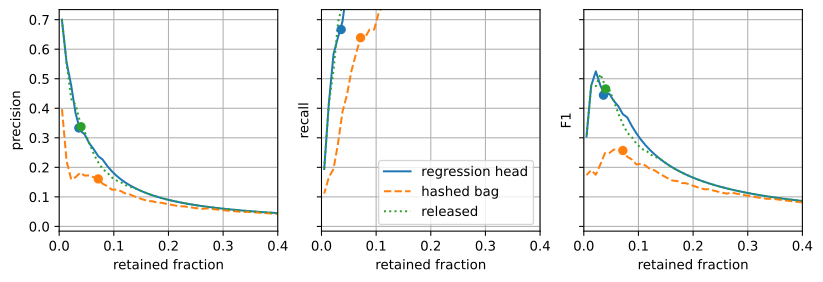
on the 20,000-document stream (FineWeb-Edu kept 7.26% of this dump):
                            classifier  documents  tokens
                       regression head     0.0285  0.0484
                         logistic head     0.0186  0.0301
                            hashed bag     0.0614  0.0576
                              released     0.0356  0.0509
released, int_score >= 3 (FineWeb-Edu)     0.0710  0.0986
regression head, keep a document whose predicted score is at least the cut (t* = 1.611); stream
    shares, test precision and recall against qwen_score >= 3:
  cut  documents  tokens  precision  recall     F1
1.000     0.3674  0.4844     0.0436  1.0000 0.0835
1.500     0.0512  0.0804     0.2705  0.9167 0.4177
1.611     0.0286  0.0485     0.3333  0.6667 0.4444
2.000     0.0028  0.0052     0.6364  0.1944 0.2979
2.500     0.0000  0.0000        NaN  0.0000 0.0000
3.000     0.0000  0.0000        NaN  0.0000 0.0000
of 1e12 tokens of such a dump, regression head keeps about 4.8e+10
Look at the retained shares first. FineWeb-Edu’s own rule, the released classifier’s rounded score at least 3, keeps 7.1% of our stream’s documents and about 10% of its tokens, close to the 7.26% of documents that FineWeb-Edu kept of the whole dump. Our head at \(t^*\) keeps about 3% of the documents and about 5% of the tokens, roughly half of FineWeb-Edu’s tokens. This is the strict scale at work: a score of 3 is several times rarer on Qwen’s scale than on Llama’s, and a filter that looks for it keeps less. The token shares exceed the document shares because the kept documents are longer than average.
The sweep shows the trade. A cut at 1.5 keeps 5% of the documents and finds 92% of the educational test rows, at a precision of 0.27; \(t^*\) keeps 3% at a recall of 0.67; a cut at 2.0 keeps 0.3% at a precision of 0.64 but finds only a fifth of the positives. At 2.5 and above the head keeps nothing at all, for the reason we met with \(t^*\): its predictions never reach the label’s own threshold. Of a trillion tokens of such a dump, \(t^*\) keeps about 50 billion. A run that needs more tokens moves the cut down and accepts that most of what it adds is, by the rubric, not educational.
The manifest therefore stores the score, not the decision. lm-c1-docs-v1 records each crawl document’s predicted score to three decimals, and the threshold is a parameter of its stage, so Section 20.4 can weight bands of the score as separate sources without labelling anything again.
20.2.4 Auditing Removals
A filter that removes 97% of the documents will remove some kinds of pages more than others, and an audit asks which. It has two parts, a table of removal rates by group, each with an interval, and a reading of removed documents. We form three groupings. The country-code domain (.uk, .au, .in and others, against .com) is a proxy for the variety of English, and a weak one: much British writing lives on .com, and a .in domain says where a site is registered, not who wrote it. The host class sorts hosts, by rules on their names, into edu_gov, wiki, forum, news, blog, shop and other. The six FineWeb-2 languages enter under the rules only, because the classifier was trained on English and has nothing to say about Thai. All of it is measured on FineWeb’s output, so the audit cannot see what FineWeb’s own filters and deduplication removed before the stream was drawn.
The intervals need care. Documents from one site are alike: they share templates, authors and topics, and a filter tends to decide them alike. A bootstrap that resamples documents treats 3,000 pages of one site as 3,000 samples and reports an interval far too narrow. audit_removals resamples whole registered domains within each group, a cluster bootstrap, and marks groups with fewer than 100 documents or fewer than 10 domains as too few to report.
def audit_removals(df, keep, by, ref=None, n_boot=2000, cluster=None,
                   seed=0):
    """Removal rate per group of df[by] with a 95% percentile bootstrap
    interval, resampling whole clusters (df[cluster], e.g. the registered
    domain; each row its own cluster if None) within each group; with ref,
    the difference of each group's rate to ref's and its interval. keep is
    a boolean array or a column name. Groups with fewer than 100 rows or
    10 clusters are marked too_few."""
    removed = ~np.asarray(df[keep] if isinstance(keep, str) else keep,
                          dtype=bool)
    groups = df[by].to_numpy()
    clusters = (df[cluster].to_numpy() if cluster is not None
                else np.arange(len(df)))
    rng, reps, rows = np.random.default_rng(seed), {}, []
    for g in sorted(set(groups)):
        m = groups == g
        cl = pd.factorize(clusters[m])[0]
        G = cl.max() + 1
        r = np.bincount(cl, removed[m], G)
        n = np.bincount(cl, minlength=G)
        draws = rng.integers(G, size=(n_boot, G))
        reps[g] = r[draws].sum(1) / n[draws].sum(1)
        lo, hi = np.quantile(reps[g], [0.025, 0.975])
        rows.append(dict(group=g, n=int(m.sum()), n_clusters=int(G),
                         removal=r.sum() / n.sum(), lo=lo, hi=hi))
    out = pd.DataFrame(rows)
    if ref is not None:
        base = out.set_index('group').removal[ref]
        out['diff'] = out.removal - base
        d = np.array([np.quantile(reps[g] - reps[ref], [0.025, 0.975])
                      for g in out.group])
        out['diff_lo'], out['diff_hi'] = d[:, 0], d[:, 1]
    out['too_few'] = (out.n < 100) | (out.n_clusters < 10)
    return out
The cell applies three decisions to the stream: the rules alone, our classifier alone at \(t^*\), and both. For each group it reports the removal rate and its difference to the reference group, .com for the country codes and “other” for the host classes, with a cluster-bootstrap interval. It repeats the audit on two halves of the stream, split by registered domain so that no site appears in both, and keeps a finding only if its sign is the same in both halves. The claim under test is the one an audit exists for: that the combined filter removes some group at a rate that differs from the reference by more than the interval, and that the classifier contributes to the difference beyond the rules. That second part is read from the classifier-alone arm. On FineWeb’s output the rules remove so little that the classifier-alone and combined arms nearly coincide.
Why should anyone care which groups lose more? A filter keyed on a classifier’s score is a covariate shift by construction: it changes the distribution of the inputs a model trains on, in the direction of whatever the classifier was trained to prefer (Section 3.6). Gururangan et al. (2022) found that the filter used for GPT-3, a classifier trained to tell curated text from random web pages, preferred articles from the newspapers of American high schools in larger, wealthier and more urban areas. Dodge et al. (2021) found that C4’s list of banned words removed disproportionately much text in African-American and Hispanic-aligned English, and text that mentions gay and lesbian people. Neither filter was designed to do this. Both did it because their notion of quality was learned from text that was not drawn evenly from the people who write.
CCTLDS = ('.com', '.uk', '.au', '.ca', '.in', '.ng', '.za', '.ph', '.ie',
          '.nz')
S['domain'] = S.url.map(d2l.registered_domain)
S['cctld'] = S.url.map(d2l._cctld)
S['host_class'] = S.url.map(d2l.host_class)
assert S.groupby('domain').half.nunique().max() == 1  # halves share no domain
S['keep_heur'] = ~S.codes.map(bool)
S['keep_clf'] = SCORES[MAIN]['stream'] >= T_STAR[MAIN]
S['keep_both'] = S.keep_heur & S.keep_clf
ARMS = {'heuristics': 'keep_heur', 'classifier': 'keep_clf',
        'both': 'keep_both'}
say('stream halves:', S.half.value_counts().sort_index().to_dict(),
    '| removal rates:', {a: round(float(1 - S[k].mean()), 3)
                         for a, k in ARMS.items()})

def audit(df):
    """The two groupings and three arms on df, one long table."""
    out = []
    for by, ref, sub in (('cctld', '.com', df[df.cctld.isin(CCTLDS)]),
                         ('host_class', 'other', df)):
        for arm, keep in ARMS.items():
            t = d2l.audit_removals(sub, keep, by, ref=ref, cluster='domain')
            out.append(t.assign(grouping=by, arm=arm,
                                ref=t.group == ref))
    return pd.concat(out, ignore_index=True)

AUDIT = {'all': audit(S)} | {h: audit(S[S.half == h]) for h in 'AB'}
full = AUDIT['all']
show = full[~full.ref & ~full.too_few]
for h in 'AB':
    other = AUDIT[h].set_index(['grouping', 'group', 'arm'])
    key = list(zip(show.grouping, show.group, show.arm))
    show = show.assign(**{f'diff_{h}': other['diff'].reindex(key).to_numpy(),
                          f'too_few_{h}': other.too_few.reindex(
                              key).to_numpy()})
show = show.assign(same_sign=np.sign(show.diff_A) == np.sign(show.diff_B))
cols = ['grouping', 'group', 'arm', 'n', 'n_clusters', 'removal', 'diff',
        'diff_lo', 'diff_hi', 'diff_A', 'diff_B', 'same_sign']
print(show[cols].round(3).rename(columns={'n_clusters': 'domains',
                                          'same_sign': 'same'})
      .to_string(index=False))
few = full[full.too_few & (full.arm == 'both')].group.tolist()
print('too few (under 100 documents or 10 domains):', ', '.join(few) or '-')

beyond = show[(show.arm == 'both') & ((show.diff_lo > 0) |
                                      (show.diff_hi < 0))]
clf = show[show.arm == 'classifier'].set_index(['grouping', 'group'])
c4 = [(g, b) for g, b in zip(beyond.grouping, beyond.group)
      if (clf.diff_lo[(g, b)] > 0 or clf.diff_hi[(g, b)] < 0) and
      clf.same_sign[(g, b)] and beyond.set_index(['grouping', 'group'])
      .same_sign[(g, b)]]
say('groups whose combined removal rate differs from the reference '
    'beyond its interval, with the classifier-only interval excluding 0 '
    'and the same sign in both halves:',
    ', '.join(f'{g}={b}' for g, b in c4) or 'none')

fig, (ax1, ax2) = d2l.plt.subplots(1, 2, figsize=(10, 3.5),
                                   gridspec_kw=dict(width_ratios=(2.2, 1)))
groups = show[show.arm == 'both'].group.tolist()
series = {}
for arm in ARMS:
    t = show[show.arm == arm].set_index('group').reindex(groups)
    series[arm] = (100 * t['diff'], 100 * t.diff_lo, 100 * t.diff_hi)
d2l.plot_intervals(groups, series, 'group (country-code domain or host '
                   'class)', 'removal rate minus reference (pp)',
                   reference=0, axes=ax1)
d2l.plot_intervals(list(LANG_TABLE.language), {'heuristics': (
    100 * LANG_TABLE.rate, 100 * LANG_TABLE.lo, 100 * LANG_TABLE.hi)},
    'FineWeb-2 language', 'removal rate (%)', axes=ax2)
d2l.plt.show()
R['audit'] = dict(table=show[cols].to_dict('records'), too_few=few,
                  c4_groups=[f'{g}={b}' for g, b in c4],
                  halves=S.half.value_counts().sort_index().to_dict())
stream halves: {'A': 10089, 'B': 9911} | removal rates: {'heuristics': 0.016, 'classifier': 0.972,
'both': 0.972}
grouping group arm n domains removal diff diff_lo diff_hi diff_A diff_B same
cctld .au heuristics 544 534 0.011 -0.005 -0.013 0.005 -0.005 -0.005 True
cctld .ca heuristics 324 314 0.025 0.009 -0.006 0.027 0.016 0.002 True
cctld .in heuristics 238 235 0.025 0.009 -0.008 0.031 0.001 0.018 True
cctld .nz heuristics 111 108 0.027 0.011 -0.016 0.045 0.015 0.006 True
cctld .uk heuristics 1098 1059 0.011 -0.005 -0.011 0.002 -0.003 -0.007 True
cctld .za heuristics 110 104 0.027 0.011 -0.016 0.047 0.020 0.002 True
cctld .au classifier 544 534 0.989 0.019 0.009 0.027 0.022 0.016 True
cctld .ca classifier 324 314 0.978 0.008 -0.009 0.023 0.011 0.006 True
cctld .in classifier 238 235 0.966 -0.004 -0.029 0.018 0.021 -0.029 False
cctld .nz classifier 111 108 0.973 0.003 -0.032 0.030 0.014 -0.012 False
cctld .uk classifier 1098 1059 0.978 0.008 -0.001 0.017 0.005 0.011 True
cctld .za classifier 110 104 0.982 0.012 -0.017 0.032 0.012 0.012 True
cctld .au both 544 534 0.989 0.019 0.009 0.027 0.022 0.016 True
cctld .ca both 324 314 0.981 0.011 -0.005 0.026 0.010 0.012 True
cctld .in both 238 235 0.966 -0.004 -0.029 0.017 0.021 -0.029 False
cctld .nz both 111 108 0.973 0.003 -0.032 0.030 0.014 -0.012 False
cctld .uk both 1098 1059 0.978 0.008 -0.001 0.017 0.005 0.011 True
cctld .za both 110 104 0.982 0.012 -0.017 0.031 0.012 0.012 True
host_class blog heuristics 569 257 0.016 -0.000 -0.009 0.016 -0.001 0.001 False
host_class edu_gov heuristics 553 402 0.022 0.006 -0.006 0.019 0.002 0.010 True
host_class forum heuristics 204 186 0.020 0.003 -0.013 0.025 0.005 0.002 True
host_class news heuristics 786 680 0.003 -0.014 -0.017 -0.009 -0.013 -0.014 True
host_class shop heuristics 494 476 0.018 0.002 -0.009 0.015 -0.003 0.007 False
host_class blog classifier 569 257 0.981 0.010 -0.016 0.022 0.023 -0.018 False
host_class edu_gov classifier 553 402 0.976 0.006 -0.007 0.018 0.016 -0.004 False
host_class forum classifier 204 186 0.975 0.005 -0.017 0.024 0.009 0.002 True
host_class news classifier 786 680 0.975 0.004 -0.008 0.015 0.007 0.002 True
host_class shop classifier 494 476 0.996 0.026 0.019 0.031 0.022 0.029 True
host_class blog both 569 257 0.981 0.010 -0.017 0.021 0.022 -0.018 False
host_class edu_gov both 553 402 0.976 0.006 -0.007 0.018 0.016 -0.004 False
host_class forum both 204 186 0.975 0.005 -0.018 0.024 0.008 0.002 True
host_class news both 786 680 0.975 0.004 -0.008 0.015 0.007 0.002 True
host_class shop both 494 476 0.996 0.026 0.019 0.031 0.022 0.029 True
too few (under 100 documents or 10 domains): .ie, .ng, .ph, wiki
groups whose combined removal rate differs from the reference beyond its interval, with the
classifier-only interval excluding 0 and the same sign in both halves: cctld=.au,
host_class=shop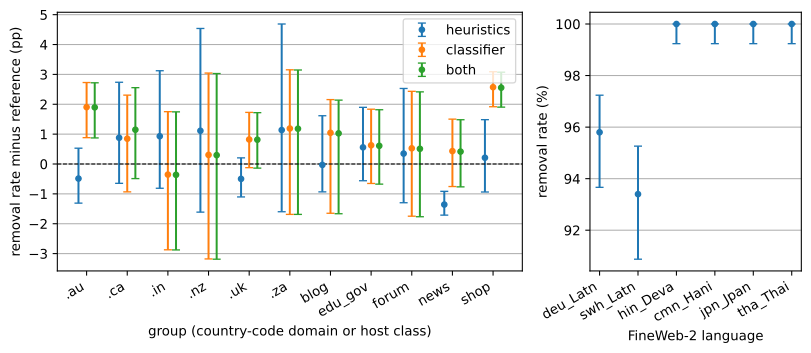
The overall rates frame everything else: the rules remove 1.6% of the stream, the classifier 97.2%. Two groups pass every test. The classifier removes .au pages at a rate 1.9 points higher than .com pages, with an interval from 0.9 to 2.7 points and the same sign in both halves, and shop hosts at a rate 2.6 points higher than other hosts. A difference of two points matters more than it seems, because what reaches the corpus is what the filter keeps: about 3% of .com pages against about 1% of .au pages, 6 of the 544, so Australian sites enter the corpus at roughly a third of the rate of .com sites. Six pages are few, so the third is a rough figure; the interval on the difference is the measured statement. The shops are the rubric working as written, since product pages teach little. The rules have one finding of their own: they remove news pages 1.4 points less often than other pages, in both halves. The other country codes show differences whose intervals include zero, and .ie, .ng, .ph and the wiki hosts are too few to report. These data cannot say why .au differs. The country code is a weak proxy, and the finding is a reason to read .au removals, not a conclusion about Australian English.
Rates say how much each group loses, not whether the losses are mistakes. For that, someone has to read removed pages. We draw 100 documents that our classifier removed and the rules kept, all with a score within 0.3 of \(t^*\), where a mistake is most likely, and 100 that the rules removed, whatever the classifier decided. The labels do not come from people. They come from Qwen3.8-27B again, this time as a judge with its reasoning switched on, under a two-line rubric that asks a different question from the training rubric: would a reader want this page in a general-purpose training corpus? The reasoning has no budget. A budget of, say, a thousand tokens can stop the model in mid-thought and force a verdict it has not reached, so each reply may use up to 12,000 tokens of the 16,384-token context; in practice the replies were short, and none was cut off. Unlike the labeller, the judge takes ten requests per server at a time, which makes the review faster but not reproducible to the bit: batching changes the arithmetic, as we saw above, so a regenerated review can change the verdicts of pages near a tie. The review is not independent of the filter it checks, since the same model wrote the training labels, and a human reading of the same 200 pages would be the stronger test. The cell reports the share of each arm labelled “drop”, the removal precision, with a Wilson interval, and prints five of the pages.
REMOVAL_RUBRIC = (  # what the review labels mean (two lines)
    'keep: a reader would want this page in a general-purpose training '
    'corpus (informative, coherent prose, code or data, in any register).\n'
    'drop: spam, boilerplate, link or product lists, machine-generated or '
    'broken text, or nothing a reader could learn from.')
rng = np.random.default_rng(0)
near = np.abs(SCORES[MAIN]['stream'] - T_STAR[MAIN]) <= 0.3
arms = {  # the stream passed FineWeb's rules, so few documents fail ours,
    # and of those the classifier keeps few: the second arm takes them all
    'classifier only': np.flatnonzero(S.keep_heur & ~S.keep_clf & near),
    'heuristics': np.flatnonzero(~S.keep_heur)}
picked = {a: np.sort(rng.choice(i, min(100, len(i)), replace=False))
          for a, i in arms.items()}
say('removed-document pools:', {a: len(i) for a, i in arms.items()},
    '| reviewed:', {a: len(i) for a, i in picked.items()})
REVIEW = pd.concat([S.iloc[i].assign(arm=a) for a, i in picked.items()],
                   ignore_index=True)
REVIEW['score'] = np.concatenate([SCORES[MAIN]['stream'][i]
                                  for i in picked.values()])
LABELS_KEY = 'lm-data-removal-labels-v1'
RUBRIC_SHA = hashlib.sha256(REMOVAL_RUBRIC.encode()).hexdigest()
REVIEW_ASK = (  # the judge's instruction; the document follows it
    'A quality filter removed the web page below from a corpus for '
    'pretraining a language model. Decide with this rubric whether the '
    'page should have been kept:\n\n' + REMOVAL_RUBRIC + '\n\nAnswer with '
    'one line of JSON and nothing else: {"label": "keep" or "drop", '
    '"rationale": "<one sentence>"}\n\nThe page (its first 3,000 '
    'characters):\n\n')

def judge_removals(urls, docs, per_server=10):
    """The judge's label and rationale for each of docs: thinking on,
    greedy, at most JUDGE_MAX_TOKENS new tokens, no reasoning budget."""
    import threading
    gates = [threading.Semaphore(per_server) for _ in urls]
    def one(i):
        body = dict(model=LABELLER, temperature=0, seed=0,
                    max_tokens=JUDGE_MAX_TOKENS,
                    messages=[{'role': 'user', 'content': REVIEW_ASK +
                               docs.text.iloc[i][:3000]}],
                    chat_template_kwargs={'enable_thinking': True})
        with gates[i % len(urls)]:
            d = d2l._vllm_post(urls[i % len(urls)], '/chat/completions',
                               body, timeout=3600.0)
        c = d['choices'][0]
        text = (c['message'].get('content') or '').split('</think>')[-1]
        found = re.findall(r'\{[^{}]*\}', text)
        try:
            v = json.loads(found[-1])
            assert v['label'] in ('keep', 'drop')
        except (IndexError, ValueError, KeyError, AssertionError):
            v = dict(label=None, rationale=text[-300:])
        return dict(id=docs.id.iloc[i], label=v['label'],
                    rationale=str(v.get('rationale', '')),
                    finish=c['finish_reason'],
                    tokens=d['usage']['completion_tokens'])
    with concurrent.futures.ThreadPoolExecutor(per_server * len(urls)) as ex:
        return pd.DataFrame(list(ex.map(one, range(len(docs)))))

if 'removal-labels' in RERUN:
    t0 = time.time()
    got = with_servers(lambda urls: judge_removals(urls, REVIEW))
    print(f'judged {len(got)} removals in {time.time() - t0:.0f} s; reply '
          f'tokens median {got.tokens.median():.0f}, largest '
          f'{got.tokens.max()}; cut off {(got.finish == "length").sum()}, '
          f'without a label {got.label.isna().sum()}')
    assert got.label.notna().all(), 'a reply without a verdict'
    got = got.assign(labeller=f'{LABELLER}@{pins[LABELLER]} thinking, '
                     f'max_tokens {JUDGE_MAX_TOKENS}',
                     rubric_sha256=RUBRIC_SHA)
    d2l.lm_save_rerun(ARTIFACTS['removal-labels'][1], lambda f:
                      d2l.write_jsonl(f, json.loads(got.to_json(
                          orient='records'))))
if LABELS_KEY not in d2l.DATA_HUB and 'removal-labels' not in RERUN:
    print(f'{LABELS_KEY} not registered: removal precision pending')
    R['review'] = None
else:
    labels = d2l.read_jsonl(d2l.lm_artifact(
        LABELS_KEY, ARTIFACTS['removal-labels'][1]
        if 'removal-labels' in RERUN else None))
    assert (labels.rubric_sha256 == RUBRIC_SHA).all(), 'another rubric'
    REVIEW = REVIEW.merge(labels[['id', 'label', 'rationale', 'labeller']],
                          on='id', how='left', validate='1:1')
    assert REVIEW.label.notna().all(), (  # t* or the heads have changed
        f'{REVIEW.label.isna().sum()} sampled documents have no label: '
        'label the new sample and register it as the next version')
    rows = []
    for a, t in REVIEW.groupby('arm'):
        k = int((t.label == 'drop').sum())
        lo, hi = d2l.wilson_ci(k, len(t))
        rows.append(dict(arm=a, n=len(t), drop=k, precision=k / len(t),
                         lo=lo, hi=hi))
    PREC = pd.DataFrame(rows)
    say(f'labeller: {REVIEW.labeller.iloc[0]}; removal precision (share '
        'labelled "drop"):')
    print(PREC.round(3).to_string(index=False))
    for _, r in REVIEW.sample(5, random_state=0).iterrows():
        say(f'\n[{r.arm}, score {r.score:.2f}, label {r.label}] '
            f'{r.rationale}')
        print(textwrap.fill(r.text[:300].replace('\n', ' ') + ' …', 100,
                            initial_indent='  ', subsequent_indent='  '))
    print('\n' + ATTRIBUTION)
    say(f'judge replies: median {labels.tokens.median():.0f} tokens, largest '
        f'{labels.tokens.max()}, cut off at max_tokens '
        f'{(labels.finish == "length").sum()} of {len(labels)}')
    R['review'] = PREC.to_dict('records')
    R['review_judge'] = dict(labeller=REVIEW.labeller.iloc[0],
                             tokens_median=float(labels.tokens.median()),
                             tokens_max=int(labels.tokens.max()),
                             cut_off=int((labels.finish == 'length').sum()))
long = S[S.keep_heur & (S.text.str.len() >= 1500)]
R['opening'] = dict(low_score_id=long.id.iloc[int(np.argmin(
    SCORES[MAIN]['stream'][long.index]))])
if R['review'] is not None:
    kept = REVIEW[(REVIEW.label == 'keep') & (REVIEW.arm == 'classifier only')]
    R['opening']['kept_label_id'] = (kept.sort_values('score').id.iloc[0]
                                     if len(kept) else None)
removed-document pools: {'classifier only': 1838, 'heuristics': 317} | reviewed: {'classifier only':
100, 'heuristics': 100}
labeller: RedHatAI/Qwen3.8-27B-INT4@71dface38d4cbfa34121f1d446d4a0fa1025f13c thinking, max_tokens
12000; removal precision (share labelled "drop"):
arm n drop precision lo hi
classifier only 100 11 0.11 0.063 0.186
heuristics 100 70 0.70 0.604 0.781
[classifier only, score 1.32, label drop] The page is generic, vague, and likely machine-generated
SEO filler with little substantive information and a truncated contact address.
In the world of technology, adapters play a crucial role in ensuring compatibility between
different devices and systems. One such adapter that has gained popularity is the 21A adapter. In
this article, we will explore what a 21A adapter is, its functions, and why it is widely used in
various indust …
[heuristics, score 1.37, label keep] The page is a concise, informative encyclopedia entry about a
figure in Greek mythology, providing coherent prose a reader could learn from.
Erisichthon (wool of the earth, much earth) In Greek mythology, a sacrilegious person, son of
Triopas and Hiscilla of Thessaly; brother of Iphimedeia, Messene, and Phorbas; father of Mestra.
Mestra could take any beast form, which was a gift from her lover, Poseidon. Erisichthon would
sell Mestra in …
[heuristics, score 0.89, label keep] The page is a coherent, informative professional bio describing
a massage therapist's training, techniques, and services.
Laresa attended Vancouver College of Massage Therapy (VCMT) where she was honoured with the Heart
Award for ‘Unconditional positive regard for others combined with a passionate commitment to
excellence in the massage therapy profession’.Laresa’s holistic approach to massage focuses on
treating speci …
[classifier only, score 1.57, label drop] The page is a disjointed, contradictory collection of
low-quality snippets about billionaire net worth that reads like machine-generated or scraped
SEO content rather than coherent, useful prose.
Elon Musk is an entrepreneur and business magnate who co-founded PayPal and Tesla Motors. He is
now the CEO of SpaceX. As of March 2017, Musk’s personal wealth is estimated to be $13.9 billion,
making him the 83rd richest person in the world. In contrast, the President of the United States
is only w …
[heuristics, score 0.40, label drop] The page is a short e-commerce product description with
marketing copy and UI boilerplate, offering little general-purpose learning value.
Big jeans were synonymous with the nineties, but no matter the decade, it's been proven that these
'94 Baggy Bootcut jeans will never go out of style. They’re effortless, cool and feature a mid
rise and bootcut leg, making whatever you pair them with look just that much better. Fit and
Sizing Loose …
Text: FineWeb, HuggingFaceFW/fineweb, CC-MAIN-2025-05 (ODC-By 1.0)
judge replies: median 131 tokens, largest 723, cut off at max_tokens 0 of 200The two arms differ sharply. Of the classifier’s removals near its threshold, the judge would have dropped about 1 in 10 (interval 6 to 19 in 100); of the rules’ removals, about 70% (interval 60% to 78%). Near its threshold the classifier mostly removes pages that a general corpus would keep, like the hiring guide that opened the section. The rules mostly remove pages that nobody would miss, such as the product description of a pair of jeans, though not always: an encyclopedia entry on Erisichthon of Greek mythology and a massage therapist’s professional profile were removed by rules and judged worth keeping. The classifier is doing what it was trained to do. It looks for pages that teach schoolchildren, and by that rubric the pages it removes are removed correctly; the judge’s rubric is broader. The gap between 0.11 and 0.70 is the gap between two definitions of quality, and choosing between them is a decision about the corpus, not about the classifier.
The last comparison puts our classifier and the released one side by side on the whole stream, each at its own threshold.
a = SCORES[MAIN]['stream'] >= T_STAR[MAIN]
b = SCORES['released']['stream'] >= T_STAR['released']
k, (k_lo, k_hi) = kappa_ci(a, b)
say(f'on the stream, {MAIN} and the released classifier keep '
    f'{a.mean():.3f} and {b.mean():.3f}; they agree on '
    f'{np.mean(a == b):.3f} of the documents, Cohen\'s kappa {k:.3f} '
    f'[{k_lo:.3f}, {k_hi:.3f}]')
R['stream_kappa'] = [k, k_lo, k_hi]
on the stream, regression head and the released classifier keep 0.029 and 0.036; they agree on 0.967
of the documents, Cohen's kappa 0.466 [0.430, 0.499]They keep 2.9% and 3.6% of the documents and agree on 96.7% of them, but most of that agreement is on documents both remove. Cohen’s kappa, which discounts the agreement expected by chance, is about 0.47. Two classifiers with the same test F1 select noticeably different corpora.
20.2.5 The Filter in the Pipeline
The filters enter the corpus of Section 20.1 as two stages of its manifest. The heuristics stage removes documents and charges each one to the first rule that fires. The edu_score stage removes nothing. It attaches the score and records the threshold, the head’s SHA-256 and the embedder’s revision as parameters, so a later stage, or a reader, can apply any threshold and know exactly which model produced the scores. The flags file lm-c1-docs-v1 holds, for each crawl document, its id, its reason codes and its score, and no text.
FLAGS_KEY = 'lm-c1-docs-v1'
HEAD_KEY, HEAD_FILE = 'lm-quality-head-v1', 'lm-quality-head-v1.npz'
head_arrays = {'weight.npy': reg_head.weight.detach().numpy()[0],
               'bias.npy': reg_head.bias.detach().numpy()}
head_bytes = {}
for k, v in head_arrays.items():
    buf = io.BytesIO()
    np.save(buf, v.astype(np.float32), allow_pickle=False)
    head_bytes[k] = buf.getvalue()
head_sha = hashlib.sha256(b''.join(head_bytes[k] for k in sorted(
    head_bytes))).hexdigest()  # of the registered file's exact weights
if C0_EMB is not None:
    with torch.no_grad():
        c0_score = reg_head(torch.tensor(C0_EMB, dtype=torch.float32)
                            )[:, 0].numpy()
else:  # the CPU path: the scores of the registered flags
    assert FLAGS_KEY in d2l.DATA_HUB and 'quality-flags' not in RERUN, (
        'c0 scores need c0 vectors: run once on a GPU')
    with gzip.open(d2l.lm_artifact(FLAGS_KEY), 'rt') as f:
        reg_rows = {r['id']: r for r in map(json.loads, f)}
    c0_score = np.array([reg_rows[d.id]['edu_score'] for d in C0])
    live = d2l.embed_docs([d.text for d in C0[:8]], EMBEDDER, MAX_LEN)
    with torch.no_grad():
        s8 = reg_head(torch.tensor(live, dtype=torch.float32))[:, 0].numpy()
    gap8 = np.abs(s8 - c0_score[:8]).max()
    print('live check on 8 c0 documents (CPU, fp32): largest score '
          f'difference to the registered flags {gap8:.3f}')
    assert gap8 <= 0.05, 'the registered flags come from other vectors'
FLAG_ROWS = [dict(id=d.id, codes=C0_CODES[d.id],
                  edu_score=round(float(v), 3)) for d, v in zip(C0, c0_score)]
kept = [d for d in C0 if not C0_CODES[d.id]]
first = collections.Counter(C0_CODES[d.id][0] for d in C0 if C0_CODES[d.id])
c0m = json.load(open(d2l.lm_artifact('lm-data-crawl-results-v1')))[
    'c0_manifest']
assert d2l.docs_hash(C0) == c0m['stages'][-1]['out_hash']
m = d2l.CorpusManifest('c1', c0m['sources'], c0m['stages'])
m.add_stage('heuristics', dict(cfg=d2l.GOPHER_CFG, charge='first rule'),
            len(C0), len(kept), first, d2l.docs_hash(C0), d2l.docs_hash(kept),
            impl='d2l.heuristic_filters')
m.add_stage('edu_score', dict(threshold=round(T_STAR[MAIN], 4),
                              head=MAIN, head_sha256=head_sha,
                              embedder=f'{EMBEDDER}@{pins[EMBEDDER]}',
                              max_len=MAX_LEN, labels=TRAIN_LABEL),
            len(kept), len(kept), {}, d2l.docs_hash(kept),
            d2l.docs_hash(kept), impl='d2l.embed_docs + linear head')
for s in m.stages[-2:]:
    say(json.dumps({k: s[k] for k in ('name', 'n_in', 'n_out', 'drops')}))
above = sum(C0_CODES[d.id] == [] and v >= T_STAR[MAIN]
            for d, v in zip(C0, c0_score))
say(f'c0 documents kept by the rules with edu_score >= t*: {above:,} of '
    f'{len(kept):,} (the flag keeps the score; the threshold is a '
    'parameter)')
if 'quality-flags' in RERUN:
    d2l.lm_save_rerun(ARTIFACTS['quality-flags'][1],
                      lambda f: d2l.write_docs(f, FLAG_ROWS))
elif C0_EMB is not None:  # GPU: live scores against the registered flags
    with gzip.open(d2l.lm_artifact(FLAGS_KEY), 'rt') as f:
        reg_rows = {r['id']: r for r in map(json.loads, f)}
    codes_same = all(reg_rows[r['id']]['codes'] == r['codes']
                     for r in FLAG_ROWS)
    diff = np.array([abs(reg_rows[r['id']]['edu_score'] - r['edu_score'])
                     for r in FLAG_ROWS])
    flip = sum((reg_rows[r['id']]['edu_score'] >= T_STAR[MAIN]) !=
               (r['edu_score'] >= T_STAR[MAIN]) for r in FLAG_ROWS)
    say(f'against {FLAGS_KEY}: reason codes '
        f'{"identical" if codes_same else "DIFFER"}; edu_score largest '
        f'difference {diff.max():.3f}; {flip} decisions '
        'flip (each within that difference of t*)')
    assert codes_same and diff.max() <= 0.01  # bf16 tolerance (spec)
    assert flip <= np.sum(np.abs(c0_score - T_STAR[MAIN]) <= diff.max())
R['c1_manifest'] = m.to_dict()
{"name": "heuristics", "n_in": 3288, "n_out": 1032, "drops": {"c4_quality": 123, "gopher_dup_ngram":
176, "fw_line_punct": 195, "gopher_words": 322, "gopher_stop_words": 21, "fw_dup_chars": 89,
"gopher_dup_text": 571, "gopher_top_ngram": 247, "gopher_alpha": 403, "gopher_ellipsis": 52,
"fw_short_lines": 33, "gopher_bullets": 15, "gopher_word_len": 7, "gopher_symbols": 2}}
{"name": "edu_score", "n_in": 1032, "n_out": 1032, "drops": {}}
c0 documents kept by the rules with edu_score >= t*: 20 of 1,032 (the flag keeps the score; the
threshold is a parameter)
against lm-c1-docs-v1: reason codes identical; edu_score largest difference 0.000; 0 decisions flip
(each within that difference of t*)The rules keep 1,032 of the 3,288 crawl documents, and 20 of those score at or above \(t^*\), about 2%, in line with the stream. The last cell compares every number this run computed with the registered results, and the manifest and the head’s weights with their registered copies.
def rounded(x):
    """Floats to 4 decimals, numpy values to Python, NaN to None."""
    if isinstance(x, dict):
        return {str(k): rounded(v) for k, v in x.items()}
    if isinstance(x, (list, tuple, np.ndarray)):
        return [rounded(v) for v in x]
    if isinstance(x, (np.integer, np.floating, np.bool_)):
        x = x.item()
    if isinstance(x, float):
        return None if x != x else round(x, 4)
    return x

RES_KEY, RES_FILE = ARTIFACTS['quality-results']
results = rounded(R)
blob = json.dumps(results, sort_keys=True, indent=1).encode('utf-8')
if 'quality-results' in RERUN:
    d2l.lm_save_rerun(RES_FILE, lambda f: pathlib.Path(f).write_bytes(blob))
    d2l.lm_save_rerun(HEAD_FILE, lambda f: d2l.lm_write_zip(f, head_bytes))
else:
    def comparable(x):
        """x without the perplexity results (GPU only) and the head's hash
        (the weights' last bits depend on the CPU's thread count; they are
        compared to 1e-5 below)."""
        if isinstance(x, dict):
            return {k: comparable(v) for k, v in x.items()
                    if k not in ('ppl', 'head_sha256')}
        return [comparable(v) for v in x] if isinstance(x, list) else x
    reg = json.load(open(d2l.lm_artifact(RES_KEY)))
    live, old = comparable(results), comparable(reg)
    a = d2l.json_agreement(live, old)
    same = old['c1_manifest'] == live['c1_manifest']
    say(f'against {RES_KEY}: {a["equal"]}/{a["values"]} values equal, '
        f'largest numeric difference {a["max_diff"]:.2g}; c1 manifest '
        f'{"identical" if same else "DIFFERS"}')
    ALLOWED = set()  # paths whose non-numeric values may differ: none
    bad = [k for k in a['mismatches'] + a['missing'] if k not in ALLOWED]
    for k in bad[:20]:
        print('  differs or one-sided:', '/'.join(map(str, k)))
    head = dict(np.load(d2l.lm_artifact(HEAD_KEY)))
    w_gap = np.abs(head['weight'] - head_arrays['weight.npy']).max()
    bits = reg['c1_manifest'] == results['c1_manifest']  # with the hash
    print(f'head weights against {HEAD_KEY}: largest difference {w_gap:.1e}'
          f' (bit-identical: {bits})')
    assert same and not bad and a['max_diff'] <= 0.005 and w_gap < 1e-5
against lm-data-quality-results-v1: 901/901 values equal, largest numeric difference 0; c1 manifest
identical
head weights against lm-quality-head-v1: largest difference 0.0e+00 (bit-identical: True)Every filter in this section removes documents because they differ from something: from English function words, from a reference model’s training data, from what Llama or Qwen think a schoolteacher would use. What survives leans toward the annotator’s taste. The audit can show where it leans, but not whether a model trained on the result is better or worse for it. That takes training runs with everything but the data held fixed, the method of Section 20.4, whose web text is FineWeb-Edu as released, filtered by the labels of Llama-3-70B.
20.2.6 Summary
A quality filter decides which part of the web a model learns from, and it follows a definition of quality that somebody wrote down: rules over surface statistics, or a rubric that a large model applies and a small classifier learns. The Gopher, C4 and FineWeb rules remove about two thirds of our crawl documents and match FineWeb’s code on about 96% of them. They remove every Chinese, Japanese and Thai document, whose words are not separated by spaces, and our word pattern removes every Hindi one. The documents of lowest perplexity are boilerplate and machine-written prose. Qwen3.8-27B, scoring documents under FineWeb-Edu’s rubric from its next-token probabilities, uses a far stricter scale than Llama-3-70B did (about 1.4% against 9% at 3 or more) yet orders documents alike. A linear head on a frozen embedder learns its labels about as well as the released classifier does. Both stay below the F1 of about 0.67 at which Qwen reproduces its own labels when asked a second way. Since \(\textrm{F1} = 2\pi\,\textrm{TPR}/(\pi + \rho)\), a threshold is a choice of retained fraction, here about 3% of the documents. An audit that resamples whole sites finds that the classifier removes Australian domains and shops more often, and near its threshold it mostly removes pages that a general corpus would keep.
20.2.7 Exercises
Two F1 scores on one card. The released classifier’s card reports an F1 of 82% “when converted to a binary classifier using a score threshold of 3”, and a classification report in which score 5 has an F1 of 0.02.
- Explain why both can be true, and what each says about using the classifier as a filter at 3.
- The card’s confusion matrix over its 46,867 hold-out rows has these rows, true scores 0 to 5, and columns, predicted scores 0 to 5: (2791, 2858, 45, 0, 0, 0), (919, 22343, 3180, 69, 1, 0), (3, 3225, 6330, 757, 7, 0), (1, 66, 1473, 1694, 173, 0), (0, 4, 98, 420, 283, 2), (0, 0, 18, 85, 21, 1). Compute the F1 of the positive class “score at least 3”. Which average over the two classes gives 82%?
- [code] Our test rows are drawn from this hold-out. Compute the released classifier’s F1 against Llama’s labels at its rounded score 3, and compare it with the table’s 0.54 at \(t^*\). Why do the two differ?
Thresholds on a regression.
- Why is the F1 at the threshold that maximizes F1 on the test rows an optimistic estimate of the F1 at deployment? Name two ways to avoid the bias.
- Among the documents that a head cannot tell apart, a share \(q\) is labelled 3 and the rest 1. Show that the prediction minimizing the expected squared error on them is \(1 + 2q\), and find the \(q\) at which it reaches 2.5. Use this to explain why our regression head keeps nothing at a cut of 2.5.
- Would the logistic head’s probability have the same problem with a cut at 0.5? Compare its \(t^*\) with 0.5 and explain.
The cost of a false removal. A crawl holds \(T\) tokens in documents of equal length, of which a share \(\pi\) are labelled educational.
- Using Equation 20.2.1, write the educational tokens that a filter with retained fraction \(\rho\) and score F1 removes, in terms of \(T\), \(\pi\), \(\rho\) and F1.
- Put in this section’s numbers (\(\pi \approx 0.014\), \(\rho \approx 0.029\), \(\textrm{F1} \approx 0.44\)) for \(T = 10^{12}\). How many educational tokens does \(t^*\) remove?
- A classifier at the noise ceiling of Equation 20.2.2 keeps the same \(\rho\). Bound the educational tokens it removes, and say when your bound is vacuous. Which part of the loss could a better classifier recover, and which part is in the labels?
Asymmetric noise. ● The labeller misses a true positive with probability \(\eta_1\) and invents a positive from a true negative with probability \(\eta_0\).
- Derive the precision, recall and F1 against the labels of a perfect classifier of the true label.
- With \(\pi^* = 0.0926\) and \(\eta_1 = 0.02\), find the \(\eta_0\) at which this ceiling equals the symmetric ceiling at \(\eta = 0.05\).
- Our two protocols disagree on 19 test rows, 17 of them in one direction. Can \(\eta_0\) and \(\eta_1\) of each protocol be estimated from two annotations alone? What would a third annotation add?
[code] Two labellers, two filters. Train a second regression head on Llama’s scores, choose its threshold on the validation rows against Llama’s labels, and apply both heads to the stream. Report the share each keeps, their Cohen’s kappa with an interval, and the host classes and country codes where their decisions differ most. Then predict which of the two filtered corpora would train the better model, and say how the proxy runs of Section 20.4 could test your prediction.
[code] How far behind is the bag? Before measuring, state the largest F1 gap between the hashed bag and the regression head that you would accept for a filter that runs on a CPU. Measure the gap with a paired bootstrap over the test rows. Then try to close it without a GPU: more epochs, character n-grams, or training the bag on the score rather than the binary label. Which change helps, and is the improvement larger than its interval?
[code] A human review. Read the 200 reviewed documents yourself and label each one under the two-line rubric of the review cell, without looking at the judge’s labels. Compute the removal precision of each arm with its Wilson interval and Cohen’s kappa between your labels and the judge’s. Do your labels change the conclusion about the two arms? Where you and the judge disagree, which of you followed the rubric?
[extended] Quality or script? Choose one of the six FineWeb-2 languages that you read. Draw 50 of its documents that the English rules remove, label each as worth keeping or not, and record which rule fired first. Are the removals quality or script artifacts? Rewrite the rules that fire most so that they suit the language (a word tokenizer for the script, stop words of the language), and report the removal rate and your labels’ precision again.