d2l.set_figsize()
img = d2l.plt.imread('../img/catdog.jpg')
d2l.plt.imshow(img);32.3 Object Detection and Bounding Boxes
In earlier sections (e.g., Section 7.1 to Section 7.2.3), we introduced various models for image classification. In image classification tasks, we assume that there is only one major object in the image and we only focus on how to recognize its category. However, there are often multiple objects in the image of interest. We not only want to know their categories, but also their specific positions in the image. In computer vision, we refer to such tasks as object detection (or object recognition).
Object detection has been widely applied in many fields. For example, self-driving needs to plan traveling routes by detecting the positions of vehicles, pedestrians, roads, and obstacles in the captured video images. Besides, robots may use this technique to detect and localize objects of interest throughout its navigation of an environment. Moreover, security systems may need to detect abnormal objects, such as intruders or bombs.
In the next few sections, we will introduce several deep learning methods for object detection. We will begin with an introduction to positions (or locations) of objects.
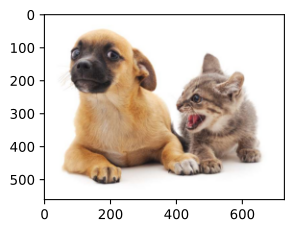
from mxnet import imageWe will load the sample image to be used in this section. We can see that there is a dog on the left side of the image and a cat on the right. They are the two major objects in this image.
d2l.set_figsize()
img = d2l.plt.imread('../img/catdog.jpg')
d2l.plt.imshow(img);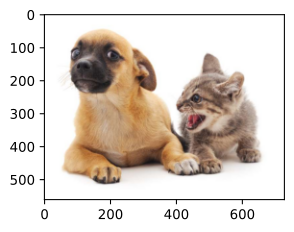
d2l.set_figsize()
img = d2l.plt.imread('../img/catdog.jpg')
d2l.plt.imshow(img);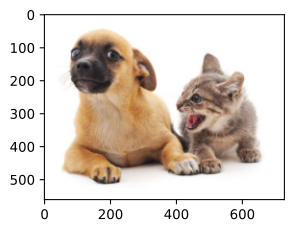
d2l.set_figsize()
img = image.imread('../img/catdog.jpg').asnumpy()
d2l.plt.imshow(img);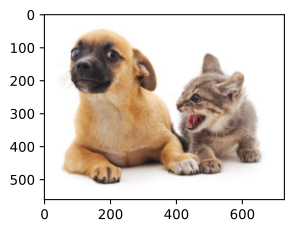
32.3.1 Bounding Boxes
In object detection, we usually use a bounding box to describe the spatial location of an object. The bounding box is rectangular, which is determined by the \(x\) and \(y\) coordinates of the upper-left corner of the rectangle and the such coordinates of the lower-right corner. Another commonly used bounding box representation is the \((x, y)\)-axis coordinates of the bounding box center, and the width and height of the box.
Here we define functions to convert between these two representations: box_corner_to_center converts from the two-corner representation to the center-width-height representation, and box_center_to_corner vice versa. The input argument boxes should be a two-dimensional tensor of shape (\(n\), 4), where \(n\) is the number of bounding boxes.
def box_corner_to_center(boxes):
    """Convert from (upper-left, lower-right) to (center, width, height)."""
    x1, y1, x2, y2 = boxes[:, 0], boxes[:, 1], boxes[:, 2], boxes[:, 3]
    cx = (x1 + x2) / 2
    cy = (y1 + y2) / 2
    w = x2 - x1
    h = y2 - y1
    boxes = d2l.stack((cx, cy, w, h), axis=-1)
    return boxes


def box_center_to_corner(boxes):
    """Convert from (center, width, height) to (upper-left, lower-right)."""
    cx, cy, w, h = boxes[:, 0], boxes[:, 1], boxes[:, 2], boxes[:, 3]
    x1 = cx - 0.5 * w
    y1 = cy - 0.5 * h
    x2 = cx + 0.5 * w
    y2 = cy + 0.5 * h
    boxes = d2l.stack((x1, y1, x2, y2), axis=-1)
    return boxes
We will define the bounding boxes of the dog and the cat in the image based on the coordinate information. The origin of the coordinates in the image is the upper-left corner of the image, and to the right and down are the positive directions of the \(x\) and \(y\) axes, respectively.
# Here `bbox` is the abbreviation for bounding box
dog_bbox, cat_bbox = [60.0, 45.0, 378.0, 516.0], [400.0, 112.0, 655.0, 493.0]
We can verify the correctness of the two bounding box conversion functions by converting twice.
boxes = d2l.tensor((dog_bbox, cat_bbox))
box_center_to_corner(box_corner_to_center(boxes)) == boxestensor([[True, True, True, True],
[True, True, True, True]])<tf.Tensor: shape=(2, 4), dtype=bool, numpy=
array([[ True,  True,  True,  True],
[ True, True, True, True]])>Array([[ True, True, True, True],
[ True, True, True, True]], dtype=bool)array([[ True, True, True, True],
[ True, True, True, True]])Let’s draw the bounding boxes in the image to check if they are accurate. Before drawing, we will define a helper function bbox_to_rect. It represents the bounding box in the bounding box format of the matplotlib package.
def bbox_to_rect(bbox, color):
    """Convert bounding box to matplotlib format."""
    # Convert the bounding box (upper-left x, upper-left y, lower-right x,
    # lower-right y) format to the matplotlib format: ((upper-left x,
    # upper-left y), width, height)
    return d2l.plt.Rectangle(
        xy=(bbox[0], bbox[1]), width=bbox[2]-bbox[0], height=bbox[3]-bbox[1],
        fill=False, edgecolor=color, linewidth=2)
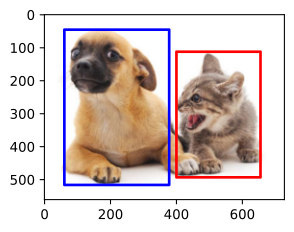
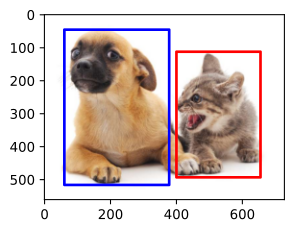
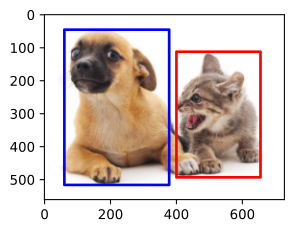
After adding the bounding boxes on the image, we can see that the main outline of the two objects is basically inside the two boxes.
fig = d2l.plt.imshow(img)
fig.axes.add_patch(bbox_to_rect(dog_bbox, 'blue'))
fig.axes.add_patch(bbox_to_rect(cat_bbox, 'red'));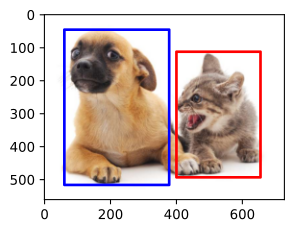
32.3.2 Summary
- Object detection not only recognizes all the objects of interest in the image, but also their positions. The position is generally represented by a rectangular bounding box.
- We can convert between two commonly used bounding box representations.
32.3.3 Exercises
- Find another image and try to label a bounding box that contains the object. Compare labeling bounding boxes and categories: which usually takes longer?
- Why is the innermost dimension of the input argument
boxesofbox_corner_to_centerandbox_center_to_corneralways 4? - Data augmentation for object detection must transform the boxes together with the image. Let the image have width \(W\) and height \(H\).
- Show that flipping the image left to right maps the box \((x_1, y_1, x_2, y_2)\) to \((W - x_2, y_1, W - x_1, y_2)\), and that rotating it by 90 degrees counterclockwise maps the box to \((y_1, W - x_2, y_2, W - x_1)\) in an image of width \(H\) and height \(W\). Why do the corners have to be reordered?
- Implement both maps for a tensor
boxesof shape (\(n\), 4). Apply them todog_bboxandcat_bbox, and draw the results withbbox_to_recton the flipped imageimg[:, ::-1]and on the rotated imageimg.transpose(1, 0, 2)[::-1]to check them.
- Suppose that an annotator places each of the four corner coordinates \(x_1, y_1, x_2, y_2\) with an independent error of standard deviation \(\sigma\) pixels. Write
box_corner_to_centeras a \(4 \times 4\) matrix acting on \((x_1, y_1, x_2, y_2)^\top\), and use it to show that the center coordinates have standard deviation \(\sigma/\sqrt{2}\), the width and height have standard deviation \(\sqrt{2}\sigma\), and the center is uncorrelated with the width and height. For the cat box and \(\sigma = 5\) pixels, estimate to first order the relative standard deviation of the box area. - An axis-aligned box describes a rotated object only loosely. Show that a rectangular object of width \(a\) and height \(b\), rotated by an angle \(\theta \in [0, \pi/2]\), has a bounding box of width \(a\cos\theta + b\sin\theta\) and height \(a\sin\theta + b\cos\theta\). Show that the fraction of the box area covered by the object is smallest at \(\theta = \pi/4\), where it equals \(2ab/(a+b)^2\). Evaluate this for an elongated object such as a pen with \(a = 4b\): what fraction of its box is background?