import collections
import copy
import gzip
import hashlib
import itertools
import json
import os
import shutil
import tempfile
import textwrap
import time
import unicodedata
import warnings
import pandas as pd
import regex
import sentencepiece as spm
import tiktoken
import transformers
from scipy.interpolate import PchipInterpolator
from torch.utils.checkpoint import checkpoint20.6 Tokenizers at Scale
Every model in this part reads text through a tokenizer, and so far we have taken the tokenizer as given. Section 8.2 built one, a byte-level BPE, and noticed in passing that it treats languages unequally: GPT-2’s tokenizer spent about seven tokens on a Greek word where an English word needed one. That looked like a curiosity of an old tokenizer. It is more than that, because a language model counts everything in tokens. A language that needs three times the tokens for the same text costs three times the compute to train on and to serve, and fits a third as much into the context window. Below, the same passages in ten languages go through four released tokenizers, and under all but the newest of them the Hindi version of a passage needs several times the tokens of the English one.
Recall how that tokenizer works. Byte-level BPE starts from the 256 byte values, so that any string can be encoded, and repeatedly merges the most frequent adjacent pair of symbols into a new symbol until the vocabulary is full (Sennrich et al. 2016; Radford et al. 2019). A regular expression first cuts the text into words, numbers and punctuation, so that no merge crosses those boundaries, and a few special tokens such as <|endoftext|> are reserved outside the merges. Section 8.2.5.3 measured what this does to different scripts and to numbers.
This section asks four questions that the builders of a model must answer before its first training step. Is merging the only way to build a vocabulary? It is not: the unigram model gives every piece a probability and segments text by maximizing it. What does the text a tokenizer is trained on do to each language? How large should the vocabulary be? The answer is a question of compute, with a short derivation. And can a trained model’s vocabulary be changed afterwards? At the end we freeze the tokenizer that the rest of this part uses and write the token files that the next chapter trains on. A tokenizer is the one component of a language model that cannot be changed cheaply once a model has been trained on it, so these choices deserve more thought than they usually get.
Most of this section runs on a CPU. Two experiments need a GPU: six small language models that compare tokenizers, and eight runs that extend the vocabulary of a released model. A normal build reads their registered results, checks that they match this build’s tokenizers, text and configuration, and repeats part of each. Both are small, at what this chapter calls T1 scale, and the cell below prints what that means.
LANGS = ('eng_Latn', 'deu_Latn', 'rus_Cyrl', 'arb_Arab', 'hin_Deva',
         'cmn_Hani', 'jpn_Jpan', 'tha_Thai', 'swh_Latn', 'kor_Hang')
BELEBELE = {l: 'zho_Hans' if l == 'cmn_Hani' else l for l in LANGS}
V_SMALL = 16_384            # the small tokenizers' vocabulary
ALPHAS = (1.0, 0.3, 0.0)     # language weighting of tokenizer text
TOK_PROXY = d2l.ProxyCfg(num_hiddens=256, num_heads=4, num_blks=4,
                         seq_len=512, vocab_size=V_SMALL)
SEEDS, LOG_EVERY, LIVE_TOKENS = (0, 1), 4, 2**19
LM_EPOCHS = 1.0              # passes of each small LM over its 45 MB
EXT_MODEL, N_NEW = 'Qwen/Qwen3-0.6B-Base', 4_096
EXT_TRAIN = dict(embed_steps=50, embed_lr=3e-3, lr=1e-5, warmup=10,
                 steps=150, batch=8, micro_batch=4, seq_len=1024,
                 eval_at=(0, 25, 50, 100, 150), seeds=(0, 1),
                 loss_chunk=1024, final_lr_frac=0.1, curve_docs=100,
                 pool_tokens=2**22)
N_TOK_DOCS, R2_VOCAB = 80_000, 32_768  # the reference tokenizer
ARTIFACTS = {  # name: (registered key, file a regeneration writes)
    'tok-lm': ('lm-data-tok-results-v1', 'tok-lm.json'),
    'tok-extend': ('lm-data-tok-results-v1', 'tok-extend.json')}
RERUN = d2l.lm_rerun(ARTIFACTS)
GPU = torch.cuda.is_available()
assert GPU or not RERUN, 'the regenerations train on a GPU'
assert GPU or not os.environ.get('CUDA_VISIBLE_DEVICES'), (
    'a GPU slot without CUDA: the small CPU path must not be captured')
SMALL = not GPU  # the CPU path: step-0 diagnostics on fewer texts
DEVICE = d2l.try_gpu()
N_EXT = (dict(hindi=8, passages=24, english=8, contexts=4, ctx_len=256)
         if SMALL else dict(hindi=500, passages=488, english=200,
                            contexts=200, ctx_len=1024))
RERUN_DIR = os.path.join('..', 'data', 'lm', 'rerun')

def say(*args, sep=' '):
    """print, each line wrapped to the page's 100 columns."""
    print('\n'.join(l if len(l) <= 100 else textwrap.fill(
        l, 100, subsequent_indent='    ', break_long_words=False,
        break_on_hyphens=False) for l in sep.join(map(str, args)).split('\n')))

with torch.device('meta'):
    N_PARAMS = d2l.num_params(d2l._proxy_model(TOK_PROXY))
TIER_LM = f'{N_PARAMS / 1e6:.1f}M-parameter LMs, one epoch over 45 MB'
TIER_EXT = (f'{EXT_MODEL.split("/")[1]}, {EXT_TRAIN["steps"]} steps of '
            f'{EXT_TRAIN["batch"]} x {EXT_TRAIN["seq_len"]:,} tokens')
TIER = f'at T1 scale ({TIER_LM}; {TIER_EXT})'  # registered with the runs
TIER_LM, TIER_EXT = (f'at T1 scale ({t})' for t in (TIER_LM, TIER_EXT))
say(f'small-LM comparison and extension {TIER.replace(" scale", "")}')
say(f'GPU={GPU}, SMALL={SMALL}, regenerating:',
    ', '.join(sorted(RERUN)) or 'none')
small-LM comparison and extension at T1 (7.3M-parameter LMs, one epoch over 45 MB; Qwen3-0.6B-Base,
150 steps of 8 x 1,024 tokens)
GPU=True, SMALL=False, regenerating: noneThe parallel passages are those of the Belebele reading-comprehension benchmark (CC BY-SA 4.0), downloaded from a pinned commit and never re-hosted. The ten-language slice is FineWeb-2 text for nine languages and FineWeb-Edu text for English (Penedo et al. 2024), both ODC-By: about 4.5 MB of training text per language with a tenth held out, plus 30,500 Hindi documents for the extension experiment. The reference tokenizer and its shards were built once by tools/build_r2_shards.py; this notebook reads and checks them. The results of both GPU experiments sit in one registered file, lm-data-tok-results-v1.
d2l.DATA_HUB['belebele-eng_Latn'] = (  # FLORES passages, CC BY-SA 4.0
    'https://huggingface.co/datasets/facebook/belebele/resolve/'
    '7899cdfa4e1e0d733fd77c848e2c273cb1d32be2/data/eng_Latn.jsonl',
    '39c6796587fef3057a50ff60ecfa3d99c65ada99')
d2l.DATA_HUB['belebele-deu_Latn'] = (
    'https://huggingface.co/datasets/facebook/belebele/resolve/'
    '7899cdfa4e1e0d733fd77c848e2c273cb1d32be2/data/deu_Latn.jsonl',
    '2492011aa4718237cfaf71256150acb453184401')
d2l.DATA_HUB['belebele-rus_Cyrl'] = (
    'https://huggingface.co/datasets/facebook/belebele/resolve/'
    '7899cdfa4e1e0d733fd77c848e2c273cb1d32be2/data/rus_Cyrl.jsonl',
    '9c17bbd2594ec9ea831ad887587a4a401f80c48d')
d2l.DATA_HUB['belebele-arb_Arab'] = (
    'https://huggingface.co/datasets/facebook/belebele/resolve/'
    '7899cdfa4e1e0d733fd77c848e2c273cb1d32be2/data/arb_Arab.jsonl',
    'd409a6fda63a97566583558886f0414c8edd152a')
d2l.DATA_HUB['belebele-hin_Deva'] = (
    'https://huggingface.co/datasets/facebook/belebele/resolve/'
    '7899cdfa4e1e0d733fd77c848e2c273cb1d32be2/data/hin_Deva.jsonl',
    'e7017e822412dd49ef24f24419bc3e2e45175285')
d2l.DATA_HUB['belebele-zho_Hans'] = (
    'https://huggingface.co/datasets/facebook/belebele/resolve/'
    '7899cdfa4e1e0d733fd77c848e2c273cb1d32be2/data/zho_Hans.jsonl',
    'f7da1fed3c0c6d7e43a324bf8739231f2b346b6e')
d2l.DATA_HUB['belebele-jpn_Jpan'] = (
    'https://huggingface.co/datasets/facebook/belebele/resolve/'
    '7899cdfa4e1e0d733fd77c848e2c273cb1d32be2/data/jpn_Jpan.jsonl',
    '2a3755b2eaea864e066f4414c3f64e0a53cca41a')
d2l.DATA_HUB['belebele-tha_Thai'] = (
    'https://huggingface.co/datasets/facebook/belebele/resolve/'
    '7899cdfa4e1e0d733fd77c848e2c273cb1d32be2/data/tha_Thai.jsonl',
    '4aae5d586fe29db59bf12bfcbc9b75e816ca4380')
d2l.DATA_HUB['belebele-swh_Latn'] = (
    'https://huggingface.co/datasets/facebook/belebele/resolve/'
    '7899cdfa4e1e0d733fd77c848e2c273cb1d32be2/data/swh_Latn.jsonl',
    '1c327092d52031a5d7dfffe5b7419e0f2f584bc8')
d2l.DATA_HUB['belebele-kor_Hang'] = (
    'https://huggingface.co/datasets/facebook/belebele/resolve/'
    '7899cdfa4e1e0d733fd77c848e2c273cb1d32be2/data/kor_Hang.jsonl',
    '17fa36b78cef39784d497a7cf40caf678e83c955')
d2l.DATA_HUB['lm-data-fw2-slice-v1'] = (  # FineWeb-2, FineWeb-Edu: ODC-By
    d2l.LM_DATA_URL + 'lm-data-fw2-slice-v1.tar',
    '80ddb29c077df2fa73fb85f45197e32459ba4f56')
d2l.DATA_HUB['lm-r2-tokenizer-v1'] = (  # the reference tokenizer
    d2l.LM_DATA_URL + 'lm-r2-tokenizer-v1.json',
    '4e8dbe43379e205000c68cbec6798278761a38cd')
d2l.DATA_HUB['lm-fwedu-val-v1'] = (  # FineWeb-Edu validation shard: ODC-By
    d2l.LM_DATA_URL + 'lm-fwedu-val-v1.tar',
    '2675d35e9e0fb6a8e5b287c3928f5c014a8a34ab')
d2l.DATA_HUB['lm-fwedu-shards-100m-v1'] = (  # train-00000: ODC-By
    d2l.LM_DATA_URL + 'lm-fwedu-shards-100m-v1.tar',
    '66992765074d705d749c304b54f06fe5586f0c0f')
d2l.DATA_HUB['lm-fwedu-manifest-4b-v1'] = (  # 40 shards under fwedu-r2-v1/
    d2l.LM_DATA_URL + 'lm-fwedu-manifest-4b-v1.json',
    '2d97947273a7df83f494ad20bbb561bfbd2b336c')
d2l.DATA_HUB['lm-data-tok-results-v1'] = (  # small LMs and extension runs
    d2l.LM_DATA_URL + 'lm-data-tok-results-v1.json',
    'b0eb51e54b42e5273dc9b17ba416f9f998531548')

SLICE_KEY, RES_KEY = 'lm-data-fw2-slice-v1', 'lm-data-tok-results-v1'
R2_KEYS = ('lm-r2-tokenizer-v1', 'lm-fwedu-val-v1',
           'lm-fwedu-shards-100m-v1', 'lm-fwedu-manifest-4b-v1')
for name, keys in (('this section', (SLICE_KEY, RES_KEY) + R2_KEYS),
                   ('upstream', ('lm-mix-runs-t1-v1',))):
    say(f'{name}: registered', ', '.join(
        k for k in keys if k in d2l.DATA_HUB) or 'none', '| pending:',
        ', '.join(k for k in keys if k not in d2l.DATA_HUB) or 'none')

def open_tar(key):
    """The folder of a registered tar, extracted afresh whenever the
    registered sha1 differs from the one stamped at the last extraction."""
    path = d2l.download_keyed(key)
    root = os.path.join(os.path.dirname(path), 'files')
    stamp, old = os.path.join(root, '.sha1'), None
    if os.path.exists(stamp):
        with open(stamp) as f:
            old = f.read()
    if old != d2l.DATA_HUB[key][1]:
        shutil.rmtree(root, ignore_errors=True)
        os.makedirs(root)
        d2l.extract(path, root)
        with open(stamp, 'w') as f:
            f.write(d2l.DATA_HUB[key][1])
    return root

def write_json(path, obj):
    with open(path, 'w', encoding='utf-8') as f:
        json.dump(obj, f, sort_keys=True, ensure_ascii=False)

ROOT = open_tar(SLICE_KEY)
SLICE = pd.read_parquet(os.path.join(ROOT, 'slice.parquet'))
HINDI = pd.read_parquet(os.path.join(ROOT, 'hindi.parquet'))
with open(os.path.join(ROOT, 'meta.json')) as f:
    SLICE_META = json.load(f)
TRAIN, HELD = ({l: SLICE[(SLICE.lang == l) & (SLICE.part == p)].text.tolist()
                for l in LANGS} for p in ('train', 'heldout'))
assert all(t == unicodedata.normalize('NFC', t) for t in SLICE.text)
RESULTS = None  # the registered results of both regenerations
if RES_KEY in d2l.DATA_HUB:
    with open(d2l.lm_artifact(RES_KEY), encoding='utf-8') as f:
        RESULTS = json.load(f)
assert RESULTS is not None or RERUN in (set(), set(ARTIFACTS)), (
    'the first generation makes both parts in one run (D2L_RERUN=1); a '
    'single part reads the other one from the registered results')
print(pd.DataFrame({
    'train docs': {l: len(TRAIN[l]) for l in LANGS},
    'train MB': {l: sum(len(t.encode()) for t in TRAIN[l]) / 1e6
                 for l in LANGS},
    'held-out docs': {l: len(HELD[l]) for l in LANGS}}).round(2))
print('Hindi extension documents:', HINDI.part.value_counts().to_dict())
this section: registered lm-data-fw2-slice-v1, lm-data-tok-results-v1, lm-r2-tokenizer-v1,
lm-fwedu-val-v1, lm-fwedu-shards-100m-v1, lm-fwedu-manifest-4b-v1 | pending: none
upstream: registered lm-mix-runs-t1-v1 | pending: none
train docs train MB held-out docs
eng_Latn 972 4.54 108
deu_Latn 1520 4.51 168
rus_Cyrl 606 4.11 67
arb_Arab 463 5.04 51
hin_Deva 785 4.51 87
cmn_Hani 1106 4.60 122
jpn_Jpan 1110 4.66 123
tha_Thai 491 4.66 54
swh_Latn 1459 4.62 162
kor_Hang 1687 4.49 187
Hindi extension documents: {'ext_train': 30000, 'ext_heldout': 500}Section 8.2.5.3 measured a tokenizer’s fertility as tokens per word. Words are a poor unit across languages: Thai and Chinese put no spaces between them, and a German compound is a single word. Parallel text lets us do without them. Petrov and colleagues (2023) define the tokenization premium of a language as the number of tokens its version of a set of passages needs, divided by the number the English version needs. The passages say the same thing, so a premium of 2 means twice the compute and twice the context for the same content. fertility_table also reports bytes per token and the share of tokens that are single bytes of a multi-byte character. Such a token means that the tokenizer had no piece for the character at all and spelled it out.
def fertility_table(encoders, parallel, ref='eng_Latn'):
    """Per encoder and language: passages, UTF-8 bytes, tokens, bytes per
    token, tokens per passage, the share of byte-fallback tokens and the
    premium, the tokens a language needs over the tokens ref needs for
    translations of the same passages. encoders maps a name to encode(str)
    -> ids, or to (encode, fallback_ids); parallel maps a language to its
    passages, aligned across languages."""
    rows = []
    for name, enc in encoders.items():
        enc, fallback = enc if isinstance(enc, tuple) else (enc, ())
        fallback = set(fallback)
        for lang, passages in parallel.items():
            ids = [enc(p) for p in passages]
            n = sum(map(len, ids))
            n_bytes = sum(len(p.encode('utf-8')) for p in passages)
            rows.append(dict(
                encoder=name, lang=lang, passages=len(passages),
                bytes=n_bytes, tokens=n, bytes_per_token=n_bytes / n,
                tokens_per_passage=n / len(passages),
                fallback_share=sum(i in fallback for x in ids for i in x)
                / n))
    df = pd.DataFrame(rows)
    ref_tokens = df[df.lang == ref].set_index('encoder').tokens
    df['premium'] = df.tokens / df.encoder.map(ref_tokens)
    return df
We compare four released tokenizers: GPT-2’s (2019) and o200k_base (OpenAI’s tokenizer of 2024), both through tiktoken, and those of Qwen3 and Qwen3.5, the model family this part of the book uses, loaded from pinned revisions. The text is Belebele’s 488 distinct passages in each of the ten languages. (Belebele calls simplified Chinese zho_Hans; FineWeb-2 calls it cmn_Hani.)
def belebele(lang):
    """The distinct passages of a Belebele language by link (a passage's
    link is the same in every language)."""
    with open(d2l.download_keyed('belebele-' + BELEBELE[lang]),
              encoding='utf-8') as f:
        return {r['link']: r['flores_passage'] for r in map(json.loads, f)}

def hf_tokenizer(model_id):
    return transformers.AutoTokenizer.from_pretrained(
        model_id, revision=d2l.HF_REVISIONS[model_id])

def encoder(tok):
    """(encode, fallback ids) of any tokenizer the section uses; special
    strings in a text stay text."""
    if hasattr(tok, 'encode_as_ids'):  # SentencePiece
        return tok.encode, d2l._fallback_ids(tok)
    return (lambda s: d2l._doc_token_ids(tok, [s])[0],
            d2l._fallback_ids(tok))

by_link = {lang: belebele(lang) for lang in LANGS}
LINKS = sorted(by_link['eng_Latn'])
assert all(sorted(p) == LINKS for p in by_link.values())
BELE = {lang: [p[k] for k in LINKS] for lang, p in by_link.items()}
RELEASED = {'GPT-2': tiktoken.get_encoding('gpt2'),
            'o200k_base': tiktoken.get_encoding('o200k_base'),
            'Qwen3': hf_tokenizer('Qwen/Qwen3-0.6B-Base'),
            'Qwen3.5': hf_tokenizer('Qwen/Qwen3.5-0.8B-Base')}
FERT = d2l.fertility_table({k: encoder(t) for k, t in RELEASED.items()},
                           BELE)
say(f'{len(LINKS)} passages per language')
say(FERT.pivot(index='lang', columns='encoder', values='premium')
    .loc[list(LANGS)].round(2))
say(FERT.pivot(index='lang', columns='encoder', values='bytes_per_token')
    .loc[list(LANGS)].round(2))
say(FERT.pivot(index='lang', columns='encoder', values='fallback_share')
    .loc[list(LANGS)].round(3))
PREM = FERT.set_index(['encoder', 'lang']).premium
# C1: English-centred tokenizers charge non-Latin scripts several times
assert min(PREM['GPT-2', l] for l in ('hin_Deva', 'tha_Thai')) > 3
assert PREM['Qwen3.5', 'hin_Deva'] < PREM['Qwen3', 'hin_Deva']
say(f"Hindi premium: Qwen3 {PREM['Qwen3', 'hin_Deva']:.1f}, "
    f"Qwen3.5 {PREM['Qwen3.5', 'hin_Deva']:.1f}")
488 passages per language
encoder GPT-2 Qwen3 Qwen3.5 o200k_base
lang
eng_Latn 1.00 1.00 1.00 1.00
deu_Latn 2.14 1.56 1.31 1.31
rus_Cyrl 5.74 1.77 1.37 1.43
arb_Arab 4.39 1.63 1.30 1.38
hin_Deva 7.43 4.45 2.01 1.56
cmn_Hani 3.20 1.06 0.95 1.28
jpn_Jpan 2.99 1.44 1.18 1.68
tha_Thai 9.00 2.57 1.21 1.95
swh_Latn 2.13 1.93 1.82 1.48
kor_Hang 5.06 1.64 1.23 1.47
encoder GPT-2 Qwen3 Qwen3.5 o200k_base
lang
eng_Latn 4.91 4.82 4.83 4.95
deu_Latn 2.72 3.67 4.37 4.49
rus_Cyrl 1.71 5.44 7.03 6.88
arb_Arab 1.79 4.72 5.94 5.74
hin_Deva 1.69 2.76 6.14 8.07
cmn_Hani 1.42 4.20 4.70 3.58
jpn_Jpan 2.09 4.23 5.19 3.74
tha_Thai 1.50 5.15 10.99 6.97
swh_Latn 2.43 2.62 2.79 3.50
kor_Hang 1.17 3.52 4.72 4.03
encoder GPT-2 Qwen3 Qwen3.5 o200k_base
lang
eng_Latn 0.001 0.000 0.000 0.000
deu_Latn 0.006 0.000 0.000 0.000
rus_Cyrl 0.290 0.001 0.000 0.000
arb_Arab 0.389 0.009 0.002 0.000
hin_Deva 0.472 0.260 0.001 0.001
cmn_Hani 0.656 0.030 0.001 0.028
jpn_Jpan 0.389 0.047 0.001 0.025
tha_Thai 0.489 0.000 0.000 0.003
swh_Latn 0.001 0.000 0.000 0.000
kor_Hang 0.800 0.084 0.011 0.027
Hindi premium: Qwen3 4.5, Qwen3.5 2.0GPT-2’s tokenizer needs more than seven times English’s tokens for Hindi and nine times for Thai, and almost half of its Hindi tokens are lone bytes. Qwen3’s tokenizer, three times larger, brings Thai down to 2.6 but leaves Hindi at 4.5, and a quarter of its Hindi tokens are still pieces of a character. Qwen3.5’s tokenizer halves the Hindi premium again, to 2.0. Notice that Qwen3.5 reads more bytes per Hindi token (6.1) than per English token (4.8) and still needs twice as many tokens. The reason is the encoding: a Devanagari character takes three bytes in UTF-8 and a Latin letter one, so the Hindi version of the passages is about 2.6 times as long in bytes as the English. Part of every premium belongs to UTF-8, and no tokenizer removes it without pieces of many bytes.
20.6.1 The Unigram Model
BPE builds its vocabulary by a sequence of decisions: merge the most frequent pair, then the next most frequent, and so on. Encoding replays these decisions in the order they were made, so the segmentation of a word is whatever the merge order produces. Nothing ever compares two segmentations of the same word and asks which one is better. The unigram model of Kudo (2018) asks exactly that. It gives each piece \(x\) of the vocabulary a probability \(p(x)\), treats the pieces of a segmentation as independent draws, and prefers the most probable segmentation. Training chooses the vocabulary and the probabilities to make the corpus likely.
Let us make this precise. A segmentation \(\mathbf{s} = (x_1, \ldots, x_k)\) of a word \(w\) has probability \(P(\mathbf{s}) = \prod_{m=1}^k p(x_m)\), and the word has probability \(P(w) = \sum_{\mathbf{s}} P(\mathbf{s})\), summed over all its segmentations. There can be exponentially many, but they have a simple structure. Write the word’s characters at positions \(0\) to \(n\) and draw an edge from \(i\) to \(j\) whenever the substring \(w_{i:j}\) is a piece. This is the word’s lattice. Every path from \(0\) to \(n\) is a segmentation, and its probability is the product of the edge probabilities along it. For the word sports (written ▁sports, with SentencePiece’s mark of a word start) the lattice of a trained vocabulary contains the paths ▁s|port|s and ▁sp|ort|s, among others.
Sums over all paths of a lattice are computed by dynamic programming. The forward sum \(f_j\) collects the probability of every path from \(0\) to \(j\), and the backward sum \(g_i\) that of every path from \(i\) to \(n\):
\[ f_0 = 1, \quad f_j = \sum_{i < j} f_i\, p(w_{i:j}), \qquad g_n = 1, \quad g_i = \sum_{j > i} p(w_{i:j})\, g_j, \]
where a term is zero when \(w_{i:j}\) is not a piece. Then \(P(w) = f_n\), and the probability that a segmentation of \(w\) uses the edge from \(i\) to \(j\) is the share of all paths through it, \(f_i\, p(w_{i:j})\, g_j / P(w)\).
Training maximizes the log-likelihood of a corpus in which word \(w\) occurs \(c_w\) times, \(\sum_w c_w \log P(w)\). The segmentations are hidden, so we use expectation-maximization. The E-step computes the expected number of times \(N_x\) that piece \(x\) is used, summing the edge probabilities over every edge labelled \(x\) in every word. The M-step chooses new probabilities that maximize \(\sum_x N_x \log p(x)\) subject to \(\sum_x p(x) = 1\). With a Lagrange multiplier \(\lambda\), setting the derivative of \(\sum_x N_x \log p(x) - \lambda (\sum_x p(x) - 1)\) to zero gives \(N_x / p(x) = \lambda\), so the probabilities are the expected counts, normalized:
\[ N_x = \sum_w c_w \sum_{(i, j):\, w_{i:j} = x} \frac{f_i\, p(w_{i:j})\, g_j}{P(w)}, \qquad p_{\textrm{new}}(x) = \frac{N_x}{\sum_y N_y}. \tag{20.6.1}\]
In words, each piece gets the probability of being used, averaged over all the ways the corpus could have been cut. Each round of EM never lowers the likelihood; the exercises ask you to show it.
Three more operations complete the model. Viterbi segmentation replaces the sum in the forward recursion by a maximum and remembers which edge won, which gives the most probable path in time proportional to the word’s length times the longest piece; this is d2l.viterbi_segment. Pruning shrinks the vocabulary, which EM alone never does. Training starts from every character and the 100,000 most frequent substrings, runs two rounds of EM, and then removes the pieces whose removal costs the least likelihood: a piece’s loss is how often the Viterbi segmentations use it times how much less probable its best segmentation without it is. Keeping 80% per round until the target size is reached, with every single character kept so that each word stays segmentable, is the procedure of d2l.UnigramTokenizer. Finally, because the model is probabilistic, it can sample segmentations, drawing \(\mathbf{s}\) with probability proportional to \(P(\mathbf{s})^{\beta}\) by running the forward recursion on \(p(x)^{\beta}\) and then drawing edges backwards from \(n\). At \(\beta = 0\) all segmentations are equally likely, and as \(\beta \to \infty\) the sample becomes the Viterbi path. Kudo trained translation models on a fresh sample each time a sentence was read, so that the model sees many segmentations of each word and cannot rely on any one of them. He called this subword regularization. (The code calls \(\beta\) alpha, Kudo’s name for it.)
def _unigram_lattice(s, logp, max_len):
    """Edges (i, j, piece) of the segmentation lattice of s, by start i:
    s[i:j] is a piece of logp."""
    return [(i, j, s[i:j]) for i in range(len(s))
            for j in range(i + 1, min(len(s), i + max_len) + 1)
            if s[i:j] in logp]


def _unigram_fb(s, logp, max_len):
    """log P(s), summed over all segmentations of s, and each piece's
    posterior expected count in s (forward-backward on the lattice)."""
    n, edges = len(s), _unigram_lattice(s, logp, max_len)
    fwd, bwd = [-math.inf] * (n + 1), [-math.inf] * (n + 1)
    fwd[0] = bwd[n] = 0.0
    for i, j, x in edges:  # by start: fwd[i] is complete when read
        fwd[j] = d2l._logaddexp(fwd[j], fwd[i] + logp[x])
    for i, j, x in reversed(edges):  # by start, descending
        bwd[i] = d2l._logaddexp(bwd[i], logp[x] + bwd[j])
    counts = collections.Counter()
    for i, j, x in edges:
        counts[x] += math.exp(fwd[i] + logp[x] + bwd[j] - fwd[n])
    return fwd[n], counts


def viterbi_segment(text, logp, max_len, *, unk=None):
    """The most probable segmentation of text into pieces of logp (piece
    -> log-probability) of at most max_len characters; ties go to fewer
    pieces. With unk, a character that is no piece is a piece of
    log-probability unk (SentencePiece's rule for unknown characters)."""
    n = len(text)
    best, back = [(-math.inf, 0)] * (n + 1), [0] * (n + 1)
    best[0] = (0.0, 0)  # (log-probability, minus the number of pieces)
    for j in range(1, n + 1):
        for i in range(max(0, j - max_len), j):
            lp = logp.get(text[i:j], unk if j == i + 1 else None)
            if lp is not None and best[i][0] > -math.inf:
                cand = (best[i][0] + lp, best[i][1] - 1)
                if cand > best[j]:
                    best[j], back[j] = cand, i
    if best[n][0] == -math.inf:
        raise ValueError(f'no segmentation of {text!r}')
    out, j = [], n
    while j > 0:
        out.append(text[back[j]:j])
        j = back[j]
    return out[::-1]


def _unigram_sample(s, logp, max_len, alpha, rng):
    """A segmentation of s drawn with probability proportional to
    P(segmentation)^alpha: forward filtering, then backward sampling."""
    fwd, into = [-math.inf] * (len(s) + 1), collections.defaultdict(list)
    fwd[0] = 0.0
    for i, j, x in _unigram_lattice(s, logp, max_len):
        fwd[j] = d2l._logaddexp(fwd[j], fwd[i] + alpha * logp[x])
        into[j].append((i, x))
    out, j = [], len(s)
    while j > 0:
        w = np.array([fwd[i] + alpha * logp[x] for i, x in into[j]])
        p = np.exp(w - w.max())
        i, x = into[j][rng.choice(len(w), p=p / p.sum())]
        out.append(x)
        j = i
    return out[::-1]


class UnigramTokenizer:
    """A unigram language model over pieces (Kudo 2018), trained by EM
    with pruning: seed the vocabulary with every character and the
    seed_size most frequent substrings (scored by count times length),
    then alternate em_iters EM steps with keeping prune_frac of the pieces
    until vocab_size remain. Words are split at whitespace and marked by a
    leading U+2581, as SentencePiece marks them."""
    def __init__(self, vocab_size, seed_size=100_000, em_iters=2,
                 prune_frac=0.8, max_piece_len=12):
        self.vocab_size, self.seed_size = vocab_size, seed_size
        self.em_iters, self.prune_frac = em_iters, prune_frac
        self.max_len, self.pieces, self.history = max_piece_len, {}, []

    @staticmethod
    def _words(sentences):
        return collections.Counter('▁' + w for s in sentences
                                   for w in s.split())

    def _em_step(self, words, logp):
        """E: expected piece counts under logp; M: probabilities
        proportional to them. Returns the new log-probabilities and the
        corpus log-likelihood under the old ones."""
        counts, loglik = collections.Counter(), 0.0
        for w, c in words.items():
            logz, cw = d2l._unigram_fb(w, logp, self.max_len)
            loglik += c * logz
            for x, v in cw.items():
                counts[x] += c * v
        for x in logp:  # a character stays a piece, however rare
            if len(x) == 1 and counts[x] <= 0:
                counts[x] = 1e-6
        log_total = math.log(sum(counts.values()))
        return ({x: math.log(counts[x]) - log_total for x in logp
                 if counts[x] > 0}, loglik)

    def _prune(self, words, logp, keep):
        """The keep pieces whose removal costs the most likelihood: a
        piece's loss is its count in the Viterbi segmentations times what
        its log-probability gains over the best segmentation of its own
        string without it. Characters are always kept."""
        freq = collections.Counter()
        for w, c in words.items():
            for x in d2l.viterbi_segment(w, logp, self.max_len):
                freq[x] += c
        loss, others = {}, dict(logp)
        for x, lp in logp.items():
            if len(x) > 1:
                del others[x]
                alt = d2l.viterbi_segment(x, others, self.max_len)
                loss[x] = freq[x] * (lp - sum(others[a] for a in alt))
                others[x] = lp
        chars = [x for x in logp if len(x) == 1]
        ranked = sorted(loss, key=lambda x: (-loss[x], x))
        kept = set(chars) | set(ranked[:max(keep - len(chars), 0)])
        return {x: lp for x, lp in logp.items() if x in kept}

    def train(self, sentences):
        words = self._words(sentences)
        subs, chars = collections.Counter(), collections.Counter()
        for w, c in words.items():
            for i in range(len(w)):
                chars[w[i]] += c
                for j in range(i + 2, min(len(w), i + self.max_len) + 1):
                    subs[w[i:j]] += c
        seed = sorted(subs, key=lambda x: (-subs[x] * len(x), x))
        seed = {x: subs[x] * len(x) for x in seed[:self.seed_size]}
        seed.update(chars)
        total = sum(seed.values())
        logp = {x: math.log(v / total) for x, v in seed.items()}
        while True:
            for _ in range(self.em_iters):
                logp, loglik = self._em_step(words, logp)
                self.history.append((len(logp), loglik))
            if len(logp) <= self.vocab_size:
                break
            logp = self._prune(words, logp, max(
                self.vocab_size, int(len(logp) * self.prune_frac)))
        self.pieces = logp
        return self

    def encode(self, text):
        return [x for w in text.split() for x in d2l.viterbi_segment(
            '▁' + w, self.pieces, self.max_len)]

    def encode_sample(self, text, alpha=0.2, seed=0):
        """A segmentation drawn with probability proportional to
        P(segmentation)^alpha, word by word (subword regularization)."""
        rng = np.random.default_rng(seed)
        return [x for w in text.split() for x in d2l._unigram_sample(
            '▁' + w, self.pieces, self.max_len, alpha, rng)]
Every step of this derivation can be checked by brute force on short strings over the alphabet \(\{a, b, c\}\), where all segmentations can be listed. The cell compares the forward sum and the expected counts with their values over the enumerated segmentations, Viterbi with the best enumerated segmentation, each round of EM with the previous one, and the frequencies of sampled segmentations with their probabilities.
def segmentations(s, logp, max_len):
    """Every segmentation of s into pieces of logp (brute force)."""
    if not s:
        yield []
        return
    for j in range(1, min(max_len, len(s)) + 1):
        if s[:j] in logp:
            for rest in segmentations(s[j:], logp, max_len):
                yield [s[:j]] + rest

def random_pieces(rng, n=12, max_len=4):
    pieces = set('abc') | {''.join(rng.choice(list('abc'), k)) for k in
                           rng.integers(2, max_len + 1, n)}
    w = rng.random(len(pieces))
    return dict(zip(sorted(pieces), np.log(w / w.sum())))

rng, err, ties = np.random.default_rng(0), 0.0, 0
for _ in range(200):  # forward-backward and Viterbi against enumeration
    logp = random_pieces(rng)
    s = ''.join(rng.choice(list('abc'), rng.integers(1, 13)))
    segs = list(segmentations(s, logp, 4))
    lps = np.array([sum(logp[x] for x in g) for g in segs])
    logz, counts = d2l._unigram_fb(s, logp, 4)
    brute = collections.Counter()
    for g, lp in zip(segs, lps):
        for x in g:
            brute[x] += math.exp(lp - np.logaddexp.reduce(lps))
    err = max(err, abs(logz - np.logaddexp.reduce(lps)),
              *(abs(brute[x] - counts[x]) for x in set(brute) | set(counts)))
    v = d2l.viterbi_segment(s, logp, 4)
    top = [len(g) for g, lp in zip(segs, lps) if lp >= lps.max() - 1e-12]
    ties += len(top) > 1
    assert ''.join(v) == s and len(v) == min(top)
    assert sum(logp[x] for x in v) >= lps.max() - 1e-12
assert err < 1e-9
say(f'forward-backward vs enumeration: max difference {err:.1e}; '
    f'Viterbi = argmax on 200 strings ({ties} with tied maxima)')

toy = [''.join(rng.choice(list('abc'), rng.integers(3, 9)))
       for _ in range(5000)]
uni = d2l.UnigramTokenizer(vocab_size=0, max_piece_len=3)
words = collections.Counter(toy)
logp = random_pieces(np.random.default_rng(1), n=20, max_len=3)
lls = []
for _ in range(6):  # EM never lowers the corpus log-likelihood
    logp, ll = uni._em_step(words, logp)
    lls.append(ll)
assert all(b >= a - 1e-9 for a, b in zip(lls, lls[1:]))
say('EM log-likelihood:', ', '.join(f'{ll:,.1f}' for ll in lls))

s, alpha = 'abcabc', 0.2  # sampled segmentations against posteriors
logp = random_pieces(np.random.default_rng(2), n=40)
segs = [tuple(g) for g in segmentations(s, logp, 4)]
w = alpha * np.array([sum(logp[x] for x in g) for g in segs])
post = dict(zip(segs, np.exp(w - np.logaddexp.reduce(w))))
draws, rng = 10_000, np.random.default_rng(0)
freq = collections.Counter(tuple(d2l._unigram_sample(s, logp, 4, alpha, rng))
                           for _ in range(draws))
z = max(abs(freq[g] / draws - p) / math.sqrt(p * (1 - p) / draws)
        for g, p in post.items())
assert z < 3
say(f'{len(segs)} segmentations of {s!r}: sampled frequencies within '
    f'{z:.1f} standard errors of their posteriors')
forward-backward vs enumeration: max difference 2.5e-14; Viterbi = argmax on 200 strings (4 with
tied maxima)
EM log-likelihood: -38,093.2, -33,945.1, -33,167.4, -32,760.7, -32,469.2, -32,229.6
7 segmentations of 'abcabc': sampled frequencies within 2.4 standard errors of their posteriorsForward-backward agrees with enumeration to rounding error, the log-likelihood rises at every round of EM, and 10,000 samples of the seven segmentations of abcabc land within 2.4 standard errors of their probabilities. Four of the 200 random strings have two best segmentations of equal probability; Viterbi then takes the one with fewer pieces.
Now a real vocabulary. We train UnigramTokenizer to 4,096 pieces on 1 MB of English from the slice, and the unigram trainer of SentencePiece, the production implementation (Kudo and Richardson, 2018), on the same text. Then we load SentencePiece’s pieces and scores into our viterbi_segment and ask whether it reproduces SentencePiece’s segmentation of 1,000 held-out lines. SentencePiece marks a word start with ▁ (U+2581) attached to the following piece and spells a character that has no piece by its UTF-8 bytes (byte_fallback); sp_viterbi imitates both. The cell also lists words whose two best segmentations are close and samples five segmentations of one sentence at \(\beta = 0.2\).
def first_bytes(texts, n_bytes):
    """Documents in order until n_bytes UTF-8 bytes."""
    out, b = [], 0
    for t in texts:
        if b >= n_bytes:
            break
        out.append(t)
        b += len(t.encode('utf-8'))
    return out

def lines(texts):
    return [l for t in texts for l in t.split('\n') if l.strip()]

eng_1mb = first_bytes(TRAIN['eng_Latn'], 1_000_000)
held_lines = lines(HELD['eng_Latn'])[:1000]
tic = time.time()
uni = d2l.UnigramTokenizer(4096).train(lines(eng_1mb))
t_ours = time.time() - tic
tic = time.time()
sp_uni = d2l.sp_train(eng_1mb, 'unigram', 4096)
t_sp = time.time() - tic
say(f'from scratch: {len(uni.pieces):,} pieces in {t_ours:.0f} s '
    f'({len(uni.history) // uni.em_iters} rounds); SentencePiece: '
    f'{t_sp:.1f} s')

def sp_viterbi(sp, text):
    """SentencePiece's segmentation recomputed by viterbi_segment from its
    pieces and scores: spaces become U+2581 (with the dummy prefix), a
    character that is no piece is spelled by its byte pieces."""
    logp, unk = d2l._sp_pieces_scores(sp)
    s = '▁' + text.replace(' ', '▁')
    out = []
    for x in d2l.viterbi_segment(s, logp, 16, unk=unk):
        out += ([x] if x in logp else
                [f'<0x{b:02X}>' for b in x.encode('utf-8')])
    return out

same = [sp_viterbi(sp_uni, l) == sp_uni.encode(l, out_type=str)
        for l in held_lines]
say(f'viterbi_segment reproduces SentencePiece on {sum(same)} of '
    f'{len(same)} held-out lines')
for l, ok in list(zip(held_lines, same)):
    if not ok:  # the first disagreements and their cause
        a, b = sp_viterbi(sp_uni, l), sp_uni.encode(l, out_type=str)
        k = next(i for i, (x, y) in enumerate(zip(a, b)) if x != y)
        say('  ours', a[k:k + 4], '| SentencePiece', b[k:k + 4])
assert sum(same) >= 0.99 * len(same)  # C2

logp_sp, _ = d2l._sp_pieces_scores(sp_uni)
shared = set(uni.pieces) & set(logp_sp)
say(f'vocabulary overlap: {len(shared):,} of {len(uni.pieces):,} pieces '
    f'({len(shared) / len(uni.pieces):.0%})')
two = []  # frequent words whose two best segmentations are close
for w, _ in d2l.UnigramTokenizer._words(held_lines).most_common():
    if not 7 <= len(w) <= 13:
        continue
    segs = sorted(((sum(uni.pieces[x] for x in g), g) for g in
                   segmentations(w, uni.pieces, 12)), reverse=True)[:2]
    if len(segs) == 2 and segs[0][0] - segs[1][0] < 1.0:
        two.append((w, segs))
    if len(two) == 5:
        break
for w, segs in two:
    say(w, ' | '.join(f'{" ".join(g)} ({lp:.1f})' for lp, g in segs))
sentence = held_lines[0][:80]
say('Viterbi:', ' '.join(uni.encode(sentence)))
for seed in range(5):
    say(f'sample {seed}:', ' '.join(uni.encode_sample(sentence, 0.2, seed)))
from scratch: 4,096 pieces in 65 s (16 rounds); SentencePiece: 1.5 s
viterbi_segment reproduces SentencePiece on 1000 of 1000 held-out lines
vocabulary overlap: 3,067 of 4,096 pieces (75%)
▁Diabetes ▁D ia b et es (-33.3) | ▁D ia be t es (-33.4)
▁sports ▁s port s (-18.5) | ▁sp ort s (-19.3)
▁poverty ▁p over ty (-22.8) | ▁po ver ty (-23.8)
▁Portuguese ▁P ort u gue se (-37.3) | ▁P ort u gue s e (-38.0)
▁Hebrew ▁He b re w (-26.7) | ▁He b r ew (-27.2)
Viterbi: ▁Since ▁2002 , ▁when ▁H A V A ▁was ▁en ac ted , ▁computer ▁scientists ▁have ▁release d
▁over ▁three
sample 0: ▁Since ▁2002 , ▁when ▁H A V A ▁was ▁en a ct ed , ▁ com p u ter ▁scientists ▁have ▁ r e l e
a s ed ▁ over ▁three
sample 1: ▁Since ▁2002 , ▁w he n ▁H A V A ▁w as ▁en a ct ed , ▁computer ▁scientists ▁have ▁release d
▁over ▁t h r e e
sample 2: ▁Since ▁ 200 2 , ▁when ▁H A V A ▁was ▁ en ac t ed , ▁comp u ter ▁scientists ▁have ▁re l ea
se d ▁ over ▁three
sample 3: ▁Since ▁20 0 2 , ▁when ▁H A V A ▁was ▁en a c t ed , ▁comp u ter ▁scientists ▁h av e
▁release d ▁over ▁t h re e
sample 4: ▁S i n c e ▁ 200 2 , ▁when ▁ H A V A ▁was ▁ en a c t e d , ▁computer ▁scientists ▁have
▁release d ▁over ▁threeOur pure-Python trainer needs about a minute where SentencePiece’s C++ needs a second or two, but the model is the same: Viterbi on SentencePiece’s pieces and scores reproduces every one of its 1,000 segmentations. The two trainers agree on three quarters of their pieces (3,067 of 4,096). They seed and prune differently, and the pieces they disagree on are rare ones whose fate was close. The word list shows what a probabilistic lexicon has that a merge table lacks. For sports the two best paths are ▁s|port|s and ▁sp|ort|s, with log-probabilities \(-18.5\) and \(-19.3\) nats, so the first is \(e^{0.8} \approx 2.2\) times as probable as the second. At \(\beta = 0.2\) the ratio shrinks to \(e^{0.16} \approx 1.17\), nearly a coin toss. That is why the sampled segmentations of the sentence, a held-out FineWeb-Edu line (ODC-By), look so ragged: three stays whole in three samples and falls apart in the other two, and even Since is spelled out once. A model trained on such samples has to recognize a word however it is cut.
Two defaults of SentencePiece change the text a model sees, and neither says so. Its default normalization, nmt_nfkc, applies Unicode’s compatibility folding: ligatures become letters, superscripts become digits, full-width forms become ASCII. That is convenient for machine translation and wrong for a pretraining corpus, in which \(x^2\) and x2 are different things. The notebook normalizes every text to NFC itself, which only composes accents with their letters, and tells SentencePiece to leave the text alone. The second default, character_coverage of 0.9995, leaves out of the vocabulary the rarest characters that together make up 0.05% of the training text; byte fallback then spells them in bytes.
probe = ['finance', 'x² + y²', 'ABC12',
         'café', 'Ⅳ ①']
nfkc = spm.SentencePieceNormalizer(rule_name='nmt_nfkc')
say(pd.DataFrame({'text': probe,
                  'nmt_nfkc': [nfkc.normalize(s) for s in probe],
                  'changed': [nfkc.normalize(s) != s for s in probe]}))
jpn = first_bytes(TRAIN['jpn_Jpan'], 1_000_000)
rows = {}
for cov in (0.9995, 1.0):
    sp = d2l.sp_train(jpn, 'unigram', 4096, character_coverage=cov)
    fb = d2l._fallback_ids(sp)
    ids = [i for p in BELE['jpn_Jpan'] for i in sp.encode(p)]
    chars = {p for p in d2l._sp_pieces_scores(sp)[0] if len(p) == 1}
    rows[cov] = dict(single_characters=len(chars),
                     fallback_share=sum(i in fb for i in ids) / len(ids),
                     tokens=len(ids))
say(pd.DataFrame(rows).T.round(4).rename_axis('character_coverage'))
text nmt_nfkc changed
0 finance finance True
1 x² + y² x2 + y2 True
2 ABC12 ABC12 True
3 café café False
4 Ⅳ ① IV 1 True
single_characters fallback_share tokens
character_coverage
0.9995 2523.0 0.0135 75365.0
1.0000 2707.0 0.0096 75988.0Four of the five probe strings change under nmt_nfkc; only café, already composed, survives. On Japanese, full coverage keeps 2,707 single characters as pieces and the default 2,523. The default spells more of the Belebele text in bytes (1.35% of tokens against 0.96%) and yet needs 0.8% fewer tokens in all, because the 184 slots freed from rare characters go to longer pieces of common text. That is what coverage below 1 is for, and it is a choice to make on purpose.
The unigram model and BPE produce the same kind of object, a list of pieces, and both encode a word as a sequence of pieces. They differ in the rule that chooses the sequence. BPE replays its merges in the order it learned them. The unigram model picks the most probable segmentation and can sample others. In the rest of this section the more consequential differences are not between these two algorithms but between what any tokenizer does to different languages.
20.6.2 The Tokenization Premium
A tokenizer is a compressor fitted to its training text. Frequent strings become single pieces, and rare strings are spelled from smaller ones. A language that is rare in that text therefore gets few pieces and many tokens. Released tokenizers are usually trained on a sample of the model’s pretraining data, in which English dominates, so the premium of the opening is partly a choice of training text. We can test this directly with the temperature weighting of Section 20.4.1.1, which samples a source with \(n_i\) documents in proportion to \(n_i^\alpha\): at \(\alpha = 1\) in proportion to size, at \(\alpha = 0\) uniformly. We train three byte-level BPEs of 16,384 pieces on the ten-language slice, with the languages weighted at \(\alpha = 1\), \(0.3\) and \(0\) according to FineWeb-2’s document counts. FineWeb-2 has no English, so English is given German’s count, so that at \(\alpha = 1\) it weighs as one large European language among others. (Section 20.4 uses FineWeb’s English count instead, about fifty times German’s, which at \(\alpha = 1\) would hand English about nine tenths of the tokenizer’s text.) The most heavily weighted language contributes all of its 4.5 MB of training text and the others proportionally less.
These three tokenizers, and the reference tokenizer later in the section, are built with the Hugging Face tokenizers library, which assembles a tokenizer from four parts: a normalizer (here NFC), a pre-tokenizer (the split rule, then a map from bytes to printable symbols), a model (BPE) and a decoder that undoes the byte map. The split rule, R2_SPLIT_REGEX, is Qwen3’s. It matches contractions, runs of letters with at most one leading non-letter, single digits, runs of punctuation, newlines and whitespace. train_hf_bpe builds this pipeline for any vocabulary size and list of special tokens, which take the first ids.
R2_SPLIT_REGEX = (r"""(?i:'s|'t|'re|'ve|'m|'ll|'d)|[^\r\n\p{L}\p{N}]?\p{L}+"""
                  r"""|\p{N}| ?[^\s\p{L}\p{N}]+[\r\n]*|\s*[\r\n]+|\s+(?!\S)"""
                  r"""|\s+""")


def train_hf_bpe(texts, vocab_size, specials, regex=R2_SPLIT_REGEX,
                 min_frequency=2):
    """A byte-level BPE (Hugging Face tokenizers) trained on texts: NFC,
    the split regex, bytes as 256 base symbols, the special tokens first
    (ids 0, 1, ...), no BOS or EOS added on encode. Special-token strings
    inside a text are encoded as text (encode_special_tokens is set; the
    flag is not saved in tokenizer.json, so loaders set it again)."""
    from tokenizers import (Regex, Tokenizer, decoders, models, normalizers,
                            pre_tokenizers, trainers)
    tok = Tokenizer(models.BPE(dropout=None, byte_fallback=False,
                               unk_token=None))
    tok.normalizer = normalizers.NFC()
    tok.pre_tokenizer = pre_tokenizers.Sequence([
        pre_tokenizers.Split(Regex(regex), behavior='isolated', invert=False),
        pre_tokenizers.ByteLevel(add_prefix_space=False, trim_offsets=False,
                                 use_regex=False)])
    tok.decoder = decoders.ByteLevel()
    trainer = trainers.BpeTrainer(
        vocab_size=vocab_size, min_frequency=min_frequency,
        special_tokens=list(specials), show_progress=False,
        initial_alphabet=pre_tokenizers.ByteLevel.alphabet())
    tok.train_from_iterator(texts, trainer=trainer)
    if tok.get_vocab_size() != vocab_size:
        raise ValueError(f'trained {tok.get_vocab_size()} pieces, not '
                         f'{vocab_size}: too little text for this vocabulary')
    tok.encode_special_tokens = True
return tok weight, alpha=1.0 weight, alpha=0.3 weight, alpha=0.0
eng_Latn 0.1705 0.1388 0.1
deu_Latn 0.1705 0.1388 0.1
rus_Cyrl 0.2403 0.1539 0.1
arb_Arab 0.0213 0.0744 0.1
hin_Deva 0.0076 0.0546 0.1
cmn_Hani 0.2186 0.1496 0.1
jpn_Jpan 0.1375 0.1301 0.1
tha_Thai 0.0123 0.0631 0.1
swh_Latn 0.0004 0.0228 0.1
kor_Hang 0.0209 0.0740 0.1
MB seconds Latin Cyrillic Han Arabic Kana Thai Hangul \
alpha
1.0 18.8 15.4 5981.0 2597.0 4297.0 501.0 903.0 185.0 411.0
0.3 29.5 20.6 5626.0 1778.0 3349.0 1079.0 858.0 631.0 1154.0
0.0 45.7 24.8 5991.0 1269.0 2561.0 1404.0 712.0 944.0 1487.0
Devanagari
alpha
1.0 93.0
0.3 399.0
0.0 574.0
encoder alpha=0.0 alpha=0.3 alpha=1.0
lang
eng_Latn 1.00 1.00 1.00
deu_Latn 1.20 1.20 1.20
rus_Cyrl 1.42 1.38 1.30
arb_Arab 1.19 1.29 1.51
hin_Deva 1.77 1.91 2.42
cmn_Hani 0.99 0.98 0.95
jpn_Jpan 1.06 1.06 1.07
tha_Thai 1.58 1.75 2.24
swh_Latn 1.04 1.34 1.88
kor_Hang 1.08 1.19 1.49
swh_Latn: premium 1.88 -> 1.34 -> 1.04 (falls as alpha falls)
hin_Deva: premium 2.42 -> 1.91 -> 1.77 (falls as alpha falls)
tha_Thai: premium 2.24 -> 1.75 -> 1.58 (falls as alpha falls)Lowering \(\alpha\) moves pieces to the small languages. At \(\alpha = 1\) Hindi gets 0.8% of the weight and the tokenizer has 93 pieces in Devanagari script; at \(\alpha = 0\) Hindi gets a tenth of the text, the tokenizer has 574 Devanagari pieces, and Hindi’s premium falls from 2.42 to 1.77. Swahili, the smallest of the ten corpora, falls from 1.88 to 1.04, almost English’s cost. The pieces come from somewhere. The vocabulary has a fixed size, so Russian rises from 1.30 to 1.42 as its Cyrillic pieces drop from 2,597 to 1,269, and Chinese from 0.95 to 0.99. Weighting divides a fixed vocabulary among languages, and every division favours someone.
Even at \(\alpha = 0\) Hindi keeps a premium of 1.77, and part of the reason lies before BPE. In the split rule, \p{L}+ matches letters, but Unicode classes the vowel signs and the virama of Devanagari as combining marks, not letters. The rule therefore cuts हिन्दी (Hindi) into ह|िन|्द|ी before BPE sees it, and no merge can cross those cuts. The reference tokenizer shares this rule, which is harmless for the English model of the next chapter and would not be for a Hindi one. Our implementation of the English quality rules in Section 20.2 had the same flaw: its word pattern, Python’s \w, also skips the vowel signs, so it cut every Hindi word into fragments and removed every Hindi document. A word pattern that keeps the marks with their letters, [\p{L}\p{M}]+, avoids both cuts.
20.6.2.1 Bits per Byte and the Choice of Algorithm
Fewer tokens answer only half of the question. A tokenizer that packs more text into each token makes each prediction harder, and a model could lose per token what it saves in tokens. To compare tokenizers, we need a measure of how well a model predicts the text that does not depend on how the text was cut. Perplexity per token is not such a measure, because longer tokens carry more surprise each. Section 18.4.3 and the mixtures of Section 20.4 used bits per byte instead: the total surprisal of a text in bits divided by its length in UTF-8 bytes. If \(L\) is the mean loss per token in nats and \(\bar b\) the mean number of bytes per token, then
\[ \textrm{bpb} = \frac{L}{\bar b \ln 2}, \tag{20.6.2}\]
so a tokenizer with twice the bytes per token is allowed twice the loss per token. This is the bits per character of the coding appendix (Section 37.2.4.1) with bytes in place of characters. Two cautions come with it. Bytes must be counted on the same normalized text for every tokenizer, because a text before and after NFC can differ in length. And bits per byte compares models on one language: a byte is a whole English letter but a third of a Devanagari character, whose first two bytes are almost always the same.
The experiment holds everything fixed except the tokenizer. Three tokenizers of 16,384 pieces are trained on the same 45 MB of ten-language text: SentencePiece’s unigram model, SentencePiece’s BPE, and the byte-level BPE trained at \(\alpha = 0\) above. One small d2l.GPT per tokenizer and seed then trains for one epoch over that text and is scored per language. The models are small and the text is short, so everything here holds at T1 scale and no further.
def fingerprint(tok):
    if hasattr(tok, 'id_to_piece'):
        return d2l._sp_fingerprint(tok)
    return hashlib.sha256(tok.to_str(pretty=False).encode()).hexdigest()

def token_ids(tok, texts):
    if hasattr(tok, 'id_to_piece'):
        return tok.encode(list(texts))
    return d2l._doc_token_ids(tok, texts)

def eos_id(tok):
    return (tok.eos_id() if hasattr(tok, 'eos_id')
            else tok.token_to_id('<|endoftext|>'))

def as_pool(tok, texts):
    """Every text's ids followed by EOS, in one uint16 array."""
    return np.array([i for ids in token_ids(tok, texts)
                     for i in ids + [eos_id(tok)]], dtype=np.uint16)

@torch.no_grad()
def doc_nll(model, docs, eos, cfg, batch=32):
    """Summed NLL (nats) of every document, scored on its own after one
    EOS of context, in windows of seq_len tokens that advance by half a
    window (each token scored once, the later ones with at least half a
    window of context)."""
    L, windows = cfg.seq_len, []
    for k, ids in enumerate(docs):
        seq, done = [eos] + list(ids), 0  # targets seq[1:done + 1] scored
        while done < len(seq) - 1:
            end = min(L if done == 0 else done + L // 2, len(seq) - 1)
            windows.append((k, seq[max(end - L, 0):end + 1], end - done))
            done = end
    windows.sort(key=lambda w: len(w[1]))
    nll, model = np.zeros(len(docs)), model.eval()
    device = next(model.parameters()).device
    for a in range(0, len(windows), batch):
        ws = windows[a:a + batch]
        T = max(len(x) for _, x, _ in ws)
        X = torch.tensor([x + [0] * (T - len(x)) for _, x, _ in ws],
                         device=device)
        lp = d2l._per_token_nll(model, X, cfg).double().cpu().numpy()
        for r, (k, x, m) in enumerate(ws):
            nll[k] += lp[r, len(x) - 1 - m:len(x) - 1].sum()
    return nll

def lm_config(lr):
    """The small-LM runs' configuration, as their results file stores it."""
    return json.loads(json.dumps(dict(
        proxy=TOK_PROXY._replace(lr=lr)._asdict(), lr_from='lm-mix-runs-t1-v1',
        seeds=SEEDS, epochs=LM_EPOCHS, log_every=LOG_EVERY,
        vocab_size=V_SMALL)))

def train_small_lm(pool, seed, lr, stop_tokens=None):
    """One small LM on a token pool: one epoch (or stop_tokens); returns
    train_proxy_lm's record, the model and its configuration."""
    cfg = TOK_PROXY._replace(lr=lr)
    per_step = cfg.batch * cfg.seq_len
    tokens = int(LM_EPOCHS * (len(pool) - 1)) // per_step * per_step
    with tempfile.TemporaryDirectory() as d:
        ckpt = os.path.join(d, 'last.pt')
        out = d2l.train_proxy_lm(
            {'slice': pool}, {'slice': 1.0}, tokens, cfg, seed=seed,
            log_every=LOG_EVERY, stop_tokens=stop_tokens, ckpt=ckpt,
            ckpt_every=10**9, device=DEVICE)
        model = d2l._proxy_model(cfg, seed).to(DEVICE)
        model.load_state_dict(torch.load(ckpt, map_location=DEVICE,
                                         weights_only=False)['model'])
    return out, model, cfg
First the three tokenizers. The cell trains the two SentencePiece models, encodes the 45.7 MB of training text and the evaluation texts with all three, and records fingerprints of the tokenizers, with which a normal build checks that its tokenizers are those the registered runs used.
LM_TEXT = [t for l in LANGS for t in TRAIN[l]]
tic = time.time()
LM_TOKS = {'SP unigram': d2l.sp_train(LM_TEXT, 'unigram', V_SMALL),
           'SP BPE': d2l.sp_train(LM_TEXT, 'bpe', V_SMALL),
           'HF BPE': ALPHA_TOK[0.0]}
say(f'two SentencePiece models trained in {time.time() - tic:.0f} s')
POOLS = {k: as_pool(t, LM_TEXT) for k, t in LM_TOKS.items()}
EVAL_IDS = {k: {'heldout': {l: token_ids(t, HELD[l]) for l in LANGS},
                'belebele': {l: token_ids(t, BELE[l]) for l in LANGS}}
            for k, t in LM_TOKS.items()}
N_BYTES = {'heldout': {l: [len(x.encode()) for x in HELD[l]] for l in LANGS},
           'belebele': {l: [len(x.encode()) for x in BELE[l]]
                        for l in LANGS}}
TOK_INFO = {k: dict(fingerprint=fingerprint(t), train_tokens=len(POOLS[k]),
                    eos=eos_id(t), n_tokens={s: {l: [len(x) for x in v]
                                                 for l, v in d.items()}
                                             for s, d in EVAL_IDS[k].items()})
            for k, t in LM_TOKS.items()}
TEXT_HASH = d2l.docs_hash([(str(i), t) for i, t in enumerate(LM_TEXT)])
say(f'{sum(len(t.encode()) for t in LM_TEXT) / 1e6:.1f} MB of training '
    'text:', ', '.join(f'{k} {len(p):,} tokens' for k, p in POOLS.items()))
two SentencePiece models trained in 60 s
45.7 MB of training text: SP unigram 12,244,448 tokens, SP BPE 12,205,001 tokens, HF BPE 12,073,918
tokensThe three tokenizers cut the same bytes into nearly the same number of tokens, within about 1% of each other. Each tokenizer gets one small model per seed, for two seeds, trained for one epoch over its own tokens of the same text, so the six models read the same bytes but not the same number of steps (368 to 373 steps of 32,768 tokens). The recipe and the learning rate are those of the T1 runs of Section 20.4. Each model is scored on the held-out tenth of every language and on the Belebele passages. A normal build reads the registered runs, checks that they used this build’s tokenizers, text and configuration, and retrains the first \(2^{19}\) tokens of one run to compare its losses with the registered log.
if 'tok-lm' in RERUN:
    with open(d2l.lm_artifact('lm-mix-runs-t1-v1')) as f:
        LR = json.load(f)['lr_choice']['chosen']
    runs = []
    for name in LM_TOKS:
        for seed in SEEDS:
            out, model, cfg = train_small_lm(POOLS[name], seed, LR)
            nll = {s: {l: np.round(doc_nll(model, v, TOK_INFO[name]['eos'],
                                           cfg), 4).tolist()
                       for l, v in d.items()}
                   for s, d in EVAL_IDS[name].items()}
            runs.append(dict(
                tokenizer=name, seed=seed, nll=nll, log=out['log'],
                **{k: out[k] for k in ('steps', 'n_params', 'throughput',
                                       'peak_mem', 'seconds')}))
            say(f'{name}, seed {seed}: {out["steps"]} steps of '
                f'{cfg.batch * cfg.seq_len:,} tokens, {out["seconds"]:.0f}'
                f' s, final loss {out["log"][-1][2]:.3f}', d2l.lm_peak())
            del model
            d2l.lm_free()
    TOKLM = json.loads(json.dumps(dict(
        schema='d2l-tok-lm/1', tier=TIER, text_hash=TEXT_HASH,
        config=lm_config(LR), tokenizers=TOK_INFO, n_bytes=N_BYTES,
        runs=runs)))  # as the file will read back
    d2l.lm_save_rerun('tok-lm.json', lambda p: write_json(p, TOKLM))
elif RESULTS is None:
    raise KeyError(f'{RES_KEY} is not registered: regenerate it with '
                   'D2L_RERUN=1, upload and register it')
else:
    TOKLM = RESULTS['tok-lm']
LR = TOKLM['config']['proxy']['lr']
# The runs used this build's tokenizers, text, bytes and configuration
assert TOKLM['config'] == lm_config(LR) and TOKLM['tier'] == TIER
assert TOKLM['text_hash'] == TEXT_HASH
assert TOKLM['n_bytes'] == json.loads(json.dumps(N_BYTES))
for name, info in json.loads(json.dumps(TOK_INFO)).items():
    assert TOKLM['tokenizers'][name] == info, f'{name} differs from its run'
say(f'{len(TOKLM["runs"])} runs {TIER_LM}, learning rate {LR:g} (from '
    f'{TOKLM["config"]["lr_from"]})')
if GPU and 'tok-lm' not in RERUN:  # live check: the start of one run
    out, model, _ = train_small_lm(POOLS['HF BPE'], 0, LR,
                                   stop_tokens=LIVE_TOKENS)
    reg = {s: l for s, _, l, _ in next(
        r for r in TOKLM['runs'] if r['tokenizer'] == 'HF BPE'
        and r['seed'] == 0)['log']}
    diff = max(abs(l - reg[s]) for s, _, l, _ in out['log'] if s in reg)
    say(f'live check, HF BPE seed 0, first {LIVE_TOKENS:,} tokens: '
        f'largest loss difference {diff:.4f} nats', d2l.lm_peak())
    assert diff < 0.02
    del model
    d2l.lm_free()
6 runs at T1 scale (7.3M-parameter LMs, one epoch over 45 MB), learning rate 0.002 (from
lm-mix-runs-t1-v1)
live check, HF BPE seed 0, first 524,288 tokens: largest loss difference 0.0010 nats peak 2.0 GiB
(2.8 GiB reserved)The retrained start of the run matches the registered log well within the tolerance of 0.02 nats.
Before comparing languages, a check of the measure itself. On 100 held-out documents the cell computes bits per byte in three ways: from the mean loss per token and the bytes per token, as in Equation 20.6.2; as the summed loss over the summed bytes; and as the byte-weighted average of per-document values.
def run_of(name, seed):
    return next(r for r in TOKLM['runs']
                if r['tokenizer'] == name and r['seed'] == seed)

LN2, rows = math.log(2), {}
for name in LM_TOKS:  # 10 held-out documents per language: 100
    nll = np.concatenate([run_of(name, 0)['nll']['heldout'][l][:10]
                          for l in LANGS])
    N = np.concatenate([TOKLM['tokenizers'][name]['n_tokens']['heldout'][l]
                        [:10] for l in LANGS])
    B = np.concatenate([TOKLM['n_bytes']['heldout'][l][:10] for l in LANGS])
    L, bbar = nll.sum() / N.sum(), B.sum() / N.sum()
    ways = (L / (bbar * LN2), nll.sum() / (B.sum() * LN2),
            np.sum(B / B.sum() * nll / (B * LN2)))
    assert max(ways) - min(ways) < 1e-9
    rows[name] = dict(loss_per_token=L, perplexity=math.exp(L),
                      bytes_per_token=bbar, bpb=ways[0],
                      max_difference=max(ways) - min(ways))
say(f'100 held-out documents, seed 0 {TIER_LM}')
say(pd.DataFrame(rows).T.round(4))
100 held-out documents, seed 0 at T1 scale (7.3M-parameter LMs, one epoch over 45 MB)
loss_per_token perplexity bytes_per_token bpb \
SP unigram 5.3664 214.0951 3.9874 1.9416
SP BPE 5.3834 217.7636 4.0080 1.9378
HF BPE 5.4914 242.6009 3.9975 1.9818
max_difference
SP unigram 0.0
SP BPE 0.0
HF BPE 0.0 The three agree exactly, as they must. The table also shows the pitfall. Perplexity puts the three tokenizers at 214, 218 and 243, a spread of more than 10%, while bits per byte puts them at 1.94, 1.94 and 1.98, and the first two even trade places between the two measures. Per-token perplexity compares models that share a tokenizer and nothing else.
Now the languages. The plot places each language at its premium under each tokenizer and at the bits per byte of the small models on its Belebele passages, with a gray line joining the three tokenizers of one language. The tables add the range over the two seeds, which is the noise against which differences are read: a difference smaller than the larger of two seed ranges is not interpreted. The average over languages is compared between tokenizers with the paired bootstrap of Section 18.5, which resamples the 488 passages.
Belebele and held-out bits per byte at T1 scale (7.3M-parameter LMs, one epoch over 45 MB)
          premium                   bpb_belebele                   seed_range
tokenizer  HF BPE SP BPE SP unigram       HF BPE SP BPE SP unigram     HF BPE SP BPE SP unigram
lang
eng_Latn    1.000  1.000      1.000        2.521  2.543      2.551      0.022  0.006      0.031
deu_Latn    1.202  1.205      1.165        2.574  2.593      2.579      0.022  0.001      0.019
rus_Cyrl    1.418  1.405      1.405        1.733  1.712      1.742      0.019  0.011      0.007
arb_Arab    1.193  1.185      1.145        1.860  1.860      1.833      0.018  0.001      0.002
hin_Deva    1.768  1.320      1.285        1.301  1.208      1.202      0.047  0.004      0.007
cmn_Hani    0.995  0.936      0.909        3.041  3.007      3.032      0.023  0.022      0.004
jpn_Jpan    1.060  1.026      0.994        2.129  2.105      2.125      0.008  0.013      0.006
tha_Thai    1.577  1.245      1.199        1.265  1.189      1.146      0.024  0.005      0.005
swh_Latn    1.039  1.037      1.000        2.492  2.516      2.477      0.027  0.018      0.002
kor_Hang    1.085  1.049      1.085        2.217  2.164      2.224      0.042  0.019      0.010
          bpb_heldout                   heldout_range
tokenizer      HF BPE SP BPE SP unigram        HF BPE SP BPE SP unigram
lang
eng_Latn        2.610  2.639      2.638         0.025  0.003      0.025
deu_Latn        2.636  2.666      2.640         0.023  0.005      0.020
rus_Cyrl        1.833  1.805      1.835         0.024  0.010      0.000
arb_Arab        1.830  1.843      1.810         0.021  0.002      0.010
hin_Deva        1.326  1.242      1.237         0.053  0.003      0.004
cmn_Hani        3.009  2.970      2.997         0.032  0.020      0.002
jpn_Jpan        2.176  2.145      2.163         0.011  0.009      0.005
tha_Thai        1.363  1.292      1.241         0.027  0.002      0.003
swh_Latn        2.532  2.564      2.545         0.032  0.013      0.008
kor_Hang        2.268  2.224      2.282         0.042  0.025      0.011
macro bits per byte, SP unigram - SP BPE: +0.0021 [+0.0002, +0.0039] over 488 passages
macro bits per byte, SP unigram - HF BPE: -0.0221 [-0.0238, -0.0203] over 488 passages
macro bits per byte, SP BPE - HF BPE: -0.0241 [-0.0254, -0.0229] over 488 passages
eng_Latn: unigram - BPE +0.008 bits per byte (seed range 0.031): not distinguished
deu_Latn: unigram - BPE -0.015 bits per byte (seed range 0.019): not distinguished
rus_Cyrl: unigram - BPE +0.030 bits per byte (seed range 0.011): differs
arb_Arab: unigram - BPE -0.027 bits per byte (seed range 0.002): differs
hin_Deva: unigram - BPE -0.005 bits per byte (seed range 0.007): not distinguished
cmn_Hani: unigram - BPE +0.026 bits per byte (seed range 0.022): differs
jpn_Jpan: unigram - BPE +0.020 bits per byte (seed range 0.013): differs
tha_Thai: unigram - BPE -0.042 bits per byte (seed range 0.005): differs
swh_Latn: unigram - BPE -0.039 bits per byte (seed range 0.018): differs
kor_Hang: unigram - BPE +0.060 bits per byte (seed range 0.019): differs
unigram against BPE moves a language by at most 3.6% of its bits per byte (tha_Thai); under one
    tokenizer the premium spans a factor of 1.50-1.78 across languages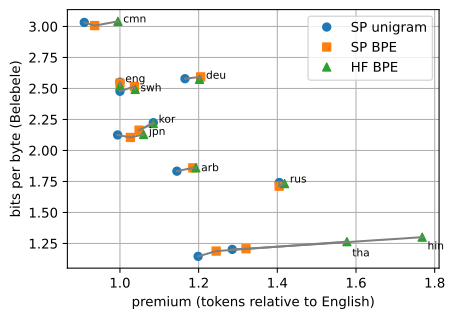
At T1 scale the algorithm matters little. Unigram against BPE at the same vocabulary size changes a language’s bits per byte by at most 3.6% (Thai), and their averages over languages differ by 0.002 bits per byte, with an interval that barely excludes zero. Both SentencePiece models are better than the byte-level BPE by about 0.02 bits per byte. In the plot the lines are short. The premium, by contrast, varies a lot between languages under every tokenizer: the most expensive language needs 1.5 to 1.8 times the tokens of the cheapest. Seven of the ten languages show a unigram-BPE difference larger than their seed range, but these differences are small, they go both ways, and two seeds cannot rank tokenizers language by language. Bostrom and Durrett (2020) found the unigram model better than BPE for pretraining BERT-sized models in English and Japanese; our small models can neither confirm nor refute that at their scale.
One large tokenizer effect stands out: the byte-level BPE gives Hindi a premium of 1.77, against 1.32 for SentencePiece’s BPE, and also the worst Hindi bits per byte of the three (1.30 against 1.21, beyond the seed range). This is the split rule again. SentencePiece does not cut inside a word of one script, while the byte-level BPE inherits the cuts at every vowel sign. So a tokenizer decides how many tokens a language costs far more than how well a model predicts it, at least at this scale, and its pre-tokenization rule can matter more than its algorithm. The vertical order of the languages, finally, says little: Chinese sits near 3 bits per byte and Hindi near 1.2 because their scripts spend their bytes differently, not because one is harder to model.
20.6.3 Vocabulary Size and Pre-Tokenization
Every tokenizer so far had a vocabulary size chosen by habit: 16,384 here, 50,257 for GPT-2, 151,669 for Qwen3. Is there a better reason for a number? The vocabulary enters a model twice. It sets the size of the embedding matrix, \(V\) rows of width \(d\), which with tied embeddings is also the output layer that computes a logit for every piece at every position. And through the tokenizer it sets how many tokens a text becomes. A larger \(V\) makes every token more expensive and the text shorter. That trade-off can be written down.
Training a transformer with \(N\) parameters costs about \(6N\) floating-point operations per token, two for each parameter in the forward pass and four in the backward pass. Let \(A\) be the parameters outside the vocabulary matrix. With tied embeddings the vocabulary adds \(Vd\) parameters, used once per position by the output layer (the input lookup costs nothing). A token covers \(\bar b(V)\) bytes on average, so the compute per byte of text is
\[ C(V) = \frac{6\,(A + Vd)}{\bar b(V)}. \]
To find the best \(V\), take logarithms and differentiate with respect to \(\log V\):
\[ \frac{d \log C}{d \log V} = \frac{Vd}{A + Vd} - \frac{d \log \bar b}{d \log V}. \]
The first term is the softmax share \(s(V)\), the fraction of parameters in the vocabulary matrix. The second is the elasticity of compression \(\varepsilon(V)\): by how many percent the bytes per token grow when the vocabulary grows by one percent. The derivative is zero where the two are equal, and if \(\varepsilon\) is roughly constant near that point we can solve for \(V\):
\[ \varepsilon(V^*) = s(V^*) = \frac{V^* d}{A + V^* d}, \qquad V^* = \frac{\varepsilon}{1 - \varepsilon} \cdot \frac{A}{d}. \tag{20.6.3}\]
In words, growing the vocabulary is worth it as long as the fraction of tokens it saves exceeds the fraction of compute it adds. Since compression gains shrink as the vocabulary grows, \(\varepsilon\) falls with \(V\) while \(s\) rises, and the crossing is a minimum. For a model with 24 blocks of width \(d = 1{,}024\), so \(A = 12 \cdot 24 \cdot 1024^2 \approx 302\) million, and \(\varepsilon = 0.1\), the formula gives \(V^* = 32{,}768\). Two consequences are visible without numbers: a larger model (larger \(A\)) deserves a larger vocabulary, and so does text that keeps compressing as pieces are added (larger \(\varepsilon\)), such as many languages at once.
Tao and colleagues (2024) reach the same direction with a model that also lets the vocabulary change the loss, which ours holds fixed. They estimate, for instance, that Llama 2 70B would have been better served by at least 216,000 pieces than by its 32,000. Our model is the compute half of their argument, and it is enough to see where released vocabularies sit.
To measure \(\bar b(V)\) we use a property of BPE: merges are learned in order, so the first \(V\) ids of a trained vocabulary, with the merges that made them, are exactly the tokenizer that training would have produced had it stopped at \(V\). One BPE of 65,536 pieces therefore gives \(\bar b\) at every smaller size. We train one on English FineWeb-Edu documents and one on the ten-language slice, measure bytes per token on held-out text at seven sizes, and fit a smooth increasing curve to \(\log \bar b\) against \(\log V\); its slope is the elasticity. A synthetic curve with \(\bar b = cV^{0.1}\) checks the code against the formula.
R2 = d2l.r2_tokenizer()
R2_RAW = d2l.r2_tokenizer(raw=True)
SHARDS = d2l.fwedu_shards('100m')

def shard_texts(shards, n_bytes, start=0):
    """Decoded documents of a shard set, in order, until n_bytes bytes."""
    out, b = [], 0
    for _, ids in shards.iter_docs(start):
        if b >= n_bytes:
            break
        out.append(R2_RAW.decode(ids[:-1].tolist()))
        b += len(out[-1].encode())
    return out

tic = time.time()
ENG = shard_texts(SHARDS, sum(len(t.encode()) for t in LM_TEXT))
BIG = {'English': d2l.train_hf_bpe(ENG, 65_536, ['<|endoftext|>']),
       'ten languages': d2l.train_hf_bpe(LM_TEXT, 65_536,
                                         ['<|endoftext|>'])}
say(f'two BPEs of 65,536 pieces, on {len(ENG):,} English documents and '
    f'on the slice ({sum(len(t.encode()) for t in ENG) / 1e6:.0f} and '
    f'{sum(len(t.encode()) for t in LM_TEXT) / 1e6:.0f} MB): '
    f'{time.time() - tic:.0f} s')
GRID = [2**k for k in range(10, 17)]
EVAL = {'English': HELD['eng_Latn'],
        'ten languages': [t for l in LANGS for t in HELD[l]]}

def bytes_per_token(tok, texts):
    return (sum(len(t.encode()) for t in texts)
            / sum(len(e.ids) for e in tok.encode_batch(texts)))

BBAR = pd.DataFrame({k: [bytes_per_token(d2l._bpe_prefix(BIG[k], V),
                                         EVAL[k]) for V in GRID]
                     for k in BIG}, index=GRID)
# log b-bar as a smooth monotone function of log V: its value and its
# slope (the elasticity) come from the same curve
LOG_BBAR = {k: PchipInterpolator(np.log(GRID), np.log(BBAR[k]))
            for k in BIG}
bbar = lambda k, V: np.exp(LOG_BBAR[k](np.log(V)))
elasticity = lambda k, V: LOG_BBAR[k].derivative()(np.log(V))
d, A = 1024, 12 * 24 * 1024**2   # the reference transformer of D3
share = lambda V: V * d / (A + V * d)
cost = lambda V, bb: 6 * (A + V * d) / bb  # FLOP per byte
say(pd.concat([BBAR.round(3).add_prefix('bytes/token, '),
               pd.DataFrame({k: elasticity(k, np.array(GRID, float))
                             for k in BIG}, index=GRID
                            ).round(3).add_prefix('elasticity, '),
               pd.Series({V: share(V) for V in GRID},
                         name='softmax share').round(3)], axis=1))

V = np.geomspace(1_000, 200_000, 20_001)  # D3 check on b-bar = c V^0.1
v_star = 0.1 * A / (d * 0.9)
v_grid = V[np.argmin(cost(V, V**0.1))]
assert abs(v_grid / v_star - 1) < 0.01
say(f'synthetic b-bar = c V^0.1: grid minimum {v_grid:,.0f}, formula '
    f'{v_star:,.0f}')
FINE = np.geomspace(GRID[0], GRID[-1], 2_001)
for k in BIG:  # the measured minimum and the elasticity crossing
    v_min = FINE[np.argmin(cost(FINE, bbar(k, FINE)))]
    gap = elasticity(k, FINE) - share(FINE)
    cross = FINE[np.argmax(gap < 0)] if (gap < 0).any() else None
    say(f'{k}: cost minimum at V = {v_min:,.0f}; elasticity falls to '
        'the softmax share at ' + (f'V = {cross:,.0f}' if cross else
                                   'no V in the grid'))
two BPEs of 65,536 pieces, on 9,566 English documents and on the slice (46 and 46 MB): 40 s
bytes/token, English bytes/token, ten languages elasticity, English \
1024 2.431 2.018 0.236
2048 2.847 2.425 0.219
4096 3.296 2.853 0.189
8192 3.710 3.297 0.154
16384 4.090 3.764 0.112
32768 4.361 4.250 0.069
65536 4.529 4.721 0.036
elasticity, ten languages softmax share
1024 0.280 0.003
2048 0.249 0.007
4096 0.221 0.014
8192 0.200 0.027
16384 0.183 0.053
32768 0.162 0.100
65536 0.139 0.182
synthetic b-bar = c V^0.1: grid minimum 32,769, formula 32,768
English: cost minimum at V = 26,913; elasticity falls to the softmax share at V = 26,913
ten languages: cost minimum at V = 51,276; elasticity falls to the softmax share at V = 51,383For English the elasticity falls from 0.24 at 1,024 pieces to 0.04 at 65,536, while the softmax share at \(d = 1{,}024\) rises from 0.3% to 18%. They cross near 27,000 pieces, which is also where the cost curve has its minimum (the two numbers agree because both come from one fitted curve). Ten-language text keeps compressing for longer, with an elasticity of 0.16 at 32,768 pieces against English’s 0.07, and its optimum moves to about 51,000 pieces. The synthetic check recovers the formula’s 32,768. The right panel of the plot shows how flat the minimum is: a vocabulary half or twice the optimal size costs only a few percent more compute per byte. Any round number near the optimum will do; the cost model does not pin the vocabulary down to better than a factor of two.
Where do released tokenizers sit? For each one we measure bytes per token on the same English held-out text and compute, from the model’s own configuration and without loading weights, the share of its parameters in the vocabulary matrix. The reference tokenizer is placed at the width of the next chapter’s reference model, \(d = 768\).
def released_params(model_id):
    """(vocabulary rows, width, parameters) from the pinned configuration,
    on the meta device: no weights are loaded."""
    cfg = transformers.AutoConfig.from_pretrained(
        model_id, revision=d2l.HF_REVISIONS[model_id]).get_text_config()
    with torch.device('meta'), warnings.catch_warnings():
        warnings.simplefilter('ignore')  # kernels a CPU cannot run
        m = transformers.AutoModelForCausalLM.from_config(cfg)
    return cfg.vocab_size, cfg.hidden_size, d2l.num_params(m)

FIT = {'GPT-2': (50_257, 768, 124_439_808),  # OpenAI's released config
       'Qwen3': released_params('Qwen/Qwen3-0.6B-Base'),
       'Qwen3.5': released_params('Qwen/Qwen3.5-0.8B-Base'),
       'reference': (32_768, 768, 138_442_752),  # chap. 21's model
       'o200k_base': (200_019, None, None)}
TOKENIZERS = {**RELEASED, 'reference': R2}
rows = {}
for k, (Vk, dk, n) in FIT.items():
    bb = sum(len(t.encode()) for t in HELD['eng_Latn']) / sum(map(
        len, d2l._doc_token_ids(TOKENIZERS[k], HELD['eng_Latn'])))
    row = dict(V=Vk, bytes_per_token=bb)
    if dk:
        Ak = n - Vk * dk  # tied embeddings: one V x d matrix
        row.update(d=dk, non_embedding_M=Ak / 1e6,
                   softmax_share=Vk * dk / (Ak + Vk * dk),
                   GFLOP_per_kB=6 * (Ak + Vk * dk) / bb * 1e3 / 1e9)
    rows[k] = row
say('English held-out text; tied embeddings')
say(pd.DataFrame(rows).T.round(3))

fig, axes = d2l.plt.subplots(1, 2, figsize=(7, 2.8))
d2l.plot(GRID, [BBAR[k].to_numpy() for k in BIG], 'vocabulary size V',
         'bytes per token', legend=list(BIG), xscale='log', axes=axes[0],
         fmts=('-o', '--s'))
LABEL_AT = {'reference': ((-5, 5), 'right'), 'GPT-2': ((-5, 6), 'right'),
            'Qwen3': ((-4, -11), 'right'), 'Qwen3.5': ((0, -11), 'center'),
            'o200k_base': ((0, 6), 'center')}  # text clear of the curves
for k in TOKENIZERS:
    axes[0].plot(rows[k]['V'], rows[k]['bytes_per_token'], 'k^',
                 markersize=4)
    axes[0].annotate(k, (rows[k]['V'], rows[k]['bytes_per_token']),
                     xytext=LABEL_AT[k][0], textcoords='offset points',
                     ha=LABEL_AT[k][1], fontsize=7)
axes[0].set_xlim(700, 4e5)  # every released vocabulary on the panel
axes[0].set_ylim(1.85, 5.0)
axes[0].legend(list(BIG), loc='lower right')
c = cost(FINE, bbar('English', FINE)) / 1e9
d2l.plot(FINE, c, 'vocabulary size V', 'GFLOP per byte', xscale='log',
         axes=axes[1])
axes[1].plot(FINE[np.argmin(c)], c.min(), 'ko')
axes[1].text(0.95, 0.9, '$d = 1{,}024$', transform=axes[1].transAxes,
             ha='right')
for ax, n in zip(axes, (3, 2)):
    ax.set_xticks([1e3, 1e4, 1e5][:n], ['1K', '10K', '100K'][:n])
fig.tight_layout()
English held-out text; tied embeddings
V bytes_per_token d non_embedding_M softmax_share \
GPT-2 50257.0 4.568 768.0 85.842 0.310
Qwen3 151936.0 4.454 1024.0 440.467 0.261
Qwen3.5 248320.0 4.410 1024.0 498.113 0.338
reference 32768.0 4.374 768.0 113.277 0.182
o200k_base 200019.0 4.677 NaN NaN NaN
GFLOP_per_kB
GPT-2 163.466
Qwen3 802.862
Qwen3.5 1023.749
reference 189.905
o200k_base NaN 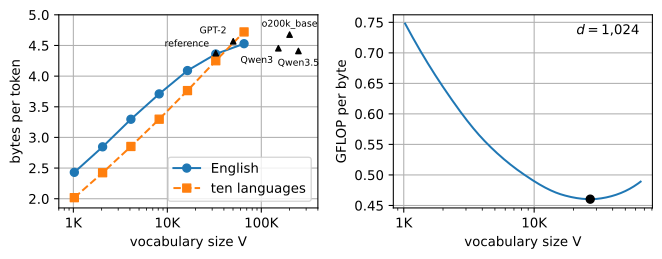
On English all five tokenizers cover between 4.4 and 4.7 bytes per token, although their vocabularies range from 32,768 to 248,320 pieces. Beyond a few tens of thousands of pieces, English is compressed nearly as far as it goes. The small released models spend a quarter to a third of their parameters on the vocabulary matrix (GPT-2 small 31%, Qwen3-0.6B 26%, Qwen3.5-0.8B 34%), and the reference model 18%. By the cost model these small models have more vocabulary than English needs. Their vocabularies were not chosen for them alone, however: one tokenizer serves a whole family of model sizes up to hundreds of billions of parameters, and many languages, and Equation 20.6.3 says that both push \(V\) up. The reference tokenizer, measured on the training shard later in this section, needs only 1% more tokens than GPT-2’s on English prose with a matrix 35% smaller.
A few practical rules come from costs the model leaves out. Round \(V\) up to a multiple of 64 or 128 so that the output layer’s matrix multiply fits the GPU’s tiles; Qwen3’s tokenizer has 151,669 ids and its matrix 151,936 rows. Reserve ids for special tokens that a later stage will need, so that adding a chat or tool token does not mean resizing the model. And tie the input and output embeddings in small models, which halves the vocabulary’s parameters.
20.6.3.1 Numbers, Whitespace and Code
Before any merge is learned, the pre-tokenization rule has already decided much of how a tokenizer treats numbers and code. Section 8.2.5.3 showed GPT-2 cutting 12345678 wherever BPE had found frequent fragments and o200k_base cutting runs of digits into groups of at most three. Qwen3, Qwen3.5 and the reference tokenizer go further and make every digit its own token. For code, what matters is whitespace. An indented line starts with a run of spaces, and a tokenizer with no piece for long runs spends a token on every space or two. We measure both, on a passage full of numbers and on the first 2,000 lines of the book’s own library, d2l/torch.py.
VB = {k: d2l._vocab_bytes(t) for k, t in TOKENIZERS.items()}

def pieces(k, s):
    return '|'.join(VB[k][i].decode('utf-8', 'replace')
                    for i in d2l._doc_token_ids(TOKENIZERS[k], [s])[0])

say(pd.DataFrame({s: {k: pieces(k, s) for k in TOKENIZERS}
                  for s in ('12345678', '3.14159', '1,234,567')}))
NUMBERS = ('In 2019 the plant produced 1,234,567 tonnes, up 12.5% from '
           '1,097,393 in 2018; the price rose from $3,456.78 to $3,901.25 '
           'per unit, and 47 of its 365 days ran at 98.6% capacity.\n'
           '| year | output | share |\n| 2016 | 864,512 | 31.4% |\n'
           '| 2017 | 970,031 | 33.9% |\n| 2018 | 1,097,393 | 36.2% |\n')
with open(d2l.__file__, encoding='utf-8') as f:
    CODE = ''.join(itertools.islice(f, 2000))
rows = {}
for k, tok in TOKENIZERS.items():
    ids = d2l._doc_token_ids(tok, [NUMBERS])[0]
    digit_tokens = [i for i in ids if any(48 <= c <= 57 for c in VB[k][i])]
    code = d2l._doc_token_ids(tok, [CODE])[0]
    spaces = [len(b) for b in VB[k] if b and b.strip(b' ') == b'']
    rows[k] = dict(digits_per_token=sum(c.isdigit() for c in NUMBERS)
                   / len(digit_tokens),
                   code_tokens_per_line=len(code) / CODE.count('\n'),
                   code_bytes_per_token=len(CODE.encode()) / len(code),
                   longest_space_token=max(spaces, default=0))
say(pd.DataFrame(rows).T.round(2))
12345678 3.14159 1,234,567
GPT-2 123|45|678 3|.|14|159 1|,|234|,|5|67
o200k_base 123|456|78 3|.|141|59 1|,|234|,|567
Qwen3 1|2|3|4|5|6|7|8 3|.|1|4|1|5|9 1|,|2|3|4|,|5|6|7
Qwen3.5 1|2|3|4|5|6|7|8 3|.|1|4|1|5|9 1|,|2|3|4|,|5|6|7
reference 1|2|3|4|5|6|7|8 3|.|1|4|1|5|9 1|,|2|3|4|,|5|6|7
digits_per_token code_tokens_per_line code_bytes_per_token \
GPT-2 2.12 19.25 2.12
o200k_base 2.07 10.63 3.83
Qwen3 1.00 10.67 3.82
Qwen3.5 1.00 11.36 3.59
reference 1.00 17.64 2.31
longest_space_token
GPT-2 1.0
o200k_base 128.0
Qwen3 128.0
Qwen3.5 128.0
reference 2.0 The three rules cut 12345678 in three ways. Single digits are the only rule under which every number is cut the same way, digit by digit, so that the model sees place value in the same form everywhere. They cost about twice as many tokens on the numeric passage as GPT-2’s or o200k_base’s groups. On code, o200k_base and the Qwen tokenizers have pieces for whitespace runs of up to 128 bytes and need about 11 tokens per line of the library. GPT-2’s has none and needs 19. The reference tokenizer, whose longest whitespace piece is two spaces, needs 17.6, about 65% more than Qwen3’s. It was trained on educational web prose, where long runs of spaces are rare. A model trained on it will read code expensively, and only a change of vocabulary can fix that, which is the subject of the next part of this section.
20.6.4 Extending a Trained Vocabulary
Suppose a trained model’s tokenizer fragments a language you care about. Qwen3-0.6B-Base is an example: its tokenizer needs 4.5 times English’s tokens for Hindi, while that of its successor Qwen3.5 needs 2.0. Part of Qwen3.5’s improvement is a larger vocabulary, and part is a split rule that keeps combining marks with their letters. Training a new model with a better tokenizer is out of reach for most of us. Can we add pieces to the old one instead?
Adding pieces to a tokenizer is easy. The hard question is what to put in their rows of the embedding matrix, which in Qwen3-0.6B are shared between input and output. Section 19.1 showed that training places the row of a token near the rows of tokens used in similar contexts. An initialization decides where in that space a new row starts. We compare three simple choices. Random rows are drawn from the model’s own initializer. Mean rows are the mean of all old rows plus noise of 1% of their standard deviation, so that no two rows are equal. The decomposition uses the old tokenizer: it splits each new piece into old pieces, and the new row is the mean of their rows. WECHSEL (Minixhofer and colleagues, 2022) and FOCUS (Dobler and de Melo, 2023) place a new row more carefully, as a weighted average of the rows of old pieces that are similar to it according to auxiliary word embeddings; we describe them and do not implement them. extend_vocab implements the three choices for a Transformers model and tokenizer. It resizes the input matrix and, if the embeddings are untied, the output matrix too, and it updates config.vocab_size. Forgetting either of the last two is a common bug that produces no error until the first new id is used.
def extend_vocab(model, tokenizer, new_pieces, init='random', seed=0):
    """Add new_pieces to a Transformers tokenizer (as added tokens, which
    are matched before the model's own segmentation) and rows for them to
    the model's input and, if untied, output matrices, initialized by
    init: 'random' (normal, the config's initializer_range), 'mean' (the
    mean of the old rows plus noise of 1% of their standard deviation, so
    that no two rows are equal) or 'decomp' (the mean of the old rows of
    the pieces the old tokenizer splits the new piece into). Returns
    (model, tokenizer) with config.vocab_size updated."""
    if init not in ('random', 'mean', 'decomp'):
        raise ValueError(f'unknown init {init!r}')
    pieces, n_old = list(new_pieces), len(tokenizer)
    parts = tokenizer(pieces, add_special_tokens=False)['input_ids']
    if tokenizer.add_tokens(pieces) != len(pieces):
        raise ValueError('a new piece is in the vocabulary already')
    out = model.get_output_embeddings()
    tied = out is None or out.weight is model.get_input_embeddings().weight
    old = [model.get_input_embeddings().weight] + ([] if tied
                                                   else [out.weight])
    old = [W.detach()[:n_old].float().cpu() for W in old]
    model.resize_token_embeddings(len(tokenizer), mean_resizing=False)
    mats = [model.get_input_embeddings().weight] + (
        [] if tied else [model.get_output_embeddings().weight])
    g = torch.Generator().manual_seed(seed)
    std = model.config.get_text_config().initializer_range
    k, d = len(pieces), old[0].shape[1]
    with torch.no_grad():
        for W, W0 in zip(mats, old):
            if init == 'random':
                new = torch.randn(k, d, generator=g) * std
            elif init == 'mean':
                new = W0.mean(0) + 0.01 * W0.std() * torch.randn(
                    k, d, generator=g)
            else:
                new = torch.stack([W0[ids].mean(0) for ids in parts])
            W[n_old:n_old + k] = new.to(W.device, W.dtype)
    model.config.get_text_config().vocab_size = len(tokenizer)
    return model, tokenizer
The new pieces come from a byte-level BPE of 8,192 pieces trained on 30,000 Hindi documents. Its split rule keeps letters and their combining marks together and never puts a space inside a piece. This matters for English. The new pieces are added as added tokens, which the tokenizer matches before its own segmentation, so a new piece that contained an ASCII character would change how some English text is cut. We keep the pieces that hold at least two Devanagari characters and no ASCII byte and that are not already in Qwen3’s vocabulary, and add the first 4,096 of them in merge order. The cell then checks that 1,000 lines of English get the same ids as before.
HI_REGEX = r"""[\p{L}\p{M}]+|\p{N}|[^\s\p{L}\p{M}\p{N}]+|\s+"""
HI_TRAIN = HINDI[HINDI.part == 'ext_train'].text.tolist()
HI_HELD = HINDI[HINDI.part == 'ext_heldout'].text.tolist()
tic = time.time()
hi_bpe = d2l.train_hf_bpe(HI_TRAIN, 8192, ['<|endoftext|>'], regex=HI_REGEX)
QWEN = RELEASED['Qwen3']
in_qwen, cand, NEW = QWEN.get_vocab(), 0, []
for i, b in enumerate(d2l._vocab_bytes(hi_bpe)):  # ids in merge order
    try:
        s = b.decode('utf-8')
    except (AttributeError, UnicodeDecodeError):  # special, partial
        continue
    if (len(b) > 1 and not any(c < 128 for c in b)
            and len(regex.findall(r'\p{Devanagari}', s)) >= 2):
        cand += 1
        if hi_bpe.id_to_token(i) not in in_qwen:
            NEW.append(s)
say(f'Hindi BPE in {time.time() - tic:.0f} s: {cand:,} Devanagari '
    f'pieces, {len(NEW):,} new to Qwen3; the first {N_NEW:,} are added')
assert len(NEW) >= N_NEW
NEW = NEW[:N_NEW]
EXT_TOK = copy.deepcopy(QWEN)
EXT_TOK.add_tokens(NEW)
ascii_lines = [l for l in lines(HELD['eng_Latn']) if l.isascii()][:1000]
assert len(ascii_lines) == 1000
assert (QWEN(ascii_lines, add_special_tokens=False)['input_ids']
        == EXT_TOK(ascii_lines, add_special_tokens=False)['input_ids'])
say(f'1,000 ASCII lines: the same ids before and after extension')
hb = sum(len(t.encode()) for t in HI_HELD)
for name, tok in (('Qwen3', QWEN), ('Qwen3 + Hindi', EXT_TOK),
                  ('Qwen3.5', RELEASED['Qwen3.5'])):
    n = sum(map(len, d2l._doc_token_ids(tok, HI_HELD)))
    say(f'{name}: {hb / n:.2f} bytes per token on 500 held-out Hindi '
        'documents')
say('new pieces:', ' '.join(NEW[:12]), '...', ' '.join(NEW[-6:]))
Hindi BPE in 10 s: 7,154 Devanagari pieces, 7,153 new to Qwen3; the first 4,096 are added
1,000 ASCII lines: the same ids before and after extension
Qwen3: 2.79 bytes per token on 500 held-out Hindi documents
Qwen3 + Hindi: 5.28 bytes per token on 500 held-out Hindi documents
Qwen3.5: 6.13 bytes per token on 500 held-out Hindi documents
new pieces: के है ें ने ार या में की से कर को कि ... शुरुआती विधायकों ्न बंग बेचने हिमाचलOf the Hindi BPE’s 7,154 pieces with at least two Devanagari characters, 7,153 are new to Qwen3. The first ones are endings and particles such as के, है and में; the last ones are whole words such as हिमाचल (Himachal). English is cut exactly as before. The extended tokenizer reads 5.28 bytes of Hindi per token against 2.79 before, close to Qwen3.5’s 6.13, so Hindi needs about half the tokens it did. That is the whole benefit the tokenizer can deliver, and it is not yet a benefit to the model. Whether the model can use the new tokens depends on their rows.
20.6.4.1 Initialization at Step Zero
Before any training, three measurements show what an initialization did. The first is the probability the new tokens receive on English text, where none of them should appear. If it is large, the new rows have hijacked the softmax, and the model has become worse at English before training starts. The second is the probability they receive on Hindi text, where about half of the next tokens are new ones. The third is bits per byte on held-out Hindi documents, on Belebele’s Hindi passages and on English documents. Bits per byte is the right measure here because the extended and the original tokenizers cut Hindi differently. English ids are unchanged, so only the softmax’s normalizer, which now sums over the new rows as well, can move English. The cell also checks an identity of the decomposition. With tied embeddings, the output row of a new token is the mean of its pieces’ rows, so its logit is the mean of their logits.
@torch.no_grad()
def new_mass(model, tok, texts, lo):
    """Mean probability of the ids lo and above (the new tokens) over the
    positions of the first 256 tokens of each text."""
    out = []
    for ids in d2l._doc_token_ids(tok, texts):
        x = torch.tensor([ids[:256]], device=model.device)
        p = model(input_ids=x).logits[0].float().softmax(-1)
        out.append(p[:, lo:].sum(-1).mean().item())
    return np.array(out)

def bpb(model, tok, texts):
    return d2l.bits_per_byte(model, tok, texts, ctx_len=N_EXT['ctx_len'])

def step0(model, tok):
    """The step-0 diagnostics of one model and tokenizer: new-token mass on
    English and on Hindi contexts, Hindi, Belebele and English bits per
    byte, Hindi bytes per token, and per-passage Belebele bits per byte."""
    per = np.array([bpb(model, tok, [p]) for p in PASSAGES])
    w = np.array([len(p.encode()) for p in PASSAGES])
    k = N_EXT['contexts']
    en, hi = ((new_mass(model, tok, EN_DOCS[:k], LO),
               new_mass(model, tok, HI_DOCS[:k], LO)) if len(tok) > LO
              else (np.zeros(1), np.zeros(1)))
    n = sum(map(len, d2l._doc_token_ids(tok, HI_DOCS)))
    return dict(new_mass=float(en.mean()), new_mass_max=float(en.max()),
                hindi_new_mass=float(hi.mean()),
                hindi_bpb=bpb(model, tok, HI_DOCS),
                belebele_bpb=float((per * w).sum() / w.sum()),
                english_bpb=bpb(model, tok, EN_DOCS),
                hindi_bytes_per_token=sum(len(t.encode())
                                          for t in HI_DOCS) / n,
                per_passage=per.round(5).tolist())

@torch.no_grad()
def decomp_check(model, tok, n=64):
    """Largest |logit(new) - mean(logit(its pieces))| over the first n
    new tokens and the positions of two English contexts, and the
    rounding bound of the stored rows' dtype."""
    W = model.get_output_embeddings().weight
    parts = QWEN(NEW[:n], add_special_tokens=False)['input_ids']
    worst = 0.0
    for ids in d2l._doc_token_ids(tok, EN_DOCS[:2]):
        x = torch.tensor([ids[:128]], device=W.device)
        h = model.get_decoder()(input_ids=x).last_hidden_state[0].float()
        new = h @ W[LO:LO + n].float().T
        mean = torch.stack([(h @ W[p].float().T).mean(1) for p in parts], 1)
        tol = (1e-5 if W.dtype == torch.float32 else 2**-8) * (
            h.abs() @ W[LO:LO + n].float().abs().T) + 1e-5
        assert ((new - mean).abs() <= tol).all()
        worst = max(worst, (new - mean).abs().max().item())
    return worst
The four arms are the unextended model with its own tokenizer, the control, and the three initializations (seed 0). All four read the same 500 Hindi documents, 488 Belebele passages and 200 English validation documents, in bf16.
BASE, _ = d2l.load_hf(EXT_MODEL, dtype=torch.float32 if SMALL
                      else torch.bfloat16)
VAL = d2l.fwedu_shards('val')
with gzip.open(os.path.join(VAL.root, 'val.jsonl.gz'), 'rt',
               encoding='utf-8') as f:
    VAL_TEXT = [json.loads(line) for line in f]
EN_DOCS = [r['text'] for r in VAL_TEXT[:N_EXT['english']]]
HI_DOCS, PASSAGES = HI_HELD[:N_EXT['hindi']], BELE['hin_Deva'][
    :N_EXT['passages']]
LO = len(QWEN)  # the first new id

tic = time.time()
STEP0 = {'control': step0(BASE, QWEN)}
for init in ('random', 'mean', 'decomp'):
    model, tok = d2l.extend_vocab(copy.deepcopy(BASE), copy.deepcopy(QWEN),
                                  NEW, init=init, seed=0)
    assert model.config.get_text_config().vocab_size == len(tok) == LO + N_NEW
    STEP0[init] = step0(model, tok)
    if init == 'decomp':
        say(f'decomposition identity: largest logit difference '
            f'{decomp_check(model, tok):.2e} ({model.dtype})')
    del model
    d2l.lm_free()
say(f'step 0 on {len(HI_DOCS)} Hindi documents, {len(PASSAGES)} Belebele '
    f'passages, {len(EN_DOCS)} English documents'
    + (' (the small CPU path)' if SMALL else ''),
    f'{time.time() - tic:.0f} s', d2l.lm_peak())
say(pd.DataFrame({k: {c: v for c, v in s.items() if c != 'per_passage'}
                  for k, s in STEP0.items()}).T.round(4))
per = {k: np.array(s['per_passage']) for k, s in STEP0.items()}
for init in ('mean', 'decomp'):  # C5 at step 0, over passages
    r = d2l.paired_bootstrap(per[init], per['random'])
    say(f'{init} - random, Belebele Hindi bits per byte: {r.mean:+.3f} '
        f'[{r.ci[0]:+.3f}, {r.ci[1]:+.3f}];',
        'lower than random' if r.ci[1] < 0 else 'not lower than random',
        '| new-token mass', 'below' if STEP0[init]['new_mass']
        < STEP0['random']['new_mass'] else 'NOT below', "random's")
Qwen/Qwen3-0.6B-Base@da87bfb608c1: Qwen3ForCausalLM, stop tokens [151643]
0 missing keys; unexpected keys: none
kernels: attention sdpa
decomposition identity: largest logit difference 3.79e-02 (torch.bfloat16)
step 0 on 500 Hindi documents, 488 Belebele passages, 200 English documents 232 s peak 4.0 GiB (11.2
GiB reserved)
new_mass new_mass_max hindi_new_mass hindi_bpb belebele_bpb \
control 0.0 0.0000 0.0000 0.6163 0.6652
random 0.0 0.0001 0.0016 2.3854 2.5350
mean 0.0 0.0000 0.0001 2.8918 3.0657
decomp 0.0 0.0007 0.7264 1.4797 1.6269
english_bpb hindi_bytes_per_token
control 0.8225 2.7872
random 0.8225 5.2772
mean 0.8225 5.2772
decomp 0.8225 5.2772
mean - random, Belebele Hindi bits per byte: +0.524 [+0.515, +0.533]; not lower than random |
new-token mass below random's
decomp - random, Belebele Hindi bits per byte: -0.915 [-0.923, -0.906]; lower than random |
new-token mass below random'sNo initialization disturbs English. English bits per byte is 0.8225 in all four arms, and averaged over any English document the new tokens receive at most 0.07% of the probability. On Hindi the arms differ sharply. The decomposition gives the new tokens 73% of the probability on Hindi text and reaches 1.48 bits per byte. Random rows receive 0.2% and reach 2.39. Mean rows receive almost nothing and reach 2.89, worse than random by 0.52 bits per byte on the Belebele passages (a 95% interval over passages of 0.52 to 0.53). The control, reading Hindi through Qwen3’s fragmenting tokenizer, is at 0.62.
Why is the mean worse than random? Every mean row is the same vector up to 1% noise, so every new token receives the same logit at every position, the average of the old logits. The new tokens can win no probability, and as inputs they cannot be told apart. The mean initialization is recommended for a different purpose (Hewitt, 2021, and the default of Transformers’ resize_token_embeddings): it keeps new rows from hijacking the softmax, and that it does here. It does nothing for the new tokens themselves. The decomposition starts better because a new token’s logit is the mean of its pieces’ logits (the identity holds to bf16 rounding), which is high exactly where the pieces are likely, that is, on Hindi. Still, 1.48 bits per byte is far from the control’s 0.62. The model has never read the new tokens as inputs, and their rows are only a guess.
20.6.4.2 Continued Training
Training on Hindi decides whether the new rows can be learned. Each extended arm and the control train for 150 steps of 8 sequences of 1,024 tokens, in two phases, the usual recipe for vocabulary extension. For the first 50 steps only the new rows train, at a high learning rate of \(3 \times 10^{-3}\), while the rest of the model, including the old rows of the shared matrix, is frozen; the control has no new rows, so it waits. Then every parameter trains for 100 steps at a low rate of \(10^{-5}\). Each phase warms up over 10 steps and decays along a cosine, with AdamW.
The low body rate follows from what a released base model is. It ends pretraining with its learning rate decayed to nearly zero, and raising the rate again, on small batches of 8,192 tokens, can move it away from where it ended. A control that got worse in this way would flatter the extended arms, so the body rate is the largest at which the control, which has nothing new to learn, stays where it started on Hindi and on English. The rate of the first phase is the one at which the new rows reached the lowest Hindi loss. Both were chosen on Hindi documents that are neither in the training pool nor in the evaluation set, so no reported number was tuned on them.
All arms read the same documents. An extended arm needs fewer tokens for them, so in 150 steps it reads more Hindi text than the control does. The weights are in fp32 with bf16 arithmetic. Gradient checkpointing and a loss computed in chunks of 1,024 positions keep the \(8{,}192 \times 155{,}765\) matrix of logits from ever existing at once, and a run fits in about 14 GB of one GPU.
def hindi_docs_for(tok, n_tokens):
    """The first Hindi training documents whose tokens under tok reach
    n_tokens."""
    k, n = 0, 0
    for ids in d2l._doc_token_ids(tok, HI_TRAIN[:5000]):
        k, n = k + 1, n + len(ids) + 1
        if n >= n_tokens:
            return HI_TRAIN[:k]
    raise ValueError('too few Hindi documents for the training pool')

def chunk_ce(h, W, y):
    """Summed cross-entropy of one chunk of positions; checkpointed, so
    its logits are recomputed in the backward pass, never stored."""
    with torch.autocast(h.device.type, dtype=torch.bfloat16,
                        enabled=h.device.type == 'cuda'):
        z = h @ W.T
    return F.cross_entropy(z.float(), y, reduction='sum')

def phase_lr(step):
    """(first phase?, learning rate) at step: the new rows alone at
    embed_lr for the first embed_steps steps, then every parameter at lr;
    each phase warms up over warmup steps and decays by a cosine."""
    E = EXT_TRAIN
    first = step < E['embed_steps']
    s, n = ((step, E['embed_steps']) if first else
            (step - E['embed_steps'], E['steps'] - E['embed_steps']))
    sched = d2l.ProxyCfg(1, 1, 1, warmup_frac=E['warmup'] / n,
                         final_lr_frac=E['final_lr_frac'])
    return first, (E['embed_lr'] if first else E['lr']) * d2l._lr_at(
        s, n, sched)

def train_ext(arm, seed, docs):
    """Continued training of one arm on docs: the new rows alone (body and
    old rows frozen; the control has none, so it waits), then everything
    at a low rate. Returns the Hindi curve, English before and after, the
    batch losses (None while the control waits) and the cost."""
    E = EXT_TRAIN
    model, tok = d2l.load_hf(EXT_MODEL, dtype=torch.float32)
    n_old = len(tok)
    if arm != 'control':
        model, tok = d2l.extend_vocab(model, tok, NEW, init=arm, seed=seed)
    eos = d2l._lm_boundary_id(tok)
    pool = np.array([i for ids in d2l._doc_token_ids(tok, docs)
                     for i in ids + [eos]], dtype=np.uint32)
    stream = d2l._ProxyStream({'hi': pool}, {'hi': 1.0}, E['steps'] * E[
        'batch'] * E['seq_len'], E['seq_len'], E['batch'], seed)
    model.gradient_checkpointing_enable()
    model.config.use_cache = False
    W = model.get_output_embeddings().weight
    assert W is model.get_input_embeddings().weight, 'tied embeddings'
    for p in model.parameters():  # first phase: the new rows only
        p.requires_grad_(p is W)
    rows = torch.arange(len(W), device=W.device)[:, None] >= n_old
    hook = W.register_hook(lambda g: g * rows)
    opt = torch.optim.AdamW([W], lr=E['embed_lr'], betas=(0.9, 0.95),
                            weight_decay=0.0)
    curve, losses = [], []
    evaluate = lambda texts: bpb(model.eval(), tok, texts)
    english = {0: evaluate(EN_DOCS)}
    curve.append((0, evaluate(HI_HELD[:E['curve_docs']])))
    tic = time.time()
    for step in range(E['steps']):
        if step == E['embed_steps']:  # second phase: every parameter
            hook.remove()
            for p in model.parameters():
                p.requires_grad_(True)
            opt = torch.optim.AdamW(model.parameters(), lr=E['lr'],
                                    betas=(0.9, 0.95), weight_decay=0.0)
        first, lr = phase_lr(step)
        if first and arm == 'control':  # no new rows to train
            losses.append(None)
        else:
            model.train()
            for g in opt.param_groups:
                g['lr'] = lr
            X = torch.from_numpy(stream.batch(step)[0]).to(model.device)
            total = 0.0
            for Xm in X.split(E['micro_batch']):
                with torch.autocast(X.device.type, dtype=torch.bfloat16,
                                    enabled=X.device.type == 'cuda'):
                    H = model.get_decoder()(
                        input_ids=Xm[:, :-1]).last_hidden_state
                h, y = H.flatten(0, 1), Xm[:, 1:].flatten()
                loss = sum(checkpoint(
                    chunk_ce, h[i:i + E['loss_chunk']], W,
                    y[i:i + E['loss_chunk']], use_reentrant=False)
                    for i in range(0, len(y), E['loss_chunk'])) / (
                        X.shape[0] * E['seq_len'])
                loss.backward()
                total += loss.item()
            torch.nn.utils.clip_grad_norm_(model.parameters(), 1.0)
            opt.step()
            opt.zero_grad(set_to_none=True)
            losses.append(round(total, 4))
        if step + 1 in E['eval_at']:
            curve.append((step + 1, evaluate(HI_HELD[:E['curve_docs']])))
    english[E['steps']] = evaluate(EN_DOCS)
    out = dict(arm=arm, seed=seed, curve=curve, english=english,
               losses=losses, seconds=time.time() - tic,
               train_tokens=len(pool), peak=d2l.lm_peak())
    del model, opt
    d2l.lm_free()
    return out
The eight runs, four arms with two data-order seeds each, are read from the registered results unless regenerated. Hindi bits per byte is measured along training on 100 held-out documents in fp32, so its values at step 0 differ slightly from the table above; English is measured on the 200 English documents before and after training.
if 'tok-extend' in RERUN:
    docs = hindi_docs_for(QWEN, EXT_TRAIN['pool_tokens'])
    runs = []
    for arm in ('control', 'random', 'mean', 'decomp'):
        for seed in EXT_TRAIN['seeds']:
            runs.append(train_ext(arm, seed, docs))
            r = runs[-1]
            say(f'{arm}, seed {seed}: Hindi bits per byte '
                + ' -> '.join(f'{v:.3f}' for _, v in r['curve'])
                + f', {r["seconds"]:.0f} s, {r["peak"]}')
    TOKEXT = dict(schema='d2l-tok-extend/1', tier=TIER, model=EXT_MODEL,
                  revision=d2l.HF_REVISIONS[EXT_MODEL], config=EXT_TRAIN,
                  n_eval=N_EXT, new_pieces=NEW, n_docs=len(docs),
                  step0=STEP0, runs=runs)
    TOKEXT = json.loads(json.dumps(TOKEXT))
    d2l.lm_save_rerun('tok-extend.json', lambda p: write_json(p, TOKEXT))
elif RESULTS is None:
    raise KeyError(f'{RES_KEY} is not registered: regenerate it with '
                   'D2L_RERUN=1, upload and register it')
else:
    TOKEXT = RESULTS['tok-extend']
assert TOKEXT['new_pieces'] == NEW, 'the new pieces differ from the runs'
assert {k: TOKEXT[k] for k in ('tier', 'model', 'revision', 'config')} == (
    json.loads(json.dumps(dict(tier=TIER, model=EXT_MODEL, config=EXT_TRAIN,
                               revision=d2l.HF_REVISIONS[EXT_MODEL])))), (
    'the registered runs used another model or configuration')
ARMS = ('control', 'random', 'mean', 'decomp')
steps = [s for s, _ in TOKEXT['runs'][0]['curve']]
curves = {a: np.array([[v for _, v in r['curve']] for r in TOKEXT['runs']
                       if r['arm'] == a]) for a in ARMS}
say(f'continued training on Hindi {TIER_EXT}')
say(pd.DataFrame({a: dict(zip(steps, c.mean(0))) for a, c in
                  curves.items()}).round(3).rename_axis('step'))
say(pd.DataFrame([dict(arm=r['arm'], seed=r['seed'], **{
    f'English bpb, step {s}': v for s, v in r['english'].items()})
    for r in TOKEXT['runs']]).round(3).to_string(index=False))
d2l.plot_intervals(steps, {a: (c.mean(0), c.min(0), c.max(0))
                           for a, c in curves.items()}, 'step',
                   'Hindi bits per byte', kind='band',
                   marks={'seeds': ('.', {a: (np.tile(steps, len(c)),
                                              c.ravel())
                                          for a, c in curves.items()})})
continued training on Hindi at T1 scale (Qwen3-0.6B-Base, 150 steps of 8 x 1,024 tokens)
control random mean decomp
step
0 0.627 2.382 2.876 1.488
25 0.627 1.402 1.134 1.055
50 0.627 1.246 1.026 0.959
100 0.637 1.057 0.933 0.862
150 0.626 1.034 0.918 0.847
arm seed English bpb, step 0 English bpb, step 150
control 0 0.822 0.825
control 1 0.822 0.824
random 0 0.822 0.832
random 1 0.822 0.832
mean 0 0.822 0.829
mean 1 0.822 0.830
decomp 0 0.822 0.828
decomp 1 0.822 0.829<Axes: xlabel='step', ylabel='Hindi bits per byte'>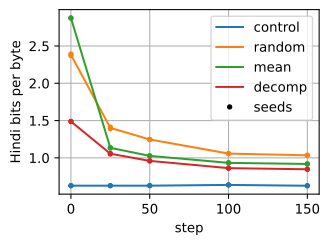
The control stays flat, from 0.627 to 0.626 bits per byte, so the recipe does what it was chosen for. The extended arms improve quickly in the first phase, and the gaps between initializations shrink from between 0.5 and 1.4 bits per byte at step 0 to at most 0.2 at step 150. The decomposition stays best throughout and ends at 0.85. The mean overtakes random within 25 steps and ends at 0.92 against 1.03. A plausible reason is that random rows are small vectors in a region the model never visited, while the mean rows, once training pulls them apart, start among the old ones. English barely moves, from 0.822 to at most 0.832.
No extended arm reaches the control, however. After 150 steps, 1.2 million tokens, the best is still about 0.2 bits per byte above it. At this budget the extension halves the number of tokens Hindi needs and loses a fifth of a bit per byte in prediction. Published extensions continue training on far more text, often billions of tokens, and how long the extended model needs to catch up is something 150 steps cannot tell. The number of new tokens is not the benefit. The benefit is fewer tokens per byte, and it reaches the model only after the model has learned to use them.
20.6.4.3 Byte Patches
Every tokenizer in this section makes a compression decision once, before the model sees any data, and the extension experiment showed how hard that decision is to revisit. The Byte Latent Transformer (Pagnoni and colleagues, 2024) moves the decision into the model. A small byte-level model predicts the next byte, and a new patch starts wherever its prediction becomes uncertain, so predictable stretches become long patches and surprising ones short. The toy below imitates only the boundary rule, with a character trigram model trained on Hindi text: a patch ends where the entropy of the next character jumps. It compares patch lengths with token lengths, both in UTF-8 bytes because a byte-level token can be part of a character. It says nothing about how well a model would learn from such patches.
text = ''.join(HI_TRAIN[:2000])
nxt = collections.defaultdict(collections.Counter)
for a, b, c in zip(text, text[1:], text[2:]):
    nxt[a + b][c] += 1
def entropy(ctx):
    n = np.array(list(nxt[ctx].values()), float)
    return float(-(n / n.sum() * np.log2(n / n.sum())).sum()) if len(n) else 8.
para = next(p for t in HI_HELD for p in t.split('\n') if len(p) > 300)
H = np.array([entropy(para[i - 2:i]) for i in range(2, len(para))])
cuts = [0] + [i + 2 for i in range(1, len(H)) if H[i] > H[i - 1] + 0.5]
patches = [len(para[a:b].encode()) for a, b in zip(cuts, cuts[1:]
                                                   + [len(para)])]
toks = {k: [len(VB[k][i]) for i in
            d2l._doc_token_ids(TOKENIZERS[k], [para])[0]]
        for k in ('Qwen3', 'Qwen3.5', 'reference')}
say(f'UTF-8 bytes per patch and per token, one Hindi paragraph of '
    f'{len(para.encode()):,} bytes')
say(pd.DataFrame({'entropy patches': pd.Series(patches).describe(),
                  **{f'{k} tokens': pd.Series(v).describe()
                     for k, v in toks.items()}}).round(2))
UTF-8 bytes per patch and per token, one Hindi paragraph of 1,092 bytes
entropy patches Qwen3 tokens Qwen3.5 tokens reference tokens
count 134.00 371.00 134.00 432.00
mean 8.15 2.94 8.15 2.53
std 4.00 1.49 4.38 1.44
min 1.00 1.00 1.00 1.00
25% 6.00 1.00 6.00 1.00
50% 8.00 3.00 7.00 3.00
75% 10.00 4.00 10.00 3.00
max 27.00 6.00 28.00 5.00On one paragraph of 1,092 bytes, the entropy rule makes 134 patches of 8.15 bytes on average, against 2.94 bytes for Qwen3’s tokens and 2.53 for the reference tokenizer’s, which was trained on English. That Qwen3.5’s tokenizer happens to make exactly 134 tokens of the paragraph is a coincidence. Even a trigram model with a hand-set threshold produces units as long as Qwen3.5’s tokens. Whether a learned version matches tokenized models at equal compute, as BLT’s authors report, is a claim we cite here and do not test.
20.6.5 The Reference Tokenizer and Its Shards
Every model trained in the rest of this part reads text through one tokenizer, and the next chapter reads that text from token files written once. Changing either later would mean retraining every model built on them, so we fix both here, in Table 20.6.1, and test them. The reference tokenizer is a byte-level BPE, so that any string can be encoded without an unknown token. It has 32,768 pieces, a power of two in the flat part of the English cost curve. It normalizes to NFC and nothing more, uses Qwen3’s split rule with single digits, and reserves the first 32 ids for special tokens. Only <|endoftext|>, id 0, occurs in pretraining, at the end of every document. There is no beginning-of-sequence token: the end of one document is the context in which the next one begins. The tokenizer was trained on the first 80,000 documents of the shuffled training stream, which shares no document with the validation set. The alternative we rejected, GPT-2’s tokenizer, would have given the reference model an embedding matrix 53% larger, numbers cut by frequency and no better handling of whitespace.
One rule is easy to get wrong: special-token strings inside a document are text. A web page about tokenizers may contain the characters <|endoftext|>. If the tokenizer matched them as the special id, the document would end in the middle, and the model would learn that the string ends documents. Released tokenizers differ here; Qwen3’s, for instance, matches added tokens such as <think> inside ordinary text.
| Field | Value |
|---|---|
| Tokenizer | byte-level BPE, 32,768 pieces, NFC, single digits, no BOS |
| Special ids | 0 end of text (the EOS after every document), 1 padding, 2 and 3 chat-turn delimiters, 4-31 reserved |
.bin |
little-endian ids, uint16 for at most 65,536 ids, else uint32 |
.idx |
uint32 offsets, one per document plus the token count; document \(i\) is ids offsets[i] to offsets[i+1], its closing EOS included |
.meta.parquet |
doc_id, n_tokens, then url, dump, bucket, edu_score, int_score, gpt2_tokens, src_file, src_row |
manifest.json |
d2l-corpus/1: sources, stages, tokenizer hash, format, splits |
r2_tokenizer downloads the committed tokenizer.json, checks its SHA-256 against the value recorded in the library, and wraps it for Transformers with EOS id 0, padding id 1, no BOS, and special strings in text encoded as text. The wrapper is a PreTrainedTokenizerFast, which Transformers 5 reports as TokenizersBackend. The hash check guards against a quiet failure: a checkpoint paired with a different tokenizer file of the same size runs without any error and produces nonsense.
R2_TOKENIZER_SHA256 = (  # of lm-r2-tokenizer-v1 (tools/build_r2_shards.py)
    'b1b4b45c36aac256ae4f4bd5e5fd595395242fc6949299cb0e2e25d2a5a656e3')


def r2_tokenizer(raw=False):
    """The reference tokenizer (artifact lm-r2-tokenizer-v1; its file is
    checked against R2_TOKENIZER_SHA256): a Transformers
    PreTrainedTokenizerFast with EOS <|endoftext|> = 0, pad <|pad|> = 1,
    no BOS, and special-token strings in text encoded as text; raw=True
    gives the tokenizers.Tokenizer itself."""
    if 'lm-r2-tokenizer-v1' not in d2l.DATA_HUB or not d2l.R2_TOKENIZER_SHA256:
        raise KeyError('lm-r2-tokenizer-v1 is not registered yet: it is '
                       'built by tools/build_r2_shards.py')
    return d2l._r2_from_file(d2l.download_keyed('lm-r2-tokenizer-v1'),
                             raw=raw, sha256=d2l.R2_TOKENIZER_SHA256)
Can the tokenizer be rebuilt from its recorded inputs? The cell checks the wrapper’s contract, decodes the first 80,000 documents of the training shard, trains train_hf_bpe on them with the reference special tokens, hashes the result, and round-trips text through the tokenizer.
say(type(R2).__name__, f'| {len(R2):,} ids | eos {R2.eos_token_id} | '
    f'bos {R2.bos_token_id} | pad {R2.pad_token_id} | SHA-256 '
    f'{d2l.R2_TOKENIZER_SHA256[:16]}...')
assert R2.eos_token_id == 0 and R2.bos_token_id is None
assert d2l._lm_boundary_id(R2) == 0 and len(R2) == R2_VOCAB
assert R2.encode('a b', add_special_tokens=False) == R2(
    'a b', add_special_tokens=False)['input_ids'] == R2_RAW.encode('a b').ids
SPECIAL_TEXT = ('A page about chat templates: <|endoftext|> ends a document, '
                '<|pad|> pads a batch, <|im_start|> and <|im_end|> wrap a '
                'turn.')
ids = R2.encode(SPECIAL_TEXT, add_special_tokens=False)
assert min(ids) >= 32 and R2.decode(ids) == SPECIAL_TEXT
say(f'special strings in text: {len(ids)} ordinary tokens, none below 32')

assert SHARDS.n_docs >= N_TOK_DOCS
tic = time.time()
DOCS = R2_RAW.decode_batch([SHARDS.doc(i)[:-1].tolist()
                            for i in range(N_TOK_DOCS)])
retrained = d2l.train_hf_bpe(DOCS, R2_VOCAB, d2l.R2_SPECIALS)
sha = hashlib.sha256(retrained.to_str(pretty=False).encode()).hexdigest()
say(f'retrained on the first {N_TOK_DOCS:,} training documents '
    f'({sum(map(len, DOCS)) / 1e6:.0f}M characters) in '
    f'{time.time() - tic:.0f} s: SHA-256 {sha[:16]}...',
    'equal to the committed file' if sha == d2l.R2_TOKENIZER_SHA256
    else 'DIFFERENT')
assert sha == d2l.R2_TOKENIZER_SHA256
texts = [r['text'] for r in VAL_TEXT[:10_000]]
assert R2_RAW.decode_batch([e.ids for e in R2_RAW.encode_batch(
    texts, add_special_tokens=False)]) == texts
assert [e.ids for e in R2_RAW.encode_batch(DOCS[:10_000])] == [
    SHARDS.doc(i)[:-1].tolist() for i in range(min(10_000, N_TOK_DOCS))]
meta = SHARDS.meta(0).iloc[:N_TOK_DOCS]
ratio = (meta.n_tokens - 1).sum() / meta.gpt2_tokens.sum()
say(f'round trips: {len(texts):,} validation texts and '
    f'{min(10_000, N_TOK_DOCS):,} training documents; reference tokens '
    f'per GPT-2 token: {ratio:.3f}')
del DOCS, retrained
TokenizersBackend | 32,768 ids | eos 0 | bos None | pad 1 | SHA-256 b1b4b45c36aac256...
special strings in text: 46 ordinary tokens, none below 32
retrained on the first 80,000 training documents (378M characters) in 31 s: SHA-256
b1b4b45c36aac256... equal to the committed file
round trips: 8,341 validation texts and 10,000 training documents; reference tokens per GPT-2 token:
1.010Retraining on 378 million characters reproduces the committed file byte for byte, so the tokenizer is a function of recorded data and code rather than of one lucky run. The sentence that mentions all four special tokens encodes to 46 ordinary tokens, none below id 32, and decodes back unchanged. On the training documents the reference tokenizer needs 1.010 tokens for every token of GPT-2’s.
Token files fix how the tokens are stored. write_shards turns each document into its ids followed by one EOS and appends documents to a shard until it holds at least shard_tokens tokens. It closes a shard only at a document boundary, so no document spans two shards. Each shard is three files: .bin with the raw little-endian ids, as uint16 when every id fits into 16 bits and as uint32 otherwise; .idx with the offset of every document, so that the range from one offset to the next is the document with its closing EOS; and .meta.parquet with one row per document for audits. A manifest.json records the sources, the processing stages, the tokenizer’s hash and the format. TokenShards reads them through memory maps. It finds documents by global index and token ranges by global position, across shard boundaries, and its verify recomputes every hash and checks that EOS ends every document and occurs nowhere else.
def write_shards(docs, tokenizer, out_dir, split, shard_tokens=100_000_000,
                 eos_id=None, meta_fn=None, manifest=None, *, batch_docs=1000,
                 max_shards=None):
    """Tokenize documents into shards out_dir/{split}-{k:05d}.bin|.idx|
    .meta.parquet and return the split's manifest entry. docs yields
    (doc_id, text) or (doc_id, text, meta); each document becomes its ids
    and one EOS (eos_id, default the tokenizer's <|endoftext|>); special
    strings in a text stay text, and a special id inside a document is an
    error. A shard closes at the first document boundary at or after
    shard_tokens; ids are uint16 for vocabularies up to 65,536, else uint32.
    meta_fn(doc_id, text, meta) gives a document's extra meta columns
    (default: meta itself). With max_shards, writing stops when that many
    shards are closed (the rest of docs is not read). The entry is stored
    in manifest (a CorpusManifest, created if None), which is saved as
    out_dir/manifest.json."""
    import itertools
    os.makedirs(out_dir, exist_ok=True)
    vocab, eos, special = d2l._tok_info(tokenizer)
    eos = eos if eos_id is None else eos_id
    if eos is None:
        raise ValueError('the tokenizer has no <|endoftext|>: pass eos_id')
    dtype = np.dtype('uint16' if vocab <= 2**16 else 'uint32')
    special = np.array(sorted(special | {eos}), dtype=np.int64)
    shards, w, docs = [], None, iter(docs)
    while (len(shards) != max_shards
           and (batch := list(itertools.islice(docs, batch_docs)))):
        batch = [(d[0], d[1], d[2] if len(d) > 2 else None) for d in batch]
        for (doc_id, text, meta), ids in zip(
                batch, d2l._doc_token_ids(tokenizer, [b[1] for b in batch])):
            ids = np.asarray(ids, dtype=np.int64)
            bad = np.isin(ids, special)
            if bad.any():
                raise ValueError(f'document {doc_id}: special id '
                                 f'{int(ids[bad][0])} inside the text')
            if w is None:
                w = d2l._ShardWriter(out_dir, f'{split}-{len(shards):05d}',
                                     dtype)
            extra = meta_fn(doc_id, text, meta) if meta_fn else (meta or {})
            w.add(doc_id, np.append(ids, eos).astype(dtype), extra)
            if w.n_tokens >= shard_tokens:
                shards.append(w.close())
                w = None
                if len(shards) == max_shards:
                    break
    if w is not None:
        shards.append(w.close())
    entry = dict(n_tokens=sum(s['n_tokens'] for s in shards),
                 n_docs=sum(s['n_docs'] for s in shards), shards=shards)
    manifest = manifest or d2l.CorpusManifest(os.path.basename(
        os.path.normpath(out_dir)))
    manifest.splits = dict(manifest.splits or {}, **{split: entry})
    fmt = dict(dtype=dtype.name, eos_id=int(eos), endianness='little',
               doc_end='eos', idx_dtype='uint32',
               meta_required=['doc_id', 'n_tokens'])
    if manifest.format not in (None, fmt):
        raise ValueError(f'manifest format {manifest.format} != {fmt}')
    manifest.format = fmt
    manifest.tokenizer = manifest.tokenizer or dict(vocab_size=vocab)
    manifest.save(os.path.join(out_dir, 'manifest.json'))
    return entry


class TokenShards:
    """Read-only access to a shard set written by write_shards: documents
    by global index, token ranges by global position, per-shard meta, and
    verify(), which recomputes every file's SHA-256 and the EOS and offset
    invariants. max_tokens keeps the smallest prefix of shards holding at
    least that many tokens; fetch=True downloads missing files from the
    manifest's url and checks sha1 and SHA-256. A pickled copy (a data
    loader's worker) carries no memory maps; it opens its own."""
    def __init__(self, root, split='train', fetch=False, max_tokens=None):
        self.root, self.split, self.fetch = root, split, fetch
        with open(os.path.join(root, 'manifest.json'), encoding='utf-8') as f:
            self.manifest = json.load(f)
        shards = self.manifest['splits'][split]['shards']
        if max_tokens is not None:
            total = np.cumsum([s['n_tokens'] for s in shards])
            shards = shards[:int(np.searchsorted(total, max_tokens)) + 1]
        self.shards = shards
        fmt = self.manifest['format']
        self.dtype = np.dtype(fmt['dtype']).newbyteorder('<')
        self.eos_id = fmt['eos_id']
        self.vocab_size = (self.manifest.get('tokenizer') or {}).get(
            'vocab_size')
        self._docs = np.cumsum([0] + [s['n_docs'] for s in shards])
        self._toks = np.cumsum([0] + [s['n_tokens'] for s in shards])
        self.n_docs, self.n_tokens = int(self._docs[-1]), int(self._toks[-1])
        self.n_shards = len(shards)
        self._mm, self._idx = {}, {}

    def __getstate__(self):  # a worker process reopens the memory maps
        return dict(self.__dict__, _mm={})

    def _path(self, k, ext):
        s = self.shards[k]
        path = os.path.join(self.root, s['file'] + d2l._SHARD_EXT[ext])
        if not os.path.exists(path):
            if not self.fetch or 'url' not in s:
                raise FileNotFoundError(path)
            d2l._fetch_shard_file(s, ext, path)
        return path

    def shard(self, k):
        if k not in self._mm:
            self._mm[k] = np.memmap(self._path(k, 'bin'), dtype=self.dtype,
                                    mode='r')
        return self._mm[k]

    def offsets(self, k):
        if k not in self._idx:
            self._idx[k] = np.fromfile(self._path(k, 'idx'), dtype='<u4')
        return self._idx[k]

    def locate(self, i):
        """(shard, document within it, offset of its first token there)."""
        if not 0 <= i < self.n_docs:
            raise IndexError(i)
        k = int(np.searchsorted(self._docs, i, side='right')) - 1
        j = i - int(self._docs[k])
        return k, j, int(self.offsets(k)[j])

    def locate_token(self, t):
        """(shard, position within it) of global token position t."""
        if not 0 <= t < self.n_tokens:
            raise IndexError(t)
        k = int(np.searchsorted(self._toks, t, side='right')) - 1
        return k, t - int(self._toks[k])

    def doc(self, i):
        k, j, a = self.locate(i)
        return np.asarray(self.shard(k)[a:self.offsets(k)[j + 1]],
                          dtype=np.int32)

    def iter_docs(self, start=0):
        for i in range(start, self.n_docs):
            yield i, self.doc(i)

    def read(self, start, n):
        """n tokens from global position start, across shard boundaries."""
        if start < 0 or start + n > self.n_tokens:
            raise IndexError((start, n))
        out = []
        while n > 0:
            k, a = self.locate_token(start)
            take = min(n, self.shards[k]['n_tokens'] - a)
            out.append(np.asarray(self.shard(k)[a:a + take], dtype=np.int32))
            start, n = start + take, n - take
        return np.concatenate(out) if out else np.zeros(0, dtype=np.int32)

    def meta(self, k):
        return pd.read_parquet(self._path(k, 'meta'))

    def verify(self):
        """Recompute every file's SHA-256 and check that offsets start at 0,
        increase and end at the shard's token count, that EOS ends every
        document and occurs nowhere else, and that the meta rows match."""
        for k, s in enumerate(self.shards):
            for ext in d2l._SHARD_EXT:
                path = self._path(k, ext)
                if d2l._sha256_file(path) != s['sha256'][ext]:
                    raise ValueError(f'{path}: SHA-256 differs from the '
                                     'manifest')
            ids, idx = self.shard(k), self.offsets(k)
            name = s['file']
            if (len(idx) != s['n_docs'] + 1 or idx[0] != 0
                    or idx[-1] != len(ids) or len(ids) != s['n_tokens']
                    or (np.diff(idx.astype(np.int64)) <= 0).any()):
                raise ValueError(f'{name}.idx: offsets do not match the '
                                 'shard')
            if (np.asarray(ids[idx[1:].astype(np.int64) - 1]) != self.eos_id
                    ).any() or int((ids == self.eos_id).sum()) != s['n_docs']:
                raise ValueError(f'{name}.bin: EOS not exactly at the '
                                 'document ends')
            m = self.meta(k)
            if len(m) != s['n_docs'] or (m['n_tokens'].to_numpy()
                                         != np.diff(idx)).any():
                raise ValueError(f'{name}.meta.parquet: rows do not match '
                                 'the offsets')
        return True


def fwedu_shards(which='100m', fetch=True, max_tokens=None):
    """The reference shards of FineWeb-Edu under the reference tokenizer:
    which='val' (2^23 validation tokens), '100m' (train-00000, 10^8 tokens)
    or '4b' (the 40 training shards, downloaded one by one when first read).
    Each lives in ../data/lm/fwedu-r2-v1/<which>/, extracted on the first
    call (make that call once before starting several processes)."""
    keys = {'val': 'lm-fwedu-val-v1', '100m': 'lm-fwedu-shards-100m-v1',
            '4b': 'lm-fwedu-manifest-4b-v1'}
    if which not in keys:
        raise ValueError(f'which is one of {tuple(keys)}')
    key = keys[which]
    if key not in d2l.DATA_HUB:
        raise KeyError(f'{key} is not registered yet: it is built by '
                       'tools/build_r2_shards.py')
    root = os.path.join('..', 'data', 'lm', 'fwedu-r2-v1', which)
    path, sha1 = d2l.download_keyed(key), d2l.DATA_HUB[key][1]
    stamp = os.path.join(root, '.extracted-' + key)
    old = None
    if os.path.exists(stamp):
        with open(stamp) as f:
            old = f.read()
    if old != sha1:
        shutil.rmtree(root, ignore_errors=True)  # afresh when the
        os.makedirs(root)                        # registered sha1 changes
        if which == '4b':  # the manifest only; shards come when read
            shutil.copyfile(path, os.path.join(root, 'manifest.json'))
        else:
            d2l.extract(path, root)
        with open(stamp, 'w') as f:
            f.write(sha1)
    return d2l.TokenShards(root, 'val' if which == 'val' else 'train',
                           fetch=fetch, max_tokens=max_tokens)
The checks below write 2,000 validation documents and the special-token sentence into a temporary set of small shards, read everything back and test the invariants. They write the same documents with Qwen3’s tokenizer, whose ids need 32 bits, the path the next chapter takes for Qwen3, and they verify the registered shards. The resume cursor matters for training: locate(i) gives the shard and offset of document \(i\), and iteration started there continues where an interrupted run stopped.
docs = [(r['doc_id'], r['text']) for r in VAL_TEXT[:2000]]
docs.append(('fixture-special-strings', SPECIAL_TEXT))
with tempfile.TemporaryDirectory() as tmp:
    entry = d2l.write_shards(docs, R2, tmp, 'val', shard_tokens=500_000)
    ts = d2l.TokenShards(tmp, 'val')
    ids = d2l._doc_token_ids(R2, [t for _, t in docs])
    assert ts.n_docs == len(docs) and ts.n_shards > 1
    assert all(np.array_equal(ts.doc(i), ids[i] + [0])
               for i in range(len(docs)))
    for k, s in enumerate(entry['shards']):
        x, idx = np.asarray(ts.shard(k)), ts.offsets(k)
        n = np.diff(idx)
        assert (x == 0).sum() == (x < 32).sum() == s['n_docs']
        assert np.array_equal(idx, np.concatenate([[0], np.cumsum(n)]))
    assert ts.verify()
    i = ts.n_docs // 2 + 1  # a resume cursor
    k, j, off = ts.locate(i)
    first = next(ts.iter_docs(start=i))
    assert first[0] == i and np.array_equal(
        first[1], ts.shard(k)[off:ts.offsets(k)[j + 1]])
    t = entry['shards'][0]['n_tokens'] - 5  # across the first boundary
    assert np.array_equal(ts.read(t, 10), np.concatenate(
        [ts.shard(0)[-5:], ts.shard(1)[:5]]))
    say(f'{ts.n_docs:,} documents, {ts.n_tokens:,} tokens in '
        f'{ts.n_shards} shards; doc {i} is shard {k}, document {j}, '
        f'token {off:,}; meta columns: {list(ts.meta(0).columns)}')
    q = d2l.write_shards(docs[:100] + docs[-1:], QWEN,
                         os.path.join(tmp, 'qwen'), 'val')
    tq = d2l.TokenShards(os.path.join(tmp, 'qwen'), 'val')
    assert tq.dtype == np.uint32 and tq.eos_id == 151643 and tq.verify()
    say(f'Qwen3: {tq.dtype}, EOS {tq.eos_id}, {tq.n_tokens:,} tokens; '
        f'the fixture ends in {tq.doc(tq.n_docs - 1)[-3:].tolist()}')
for name, ts in (('train', SHARDS), ('val', VAL)):
    i = ts.n_docs - 7
    k, j, off = ts.locate(i)  # the resume cursor of document i
    assert np.array_equal(next(ts.iter_docs(start=i))[1], ts.shard(k)[
        off:ts.offsets(k)[j + 1]]) and ts.verify()
    say(f'{name}: {ts.n_docs:,} documents, {ts.n_tokens:,} tokens, '
        f'{ts.n_shards} shard(s), {ts.dtype}, EOS {ts.eos_id}, '
        f'vocabulary {ts.vocab_size:,}; verified')
say(json.dumps(SHARDS.manifest['format']))
2,001 documents, 2,029,682 tokens in 5 shards; doc 1001 is shard 2, document 91, token 79,009; meta
columns: ['doc_id', 'n_tokens']
Qwen3: uint32, EOS 151643, 128,563 tokens; the fixture ends in [2484, 13, 151643]
train: 95,793 documents, 100,000,084 tokens, 1 shard(s), uint16, EOS 0, vocabulary 32,768; verified
val: 8,341 documents, 8,390,187 tokens, 1 shard(s), uint16, EOS 0, vocabulary 32,768; verified
{"doc_end": "eos", "dtype": "uint16", "endianness": "little", "eos_id": 0, "idx_dtype": "uint32",
"meta_required": ["doc_id", "n_tokens"]}Every invariant holds. The 2,001 documents become 2,029,682 tokens in 5 shards, and the fixture ends in its text and then EOS 151643 under Qwen3. The registered training shard holds 100,000,084 tokens of 95,793 documents and the validation set 8,390,187 tokens, just over \(2^{23}\), both as uint16 and both verified.
One check remains, and it is easy to skip. FineWeb-Edu is deduplicated within each crawl dump but not across dumps, so the same page can sit in validation under one dump and in training under another, and a validation loss would then partly measure memorization. The builder’s val_dedup stage dropped validation documents that repeat a training document’s text or URL. What is left can be measured with the exact n-gram matching on token ids of Section 20.3: hash every window of 50 tokens in validation and in the training shard, and confirm each match of hashes on the ids themselves.
stage = next(s for s in VAL.manifest['stages'] if s['name'] == 'val_dedup')
say(f"val_dedup: {stage['n_in']:,} validation documents in, "
    f"{stage['n_out']:,} out; dropped {stage['drops']}")
N = 50
tic = time.time()
v_ids = np.concatenate([np.asarray(VAL.shard(k)) for k in
                        range(VAL.n_shards)])
t_ids = np.asarray(SHARDS.shard(0))
hv, okv = d2l._rolling_ngram_hashes(v_ids, N, eos=0)
ht, okt = d2l._rolling_ngram_hashes(t_ids, N, eos=0)
t_pos = np.flatnonzero(okt)
order = np.argsort(ht[t_pos], kind='stable')
t_sorted = ht[t_pos][order]
j = np.minimum(np.searchsorted(t_sorted, hv), len(t_sorted) - 1)
starts = np.flatnonzero(okv & (t_sorted[j] == hv))
t_start = t_pos[order[j[starts]]]
span = np.arange(N)
same = (v_ids[starts[:, None] + span] == t_ids[t_start[:, None] + span]
        ).all(1)  # the hash match confirmed on the ids
starts = starts[same]
v_off = np.concatenate([[0], np.cumsum([VAL.shard(k).shape[0]
                                        for k in range(VAL.n_shards)])])
doc_starts = np.concatenate([VAL.offsets(k)[:-1].astype(np.int64)
                             + v_off[k] for k in range(VAL.n_shards)])
hit_doc = np.searchsorted(doc_starts, starts, 'right') - 1
hit_docs = np.unique(hit_doc)
cover = np.zeros(len(v_ids) + 1, np.int64)
np.add.at(cover, starts, 1)
np.add.at(cover, starts + N, -1)
covered = (np.cumsum(cover)[:-1] > 0).sum()
f_docs = len(hit_docs) / VAL.n_docs
say(f'{len(starts):,} validation 50-grams also in train-00000 '
    f'({SHARDS.shards[0]["n_docs"]:,} documents), {time.time() - tic:.0f}'
    f' s: {len(hit_docs):,} of {VAL.n_docs:,} validation documents '
    f'({f_docs:.2%}), {covered / VAL.n_tokens:.3%} of their tokens')
docs_of = collections.defaultdict(set)  # shared span -> its documents
for h, k in zip(hv[starts].tolist(), hit_doc.tolist()):
    docs_of[h].add(k)
first = {h: s for s, h in zip(starts[::-1], hv[starts][::-1].tolist())}
shown = []  # the most shared spans, one per group of documents
for h in sorted(docs_of, key=lambda h: (-len(docs_of[h]), first[h])):
    if not any(docs_of[h] & g for g in shown) and len(shown) < 3:
        shown.append(docs_of[h])
        s = first[h]
        say(f'{len(docs_of[h])} documents: '
            f'{R2_RAW.decode(v_ids[s:s + N].tolist())!r}'[:100])
if f_docs > 0.05:
    say('more than 5% of validation documents overlap: inspect the spans'
        ' above before reading this as boilerplate')
val_dedup: 14,277 validation documents in, 13,455 out; dropped {'text_hash': 658, 'url': 164}
16,901 validation 50-grams also in train-00000 (95,793 documents), 41 s: 211 of 8,341 validation
documents (2.53%), 0.355% of their tokens
4 documents: ', all rights reserved. H-Net permits the redistribution and reprinting of this work fo
3 documents: 'Send the link below via email or IMCopy\nPresent to your audienceStart remote presenta
3 documents: 'Statistics from Altmetric.com\nIf you wish to reuse any or all of this article please Of 14,277 validation candidates, 658 repeated a training document’s text and 164 its URL. After their removal, 211 of the 8,341 validation documents (2.5%) still share a span of 50 tokens with the first training shard, covering about a third of a percent of all validation tokens. The shared spans, printed above as FineWeb-Edu text (ODC-By), are boilerplate: a licence notice that appears in four documents, the interface text of a presentation website, the reuse notice of an article-metrics service. That residue is expected and small. It was measured against one training shard of forty, and the whole training set would find more of the same kind.
The chapter’s work ends in a manifest. It records what the next chapter reads, with its hash, its sources and processing stages, and the sizes of the four artifacts.
M = d2l.CorpusManifest.load(os.path.join(SHARDS.root, 'manifest.json'))
say(f'{M.name} ({M.SCHEMA}), SHA-256 {M.sha256()[:16]}...')
src = M.sources[0]
say(pd.DataFrame([{k: src.get(k) for k in ('id', 'uri', 'revision',
                                           'license', 'n_docs')}]))
short = lambda files: ', '.join(f.split('/')[-1][:3] for f in files)
say(f"validation files {short(src['val_files'])}; train scope "
    f"{short(src['train_scope'])}; reserved {short(src['reserved'])}")
say(pd.DataFrame([{k: s.get(k) for k in ('name', 'n_in', 'n_out',
                                         'tokens_out', 'drops')}
                  for s in M.stages]).to_string(index=False))
say('tokenizer:', {k: v for k, v in M.tokenizer.items()
                   if k != 'specials'})
for key in R2_KEYS:
    if key not in d2l.DATA_HUB:
        say(f'{key}: pending')
        continue
    path = d2l.download_keyed(key)
    line = f'{key}: {os.path.getsize(path) / 1e6:,.2f} MB'
    if key == 'lm-fwedu-manifest-4b-v1':  # shards are fetched when read
        with open(path) as f:
            split = json.load(f)['splits']['train']
        gb = sum(s['bytes']['bin'] for s in split['shards']) / 1e9
        line += (f", listing {split['n_tokens']:,} tokens in "
                 f"{len(split['shards'])} shards ({gb:.1f} GB of .bin)")
    say(line)
lm-fwedu-shards-100m-v1 (d2l-corpus/1), SHA-256 0d8ab8b5a85246cc...
id uri \
0 fineweb-edu hf://datasets/HuggingFaceFW/fineweb-edu/sample...
revision license n_docs
0 87f09149ef4734204d70ed1d046ddc9ca3f2b8f9 odc-by 5842000
validation files 000, 001, 002, 003, 004; train scope 000, 001, 002, 003, 004, 006, 007, 008;
reserved 005, 012, 013
name n_in n_out tokens_out drops
nfc 5842000 5842000 NaN {'empty': 0}
bucket_split 5842000 5636731 NaN {'side_buckets_1_8': 182597, 'val_bucket_0': 22672}
shuffle 5636731 5636731 NaN {}
tokenize 5636731 95793 100000084.0 {'beyond_last_shard': 5540938}
tokenizer: {'file': 'tokenizer.json', 'sha256':
'b1b4b45c36aac256ae4f4bd5e5fd595395242fc6949299cb0e2e25d2a5a656e3', 'split_special_tokens':
True, 'vocab_size': 32768}
lm-r2-tokenizer-v1: 1.03 MB
lm-fwedu-val-v1: 32.25 MB
lm-fwedu-shards-100m-v1: 207.66 MB
lm-fwedu-manifest-4b-v1: 0.03 MB, listing 4,000,073,259 tokens in 40 shards (8.0 GB of .bin)The source is FineWeb-Edu’s sample of 10 billion tokens at a pinned revision: 5.8 million documents, split by bucket into validation and training and shuffled. The forty training shards of \(10^8\) tokens each hold 4.0 billion tokens, 8 GB of ids, downloaded shard by shard when they are first read. The last cell compares a normal build with the registered results.
PARTS = {'tok-lm': TOKLM, 'tok-extend': TOKEXT}
if RERUN:  # the registered file holds both parts
    merged = dict(schema='d2l-tok-results/1', **PARTS)
    d2l.lm_save_rerun(RES_KEY + '.json', lambda p: write_json(p, merged))
    say(f'regenerated: {", ".join(sorted(RERUN))}' + (
      '; the other part is the registered one'
      if len(RERUN) < len(ARTIFACTS) else ''))
else:
    reg = RESULTS['tok-extend']['step0']
    diff = {k: max(abs(STEP0[k][c] - reg[k][c]) for c in
                   ('hindi_bpb', 'belebele_bpb', 'english_bpb'))
            for k in STEP0}
    say('small-LM runs: tokenizers, texts and byte counts equal to the '
        'registered runs')
    if SMALL:
        say('step 0: the small CPU path scores fewer texts than the '
            'registered results; not compared')
    else:
        say('step 0, largest bits-per-byte difference from the registered '
            'values:', {k: round(v, 4) for k, v in diff.items()})
        assert max(diff.values()) < 0.01
small-LM runs: tokenizers, texts and byte counts equal to the registered runs
step 0, largest bits-per-byte difference from the registered values: {'control': 0.0, 'random': 0.0,
'mean': 0.0, 'decomp': 0.0}These shards are what Section 21.1 streams into the training of the reference model. The tokenizer they were cut with is now frozen, with its strengths on English prose and its costs on Hindi and on code, and the extension experiment showed how slowly a trained model adapts to a new vocabulary. Whether a model should cut its text into tokens before reading it at all is a question this part leaves open.
20.6.6 Summary
A tokenizer is a compressor fitted to its training text: English-centred tokenizers need several times English’s tokens for Hindi and Thai, and giving small languages more weight in that text moves pieces to them. The unigram model replaces BPE’s merge order by piece probabilities that EM estimates from forward-backward counts, with pruning; it segments by Viterbi and can sample segmentations for subword regularization. Tokenizers are compared in bits per byte, never in perplexity, and at T1 scale unigram against BPE moved a language’s bits per byte by a few percent, far less than token counts vary between languages. Compute per byte is lowest where the elasticity of compression equals the vocabulary’s share of parameters, which favours larger vocabularies for larger models and for multilingual text. Pieces can be added to a trained model, and a decomposition initialization starts far ahead of random or mean rows, but at T1 scale no extended model reached the unextended one within 150 steps. The reference tokenizer (byte-level BPE, 32,768 pieces, EOS 0, no BOS) is reproducible from its recorded inputs, and its verified shards are what the next chapter trains on.
20.6.7 Exercises
Same bits per byte, different perplexities. Two models reach the same bits per byte on a text. Model A reports a perplexity of 20 per token and model B one of 40. Using Equation 20.6.2, which tokenizer covers more bytes per token, and by what factor? Check the relation against the table of the three small models in the subsection Section 20.6.2.1.
Resuming from a cursor. Using
d2l.fwedu_shards('val'), pick 100 random document indices \(i\). For each, check thatlocate(i)returns a cursor from whichiter_docs(start=i)yields document \(i\) first, with the same ids asdoc(i). Then check, without callingverify, that id 0 occurs in the validation shard exactly at the positionsoffsets(k)[1:] - 1. Which property ofwrite_shardswould each check catch if it broke?The vocabulary of a larger model. A model has \(A = 7 \times 10^9\) non-embedding parameters, width \(d = 4{,}096\) and tied embeddings, and its tokenizer’s elasticity of compression is about 0.08 near the optimum.
- Use Equation 20.6.3 to find \(V^*\). How much compute per byte would a vocabulary of 32,000 cost relative to \(V^*\), if \(\varepsilon\) stays at 0.08 between the two?
- Suppose instead that the cost that matters is memory, the number of parameters, and that the embeddings are untied, so the vocabulary contributes \(2Vd\). Redo the derivation. How does \(V^*\) change?
EM never lowers the likelihood. Show that a round of Equation 20.6.1 never decreases \(\sum_w c_w \log P(w)\). Write \(\log P(w)\) as \(\log \sum_{\mathbf{s}} q(\mathbf{s}) P(\mathbf{s}) / q(\mathbf{s})\) with \(q\) the posterior over segmentations under the old probabilities, apply Jensen’s inequality, and show that the M-step maximizes the resulting lower bound, which equals the old log-likelihood at the old probabilities. Where does the argument use the fact that every segmentation is a product of piece probabilities?
[code] The split rule and Hindi. Change
R2_SPLIT_REGEXso that a run of letters keeps its combining marks ([\p{L}\p{M}]+in place of\p{L}+), retrain the byte-level BPE at \(\alpha = 0\), and measure the premium of every language on Belebele. How much of the gap between the byte-level BPE’s Hindi premium (1.77) and SentencePiece BPE’s (1.32) does the split rule explain? Which other languages move, and why?[code] Digits and arithmetic. Count how the numbers of a passage of your own are cut by GPT-2’s tokenizer,
o200k_baseand the reference tokenizer: how many distinct segmentations do numbers of the same length receive? Then score 200 additions of two three-digit numbers withd2l.score_choiceson Qwen3-0.6B-Base, choosing between the true sum and three sums that differ from it in one digit, once with the numbers written normally and once with spaces between their digits. Qwen3 cuts digits singly either way: what changes in its input, and does the accuracy change? What would you predict for a model whose tokenizer cuts 12345678 as123|45|678?[code] How many new pieces? Repeat the extension with 1,024, 4,096 and 8,192 new Hindi pieces, all with the decomposition initialization and the two-phase recipe. Before running, predict the Hindi bytes per token, the Hindi bits per byte after 150 steps and the English bits per byte for each. Do more pieces always help within this budget? (A GPU with about 16 GB, roughly 15 minutes.)
[code] One phase or two. Replace the two-phase recipe by a single phase in which every parameter trains for 150 steps at \(10^{-4}\), a rate usual for fine-tuning, with the same warmup and cosine decay. Run the control and the decomposition arm and record Hindi and English bits per byte every 10 steps. Before running, predict what happens to the control, which has nothing new to learn. Then compare the gap between the decomposition arm and the control at step 150 under both recipes. Which recipe makes the extension look better, and which comparison would you trust? (A GPU with about 16 GB, roughly 10 minutes.)
Extension by merges. The extension of Section 20.6.4 appends whole pieces as added tokens, which the tokenizer matches before its own segmentation. Instead, add the Hindi BPE’s merges to Qwen3’s merge table, so that the extended tokenizer is a BPE in which every new piece is built by merges. What must be true of the new merges’ order and of the split rule for this to work? Compare how the two extended tokenizers cut text that mixes Hindi and English, such as a Hindi sentence with an English product name, and say which behaviour you would want.