import collections
import difflib
import gzip
import hashlib
import io
import itertools
import json
import os
import pathlib
import re
import resource
import sys
import textwrap
import time
import unicodedata
import pandas as pd
from datasketch import MinHash, MinHashLSH
from scipy import stats20.3 Deduplication and Decontamination
The filters of Section 20.2 judge one page at a time. They can tell a manual from an advertisement for love spells, but they cannot notice that they have just kept the same manual for the third time. The web is full of such repeats. Mirror sites copy whole pages, blogs republish a post with a paragraph added, and shop software prints the same notice about card payments under thousands of products. A model trained on a corpus with repeats reads those texts again and again, and what a model reads often it learns to reproduce word for word. The repeats also use compute that new text would have used better.
Exact copies are easy to find: hash every document and look for equal hashes. The repeats that matter are rarely exact. The cell below prints two posts from one music blog in FineWeb’s output, the second of which is the first with one paragraph added, and their SHA-256 hashes have nothing in common. To catch such a pair we need a measure of similarity, and comparing every pair of documents is out of reach: the cell times about eight microseconds per pair, which is half an hour for the 20,000 documents of our stream and about \(10^5\) years for a billion.
The way out goes back to Andrei Broder, who in 1997 needed to find near-duplicate pages in the index of the AltaVista search engine. Give every document a short signature such that two signatures agree in any one position with probability equal to the similarity of the documents. Cut the signatures into pieces and use the pieces as keys of a hash table, and similar documents meet in a bucket without being compared with the rest. How the pieces are cut sets a threshold, which we can tune on labelled pairs like that of any classifier. This section builds the signature, checks it against its derivation and tunes it, then adds two methods that see what document signatures cannot: long spans shared by otherwise different documents, and documents that say the same thing in other words. It closes on the duplicates that matter most, test items that leaked into training data, and on the last three stages of the manifest that Section 20.1 began.
Everything in this notebook runs on the CPU, with four worker processes, in a few minutes and about 7 GiB of memory. Two inputs were made once on a GPU and are read from registered files: the paraphrased test items, written by Qwen3.5-4B, and the embeddings of the test items and of windows of FineWeb documents, made by Qwen3-Embedding-0.6B. The labelled pairs, the decisions for our crawl, the manifest and the section’s numbers are registered as well, so that a reader’s run can be compared with ours. Setting D2L_RERUN to names from ARTIFACTS regenerates those files under new names. dedup-plants and dedup-emb need a GPU, and dedup-plants runs alone, or with dedup-pairs, because the detectors read the plants before the cell that makes them. The last cell compares whatever this run computed with the registered results.
K = 128            # MinHash rows per signature
TAU = 0.8          # a pair is a near-duplicate when its Jaccard is >= TAU
R_GRID = (4, 5, 6, 7, 8, 9, 10, 11, 12, 13, 14, 16)  # rows; b = K // r
SEEDS = (0, 1, 2)  # hash seeds 0xD2 + s (seed 0 is the specification's)
N_GRAM = 13        # word n-grams of the decontamination index (GPT-3)
N_WORKERS = min(4, os.cpu_count())  # each spawned worker imports d2l
PARAPHRASER = 'Qwen/Qwen3.5-4B'      # writes the paraphrased plants (GPU)
EMBEDDER = 'Qwen/Qwen3-Embedding-0.6B'
GPU = torch.cuda.is_available()
ARTIFACTS = {  # name: (registered key, file a regeneration writes)
    'dedup-plants': ('lm-contam-plant-v1', 'lm-contam-plant-v1.jsonl'),
    'dedup-pairs': ('lm-dedup-pairs-v1', 'lm-dedup-pairs-v1.jsonl.gz'),
    'dedup-emb': ('lm-data-dedup-emb-v1', 'lm-data-dedup-emb-v1.npz'),
    'dedup-results': ('lm-data-dedup-results-v1',
                      'lm-data-dedup-results-v1.json'),
    'dedup-c2': ('lm-c2-docs-v1', 'lm-c2-docs-v1.jsonl.gz'),
    'dedup-manifest': ('lm-corpus-manifest-v1', 'lm-corpus-manifest-v1.json')}
RERUN = d2l.lm_rerun(ARTIFACTS)
assert GPU or not ({'dedup-plants', 'dedup-emb'} & RERUN), (
    'these regenerations need a GPU')
# The plants are written by a run of their own, with the pairs at most (the
# detectors read them before the cell that makes them); register, then the
# rest. A regeneration run compares only with what is registered already.
assert 'dedup-plants' not in RERUN or RERUN <= {'dedup-plants',
                                                'dedup-pairs'}, (
    'regenerate dedup-plants (and dedup-pairs) first, then register them')
PLANTS_PENDING = 'dedup-plants' in RERUN
R, TIMES, MEM = {}, {}, {}  # results (compared at the end); wall clocks
# and memory sizes (depend on the machine and Python: never compared)
ATTRIBUTION = ('Text: FineWeb, HuggingFaceFW/fineweb, CC-MAIN-2025-05 '
               '(ODC-By 1.0)')


def say(*args, sep=' '):
    """print, each line wrapped to the page's 100 columns."""
    print('\n'.join(l if len(l) <= 100 else textwrap.fill(
        l, 100, subsequent_indent='    ', break_long_words=False,
        break_on_hyphens=False) for l in sep.join(map(str, args)).split('\n')))


say(f'K={K}, TAU={TAU}, seeds {[hex(0xD2 + s) for s in SEEDS]}, '
    f'workers {N_WORKERS}, GPU={GPU}, regenerating: '
    f'{", ".join(sorted(RERUN)) or "none"}')
K=128, TAU=0.8, seeds ['0xd2', '0xd3', '0xd4'], workers 4, GPU=False, regenerating: noneNone of the registered files holds text of our crawl. The labelled pairs are stored as document ids and edit parameters, and the cell that reads them rebuilds both texts of every pair from FineWeb’s stream. The planted test set holds benchmark items under their licences, FineWeb ids and character offsets, and for every paraphrase the hash of its prompt and the model’s revision. The embeddings are of FineWeb text and of benchmark items only. The decisions for our crawl and the manifest are ids, reason codes, counts and hashes.
d2l.DATA_HUB['lm-contam-plant-v1'] = (  # 100 GSM8K, ARC-Challenge and
    # MMLU test items each, verbatim, reformatted and paraphrased by
    # Qwen3.5-4B, with FineWeb ids and offsets (20.3); MIT, CC BY-SA 4.0
    d2l.LM_DATA_URL + 'lm-contam-plant-v1.jsonl',
    '54e171c603a7133729715881267efb4e2f35a503')
d2l.DATA_HUB['lm-dedup-pairs-v1'] = (  # 12,000 labelled pairs as ids and
    # edit parameters, no text (20.3)
    d2l.LM_DATA_URL + 'lm-dedup-pairs-v1.jsonl.gz',
    '366ff9d4242d86faffa6796c1af130cb022c8860')
d2l.DATA_HUB['lm-data-dedup-emb-v1'] = (  # Qwen3-Embedding vectors of the
    # benchmark items and of 128-word windows of FineWeb documents (20.3)
    d2l.LM_DATA_URL + 'lm-data-dedup-emb-v1.npz',
    'a1d73933ad4fa3a34b53427802c003962d2c0532')
d2l.DATA_HUB['lm-c2-docs-v1'] = (  # keep or drop, stage and reason for
    # every c0 document, no text (20.3)
    d2l.LM_DATA_URL + 'lm-c2-docs-v1.jsonl.gz',
    '9bb87a9e2572038a42f64fcd921ab8661f26b0d4')
d2l.DATA_HUB['lm-corpus-manifest-v1'] = (  # the nine-stage manifest of
    # lm-corpus-v1 (20.3)
    d2l.LM_DATA_URL + 'lm-corpus-manifest-v1.json',
    '4c2ff314b12af6863aadf776801939e2853637e2')
d2l.DATA_HUB['lm-data-dedup-results-v1'] = (  # 20.3's numbers
    d2l.LM_DATA_URL + 'lm-data-dedup-results-v1.json',
    '90e8d6b236630aad59762b8d13824acf35492f5d')

DEDUP_KEYS = tuple(key for key, _ in ARTIFACTS.values())
UPSTREAM = ('lm-data-audit-stream-v1', 'lm-data-emb-qwen3emb-v1',
            'lm-c1-docs-v1', 'lm-data-quality-results-v1', 'lm-c0-docs-v1',
            'lm-data-crawl-results-v1', 'lm-r2-tokenizer-v1', 'gsm8k-test',
            'arc-challenge-test')
for name, keys in (('this section', DEDUP_KEYS), ('upstream', UPSTREAM)):
    say(f'{name}: registered', ', '.join(
        k for k in keys if k in d2l.DATA_HUB) or 'none', '| pending:',
        ', '.join(k for k in keys if k not in d2l.DATA_HUB) or 'none')
say('MMLU test:', d2l.EVAL_TASKS['mmlu'].dataset,
    d2l.EVAL_TASKS['mmlu'].revision[:8], '(chapter 18 loader)')
this section: registered lm-contam-plant-v1, lm-dedup-pairs-v1, lm-data-dedup-emb-v1,
lm-data-dedup-results-v1, lm-c2-docs-v1, lm-corpus-manifest-v1 | pending: none
upstream: registered lm-data-audit-stream-v1, lm-data-emb-qwen3emb-v1, lm-c1-docs-v1,
lm-data-quality-results-v1, lm-c0-docs-v1, lm-data-crawl-results-v1, lm-r2-tokenizer-v1,
gsm8k-test, arc-challenge-test | pending: none
MMLU test: cais/mmlu c30699e8 (chapter 18 loader)The opening cell reads the 20,000 documents of the audit stream of Section 20.2 and 6,000 more, four pages from each of 1,500 hosts, so that pages of one site can be compared with each other. It finds the most similar pair of same-host pages that are not identical, prints the lines in which they differ, and then times the exact comparison of all pairs among 1,000 documents.
STREAM = pd.read_parquet(d2l.lm_artifact('lm-data-audit-stream-v1'))
SLICE = STREAM[STREAM.role.isin(['stream', 'host_pair'])].reset_index(
    drop=True)
SLICE['host'] = [d2l._url_host(u) for u in SLICE.url]
STREAM_S = SLICE[SLICE.role == 'stream'].reset_index(drop=True)
TEXT = dict(zip(SLICE.id, SLICE.text))
HOSTS = SLICE[SLICE.role == 'host_pair'].groupby('host').id.apply(list)
HOST_PAIRS = [p for ids in HOSTS for p in itertools.combinations(ids, 2)]
say(f'slice: {len(STREAM_S):,} stream documents and '
    f'{(SLICE.role == "host_pair").sum():,} same-host documents '
    f'({len(HOSTS):,} hosts, {len(HOST_PAIRS):,} same-host pairs)')

host_sets = {i: set(d2l.shingles(TEXT[i]))
             for i in SLICE.id[SLICE.role == 'host_pair']}
J_host = np.array([d2l.jaccard_exact(host_sets[a], host_sets[b])
                   for a, b in HOST_PAIRS])
top = int(np.argmax(np.where(J_host < 1.0, J_host, -1.0)))
a, b = HOST_PAIRS[top]  # the most similar same-host pair that is not equal
same_hash = (hashlib.sha256(TEXT[a].encode()).digest()
             == hashlib.sha256(TEXT[b].encode()).digest())
host_of = dict(zip(SLICE.id, SLICE.host))
small, large = sorted((host_sets[a], host_sets[b]), key=len)
say(f'\nmost similar same-host pair below J = 1: {host_of[a]}, '
    f'J = {J_host[top]:.3f}, containment of the smaller '
    f'{d2l.containment(small, large):.3f}, '
    f'{len(TEXT[a].split()):,} and {len(TEXT[b].split()):,} words, '
    f'SHA-256 equal: {same_hash}')
diff = [line for line in difflib.unified_diff(
    TEXT[a].split('\n'), TEXT[b].split('\n'), lineterm='', n=0)
        if line[:1] in '+-' and line[:3] not in ('---', '+++')]
for line in diff[:6]:  # the lines in which the two pages differ
    say('  ' + (line if len(line) <= 96 else line[:95] + '…'))
say(ATTRIBUTION)

sets = [set(d2l.shingles(t)) for t in STREAM_S.text[:1000]]
t0 = time.perf_counter()
for i in range(len(sets)):
    for j in range(i + 1, len(sets)):
        d2l.jaccard_exact(sets[i], sets[j])
TIMES['all_pairs_1000'] = time.perf_counter() - t0
per_pair = TIMES['all_pairs_1000'] / (1000 * 999 / 2)
say(f'\nexact Jaccard of all pairs of 1,000 documents: measured '
    f'{TIMES["all_pairs_1000"]:.1f} s ({1e6 * per_pair:.1f} µs per pair);'
    ' extrapolated (quadratic):')
for n in (20_000, 10**9):
    sec = n * (n - 1) / 2 * per_pair
    say(f'  {n:>13,} documents: {sec:.3g} s = {sec / 3600:.3g} hours = '
        f'{sec / 3.156e7:.3g} years')
R['opening'] = dict(pair=[a, b], J=J_host[top], n_hosts=len(HOSTS),
                    n_host_pairs=len(HOST_PAIRS), same_sha256=same_hash)
del host_sets, sets
slice: 20,000 stream documents and 6,000 same-host documents (1,500 hosts, 9,000 same-host pairs)
most similar same-host pair below J = 1: nialler9.com, J = 0.701, containment of the smaller 1.000,
193 and 268 words, SHA-256 equal: False
+After last week’s new ‘Whitney’ track, both FAWS EPs are now available from Bandcamp for free.…
Text: FineWeb, HuggingFaceFW/fineweb, CC-MAIN-2025-05 (ODC-By 1.0)
exact Jaccard of all pairs of 1,000 documents: measured 4.1 s (8.3 µs per pair); extrapolated
(quadratic):
20,000 documents: 1.66e+03 s = 0.461 hours = 5.26e-05 years
1,000,000,000 documents: 4.15e+12 s = 1.15e+09 hours = 1.31e+05 yearsThe two pages are 193 and 268 words long, and the only difference is a paragraph that the longer one adds about two EPs on Bandcamp. Their hashes differ, so an exact method treats them as two documents. The resemblance \(J\) of Section 20.3.2.1 puts them at 0.70, below the threshold of 0.8 that we will use, while the share of the shorter page found in the longer one is 1.00. Which of these numbers describes “a duplicate” is the first decision of the section. The timing is the second fact. A quadratic method that costs half an hour on the 20,000 documents of the stream would take about \(10^5\) years on \(10^9\) documents, and no amount of hardware closes a gap of that size. The method has to avoid comparing pairs, not compare them faster.
20.3.1 Exact Duplicates
A document hash finds copies. We hash the NFC text of every document with SHA-256 and keep the first document of each hash. NFC matters here as it did in Section 20.1: the same “é” written as one code point or as two gives different bytes, and different bytes give different hashes. A collision of two different texts under SHA-256 is not a practical concern, so equal hashes mean equal texts.
The same idea applied to lines finds shared parts. Hash every line of at least five words and count the documents that contain it. A line that occurs in many documents is almost always boilerplate: a cookie notice, a navigation bar, the text that blog or shop software prints under every post. Such a line is a span problem, not a document problem. The documents that carry it differ, and removing them would throw away their content to get rid of one sentence. C4 handled this at the span level, discarding all but one of every three-sentence span that occurred more than once in the corpus (Raffel et al. 2020).
One pitfall belongs here because it is easy to commit and hard to notice. Deduplication must come before the split into training and validation data. After the split, copies of one page land on both sides, and the validation loss partly measures how well the model remembers its training set.
def nfc_sha256(text):
    return hashlib.sha256(unicodedata.normalize('NFC', text).encode(
        'utf-8')).hexdigest()

def paragraphs(text, min_words=5):
    """The distinct lines of a document with at least min_words words."""
    return {p.strip() for p in text.split('\n')
            if len(p.split()) >= min_words}

C0 = d2l.c0_documents()
with gzip.open(d2l.lm_artifact('lm-c1-docs-v1'), 'rt') as f:
    FLAGS = {r['id']: r for r in map(json.loads, f)}
C1 = [d for d in C0 if not FLAGS[d.id]['codes']]
for name, texts in (('slice', SLICE.text.tolist()),
                    ('c1', [d.text for d in C1])):
    h = collections.Counter(map(nfc_sha256, texts))
    para = collections.Counter(p for t in texts for p in paragraphs(t))
    shared = {p for p, c in para.items() if c > 1}
    docs = sum(bool(paragraphs(t) & shared) for t in texts)
    R.setdefault('exact', {})[name] = dict(
        docs=len(texts), distinct=len(h), copies=len(texts) - len(h),
        paragraphs=len(para), shared_paragraphs=len(shared),
        docs_with_shared=docs)
    say(f'{name}: {len(texts):,} documents, {len(h):,} distinct NFC '
        f'hashes ({len(texts) - len(h):,} exact copies); {len(shared):,} '
        f'of {len(para):,} distinct paragraphs occur in more than one '
        f'document, and {docs:,} documents contain one')

# five paragraphs shared by different slice documents (by count, ties by
# the paragraph's hash), each with the two documents of lowest id
by_para = collections.defaultdict(list)
for i, t in sorted(TEXT.items()):
    for p in paragraphs(t):
        by_para[p].append(i)
common = sorted((p for p, ids in by_para.items() if len(ids) > 1),
                key=lambda p: (-len(by_para[p]), nfc_sha256(p)))[:5]
say()
for p in common:
    ids = by_para[p]
    say(f'{len(ids):>4} documents, e.g. {ids[0][10:18]}… and '
        f'{ids[1][10:18]}…: {p[:100]!r}')
say(ATTRIBUTION)
R['exact']['common'] = [len(by_para[p]) for p in common]
slice: 26,000 documents, 26,000 distinct NFC hashes (0 exact copies); 1,482 of 389,001 distinct
paragraphs occur in more than one document, and 1,742 documents contain one
c1: 1,032 documents, 1,020 distinct NFC hashes (12 exact copies); 174 of 18,118 distinct paragraphs
occur in more than one document, and 73 documents contain one
36 documents, e.g. 1b16df4f… and 226a5e06…: 'Your payment information is processed securely. We do
not store credit card details nor have access '
19 documents, e.g. 0e1d0d5e… and 102703e9…: 'Choosing a selection results in a full page refresh.'
17 documents, e.g. 176d3347… and 3c1cc4d8…: 'Your email address will not be published'
17 documents, e.g. 0fe8960c… and 160bb894…: 'Only logged in customers who have purchased this
product may leave a review.'
15 documents, e.g. 145a4817… and 1b708247…: 'Getting your Trinity Audio player ready...'
Text: FineWeb, HuggingFaceFW/fineweb, CC-MAIN-2025-05 (ODC-By 1.0)FineWeb’s output has no exact copies at all: 26,000 documents, 26,000 distinct hashes. Yet 1,482 lines occur in more than one of its documents, and 1,742 documents, about one in fifteen, contain at least one of them. The most frequent is a notice about secure card payments in 36 documents, followed by the notices that shop software prints under products and WordPress’s “Your email address will not be published”. Our own crawl after the rules, c1, has 12 exact copies among its 1,032 documents. Nothing has deduplicated it yet, while FineWeb removed copies within its dump before we drew the stream.
20.3.2 MinHash and Banding
An exact hash answers one question, equal or not. It cannot be a little bit equal: change one character and the two digests share nothing. Near-duplicates need a similarity and a way to find similar pairs without the comparison of all pairs that the opening cell timed. The three subsections below build this. We define similarity as the overlap of two sets of word sequences, show that a signature of 128 numbers per document estimates it, and cut the signature into bands that act as hash keys, so that similar documents meet in a bucket and dissimilar ones almost never do.
20.3.2.1 Similarity as Set Overlap
A document becomes a set by shingling: its shingles are its runs of \(n\) consecutive words. FineWeb uses \(n = 5\) (Penedo et al. 2024), and so do we. For two documents with shingle sets \(A\) and \(B\), Broder defined two measures of overlap,
\[ J(A, B) = \frac{|A \cap B|}{|A \cup B|}, \qquad C(A, B) = \frac{|A \cap B|}{|A|}. \]
The resemblance or Jaccard similarity \(J\) is symmetric and equals 1 only for equal sets. The containment \(C\) of \(A\) in \(B\) asks how much of \(A\) is found in \(B\). The opening pair is the case in which the two disagree. When \(A\) lies inside \(B\), the containment is 1 and the resemblance is \(|A|/|B|\), so a page cut to half its length is a perfect match by \(C\) and a poor one by \(J\). FineWeb and this section use \(J\). A truncated copy therefore counts as a duplicate only if most of the page survives, which is a choice and should be recognised as one. Readers who met the intersection over union of boxes in Section 32.4 know \(J\) already, with areas of pixels in place of counts of shingles.
The code follows a fixed specification, so that two implementations can be compared bit for bit. Text is normalized to NFC and lowercased, and a word is a match of the regular expression \w+. A document with fewer than five words has no shingles, and later no signature, so it never matches anything. Shingles are hashed with blake2b, never with Python’s built-in hash, which is salted afresh in every process: signatures built on it would change from run to run, and so would every manifest hash computed from them.
def shingles(text, n=5):
    """The word n-grams of text as strings (the MinHash specification):
    NFC, lowercase, the regex \\w+ tokens, n consecutive tokens joined by
    one space. Empty if text has fewer than n words."""
    import unicodedata
    import regex
    words = regex.findall(r'\w+', unicodedata.normalize('NFC', text).lower())
    return [' '.join(words[i:i + n]) for i in range(len(words) - n + 1)]


def jaccard_exact(a, b):
    """The resemblance |A & B| / |A | B| of two shingle collections taken
    as sets; 0 if both are empty."""
    a = a if isinstance(a, (set, frozenset)) else set(a)
    b = b if isinstance(b, (set, frozenset)) else set(b)
    inter = len(a & b)
    union = len(a) + len(b) - inter
    return inter / union if union else 0.0


def containment(a, b):
    """The containment |A & B| / |A| of A in B (Broder); 0 if A is empty."""
    a = a if isinstance(a, (set, frozenset)) else set(a)
    b = b if isinstance(b, (set, frozenset)) else set(b)
    return len(a & b) / len(a) if a else 0.0
How similar are web pages to each other? The cell shingles all 26,000 documents and computes the exact \(J\) of 5,000 random pairs and of 5,000 pairs of pages from one host.
t0 = time.perf_counter()
SH = {i: set(d2l.shingles(t)) for i, t in TEXT.items()}
TIMES['shingle_slice'] = time.perf_counter() - t0
sizes = np.array([len(s) for s in SH.values()])
mem = sum(sys.getsizeof(s) + sum(map(sys.getsizeof, s)) for s in SH.values())
say(f'{len(SH):,} documents: shingles per document median '
    f'{np.median(sizes):,.0f}, 90th percentile '
    f'{np.percentile(sizes, 90):,.0f}; all shingle sets take '
    f'{mem / 2**30:.2f} GiB as Python sets, signatures of {K} rows '
    f'{len(SH) * K * 8 / 2**20:.0f} MiB')
rng = np.random.default_rng(0)
ids = STREAM_S.id.to_numpy()
rand = [tuple(ids[rng.choice(len(ids), 2, replace=False)])
        for _ in range(5000)]
host = [HOST_PAIRS[i] for i in rng.choice(len(HOST_PAIRS), 5000,
                                          replace=False)]
J_rand, J_same = (np.array([d2l.jaccard_exact(SH[x], SH[y]) for x, y in ps])
                  for ps in (rand, host))
edges = np.linspace(0, 1, 51)
counts = [np.histogram(j, edges)[0].astype(float) for j in (J_rand, J_same)]
for c in counts:
    c[c == 0] = np.nan  # empty bins are left out on the log scale
d2l.plot((edges[:-1] + edges[1:]) / 2, counts, 'exact Jaccard of the pair',
         'pairs', legend=['random pairs', 'same-host pairs'], yscale='log',
         xlim=[0, 1], fmts=('o-', 's--'), figsize=(4.5, 3))
for name, j in (('random', J_rand), ('same-host', J_same)):
    say(f'{name:>9} pairs: median J {np.median(j):.3f}, 99th percentile '
        f'{np.percentile(j, 99):.3f}, J >= {TAU}: {np.sum(j >= TAU)}')
MEM['shingle_sets'] = mem
R['jaccard'] = dict(median_shingles=np.median(sizes),
                    random=np.percentile(J_rand, [50, 90, 99]).tolist(),
                    same_host=np.percentile(J_same, [50, 90, 99]).tolist(),
                    random_dup=int(np.sum(J_rand >= TAU)),
                    same_host_dup=int(np.sum(J_same >= TAU)))
del SH  # 1.8 GiB: the signatures below replace the sets
26,000 documents: shingles per document median 360, 90th percentile 1,186; all shingle sets take
1.76 GiB as Python sets, signatures of 128 rows 25 MiB
random pairs: median J 0.000, 99th percentile 0.000, J >= 0.8: 0
same-host pairs: median J 0.000, 99th percentile 0.317, J >= 0.8: 0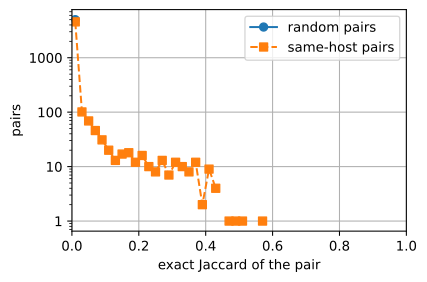
A document has a median of 360 shingles, and all the shingle sets together take 1.76 GiB as Python sets; signatures of 128 numbers take 25 MiB, about seventy times less. Two random pages share no five-word sequence at all, up to the 99th percentile. Pages of one site share more, through their templates, and the figure shows their tail on the log scale, but even their 99th percentile is 0.32, and no pair in either sample reaches 0.8. This is the shape the method has to exploit. Almost every pair is far below the threshold, and the work worth saving is the work of looking at those pairs at all.
20.3.2.2 MinHash
Let us start with a thought experiment that is too expensive to run. Put all possible shingles in a random order \(\pi\), and let \(h_\pi(A)\) be the shingle of \(A\) that comes first in this order, the minimum of \(A\) under \(\pi\). Two documents agree in this one value with a probability that we can compute.
Proposition. For a uniformly random order \(\pi\) and non-empty sets \(A\) and \(B\), \(\Pr[h_\pi(A) = h_\pi(B)] = J(A, B)\).
Proof. Let \(x^*\) be the element of \(A \cup B\) that comes first under \(\pi\). The order is uniform, so every element of the union is equally likely to be \(x^*\), and the probability that \(x^*\) falls in a subset is the size of the subset over the size of the union, as for any uniform choice in Section 1.6. If \(x^*\) lies in \(A \cap B\), it is the minimum of both sets and the two values agree. If \(x^*\) lies in \(A\) but not in \(B\), it is the minimum of \(A\), while the minimum of \(B\) comes later, so the values differ, and the same holds with the roles exchanged. The values therefore agree exactly when \(x^* \in A \cap B\), which has probability \(|A \cap B| / |A \cup B|\). \(\blacksquare\)
One order gives one coin flip with success probability \(J\). A MinHash signature repeats the experiment with \(k\) independent orders and stores the \(k\) minima. The share of positions in which two signatures agree estimates \(J\), and since the number of agreeing positions is a binomial count of \(k\) trials (Section 1.6), the estimate is unbiased with a variance we can write down:
\[ \hat J = \frac{1}{k}\sum_{i=1}^{k} \mathbf{1}\bigl[h_{\pi_i}(A) = h_{\pi_i}(B)\bigr], \qquad \mathbb{E}[\hat J] = J, \qquad \operatorname{Var}[\hat J] = \frac{J(1 - J)}{k}. \tag{20.3.1}\]
The remarkable part is what the signature does not depend on. It has \(k\) numbers whether the document has 50 shingles or 50,000, and two signatures estimate the similarity without the documents. The estimate is noisy: at \(J = 0.8\) and \(k = 128\) the standard deviation is \(\sqrt{0.16/128} \approx 0.035\), so pairs at 0.75 and at 0.85 are not reliably told apart.
A random order of all possible shingles cannot be stored, so implementations use hash functions instead. Each shingle is hashed to a number \(x\) below the prime \(p = 2^{61} - 1\), and position \(i\) of the signature is the minimum of \((a_i x + c_i) \bmod p\) over the document’s shingles. For \(a_i \neq 0\) this map is a bijection of \(\{0, \ldots, p - 1\}\), so it does order the shingles, but it is one of about \(p^2\) such maps rather than a uniform choice among all orders, and the proposition holds only approximately. Whether that matters is a question for measurement. The specification fixes every remaining choice:
- NFC, lower case,
\w+words, shingles of five words joined by one space; - each shingle hashed by blake2b with an 8-byte digest, read as a little-endian integer and reduced modulo \(p\);
- \((a_i, c_i)\) for \(i = 1, \ldots, 128\) drawn from
numpy.random.default_rng(0xD2)as integers in \([1, p)\); - the product \(a_i x\) computed exactly.
The last point hides a trap. Both factors are below \(2^{61}\), so their product needs up to 122 bits, and NumPy’s uint64 arithmetic silently discards everything above 64. The library splits the multiplication into 32-bit halves.
MINHASH_PRIME = (1 << 61) - 1  # the Mersenne prime 2^61 - 1


def minhash_signature(shingle_list, k=128, seed=0xD2):
    """The MinHash signature, a (k,) uint64 array, of a shingle collection:
    row i is the minimum over shingles of (a_i x + c_i) mod p, where x is
    the shingle's blake2b hash (8 bytes, little-endian) mod p, p = 2^61 - 1
    and (a, c) are drawn from numpy.random.default_rng(seed). None for an
    empty collection (fewer words than the shingle size): such a document
    never matches."""
    if not shingle_list:
        return None
    x = np.unique(d2l._shingle_hashes(shingle_list)) % np.uint64(
        d2l.MINHASH_PRIME)
    a, c = d2l._minhash_params(k, seed)
    return d2l._minhash_rows(x, a, c)  # exact mulmod: 32-bit halves


MINHASH_FIXTURE = (  # five strings whose signatures the library pins
    'The quick brown fox jumps over the lazy dog.',
    'Deduplication keeps one copy of every document in the corpus.',
    'Café crème: une boisson chaude, servie le matin avec du pain.',
    'ONE two Three four FIVE six seven, eight; nine: ten!',
    'Near-duplicate pages differ only by a date or a sidebar.')
MINHASH_FIXTURE_SHA256 = (  # of their k = 128, seed 0xD2 signatures' bytes
    'b9b07bf416ce76f2b5cf1ae3d12fc617bdfa5bc7e464230c6bca1ada3bda0195')
We check the estimator on sets whose similarity we choose: for each \(J\) from 0.1 to 0.9, 200 pairs with unions of 200 random words. If the hash family behaves like random orders, the mean of \(\hat J\) lies within three standard errors of \(J\) and the variance across pairs is close to \(J(1 - J)/k\). The same pairs go through datasketch’s MinHash, an independent implementation. Finally, the signatures of five fixed strings, whose hash the library pins, are compared position by position with a version of the specification in Python integers, which never overflow.
rng = np.random.default_rng(0)
rows, n_pairs, U = [], 200, 200  # 200 pairs per J, unions of 200 shingles
for J in np.round(np.arange(0.1, 1.0, 0.1), 1):
    ours, oracle = [], []
    for _ in range(n_pairs):
        words = [f'w{x}' for x in rng.integers(0, 2**62, U)]
        inter = round(J * U)
        a_only = (U - inter) // 2
        A, B = words[:inter + a_only], words[:inter] + words[inter + a_only:]
        assert d2l.jaccard_exact(A, B) == J  # (distinct draws: 2^62 range)
        ours.append(np.mean(d2l.minhash_signature(A, K)
                            == d2l.minhash_signature(B, K)))
        ma, mb = MinHash(num_perm=K), MinHash(num_perm=K)
        ma.update_batch([w.encode() for w in A])
        mb.update_batch([w.encode() for w in B])
        oracle.append(ma.jaccard(mb))
    se = math.sqrt(J * (1 - J) / K / n_pairs)  # of the mean of n_pairs
    rows.append(dict(J=J, bias=np.mean(ours) - J,
                     z=(np.mean(ours) - J) / se,
                     var_ratio=np.var(ours, ddof=1) / (J * (1 - J) / K),
                     z_datasketch=(np.mean(oracle) - J) / se))
D1 = pd.DataFrame(rows)
say(D1.round(4).to_string(index=False))
assert (D1.z.abs() <= 3).all() and (D1.z_datasketch.abs() <= 3).all()
assert D1.var_ratio.between(0.7, 1.3).all()
say(f'95% half-width at J = 0.8, k = {K}: '
    f'{1.96 * math.sqrt(0.8 * 0.2 / K):.4f}')

def reference(shingle_list, k=K, seed=0xD2):
    """The specification in Python integers: no NumPy arithmetic."""
    p = d2l.MINHASH_PRIME
    a, c = np.random.default_rng(seed).integers(1, p, size=(2, k),
                                                dtype=np.uint64)
    xs = {int.from_bytes(hashlib.blake2b(s.encode('utf-8'), digest_size=8)
                         .digest(), 'little') % p for s in shingle_list}
    return [min((int(ai) * x + int(ci)) % p for x in xs)
            for ai, ci in zip(a, c)]

sigs = [d2l.minhash_signature(d2l.shingles(t), K)
        for t in d2l.MINHASH_FIXTURE]
same = [s.tolist() == reference(d2l.shingles(t))
        for s, t in zip(sigs, d2l.MINHASH_FIXTURE)]
say(f'fixture: signatures equal to the Python-integer specification: '
    f'{sum(same)} of {len(same)}')
assert all(same), 'not bit-exact to the specification'
fix = hashlib.sha256(b''.join(s.astype('<u8').tobytes() for s in sigs))
say(f'fixture signatures: SHA-256 {fix.hexdigest()[:16]}…, pinned '
    f'{d2l.MINHASH_FIXTURE_SHA256[:16]}…')
assert fix.hexdigest() == d2l.MINHASH_FIXTURE_SHA256, 'fixture changed'
R['minhash'] = dict(table=D1.to_dict('list'), fixture=fix.hexdigest(),
                    reference_equal=sum(same))
J bias z var_ratio z_datasketch
0.1 -0.0009 -0.4792 1.0779 0.7708
0.2 -0.0016 -0.6406 1.0658 -0.5625
0.3 0.0005 0.1909 1.0693 0.9411
0.4 -0.0035 -1.1354 1.0935 1.9392
0.5 -0.0014 -0.4500 1.0989 0.0000
0.6 -0.0057 -1.8499 0.8833 -1.1227
0.7 -0.0002 -0.0818 0.8818 -1.8139
0.8 0.0002 0.0938 1.1554 0.5937
0.9 -0.0006 -0.3125 0.9622 0.6458
95% half-width at J = 0.8, k = 128: 0.0693
fixture: signatures equal to the Python-integer specification: 5 of 5
fixture signatures: SHA-256 b9b07bf416ce76f2…, pinned b9b07bf416ce76f2…In every bin the bias is within two standard errors (the largest \(|z|\) is 1.85), and the variance is between 0.88 and 1.16 times its formula. Datasketch behaves the same way. The fixture signatures are equal to the integer reference in all five strings, and their hash equals the pinned one, so any implementation of the specification can test itself against these five. For sets of this size, then, the \((a x + c) \bmod p\) family is as good as a random order, and the 95% half-width at \(J = 0.8\) is \(1.96 \sqrt{0.8 \cdot 0.2 / 128} = 0.069\), as the formula says.
20.3.2.3 Banding and the S-Curve
An estimate of \(J\) for one pair still leaves us comparing pairs. Banding turns the signature into a search. Cut the \(k = br\) positions of every signature into \(b\) bands of \(r\) positions, and use each band, hashed, as the key of a bucket. Two documents become a candidate pair if they share a bucket in at least one band. For a pair of similarity \(s\), one position agrees with probability \(s\), and the positions come from different hash functions, so a whole band agrees with probability \(s^r\). All \(b\) bands disagree with probability \((1 - s^r)^b\), and the pair becomes a candidate with probability
\[ P(s) = 1 - (1 - s^r)^b. \tag{20.3.2}\]
For small \(s\) the curve is close to \(b s^r\), tiny, and for \(s\) near 1 it is close to 1; in between it rises steeply, which gives it its name, the S-curve. Its derivative \(P'(s) = b r s^{r-1} (1 - s^r)^{b-1}\) is largest where \((r - 1)(1 - s^r) = (b - 1) r s^r\), that is at \(s^* = ((r - 1)/(br - 1))^{1/r}\), close to \((1/b)^{1/r}\). More rows per band move the step to the right, more bands move it to the left. The smallest case needs four numbers. With \(b = r = 2\), \(P(s) = 1 - (1 - s^2)^2\), which is 0.4375 at \(s = 0.5\) and 0.964 at \(s = 0.9\), so a signature of four values already separates these two similarities most of the time.
The budget \(k\) is fixed by memory and by the cost of hashing, so the design question is how to split it. A natural answer compares the S-curve with the ideal step at the threshold \(\tau\). The area under the curve left of \(\tau\) counts pairs below the threshold that become candidates, the area above the curve right of \(\tau\) counts duplicates that are missed, and two weights say what each error costs:
\[ E(b, r) = w_{\textrm{fp}} \int_0^{\tau} P(s)\, ds + w_{\textrm{fn}} \int_{\tau}^{1} \bigl(1 - P(s)\bigr)\, ds. \tag{20.3.3}\]
best_br minimizes \(E\) over \(r\) with \(b = \lfloor k/r \rfloor\), as datasketch’s MinHashLSH does internally. The integral weighs every similarity in \([0, 1]\) equally, an assumption that will matter.
def scurve(s, b, r):
    """The probability that a pair of Jaccard s becomes a candidate under b
    bands of r rows: 1 - (1 - s^r)^b."""
    return 1 - (1 - np.asarray(s, dtype=float) ** r) ** b


def _br_error(b, r, tau, w_fp=1.0, w_fn=1.0, n_grid=20_001):
    """The weighted error areas of an S-curve against the step at tau:
    w_fp times the area under P on [0, tau] (pairs below the threshold that
    become candidates) plus w_fn times the area above P on [tau, 1]
    (trapezoid rule on n_grid points)."""
    s = np.linspace(0, 1, n_grid)
    P = d2l.scurve(s, b, r)
    lo, hi = s <= tau, s >= tau
    return (w_fp * np.trapezoid(P[lo], s[lo])
            + w_fn * np.trapezoid(1 - P[hi], s[hi]))


def best_br(k, tau, w_fp=1.0, w_fn=1.0):
    """The (b, r) with b = k // r that minimizes the weighted error areas
    of its S-curve against the step at tau (the smallest r on a tie)."""
    errors = {(k // r, r): d2l._br_error(k // r, r, tau, w_fp, w_fn)
              for r in range(1, k + 1)}
    return min(errors, key=errors.get)


def lsh_candidates(sigs, b, r, *, max_bucket=1000, seed=0):
    """Candidate pairs (i, j), i < j, of signatures (a sequence of arrays,
    None for an empty document) that agree in all r rows of at least one of
    b bands; the bucket key of band j is blake2b (8 bytes) of its rows'
    bytes. A bucket with more than max_bucket members (templated pages) is
    cut to max_bucket members drawn with default_rng((seed, j)). Returns
    (set of pairs, report of bucket sizes and the cut buckets)."""
    import itertools
    pairs, sizes, cut = set(), collections.Counter(), []
    rows = [i for i, s in enumerate(sigs) if s is not None]
    for j in range(b):
        buckets = collections.defaultdict(list)
        for i in rows:
            band = sigs[i][j * r:(j + 1) * r].astype('<u8')
            buckets[hashlib.blake2b(band.tobytes(), digest_size=8)
                    .digest()].append(i)
        for members in buckets.values():
            if len(members) < 2:
                continue
            sizes[len(members)] += 1
            if max_bucket and len(members) > max_bucket:
                cut.append((j, len(members)))
                members = sorted(np.random.default_rng((seed, j)).choice(
                    members, max_bucket, replace=False).tolist())
            pairs.update(itertools.combinations(members, 2))
    return pairs, dict(n_pairs=len(pairs), bucket_sizes=dict(sizes),
                       largest=max(sizes, default=0), cut=cut)


def union_find_clusters(n, pairs):
    """Connected components of n items under pairs, by union-find (path
    compression, union by size); each item's label is the smallest index
    of its component, so the result does not depend on the pair order."""
    parent, size = list(range(n)), [1] * n
    def find(i):
        root = i
        while parent[root] != root:
            root = parent[root]
        while parent[i] != root:
            parent[i], i = root, parent[i]
        return root
    for i, j in pairs:
        ri, rj = find(i), find(j)
        if ri != rj:
            if size[ri] < size[rj]:
                ri, rj = rj, ri
            parent[rj] = ri
            size[ri] += size[rj]
    roots = np.array([find(i) for i in range(n)], dtype=np.int64)
    low = np.full(n, n, dtype=np.int64)
    np.minimum.at(low, roots, np.arange(n))
    return low[roots]


def near_dedup(texts, threshold=0.8, ngram=5, num_perm=128, seed=0, *,
               workers=1):
    """The indices of texts to keep after near-duplicate removal: MinHash
    signatures (hash seed 0xD2 + seed), banding at best_br(num_perm,
    threshold), union-find clusters; each cluster keeps its lowest index.
    workers > 1 computes the signatures in separate processes."""
    sigs = d2l._minhash_texts(texts, num_perm, (0xD2 + seed,), ngram,
                              workers)[0xD2 + seed]
    pairs, _ = d2l.lsh_candidates(sigs, *d2l.best_br(num_perm, threshold))
    labels = d2l.union_find_clusters(len(sigs), pairs)
    return [i for i in range(len(sigs)) if labels[i] == i]
paper = (0.56, 0.77, 0.92, 0.988) # FineWeb's matched probabilities
ours = [round(float(d2l.scurve(s, 14, 8)), 2 if p < 0.98 else 3)
for s, p in zip((0.7, 0.75, 0.8, 0.85), paper)]
say('(14, 8) at s = 0.7, 0.75, 0.8, 0.85:', ours, '| paper:', paper)
assert tuple(ours) == paper
say(f'b = r = 2: P(0.5) = {d2l.scurve(0.5, 2, 2):.4f}, '
f'P(0.9) = {d2l.scurve(0.9, 2, 2):.4f}')
s = np.linspace(0, 1, 200_001)
for b, r in ((14, 8), (9, 13), (20, 5)):
slope = np.gradient(d2l.scurve(s, b, r), s)
steep = ((r - 1) / (b * r - 1)) ** (1 / r)
say(f'({b}, {r}): steepest at {s[np.argmax(slope)]:.4f}; '
f'((r - 1)/(br - 1))^(1/r) = {steep:.4f}; '
f'(1/b)^(1/r) = {(1 / b) ** (1 / r):.4f}')
assert abs(s[np.argmax(slope)] - steep) < 1e-4
BR = d2l.best_br(K, TAU)
brute = {(b, r): d2l._br_error(b, r, TAU) for r in range(1, K + 1)
for b in range(1, K // r + 1)} # every b r <= K
best = min(brute, key=brute.get)
say(f'best_br({K}, {TAU}) = {BR}, error {d2l._br_error(*BR, TAU):.4f}; '
f'brute force over b r <= {K}: {best}, error {brute[best]:.4f}')
assert BR == (9, 13) and abs(brute[best] - d2l._br_error(*BR, TAU)) < 1e-9
for r in (12, 13, 14):
say(f' ({K // r}, {r}): error {d2l._br_error(K // r, r, TAU):.4f}, '
f'P({TAU}) = {d2l.scurve(TAU, K // r, r):.3f}')
lsh = MinHashLSH(threshold=TAU, num_perm=K)
DS_BR = (lsh.b, lsh.r)
BR5 = d2l.best_br(K, TAU, w_fn=5.0)
say(f'datasketch MinHashLSH(threshold={TAU}, num_perm={K}): (b, r) = '
f'{DS_BR}; best_br with w_fn = 5: {BR5}')
R['scurve'] = dict(paper=list(ours), best_br=list(BR), brute=list(best),
datasketch=list(DS_BR), best_br_w5=list(BR5))(14, 8) at s = 0.7, 0.75, 0.8, 0.85: [0.56, 0.77, 0.92, 0.988] | paper: (0.56, 0.77, 0.92, 0.988)
b = r = 2: P(0.5) = 0.4375, P(0.9) = 0.9639
(14, 8): steepest at 0.7079; ((r - 1)/(br - 1))^(1/r) = 0.7079; (1/b)^(1/r) = 0.7190
(9, 13): steepest at 0.8399; ((r - 1)/(br - 1))^(1/r) = 0.8399; (1/b)^(1/r) = 0.8445
(20, 5): steepest at 0.5264; ((r - 1)/(br - 1))^(1/r) = 0.5264; (1/b)^(1/r) = 0.5493
best_br(128, 0.8) = (9, 13), error 0.0586; brute force over b r <= 128: (9, 13), error 0.0586
(10, 12): error 0.0600, P(0.8) = 0.509
(9, 13): error 0.0586, P(0.8) = 0.399
(9, 14): error 0.0588, P(0.8) = 0.333
datasketch MinHashLSH(threshold=0.8, num_perm=128): (b, r) = (9, 13); best_br with w_fn = 5: (12,
10)FineWeb’s setting, 112 positions as 14 bands of 8 rows, gives candidate probabilities of 0.56, 0.77, 0.92 and 0.988 at similarities 0.7, 0.75, 0.8 and 0.85, the four values its paper reports. Its steepest point is at 0.71, because FineWeb aimed at pages about 75% similar. The steepest points agree with the formula to four decimals. Under equal weights the best split of 128 positions for \(\tau = 0.8\) is \((9, 13)\), found alike by best_br, by a brute-force search over all \(br \leq 128\) and by datasketch. A pair at the threshold becomes a candidate with probability 0.40 there, and the steepest point lies at 0.84, so this optimum misses more borderline duplicates than it admits borderline non-duplicates. Weighting misses five times as heavily moves the choice to \((12, 10)\).
To tune \((b, r)\) on data we need pairs with known similarity. The stream cannot provide near-duplicates, because FineWeb deduplicated its dump with MinHash before we drew from it, so the pairs are made by editing stream documents. From 2,000 documents of at least 50 words, the generator makes three copies each, every copy by one random edit: words substituted or deleted at a rate between 1% and 30%, a block of 20 to 200 words of boilerplate inserted, the paragraphs shuffled, or the text truncated to 30% to 90% of its words. Then come 3,000 pairs of different pages from one host, which share templates, and 3,000 random pairs. The label is the exact \(J \geq 0.8\) of the final texts. This makes the task a test of the sketch: estimate a known \(J\) well enough to threshold it. Whether \(J \geq 0.8\) is the right definition of a duplicate is a separate question, which no labelled pair can settle. The pairs are split into training and test halves by the SHA-256 of the base document, so that the copies of one document stay together.
DUP_PAIRS_SPEC = dict(  # the labelled pair set lm-dedup-pairs-v1
    n_base=2000, variants=3, min_words=50,
    ops=('sub', 'del', 'boiler', 'shuffle', 'trunc'),
    rates=(0.01, 0.02, 0.05, 0.1, 0.2, 0.3),  # of the words, sub and del
    boiler_words=(20, 200), trunc=(0.3, 0.9),
    n_neg_host=3000, n_neg_random=3000, ngram=5, tau=0.8)


def pair_texts(row, texts, vocab=None):
    """The two texts of a labelled pair: texts[a] and texts[b], or texts[a]
    and its perturbed copy by row['op'] and row['params'] (vocab: the
    substitution words, needed for 'sub')."""
    a = texts[row['a']]
    if row['b'] is not None:
        return a, texts[row['b']]
    return a, d2l._dup_perturb(a, row['op'], row['params'], vocab)


def make_dup_pairs(docs, spec, seed=0):
    """The labelled pairs of spec from docs (a DataFrame with id, url, text
    and role 'stream' or 'host_pair'): spec['variants'] perturbed copies of
    each of spec['n_base'] stream documents (the first of a seeded
    permutation with at least spec['min_words'] words), pairs of different
    documents of one host (neg_host) and random stream pairs (neg_random).
    Each row: pair_id, a, b (None for a copy), op, params (with the copy's
    seed), J, C (containment of the smaller shingle set in the larger),
    label (J >= tau) and split (train or test by the SHA-256 of a)."""
    import itertools
    import regex
    rng = np.random.default_rng(seed)
    texts = dict(zip(docs.id, docs.text))
    stream = docs.id[docs.role == 'stream'].tolist()
    vocab = d2l._dup_vocab(texts[i] for i in stream)
    long_enough = (stream[i] for i in rng.permutation(len(stream))
                   if len(regex.findall(r'\w+', texts[stream[i]]))
                   >= spec['min_words'])
    todo = []
    for a in itertools.islice(long_enough, spec['n_base']):
        for _ in range(spec['variants']):
            op = str(rng.choice(spec['ops']))
            params = dict(seed=int(rng.integers(2**31)))
            if op in ('sub', 'del'):
                params['rate'] = float(rng.choice(spec['rates']))
            elif op == 'boiler':
                lo, hi = spec['boiler_words']
                params['words'] = int(rng.integers(lo, hi + 1))
            elif op == 'trunc':
                params['frac'] = round(float(rng.uniform(*spec['trunc'])), 4)
            todo.append((a, None, op, params))
    hosts = docs[docs.role == 'host_pair'].assign(
        host=[d2l._url_host(u) for u in docs.url[docs.role == 'host_pair']])
    same = [p for ids in hosts.groupby('host').id.apply(list)
            for p in itertools.combinations(ids, 2)]
    for k in sorted(rng.choice(len(same), spec['n_neg_host'],
                               replace=False).tolist()):
        todo.append((*same[k], 'neg_host', {}))
    seen = set()
    while len(seen) < spec['n_neg_random']:
        i, j = sorted(rng.choice(len(stream), 2, replace=False).tolist())
        if (i, j) not in seen:
            seen.add((i, j))
            todo.append((stream[i], stream[j], 'neg_random', {}))
    rows = []
    for n, (a, b, op, params) in enumerate(todo):
        row = dict(pair_id=f'p{n:05d}', a=a, b=b, op=op, params=params)
        sa, sb = (set(d2l.shingles(t, spec['ngram']))
                  for t in d2l.pair_texts(row, texts, vocab))
        small, large = (sa, sb) if len(sa) <= len(sb) else (sb, sa)
        J = d2l.jaccard_exact(sa, sb)
        half = int(hashlib.sha256(a.encode('utf-8')).hexdigest(), 16) % 2
        rows.append(dict(row, J=J, C=d2l.containment(small, large),
                         label=bool(J >= spec['tau']),
                         split=('train', 'test')[half]))
    return rows
PAIRS_KEY, PAIRS_FILE = ARTIFACTS['dedup-pairs']
VOCAB = d2l._dup_vocab(STREAM_S.text)
if 'dedup-pairs' in RERUN:
t0 = time.perf_counter()
rows = d2l.make_dup_pairs(SLICE, d2l.DUP_PAIRS_SPEC, seed=0)
say(f'made {len(rows):,} pairs in {time.perf_counter() - t0:.0f} s')
d2l.lm_save_rerun(PAIRS_FILE, lambda f: d2l.write_docs(f, rows))
with gzip.open(d2l.lm_artifact(
PAIRS_KEY, PAIRS_FILE if 'dedup-pairs' in RERUN else None),
'rt') as f:
PAIR_ROWS = [json.loads(line) for line in f] # b is None for copies
PAIRS = pd.DataFrame(PAIR_ROWS)
t0 = time.perf_counter()
PAIR_TEXT = [d2l.pair_texts(row, TEXT, VOCAB) for row in PAIR_ROWS]
J_live = np.array([d2l.jaccard_exact(d2l.shingles(x), d2l.shingles(y))
for x, y in PAIR_TEXT])
TIMES['pairs_regen'] = time.perf_counter() - t0
gap = np.abs(J_live - PAIRS.J.to_numpy()).max()
say(f'{len(PAIRS):,} pairs regenerated from the stream in '
f'{TIMES["pairs_regen"]:.0f} s; largest |J - stored J| {gap:.1e}')
assert gap <= 1e-12, 'the regenerated texts differ from the registered ones'
counts = PAIRS.groupby(['op', 'split']).size().unstack()
counts['label rate'] = PAIRS.groupby('op').label.mean().round(3)
counts['median J'] = PAIRS.groupby('op').J.median().round(3)
say(counts.to_string())
R['pairs'] = dict(n=len(PAIRS), by_op=PAIRS.op.value_counts().to_dict(),
labels=int(PAIRS.label.sum()))12,000 pairs regenerated from the stream in 11 s; largest |J - stored J| 0.0e+00
split test train label rate median J
op
boiler 592 592 0.427 0.765
del 557 627 0.349 0.629
neg_host 1504 1496 0.000 0.000
neg_random 1565 1435 0.000 0.000
shuffle 593 629 0.649 0.839
sub 579 639 0.323 0.604
trunc 556 636 0.167 0.608The rebuilt texts reproduce every stored \(J\) exactly. The table shows how unevenly the edits move a page across the threshold. Shuffled paragraphs stay duplicates most often, because only the shingles that cross a paragraph boundary change. Substitutions do surprising damage. Each changed word removes up to five shingles, so a substitution rate \(q\) leaves a share of about \(x = (1 - q)^5\) of each document’s shingles intact, and then \(J = x/(2 - x)\). One word in fifty gives \(J \approx 0.82\), a duplicate; one word in twenty gives \(0.63\), not one. Truncation is the case of containment: a copy cut to a share \(f\) of its words has \(J \approx f\), so only copies that keep at least 80% of the page are labelled duplicates.
The derivation predicts that a pair of exact similarity \(J_i\) becomes a candidate with probability \(P(J_i)\), and the pairs let us test this. We test 13 settings, the 12 splits of 128 positions with \(r\) from 4 to 16 and FineWeb’s \((14, 8)\) on the first 112 positions, with three hash seeds each. In every bin of \(J\) of width 0.05, the number of candidates is a sum of independent trials with different probabilities, a Poisson-binomial count, whose exact distribution gives a 95% interval around the expected count \(\sum_i P(J_i)\). The curve at the bin’s centre would not do: at \((9, 13)\) it rises from 0.40 to 0.69 between 0.80 and 0.85. A hash that behaves as derived leaves about 5% of the (setting, bin, seed) cells outside their intervals, or fewer; a flawed one leaves many more.
t0 = time.perf_counter()
key_a = PAIRS.a.tolist()
key_b = [r['b'] if r['b'] is not None else r['pair_id'] + '/b'
         for r in PAIR_ROWS]
doc_text = dict(zip(key_a, (x for x, _ in PAIR_TEXT)))
doc_text.update(zip(key_b, (y for _, y in PAIR_TEXT)))
uniq = list(doc_text)
pos = {k: i for i, k in enumerate(uniq)}
ia, ib = (np.array([pos[k] for k in keys]) for keys in (key_a, key_b))
PSIGS = d2l._minhash_texts([doc_text[k] for k in uniq], K,
                           [0xD2 + s for s in SEEDS], 5, N_WORKERS)
CONFIGS = [(K // r, r) for r in R_GRID] + [(14, 8)]  # (14, 8): rows 0-111
DECIDE = {}
for s in SEEDS:
    Sg, ok = d2l._sig_matrix(PSIGS[0xD2 + s], K)
    both = ok[ia] & ok[ib]
    for b, r in CONFIGS:
        DECIDE[b, r, s] = d2l._band_match(Sg[ia], Sg[ib], b, r) & both
cand, rep = d2l.lsh_candidates(PSIGS[0xD2], 9, 13)  # the bucket pipeline
via = np.array([(min(i, j), max(i, j)) in cand for i, j in zip(ia, ib)])
assert (via == DECIDE[9, 13, 0]).all() and not rep['cut']
TIMES['scurve_measure'] = time.perf_counter() - t0
say(f'{len(uniq):,} distinct pair documents, {len(SEEDS)} seeds, '
    f'{len(CONFIGS)} settings: {TIMES["scurve_measure"]:.0f} s; bucket '
    f'pipeline at (9, 13) = per-pair band test on all {len(PAIRS):,} pairs')

J = PAIRS.J.to_numpy()
BINS = np.minimum((J / 0.05).astype(int), 19)
table = []
for b, r in CONFIGS:
    p = d2l.scurve(J, b, r)
    for g in np.unique(BINS):
        m = BINS == g
        lo, hi = d2l._pb_interval(p[m])
        for s in SEEDS:
            obs = int(DECIDE[b, r, s][m].sum())
            table.append(dict(b=b, r=r, seed=s, bin=g * 0.05, n=int(m.sum()),
                              J_mean=J[m].mean(), expected=p[m].sum(), lo=lo,
                              hi=hi, observed=obs, inside=lo <= obs <= hi))
SC = pd.DataFrame(table)
inf = SC[SC.n >= 30]
per = inf.groupby(['b', 'r']).inside.mean()
n_out, n_cells = int((~inf.inside).sum()), len(inf)
bound = stats.binom.ppf(0.999, n_cells, 0.05)
say(f'{n_cells} (setting, bin, seed) cells with n >= 30: {n_out} outside '
    f'their 95% interval (a correct hash: about 5% or fewer, at most '
    f'{bound:.0f} at the 0.999 level); share inside per (b, r): '
    + ', '.join(f'{b}x{r} {v:.2f}' for (b, r), v in per.items()))
assert n_out <= bound, 'the candidate rates depart from the S-curve'
show = SC[(SC.b == 9) & (SC.r == 13) & (SC.n >= 30)].pivot_table(
    index=['bin', 'n', 'J_mean', 'expected', 'lo', 'hi'], columns='seed',
    values='observed').reset_index()
say('\n(9, 13): observed candidates per seed against the expected count '
    'and its interval')
say(show.round(3).to_string(index=False))

s_grid = np.linspace(0, 1, 501)
theory = [(14, 8), (9, 13), (20, 5), (8, 16), (450, 20)]
d2l.set_figsize((5, 3.5))
ax = d2l.plt.gca()
d2l.plot_intervals(s_grid, {f'{b} x {r}': (d2l.scurve(s_grid, b, r),) * 3
                            for b, r in theory}, 'exact Jaccard of the pair',
                   'P(candidate)', kind='band', axes=ax)
ax.axvline(TAU, linestyle='--', color='black', linewidth=0.8,
           label=f'threshold {TAU}')
pooled = SC[SC.n >= 30].groupby(['b', 'r', 'bin']).agg(
    J_mean=('J_mean', 'first'), n=('n', 'first'), obs=('observed', 'sum'),
    exp=('expected', 'first')).reset_index()
xs = pooled[(pooled.b == 14) & (pooled.r == 8)].J_mean.to_numpy()
series, exp_marks = {}, {}
for b, r in ((14, 8), (9, 13)):
    q = pooled[(pooled.b == b) & (pooled.r == r)]
    ci = np.array([d2l.wilson_ci(o, 3 * n) for o, n in zip(q.obs, q.n)])
    series[f'{b} x {r} measured'] = (q.obs / (3 * q.n), ci[:, 0], ci[:, 1])
    exp_marks[f'{b} x {r} measured'] = (xs, q.exp / q.n)
d2l.plot_intervals(xs, series, 'exact Jaccard of the pair', 'P(candidate)',
                   axes=ax, marks={'expected (bin mean of the curve)': (
                       'x', exp_marks)})
ax.legend(loc='center left', bbox_to_anchor=(1.02, 0.5))  # beside the axes
R['scurve_measure'] = dict(n_cells=n_cells, n_outside=n_out,
                           inside=per.round(4).to_dict(),
                           table=SC.round(6).to_dict('list'))
16,934 distinct pair documents, 3 seeds, 13 settings: 32 s; bucket pipeline at (9, 13) = per-pair
band test on all 12,000 pairs
780 (setting, bin, seed) cells with n >= 30: 19 outside their 95% interval (a correct hash: about 5%
or fewer, at most 59 at the 0.999 level); share inside per (b, r): 8x16 1.00, 9x13 0.98, 9x14
1.00, 10x12 0.97, 11x11 0.95, 12x10 0.98, 14x8 0.93, 14x9 0.98, 16x8 0.95, 18x7 0.98, 21x6 1.00,
25x5 0.98, 32x4 0.97
(9, 13): observed candidates per seed against the expected count and its interval
bin n J_mean expected lo hi 0 1 2
0.00 5820 0.001 0.000 0 0 0.0 0.0 0.0
0.05 264 0.082 0.000 0 0 0.0 0.0 0.0
0.10 182 0.117 0.000 0 0 0.0 0.0 0.0
0.15 175 0.183 0.000 0 0 0.0 0.0 0.0
0.20 236 0.220 0.000 0 0 0.0 0.0 0.0
0.25 86 0.273 0.000 0 0 0.0 0.0 0.0
0.30 142 0.328 0.001 0 0 0.0 0.0 0.0
0.35 203 0.375 0.006 0 0 0.0 0.0 0.0
0.40 378 0.425 0.055 0 1 0.0 0.0 0.0
0.45 248 0.472 0.139 0 1 0.0 0.0 0.0
0.50 187 0.524 0.398 0 2 2.0 0.0 0.0
0.55 210 0.576 1.517 0 4 1.0 0.0 1.0
0.60 472 0.628 10.288 5 17 4.0 10.0 11.0
0.65 422 0.672 21.969 14 31 25.0 25.0 24.0
0.70 299 0.725 39.741 29 52 39.0 33.0 41.0
0.75 372 0.776 108.893 92 126 110.0 102.0 114.0
0.80 813 0.826 445.087 418 473 431.0 438.0 429.0
0.85 662 0.874 539.373 520 558 537.0 546.0 534.0
0.90 664 0.919 642.670 633 651 640.0 651.0 647.0
0.95 165 0.978 164.962 164 165 165.0 165.0 165.0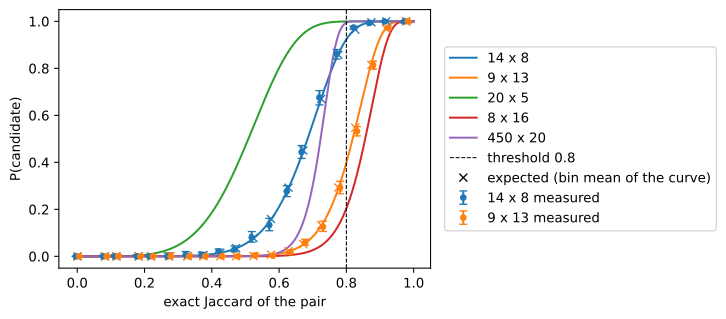
Of the 780 cells with at least 30 pairs, 19 fall outside their interval, 2.4%, against an upper bound of 59 at the 0.999 level. Every setting keeps at least 93% of its cells inside. In the table for \((9, 13)\) the bin from 0.80 to 0.85 holds 813 pairs and expects 445 candidates, with an interval from 418 to 473, and the three seeds give 431, 438 and 429; below 0.5 no pair becomes a candidate at all. The figure shows the same agreement against five theoretical curves, among them RefinedWeb’s 450 bands of 20 rows (Penedo et al. 2023), and the bucket pipeline makes the same decisions as the pair-by-pair test. The intervals treat the pairs of a bin as independent, although the three copies of one document share shingles, but the margin to the bound is wide. The sketch does what the derivation says.
Now we choose \((b, r)\) like a hyperparameter. On the training pairs we count false positives and false negatives of each setting, averaged over the three seeds, and take the setting with the fewest errors when a miss weighs \(w_{\textrm{fn}} = 1\) and when it weighs 5. On the test pairs we report precision, recall and F1, and we compare the chosen setting with its neighbours on the grid and with the optimum of Equation 20.3.3 by a bootstrap that resamples base documents, since a document and its copies move together.
y = PAIRS.label.to_numpy()
cluster = PAIRS.a.to_numpy()  # a base document and its copies, together
split = {name: (PAIRS.split == name).to_numpy() for name in ('train', 'test')}

def prf(pred, m):
    tp, fp, fn = (np.sum(v[m]) for v in (pred & y, pred & ~y, ~pred & y))
    return dict(P=tp / max(tp + fp, 1), R=tp / max(tp + fn, 1),
                F1=2 * tp / max(2 * tp + fp + fn, 1), FP=fp, FN=fn)

rows = []
for (b, r) in CONFIGS + ([DS_BR] if DS_BR not in CONFIGS else []):
    if (b, r, 0) not in DECIDE:  # datasketch's setting, if not on the grid
        for s in SEEDS:
            Sg, ok = d2l._sig_matrix(PSIGS[0xD2 + s], K)
            DECIDE[b, r, s] = (d2l._band_match(Sg[ia], Sg[ib], b, r)
                               & ok[ia] & ok[ib])
    for name, m in split.items():
        per_seed = pd.DataFrame([prf(DECIDE[b, r, s], m) for s in SEEDS])
        rows.append(dict(b=b, r=r, split=name, **per_seed.mean().to_dict(),
                         F1_min=per_seed.F1.min(), F1_max=per_seed.F1.max()))
GRID = pd.DataFrame(rows)
train = GRID[(GRID.split == 'train') & GRID.r.isin(R_GRID)
             & (GRID.b * GRID.r <= K) & (GRID.b == K // GRID.r)]
CHOSEN = {}
for w in (1, 5):
    err = train.FP + w * train.FN
    best_row = train.loc[err.idxmin()]
    CHOSEN[w] = (int(best_row.b), int(best_row.r))
say('the grid, means over three seeds (FP, FN: counts on the split):')
say(GRID.round(3).to_string(index=False))
steps = abs(R_GRID.index(CHOSEN[1][1]) - R_GRID.index(BR[1]))
say(f'\nchosen on train: w_fn = 1 -> {CHOSEN[1]}, w_fn = 5 -> '
    f'{CHOSEN[5]}; the D3 optimum {BR} is {steps} grid step(s) from the '
    f'w_fn = 1 choice; FineWeb (14, 8) on 112 rows and datasketch '
    f'{DS_BR} are rows of the table')

def f1_diff_ci(pa, pb, m, n_boot=2000, seed=0):
    """F1(pa) - F1(pb) on the pairs m with a cluster-bootstrap 95% interval
    (base documents resampled; per-pair decisions averaged over seeds)."""
    g = np.unique(cluster[m], return_inverse=True)[1]
    C = np.random.default_rng(seed).multinomial(
        g.max() + 1, np.full(g.max() + 1, 1 / (g.max() + 1)), size=n_boot)
    def f1(pred):
        yy = y[m].astype(float)
        tp, fp, fn = (np.bincount(g, v) for v in (
            pred * yy, pred * (1 - yy), (1 - pred) * yy))
        point = 2 * tp.sum() / (2 * tp.sum() + fp.sum() + fn.sum())
        return point, 2 * (C @ tp) / (2 * (C @ tp) + C @ fp + C @ fn)
    (fa, ra), (fb, rb) = f1(pa[m]), f1(pb[m])
    return fa - fb, np.quantile(ra - rb, [0.025, 0.975])

def mean_decision(b, r):
    return np.mean([DECIDE[b, r, s] for s in SEEDS], axis=0)

def compare(br, br2, w):
    """F1(br) - F1(br2) and the weighted errors per pair that br saves
    against br2, on the test pairs, with cluster-bootstrap intervals."""
    pa, pb = mean_decision(*br), mean_decision(*br2)
    d, (lo, hi) = f1_diff_ci(pa, pb, split['test'])
    cost = lambda p: p * ~y + w * (1 - p) * y  # weighted errors per pair
    eb = d2l.paired_bootstrap(cost(pb)[split['test']],
                              cost(pa)[split['test']], n_boot=2000,
                              cluster=cluster[split['test']])
    say(f'test, w_fn = {w}: F1 of {br[0]} x {br[1]} minus {br2[0]} x '
        f'{br2[1]}: {d:+.4f} [{lo:+.4f}, {hi:+.4f}]; weighted errors per '
        f'pair saved: {eb.mean:+.4f} [{eb.ci[0]:+.4f}, {eb.ci[1]:+.4f}]')
    return [d, lo, hi, eb.mean, *eb.ci]

R['choose'] = dict(grid=GRID.round(6).to_dict('list'),
                   chosen={str(w): list(v) for w, v in CHOSEN.items()},
                   d3=list(BR), steps=steps, boot={}, expected={})
for w, (b, r) in CHOSEN.items():
    i = R_GRID.index(r)
    for r2 in R_GRID[max(i - 1, 0):i + 2]:
        if r2 != r:
            R['choose']['boot'][f'{w}:{r}-{r2}'] = compare(
                (b, r), (K // r2, r2), w)
R['choose']['boot']['1:chosen-d3'] = compare(CHOSEN[1], BR, 1)

# D3 weighs similarities uniformly on [0, 1]; the expected weighted error
# under the training pairs' own similarities is a sum over those pairs
J_tr, y_tr = PAIRS.J.to_numpy()[split['train']], y[split['train']]
for w in (1, 5):
    exp_err = {}
    for r in R_GRID:
        p = d2l.scurve(J_tr, K // r, r)
        exp_err[K // r, r] = float(np.sum(p * ~y_tr + w * (1 - p) * y_tr))
    arg = min(exp_err, key=exp_err.get)
    say(f'w_fn = {w}: expected weighted error on train under the pairs\' '
        f'J: least at {arg} ({exp_err[arg]:.1f}); at the D3 optimum '
        f'{BR}: {exp_err[BR]:.1f}; measured choice {CHOSEN[w]}')
    assert arg == CHOSEN[w], 'the hashed choice departs from its expectation'
    R['choose']['expected'][str(w)] = dict(argmin=list(arg),
                                           at_argmin=exp_err[arg],
                                           at_d3=exp_err[BR])

tr, te = (GRID[(GRID.split == n) & (GRID.b == K // GRID.r)
               & GRID.r.isin(R_GRID)] for n in ('train', 'test'))
ax = d2l.plot_intervals(
    np.array(R_GRID), {
        'train': (tr.F1, tr.F1_min, tr.F1_max),
        'test': (te.F1, te.F1_min, te.F1_max)},
    'rows per band r (b = 128 // r)', 'F1 against J >= 0.8',
    marks={f'chosen, w_fn = {w}': (m, {'train': (
        [CHOSEN[w][1]], tr.F1[tr.r == CHOSEN[w][1]].to_numpy() + 0.015)})
        for w, m in ((1, 'v'), (5, 'D'))})  # a marker above the point
_ = ax.legend(loc='center left', bbox_to_anchor=(1.02, 0.5))  # beside
the grid, means over three seeds (FP, FN: counts on the split):
b r split P R F1 FP FN F1_min F1_max
32 4 train 0.463 1.000 0.633 1351.667 0.000 0.632 0.634
32 4 test 0.481 1.000 0.650 1225.333 0.000 0.648 0.651
25 5 train 0.519 1.000 0.684 1080.667 0.000 0.682 0.686
25 5 test 0.534 1.000 0.697 990.667 0.000 0.694 0.699
21 6 train 0.576 1.000 0.731 859.000 0.000 0.729 0.733
21 6 test 0.587 1.000 0.740 798.667 0.000 0.739 0.743
18 7 train 0.639 0.999 0.780 657.333 1.667 0.778 0.782
18 7 test 0.643 0.998 0.782 629.667 2.667 0.778 0.784
16 8 train 0.702 0.993 0.823 491.333 7.667 0.821 0.827
16 8 test 0.701 0.991 0.821 481.667 9.667 0.814 0.825
14 9 train 0.764 0.978 0.858 352.333 26.000 0.849 0.862
14 9 test 0.754 0.973 0.849 361.667 31.000 0.846 0.852
12 10 train 0.812 0.936 0.870 252.333 75.000 0.864 0.873
12 10 test 0.815 0.933 0.870 240.333 75.667 0.870 0.872
11 11 train 0.854 0.899 0.876 179.667 117.333 0.868 0.882
11 11 test 0.858 0.889 0.873 167.000 126.667 0.866 0.881
10 12 train 0.885 0.835 0.859 126.667 192.667 0.849 0.869
10 12 test 0.891 0.833 0.861 116.000 189.667 0.856 0.864
9 13 train 0.913 0.779 0.840 87.000 258.333 0.829 0.862
9 13 test 0.903 0.769 0.831 93.667 263.000 0.822 0.836
9 14 train 0.929 0.737 0.822 65.333 307.000 0.808 0.835
9 14 test 0.921 0.732 0.816 71.333 304.333 0.813 0.823
8 16 train 0.957 0.627 0.758 33.000 435.000 0.742 0.781
8 16 test 0.953 0.625 0.755 35.333 426.333 0.751 0.759
14 8 train 0.718 0.990 0.832 453.667 11.667 0.829 0.838
14 8 test 0.715 0.987 0.829 447.333 14.333 0.821 0.835
chosen on train: w_fn = 1 -> (11, 11), w_fn = 5 -> (14, 9); the D3 optimum (9, 13) is 2 grid step(s)
from the w_fn = 1 choice; FineWeb (14, 8) on 112 rows and datasketch (9, 13) are rows of the
table
test, w_fn = 1: F1 of 11 x 11 minus 12 x 10: +0.0027 [-0.0045, +0.0103]; weighted errors per pair
saved: +0.0038 [+0.0008, +0.0069]
test, w_fn = 1: F1 of 11 x 11 minus 10 x 12: +0.0120 [+0.0037, +0.0206]; weighted errors per pair
saved: +0.0020 [-0.0012, +0.0053]
test, w_fn = 5: F1 of 14 x 9 minus 16 x 8: +0.0282 [+0.0222, +0.0343]; weighted errors per pair
saved: +0.0022 [-0.0033, +0.0081]
test, w_fn = 5: F1 of 14 x 9 minus 12 x 10: -0.0212 [-0.0290, -0.0138]; weighted errors per pair
saved: +0.0172 [+0.0090, +0.0257]
test, w_fn = 1: F1 of 11 x 11 minus 9 x 13: +0.0426 [+0.0325, +0.0530]; weighted errors per pair
saved: +0.0106 [+0.0068, +0.0145]
w_fn = 1: expected weighted error on train under the pairs' J: least at (11, 11) (307.8); at the D3
optimum (9, 13): 352.0; measured choice (11, 11)
w_fn = 5: expected weighted error on train under the pairs' J: least at (14, 9) (516.8); at the D3
optimum (9, 13): 1389.8; measured choice (14, 9)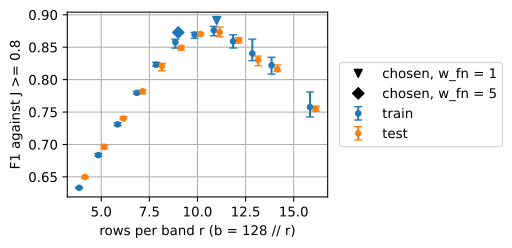
With \(w_{\textrm{fn}} = 1\) the training pairs choose \((11, 11)\), and with \(w_{\textrm{fn}} = 5\) they choose \((14, 9)\): a heavier weight on misses moves the choice to fewer rows per band, as the derivation suggests. On the test pairs \((11, 11)\) reaches precision 0.86, recall 0.89 and F1 0.87, ahead of the equal-weight optimum \((9, 13)\) by \(+0.04\) \([+0.03, +0.05]\) in F1. Its lead over its neighbours on the grid is small: against \((12, 10)\) the F1 difference is not resolved, although the error count it was chosen for is lower by a small resolved margin. FineWeb’s \((14, 8)\) has recall 0.99 at precision 0.72 on our labels, since a curve built for 0.75 counts many pairs between 0.7 and 0.8 as duplicates.
Why do the pairs disagree with Equation 20.3.3? The hashes are not to blame; the measurement above showed that. The integral weighs every similarity between 0 and 1 equally, and the pairs do not: most negatives sit at \(J = 0\), where every setting is right, and the copies crowd around the threshold. Replace the uniform weight by the pairs’ own similarities, so that the expected weighted error is \(\sum_i [P(J_i)(1 - y_i) + w_{\textrm{fn}}(1 - P(J_i))\, y_i]\), and its minimum lies at \((11, 11)\) and at \((14, 9)\), the two settings that the hashed decisions chose; the cell asserts it. The derivation is right about the curve and wrong about the data. A deployment should tune \((b, r)\) on the similarities of the pairs it will actually decide, and labelled pairs, even synthetic ones, are the cheapest way to see them.
A threshold that looks right on labelled pairs can still fail at scale. By linearity of expectation, the expected number of candidates among \(N\) documents is \(\sum_{i < j} P(s_{ij})\), the number of pairs times the mean of \(P\) over their similarities. Nearly all pairs are dissimilar, so the total is decided far below the threshold, by \(P(0.3)\) and \(P(0.5)\), and every candidate from that bulk costs a lookup and a union like a true one. The count can also explode through templates. Templated pages share whole bands, so a single bucket can collect thousands of documents, and a bucket of \(m\) documents yields \(m(m - 1)/2\) pairs. lsh_candidates therefore cuts any bucket above max_bucket members to a seeded sample and reports every cut.
N = 10**6
for br in (CHOSEN[1], (14, 8)):
    p3, p5 = d2l.scurve(0.3, *br), d2l.scurve(0.5, *br)
    exp = N * (N - 1) / 2 * 1e-3 * p5
    say(f'{br}: P(0.3) = {p3:.2e}, P(0.5) = {p5:.4f}; N = 10^6 with 0.1% '
        f'of pairs at s = 0.5: {exp:.2e} expected candidate pairs')
t0 = time.perf_counter()
SLICE_SIGS = d2l._minhash_texts(SLICE.text, K, (0xD2,), 5,
                                N_WORKERS)[0xD2]
TIMES['slice_signatures'] = time.perf_counter() - t0
n = len(SLICE)
say(f'slice: {n:,} signatures in {TIMES["slice_signatures"]:.0f} s '
    f'({N_WORKERS} workers); candidate pairs, per 1,000 documents, and '
    'scaled by (N/n)^2 to N = 10^6 (a measured count, not a corpus '
    'estimate: FineWeb is already deduplicated within its dump):')
R['cost'] = dict(n=n)
for br in (CHOSEN[1], (14, 8), (32, 4)):
    cand, rep = d2l.lsh_candidates(SLICE_SIGS, *br)
    say(f'  {br}: {len(cand):,} pairs, {len(cand) / (n / 1000):.2f} per '
        f'1,000, {len(cand) * (N / n) ** 2:.2e} scaled; largest bucket '
        f'{rep["largest"]} members, {len(rep["cut"])} cut to max_bucket')
    R['cost'][f'{br[0]}x{br[1]}'] = dict(candidates=len(cand),
                                         largest_bucket=rep['largest'],
                                         cut=len(rep['cut']))
(11, 11): P(0.3) = 1.95e-05, P(0.5) = 0.0054; N = 10^6 with 0.1% of pairs at s = 0.5: 2.68e+06
expected candidate pairs
(14, 8): P(0.3) = 9.18e-04, P(0.5) = 0.0533; N = 10^6 with 0.1% of pairs at s = 0.5: 2.67e+07
expected candidate pairs
slice: 26,000 signatures in 22 s (4 workers); candidate pairs, per 1,000 documents, and scaled by
(N/n)^2 to N = 10^6 (a measured count, not a corpus estimate: FineWeb is already deduplicated
within its dump):
(11, 11): 0 pairs, 0.00 per 1,000, 0.00e+00 scaled; largest bucket 0 members, 0 cut to max_bucket
(14, 8): 0 pairs, 0.00 per 1,000, 0.00e+00 scaled; largest bucket 0 members, 0 cut to max_bucket
(32, 4): 104 pairs, 4.00 per 1,000, 1.54e+05 scaled; largest bucket 6 members, 0 cut to max_bucketAt \((11, 11)\) a pair of similarity 0.3 becomes a candidate with probability \(2 \times 10^{-5}\), at FineWeb’s \((14, 8)\) with about \(10^{-3}\), fifty times more. For a million documents with 0.1% of their pairs at similarity 0.5, the two settings expect about \(3 \times 10^6\) and \(3 \times 10^7\) candidates. On our slice neither setting produces a single candidate, and even the loose \((32, 4)\) finds only 104 pairs, about four per thousand documents, with no bucket above six members. This is a measurement of an already deduplicated corpus, not an estimate for a raw crawl, which is where the giant buckets live.
20.3.3 From Pairs to a Deduplicated Corpus
Candidate pairs are not yet a corpus. Treat them as edges of a graph; the clusters are its connected components, which union_find_clusters computes in almost linear time. Clusters are transitive: if A resembles B and B resembles C, all three land in one cluster even when A and C are below the threshold, as with a chain of revisions of one page. Each cluster keeps one document, and which one is a choice. We keep the one with the lowest index, so that the result depends neither on the order of the pairs nor on a random draw. Keeping the document with the highest quality score or the longest one is also reasonable, and whichever rule is used belongs in the manifest. The function near_dedup wraps shingling, signatures, banding and clusters in one call, and Section 24.3 uses it on instruction data.
Deduplication also needs a scope. FineWeb deduplicates each Common Crawl dump on its own (Penedo et al. 2024). Its authors tried deduplicating all dumps together and found that it did not improve the models trained on the result: in the older dumps, the documents that survived global deduplication made worse training data than those it removed. Global deduplication sounds stricter and therefore better, and on their evidence it is not. Our corpus is one archive range of one dump, so the question returns only in the last exercise.
cand, rep = d2l.lsh_candidates(SLICE_SIGS, *BR)
LABELS = d2l.union_find_clusters(len(SLICE), cand)
keep = [i for i in range(len(SLICE)) if LABELS[i] == i]
t0 = time.perf_counter()
assert d2l.near_dedup(SLICE.text.tolist(), TAU, workers=N_WORKERS) == keep
TIMES['near_dedup'] = time.perf_counter() - t0
size = collections.Counter(LABELS.tolist())
FLAGGED = np.array([size[c] > 1 for c in LABELS])  # in a cluster of two+
say(f'slice, near_dedup(threshold={TAU}) at {BR}: {len(keep):,} of '
    f'{len(SLICE):,} kept; by role: ' + ', '.join(
        f'{role} {FLAGGED[(SLICE.role == role).to_numpy()].mean():.2%} in '
        'clusters' for role in ('stream', 'host_pair')))
R['dedup_run'] = dict(slice_kept=len(keep), slice_largest_bucket=rep[
    'largest'])

# our own crawl after quality filtering (c1) has not been deduplicated:
# clusters by size, with host counts and Jaccard ranges (no text, rule P1),
# at the setting chosen on the training pairs, which the manifest uses
c1_text = [d.text for d in C1]
c1_sigs = [d2l.minhash_signature(d2l.shingles(t), K) for t in c1_text]
c1_cand, c1_rep = d2l.lsh_candidates(c1_sigs, *CHOSEN[1])
c1_lab = d2l.union_find_clusters(len(C1), c1_cand)
c1_keep = [i for i in range(len(C1)) if c1_lab[i] == i]
c1_keep_d3 = d2l.near_dedup(c1_text, TAU)  # its default (b, r): D3's
c1_size = collections.Counter(c1_lab.tolist())
multi = {c: k for c, k in c1_size.items() if k > 1}
say(f'c1 at {CHOSEN[1]} (chosen on train; the manifest below): '
    f'{len(c1_keep):,} of {len(C1):,} kept; {len(multi)} clusters of two '
    f'or more ({sum(multi.values())} documents); largest bucket '
    f'{c1_rep["largest"]}, cut buckets: {c1_rep["cut"] or "none"}')
say(f'c1 by near_dedup(threshold={TAU}) at its default {BR}: '
    f'{len(c1_keep_d3):,} kept')
largest = sorted(multi, key=lambda c: (-multi[c], C1[c].id))[:5]
c1_sets = {}
for c in largest:
    members = np.flatnonzero(c1_lab == c)
    for i in members:
        c1_sets.setdefault(i, set(d2l.shingles(C1[i].text)))
    Js = [d2l.jaccard_exact(c1_sets[c], c1_sets[i]) for i in members[1:]]
    hosts = {d2l._url_host(C1[i].url) for i in members}
    say(f'  {len(members):>3} documents on {len(hosts)} host(s), J to the '
        f'representative {min(Js):.2f}-{max(Js):.2f}')
R['dedup_run'].update(c1_kept=len(c1_keep), c1_kept_d3=len(c1_keep_d3),
                      c1_clusters=len(multi),
                      c1_in_clusters=sum(multi.values()),
                      c1_largest=[multi[c] for c in largest])
slice, near_dedup(threshold=0.8) at (9, 13): 26,000 of 26,000 kept; by role: stream 0.00% in
clusters, host_pair 0.00% in clusters
c1 at (11, 11) (chosen on train; the manifest below): 1,014 of 1,032 kept; 13 clusters of two or
more (31 documents); largest bucket 4, cut buckets: none
c1 by near_dedup(threshold=0.8) at its default (9, 13): 1,015 kept
4 documents on 3 host(s), J to the representative 1.00-1.00
3 documents on 1 host(s), J to the representative 0.94-0.94
3 documents on 1 host(s), J to the representative 1.00-1.00
3 documents on 1 host(s), J to the representative 1.00-1.00
2 documents on 1 host(s), J to the representative 1.00-1.00The slice keeps all 26,000 documents, as expected after FineWeb’s own deduplication with a looser setting. Our crawl is different. At \((11, 11)\), the setting chosen on the training pairs and the one the manifest uses, c1 keeps 1,014 of its 1,032 documents. Its 13 clusters hold 31 documents; the largest is four copies of one page on three hosts, and the next ones are copies within one site. The default of near_dedup is the equal-weight optimum \((9, 13)\), because a library cannot know the reader’s pairs, and it keeps one document more.
20.3.3.1 Substring Duplicates
MinHash compares whole documents, and some duplication lives in parts of them. A footer of 60 words shared by two otherwise different pages of a few hundred words each adds about 56 shared shingles and leaves \(J\) near 0.1. No setting of \((b, r)\) will flag such pairs, and none should, because the pages are different, yet a model reads a footer on thousands of pages thousands of times. Lee and colleagues (2022) found in C4, for example, one sentence of 61 words that occurred more than 60,000 times. Their exact-substring deduplication finds every span of at least 50 tokens that occurs more than once and removes all copies but one.
The tool is a suffix array: the starting positions of all suffixes of the token sequence, sorted lexicographically. Two occurrences of a span start two suffixes that begin with it, so they sort next to each other, and the repeats appear as long common prefixes of neighbouring suffixes. The array lcp stores the length of the prefix that each suffix in sorted order shares with the previous one, and every entry of at least 50 marks a span of 50 tokens that occurs twice. Prefix doubling sorts by the first token, then by the first two as a pair of ranks, then by the first four, each round one sort of integer pairs, so \(\log n\) rounds of \(O(n \log n)\) finish the job. Kasai’s algorithm computes lcp in \(O(n)\), because the common prefix shrinks by at most one from the suffix at \(i\) to the one at \(i + 1\). The production tool of Lee and colleagues is written in Rust and builds the array over the whole corpus, with memory that grows with it. Ours runs in NumPy on 2 MiB of the slice, tokenized with the reference tokenizer of Section 20.6, with a unique separator after every document so that no repeat crosses a document boundary.
def suffix_array(ids):
    """The suffix array of an integer sequence by prefix doubling: sa[i] is
    the start of the i-th smallest suffix (a suffix that is a prefix of
    another sorts first). Ranks by the first 2^k tokens, sorted with
    np.lexsort, until all ranks differ: O(n log^2 n)."""
    ids = np.asarray(ids, dtype=np.int64)
    n = len(ids)
    if n == 0:
        return np.zeros(0, dtype=np.int64)
    rank = np.unique(ids, return_inverse=True)[1].astype(np.int64)
    k = 1
    while True:
        second = np.full(n, -1, dtype=np.int64)
        second[:n - k] = rank[k:] if k < n else second[:0]
        sa = np.lexsort((second, rank))
        r1, r2 = rank[sa], second[sa]
        new = np.empty(n, dtype=np.int64)
        new[sa] = np.concatenate([[0], np.cumsum(
            (r1[1:] != r1[:-1]) | (r2[1:] != r2[:-1]))])
        rank = new
        if rank[sa[-1]] == n - 1 or k >= n:
            return sa
        k *= 2


def lcp_array(ids, sa):
    """lcp[i] = the length of the longest common prefix of the suffixes
    sa[i - 1] and sa[i] (lcp[0] = 0), by Kasai's algorithm in O(n)."""
    s, sa = [int(v) for v in ids], [int(v) for v in sa]
    n = len(s)
    rank = [0] * n
    for i, p in enumerate(sa):
        rank[p] = i
    lcp, h = [0] * n, 0
    for i in range(n):
        if rank[i] > 0:
            j = sa[rank[i] - 1]
            while i + h < n and j + h < n and s[i + h] == s[j + h]:
                h += 1
            lcp[rank[i]] = h
            h = max(h - 1, 0)
        else:
            h = 0
    return np.array(lcp, dtype=np.int64)


def repeated_spans(ids, sa, lcp, min_len):
    """The maximal repeats of at least min_len tokens, as (start, length,
    count): every interval of the suffix array whose suffixes share a
    prefix of that length (found with a stack over lcp), kept if extending
    it one token to the left would not keep all its occurrences equal.
    start is the first position of an occurrence; longest first."""
    n, out, stack = len(sa), [], [(0, 0)]  # (lcp value, left bound)
    for i in range(1, n + 1):
        cur, lb = (int(lcp[i]) if i < n else 0), i - 1
        while cur < stack[-1][0]:
            length, lb = stack.pop()
            if length >= min_len:
                occ = sa[lb:i]
                left = {int(ids[p - 1]) if p > 0 else None for p in occ}
                if len(left) > 1 or None in left:
                    out.append((int(occ.min()), length, len(occ)))
        if cur > stack[-1][0]:
            stack.append((cur, lb))
    return sorted(out, key=lambda t: (-t[1], -t[2], t[0]))
rng = np.random.default_rng(0)
for _ in range(20): # against the definition on short random strings
x = rng.integers(0, 3, int(rng.integers(1, 400)))
sa = d2l.suffix_array(x)
assert sa.tolist() == sorted(range(len(x)), key=lambda i: x[i:].tolist())
naive = [0] + [next((h for h in range(len(x)) if h >= len(x) - max(
sa[i], sa[i - 1]) or x[sa[i] + h] != x[sa[i - 1] + h]))
for i in range(1, len(x))]
assert d2l.lcp_array(x, sa).tolist() == naive
TOK = d2l.r2_tokenizer() # the reference tokenizer (sec_lm_tokenizers)
order = SLICE.sort_values('id')
nbytes = np.cumsum([len(t.encode('utf-8')) for t in order.text])
sample = order.iloc[:int(np.searchsorted(nbytes, 2 * 2**20)) + 1]
doc_ids = d2l._doc_token_ids(TOK, sample.text.tolist())
seq = np.concatenate([np.append(np.asarray(t, dtype=np.int64), -1 - d)
for d, t in enumerate(doc_ids)]) # unique separators
starts = np.cumsum([0] + [len(t) + 1 for t in doc_ids])[:-1]
t0 = time.perf_counter()
sa = d2l.suffix_array(seq)
lcp = d2l.lcp_array(seq, sa)
spans = d2l.repeated_spans(seq, sa, lcp, 50)
TIMES['suffix_array'] = time.perf_counter() - t0
longest = np.maximum(lcp, np.append(lcp[1:], 0)) # per SA rank
cover = np.zeros(len(seq) + 1, dtype=np.int64)
for p, m in zip(sa[longest >= 50], longest[longest >= 50]):
cover[p] += 1
cover[p + m] -= 1
covered = np.cumsum(cover[:-1]) > 0
doc_of = np.searchsorted(starts, np.arange(len(seq)), side='right') - 1
n_cov = np.bincount(doc_of[covered], minlength=len(doc_ids))
touched = n_cov >= 50
flag = dict(zip(SLICE.id, FLAGGED))
in_mh = np.array([flag[i] for i in sample.id])
say(f'{len(sample):,} documents, {nbytes[len(sample) - 1] / 2**20:.2f} '
f'MiB, {len(seq) - len(doc_ids):,} tokens: suffix array and LCP in '
f'{TIMES["suffix_array"]:.1f} s; {len(spans):,} maximal repeats of 50+ '
f'tokens covering {covered.mean():.2%} of the tokens')
for start, length, count in spans[:3]:
d = doc_of[start]
text = TOK.decode(seq[start:start + length].tolist()).replace('\n', ' ')
say(f' {length} tokens x {count} (from {sample.id.iloc[d][10:18]}…): '
f'{text[:100]!r}')
say(f'documents with 50+ repeated tokens: {touched.sum()}; of these in a '
f'MinHash cluster: {in_mh[touched].sum()}; MinHash-clustered '
f'documents in the sample: {in_mh.sum()}')
say(ATTRIBUTION)
R['substring'] = dict(docs=len(sample), tokens=len(seq) - len(doc_ids),
spans=len(spans), covered=covered.mean(),
longest=[list(t[1:]) for t in spans[:3]],
touched=int(touched.sum()),
touched_minhash=int(in_mh[touched].sum()))627 documents, 2.00 MiB, 451,757 tokens: suffix array and LCP in 1.4 s; 3 maximal repeats of 50+
tokens covering 0.08% of the tokens
74 tokens x 2 (from 0167e8cf…): 'Ready for More? Read more recent posts from Tony’s Blog. Want to
be the first to know when we add ne'
66 tokens x 2 (from 03adef16…): 'The right of the people to be secure in their persons, houses,
papers, and effects, against unreason'
50 tokens x 2 (from 03ed49fe…): '>[, <relation> or <axis>][, <orderBy>][, <blanks>][,
<partitionBy>][, <matchBy>][, <reset>] )'
documents with 50+ repeated tokens: 4; of these in a MinHash cluster: 0; MinHash-clustered documents
in the sample: 0
Text: FineWeb, HuggingFaceFW/fineweb, CC-MAIN-2025-05 (ODC-By 1.0)The sample has 627 documents and about 450,000 tokens, and the arrays take a second or two. It contains three maximal repeats of at least 50 tokens, covering 0.08% of its tokens: a blog’s footer inviting readers to newer posts, a function signature from a software manual, and the Fourth Amendment to the Constitution of the United States. None of the four documents involved is in a MinHash cluster. A sample this small cannot contain the 60,000-fold sentences, but it shows the kind, and it shows a trap. Exact-substring deduplication would delete the amendment from one of the two pages that quote it, whatever that page was about. The same trap returns in decontamination.
20.3.3.2 Semantic Duplicates
The third relative works in a different space. SemDeDup (Abbas and colleagues, 2023) embeds every document, clusters the vectors with k-means, and within each cluster removes a document whose cosine similarity to another member exceeds \(1 - \varepsilon\). The clusters do the job that bands do for MinHash: they confine comparisons to documents that are already close, so a pass costs \(O(n^2/k)\) instead of \(O(n^2)\) for \(k\) clusters. The one difference from MinHash is the similarity. Two texts close in embedding space can share few words, and this is the point of the method. We use the Qwen3-Embedding vectors that Section 20.2 registered for the whole stream (Section 19.3 describes what such vectors encode), the k-means of Section 19.4 with 64 clusters, and remove a document when an earlier member of its cluster is closer than the threshold.
emb = np.load(d2l.lm_artifact('lm-data-emb-qwen3emb-v1'))
assert (emb['stream_ids'] == STREAM_S.id.to_numpy().astype(str)).all()
sub = np.arange(len(STREAM_S))  # the whole stream (vectors registered)
X = emb['stream'][sub].astype(np.float64)  # k-means casts to float32
X /= np.linalg.norm(X, axis=1, keepdims=True)
_, assign = d2l.kmeans(X, 64, seed=0)
assign = assign.numpy()
best_sim, partner = np.full(len(sub), -1.0), np.full(len(sub), -1)
for c in range(64):  # within a cluster: the most similar earlier document
    m = np.flatnonzero(assign == c)
    if len(m) < 2:
        continue
    sim = X[m] @ X[m].T
    sim[np.triu_indices(len(m))] = -np.inf
    best_sim[m[1:]] = sim[1:].max(axis=1)
    partner[m[1:]] = m[sim[1:].argmax(axis=1)]
mh = np.array([flag[i] for i in STREAM_S.id.iloc[sub]])
q = np.quantile(best_sim[best_sim > -1], [0.5, 0.99, 1.0])
say(f'{len(sub):,} stream documents in 64 clusters; cosine to the most '
    f'similar earlier member: median {q[0]:.3f}, 99th percentile '
    f'{q[1]:.3f}, largest {q[2]:.3f}')
rows, before = [], np.zeros(len(sub), dtype=bool)
for eps in (0.05, 0.1, 0.15, 0.2, 0.3):
    gone = best_sim > 1 - eps
    rows.append(dict(eps=eps, removed=int(gone.sum()), fraction=gone.mean(),
                     also_minhash=int((gone & mh).sum())))
    new = np.flatnonzero(gone & ~before)  # removed first at this eps
    before = gone
    for j in new[np.argsort(best_sim[new])][:2]:  # nearest the threshold
        x, z = STREAM_S.id.iloc[sub[j]], STREAM_S.id.iloc[sub[partner[j]]]
        J_xz = d2l.jaccard_exact(d2l.shingles(TEXT[x]), d2l.shingles(TEXT[z]))
        say(f'eps {eps}: cosine {best_sim[j]:.3f}, J {J_xz:.2f}\n    '
            f'{TEXT[x][:90]!r}\n    {TEXT[z][:90]!r}')
SEM = pd.DataFrame(rows)
say(SEM.round(5).to_string(index=False))
say(f'documents in MinHash clusters among them: {mh.sum()}')
say(ATTRIBUTION)
R['semantic'] = dict(SEM.round(6).to_dict('list'), n=len(sub),
                     cos_quantiles=q.round(6).tolist())
20,000 stream documents in 64 clusters; cosine to the most similar earlier member: median 0.461,
99th percentile 0.696, largest 0.942
eps 0.1: cosine 0.942, J 0.17
'You require to import a file from the file creation area to be able to sign it. FAQ : How '
'You require to import a file from the document development area to be able to sign it. FAQ'
eps 0.15: cosine 0.854, J 0.01
'Are you all set for a thrilling journey in the globe of on-line gambling? The allure of th'
'In latest several years, the planet of gambling has gone through a considerable digital tr'
eps 0.15: cosine 0.858, J 0.00
'Buying Research Papers Online\n- Numerous grateful customers\n- Unrivalled writing experienc'
'Table of Contents\n- Get Our Expert Research Paper Help/Custom Term Paper Writing Help\n- Pr'
eps 0.2: cosine 0.804, J 0.00
'Steps to Protect Your Plumbing Pipes from Freezing\nWe’ve all heard the saying: “An ounce o'
'Of course, we’re talking about frozen pipes. Every year we get many, many calls from homeo'
eps 0.2: cosine 0.804, J 0.00
'Surf Camp Ericeira - Surf holidays in Portugal - starting at 330 €\nSurf Camp Ericeira\nSurf'
'Ericeira is a picturesque coastal town of Portugal known for its stunning beaches, world-c'
eps 0.3: cosine 0.701, J 0.00
'Frequently asked questions\nOrder and delivery\nQuestion: When can I expect my order?\nAnswer'
'Frequently Asked Questions\nWhat is your processing time?\nCurrently our processing time is '
eps 0.3: cosine 0.701, J 0.00
'Let’s face it, nobody wants to think about what will happen to their family once they pass'
"Organizing Your Estate\nPlanning an estate isn't something exclusive to eccentric billionai"
eps removed fraction also_minhash
0.05 0 0.00000 0
0.10 1 0.00005 0
0.15 6 0.00030 0
0.20 27 0.00135 0
0.30 181 0.00905 0
documents in MinHash clusters among them: 0
Text: FineWeb, HuggingFaceFW/fineweb, CC-MAIN-2025-05 (ODC-By 1.0)The median cosine of a document to its most similar earlier neighbour is 0.46, the 99th percentile 0.70 and the largest 0.94. These numbers belong to this embedder, and so must \(\varepsilon\): a threshold that removes nothing here could remove a great deal under a model whose cosines between unrelated texts sit at 0.8, and SemDeDup’s values do not transfer to ours. At \(\varepsilon = 0.1\) the method removes one document, a genuine near-duplicate that MinHash missed: two pages from one template about signing files, at cosine 0.94 and \(J = 0.17\), whose wording was varied phrase by phrase. From \(\varepsilon = 0.15\) on it removes something else, different pages on one topic: online gambling, essay-writing services, plumbers’ advice on frozen pipes, surfing in Ericeira, all at \(J\) near 0. At \(\varepsilon = 0.3\) it removes 181 documents, 0.9% of the stream. Whether a second article about frozen pipes should go is a question about how much of each topic a corpus should hold. D4 (Tirumala and colleagues, 2023) builds on SemDeDup to select documents for diversity, and Section 20.4 takes up the question of proportions with training runs.
20.3.4 Decontamination
The duplicates that matter most are not pages copied from each other but test items copied into training data. Section 18.5.2.3 looked at this from the model’s side, comparing accuracy on GSM8K problems with accuracy on variants of them. Here we look from the data’s side: decontamination removes training text that overlaps evaluation items before any model sees it. The authors of GPT-3 (Brown et al. 2020) looked for overlapping sequences of 13 words, ignoring case and punctuation, between their training data and their test sets and removed overlapping documents from training. A bug in the filter left part of the overlap in place, and their paper measured its effect rather than retrain. We build the same test as an index: every 13-word sequence of every test item, normalized like the shingles and hashed, is stored with the item’s id, and a document is looked up by its own 13-word sequences.
The index misses some things by construction. A paraphrase shares no long sequence with its source, a translation shares none at all, a problem with changed numbers breaks every 13-gram that contains a number, and an item shorter than 13 words has no 13-gram to find. To measure what it finds we need leaks whose location we know, so we plant them. We draw 100 test items from each of GSM8K, ARC-Challenge and MMLU and insert each in three forms into 900 different documents of the stream: verbatim (the question, its lettered options and an answer line), reformatted by rule (lower case, spacing and punctuation changed, options in reverse order with new letters), and paraphrased by a language model. A further 1,000 documents stay untouched as controls. The paraphrases themselves are examined after the two detectors.
class NgramIndex:
    """Hashed word n-grams of indexed texts, for decontamination: a key is
    blake2b (8 bytes) of n consecutive NFC-lowercased \\w+ words joined by
    one space, so casing, punctuation and spacing do not matter."""
    def __init__(self, n=13):
        self.n, self.keys = n, {}

    def _grams(self, text):
        w = d2l.shingles(text, 1)  # the words, as the shingles see them
        return {hashlib.blake2b(' '.join(w[i:i + self.n]).encode('utf-8'),
                                digest_size=8).digest()
                for i in range(len(w) - self.n + 1)}

    def add(self, text, tag):
        for g in self._grams(text):
            self.keys.setdefault(g, set()).add(tag)
        return self

    def query(self, text):
        """[(tag, number of the text's distinct n-grams in tag's text)],
        most hits first."""
        hits = collections.Counter()
        for g in self._grams(text):
            hits.update(self.keys.get(g, ()))
        return sorted(hits.items(), key=lambda t: (-t[1], str(t[0])))
t0 = time.perf_counter()
ITEMS = d2l.benchmark_items()
ITEM_POS = {it['item_id']: i for i, it in enumerate(ITEMS)}
INDEX = d2l.NgramIndex(N_GRAM)
for it in ITEMS:
INDEX.add(it['text'], it['item_id'])
TIMES['index'] = time.perf_counter() - t0
words = lambda t: len(d2l.shingles(t, 1))
short = collections.Counter(it['benchmark'] for it in ITEMS
if words(it['text']) < N_GRAM)
qshort = collections.Counter(it['benchmark'] for it in ITEMS
if words(it['question']) < N_GRAM)
n_items = collections.Counter(it['benchmark'] for it in ITEMS)
assert dict(n_items) == dict(gsm8k=1319, arc=1172, mmlu=14042), n_items
say(f'{len(ITEMS):,} test items ({dict(n_items)}), {len(INDEX.keys):,} '
f'distinct {N_GRAM}-grams, built in {TIMES["index"]:.0f} s')
for bench in n_items:
say(f' {bench}: {short[bench]} items with fewer than {N_GRAM} words '
f'(question and answer), {qshort[bench]} with a shorter question')
R['decontam'] = dict(items=dict(n_items), short=dict(short),
short_question=dict(qshort))
PLANTS_KEY, PLANTS_FILE = ARTIFACTS['dedup-plants']
if PLANTS_PENDING:
say('the plants are made in this run (below); the detectors run '
'once they are registered')
else:
PLANTS_PATH = d2l.lm_artifact(PLANTS_KEY)
with open(PLANTS_PATH, encoding='utf-8') as f:
PLANTS = [json.loads(line) for line in f]
DOCS = d2l.contam_documents(PLANTS, STREAM_S)
HITS = {r['doc_id']: INDEX.query(DOCS[r['doc_id']]) for r in PLANTS}
PL = pd.DataFrame(PLANTS)
PL['ngram_found'] = [r['item_id'] in dict(HITS[r['doc_id']])
for r in PLANTS]
PL['ngram_any'] = [bool(HITS[r['doc_id']]) for r in PLANTS]
rows = []
for (bench, form), g in PL[PL.form != 'control'].groupby(
['benchmark', 'form']):
k = int(g.ngram_found.sum())
rows.append(dict(benchmark=bench, form=form, n=len(g), found=k,
recall=k / len(g), lo=d2l.wilson_ci(k, len(g))[0],
hi=d2l.wilson_ci(k, len(g))[1]))
DECON = pd.DataFrame(rows)
ctrl = PL[PL.form == 'control']
fp = int(ctrl.ngram_any.sum())
say('\n13-gram index: planted items found, by benchmark and form')
say(DECON.round(3).to_string(index=False))
say(f'controls flagged: {fp} of {len(ctrl)} (Wilson 95% interval '
f'{d2l.wilson_ci(fp, len(ctrl))[0]:.4f}-'
f'{d2l.wilson_ci(fp, len(ctrl))[1]:.4f})')
for _, r in ctrl[ctrl.ngram_any].iterrows(): # look at the span
tag = HITS[r.doc_id][0][0]
grams = set(d2l.shingles(ITEMS[ITEM_POS[tag]]['text'], N_GRAM))
span = next(g for g in d2l.shingles(DOCS[r.doc_id], N_GRAM)
if g in grams)
say(f' control {r.doc_id[10:18]}… shares {HITS[r.doc_id][0][1]} '
f'{N_GRAM}-gram(s) with {tag}, e.g. {span!r}')
exact_forms = DECON[DECON.form.isin(['verbatim', 'reformat'])]
assert (exact_forms.found == exact_forms.n).all(), 'a missed plant: a bug'
R['decontam'].update(ngram=DECON.round(6).to_dict('list'),
ngram_fp=fp, n_controls=len(ctrl))16,533 test items ({'gsm8k': 1319, 'arc': 1172, 'mmlu': 14042}), 633,848 distinct 13-grams, built in
3 s
gsm8k: 0 items with fewer than 13 words (question and answer), 0 with a shorter question
arc: 102 items with fewer than 13 words (question and answer), 304 with a shorter question
mmlu: 1589 items with fewer than 13 words (question and answer), 4080 with a shorter question
13-gram index: planted items found, by benchmark and form
benchmark form n found recall lo hi
arc paraphrase 100 0 0.00 0.000 0.037
arc reformat 100 100 1.00 0.963 1.000
arc verbatim 100 100 1.00 0.963 1.000
gsm8k paraphrase 100 2 0.02 0.006 0.070
gsm8k reformat 100 100 1.00 0.963 1.000
gsm8k verbatim 100 100 1.00 0.963 1.000
mmlu paraphrase 100 6 0.06 0.028 0.125
mmlu reformat 100 100 1.00 0.963 1.000
mmlu verbatim 100 100 1.00 0.963 1.000
controls flagged: 1 of 1000 (Wilson 95% interval 0.0002-0.0056)
control cfc0c217… shares 2 13-gram(s) with mmlu-3828, e.g. 'we hold these truths to be self
evident that all men are created'The index holds 633,848 distinct 13-grams of 16,533 test items, and it has blind spots before any plant is placed: 102 ARC-Challenge items and 1,589 MMLU items are shorter than 13 words even with their answer, and 304 and 4,080 of their questions are shorter on their own. No leak of these can be found this way. The plants were drawn from items whose question has at least 13 words, so that a missed verbatim plant would be a bug.
All 300 verbatim and all 300 reformatted plants are found. The second result says less than it seems. The index ignores case, spacing and punctuation, and reversing the options keeps each option’s words, so the reformatted form is found by construction; its recall of 1 shows that the normalization works. The paraphrases are a different matter, 0, 2 and 6 of 100. A 13-gram detector finds copies and nothing else.
One control is flagged. The page quotes “we hold these truths to be self evident that all men are created”, and so does MMLU item 3828. A rule that removes every overlapping document deletes every page that quotes the Declaration of Independence or a famous poem, because benchmarks quote them too. Before removing a document, look at the span.
Why do leaked items and duplicates deserve this effort? Language models reproduce text they have seen often. Carlini and colleagues (Carlini et al. 2021) extracted hundreds of verbatim sequences from GPT-2’s training data, among them names, phone numbers and code, and later work by the same group found that the share of training data a model reproduces grows with the model’s size, with the number of copies of a sequence and with the length of the prompt. Lee and colleagues found that models trained on their deduplicated corpora emit memorized text about ten times less often. Deduplication is a privacy measure as well as a quality measure, and Section 25.7 measures extraction on a model whose training data is known. An overlap, however, is evidence of leakage and not of memorization: a model can see an item once and not learn it, and what a leak did to a score can only be measured on the model, as in Section 18.5.2.3.
A paraphrase keeps the meaning of an item, and meaning is what embeddings measure. The second detector cuts every document into windows of 128 words starting every 64 words, so that a short item is not lost in a long page, and scores each window by the cosine of its closest test item; a document’s score is its best window’s. The threshold is the 99th percentile of the 1,000 controls, a false-positive budget of 1%, and since a threshold fits the documents it was set on, the false positives are counted on 1,000 other untouched documents. The fair comparison for the paraphrases is the verbatim form under the same detector, its ceiling, not a recall of 1. The vectors were made once on a GPU; the cell checks 16 of them on the CPU.
EMB_KEY, EMB_FILE = ARTIFACTS['dedup-emb']
LIVE_COS_MIN = 0.999  # CPU fp32 against the registered GPU vectors
SIZE, STRIDE = 128, 64  # words per window, words between window starts
if not PLANTS_PENDING:
    # held-out controls: the threshold is set on the plants file's controls
    # and its false positives are counted on 1,000 other untouched documents
    used = {r['doc_id'] for r in PLANTS}
    HOLDOUT = sorted((i for i in STREAM_S.id if i not in used), key=lambda
                     i: hashlib.sha256(i.encode('utf-8')).hexdigest())[:1000]
    WIN = [(r['doc_id'], s, t) for r in PLANTS
           for s, t in d2l.word_windows(DOCS[r['doc_id']], SIZE, STRIDE)]
    WIN += [(i, s, t) for i in HOLDOUT
            for s, t in d2l.word_windows(TEXT[i], SIZE, STRIDE)]
    with open(PLANTS_PATH, 'rb') as f:
        plants_sha1 = hashlib.sha1(f.read()).hexdigest()
    if 'dedup-emb' in RERUN:
        t0 = time.perf_counter()
        arrays = dict(
            item_ids=np.array([it['item_id'] for it in ITEMS]),
            items=d2l.embed_docs([it['text'] for it in ITEMS], EMBEDDER),
            win_doc=np.array([w[0] for w in WIN]),
            win_start=np.array([w[1] for w in WIN], dtype=np.int64),
            windows=d2l.embed_docs([w[2] for w in WIN], EMBEDDER),
            holdout_ids=np.array(HOLDOUT), plants_sha1=np.array(plants_sha1),
            made_by=np.array(f'{EMBEDDER}@'
                             f'{d2l.HF_ENCODER_REVISIONS[EMBEDDER]} '
                             'max_len=512 pool=last bf16'))
        say(f'embedded {len(ITEMS):,} items and {len(WIN):,} windows in '
            f'{time.perf_counter() - t0:.0f} s, {d2l.lm_peak()}')
        def write(path):
            members = {}
            for k, v in arrays.items():
                buf = io.BytesIO()
                np.save(buf, v, allow_pickle=False)
                members[k + '.npy'] = buf.getvalue()
            d2l.lm_write_zip(path, members)
        d2l.lm_save_rerun(EMB_FILE, write)
    E = dict(np.load(d2l.lm_artifact(
        EMB_KEY, EMB_FILE if 'dedup-emb' in RERUN else None)))
    assert E['item_ids'].tolist() == [it['item_id'] for it in ITEMS]
    assert E['win_doc'].tolist() == [w[0] for w in WIN]
    assert E['win_start'].tolist() == [w[1] for w in WIN]
    assert E['holdout_ids'].tolist() == HOLDOUT
    assert str(E['plants_sha1']) == plants_sha1, 'vectors of other plants'
    # float64 products: the same on any CPU and thread count up to rounding
    Iv, Wv = E['items'].astype(np.float64), E['windows'].astype(np.float64)
    top = np.concatenate([(w @ Iv.T).max(axis=1) for w in np.array_split(
        Wv, max(1, len(Wv) // 2048))])  # each window's best item
    doc_top = pd.Series(top).groupby(E['win_doc']).max()
    win_of = collections.defaultdict(list)
    for j, d in enumerate(E['win_doc'].tolist()):
        win_of[d].append(j)
    PL['emb_top'] = PL.doc_id.map(doc_top)
    planted = PL[PL.form != 'control'].copy()
    planted['emb_own'] = [  # the document's best window against its item
        float((Wv[win_of[r.doc_id]] @ Iv[ITEM_POS[r.item_id]]).max())
        for _, r in planted.iterrows()]
    planted['words'] = [len(t.split()) for t in planted.text]
    first = [len(DOCS[r.doc_id][:int(r.char_start)].split())
             for _, r in planted.iterrows()]  # the plant's first word
    planted['fits'] = [any(s <= w0 and w0 + n <= s + SIZE
                           for s in E['win_start'][win_of[d]])
                       for d, w0, n in zip(planted.doc_id, first,
                                           planted.words)]
    calib = PL[PL.form == 'control'].emb_top
    THR = float(np.quantile(calib, 0.99))
    held = doc_top.loc[HOLDOUT]
    fp = int((held > THR).sum())
    fp_lo, fp_hi = d2l.wilson_ci(fp, len(held))
    planted['found'] = planted.emb_own > THR
    rows = []
    for _, g in itertools.chain(
            planted.groupby(['form', 'fits']),
            ((k, g.assign(fits='all')) for k, g in planted.groupby('form'))):
        k = int(g.found.sum())
        lo, hi = d2l.wilson_ci(k, len(g))
        rows.append(dict(form=g.form.iloc[0], fits=g.fits.iloc[0], n=len(g),
                         found=k, recall=k / len(g), lo=lo, hi=hi,
                         median_words=g.words.median(),
                         ngram=PL.loc[g.index].ngram_found.mean()))
    EMBT = pd.DataFrame(rows)
    say(f'embedding detector: {len(WIN):,} windows of {SIZE} words every '
        f'{STRIDE}; threshold {THR:.4f} (99th percentile of the '
        f'{len(calib):,} controls of the plants file); held-out controls '
        f'above it: {fp} of {len(held):,} (Wilson 95% interval '
        f'{fp_lo:.4f}-{fp_hi:.4f})')
    say('recall by form; fits: some window holds the whole plant')
    say(EMBT.round(3).to_string(index=False))

    texts = [it['text'] for it in ITEMS[:8]] + [w[2] for w in WIN[:8]]
    live = d2l.embed_docs(texts, EMBEDDER, device='cpu').astype(np.float32)
    reg = np.concatenate([E['items'][:8], E['windows'][:8]]).astype(
        np.float32)
    cos = np.sum(live * reg, 1) / np.linalg.norm(live, axis=1) / \
        np.linalg.norm(reg, axis=1)
    say(f'live check, 8 items and 8 windows on the CPU: cosine to the '
        f'registered vectors min {cos.min():.4f}')
    assert cos.min() >= LIVE_COS_MIN
    R['decontam_emb'] = dict(
        table=json.loads(EMBT.to_json(orient='records')), thr=THR,
        n_calibrate=len(calib), n_holdout=len(held), fp=fp,
        fp_ci=[fp_lo, fp_hi], n_windows=len(WIN), size=SIZE, stride=STRIDE)
embedding detector: 24,062 windows of 128 words every 64; threshold 0.6577 (99th percentile of the
1,000 controls of the plants file); held-out controls above it: 7 of 1,000 (Wilson 95% interval
0.0034-0.0144)
recall by form; fits: some window holds the whole plant
form fits n found recall lo hi median_words ngram
paraphrase False 19 19 1.000 0.832 1.000 120.0 0.000
paraphrase True 281 107 0.381 0.326 0.439 49.0 0.028
reformat False 21 20 0.952 0.773 0.992 114.0 1.000
reformat True 279 142 0.509 0.451 0.567 47.0 1.000
verbatim False 19 18 0.947 0.754 0.991 136.0 1.000
verbatim True 281 129 0.459 0.402 0.518 47.0 1.000
paraphrase all 300 126 0.420 0.366 0.477 50.0 0.027
reformat all 300 162 0.540 0.483 0.596 49.0 1.000
verbatim all 300 147 0.490 0.434 0.546 48.0 1.000
Qwen/Qwen3-Embedding-0.6B@97b0c614be4d: Qwen3Model
torch.float32, cpu, attention sdpa
live check, 8 items and 8 windows on the CPU: cosine to the registered vectors min 0.9998The held-out controls confirm the budget: 7 of 1,000 are above the threshold. The detector finds 0.42 of the paraphrases, about two in five, with an interval of \([0.37, 0.48]\), against 0.49 of the verbatim plants and 0.54 of the reformatted ones. Paraphrasing costs it little. What limits it is dilution, as the split by length shows. About 20 plants per form are too long for any window to hold whole, most of them over 100 words; they fill their windows, and 95% to 100% of them are found. The other 280 or so have a median under 50 words, share their window with about 80 words of the host page, and only 38% to 51% are found. Smaller windows would help the short plants and add false positives, since every window is another chance to resemble some test item by accident. We keep this detector out of the pipeline: at its budget it would remove about one innocent document in a hundred to find fewer than half of the plants, which makes it a tool for reviewing a corpus rather than for filtering one.
The planted set is an artifact of its own. Its 300 items were drawn with a fixed seed from items whose question has at least 13 words and whose page form has at most 180, and each form was inserted as a line of its own at a sentence start of a stream document. Qwen3.5-4B wrote the paraphrases once, with thinking off and greedy decoding, and the prompt’s hash and the model’s revision are stored in every row. It takes two prompts. A prompt that mentions answer options at all makes this model invent four options for GSM8K problems, which have none, so pages with lettered options and pages without get different instructions. Detection is by n-grams and embeddings, so no model grades its own paraphrases. GSM8K and MMLU are under the MIT licence and ARC-Challenge under CC BY-SA 4.0, whose share-alike term is the reason the planted items live in a file of their own with its licence stated.
# one prompt for pages with lettered options (ARC, MMLU) and one for pages
# without (GSM8K): a prompt that mentions options at all made Qwen3.5-4B
# invent four options for 15-33 of the 100 GSM8K questions
PARAPHRASE_PROMPTS = dict(
    options='Rewrite the following test question so that it asks the same '
    'thing in different words. Change the wording and the sentence '
    'structure of the question and of each answer option. Keep every '
    'number as it is written, keep the options in the same order with the '
    'same letters, and keep the final answer line unchanged. Write only '
    'the rewritten question.\n\n{text}',
    plain='Rewrite the following word problem so that it asks the same '
    'thing in different words. Change the wording and the sentence '
    'structure. Keep every number as it is written, and keep the final '
    'answer line unchanged. Write only the rewritten problem.\n\n{text}')
PROMPT_SHA = hashlib.sha256(json.dumps(
    PARAPHRASE_PROMPTS, sort_keys=True).encode('utf-8')).hexdigest()
opts = lambda t: len(re.findall(r'(?m)^\s*\(?[A-J][).]\s', t))
if PLANTS_PENDING:
    model, tok = d2l.load_hf(PARAPHRASER)

    def paraphrase(texts):
        t0 = time.perf_counter()
        gens = d2l.generate(model, tok, [[{
            'role': 'user', 'content': PARAPHRASE_PROMPTS[
                'options' if opts(t) else 'plain'].format(text=t)}]
            for t in texts], max_new_tokens=256, chat=True,
            enable_thinking=False, batch_size=16)
        assert not any('<think>' in g.text for g in gens)
        cut = sum(g.finish_reason == 'length' for g in gens)
        say(f'{len(gens)} paraphrases in {time.perf_counter() - t0:.0f} s,'
            f' {cut} cut at 256 tokens, {d2l.lm_peak()}')
        assert cut == 0, 'a paraphrase was cut: raise max_new_tokens'
        return [g.text.strip() for g in gens]

    PLANTS = d2l.make_plants(ITEMS, STREAM_S, paraphrase, seed=0,
                             prompt_sha256=PROMPT_SHA,
                             model_revision=d2l.HF_REVISIONS[PARAPHRASER])
    del model
    d2l.lm_free()
    d2l.lm_save_rerun(PLANTS_FILE, lambda f: d2l.write_jsonl(f, PLANTS))
PL0 = pd.DataFrame(PLANTS)
say(PL0.groupby(['form', 'benchmark'], dropna=False).size().unstack(
    fill_value=0).to_string())
para = PL0[PL0.form == 'paraphrase']
stale = ((para.prompt_sha256 != PROMPT_SHA)
         | (para.model_revision != d2l.HF_REVISIONS[PARAPHRASER])).sum()
say(f'paraphrases written with these prompts and {PARAPHRASER}@'
    f'{d2l.HF_REVISIONS[PARAPHRASER][:8]}: {len(para) - stale} of '
    f'{len(para)}')
assert stale == 0, 'the plants were made with another prompt or model'
# what the paraphraser wrote, printed and never filtered on: 5-gram overlap
# with the verbatim page (an echo is near 1), empty outputs, a lost answer
# line, a changed set of numbers (GSM8K's answers depend on them)
verb = PL0[PL0.form == 'verbatim'].set_index('item_id').text
nums = lambda t: sorted(re.findall(r'\d+(?:\.\d+)?', t.replace(',', '')))
rows = []
for bench, g in para.groupby('benchmark'):
    v = verb.loc[g.item_id].tolist()
    J_vp = [d2l.jaccard_exact(d2l.shingles(a), d2l.shingles(b))
            for a, b in zip(v, g.text)]
    rows.append(dict(
        benchmark=bench, n=len(g), J_median=np.median(J_vp),
        J_max=max(J_vp), blank=int((g.text.str.strip() == '').sum()),
        no_answer_line=sum(not re.search(r'(?im)^\s*answer\s*:', t)
                           for t in g.text),
        numbers_changed=sum(nums(a) != nums(b) for a, b in zip(v, g.text)),
        options_added=sum(opts(b) > opts(a) for a, b in zip(v, g.text))))
PCHK = pd.DataFrame(rows)
say('\nparaphrases against their verbatim pages (5-gram Jaccard):')
say(PCHK.round(3).to_string(index=False))
assert PCHK.blank.sum() == 0, 'an empty paraphrase'
R['plants'] = dict(check=json.loads(PCHK.to_json(orient='records')))
first = PL0[PL0.benchmark == 'arc'].item_id.iloc[0]
for _, r in PL0[PL0.item_id == first].iterrows():
    say(f'\n{r.form}:\n' + textwrap.fill(textwrap.shorten(
        r.text, 300, placeholder=' …'), 96, initial_indent='  ',
        subsequent_indent='  '))
say('\nItem: ARC-Challenge test, allenai/ai2_arc (CC BY-SA 4.0)')
benchmark arc gsm8k mmlu NaN
form
control 0 0 0 1000
paraphrase 100 100 100 0
reformat 100 100 100 0
verbatim 100 100 100 0
paraphrases written with these prompts and Qwen/Qwen3.5-4B@851bf6e8: 300 of 300
paraphrases against their verbatim pages (5-gram Jaccard):
benchmark n J_median J_max blank no_answer_line numbers_changed options_added
arc 100 0.031 0.600 0 0 2 0
gsm8k 100 0.014 0.178 0 0 26 0
mmlu 100 0.059 1.000 0 0 3 0
verbatim:
Which statement is an example of an inherited trait in a living thing? (A) A child learns to
ride a bicycle. (B) A cat has a kitten with a broken leg. (C) A white dog has a puppy with
white fur. (D) A person has a scar from a burn. Answer: C
reformat:
which statement is an example of an inherited trait in a living thing ? (a) a person has a
scar from a burn. (b) a white dog has a puppy with white fur. (c) a cat has a kitten with a
broken leg. (d) a child learns to ride a bicycle. answer: b
paraphrase:
Which of the following describes a characteristic passed down genetically? (A) A young person
acquires the skill of cycling. (B) A feline offspring is born with a fractured limb. (C) A
puppy born to a white canine possesses white fur. (D) An individual develops a burn mark on
their skin. Answer: C
Item: ARC-Challenge test, allenai/ai2_arc (CC BY-SA 4.0)The three forms of the ARC item show what the paraphraser does: it keeps the question and the answer and changes almost every phrase, so that “a cat has a kitten with a broken leg” becomes “a feline offspring is born with a fractured limb”. The check table, printed and never used to filter, says the same for all 300: the median 5-gram \(J\) between a paraphrase and its verbatim page is between 0.01 and 0.06, and no paraphrase is empty, lost its answer line or gained options. Two departures remain. In 26 of the 100 GSM8K paraphrases the set of digits changed, mostly because numbers were written as words (“two dozen”), which leaves the problem the same and hides it from the 13-gram index. One MMLU “paraphrase” repeats its item unchanged. Removing such rows after seeing the detectors’ results would tune the test to the detectors, so they stay.
Planted paraphrases are not a hypothetical worry. Yang and colleagues (2023) showed that test items rephrased by a language model pass n-gram decontamination and that a 13B model trained on them reaches scores on the original benchmarks far above its ability. The perturbed variants of GSM-Symbolic (Mirzadeh et al. 2025), used in Section 18.5.2.3, attack the problem from the other end, with problems that a model cannot have seen.
20.3.4.1 The Version-1 Manifest
The teaching pipeline ends with three stages on c1. exact_dedup keeps the first document of each hash of the NFC text, in c0 order. minhash_dedup clusters the rest at \((11, 11)\), the setting chosen on the training pairs, and keeps the lowest index of each cluster. decontam removes documents with a 13-gram of any test item and charges each to the benchmark of its first hit. The result is c2. The manifest lm-corpus-manifest-v1 records all nine stages from the archive range of Section 20.1 on, with parameters, counts and hashes, and every step is deterministic: no salted hash, fixed hash seeds, lowest index per cluster, documents in their order. The cell builds c2 twice, computing the signatures with one process and with four, and compares the manifest hashes. Token counts are of the reference tokenizer; for the first stages they are of the c0 text, which is the text after personal data was removed. lm-c2-docs-v1 holds, for every c0 document, whether it is kept, the stage that dropped it, the reason and the document it copied, without text.
QRES = json.load(open(d2l.lm_artifact('lm-data-quality-results-v1')))
C1M = QRES['c1_manifest']
assert d2l.docs_hash(C1) == C1M['stages'][-1]['out_hash']
NTOK = dict(zip((d.id for d in C0), map(len, d2l._doc_token_ids(
    TOK, [d.text for d in C0]))))
tokens = lambda docs: sum(NTOK[d.id] for d in docs)
BENCH = dict(gsm8k=d2l.DATA_HUB['gsm8k-test'][1],
             arc=d2l.DATA_HUB['arc-challenge-test'][1],
             mmlu=d2l.EVAL_TASKS['mmlu'].revision)
B2, R2 = CHOSEN[1]

def build_c2(workers):
    """c1 -> exact_dedup -> minhash_dedup -> decontam: the manifest and one
    row per c0 document (keep, first dropping stage, reason, kept copy)."""
    m = d2l.CorpusManifest('lm-corpus-v1', C1M['sources'], C1M['stages'])
    drop = {d.id: ('heuristics', FLAGS[d.id]['codes'][0], None)
            for d in C0 if FLAGS[d.id]['codes']}
    seen, exact = {}, []
    for d in C1:
        h = nfc_sha256(d.text)
        if h in seen:
            drop[d.id] = ('exact_dedup', 'exact', seen[h])
        else:
            seen[h] = d.id
            exact.append(d)
    m.add_stage('exact_dedup', dict(key='sha256(NFC text)',
                                    keep='first in c0 order'),
                len(C1), len(exact), {'exact': len(C1) - len(exact)},
                d2l.docs_hash(C1), d2l.docs_hash(exact),
                impl='hashlib.sha256', tokens_out=tokens(exact))
    sigs = d2l._minhash_texts([d.text for d in exact], K, (0xD2,), 5,
                              workers)[0xD2]
    pairs, rep = d2l.lsh_candidates(sigs, B2, R2)
    lab = d2l.union_find_clusters(len(exact), pairs)
    near = [d for i, d in enumerate(exact) if lab[i] == i]
    for i, d in enumerate(exact):
        if lab[i] != i:
            drop[d.id] = ('minhash_dedup', 'near_dup', exact[lab[i]].id)
    m.add_stage('minhash_dedup', dict(
        ngram=5, k=K, b=B2, r=R2, seed=0xD2, threshold=TAU, max_bucket=1000,
        keep='lowest index of a cluster', cut_buckets=len(rep['cut'])),
                len(exact), len(near), {'near_dup': len(exact) - len(near)},
                d2l.docs_hash(exact), d2l.docs_hash(near),
                impl='d2l.minhash_signature, lsh_candidates, '
                'union_find_clusters', tokens_out=tokens(near))
    clean, charged = [], collections.Counter()
    for d in near:
        hit = INDEX.query(d.text)
        if hit:
            bench = ITEMS[ITEM_POS[hit[0][0]]]['benchmark']
            charged[bench] += 1
            drop[d.id] = ('decontam', bench, hit[0][0])
        else:
            clean.append(d)
    m.add_stage('decontam', dict(n=N_GRAM, key='blake2b-8 of lowercased '
                                 'word 13-grams', items=dict(n_items),
                                 sources=BENCH, charge='first hit'),
                len(near), len(clean), dict(charged), d2l.docs_hash(near),
                d2l.docs_hash(clean), impl='d2l.NgramIndex',
                tokens_out=tokens(clean))
    rows = [dict(id=d.id, keep=d.id not in drop,
                 stage=drop.get(d.id, (None,) * 3)[0],
                 reason=drop.get(d.id, (None,) * 3)[1],
                 copy_of=drop.get(d.id, (None,) * 3)[2]) for d in C0]
    return m, rows

t0 = time.perf_counter()
MAN, C2_ROWS = build_c2(1)
TIMES['c2_1'] = time.perf_counter() - t0
t0 = time.perf_counter()
man4, rows4 = build_c2(4)
TIMES['c2_4'] = time.perf_counter() - t0
say(f'manifest SHA-256 with 1 worker {MAN.sha256()[:16]}… '
    f'({TIMES["c2_1"]:.0f} s), with 4 workers {man4.sha256()[:16]}… '
    f'({TIMES["c2_4"]:.0f} s)')
assert man4.sha256() == MAN.sha256() and rows4 == C2_ROWS
assert [s['name'] for s in MAN.stages] == [
    'extract', 'lang_id', 'nfc', 'pii', 'heuristics', 'edu_score',
    'exact_dedup', 'minhash_dedup', 'decontam']
if not c1_rep['cut']:  # the same clusters as the c1 report above
    assert MAN.stages[-2]['n_out'] == len(c1_keep)
# c0 holds the text after pii, so the first stages' counts are of that text
tok_after = dict(lang_id=tokens(C0), nfc=tokens(C0), pii=tokens(C0),
                 heuristics=tokens(C1), edu_score=tokens(C1))
def top_drops(drops, n=3):
    items = sorted(drops.items(), key=lambda kv: -kv[1])
    text = ', '.join(f'{k} {v}' for k, v in items[:n]) or '—'
    return text + (f' (+{len(items) - n} more)' if len(items) > n else '')

FUNNEL = pd.DataFrame([dict(
    stage=s['name'], n_in=s['n_in'], n_out=s['n_out'],
    tokens_out=s['tokens_out'] or tok_after.get(s['name']),
    tokens_of='c0 text' if s['name'] in ('lang_id', 'nfc', 'pii') else
    'output', drops=top_drops(s['drops'], 2)) for s in MAN.stages])
FUNNEL['tokens_out'] = FUNNEL.tokens_out.astype('Int64')
FUNNEL.loc[FUNNEL.tokens_out.isna(), 'tokens_of'] = '—'
say(FUNNEL.to_string(index=False))
print('\n' + MAN.to_card())
C2_KEY, C2_FILE = ARTIFACTS['dedup-c2']
MAN_KEY, MAN_FILE = ARTIFACTS['dedup-manifest']
if 'dedup-c2' in RERUN:
    d2l.lm_save_rerun(C2_FILE, lambda f: d2l.write_docs(f, C2_ROWS))
elif RERUN and C2_KEY not in d2l.DATA_HUB:
    say(f'{C2_KEY} is not registered yet: nothing to compare with')
else:
    with gzip.open(d2l.lm_artifact(C2_KEY), 'rt') as f:
        reg = [json.loads(line) for line in f]
    same = sorted(reg, key=lambda r: r['id']) == sorted(
        C2_ROWS, key=lambda r: r['id'])
    say(f'against {C2_KEY}: {"identical" if same else "DIFFERENT"}')
    assert same
if 'dedup-manifest' in RERUN:
    d2l.lm_save_rerun(MAN_FILE, MAN.save)
elif RERUN and MAN_KEY not in d2l.DATA_HUB:
    say(f'{MAN_KEY} is not registered yet: nothing to compare with')
else:
    with open(d2l.lm_artifact(MAN_KEY), 'rb') as f:
        reg_sha = hashlib.sha256(f.read()).hexdigest()
    say(f'against {MAN_KEY}: SHA-256 '
        f'{"identical" if reg_sha == MAN.sha256() else "DIFFERENT"}')
    assert reg_sha == MAN.sha256()
R['c2'] = dict(manifest_sha256=MAN.sha256(),
               funnel=json.loads(FUNNEL.to_json(orient='records')),
               kept=sum(r['keep'] for r in C2_ROWS))
manifest SHA-256 with 1 worker 3de9eb949cce2841… (4 s), with 4 workers 3de9eb949cce2841… (8 s)
stage n_in n_out tokens_out tokens_of drops
extract 9731 9286 <NA> — empty 305, not_html 140 (+1 more)
lang_id 9286 3288 2850469 c0 text not_en 5448, low_score 550
nfc 3288 3288 2850469 c0 text —
pii 3288 3288 2850469 c0 text —
heuristics 3288 1032 923725 output gopher_dup_text 571, gopher_alpha 403 (+12 more)
edu_score 1032 1032 923725 output —
exact_dedup 1032 1020 920541 output exact 12
minhash_dedup 1020 1014 918627 output near_dup 6
decontam 1014 1014 918627 output —
# Dataset card: lm-corpus-v1
Schema `d2l-corpus/1`, manifest SHA-256 `3de9eb949cce2841…`.
## Sources
| id | uri | revision | license | documents | bytes |
|---|---|---|---|---|---|
| cc-main-2025-05-00000 | https://data.commoncrawl.org/crawl-data/CC-MAIN-2025-05/segments/1736703361941.29/warc/CC-MAIN-20250126135402-20250126165402-00000.warc.gz | ece35baafe3dc587bcf1875916028dce71b496cf4383895f8f8e2c6210467070 | none granted (Common Crawl terms of use); text not redistributed | 9731 | 268435456 |
## Processing stages
| stage | implementation | in | out | dropped (reason: count) |
|---|---|---|---|---|
| extract | trafilatura 2.1.0 | 9731 | 9286 | empty: 305, not_200: 0, not_html: 140 |
| lang_id | fasttext 0.9.2 | 9286 | 3288 | low_score: 550, not_en: 5448 |
| nfc | unicodedata 15.0.0 | 3288 | 3288 | — |
| pii | d2l.scrub_pii | 3288 | 3288 | — |
| heuristics | d2l.heuristic_filters | 3288 | 1032 | c4_quality: 123, fw_dup_chars: 89, fw_line_punct: 195, fw_short_lines: 33, gopher_alpha: 403, gopher_bullets: 15, gopher_dup_ngram: 176, gopher_dup_text: 571, gopher_ellipsis: 52, gopher_stop_words: 21, gopher_symbols: 2, gopher_top_ngram: 247, gopher_word_len: 7, gopher_words: 322 |
| edu_score | d2l.embed_docs + linear head | 1032 | 1032 | — |
| exact_dedup | hashlib.sha256 | 1032 | 1020 | exact: 12 |
| minhash_dedup | d2l.minhash_signature, lsh_candidates, union_find_clusters | 1020 | 1014 | near_dup: 6 |
| decontam | d2l.NgramIndex | 1014 | 1014 | — |
against lm-c2-docs-v1: identical
against lm-corpus-manifest-v1: SHA-256 identicalThe two manifests have the same SHA-256, and so do the registered ones. The funnel shows how small deduplication’s part is in one archive range: of 1,032 documents, 12 exact and 6 near-duplicates go, about 0.6% of the tokens, and the decontamination stage removes nothing, since our range holds no 13-gram of these test sets. It may still hold paraphrases, which the 13-gram index cannot see. On a quarter of one archive file a page rarely meets its copy; across a whole dump it meets it often, which is why deduplication removes far more at the scale of FineWeb. Of 9,731 records, 1,014 documents with 918,627 tokens reach the corpus, about one record in ten and a third of the English text that extraction produced.
def rounded(x):
    """Floats to 4 decimals, numpy values to Python, NaN to None."""
    if isinstance(x, dict):
        return {str(k): rounded(v) for k, v in x.items()}
    if isinstance(x, (list, tuple, np.ndarray)):
        return [rounded(v) for v in x]
    if isinstance(x, (np.integer, np.floating, np.bool_)):
        x = x.item()
    if isinstance(x, float):
        return None if x != x else round(x, 4)
    return x

def loose_bad(new, old, path=()):
    """The paths of results that depend on float32 arithmetic (k-means)
    or on vector products where new and old differ by more than the
    tolerance: 2 for a count, 1e-3 for the threshold, 0.01 for a rate."""
    if isinstance(new, dict) and isinstance(old, dict):
        keys = set(new) | set(old)
        return [p for k in sorted(keys, key=str) for p in (loose_bad(
            new.get(k), old.get(k), path + (k,)) if k in new and k in old
            else [path + (k,)])]
    if isinstance(new, list) and isinstance(old, list):
        if len(new) != len(old):
            return [path]
        return [p for i, (u, v) in enumerate(zip(new, old))
                for p in loose_bad(u, v, path + (i,))]
    num = lambda v: isinstance(v, (int, float)) and not isinstance(v, bool)
    if num(new) and num(old):
        tol = (2 if isinstance(new, int) and isinstance(old, int) else
               1e-3 if path[-1] == 'thr' else 0.01)
        return [] if abs(new - old) <= tol else [path]
    return [] if new == old else [path]

LOOSE = ('semantic', 'decontam_emb')  # compared with loose_bad
RES_KEY, RES_FILE = ARTIFACTS['dedup-results']
if PLANTS_PENDING:
    say('a dedup-plants run: the results are written by the next run')
elif 'dedup-results' in RERUN:
    blob = json.dumps(rounded(R), sort_keys=True, indent=1).encode('utf-8')
    d2l.lm_save_rerun(RES_FILE, lambda f: pathlib.Path(f).write_bytes(blob))
elif RERUN and RES_KEY not in d2l.DATA_HUB:
    say(f'{RES_KEY} is not registered yet: nothing to compare with')
else:
    reg = json.load(open(d2l.lm_artifact(RES_KEY)))
    live = rounded(R)
    strict = lambda x: {k: v for k, v in x.items() if k not in LOOSE}
    a = d2l.json_agreement(strict(live), strict(reg))
    bad = a['mismatches'] + a['missing']
    loose = loose_bad({k: live.get(k) for k in LOOSE},
                      {k: reg.get(k) for k in LOOSE})
    say(f'against {RES_KEY}: {a["equal"]}/{a["values"]} values equal, '
        f'largest numeric difference {a["max_diff"]:.2g}; '
        f'{", ".join(LOOSE)} within tolerance: {not loose}')
    for k in (bad + loose)[:20]:
        say('  differs or one-sided:', '/'.join(map(str, k)))
    assert not bad and not loose and a['max_diff'] <= 1e-9
# the kernel's own peak; each of the N_WORKERS spawned workers adds its
# own (a fresh Python that imports d2l), not visible in this number
MEM['peak_rss'] = resource.getrusage(resource.RUSAGE_SELF).ru_maxrss * 1024
say('wall clock (s): ' + ', '.join(f'{k} {v:.0f}' for k, v in TIMES.items()))
say(f'memory: shingle sets {MEM["shingle_sets"] / 2**30:.2f} GiB; peak '
    f'RSS of this process {MEM["peak_rss"] / 2**30:.1f} GiB, plus up to '
    f'{N_WORKERS} workers')
against lm-data-dedup-results-v1: 9185/9185 values equal, largest numeric difference 0; semantic,
decontam_emb within tolerance: True
wall clock (s): all_pairs_1000 4, shingle_slice 13, pairs_regen 11, scurve_measure 32,
slice_signatures 22, near_dedup 23, suffix_array 1, index 3, c2_1 4, c2_4 8
memory: shingle sets 1.76 GiB; peak RSS of this process 7.0 GiB, plus up to 4 workersDeduplication decides that each text is seen once. It does not decide which texts deserve to be seen more than once, or how much of a corpus should be code, mathematics or prose. Those are questions about proportions, and Section 20.4 answers them with training runs.
20.3.5 Summary
Repeated text wastes compute and raises memorization, repeated test items inflate scores, and most repeats on the web are near copies that exact hashes miss. MinHash gives every document a signature of \(k\) numbers whose positions agree with probability equal to the Jaccard similarity of the two shingle sets, an unbiased estimate with variance \(J(1 - J)/k\), and banding turns signatures into hash-table lookups that make a pair a candidate with probability \(1 - (1 - s^r)^b\). On 12,000 labelled pairs the measured candidate rates follow this S-curve for 13 settings and three hash seeds, and the best split of 128 positions, \((11, 11)\) with test F1 0.87, differs from the uniform-weight optimum only because the pairs’ similarities are not uniform. Suffix arrays find repeated spans inside different documents, and embeddings find rewordings and, at loose thresholds, pages that merely share a topic. A 13-gram index finds every verbatim and reformatted test item planted in FineWeb pages and almost no paraphrase. An embedding detector finds about half of the copies and two in five paraphrases, limited by the host text around short items. On our crawl the three stages remove 1.7% of the documents and leave a manifest whose hash does not depend on the number of workers.
20.3.6 Exercises
Containment. A document has 100 five-gram shingles, all of which occur in a document of 1,000 shingles.
- Compute \(J\) and the containment of the smaller in the larger. Will MinHash at \(\tau = 0.8\) make the pair a candidate?
- Show that the containment can be computed from \(J\) and the sizes \(|A|\) and \(|B|\). Why is an estimate of \(C\) from \(\hat J\) noisy when \(J\) is small, and why would banding not find the pair anyway?
- Should a deduplicator remove the shorter document? Give one case in which it should and one in which it should not.
[code] Short documents and salted hashes.
- Show that
minhash_signature(shingles(t))isNonefor every text with fewer than five words, and thatlsh_candidatesnever pairs such a document. What should a pipeline do with such documents instead? - Replace blake2b by Python’s built-in
hashin a copy of the signature function and compute the fixture’s signatures in two separate processes. Name two places in this section’s pipeline where the result would break something.
- Show that
Candidates from the bulk. A corpus of \(N\) documents has a share \(\phi\) of its pairs at similarity \(s\) and the rest at similarity 0.
- For \(s < \tau\), derive the expected number of false-positive candidates under \(b\) bands of \(r\) rows.
- Show that \(P(s) \leq b s^r\) by the union bound over bands, and that the bound is tight when \(b s^r \ll 1\). Use it to evaluate the expected count for \(N = 10^8\), \(\phi = 10^{-4}\), \(s = 0.3\) and \((b, r) = (14, 8)\).
- Keeping \(b\) fixed, by what factor does lowering \(r\) by one multiply this count? Why is that factor large where the count matters most?
Limits of the S-curve.
- Write \(P(s)\) for \(r = 1\) and for \(b = 1\), and explain in words what each extreme does.
- Among the splits of 128 positions with \(b\) a power of two, which has \((1/b)^{1/r}\) closest to 0.8? Compare its exact steepest point with that of \((9, 13)\) and say which approximation is worse, and why.
Shingle size.
- A copy replaces a share \(q\) of the words of a document at random. Derive the approximate \(J\) of the pair under \(n\)-word shingles, and find the largest \(q\) at which the pair is still a duplicate at \(\tau = 0.8\) for \(n = 3\), 5 and 8.
- [code] Before measuring, predict how the test F1 of the best \((b, r)\) changes with \(n\). Then rebuild the labelled pairs’ labels and decisions for \(n\) from 3 to 8 and plot F1 against \(n\). Is the change a property of the sketch or of the labels?
[code] The signature budget. For \(k \in \{64, 128, 256\}\), predict, then measure, the setting chosen on the training pairs, its test F1, and the number of candidate pairs it produces on c1. Report each F1 difference with a bootstrap over base documents. Is doubling \(k\) worth its cost in memory and hashing time at \(\tau = 0.8\)?
[code] Changed numbers. Make a fourth form of the 100 planted GSM8K problems that needs no model: replace every number by a different number of the same magnitude, and keep the wording. Before running, predict the recall of the 13-gram index and of the embedding detector on this form. Measure both with intervals, and explain the 13-gram result from the number of words between the numbers of a typical problem.
[extended] Two snapshots. Extract documents from the same byte range of the archive files of two Common Crawl dumps a year apart, with the pipeline of Section 20.1 and Section 20.2. Deduplicate each dump on its own and both together, and compare the retained tokens, the near-duplicate rate within and across dumps, and the edu scores of the documents that global deduplication removes from the older dump. Does your result agree with FineWeb’s argument for per-dump deduplication?