import collections
import gc
import huggingface_hub
import itertools
import json
import os
import sys
import transformers
from safetensors.torch import load_file18.2 A Released Checkpoint in the Book’s Own Code
When we loaded GPT-2 into our own GPT class, two checks satisfied us: the model gave an English sentence a plausible probability, and it wrote fluent text (Section 11.2.5). We asked for nothing stricter. In Section 18.1 the Transformers library then ran a current model for us, and we took its modeling code on trust. Would such a model also run in the code we wrote ourselves? And if it ran, how would we know that it ran correctly: the same as what, and to which precision?
Running released weights in an independent implementation is called porting. Inference engines and from-scratch reimplementations (Raschka 2024) do it for every architecture they support. A port has two parts. The first is a list of the ways in which the released block differs from a block we already have. For our example, Qwen3-0.6B (Yang et al. 2025), the list is short: a wider attention head, a normalization of queries and keys, another convention for rotary positions, and a few constants. The second is a comparison with the reference implementation, the code that the weights were released with, here Transformers. The comparison should be as tight as rounding allows and no tighter: two correct programs do not agree to the last bit, and a wrong one may well agree to the third digit.
The second part is where the care goes. Later chapters fine-tune, quantize, serve and take apart models of this family in the code of this section. A wrong constant that moves the logits by a fraction of a percent does not show in a sample of text, but it shifts every measurement built on the model. In this section we write Qwen3-0.6B as subclasses of d2l.GPT, map its weights, and compare the result with Transformers in its logits, in the text it generates, and layer by layer. We port Qwen3 and not the Qwen3.5 of the previous section because Qwen3.5 mixes attention layers with the linear recurrences of Chapter 12; Section 31.6 ports those. The section ends with a porting bug that a comparison of half-precision logits accepts, although half precision is how the weights are shipped and usually run. A reader who only wants to use the model can stop once the weights are loaded, at the end of Section 18.2.2. Whether the loaded model can be trusted is the subject of the second and longer half.
Every comparison below runs on the same fixed inputs, stored as token ids in a file that the next cell registers.
d2l.DATA_HUB['lm-qwen3-port-prompts-v1'] = (
    d2l.LM_DATA_URL + 'lm-qwen3-port-prompts-v1.json',
    'b5840fad4ad3d8d1897c12d522def18f6eb8fa06')
The file holds 32 prompts of 64 tokens and one prompt of 4,096 tokens. The short prompts come in eight groups of four: English prose, Python code, Chinese, LaTeX, lines of arithmetic, four further languages, 32 random tokens followed by their own repetition (which a model can continue only by copying), and questions rendered by a chat template. A port that is wrong only for rare tokens, or only inside a chat turn, should not pass for lack of such inputs. Without a GPU, the notebook shrinks to three prompts of 32 tokens.
QWEN, QWEN_17B_BASE, QWEN_8B = (
    'Qwen/Qwen3-0.6B', 'Qwen/Qwen3-1.7B-Base', 'Qwen/Qwen3-8B')
device = d2l.try_gpu()
SMALL = device.type == 'cpu'  # no GPU: 3 prompts of 32 tokens
# A job given a GPU (CUDA_VISIBLE_DEVICES set) must not fall back to SMALL
assert not (SMALL and os.environ.get('CUDA_VISIBLE_DEVICES')), (
    'a GPU is assigned, but PyTorch sees none')
# The tolerance rule below assumes IEEE fp32 matrix products (no TF32),
# which is PyTorch's default
assert torch.get_float32_matmul_precision() == 'highest'
transformers.logging.set_verbosity_error()  # no notices or progress bars
transformers.logging.disable_progress_bar()
huggingface_hub.utils.disable_progress_bars()
huggingface_hub.utils.logging.set_verbosity_error()
with open(d2l.download('lm-qwen3-port-prompts-v1',
                       os.path.join('..', 'data', 'lm'))) as f:
    prompts = json.load(f)
ids = torch.tensor(prompts['ids'])  # (32, 64): 8 categories of 4 prompts
texts = prompts['texts']  # the 28 prompts that are text (not random ids)
long_ids = torch.tensor(prompts['long']['ids'])
if SMALL:  # the first prompt of three categories, cut to 32 tokens
    rows = [0, 4, 8]
    texts = [texts[prompts['text_rows'].index(r)] for r in rows]
    ids, long_ids = ids[rows, :32], None
NEW_TOKENS = 16 if SMALL else 64  # generated per prompt
print(f'{len(ids)} prompts of {ids.shape[1]} tokens, {len(texts)} of them '
      f'as text; long prompt: '
      f'{"none" if long_ids is None else f"{len(long_ids):,} tokens"}')
32 prompts of 64 tokens, 28 of them as text; long prompt: 4,096 tokens18.2.1 The Qwen3 Block as a Diff
Table 11.2.2 describes Qwen3 by its ingredients: grouped-query attention, RMSNorm before each sublayer, QK-norm, RoPE, and a SwiGLU feed-forward network. Except for QK-norm, d2l.GPT has them all. A list of ingredients does not give shapes, however, and a checkpoint loads only if every shape fits.
18.2.1.1 Differences from the Book’s GPT
We build the book’s GPT with the widths of Qwen3-0.6B (28 blocks of width 1,024 with 16 query heads and 8 key–value heads) and set its tensors next to those of the released file. No weights are downloaded and no memory is allocated for this. The model is built on PyTorch’s meta device, which records shapes and holds no data (Section 5.2.2.2), and d2l.safetensors_header of Section 18.1 reads names and shapes from the header of the file.
with torch.device('meta'):  # shapes only: no memory is allocated
    gpt_meta = d2l.GPT(151936, num_hiddens=1024, num_heads=16, num_blks=28,
                       num_kv_heads=8)
gpt_shapes = {k: tuple(v.shape) for k, v in gpt_meta.state_dict().items()}
header = d2l.safetensors_header(QWEN)  # name -> (shape, dtype)
roles = [('query, key, value', ['attention.W_qkv'],
          ['self_attn.q_proj', 'self_attn.k_proj', 'self_attn.v_proj']),
         ('attention output', ['attention.W_o'], ['self_attn.o_proj']),
         ('query, key norms', [], ['self_attn.q_norm', 'self_attn.k_norm']),
         ('FFN gate', ['ffn.W_g'], ['mlp.gate_proj']),
         ('FFN up', ['ffn.W_1'], ['mlp.up_proj']),
         ('FFN down', ['ffn.W_2'], ['mlp.down_proj']),
         ('norms', ['norm1', 'norm2'],
          ['input_layernorm', 'post_attention_layernorm'])]
print(f'{"role":19}{"d2l.GPT":21}Qwen3-0.6B (layer 0)')
for role, gpt_names, qwen_names in roles:
    left = [f'{n.split(".")[-1]} {gpt_shapes[f"blks.0.{n}.weight"]}'
            for n in gpt_names] or ['(no counterpart)']
    right = [f'{n.split(".")[-1]} {header[f"model.layers.0.{n}.weight"][0]}'
             for n in qwen_names]
    for i, (a, b) in enumerate(itertools.zip_longest(left, right,
                                                     fillvalue='')):
        print(f'{role if i == 0 else "":19}{a:21}{b}')
role d2l.GPT Qwen3-0.6B (layer 0)
query, key, value W_qkv (2048, 1024) q_proj (2048, 1024)
k_proj (1024, 1024)
v_proj (1024, 1024)
attention output W_o (1024, 1024) o_proj (1024, 2048)
query, key norms (no counterpart) q_norm (128,)
k_norm (128,)
FFN gate W_g (2731, 1024) gate_proj (3072, 1024)
FFN up W_1 (2731, 1024) up_proj (3072, 1024)
FFN down W_2 (1024, 2731) down_proj (1024, 3072)
norms norm1 (1024,) input_layernorm (1024,)
norm2 (1024,) post_attention_layernorm (1024,)A shape reads (outputs, inputs), and only the two block norms fit. The first row looks like a match and is not one. The 2,048 rows of our W_qkv are three matrices stacked: 1,024 rows for the queries and 512 each for the keys and the values, whose 8 heads are 64 wide. In the released file the queries alone fill 2,048 rows, twice the width of the model, because each of the 16 heads is 128 wide, against 64 in ours. The output projection o_proj reads 2,048 columns for the same reason. Keys and values have matrices of their own, of 1,024 rows each. The two vectors of 128 gains, q_norm and k_norm, have no counterpart: they are the QK-norm of Section 11.1.2.5, which our block left to an exercise. And the feed-forward network is 3,072 wide, three times the width of the model. Our SwiGLU takes eight thirds of the width, which rounds to 2,731.
Other differences are settings that no shape reveals. Some are fields of the configuration file: the RoPE base, the \(\epsilon\) of the norms, and whether the output layer is tied to the embedding. Two can be learned only from the source code of the reference implementation: where QK-norm is applied, and which coordinates RoPE rotates together. Table 18.2.1 lists both kinds. Here \(d\) is the width of the model, \(H\) the number of query heads, \(d_h\) the width of one head, and \(\theta\) the base of the RoPE frequencies \(\omega_i = \theta^{-2i/d_h}\).
d2l.GPT built at the same width, depth and number of heads. The last row differs within the Qwen3 family.
| setting | d2l.GPT |
Qwen3-0.6B |
|---|---|---|
| head width \(d_h\) | \(d/H = 64\) | 128 |
| query width \(H d_h\) | 1,024 | 2,048 |
| projections | one fused W_qkv |
q_proj, k_proj, v_proj |
| QK-norm | none | RMSNorm per head, before RoPE |
| RoPE base \(\theta\) | \(10^4\) | \(10^6\) |
| RoPE coordinate pairs | \((2i, 2i+1)\) | \((i, i + d_h/2)\) |
| feed-forward width | \(\mathrm{round}(8d/3) = 2{,}731\) | 3,072 |
| RMSNorm \(\epsilon\) | \(10^{-5}\) | \(10^{-6}\) |
| output layer | tied to the embedding | tied; untied in Qwen3-8B |
None of the nine rows changes what a transformer block is, and most become constructor arguments below. The pairing of RoPE coordinates is the exception. It is a property of how the weights are stored, and Section 18.2.2 deals with it.
18.2.1.2 Attention with QK-Norm and a Wider Head
Qwen3Attention is the book’s CausalAttention (Section 11.2) with its projections replaced. It keeps the parent’s forward, which calls qkv and hands the result to the fused attention kernel F.scaled_dot_product_attention, and it changes what qkv computes. The fourteen lines of qkv hold the idea of the port’s model code, and the constructor around them is plumbing. Three matrices W_q, W_k and W_v produce \(H\) query heads and \(H_\textrm{kv}\) key and value heads of an explicit width head_dim, so the query width \(H d_h\) need not equal the width of the model. With qk_norm, the query and the key of each head pass through an RMSNorm before they are rotated, which keeps the attention logits from growing with the weights. One vector of \(d_h\) gains serves all heads.
A second method, forward_step, serves generation with a KV cache as in Section 11.3.1.1: it writes the keys and values of the new tokens into preallocated buffers and attends over everything stored so far.
One function precedes the class, and it looks superfluous. qwen3_rope_tables is the port’s table of rotation angles. It differs from the book’s d2l.rope_tables in one expression: the frequencies are computed as \(1/\theta^{2i/d_h}\), the way Transformers computes them, and not as the book’s \(\theta^{-2i/d_h}\). On paper the two are the same number, and to keep a second function for the sake of this difference looks like pedantry. Section 18.2.3 measures what the difference does in fp32.
def qwen3_rope_tables(n, head_dim, theta, offset=0, device=None):
    """Cosines and sines, each (n, head_dim / 2) in fp32, of the RoPE angles
    of positions offset, ..., offset + n - 1, with the frequencies computed
    as Transformers computes them."""
    # 1 / theta^(2i/d) on the CPU, as Transformers builds its buffer; the
    # book's theta^(-2i/d) is equal in exact arithmetic but not in fp32
    inv = 1.0 / float(theta) ** (torch.arange(
        0, head_dim, 2, dtype=torch.float32, device='cpu') / head_dim)
    pos = torch.arange(n, dtype=torch.float32, device=device) + offset
    angles = pos[:, None] * inv.to(pos.device)[None, :]
    return torch.cos(angles), torch.sin(angles)


class Qwen3Attention(d2l.CausalAttention):
    """Causal attention with separate projections, an explicit head width,
    optional RMSNorm of queries and keys per head before RoPE (QK-norm),
    and a step that reads and writes a key-value cache."""
    def __init__(self, num_hiddens, num_heads, num_kv_heads, *, head_dim=None,
                 qk_norm=False, rope_theta=10000.0, norm_eps=1e-6, bias=False,
                 rope=True, causal=True):
        nn.Module.__init__(self)  # CausalAttention's would allocate W_qkv
        if not causal:
            raise ValueError('Qwen3Attention is causal only')
        self.num_heads, self.num_kv_heads = num_heads, num_kv_heads
        self.head_dim = head_dim or num_hiddens // num_heads
        self.qk_norm, self.rope, self.rope_theta = qk_norm, rope, rope_theta
        self.kv_hiddens = num_kv_heads * self.head_dim
        q_hiddens = num_heads * self.head_dim  # may differ from num_hiddens
        self.W_q = nn.Linear(num_hiddens, q_hiddens, bias=bias)
        self.W_k = nn.Linear(num_hiddens, self.kv_hiddens, bias=bias)
        self.W_v = nn.Linear(num_hiddens, self.kv_hiddens, bias=bias)
        self.W_o = nn.Linear(q_hiddens, num_hiddens, bias=bias)
        if qk_norm:  # one gain per coordinate of a head, shared by the heads
            self.q_norm = nn.RMSNorm(self.head_dim, eps=norm_eps)
            self.k_norm = nn.RMSNorm(self.head_dim, eps=norm_eps)

    def qkv(self, X, offset=0, tables=None):
        B, T, _ = X.shape
        q = self.W_q(X).reshape(B, T, self.num_heads, self.head_dim)
        k = self.W_k(X).reshape(B, T, self.num_kv_heads, self.head_dim)
        v = self.W_v(X).reshape(B, T, self.num_kv_heads, self.head_dim)
        if self.qk_norm:  # normalize each head's query and key
            q, k = self.q_norm(q), self.k_norm(k)
        q, k, v = (u.transpose(1, 2) for u in (q, k, v))  # (B, heads, T, d_h)
        if self.rope:
            if tables is None:
                tables = qwen3_rope_tables(T, self.head_dim, self.rope_theta,
                                           offset, X.device)
            q, k = (d2l.rope(u, tables=tables) for u in (q, k))
        return q, k, v

    def forward_step(self, X, cache, tables=None):
        """Attention output for X at positions t, ..., t + T - 1, where cache
        = (ks, vs, t) holds this block's buffers, each (batch, kv heads,
        max_len, head_dim); writes the keys and values of X into them."""
        ks, vs, t = cache
        T = X.shape[1]
        q, k, v = self.qkv(X, t, tables)
        ks[:, :, t:t + T], vs[:, :, t:t + T] = k, v
        Y = F.scaled_dot_product_attention(
            q, ks[:, :, :t + T], vs[:, :, :t + T],
            attn_mask=d2l.causal_mask(T, t + T, X.device),
            enable_gqa=self.num_kv_heads < self.num_heads)
        return self.W_o(Y.transpose(1, 2).flatten(2))
18.2.1.3 The Feed-Forward Width and the Assembled Model
SwiGLU is the book’s FeedForward with the width as an argument. Qwen3GPT assembles the model through two openings that d2l.GPT has had since Section 11.2. One is its argument ffn_factory. The other is its class attribute CausalAttention, which a subclass may replace. Ours replaces it by a method that returns a Qwen3Attention. Once the parent’s constructor has built the blocks, the subclass sets \(\epsilon\) in every norm and, for an untied checkpoint, adds an output layer lm_head. Its forward can apply the output layer to the last positions only (logits_to_keep). With 151,936 tokens in the vocabulary, the logits of a 4,096-token prompt would otherwise fill 2.5 GB in fp32.
class SwiGLU(d2l.FeedForward):
    """SwiGLU feed-forward network with an explicit hidden width."""
    def __init__(self, num_hiddens, hidden, bias=False):
        nn.Module.__init__(self)  # FeedForward's would allocate width 8d/3
        self.act = 'swiglu'
        self.W_g = nn.Linear(num_hiddens, hidden, bias=bias)
        self.W_1 = nn.Linear(num_hiddens, hidden, bias=bias)
        self.W_2 = nn.Linear(hidden, num_hiddens, bias=bias)


class Qwen3GPT(d2l.GPT):
    """d2l.GPT with Qwen3's head width, QK-norm, RoPE base, feed-forward
    width and normalization epsilon, and an optional untied output head."""
    def __init__(self, vocab_size, num_hiddens, num_heads, num_kv_heads,
                 num_blks, *, head_dim=None, qk_norm=True, rope_theta=1e6,
                 ffn_hidden=None, norm_eps=1e-6, tie_embeddings=True,
                 max_len=40960, bias=False):
        head_dim = head_dim or num_hiddens // num_heads
        ffn_hidden = ffn_hidden or round(8 * num_hiddens / 3)
        # read by CausalAttention below while GPT builds the blocks; a plain
        # attribute may be set before nn.Module.__init__ runs
        self.attn_options = dict(head_dim=head_dim, qk_norm=qk_norm,
                                 rope_theta=rope_theta, norm_eps=norm_eps)
        super().__init__(
            vocab_size, num_hiddens=num_hiddens, num_heads=num_heads,
            num_blks=num_blks, max_len=max_len, bias=bias,
            num_kv_heads=num_kv_heads,
            ffn_factory=lambda: SwiGLU(num_hiddens, ffn_hidden, bias))
        for blk in self.blks:
            blk.norm1.eps = blk.norm2.eps = norm_eps
        self.norm.eps = norm_eps
        self.head_width, self.rope_theta = head_dim, rope_theta
        if not tie_embeddings:
            self.lm_head = nn.Linear(num_hiddens, vocab_size, bias=False)
            nn.init.normal_(self.lm_head.weight, std=0.02)

    def CausalAttention(self, d, H, *, bias, rope, num_kv_heads):
        """The attention GPT builds in each block (a method, not a lambda,
        so that the model can be pickled)."""
        return Qwen3Attention(d, H, num_kv_heads, bias=bias, rope=rope,
                              **self.attn_options)

    def forward(self, X, logits_to_keep=None, tables=None):
        if tables is None:  # RoPE angles of positions 0, ..., T - 1
            tables = qwen3_rope_tables(X.shape[1], self.head_width,
                                       self.rope_theta, device=X.device)
        H = self.token_emb(X)
        for blk in self.blks:
            H = blk(H, tables=tables)
        if logits_to_keep is not None:  # the head only where logits are read
            H = H[:, -logits_to_keep:]
        H = self.norm(H)
        if hasattr(self, 'lm_head'):
            return self.lm_head(H)
        return F.linear(H, self.token_emb.weight)
Three further methods form the cached path, and they hold nothing new: they are the cache of Section 11.3, written again for the new attention. init_cache allocates keys and values for every block, forward_cached runs new tokens through the blocks with forward_step, and generate_cached runs the loop of that section from one prompt given as token ids. It draws each token with d2l.sample_logits, the sampler that this section defines further down, and it is the counterpart of the parent’s generate, against which we test it next. The interface for text and for batches of prompts, d2l.generate, is built on forward_cached later in this section.
@d2l.add_to_class(Qwen3GPT)
def init_cache(self, batch_size, max_len):
    """Zeroed keys and values for every block, each (blocks, batch, kv
    heads, max_len, head_dim)."""
    attn = self.blks[0].attention
    shape = (len(self.blks), batch_size, attn.num_kv_heads, max_len,
             attn.head_dim)
    p = self.token_emb.weight
    return (torch.zeros(shape, device=p.device, dtype=p.dtype),
            torch.zeros(shape, device=p.device, dtype=p.dtype))

@d2l.add_to_class(Qwen3GPT)
@torch.inference_mode()
def forward_cached(self, X, ks, vs, t):
    """Logits after the last of the new tokens X, which sit at positions
    t, t + 1, ...; writes their keys and values into the cache."""
    tables = qwen3_rope_tables(X.shape[1], self.head_width, self.rope_theta,
                               t, X.device)
    H = self.token_emb(X)
    for i, blk in enumerate(self.blks):  # the modules of blk.forward
        H = H + blk.attention.forward_step(blk.norm1(H), (ks[i], vs[i], t),
                                           tables)
        H = H + blk.ffn(blk.norm2(H))
    H = self.norm(H[:, -1])
    if hasattr(self, 'lm_head'):
        return self.lm_head(H), ks, vs
    return F.linear(H, self.token_emb.weight), ks, vs

@d2l.add_to_class(Qwen3GPT)
@torch.inference_mode()
def generate_cached(self, prefix, num_tokens, temperature=1.0, top_k=None):
    """Sample as generate does, but never recompute the prefix."""
    assert len(prefix) + num_tokens <= self.max_len, 'cache overflow'
    X = torch.tensor(prefix, device=self.token_emb.weight.device)[None]
    ks, vs = self.init_cache(1, len(prefix) + num_tokens)
    logits, ks, vs = self.forward_cached(X, ks, vs, 0)
    tokens = []
    for t in range(len(prefix), len(prefix) + num_tokens):
        tokens.append(d2l.sample_logits(logits, 'sample', temperature,
                                        k=top_k))
        if t + 1 < len(prefix) + num_tokens:  # logits for the next draw
            logits, ks, vs = self.forward_cached(tokens[-1][:, None], ks, vs,
                                                 t)
    return list(prefix) + torch.cat(tokens).tolist()
Does the subclass still compute what d2l.GPT computes? Let us start with the one case that we can check exactly, before anything is downloaded: with every Qwen3 setting switched off, the subclass should be the book’s model. The cell copies the weights of a small d2l.GPT into a Qwen3GPT with the book’s settings, splitting the fused W_qkv by rows. It then makes three comparisons: the logits of the two models, the cached path of the port against its full forward pass, and the greedy continuations that the two models write. For the logits we expect agreement to rounding or better: the products by W_q, W_k and W_v are row blocks of the product by W_qkv, and every other operation is the same. The cached path evaluates attention in another order, so rounding error is the most we can ask of it.
torch.manual_seed(0)
gpt = d2l.GPT(100, num_hiddens=64, num_heads=4, num_blks=2).eval()
port = Qwen3GPT(100, num_hiddens=64, num_heads=4, num_kv_heads=4,
                num_blks=2, qk_norm=False, rope_theta=1e4, norm_eps=1e-5,
                ffn_hidden=round(8 * 64 / 3)).eval()
state = {}
for name, W in gpt.state_dict().items():  # the fused W_qkv, split by rows
    if 'W_qkv' in name:
        for part, rows in zip(('W_q', 'W_k', 'W_v'), W.split(64)):
            state[name.replace('W_qkv', part)] = rows
    else:
        state[name] = W
port.load_state_dict(state, strict=True)
X = torch.randint(0, 100, (4, 32))
with torch.no_grad():
    book_tables = d2l.rope_tables(32, port.head_width)  # GPT's angles
    full = (port(X, tables=book_tables) - gpt(X)).abs().max().item()
    ks, vs = port.init_cache(4, 32)  # 16 tokens at once, then one by one
    steps = [port.forward_cached(X[:, :16], ks, vs, 0)[0]] + [
        port.forward_cached(X[:, t:t + 1], ks, vs, t)[0]
        for t in range(16, 32)]
    cached = (torch.stack(steps, 1) - port(X)[:, 15:]).abs().max().item()
prefix = X[0, :8].tolist()
same_greedy = (port.generate_cached(prefix, 16, top_k=1)
               == gpt.generate(prefix, 16, top_k=1))
print(f'max |logit difference| from d2l.GPT: {full:.1e}')
print(f'forward_cached against forward: {cached:.1e}')
print(f'same greedy tokens: {same_greedy}')
assert full <= 1e-5 and cached <= 1e-5 and same_greedy
max |logit difference| from d2l.GPT: 0.0e+00
forward_cached against forward: 3.6e-07
same greedy tokens: TrueThe logits agree to the last bit, the cached path to better than a millionth of a logit, and both models write the same tokens. Qwen3GPT generalizes the book’s model and does not replace it: code written for d2l.GPT in earlier chapters runs on it.
The arguments of the constructor come from the configuration file of the checkpoint. qwen3_gpt_kwargs translates its field names into ours. Just as important, it refuses what the port does not implement: settings that Qwen3-0.6B does not use, such as a sliding window or attention biases, and the mixture-of-experts and Qwen3.5 members of the family. A port that ignores a field it does not know is wrong without notice.
def qwen3_gpt_kwargs(cfg):
    """Qwen3GPT's arguments from a Qwen3 configuration (a dict or a
    Transformers config); raises on settings the port does not implement.
    A dict without head_dim, tie_word_embeddings or a RoPE base gets
    Transformers' Qwen3Config defaults (128, untied, 10,000)."""
    c = cfg if isinstance(cfg, dict) else cfg.to_dict()
    kind = c.get('model_type')
    if kind == 'qwen3_moe':
        raise NotImplementedError('qwen3_moe: expert layers are not ported')
    if kind and kind.startswith('qwen3_5'):
        raise NotImplementedError(
            f'{kind}: Qwen3GPT has no Gated DeltaNet layers; '
            'load this model with d2l.load_hf')
    if kind != 'qwen3':
        raise ValueError(f'not a Qwen3 configuration: {kind!r}')
    rope = c.get('rope_parameters') or {}  # where Transformers 5 keeps theta
    for name, value in [('use_sliding_window', c.get('use_sliding_window')),
                        ('rope_scaling', c.get('rope_scaling')),
                        ('rope_type', rope.get('rope_type', 'default')
                         != 'default'),
                        ('attention_bias', c.get('attention_bias'))]:
        if value:
            raise ValueError(f'{name} is not implemented in Qwen3GPT')
    return dict(
        vocab_size=c['vocab_size'], num_hiddens=c['hidden_size'],
        num_heads=c['num_attention_heads'],
        num_kv_heads=c['num_key_value_heads'],
        num_blks=c['num_hidden_layers'], head_dim=c.get('head_dim', 128),
        qk_norm=True, rope_theta=float(c.get('rope_theta') or rope.get(
            'rope_theta', 1e4)),
        ffn_hidden=c['intermediate_size'], norm_eps=c['rms_norm_eps'],
        tie_embeddings=c.get('tie_word_embeddings', False),
        max_len=c['max_position_embeddings'], bias=False)
The first test against the release is the parameter count, and we can obtain it in three ways. We count the parameters of the port. We compute the count from the configuration, with the d2l.config_params of Section 18.1. And we sum the shapes that the file header lists. The file of Qwen3-0.6B stores its output layer as a copy of the embedding, which we subtract. Qwen3-8B has an output layer of its own.
def config_json(model_id):
    """The configuration file of a pinned Hub checkpoint, as a dict."""
    with open(huggingface_hub.hf_hub_download(
            model_id, 'config.json',
            revision=d2l.HF_REVISIONS[model_id])) as f:
        return json.load(f)

cfg, cfg_8b = config_json(QWEN), config_json(QWEN_8B)
header_8b = d2l.safetensors_header(QWEN_8B)  # an index and 5 shards
print(f'{"model":7}{"port":>15}{"configuration":>15}{"header":>15}  head')
for name, c, hdr in (('0.6B', cfg, header), ('8B', cfg_8b, header_8b)):
    kwargs = qwen3_gpt_kwargs(c)
    with torch.device('meta'):
        meta_port = Qwen3GPT(**kwargs)
    in_file = sum(math.prod(shape) for shape, _ in hdr.values())
    if kwargs['tie_embeddings'] and 'lm_head.weight' in hdr:
        in_file -= math.prod(hdr['lm_head.weight'][0])  # a stored copy
    counts = d2l.num_params(meta_port), d2l.config_params(c), in_file
    print(f'{name:7}' + ''.join(f'{n:>15,}' for n in counts) + '  '
          + ('tied' if kwargs['tie_embeddings'] else 'lm_head (untied)'))
    assert counts[0] == counts[1] == counts[2]
model port configuration header head
0.6B 596,049,920 596,049,920 596,049,920 tied
8B 8,190,735,360 8,190,735,360 8,190,735,360 lm_head (untied)The three counts agree to the last parameter for both checkpoints. This is a weaker statement than it sounds, since a matrix and its transpose count alike. Whether every tensor has the right shape, and whether the right numbers reach the right places, is the business of the weight map.
18.2.2 The Weight Map
For GPT-2, the map from the released file to our model was a dictionary of names and one rule, a transpose (Section 11.2.5). Qwen3 needs a dictionary of names and a permutation of four tensors per layer. Figure 18.2.1 shows both. Most of its lines are plain renames. The four marked tensors are the hard part of the port, because getting them wrong produces no error message.
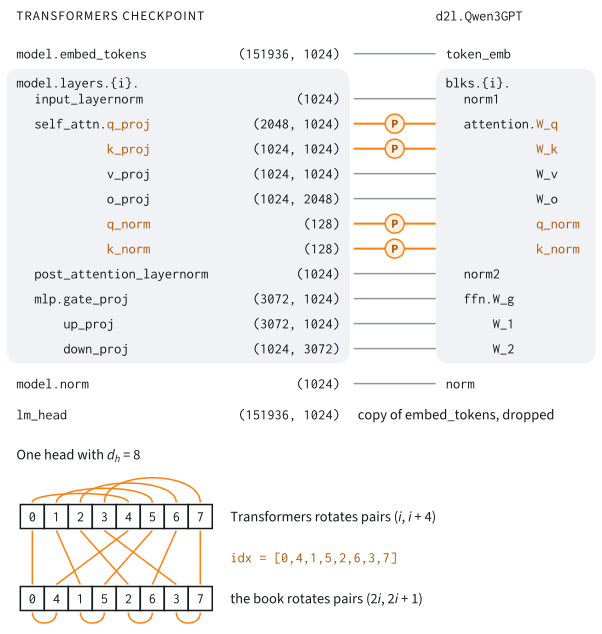
d2l.Qwen3GPT (right). Most tensors are renamed. The rows of q_proj and k_proj and the gains of q_norm and k_norm are also permuted within each head (P), because Transformers rotates the coordinate pairs \((i, i + d_h/2)\) and the book rotates the pairs \((2i, 2i+1)\). The inset shows the permutation for one head of width \(d_h = 8\).
18.2.2.1 The RoPE Pairing Convention
RoPE rotates pairs of coordinates of each query and key by an angle proportional to the position (Section 10.4.3). Which coordinates form a pair is a convention, and a model’s weights are trained under one of them. The book pairs neighbors: its rotation \(\mathbf{R}_t\) at position \(t\) turns the pair \((x_{2i}, x_{2i+1})\) by the angle \(t\,\omega_i\). Transformers pairs the two halves of the vector: its rotation \(\mathbf{R}'_t\) turns \((x_i, x_{i+d_h/2})\) by the same angle. Weights trained under one convention and run under the other have the wrong coordinates rotated together, and every shape still fits.
The remedy is to reorder the coordinates once, in the weights. Let \(\mathbf{P}\) be the permutation that moves the two members of each Transformers pair next to each other, \((\mathbf{P}\mathbf{x})_{2i} = x_i\) and \((\mathbf{P}\mathbf{x})_{2i+1} = x_{i+d_h/2}\). For \(d_h = 4\) it sends \((x_0, x_1, x_2, x_3)\) to \((x_0, x_2, x_1, x_3)\): the Transformers pairs \((x_0, x_2)\) and \((x_1, x_3)\) now sit where the book expects its pairs. Rotating in the book’s way after the permutation is then the same as rotating in Transformers’ way before it. Since a permutation matrix is orthogonal, the score of a query \(\mathbf{q}\) at position \(s\) and a key \(\mathbf{k}\) at position \(t\) is preserved:
\[ \mathbf{R}_t \mathbf{P} = \mathbf{P} \mathbf{R}'_t, \qquad (\mathbf{R}_s \mathbf{P}\mathbf{q})^\top (\mathbf{R}_t \mathbf{P}\mathbf{k}) = (\mathbf{R}'_s \mathbf{q})^\top \mathbf{P}^\top \mathbf{P}\, \mathbf{R}'_t \mathbf{k} = (\mathbf{R}'_s \mathbf{q})^\top (\mathbf{R}'_t \mathbf{k}). \tag{18.2.1}\]
Permuted queries and keys under the book’s rotation thus give the attention scores that Transformers computes. Since \(\mathbf{P}\mathbf{q} = (\mathbf{P}\mathbf{W}_q)\mathbf{x}\), we obtain them by permuting the rows of q_proj and k_proj within each head.
One operation stands between the projection and the rotation, namely QK-norm. RMSNorm divides its input by the root mean square of the coordinates, which no permutation changes, and multiplies each coordinate by its own gain. It commutes with \(\mathbf{P}\) only if the gains \(\boldsymbol{\gamma}\) move with their coordinates, \(\mathbf{P}\,\mathrm{RMSNorm}_{\boldsymbol{\gamma}}(\mathbf{x}) =
\mathrm{RMSNorm}_{\mathbf{P}\boldsymbol{\gamma}}(\mathbf{P}\mathbf{x})\), so the gains of q_norm and k_norm must be permuted as well. Values are never rotated, and v_proj and o_proj stay as they are.
The cell defines the index of the permutation and tests Equation 18.2.1 on random queries and keys with a random gain, against Transformers’ rotation written out in four lines. As a control, the test is repeated with the gain left in the order of the file.
def qwen3_rope_permutation(head_dim):
    """Index idx with idx[2i] = i and idx[2i + 1] = i + head_dim / 2: taking
    row idx[j] of a head's rows as row j turns Transformers' split-half
    RoPE pairs into the book's interleaved pairs."""
    half = torch.arange(head_dim // 2)
    return torch.stack([half, half + head_dim // 2], 1).flatten()

# Check: the book's rotation of permuted queries and keys gives the scores
# of Transformers' rotation, if the QK-norm gain is permuted too
def rotate_half(x, cos, sin):  # Transformers' RoPE: pairs (i, i + d_h / 2)
    x1, x2 = x.chunk(2, -1)
    cos, sin = torch.cat([cos, cos], -1), torch.cat([sin, sin], -1)
    return x * cos + torch.cat([-x2, x1], -1) * sin

print('idx for d_h = 8:', qwen3_rope_permutation(8).tolist())
torch.manual_seed(0)
d_h, T = 128, 64
idx = qwen3_rope_permutation(d_h)
q, k = torch.randn(T, d_h), torch.randn(T, d_h)
gamma = 1 + 0.5 * torch.randn(d_h)  # a QK-norm gain
norm = lambda x, g: F.rms_norm(x, (d_h,), g, 1e-6)
tables = qwen3_rope_tables(T, d_h, 1e6)  # positions 0, ..., 63
hf_scores = (rotate_half(norm(q, gamma), *tables)
             @ rotate_half(norm(k, gamma), *tables).T)
port_scores = lambda g: (d2l.rope(norm(q[:, idx], g), tables=tables)
                         @ d2l.rope(norm(k[:, idx], g), tables=tables).T)
scale = hf_scores.abs().max()
with_p, without = ((port_scores(g) - hf_scores).abs().max() / scale
                   for g in (gamma[idx], gamma))
print(f'max |score difference| / max |score|: rows and gain permuted '
      f'{with_p:.1e}, gain not permuted {without:.1e}')
assert with_p <= 1e-5 and without > 1e-2
idx for d_h = 8: [0, 4, 1, 5, 2, 6, 3, 7]
max |score difference| / max |score|: rows and gain permuted 3.7e-07, gain not permuted 8.0e-01The first line of the output is the index for a head of width 8, the case drawn in the inset of Figure 18.2.1: rows 0 and 4 of the file become rows 0 and 1 of the port. With rows and gains permuted, the scores agree to fp32 rounding. With the gains forgotten, the largest difference is about 80% of the largest score. It is an easy mistake to make, since a vector of 128 gains has the same shape in either order.
One consequence will matter when later chapters look inside a head. The query and key coordinates of the port are in the book’s interleaved order, so they must be permuted back before they are compared with activations recorded from Transformers.
18.2.2.2 Strict Accounting and Loading
map_qwen3_state_dict turns the tensors read from the file into a state dictionary for Qwen3GPT. Its core is the table layer, which pairs each released name with ours and with a function, keep or permute. After applying the table, the function checks its work in both directions, and a KeyError names whatever is left over on either side. The one tensor the function may drop is a stored copy of the embedding named lm_head.weight, and only after verifying that it is a copy.
A PyTorch user will ask why load_state_dict(strict=True) does not suffice. It takes three comparisons to account for a checkpoint, and the strict load makes only the last of them.
- The file against the table: no tensor is left over. Suppose we had forgotten QK-norm in the model and in the table alike. The strict load would succeed in silence. Only this check sees the two tensors per layer that nobody asked for.
- The table against the file: no name stays unfilled. This catches a tensor that the file lacks, as the test below shows.
- The names produced against the parameters of the model. This is the strict load. The mapper cannot make this comparison itself, since it builds its table from the configuration and never sees the model.
We call the three together strict accounting. It is cheap, and it catches the commonest porting mistakes (a renamed tensor, a forgotten module, a layer too many) before a single number is computed.
def map_qwen3_state_dict(hf_state, cfg, rope_layout='permute'):
    """A Qwen3GPT state dict from a Transformers Qwen3 state dict. Renames
    every tensor and, per head, permutes the rows of q_proj and k_proj and
    the gains of q_norm and k_norm into the book's RoPE pairing
    (rope_layout='none' skips this). A KeyError lists every tensor not
    consumed and every key not produced."""
    assert rope_layout in ('permute', 'none'), rope_layout
    kw = qwen3_gpt_kwargs(cfg)
    d_h = kw['head_dim'] or kw['num_hiddens'] // kw['num_heads']
    idx = qwen3_rope_permutation(d_h)

    def permute(W):  # W: (heads * d_h, ...) rows, or one head's (d_h,) gains
        if rope_layout == 'none':
            return W
        return W.unflatten(0, (-1, d_h))[:, idx.to(W.device)].flatten(0, 1)

    keep = lambda W: W
    layer = {'input_layernorm': ('norm1', keep),
             'self_attn.q_proj': ('attention.W_q', permute),
             'self_attn.k_proj': ('attention.W_k', permute),
             'self_attn.v_proj': ('attention.W_v', keep),
             'self_attn.o_proj': ('attention.W_o', keep),
             'self_attn.q_norm': ('attention.q_norm', permute),
             'self_attn.k_norm': ('attention.k_norm', permute),
             'post_attention_layernorm': ('norm2', keep),
             'mlp.gate_proj': ('ffn.W_g', keep),
             'mlp.up_proj': ('ffn.W_1', keep),
             'mlp.down_proj': ('ffn.W_2', keep)}
    names = {'model.embed_tokens': ('token_emb', keep)}
    for i in range(kw['num_blks']):
        names.update({f'model.layers.{i}.{hf}': (f'blks.{i}.{ours}', f)
                      for hf, (ours, f) in layer.items()})
    names['model.norm'] = ('norm', keep)
    if not kw['tie_embeddings']:
        names['lm_head'] = ('lm_head', keep)
    left, state, missing = dict(hf_state), {}, []
    head = left.get('lm_head.weight')
    emb = left.get('model.embed_tokens.weight')
    if kw['tie_embeddings'] and head is not None:  # a stored copy of emb
        if not (head.is_meta or emb is None or torch.equal(head, emb)):
            raise ValueError('lm_head.weight differs from the tied embedding')
        del left['lm_head.weight']
    for hf, (ours, f) in names.items():
        if hf + '.weight' in left:
            state[ours + '.weight'] = f(left.pop(hf + '.weight'))
        else:
            missing.append(f'{ours}.weight (from {hf}.weight)')
    if left or missing:
        raise KeyError(f'not consumed: {sorted(left)}; '
                       f'not produced: {missing}')
    return state
load_qwen3 reads the configuration and the weight files of a pinned revision (the library function d2l._qwen3_files downloads them), builds the model, maps the weights, and returns the model in evaluation mode. Two details keep it from allocating the model twice. It builds Qwen3GPT on the meta device, so the constructor initializes no weights that the next line would overwrite. And it loads with assign=True, which makes each parameter be the mapped tensor. The default would copy into the existing parameter, and a meta tensor has no storage to copy into. For the 8 billion parameters of Qwen3-8B, this avoids filling 32 GB with random numbers first.
def load_qwen3(model_id='Qwen/Qwen3-0.6B', revision=None, *,
               dtype=torch.bfloat16, device=None):
    """A pinned Qwen3 checkpoint from the Hugging Face Hub as a Qwen3GPT in
    eval mode: built on the meta device, then its mapped weights assigned.
    The tokenizer is loaded separately, at model.revision."""
    from safetensors.torch import load_file  # lazy, as in load_gpt2
    revision = revision or d2l.HF_REVISIONS[model_id]
    config_file, generation_file, weight_files = d2l._qwen3_files(
        model_id, revision)
    with open(config_file) as fh:
        cfg = json.load(fh)
    with torch.device('meta'):  # shapes only: no memory is allocated
        model = Qwen3GPT(**qwen3_gpt_kwargs(cfg))
    hf_state = {}
    for path in weight_files:
        hf_state.update(load_file(path))
    device = device or d2l.try_gpu()
    state = {name: W.to(device, dtype)
             for name, W in map_qwen3_state_dict(hf_state, cfg).items()}
    # assign=True: meta tensors cannot be copied into, so take the tensors
    model.load_state_dict(state, strict=True, assign=True)
    model.hf_config, model.revision = cfg, revision
    model.generation_config = None
    if generation_file is not None:
        import transformers
        with open(generation_file) as fh:
            model.generation_config = transformers.GenerationConfig.from_dict(
                json.load(fh))
    return model.eval()
Before loading a model, we run the mapper on the released file of Qwen3-0.6B, and once more after deleting one tensor.
hf_state = load_file(huggingface_hub.hf_hub_download(
    QWEN, 'model.safetensors', revision=d2l.HF_REVISIONS[QWEN]))
state = map_qwen3_state_dict(hf_state, cfg)
print(f'consumed {len(hf_state)} tensors, produced {len(state)} keys')
print('stored lm_head.weight equals the embedding (dropped):', torch.equal(
    hf_state['lm_head.weight'], hf_state['model.embed_tokens.weight']))
assert (len(hf_state), len(state)) == (311, 310)
del hf_state['model.layers.3.self_attn.k_norm.weight']
try:
    map_qwen3_state_dict(hf_state, cfg)
    raise AssertionError('a missing tensor went unnoticed')
except KeyError as e:
    print('KeyError:', e.args[0].replace('; ', '\n  '))
del hf_state, state
consumed 311 tensors, produced 310 keys
stored lm_head.weight equals the embedding (dropped): True
KeyError: not consumed: []
not produced: ['blks.3.attention.k_norm.weight (from model.layers.3.self_attn.k_norm.weight)']The file holds 311 tensors: 11 for each of the 28 layers, the embedding, the final norm, and the stored copy of the embedding, which the mapper verified and dropped. That leaves the 310 tensors that the port expects. With one k_norm removed, the error names the parameter that could not be filled, under our name and under the file’s.
18.2.3 End-to-End Agreement
The model loads. Does it compute the function that Transformers computes from the same file? A plausible loss and fluent text cannot tell us, since a port that is slightly wrong has both. So we compare logits.
This is the longest part of the section, and three of its six steps form the main line. We settle what “equal” should mean and turn the answer into a rule, apply the rule in fp32, where rounding is small, and apply it in half precision, in which the weights are usually run. The other three are side trips. One long prompt settles the question of the two angle formulas that we left open, generated text is compared, and two larger models are loaded.
18.2.3.1 A Reference and a Tolerance
Two correct implementations of one model do not produce the same floating-point numbers. They add in a different order, fuse different operations, and round in different places. The obvious check, to subtract the port’s logits from Transformers’ and to allow a small tolerance, thus needs a number, and a number picked by hand will not do. Take \(10^{-3}\), which Transformers’ own guide for contributors asks of a newly added model. We shall see that it is far too loose for fp32 and too tight for bf16. So we measure the tolerance instead, against a run in higher precision.
Three models, loaded from the same file, have one role each, and we keep their names fixed from here on. The port is our Qwen3GPT. The fp64 reference is Transformers run in fp64, that is in double precision, with 53 significant bits against the 24 of fp32. Its results stand in for the exact ones. And Transformers at the working precision, fp32 or bf16, is the yardstick: it shows how far a correct program may be from the fp64 reference.
The yardstick needs one decision. Transformers has several implementations of attention, and two of them matter here. Its eager attention writes out the score matrix, the softmax and the weighted sum as separate tensor operations. The other is called SDPA after the function it calls, F.scaled_dot_product_attention, the fused kernel (Section 18.1.5.3) that our port uses too. For the yardstick we take eager attention, and one reason is enough to remember: it shares no attention code with the port. Where the choice matters, in bf16, we print the result for SDPA as well. The fp64 reference alone uses SDPA, because the eager code computes its softmax in fp32 at any precision.
def release():  # return the memory of deleted models to the GPU
    gc.collect()
    torch.cuda.empty_cache()

ours32 = load_qwen3(QWEN, dtype=torch.float32, device=device)
hf32, tok = d2l.load_hf(QWEN, dtype=torch.float32,
                        attn_implementation='eager')
hf64, _ = d2l.load_hf(QWEN, dtype=torch.float64)  # SDPA keeps fp64 softmax
print(f'port: {d2l.num_params(ours32):,} parameters, a d2l.GPT: '
      f'{isinstance(ours32, d2l.GPT)}; Transformers: '
      f'{hf32.num_parameters():,}')
assert d2l.num_params(ours32) == hf32.num_parameters() == 596_049_920
Qwen/Qwen3-0.6B@c1899de289a0: Qwen3ForCausalLM, stop tokens [151645, 151643]
0 missing keys; unexpected keys: none
kernels: attention eager
Qwen/Qwen3-0.6B@c1899de289a0: Qwen3ForCausalLM, stop tokens [151645, 151643]
0 missing keys; unexpected keys: none
kernels: attention sdpa
port: 596,049,920 parameters, a d2l.GPT: True; Transformers: 596,049,920The load reports name the attention code of each Transformers model, and the port has the 596,049,920 parameters that Transformers counts.
Let \(\mathbf{L}^{64}\) be the logits of the fp64 reference. For a working precision \(b\), 32 for fp32 and 16 for bf16, we measure how far Transformers itself (subscript HF, for Hugging Face) is from them, and how far our port is:
\[ e^b_\textrm{HF} = \textrm{mean}\,\bigl|\mathbf{L}^b_\textrm{HF} - \mathbf{L}^{64}\bigr|, \qquad e^b_\textrm{ours} = \textrm{mean}\,\bigl|\mathbf{L}^b_\textrm{ours} - \mathbf{L}^{64}\bigr|, \qquad \textrm{accept if } e^b_\textrm{ours} \le 1.5\, e^b_\textrm{HF}. \tag{18.2.2}\]
The means run over all positions of a prompt and the whole vocabulary. The rule asks that the port be no further from the fp64 reference than Transformers is at the same precision, up to a factor. The factor 1.5 is a convention, as 5% is for significance tests.
The 32 prompts are a sample, and other prompts would give another ratio \(e^b_\textrm{ours} / e^b_\textrm{HF}\). How different could it be? We have no second sample, so we draw new ones from the first: 32 of our prompts, with replacement, 2,000 times, each time taking the same prompts for both errors. The central 95% of the resulting ratios is our interval. The procedure is called the bootstrap (Section 36.5.4). Keeping the pairs together matters: both errors are large on the same prompts, and their ratio varies less than either (Section 36.5.2.6). The rule passes only if the whole interval lies at or below 1.5, and fails only if all of it lies above. The function below is provisional; Section 18.5 treats the bootstrap properly and builds the version that the rest of this part uses.
def ratio_interval(a, b, num_samples=2000, seed=0):
    """a.mean() / b.mean() for paired per-item errors a, b, and the 95%
    percentile interval of the ratio over items resampled in pairs."""
    a, b = np.asarray(a), np.asarray(b)
    rows = np.random.default_rng(seed).integers(0, len(a),
                                                (num_samples, len(a)))
    ratios = a[rows].mean(1) / b[rows].mean(1)
    return a.mean() / b.mean(), np.percentile(ratios, [2.5, 97.5])

Rule = collections.namedtuple('Rule', 'ratio lo hi verdict')

def port_rule(e_ours, e_ref, factor=1.5):
    """The rule: passes if the whole interval of the ratio is at most
    factor, fails if it is above it, else undecided."""
    ratio, (lo, hi) = ratio_interval(e_ours, e_ref)
    verdict = ('passes' if hi <= factor else 'fails' if lo > factor
               else 'undecided')
    return Rule(ratio, lo, hi, verdict)

def rule_text(rule):
    """The ratio, its interval and the verdict, to two digits."""
    return f'{rule.ratio:.2g} [{rule.lo:.2g}, {rule.hi:.2g}] {rule.verdict}'
Four small helpers do the measuring. logits reads the logits of either kind of model, and cached_logits those of a Transformers model through its cache, a chunk of the prompt at a time. mean_abs computes the error of Equation 18.2.2 for each prompt, and batched_errors applies it at a given batch size.
def logits(model, X, **kwargs):
    """Logits of the port or of a Transformers model for the ids X."""
    with torch.inference_mode():
        out = model(X.to(next(model.parameters()).device), **kwargs)
    return getattr(out, 'logits', out)

def cached_logits(model, X, keep, chunk=1024):
    """The last keep logits of a Transformers model for the ids X, fed
    through its own cache chunk tokens at a time."""
    cache = None
    with torch.inference_mode():
        for s in range(0, X.shape[1], chunk):
            out = model(X[:, s:s + chunk].to(model.device), use_cache=True,
                        past_key_values=cache, logits_to_keep=keep)
            cache = out.past_key_values
    return out.logits

def mean_abs(L, R):
    """Per prompt: mean |L - R| over positions and vocabulary, in fp64."""
    return (L.double() - R.double()).abs().mean((1, 2)).cpu().numpy()

def batched_errors(model, ref, ids, batch_size):
    """mean_abs per prompt, model in batches of batch_size, ref in 4s."""
    e = []
    for X in ids.split(batch_size):
        L = logits(model, X)
        e += [mean_abs(L[j:j + 4], logits(ref, X[j:j + 4]))
              for j in range(0, len(X), 4)]
    return np.concatenate(e)
Now the fp32 check, on the 32 prompts in batches of four. If the port is right, the ratio should be near 1. The cell also prints the worst single logit and tests whether two runs on one batch give the same bits. Then comes a control. How far does the ratio move under a change that leaves the model alone? To find out, the cell repeats the rule with the port in batches of 1, 4 and 16.
e32_hf, e32_ours, delta32, ours_vs_hf = [], [], 0, 0
for X in ids.split(4):  # batches of 4 prompts
    L64, L_hf, L_ours = (logits(m, X) for m in (hf64, hf32, ours32))
    e32_hf.append(mean_abs(L_hf, L64))
    e32_ours.append(mean_abs(L_ours, L64))
    delta32 = max(delta32, (L_hf - L64).abs().max().item())
    ours_vs_hf = max(ours_vs_hf, (L_ours - L_hf).abs().max().item())
del L64, L_hf, L_ours  # per-batch logits: free their GPU memory
e32_hf, e32_ours = np.concatenate(e32_hf), np.concatenate(e32_ours)
rule32 = port_rule(e32_ours, e32_hf)
L1, L2 = logits(ours32, ids[:4]), logits(ours32, ids[:4])  # twice
deterministic, rerun = torch.equal(L1, L2), (L1 - L2).abs().max().item()
del L1, L2
print(f'fp32: e_HF {e32_hf.mean():.2e}, e_ours {e32_ours.mean():.2e}, '
      f'ratio {rule_text(rule32)}')
print(f'max |L_HF - L_64| {delta32:.1e}, max |L_ours - L_HF| '
      f'{ours_vs_hf:.1e}, deterministic: '
      + ('True' if deterministic else f'to within {rerun:.1e}'))
print(f'{"batch":>5}  {"ratio, Transformers in 4s":28}'
      'ratio, Transformers in the same batches')
batch_rules = {}
for b in (1, 4, 16):  # batch composition alone
    e_ours = batched_errors(ours32, hf64, ids, b)
    e_hf = batched_errors(hf32, hf64, ids, b)
    batch_rules[b] = port_rule(e_ours, e32_hf), port_rule(e_ours, e_hf)
    print(f'{b:5}  {rule_text(batch_rules[b][0]):28}'
          f'{rule_text(batch_rules[b][1])}')
if not SMALL:
    assert rule32.verdict == 'passes'
    assert all(r.verdict == 'passes' for rules in batch_rules.values()
               for r in rules)
fp32: e_HF 3.94e-06, e_ours 3.89e-06, ratio 0.99 [0.96, 1] passes
max |L_HF - L_64| 1.0e-04, max |L_ours - L_HF| 1.1e-04, deterministic: True
batch ratio, Transformers in 4s ratio, Transformers in the same batches
1 0.81 [0.79, 0.83] passes 0.98 [0.97, 1] passes
4 0.99 [0.96, 1] passes 0.99 [0.96, 1] passes
16 1.2 [1.2, 1.3] passes 0.97 [0.96, 0.99] passesBoth implementations are about \(4\times10^{-6}\) from the fp64 reference on average. In the worst case a single fp32 logit of Transformers is about \(10^{-4}\) from its fp64 value, and the largest difference between a logit of the port and the same logit of Transformers is of that size as well. The port passes, and it is deterministic: two runs on the same batch give the same bits.
The table answers the question about batching, and the answer is a warning. Its left column changes only how the port’s prompts are batched, with Transformers kept in batches of four, and the ratio moves from about 0.8 to about 1.2, although the model is the same. A matrix product of another shape is carried out by another sequence of additions, and its rounding errors differ (He and Thinking Machines Lab 2025). Here even their size differs: the port’s error is about a fifth smaller with one prompt at a time than with four, and about a fifth larger with sixteen, for reasons that we have not traced. The intervals in that column are a few hundredths wide. They could not have warned us, because they were built from the choice of prompts. An interval answers the question it was built for and no other.
In the right column both implementations are batched alike, and the ratio is about 1 at every batch size: whatever the shape of a batch does to the port’s rounding, it does to Transformers’ as well. This is how the rule should be applied, and how we apply it in the rest of the section. The factor of 1.5 then leaves ample room, whereas a correct port at 1.2 or 1.3 would come uncomfortably close to it. Either way, the second digit of a ratio means little.
18.2.3.2 Rotary Angles at Long Range
The port computes its rotary frequencies with Transformers’ expression \(1/\theta^{2i/d_h}\) and not with the book’s \(\theta^{-2i/d_h}\). We called this pedantry and promised a measurement. In fp32 the two expressions need not round alike, and an angle is a frequency times a position, so a difference in the last bit of a frequency grows with the position. The short prompts end at position 63. To see the effect we need the prompt of 4,096 tokens.
The cell first counts the frequencies that differ and prints the largest difference in angle at three positions. It then runs the long prompt through the port three times, with three tables of angles. The row transformers of its output is the port as built, with Transformers’ formula. The row book uses the book’s formula. The row exact computes the angles and their cosines and sines in fp64 and rounds only the two finished tables to fp32. One would expect the most accurate angles to do best.
The measurement differs from that on the short prompts in two ways. First, there is only one long prompt, so the bootstrap cannot resample prompts. The rule is applied to the logits of the last 256 positions, and the items are 16 blocks of 16 consecutive positions: blocks and not single positions, since the errors at neighboring positions are not independent.
Second, each variant is judged twice, and the reason is a detail of Transformers’ Qwen3 code: it computes its rotary angles, and its RMSNorm as well, in fp32 whatever the precision of the model. The norm we can forget, since it rounds a vector in the same way at every position. The angles we cannot. The fp64 reference carries fp32 angles, so the first column of ratios measures all errors against the fp64 reference as it is, and the second against the same model given fp64 angles.
One thing stays as it was. The port and Transformers in fp32 each read the prompt in one pass, so the two are batched alike. Only the fp64 reference reads it through its cache, a chunk at a time, and both errors are measured against that one reference, so the chunks favor neither program.
two_i = torch.arange(0, 128, 2, dtype=torch.float32) / 128
inv_hf, inv_book = 1.0 / 1e6 ** two_i, 1e6 ** -two_i  # equal in exact math
print(f'frequencies that differ: {(inv_hf != inv_book).sum()} of 64')
print('largest angle difference at position ' + ', '.join(
    f'{p:,}: {p * (inv_hf.double() - inv_book).abs().max():.1e}'
    for p in (63, 4095, 32767)))
inv64 = 1 / 1e6 ** (torch.arange(0, 128, 2, dtype=torch.float64) / 128)

class ExactRotary(nn.Module):
    """Transformers' rotary-embedding interface, with the angles in fp64."""
    def forward(self, x, position_ids):
        a = position_ids[..., None].double() * inv64.to(x.device)
        a = torch.cat((a, a), -1)
        return a.cos().to(x.dtype), a.sin().to(x.dtype)

if long_ids is not None:  # the last 256 of 4,096 positions, 16 blocks
    X = long_ids[None]
    blocks = lambda L, R: (L.double() - R).abs().mean(-1).reshape(
        16, 16).mean(1).cpu().numpy()
    exact = torch.arange(4096, dtype=torch.float64)[:, None] * inv64
    angles = {'transformers': None,  # the port's default, qwen3_rope_tables
              'book': d2l.rope_tables(4096, 128, base=1e6),
              'exact': (exact.cos().float(), exact.sin().float())}
    L_ours = {name: logits(ours32, X, logits_to_keep=256, tables=None
                           if t is None else tuple(u.to(device) for u in t))
              for name, t in angles.items()}
    L_hf = logits(hf32, X, logits_to_keep=256)  # one pass, as the port
    L64 = cached_logits(hf64, X, 256, chunk=512)  # Transformers: fp32 angles
    rotary, hf64.model.rotary_emb = hf64.model.rotary_emb, ExactRotary()
    L64_exact = cached_logits(hf64, X, 256, chunk=512)
    hf64.model.rotary_emb = rotary  # restore the reference
    refs = (L64, L64_exact)
    e_hf = [blocks(L_hf, R).mean() for R in refs]
    print(f'long prompt: e_HF {e_hf[0]:.1e} against the reference, '
          f'{e_hf[1]:.1e} against it with exact angles')
    print(f'{"port angles":14}{"ratio, fp64":28}'
          'ratio, fp64 with exact angles')
    for name, L in L_ours.items():
        rules = [port_rule(blocks(L, R), blocks(L_hf, R)) for R in refs]
        print(f'{name:14}{rule_text(rules[0]):28}{rule_text(rules[1])}')
        if name == 'transformers':
            assert rules[0].verdict == 'passes'
    del L_ours, L_hf, L64, L64_exact
frequencies that differ: 24 of 64
largest angle difference at position 63: 3.8e-06, 4,095: 2.4e-04, 32,767: 2.0e-03
long prompt: e_HF 6.7e-06 against the reference, 2.9e-05 against it with exact angles
port angles ratio, fp64 ratio, fp64 with exact angles
transformers 0.97 [0.92, 1] passes 1 [0.99, 1] passes
book 2.1 [1.9, 2.3] fails 0.96 [0.91, 1] passes
exact 4.5 [4, 5.1] fails 0.23 [0.21, 0.26] passesOf the 64 frequencies, 24 differ in the last bit. At the end of a 64-token prompt the angles then differ by a few millionths of a radian, which is why the short prompts could not tell the formulas apart. At position 4,095 the difference is \(2.4\times10^{-4}\), and at 32,767, still inside the context of this model, \(2\times10^{-3}\).
The first column of the table is the verdict of our rule, and it turns the expectation upside down. With Transformers’ formula the port passes at a ratio of about 1, as it did on the short prompts. With the book’s formula it fails at about 2, and with the most accurate angles of the three it fails at about 4.5.
The second column explains this odd ranking. Once the fp64 reference has exact angles, all three variants pass: the two formulas at a ratio of about 1, the exact angles at about a quarter. Transformers’ own fp32 error tells the same story from the other side. It is about \(7\times10^{-6}\) against the fp64 reference as it is, and about \(3\times10^{-5}\), more than four times as much, against the reference with exact angles. At 4,096 tokens, then, the rounding of the angles is the largest error of Transformers’ fp32 computation. The fp64 reference shares that error, so our rule cannot see it. And a port with any other angles, better ones included, is charged the whole difference as if it were a mistake of its own.
The second function was not pedantry, then. The book’s formula is no less accurate than Transformers’; it rounds differently. And the rule measures agreement with a reference implementation, its rounding habits included, which is not the same as accuracy. For a port, agreement is the right target, because any remaining difference then points to a mistake. So compute a port’s constants with the expressions of the reference implementation and in its precision, however innocent a rewriting looks, and decide separately whether its arithmetic is the one you want.
18.2.3.3 Half Precision
Released weights are stored in bf16 and usually run in bf16, so this is the precision in which a port must hold up. The rule is the same, with \(b = 16\), and we should expect much larger errors, since bf16 keeps 8 significant bits and fp32 keeps 24 (Section 5.5). The cell answers three side questions as well. Could Transformers’ fp32 logits serve in the place of the fp64 reference, which would spare us the fp64 run of a larger model? How far does batching move the ratio now? And what changes when Transformers uses SDPA, its default?
del ours32
release()
ours16 = load_qwen3(QWEN, dtype=torch.bfloat16, device=device)
hf16, _ = d2l.load_hf(QWEN, dtype=torch.bfloat16,
                      attn_implementation='eager')
e16_hf, e16_ours, e16_ours_ref32 = [], [], []
for X in ids.split(4):
    L64, L32, L_hf, L_ours = (logits(m, X)
                              for m in (hf64, hf32, hf16, ours16))
    e16_hf.append(mean_abs(L_hf, L64))
    e16_ours.append(mean_abs(L_ours, L64))
    e16_ours_ref32.append(mean_abs(L_ours, L32))
del L64, L32, L_hf, L_ours
e16_hf, e16_ours, e16_ours_ref32 = map(np.concatenate,
                                       (e16_hf, e16_ours, e16_ours_ref32))
rule16 = port_rule(e16_ours, e16_hf)
change = e16_ours_ref32.mean() / e16_ours.mean() - 1
print(f'bf16: e_HF {e16_hf.mean():.2e}, e_ours {e16_ours.mean():.2e}, '
      f'ratio {rule_text(rule16)}')
print('e_ours against the fp32 instead of the fp64 reference: relative '
      f'change {change:.1e}')
print('ratio with the port in batches of ' + ', '.join(
    f'{b}: {batched_errors(ours16, hf64, ids, b).mean() / e16_hf.mean():.2f}'
    for b in (1, 4, 16)))
hf16.set_attn_implementation('sdpa')  # Transformers' default attention
e16_sdpa = np.concatenate([mean_abs(logits(hf16, X), logits(hf64, X))
                           for X in ids.split(4)])
hf16.set_attn_implementation('eager')  # eager again, as in e16_hf
print(f'Transformers bf16 with SDPA attention: e_HF {e16_sdpa.mean():.2e}, '
      f'ratio {rule_text(port_rule(e16_ours, e16_sdpa))}')
if not SMALL:
    assert rule16.verdict == 'passes'
Qwen/Qwen3-0.6B@c1899de289a0: Qwen3ForCausalLM, stop tokens [151645, 151643]
0 missing keys; unexpected keys: none
kernels: attention eager
bf16: e_HF 4.81e-02, e_ours 3.49e-02, ratio 0.73 [0.7, 0.75] passes
e_ours against the fp32 instead of the fp64 reference: relative change -1.1e-07
ratio with the port in batches of 1: 0.76, 4: 0.73, 16: 0.71
Transformers bf16 with SDPA attention: e_HF 3.86e-02, ratio 0.9 [0.88, 0.93] passesThe errors are now a few hundredths of a logit, four orders of magnitude above those of fp32, and the port passes. This settles the account of the hand-picked tolerance of \(10^{-3}\). In fp32 the worst logit of Transformers was ten times closer to its fp64 value than that. Here its average logit is fifty times further away.
The first side question has a plain answer. Against errors of this size, Transformers’ fp32 logits can stand in for the fp64 reference: the port’s error changes in the seventh digit. We use this below for a larger model.
The ratio is about 0.7, and batching moves it by a few hundredths. A ratio below 1 is no merit of the port. It shows where the two programs round. Eager attention writes its scores and its attention weights to memory as bf16 tensors, one rounding each, which a fused kernel need not do. With the fused kernel on both sides, that is against Transformers with SDPA, the ratio rises to about 0.9, so most of the distance from 1 belonged to the attention code. A second difference lies in RMSNorm. PyTorch’s nn.RMSNorm rounds its result to bf16 once. Transformers’ norm rounds the normalized vector and, after multiplying by the gain, rounds again. Each program is a legitimate bf16 evaluation of the same weights, which is why the rule is one-sided: it bounds how much further from the fp64 reference a port may be, and asks nothing of a port that is closer.
18.2.3.4 One Decoding Loop for Every Model
Logits are compared number by number. To compare what two implementations write, one decoding loop must drive them both, or a difference in the text could come from the sampler and not from the model. d2l.generate is that loop. It serves the port, a Transformers model, and any module that maps token ids to logits, and the later sections of this chapter take their text from it. Prompts go in as strings, and one Generation record per prompt comes out.
The next five cells are library code and print nothing. Only two of them hold an idea: a function step that hides how a model obtains its next logits, and the numbering of positions when prompts are padded on the left. A reader who is following the verification may pass on to the greedy comparison of the next subsection and come back when a later section calls d2l.generate.
The sampler comes first. truncated_probs and sample_logits apply the temperature, top-\(k\), top-\(p\) and min-\(p\) rules of Section 8.6 to a batch of logit rows. In one respect they follow Transformers and not our sample_next. Where top-\(k\) and top-\(p\) are combined, top-\(p\) counts probability mass within the top \(k\) (Section 18.1.3), because the sampling settings that ship with a checkpoint are written for that convention.
Generation = collections.namedtuple(  # finish_reason: 'eos', 'stop', 'length'
    'Generation', 'text token_ids logprobs finish_reason')


def truncated_probs(logits, temperature=1.0, k=None, p=None, min_p=None):
    """Rows of logits (batch, vocab) -> the temperature-scaled distribution
    truncated by top-k, top-p and min-p and renormalized; ties in rank go
    to the smaller token id. As in Transformers and vLLM (and unlike
    sample_next of the book's section on decoding), top-p measures mass
    within the top k."""
    probs = F.softmax(logits.float() / temperature, -1)
    ranked, order = torch.sort(probs, dim=-1, descending=True, stable=True)
    keep = torch.full_like(order[:, :1], probs.shape[-1])  # tokens kept
    if k is not None:  # top-k: a fixed count
        keep = keep.clamp(max=k)
    if p is not None:  # top-p: the smallest head of mass at least p of
        cum = ranked.double().cumsum(-1)  # the top-k mass (1 without k)
        head = (cum < p * cum.gather(-1, keep - 1)).sum(-1, keepdim=True) + 1
        keep = torch.minimum(keep, head)
    if min_p is not None:  # min-p: a fraction of the top probability
        keep = torch.minimum(keep, (ranked >= min_p * ranked[:, :1]).sum(
            -1, keepdim=True))
    ranked = ranked * (torch.arange(probs.shape[-1], device=probs.device)
                       < keep)
    probs = torch.zeros_like(probs).scatter(-1, order, ranked)
    return probs / probs.sum(-1, keepdim=True)


def sample_logits(logits, strategy='greedy', temperature=1.0, k=None,
                  p=None, min_p=None, generator=None):
    """One token id per row of logits (batch, vocab): the argmax (ties to
    the smaller id), or a draw from truncated_probs by inverting its
    distribution function at a uniform from generator (a torch.Generator,
    or one per row)."""
    if strategy == 'greedy':
        return logits.argmax(-1)
    if strategy != 'sample':
        raise ValueError(f'unknown strategy: {strategy!r}')
    cdf = truncated_probs(logits, temperature, k, p, min_p).double().cumsum(-1)
    if isinstance(generator, (list, tuple)):  # one uniform per row
        u = torch.cat([torch.rand(1, generator=g, dtype=torch.float64)
                       for g in generator])
    else:
        u = torch.rand(len(cdf), generator=generator, dtype=torch.float64)
    u = u.to(cdf.device)[:, None] * cdf[:, -1:]  # in [0, total mass)
    return torch.searchsorted(cdf, u, right=True)[:, 0]
Models differ in how the next row of logits is obtained. Each of the next three functions returns the logits after the prompt and a function step that maps the chosen tokens to the next logits. For our port, _lm_cached_steps fills the KV cache with the prompt and then feeds one token at a time. For any other module that maps token ids to logits, d2l.GPT included, _lm_recompute_steps runs the whole sequence again at every step.
def _lm_cached_steps(model, ids, num_new):
    """Prefill equal-length prompts ids (lists of token ids) into the
    model's cache; returns the last logits and step(next_ids) -> logits."""
    X = torch.tensor(ids, device=model.token_emb.weight.device)
    ks, vs = model.init_cache(len(ids), X.shape[1] + num_new)
    t = X.shape[1]
    logits = model.forward_cached(X, ks, vs, 0)[0]

    def step(next_ids):  # next_ids: (batch,), at position t
        nonlocal t
        logits = model.forward_cached(next_ids[:, None], ks, vs, t)[0]
        t += 1
        return logits
    return logits, step


def _lm_recompute_steps(model, ids):
    """For any model mapping token ids to logits: each step runs the whole
    sequence again."""
    X = torch.tensor(ids, device=next(model.parameters()).device)

    def step(next_ids):
        nonlocal X
        X = torch.cat([X, next_ids[:, None]], 1)
        return model(X)[:, -1]
    return model(X)[:, -1], step
A Transformers model brings its own cache and, unlike ours, an attention mask, so prompts of different lengths can share a batch. _lm_hf_steps pads them on the left, which keeps the last position of every row the one to predict from. Rotary positions must not shift with the padding, so the function numbers the positions of each row from its first real token, as the running count of the mask.
def _lm_hf_steps(model, ids, pad_id):
    """Prompts of any lengths through a Transformers model and its cache:
    padded on the left, with positions counted from each prompt's first
    token, and logits computed at the last position only."""
    T = max(map(len, ids))
    X = torch.tensor([[pad_id] * (T - len(r)) + r for r in ids],
                     device=model.device)
    mask = torch.tensor([[0] * (T - len(r)) + [1] * len(r) for r in ids],
                        device=model.device)
    cache = None

    def run(X):
        nonlocal cache
        pos = (mask.cumsum(-1) - 1).masked_fill(mask == 0, 1)[:, -X.shape[1]:]
        out = model(input_ids=X, attention_mask=mask, position_ids=pos,
                    past_key_values=cache, use_cache=True, logits_to_keep=1)
        cache = out.past_key_values
        return out.logits[:, -1]

    def step(next_ids):
        nonlocal mask
        mask = torch.cat([mask, mask.new_ones(len(ids), 1)], 1)
        return run(next_ids[:, None])
    return run(X), step
The last two cells end a row and run the loop. _lm_finish records why a row ended. generate chooses the path, groups the prompts into batches (by equal length for a model without a mask), and runs the loop: sample, record, step. Library helpers that we do not show supply the defaults of its arguments, render chat prompts through the tokenizer’s template, and set up the random streams.
def _lm_finish(tokens, logprobs, tokenizer, eos_ids, stop):
    """One row's Generation: a final end token is dropped, and the text is
    cut before the first stop string."""
    reason = 'length'
    if tokens and tokens[-1] in eos_ids:
        tokens, reason = tokens[:-1], 'eos'
    text = tokenizer.decode(tokens)
    cuts = [text.find(s) for s in stop or () if s in text]
    if cuts:
        text, reason = text[:min(cuts)], 'stop'
    if logprobs is not None:
        logprobs = logprobs[:len(tokens)]
return Generation(text, tokens, logprobs, reason)@torch.inference_mode()
def generate(model, tokenizer, prompts, max_new_tokens=None, *,
strategy='greedy', temperature=1.0, k=None, p=None, min_p=None,
seed=0, eos_token_ids=None, stop=None, chat=False,
enable_thinking=None, return_logprobs=False, batch_size=8):
"""Continue each prompt (a string, or with chat=True also a list of
messages) and return one Generation per prompt, in input order.
strategy is 'greedy' or 'sample' (with truncated_probs's temperature,
k, p and min_p). stop and eos_token_ids take one item or a list. seed
is an int or a torch.Generator (one stream for the call) or a list of
one int per prompt (each prompt's draws then depend only on its seed).
A sampled text can still depend on the batch: batch and padding change
the logits by rounding, which can flip a near-tie."""
max_new_tokens, eos_ids, stop = d2l._lm_stopping(
model, tokenizer, max_new_tokens, eos_token_ids, stop)
ids = d2l._lm_prompt_ids(tokenizer, prompts, chat, enable_thinking)
generators = d2l._lm_generators(seed, len(ids))
hf = sys.modules.get('transformers') # loaded if model is one of its
if hf is not None and isinstance(d2l._lm_unwrap(model),
hf.PreTrainedModel):
pad = getattr(tokenizer, 'pad_token_id', None) or 0
start = lambda rows: _lm_hf_steps(model, rows, pad)
groups = [list(range(len(ids)))] # left padding: input order
else: # no attention mask: batch only prompts of equal length
if hasattr(model, 'forward_cached'):
start = lambda rows: _lm_cached_steps(model, rows, max_new_tokens)
else:
start = lambda rows: _lm_recompute_steps(model, rows)
groups = [[i for i in range(len(ids)) if len(ids[i]) == n]
for n in sorted({len(r) for r in ids})]
out = [None] * len(ids)
for rows in (g[j:j + batch_size] for g in groups
for j in range(0, len(g), batch_size)):
logits, step = start([ids[i] for i in rows])
gen = generators(rows)
tokens = [[] for _ in rows]
logprobs = [[] for _ in rows] if return_logprobs else None
active = set(range(len(rows)))
for n in range(max_new_tokens):
nxt = sample_logits(logits, strategy, temperature, k, p, min_p,
gen)
if return_logprobs: # under the untruncated distribution
lp = F.log_softmax(logits.float(), -1).gather(
-1, nxt[:, None])[:, 0].tolist()
for j, token in enumerate(nxt.tolist()):
if j in active:
tokens[j].append(token)
if return_logprobs:
logprobs[j].append(lp[j])
text = tokenizer.decode(tokens[j]) if stop else ''
if token in eos_ids or any(s in text for s in stop or ()):
active.discard(j)
if not active or n == max_new_tokens - 1:
break
logits = step(nxt)
for j, i in enumerate(rows):
out[i] = _lm_finish(tokens[j], logprobs and logprobs[j],
tokenizer, eos_ids, stop)
return out18.2.3.5 Greedy Agreement and Near-Ties
What can a comparison of greedy text add to a comparison of logits? It is unforgiving, since one different token changes everything after it. It is not sensitive, however: a token changes only where the two best candidates are nearly equal, and a port can be wrong without that happening often. We use it for two narrower purposes, to test our decoding loop against Transformers’ own generate method, and to see what rounding alone does to a text.
We generate 64 tokens from each of the 28 prompts that are text with four models, the port and Transformers in fp32 and in bf16. Where two continuations differ, the cell looks up the gap between the two largest of Transformers’ fp32 logits at the first differing token. If the port is right, a difference can arise only at a near-tie, where this gap is of the size of the rounding error. In fp32 that is a gap below about \(10^{-4}\), which is rare. In bf16 it is a gap of around 0.05, which is common.
del hf64
release()
ours32 = load_qwen3(QWEN, dtype=torch.float32, device=device)
models = {'ours32': ours32, 'hf32': hf32, 'ours16': ours16, 'hf16': hf16}
gen = {name: [g.token_ids for g in generate(m, tok, texts, NEW_TOKENS)]
       for name, m in models.items()}
eos, agree = set(hf32.generation_config.eos_token_id), 0
for s in range(0, len(texts), 8):  # Transformers' own greedy loop
    batch = tok(texts[s:s + 8], padding=True, padding_side='left',
                return_tensors='pt').to(device)
    with torch.inference_mode():
        out = hf32.generate(**batch, do_sample=False,
                            max_new_tokens=NEW_TOKENS)
    for row, ours in zip(out[:, batch['input_ids'].shape[1]:].tolist(),
                         gen['hf32'][s:s + 8]):
        agree += row[:next((i for i, t in enumerate(row) if t in eos),
                           len(row))] == ours
print(f'generate on hf32 equals hf32.generate: {agree} of {len(texts)}')
assert agree == len(texts)

def first_split(a, b):
    """Index of the first token where two continuations differ, or None."""
    return None if a == b else next(
        (i for i, (x, y) in enumerate(zip(a, b)) if x != y), min(len(a),
                                                                len(b)))

def top2_gap(model, tokenizer, text, tokens):
    """The gap between the two largest logits after text and tokens."""
    X = torch.tensor([tokenizer(text, add_special_tokens=False).input_ids
                      + tokens])
    top = logits(model, X)[0, -1].float().topk(2).values
    return (top[0] - top[1]).item()

ref, bf16_error = gen['hf32'], e16_hf.mean()  # Transformers' bf16 error
for name in ('ours32', 'ours16', 'hf16'):
    split = [first_split(g, r) for g, r in zip(gen[name], ref)]
    diverged = [(i, n) for i, n in enumerate(split) if n is not None]
    gaps = [top2_gap(hf32, tok, texts[i], ref[i][:n])
            for i, n in diverged]
    print(f'{name}: {len(texts) - len(diverged)} of {len(texts)} identical '
          f'to hf32 over {NEW_TOKENS} tokens')
    if diverged:  # where the others first differ, and how close a tie
        print(f'  the others first differ at token '
              f'{np.median([n for _, n in diverged]):g} (median); top-2 gap '
              f'there {min(gaps):.1e} to {max(gaps):.1e},')
        print(f'  below the bf16 logit error ({bf16_error:.1e}) for '
              f'{sum(g < bf16_error for g in gaps)} of {len(gaps)}')
    if name == 'ours32':  # in fp32 only a near-tie may flip a token
        for (i, n), g in zip(diverged, gaps):
            print(f'  prompt {i}: token {n}, near-tie {g < 10 * delta32}')
        assert all(g < 10 * delta32 for g in gaps)
generate on hf32 equals hf32.generate: 28 of 28
ours32: 28 of 28 identical to hf32 over 64 tokens
ours16: 14 of 28 identical to hf32 over 64 tokens
the others first differ at token 18.5 (median); top-2 gap there 3.9e-04 to 2.1e-01,
below the bf16 logit error (4.8e-02) for 11 of 14
hf16: 11 of 28 identical to hf32 over 64 tokens
the others first differ at token 18 (median); top-2 gap there 3.9e-04 to 2.1e-01,
below the bf16 logit error (4.8e-02) for 10 of 17Our loop reproduces Transformers’ greedy loop on all 28 prompts, and in fp32 the port writes the same 64 tokens as Transformers on every one. In bf16 about half of the continuations part from the fp32 text somewhere along the way, for the port and for Transformers alike, and of those that part, half have done so within the first twenty tokens. The two counts depend on the batching and do not rank the implementations. What matters is the gap at the parting. In more than half of the cases it is smaller than the mean bf16 logit error of 0.05, and it is never above about 0.2. A single logit can err by far more than the mean, as the fp32 run showed. This is the nature of bf16 inference: the same model, with rounding left to decide wherever two tokens are nearly tied. Whoever compares two bf16 runs token by token, be it two libraries, two batch sizes or two GPUs, should look at the gap before suspecting a bug.
With agreement established, we let the port answer two questions through the chat template, with the template’s thinking mode switched off (Section 18.1). The model card recommends one set of sampling settings for replies with thinking and another for replies without. The defaults in the checkpoint’s generation_config.json are the first set, so the cell passes the second itself: a temperature of 0.7, a top-\(k\) of 20 and a top-\(p\) of 0.8.
questions = ['What does a key-value cache store, in one sentence?',
             'Name two differences between a base model and a chat model.']
for q, g in zip(questions, generate(  # the card's settings without thinking
        ours16, tok, questions, 32 if SMALL else 128, chat=True,
        enable_thinking=False, strategy='sample', temperature=0.7, k=20,
        p=0.8, seed=0)):
    print(q)
    for line in g.text.splitlines():  # the reply, wrapped
        if line.strip():
            d2l.print_wrapped('  ' + line, width=96)
    print(f'  ({g.finish_reason})')
What does a key-value cache store, in one sentence?
A key-value cache stores data in a structured format, typically as key-value pairs, for
efficient access and retrieval.
(eos)
Name two differences between a base model and a chat model.
Two differences between a base model and a chat model are:
1. **Base models** are typically used for general tasks like text generation, summarization,
or information retrieval without requiring additional training. They are often simpler and
can be used for a wide range of tasks without needing fine-tuning.
2. **Chat models** are designed to interact with users in a conversational manner. They are
trained to understand context, generate responses in a natural and fluid way, and often
require more complex training and fine-tuning to achieve this level of interaction.
(eos)The replies are fluent, and the first answers a question that we did not ask. Nothing tells a model of this size that we mean the cache of Section 11.3 and not a key–value store, and a correct port reproduces a model’s misconceptions as faithfully as its abilities.
18.2.3.6 Larger Checkpoints
The same loader serves other members of the family. For Qwen3-1.7B-Base we repeat the bf16 rule with Transformers’ fp32 logits in the place of the fp64 reference, which the bf16 result above permits. Qwen3-8B, with 16 GB of bf16 weights, is more than we want to load here, but its structure can be tested without its values. We create meta tensors with the shapes that the file headers list, map them, and assign them to a Qwen3GPT built from its configuration.
del models, ours32, hf32, ours16, hf16  # models held them too
release()
if not SMALL:  # Qwen3-1.7B-Base: fp32 reference logits kept on the CPU
    hf32, _ = d2l.load_hf(QWEN_17B_BASE, dtype=torch.float32,
                          attn_implementation='eager')
    ref = [logits(hf32, X).cpu() for X in ids.split(4)]
    del hf32
    release()
    hf16, _ = d2l.load_hf(QWEN_17B_BASE, dtype=torch.bfloat16,
                          attn_implementation='eager')
    ours16 = load_qwen3(QWEN_17B_BASE, dtype=torch.bfloat16, device=device)
    e = {name: np.concatenate([mean_abs(logits(m, X), R.to(device))
                               for X, R in zip(ids.split(4), ref)])
         for name, m in (('hf', hf16), ('ours', ours16))}
    rule = port_rule(e['ours'], e['hf'])
    print(f'Qwen3-1.7B-Base, bf16, {len(ids)} prompts: ratio '
          f'{rule_text(rule)}')
    assert rule.verdict == 'passes'
    del hf16, ours16, ref
    release()
# Qwen3-8B: meta tensors with the header's shapes, mapped and assigned
dtypes = {'BF16': torch.bfloat16, 'F16': torch.float16, 'F32': torch.float32}
meta = {name: torch.empty(shape, dtype=dtypes[dtype], device='meta')
        for name, (shape, dtype) in header_8b.items()}
with torch.device('meta'):
    port_8b = Qwen3GPT(**qwen3_gpt_kwargs(cfg_8b))
state_8b = map_qwen3_state_dict(meta, cfg_8b)
port_8b.load_state_dict(state_8b, strict=True, assign=True)
print(f'Qwen3-8B dry run: {len(meta)} tensors consumed, {len(state_8b)} '
      f'keys produced, untied lm_head: {"lm_head.weight" in state_8b}, '
      f'all on meta: {all(p.is_meta for p in port_8b.parameters())}')
assert len(meta) == len(state_8b) and hasattr(port_8b, 'lm_head')
Qwen/Qwen3-1.7B-Base@ea980cb0a6c2: Qwen3ForCausalLM, stop tokens [151643]
0 missing keys; unexpected keys: none
kernels: attention eager
Qwen/Qwen3-1.7B-Base@ea980cb0a6c2: Qwen3ForCausalLM, stop tokens [151643]
0 missing keys; unexpected keys: none
kernels: attention eager
Qwen3-1.7B-Base, bf16, 32 prompts: ratio 0.89 [0.86, 0.92] passes
Qwen3-8B dry run: 399 tensors consumed, 399 keys produced, untied lm_head: True, all on meta: TrueThe 1.7B model passes at a ratio of about 0.9 against eager attention. For the 0.6B model the same comparison gave about 0.7. We have not pursued the difference; the rule is one-sided and does not ask. The dry run of the 8B model consumes all 399 tensors, its separate output layer among them. A dry run proves that names and shapes fit. It proves nothing about values, and a forgotten permutation would pass it.
18.2.4 Localizing a Failing Port
Suppose the logit rule had failed. It would have told us that something is wrong, somewhere among 310 tensors and a dozen settings. A transformer is a sequence of layers, however, and an error cannot appear before the layer that causes it. Comparing the intermediate results of the port with those of the fp64 reference, in the order of execution, finds that layer.
18.2.4.1 Relative Error per Layer
We record four tensors in every block, in the order in which they are computed: the output of attention (attn_out), the residual stream once that output has been added (resid_mid), the output of the feed-forward network (mlp_out), and the stream after the block (resid_post). collect_hiddens captures them with forward hooks, and layer_errors computes the relative error \(\|\mathbf{A} - \mathbf{A}^{64}\|_F /
\|\mathbf{A}^{64}\|_F\) of each captured tensor \(\mathbf{A}\) against the fp64 reference \(\mathbf{A}^{64}\), for every prompt, layer and capture point. The measure is relative because the stream grows by orders of magnitude from the first block to the last.
The norm runs over positions 1 to \(T-1\). Position 0 is left out for two reasons. First, the first token is the attention sink of Section 11.3.3.3, the position on which heads place their weight when they find nothing to read, and in this model its hidden state is, in most blocks, so much larger than every other that it alone would decide the Frobenius norm. Second, the first token attends only to itself, so its attention output does not depend on queries or keys, and a bug in either leaves it exact.
One definition remains, and it is the one to remember. first_divergence returns the first layer and capture point, in execution order, at which the median error over the prompts exceeds ten times a floor: the error that a correct implementation has at the same point and the same precision.
_HIDDEN_POINTS = ('attn_out', 'resid_mid', 'mlp_out', 'resid_post')


def collect_hiddens(model, input_ids):
    """Per layer, in execution order: the attention output, the residual
    stream after it, the FFN output, and the stream after the block; each
    (layers, batch, T, d) on the CPU, fp64 for an fp64 model, else fp32.
    model is a d2l.GPT or a Transformers Qwen3 model."""
    if isinstance(model, d2l.GPT):
        layers = [(b.attention, b.norm2, b.ffn, b) for b in model.blks]
    else:  # Transformers: attention, second norm and MLP of each layer
        layers = [(b.self_attn, b.post_attention_layernorm, b.mlp, b)
                  for b in model.model.layers]
    dtype = (torch.float64 if next(model.parameters()).dtype == torch.float64
             else torch.float32)
    caps = {name: [] for name in _HIDDEN_POINTS}

    def save(name, x):  # Transformers modules may return tuples
        x = x[0] if isinstance(x, tuple) else x
        caps[name].append(x.detach().to('cpu', dtype))

    handles = []
    try:
        for attn, norm2, ffn, blk in layers:
            handles += [
                attn.register_forward_hook(
                    lambda m, a, y: save('attn_out', y)),
                norm2.register_forward_pre_hook(  # the stream entering norm2
                    lambda m, a: save('resid_mid', a[0])),
                ffn.register_forward_hook(lambda m, a, y: save('mlp_out', y)),
                blk.register_forward_hook(
                    lambda m, a, y: save('resid_post', y))]
        with torch.inference_mode():
            model(input_ids)
    finally:
        for handle in handles:
            handle.remove()
    return {name: torch.stack(caps[name]) for name in _HIDDEN_POINTS}


def layer_errors(ref, ours, skip_first=1):
    """Relative Frobenius error of each capture of collect_hiddens against a
    reference over positions skip_first, ..., T - 1, per layer, capture
    point and prompt: an array (layers, 4, batch)."""
    errors = []
    for name in _HIDDEN_POINTS:
        r, o = (u[:, :, skip_first:].double().flatten(2)
                for u in (ref[name], ours[name]))
        errors.append(((o - r).norm(dim=-1) / r.norm(dim=-1)).numpy())
    return np.stack(errors, 1)


def first_divergence(errors, floor, factor=10.0):
    """The first (layer, capture point) in execution order whose median
    error over prompts exceeds factor times the median floor there (the
    clean port's error); None if there is none."""
    above = np.median(errors, -1) > factor * np.median(floor, -1)
    if not above.any():
        return None
    layer, point = np.argwhere(above)[0]  # row-major: layer by layer
    return int(layer), _HIDDEN_POINTS[point]
For the correct port we expect no divergence: its error should be of the size of Transformers’ own at every layer. The cell measures both implementations at both precisions. It prints the error of the stream after five of the 28 blocks, and then the range, over all layers and capture points, of the ratio between the port’s median error and that of Transformers. Where the ratio leaves the band from 0.5 to 2, a factor of two either way, the line names the layers and the side on which they fall. As before, the port is also run in batches of 1 and 16 and, in bf16, compared with Transformers with SDPA.
def errors_against(ref_model, models, ids, batch_size=4):
    """layer_errors of each model against ref_model on the ids, in batches
    of batch_size: a dict of arrays (layers, capture points, prompts)."""
    errors = {name: [] for name in models}
    for X in ids.split(batch_size):
        X = X.to(next(ref_model.parameters()).device)
        ref = collect_hiddens(ref_model, X)
        for name, m in models.items():
            errors[name].append(layer_errors(ref, collect_hiddens(m, X)))
    return {name: np.concatenate(e, -1) for name, e in errors.items()}

hf64, _ = d2l.load_hf(QWEN, dtype=torch.float64)
err, err_batch = {}, {}  # err_batch[bits, b]: the port in batches of b
for dtype, bits in ((torch.float32, 32), (torch.bfloat16, 16)):
    ours = load_qwen3(QWEN, dtype=dtype, device=device)
    hf, _ = d2l.load_hf(QWEN, dtype=dtype, attn_implementation='eager')
    err.update(errors_against(hf64, {f'ours{bits}': ours, f'hf{bits}': hf},
                              ids))
    for b in (1, 16):  # batch composition alone
        err_batch[bits, b] = errors_against(hf64, {'': ours}, ids, b)['']
    if bits == 16:  # Transformers' default attention instead of eager
        hf.set_attn_implementation('sdpa')
        err_sdpa16 = errors_against(hf64, {'': hf}, ids)['']
    del ours, hf
    release()
median = {k: np.median(e, -1) for k, e in err.items()}  # (layers, points)
layers = [0, 7, 14, 21, len(median['ours32']) - 1]
print('median relative error of resid_post at layer')
print(' ' * 6 + ''.join(f'{l:>9}' for l in layers))
for k, m in median.items():
    print(f'{k:6}' + ''.join(f'{m[l, 3]:9.1e}' for l in layers))

def ratio_range(e_ours, e_hf):
    """Port over Transformers, medians over prompts: its range over every
    layer and point, and the layers where it falls below 0.5 or rises
    above 2."""
    r = np.median(e_ours, -1) / np.median(e_hf, -1)
    low = sorted(set(np.nonzero(r < 0.5)[0].tolist()))
    high = sorted(set(np.nonzero(r > 2)[0].tolist()))
    return (f'{r.min():.2f} to {r.max():.2f}'
            + (f', below 0.5 at layers {low}' if low else '')
            + (f', above 2 at layers {high}' if high else ''))

print('port / Transformers (eager) over every layer and point')
for bits, name in ((32, 'fp32'), (16, 'bf16')):
    for b, e in ((1, err_batch[bits, 1]), (4, err[f'ours{bits}']),
                 (16, err_batch[bits, 16])):
        print(f'{name}, port in batches of {b:2}: '
              + ratio_range(e, err[f'hf{bits}']))
print('bf16, Transformers with SDPA:   '
      + ratio_range(err['ours16'], err_sdpa16))
Qwen/Qwen3-0.6B@c1899de289a0: Qwen3ForCausalLM, stop tokens [151645, 151643]
0 missing keys; unexpected keys: none
kernels: attention sdpa
Qwen/Qwen3-0.6B@c1899de289a0: Qwen3ForCausalLM, stop tokens [151645, 151643]
0 missing keys; unexpected keys: none
kernels: attention eager
Qwen/Qwen3-0.6B@c1899de289a0: Qwen3ForCausalLM, stop tokens [151645, 151643]
0 missing keys; unexpected keys: none
kernels: attention eager
median relative error of resid_post at layer
0 7 14 21 27
ours32 7.4e-07 1.4e-06 1.3e-06 1.2e-06 1.1e-06
hf32 7.0e-07 1.3e-06 1.4e-06 1.2e-06 1.1e-06
ours16 5.0e-03 1.1e-02 1.2e-02 1.1e-02 1.1e-02
hf16 9.0e-03 1.7e-02 1.8e-02 1.6e-02 1.5e-02
port / Transformers (eager) over every layer and point
fp32, port in batches of 1: 0.70 to 1.00
fp32, port in batches of 4: 0.89 to 1.06
fp32, port in batches of 16: 1.11 to 1.44
bf16, port in batches of 1: 0.43 to 0.79, below 0.5 at layers [0, 1]
bf16, port in batches of 4: 0.46 to 0.77, below 0.5 at layers [1]
bf16, port in batches of 16: 0.40 to 0.73, below 0.5 at layers [0, 1, 2]
bf16, Transformers with SDPA: 0.84 to 0.94In fp32 both implementations stay near \(10^{-6}\) from the first block to the last, and their ratio stays inside the band at every layer, capture point and batch size. The port agrees with Transformers all the way through.
In bf16 the errors are near \(10^{-2}\), and at every layer the port’s error is the smaller one: about half of that of Transformers’ eager code in the first layers, at some capture points just under half, and about three quarters in the last. The first layers are thus the ones that the output lists as below 0.5. The list is no alarm. In these layers the port is closer to the fp64 reference than eager attention is, as it was in the bf16 logits, and for the same reasons. Against Transformers with SDPA, every ratio lies between about 0.85 and 0.95. At every layer, then, the bf16 port is no further from the fp64 reference than either of Transformers’ two implementations of attention.
The fp32 lines of the output do a second job, and for what follows it is the more important one. Whoever holds a failing port has no correct port on which to measure a floor. Luckily, Transformers in fp32 is at hand, and at every layer and capture point its error against the fp64 reference is within a factor of two of the correct port’s, however the prompts are batched. Transformers itself can serve as the floor.
18.2.4.2 Five Porting Bugs
To see the method at work we need ports that fail. We make five, each by one small change that a tired programmer could make, and each chosen so that strict accounting cannot see it. Every tensor is still consumed, and every shape still fits.
- B1 skips the RoPE permutation of Equation 18.2.1.
- B2 leaves the RoPE base at the book’s \(10^4\).
- B3 swaps the gate and up projections of every feed-forward network, two matrices of the same shape.
- B4 enumerates the layers in the order in which their names sort as strings, so that
layers.10followslayers.1and block 2 receives the weights of layer 10. - B5 leaves \(\epsilon\) at the book’s \(10^{-5}\) in every norm.
Forgetting QK-norm altogether is not on the list, because accounting rejects it at once, as we saw: the gains of q_norm and k_norm would be left unconsumed. The cell builds each variant as a state dictionary and a set of changed constructor arguments, next to the correct port, which the tables call clean.
def build(state, cfg, dtype, device, **changes):
    """A Qwen3GPT with some arguments changed and its weights assigned from
    state; load_state_dict(strict=True) does the strict accounting."""
    with torch.device('meta'):
        model = Qwen3GPT(**{**qwen3_gpt_kwargs(cfg), **changes})
    model.load_state_dict({k: v.to(device, dtype) for k, v in state.items()},
                          strict=True, assign=True)
    return model.eval()

def swap_gate_up(state):
    """The gate projection's weights in W_1, the up projection's in W_g."""
    swap = {'W_g': 'W_1', 'W_1': 'W_g'}
    return {'.'.join(swap.get(part, part) for part in k.split('.')): v
            for k, v in state.items()}

def reorder_blocks(state, order):
    """Block j gets the weights of layer order[j]."""
    renamed = {}
    for k, v in state.items():
        parts = k.split('.')
        if parts[0] == 'blks':
            parts[1] = str(order.index(int(parts[1])))
        renamed['.'.join(parts)] = v
    return renamed

hf_state = load_file(huggingface_hub.hf_hub_download(
    QWEN, 'model.safetensors', revision=d2l.HF_REVISIONS[QWEN]))
clean = map_qwen3_state_dict(hf_state, cfg)
order = sorted(range(cfg['num_hidden_layers']), key=str)  # 0, 1, 10, ...
bugs = {  # name: (state dict, changed arguments of Qwen3GPT)
    'clean': (clean, {}),
    'B1 RoPE rows not permuted': (
        map_qwen3_state_dict(hf_state, cfg, rope_layout='none'), {}),
    'B2 rope_theta 1e4': (clean, {'rope_theta': 1e4}),
    'B3 gate and up swapped': (swap_gate_up(clean), {}),
    'B4 layers in string order': (reorder_blocks(clean, order), {}),
    'B5 every epsilon 1e-5': (clean, {'norm_eps': 1e-5})}
del hf_state
Where should each bug first show? B1 and B2 act in the first attention layer, and B5 in the norm just before it, so all three should diverge at the attention output of block 0, the first point that we capture. B3 leaves attention alone, so it should first diverge at the third capture point of block 0, the output of the feed-forward network. B4 is the instructive one: blocks 0 and 1 hold the right weights, so this port should be clean to the last bit until the attention of block 2.
For each variant the cell reports the first divergence and the error there as a multiple of the floor. We do own a correct port, so the cell takes its fp32 error as the floor. A porter would take that of Transformers, so the cell repeats the search with that floor and counts the ports for which the answer stays the same. The table adds the verdicts of the two logit rules. Its last column answers a question of its own: at how many of the 2,048 positions of the 32 prompts is the variant’s most likely next token that of the fp64 reference?
floor, found = err['ours32'], {}  # floor: the clean port's layer errors
for name, (state, changes) in bugs.items():
    bug32, bug16 = (build(state, cfg, dtype, device, **changes)
                    for dtype in (torch.float32, torch.bfloat16))
    errors, e32, e16, top1 = [], [], [], 0
    for X in ids.split(4):
        X = X.to(device)
        errors.append(layer_errors(collect_hiddens(hf64, X),
                                   collect_hiddens(bug32, X)))
        L64, L32 = logits(hf64, X), logits(bug32, X)
        e32.append(mean_abs(L32, L64))
        e16.append(mean_abs(logits(bug16, X), L64))
        top1 += (L32.argmax(-1) == L64.argmax(-1)).sum().item()
    del bug32, bug16, L64, L32
    release()
    errors = np.concatenate(errors, -1)  # (layers, points, prompts)
    e32, e16 = np.concatenate(e32), np.concatenate(e16)
    found[name] = dict(errors=errors, where=first_divergence(errors, floor),
                       rules=(port_rule(e32, e32_hf), port_rule(e16, e16_hf)),
                       e16=e16, top1=top1)
del hf64
release()
print('every state dict passes strict accounting (load_state_dict)')
print(f'{"":26}{"diverges at":14}{"x clean":>9}  {"fp32 rule":15}'
      f'{"bf16 rule":15}top-1 of {ids.numel():,}')
for name, f in found.items():
    there, times = 'none', '-'
    if f['where'] is not None:
        layer, point = f['where']
        j = _HIDDEN_POINTS.index(point)
        over = np.median(f['errors'][layer, j]) / np.median(floor[layer, j])
        there, times = f'{layer}, {point}', f'{over:.2g}'
    print(f'{name:26}{there:14}{times:>9}  ' + ''.join(
        f'{f"{r.ratio:.2g} {r.verdict}":15}' for r in f['rules'])
        + f'{f["top1"]:>5}')
same = {name: first_divergence(f['errors'], err['hf32']) == f['where']
        for name, f in found.items()}  # the floor a porter has
print('the same first divergence with Transformers fp32 as the floor: '
      f'{sum(same.values())} of {len(same)}')
b4 = found['B4 layers in string order']
exact = np.array_equal(b4['errors'][:2], found['clean']['errors'][:2])
print(f'B4: blocks 0 and 1 bitwise equal to the clean port: {exact}')
# blocks 0 and 1 are correct; bitwise only on a deterministic device
assert b4['where'] == (2, 'attn_out') and (exact or not deterministic)
assert found['clean']['where'] is None
if not SMALL:  # the clean port passes both logit rules, B1-B4 fail both
    assert all(r.verdict == 'passes' for r in found['clean']['rules'])
    assert all(r.verdict == 'fails' for name, f in found.items()
               if name[:2] in ('B1', 'B2', 'B3', 'B4') for r in f['rules'])
every state dict passes strict accounting (load_state_dict)
diverges at x clean fp32 rule bf16 rule top-1 of 2,048
clean none - 0.99 passes 0.73 passes 2047
B1 RoPE rows not permuted 0, attn_out 5.8e+05 4.8e+05 fails 39 fails 662
B2 rope_theta 1e4 0, attn_out 1.9e+05 1.3e+05 fails 11 fails 1658
B3 gate and up swapped 0, mlp_out 8.8e+05 9.4e+05 fails 77 fails 0
B4 layers in string order 2, attn_out 2.4e+06 9e+05 fails 74 fails 86
B5 every epsilon 1e-5 0, attn_out 1e+04 1.9e+03 fails 0.77 passes 2041
the same first divergence with Transformers fp32 as the floor: 6 of 6
B4: blocks 0 and 1 bitwise equal to the clean port: TrueEvery prediction holds. Each bug first diverges where it first acts, and its error at that point is four to six orders of magnitude above the clean port’s. Neither the threshold of ten nor the floor is therefore a delicate choice. In particular, the floor that a porter has serves as well: with Transformers in fp32 in the place of the clean port, the output reports the same first divergence for all six ports, the clean port’s “none” among them. It could hardly be otherwise. Transformers in fp32 was within a factor of two of the clean port at every layer, and a factor of two cannot matter against four orders of magnitude. The first four bugs also fail both logit rules, the fp32 rule at ratios above \(10^5\) and the bf16 rule at ratios from 11 to 77.
The last column shows how little a text can prove. With the wrong RoPE base, B2 still agrees with the fp64 reference on the most likely next token at four positions in five. Judged by a handful of sampled sentences, such a port could easily pass. B5 disagrees at fewer than ten of the 2,048 positions, hardly more often than the clean port. Fluent text shows that most of a port is right, and a port has to be right in all of it.
18.2.4.3 Limits of a Logit Check
B5 differs from the other bugs. The fp32 rule rejects it at a ratio of about 2,000. The bf16 rule accepts it at a ratio of 0.77, next to the 0.73 of the clean port. Why is a wrong \(\epsilon\) invisible in bf16, and why does it matter at all, given that \(\epsilon\) is a small number added for numerical safety?
RMSNorm divides its input \(\mathbf{x}\) by \(\sqrt{m + \epsilon}\), where \(m\) is the mean square of the coordinates of \(\mathbf{x}\). Replacing \(\epsilon\) by \(\epsilon'\) rescales the output by \(\sqrt{(m + \epsilon)/(m + \epsilon')}\). For \(m \gg \epsilon'\) this is a relative change of about
\[\frac{\epsilon' - \epsilon}{2m}.\]
A wrong \(\epsilon\) is harmless where the input is large and matters where it is small. The cell prints \(m\) at the input of every norm of the first and the last block, and with it the numbers needed to judge B5.
def mean_square(m, key):  # a hook: mean of x^2 per token, its median
    def hook(module, args):  # over the tokens after the first
        m[key] = (args[0][:, 1:].float() ** 2).mean(-1).median().item()
    return hook

clean32, m = build(clean, cfg, torch.float32, device), {}
norms, last = ('norm1', 'q_norm', 'k_norm', 'norm2'), len(clean32.blks) - 1
for layer in (0, last):  # the input of every norm of the first, last block
    blk = clean32.blks[layer]
    for n, module in zip(norms, (blk.norm1, blk.attention.q_norm,
                                 blk.attention.k_norm, blk.norm2)):
        module.register_forward_pre_hook(mean_square(m, (layer, n)))
logits(clean32, ids[:4])
del clean32, clean
release()
print('m, the mean square of the input of each norm (clean port, fp32)')
print(f'{"layer":>5}' + ''.join(f'{n:>9}' for n in norms))
for layer in (0, last):
    print(f'{layer:5}' + ''.join(f'{m[layer, n]:9.1e}' for n in norms))
b5, ok = found['B5 every epsilon 1e-5'], found['clean']
print(f'median relative error of resid_post at layer 0 and layer {last}')
for name, e in (('B5, fp32', b5['errors']), ('clean, fp32', ok['errors']),
                ('clean, bf16', err['ours16'])):
    print(f'  {name:12}' + ''.join(f'{np.median(e[l, 3]):9.1e}'
                                   for l in (0, last)))
for name, f in (('clean', ok), ('B5', b5)):
    print(f'{name}: fp32 rule {rule_text(f["rules"][0])}; bf16 rule '
          f'{rule_text(f["rules"][1])}')
ratio, (lo, hi) = ratio_interval(b5['e16'], ok['e16'])
print(f"B5's bf16 logit error against the clean port's: {ratio - 1:+.0%} "
      f'[{lo - 1:+.0%}, {hi - 1:+.0%}]')
m, the mean square of the input of each norm (clean port, fp32)
layer norm1 q_norm k_norm norm2
0 7.3e-04 7.1e-02 1.5e-01 3.2e-02
27 3.5e+02 1.9e+02 2.1e+02 3.8e+02
median relative error of resid_post at layer 0 and layer 27
B5, fp32 4.5e-03 2.2e-03
clean, fp32 7.4e-07 1.1e-06
clean, bf16 5.0e-03 1.1e-02
clean: fp32 rule 0.99 [0.96, 1] passes; bf16 rule 0.73 [0.7, 0.75] passes
B5: fp32 rule 1.9e+03 [1.6e+03, 2.3e+03] fails; bf16 rule 0.77 [0.75, 0.79] passes
B5's bf16 logit error against the clean port's: +6% [+4%, +9%]The first norm of the model reads token embeddings, whose mean square is \(7.3\times10^{-4}\). There the formula gives \(4.5\times10^{-6} / 7.3\times10^{-4} \approx 0.6\%\), and the measured error of the stream after block 0 is 0.45%, of the size predicted. In the last block, \(m\) is a few hundred and the formula gives about \(10^{-8}\), less than one fp32 rounding. The wrong \(\epsilon\) does its damage at the entrance of the network, where the stream is still small, and the later blocks carry the damage along. This is where the comparison layer by layer had found it: B5 first diverges at the attention output of block 0, the first point that we capture after norm1.
Now compare with rounding. One bf16 rounding changes a number by up to \(2^{-8} \approx 0.4\%\), and the clean port in bf16 is 0.5% from the fp64 reference after block 0 and 1% after block 27. The error of B5 is as large as that at the first block and smaller at the last. In its bf16 logits, B5 is about 6% further from the fp64 reference than the clean port, with an interval that excludes zero. The bug can thus be detected in bf16, but only by someone who already owns a correct port to compare with, and such a person has no bug to find. Against Transformers, batching alone moved a correct port between 0.71 and 0.76, and a ratio of 0.77 raises no suspicion. We said that the second digit of a ratio means little. Here it would have to carry the whole verdict.
Where do the six ports lie between the fp32 error and the bf16 error of a correct implementation? The last cell draws the error of the stream after each block, for the two precisions on the left and for the bugs on the right, on one scale.
resid_post = lambda e: np.median(e[:, 3], -1)  # median over prompts
precision = [resid_post(err[k]) for k in ('ours32', 'hf32', 'ours16', 'hf16')]
# right: the clean port in fp32 (from the bug cell) and in bf16, then B1-B5
porting = [resid_post(f['errors']) for f in found.values()]
porting.insert(1, precision[2])
names = ['clean fp32', 'clean bf16'] + [name.split()[0] for name in found][1:]
ylim = (min(map(min, precision + porting)) / 2,  # one scale for both
        max(map(max, precision + porting)) * 2)
# black and grey: a correct implementation in fp32 and bf16, in both panels
_, axes = d2l.plt.subplots(1, 2, figsize=(6.4, 3), sharey=True)
left = ['port fp32', 'Transformers fp32', 'port bf16', 'Transformers bf16']
with d2l.plt.rc_context({'legend.fontsize': 'small'}):
    d2l.plot(np.arange(len(floor)), precision, 'layer', 'relative error',
             left, ylim=ylim, yscale='log',
             fmts=('k-', 'k--', 'C7-', 'C7--'), axes=axes[0])
    d2l.plot(np.arange(len(floor)), porting, 'layer', None, names,
             ylim=ylim, yscale='log',
             fmts=('k-', 'C7-', 'C0-', 'C1-', 'C2-', 'C3-', 'C4-'),
             axes=axes[1])
    for ax, labels, ncol in ((axes[0], left, 2), (axes[1], names, 4)):
        ax.legend(labels, ncol=ncol, loc='lower center', frameon=False,
                  bbox_to_anchor=(0.5, 1), columnspacing=0.7,
                  handlelength=1.3)  # above the panel, clear of the curves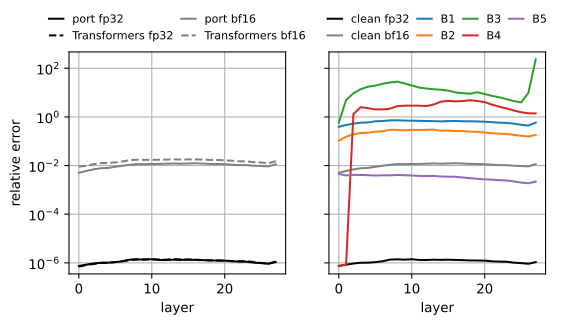
Black curves belong to a correct implementation in fp32 and gray ones to a correct implementation in bf16, in both panels. On the left, the port (solid) and Transformers with eager attention (dashed) coincide in fp32 and lie close together in bf16. On the right, the black and the gray curve are the clean port once more, and the bugs are in color. B1, B2 and B3 are far above both from the first block on, and B3 ends above 100. The stream it produces is by then more than a hundred times larger than the one it should reproduce. B4 follows the black curve for two blocks and then leaves it. B5 runs nearly flat, thousands of times above the black curve. The gray curve is the one to compare it with. B5 starts at its height and ends about five times below it: at no depth does the wrong \(\epsilon\) rise above the rounding error of a correct bf16 run.
Should we care about an error that is no larger than the rounding of a correct run? A reader who only samples text in bf16 need hardly care, and it would be wrong to pretend otherwise. But rounding has no preferred direction, and the wrong \(\epsilon\) has one: it shortens the output of the first norm for every token and in every run, by about half a percent. Whoever runs the weights in fp32 carries an error 2,000 times that of a correct port. And whoever averages over many prompts to measure a small effect, say what quantization costs a model, averages much of the rounding away and keeps the bias. The cell on B5 did just that when it resolved a difference of 6% beneath rounding many times larger. So check a port in fp32 against fp64, even a port that will only ever run in bf16. Half precision is good enough to run a model and too coarse to check one.
With the port verified, the model holds no more surprises of our own making. What it writes is decided by its weights and by the tokens it is given to read. How much of what we would call a model’s ability is decided by the latter, the prompt, is the next question.
18.2.5 Summary
Later chapters fine-tune, quantize and take apart Qwen3 models inside the book’s own code, so this section made sure that the code computes the released model and not a near relative of it. A port is a list of differences from d2l.GPT, turned into subclasses, and a weight map with strict accounting. For Qwen3 the map includes a permutation between two pairings of rotary coordinates. Whether the port computes the right function is decided against Transformers in fp64. The port may be no further from this reference than 1.5 times the error of Transformers at the working precision, with both programs batched alike. Matching a reference implementation includes matching its rounding, down to the expression for the rotary frequencies. Qwen3-0.6B passes in fp32 and in bf16, in its logits and at every layer. Its greedy text in fp32 is that of Transformers on all 28 prompts, and in bf16 the texts part where two tokens are nearly tied. A failing port is localized by the first layer at which its error leaves that of a correct implementation. A comparison of logits in bf16, the precision in which released weights are usually run, cannot see an error of the size of bf16 rounding, such as a wrong \(\epsilon\). The fp32 check rejects it, and the comparison layer by layer finds it in the first block. So check a port in fp32 against fp64, whatever precision it will run in.
18.2.6 Exercises
- [code] The untied output layer. Qwen3-8B has an output layer of its own, and the section tested the port’s handling of it on shapes alone.
- From the headers of Qwen3-0.6B and Qwen3-8B (
d2l.safetensors_header), compute the share of the parameters that the embedding and the output layer hold in each model, counting a tied layer once. What would untying add to the 0.6B model, in parameters and in bytes of bf16? Why can a large model afford an output layer of its own more easily than a small one? - Optional, for a GPU with more than 20 GB of free memory and about 40 GB of main memory: compute Transformers’ fp32 logits of Qwen3-8B for eight prompts on the CPU, then load
d2l.load_qwen3(QWEN_8B)and Transformers in bf16 one after the other and apply the bf16 rule. This is the only test of the untied output layer with real weights. - Name a mistake in the handling of
lm_head.weightthat the dry run of the section accepts and that a test with real weights rejects. You need not have run the previous part to answer.
- From the headers of Qwen3-0.6B and Qwen3-8B (
- The permutation for a head of width 4. Let \(d_h = 4\) and let the two frequencies be \(\omega_0\) and \(\omega_1\).
- Write the book’s rotation \(\mathbf{R}_t\), Transformers’ rotation \(\mathbf{R}'_t\), and the permutation \(\mathbf{P}\) as \(4 \times 4\) matrices, and verify \(\mathbf{R}_t \mathbf{P} = \mathbf{P} \mathbf{R}'_t\).
- Suppose the rows of
q_projare permuted and those ofk_projare not. Show that the score of a query \(\mathbf{q}\) at position \(s\) and a key \(\mathbf{k}\) at position \(t\) still depends on the positions only through \(t - s\), but equals \(\mathbf{q}^\top \mathbf{P}^\top \mathbf{R}_{t-s}\, \mathbf{k}\) where the correct port computes \(\mathbf{q}^\top \mathbf{P}^\top \mathbf{R}_{t-s}\, \mathbf{P}\mathbf{k}\). Already for \(s = t\) the score is wrong. Which coordinates of the query and the key does it multiply together? - Explain why
v_projando_projneed no permutation, and why a port that permutes the rows ofv_projand the columns ofo_projconsistently would also be correct.
- The size of a wrong \(\epsilon\).
- Derive the relative change \((\epsilon' - \epsilon)/(2m)\) of the output of RMSNorm. The section evaluated it for the first norm of the model. Evaluate it for the other seven values of \(m\) that the cell on B5 prints. By which factor does the first norm exceed the next largest? Estimate from this the error of a port whose \(\epsilon\) is wrong in every norm but the first.
- For which \(m\) does the change from \(\epsilon = 10^{-6}\) to \(\epsilon' = 10^{-5}\) equal one fp32 rounding of \(2^{-24}\), and for which \(m\) one bf16 rounding of \(2^{-8}\)? Use the second value to explain why B5 is borderline in bf16 at the first block.
- The output of
norm1in block 0 is too small by the factor \(1 - \delta\). Show that, with QK-norm, the attention weights hardly change and the attention output changes by the same factor \(1 - \delta\) to first order. Compare \(\delta\) with the median error of B5 atattn_outof block 0, which you can read fromfound.
- [code] A wrong pairing as a function of position. Build bug B1 with
map_qwen3_state_dict(..., rope_layout='none')and run it in fp32 on a 512-token passage of the long prompt.- Plot the mean absolute difference between its logits and those of the correct port against the position. Explain why position 0 is exact.
- Describe how the error depends on the position beyond the first few tokens. Use the largest frequency \(\omega_0 = 1\) to explain why a wrong pairing, unlike the differently rounded frequencies of the long-prompt experiment, needs no long range to do its damage.
- [code] Prompts in groups. The 32 prompts are eight groups of four of the same kind (rows \(4c\) to \(4c+3\) form group \(c\)), and
ratio_intervalresamples them as if they were independent.- Rewrite
ratio_intervalto resample whole groups, and apply it toe32_oursande32_hfand toe16_oursande16_hf. Do the intervals widen, and do the verdicts of the rule change? - Print the mean bf16 error of each group for the port and for Transformers. Which kinds of prompt have the largest errors, and is the ratio of the two errors more stable across groups than either error?
- Rewrite
- [code] Sampling and rounding. Call
d2l.generatewithstrategy='sample',p=0.95,batch_size=1and one seed per prompt.- Generate 64 tokens for the 28 text prompts with the fp32 port and with the fp32 Transformers model. On how many prompts do the two produce the same text? Repeat with the two bf16 models.
- Now run the bf16 Transformers model alone, once with
batch_size=1and once withbatch_size=8. All 28 prompts have 64 tokens, so nothing is padded in either run. Explain why the samples of some prompts change although their random numbers are the same and the sampler is correct. - Do sampled texts part earlier or later than the greedy texts of the section? Explain your finding with the size of the bf16 logit error.
- [code] The floor that a porter has. A porter owns no correct port and takes the floor of
first_divergencefrom Transformers in fp32,err['hf32']. With this floor and the factor of ten, the section found the same first divergence for all six ports as with the floor of the correct port.- How small can the factor be made before a correct port, run in batches of 1, 4 or 16 (
err['ours32']anderr_batch), is reported against this floor? Compare with the smallest multiple of the floor at which one of the five bugs diverged. How much room does the factor of ten leave on either side? - Predict from the numbers of the section whether the comparison layer by layer would report B5 if both the port and the floor ran in bf16. Then check: reload the fp64 reference, build B5 in bf16 from its entry in
bugs, and useerr['hf16']as the floor.
- How small can the factor be made before a correct port, run in batches of 1, 4 or 16 (
- [code] Two roundings in RMSNorm. ● The section attributes part of the bf16 ratio of 0.9 against Transformers’ fused kernel to the order of rounding in RMSNorm. Test this explanation.
- Write a module with the interface of
nn.RMSNormthat normalizes in fp32, rounds to the input’s precision, and then multiplies by the gain, and compare its error on random bf16 inputs with that ofnn.RMSNorm, taking an fp64 computation as the truth. - Replace every norm of the bf16 port by your module and repeat the bf16 rule against Transformers with SDPA attention. How much of the distance of the ratio from 1 does the norm explain?
- Does
first_divergence, with the clean bf16 port as the floor, report your modified port? Say what a factor of ten can and cannot localize.
- Write a module with the interface of
- [extended] Another family. ●● Choose a dense model family of Table 11.2.2 other than Qwen3 whose files you can access, and read the configuration and the file header of its smallest released checkpoint.
- In the format of Table 18.2.1, list its differences from
d2l.GPT. Which rows are covered by the arguments ofQwen3AttentionandQwen3GPT, and which need a new argument or a new subclass? - Write the weight map with strict accounting, and decide from the code of the reference implementation whether the RoPE pairing needs a permutation.
- Apply the fp32 rule and the layer comparison. If the rule fails, report the first divergence and what it led you to.
- In the format of Table 18.2.1, list its differences from