class GatedDeltaNet(d2l.GatedLinearAttention):
"""Gated linear attention whose memory is written by the delta rule."""
def __init__(self, num_hiddens, num_heads, chunk_size=32, conv_width=4,
timescales=(4, 256)):
super().__init__(num_hiddens, num_heads, chunk_size, conv_width,
timescales)
self.W_beta = nn.Linear(num_hiddens, num_heads) # Write strength
d2l.init_lecun(self.W_beta)
def memory(self, X, Q, K, V, log_a):
beta = d2l.heads_to_batch(torch.sigmoid(self.W_beta(X)),
self.num_heads).squeeze(-1)
return chunked_delta_rule(Q, K, V, beta, log_a, self.chunk_size)The Delta Rule
Dive into Deep Learning · §12.7
The Delta Rule and Gated DeltaNet
read-before-write error correction · Householder projection geometry · chunked WY triangular solve · memory as online regression
Why Additive Matrix Memories Fail on Rebound Keys
Motivation
Programs and narratives constantly update state (rate = 0.05 \to rate = 0.07, or a character travelling from Paris to Rome). When a unit key \mathbf{k} is written R times with values \mathbf{v}^{(1)}, \ldots, \mathbf{v}^{(R)}, an additive memory returns their unweighted superposition:
\mathbf{S}\mathbf{k} = \mathbf{v}^{(1)} + \mathbf{v}^{(2)} + \cdots + \mathbf{v}^{(R)}
Testing 8 mutually orthonormal keys in \mathbb{R}^{64} (zero cross-key interference) written R \in \{1, 2, 4, 8\} times each:
additive: 1.00 0.51 0.27 0.21Even with 8\times more dimensions than keys, additive recall of the latest value collapses to a coin toss (0.51) at R = 2 and 0.21 at R = 8. Global decay a_t < 1 fades old values only by aging all keys indiscriminately.
The Delta Rule: One Online Gradient Step on Recall Loss
Read Before Writing
\ell_t(\mathbf{S}) = \tfrac{1}{2}\,\|\mathbf{S}\mathbf{k}_t - \mathbf{v}_t\|^2 \implies \mathbf{S}_t = \mathbf{S}_{t-1} + \beta_t(\mathbf{v}_t - \mathbf{S}_{t-1}\mathbf{k}_t)\mathbf{k}_t^\top
- Read Before Writing: Reads prediction \hat{\mathbf{v}}_t = \mathbf{S}_{t-1}\mathbf{k}_t first, then writes the scaled error residual \beta_t(\mathbf{v}_t - \hat{\mathbf{v}}_t)\mathbf{k}_t^\top.
- Exact Replacement at \beta_t = 1: For \|\mathbf{k}_t\| = 1, \mathbf{S}_t \mathbf{k}_t = \mathbf{v}_t in one step.
Projection Geometry of the Delta Transition Matrix
Directional Erasure
Factoring \mathbf{S}_{t-1} out of the delta update reveals the right-multiplied state transition matrix:
\mathbf{S}_t = \mathbf{S}_{t-1}(\mathbf{I} - \beta_t \mathbf{k}_t \mathbf{k}_t^\top) + \beta_t \mathbf{v}_t \mathbf{k}_t^\top
For a unit key \|\mathbf{k}_t\| = 1, \mathbf{I} - \beta_t \mathbf{k}_t \mathbf{k}_t^\top has eigenvalue 1 on the (d_k - 1)-dimensional subspace \mathbf{k}_t^\perp and eigenvalue 1 - \beta_t along \mathbf{k}_t:
- \beta_t = 0: Identity \mathbf{I} (memory untouched).
- \beta_t \in (0, 1): Partial contraction along \mathbf{k}_t.
- \beta_t = 1: Orthogonal projection \mathbf{I} - \mathbf{k}_t\mathbf{k}_t^\top (erases \mathbf{k}_t completely before writing \mathbf{v}_t \mathbf{k}_t^\top).
- \beta_t = 2: Householder reflection \mathbf{I} - 2\mathbf{k}_t\mathbf{k}_t^\top (eigenvalue -1, reversing sign along \mathbf{k}_t).
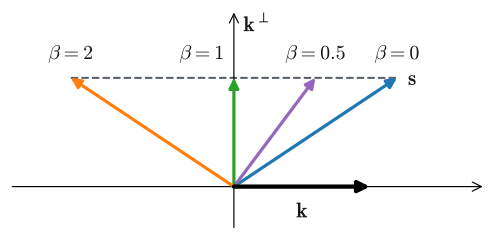
Unit-Key Stability and Householder Parity Reflections
Spectral Properties
- Mandatory Key \ell_2-Normalization: Along \mathbf{k}_t, eigenvalue \lambda_{\mathbf{k}} = 1 - \beta_t\|\mathbf{k}_t\|^2 stays in [-1, 1] for \beta_t \in [0, 2] only when \|\mathbf{k}_t\| = 1.
- Negative Eigenvalues Unlock Parity: Positive decays a_t > 0 cannot count modulo 2; at \beta_t = 2, Householder reflection (\lambda_{\mathbf{k}} = -1) toggles readout \mathbf{0} \leftrightarrow 2\mathbf{v}.
The Hidden Cost of Correction: Signal Erosion
Crowded Random Keys
\mathbb{E}[\mathbf{S}_t \mathbf{k}_i] = \Big(1 - \frac{1}{d_k}\Big)^m \mathbf{v}_i \approx e^{-m / d_k}\mathbf{v}_i
- Collateral Contraction: Every later random unit key \mathbf{k}_s has expected squared overlap 1/d_k with \mathbf{k}_i, shrinking \mathbf{v}_i by 1 - 1/d_k per step.
- Crowded Decay: After m = 2d_k random writes with \beta = 1, early signals erode to e^{-2} \approx 13.5\%.
Benchmarking Four Write Rules Across Three Regimes
Additive vs. Delta vs. Least Squares
Comparing additive, delta, β = 1, delta, β = 0.5, and offline least squares (\mathbf{S}^\star = \mathbf{V}^\top \mathbf{K}(\mathbf{K}^\top \mathbf{K})^+, fitting all pairs simultaneously) at width d = 64:
squared read error                  additive   delta, β = 1 delta, β = 0.5  least squares
8 orthonormal keys, 4 writes            2.98           0.00           0.33           0.74
32 keys                                 0.49           0.29           0.37           0.00
64 keys                                 0.98           0.60           0.49           0.00
128 keys                                1.99           1.06           0.67           0.50
256 keys                                3.94           1.49           0.89           0.75
64 keys, ρ = 0.5                        5.82           0.76           0.61           0.00
recall                              additive   delta, β = 1 delta, β = 0.5  least squares
8 orthonormal keys, 4 writes            0.28           1.00           1.00           0.28
32 keys                                 1.00           1.00           1.00           1.00
64 keys                                 1.00           0.89           0.99           1.00
128 keys                                0.96           0.53           0.82           1.00
256 keys                                0.73           0.26           0.45           0.86
64 keys, ρ = 0.5                        0.54           0.77           0.89           1.00
When Targeted Erasure Helps—and Why βt Must Be Learned
Interpreting the Write-Rule Table
The benchmark exposes three distinct regimes that motivate learning an input-dependent gate \beta_t \in (0, 1):
- Key rebinding (
8 orthonormal keys, 4 writes):delta(\beta = 1 or 0.5) achieves 1.00 recall of the latest value, whereasadditiveand unweightedleast squaresaverage all 4 values bound to each key (0.28). - Correlated keys (
64 keys, ρ = 0.5):additivepiles every value onto the shared key direction (error 5.82, recall 0.54), whereasdeltasubtracts the shared-direction prediction before writing (recall 0.89 at \beta = 0.5). - Crowded independent keys (
128 keys,256 keys): At n = 128,delta, β = 1has lower squared error thanadditive(1.06 vs. 1.99) yet worse recall (0.53 vs. 0.96) because shrinking old reads toward \mathbf{0} caps squared error near \|\mathbf{0} - \mathbf{v}_j\|^2 = 1 while eroding early signals. Halving the step to \beta = 0.5 restores 0.82 recall with 0.67 squared error.
Gated DeltaNet: Global Decay Plus Targeted Overwriting
The Gated DeltaNet Recurrence
\mathbf{S}_t = a_t\,\mathbf{S}_{t-1}(\mathbf{I} - \beta_t \mathbf{k}_t \mathbf{k}_t^\top) + \beta_t \mathbf{v}_t \mathbf{k}_t^\top
- Three Operating Modes (Yang et al., 2024):
- Global Flush (a_t \to 0): Wipes the entire matrix at topic boundaries.
- Targeted Key Update (a_t \approx 1, \beta_t \to 1): Overwrites \mathbf{k}_t while preserving \mathbf{k}_t^\perp.
- Gentle Accumulation (a_t \approx 1, \beta_t \approx 0.2): Low-erosion associative write.
Chunked Evaluation via Lower-Triangular Solve (WY Form)
Intra-Chunk Triangular System
\mathbf{u}_t + \beta_t \sum_{s < t} L_{ts}\,(\mathbf{k}_s^\top \mathbf{k}_t)\,\mathbf{u}_s = \beta_t\big(\mathbf{v}_t - \gamma_t \mathbf{S}_0 \mathbf{k}_t\big)
- WY Representation: Rewrites the delta recurrence as \mathbf{S}_t = a_t \mathbf{S}_{t-1} + \mathbf{u}_t \mathbf{k}_t^\top with corrected values \mathbf{u}_t.
- Parallel m \times m Triangular Solve: Solves \mathbf{M}\mathbf{W} = \boldsymbol{\beta} \odot \mathbf{V} and \mathbf{M}\mathbf{Z} = (\boldsymbol{\beta} \odot \boldsymbol{\gamma}) \odot \mathbf{K} across all chunks in parallel to obtain \mathbf{U} = \mathbf{W} - \mathbf{Z}\mathbf{S}_0^\top.
Inter-Chunk Matrix Scan and Numerical Verification
Chunked Algorithm Verified
Substituting \mathbf{U} = \mathbf{W} - \mathbf{Z}\mathbf{S}_0^\top into the chunk-end state yields an affine matrix recurrence across the T/m chunks:
\mathbf{S}_m = \mathbf{S}_0\,\underbrace{(\gamma_m \mathbf{I} - \mathbf{Z}^\top \mathbf{D}\mathbf{K})}_{\mathbf{A}^{(c)} \in \mathbb{R}^{d_k \times d_k}} + \mathbf{W}^\top \mathbf{D}\mathbf{K}
- Balanced complexity: Composing \mathbf{A}^{(c)} across T/m chunks costs (T/m)d_k^3 FLOPs—matching the O(T d_k^2) intra-chunk GEMMs whenever chunk size m \approx d_k.
chunk size 16: relative deviation 2.1e-07
chunk size 64: relative deviation 3.1e-07
Implementing GatedDeltaNet as a Drop-In GLA Subclass
Clean Object-Oriented Design
Because GatedLinearAttention (§12.6) isolated its state recurrence inside memory(X, Q, K, V, log_a), GatedDeltaNet adds just one linear projection W_beta (d \to h) and overrides memory:
Every other component (width-4 causal convolution, \ell_2-normalized queries and keys, log-uniform head decay initialization, per-head RMSNorm, and SiLU output gating) is inherited unchanged.
Key Rebinding Experiment: Short-Gap Overwrites
Rebinding Benchmark Results
We compare a 1-block GatedLinearAttention model against a 1-block GatedDeltaNet model (d = 64, 4 heads of 16 \times 16) on 16-pair associative recall where 8 of the 16 keys are rebound to a new value just gap=2 writes after their initial binding:
                          parameters   written twice    written once
gated linear attention        73,941      0.929 0.859      0.977 0.968
Gated DeltaNet 74,201 0.965 0.969 0.978 0.986- Why
gap=2isolates the delta rule: When a key is overwritten just 2 pairs after it was first bound, both bindings have nearly the same age—so global decay a_t cannot fade the old value without also erasing keys written once prior to that step. - Reliable overwriting: Adding the 260-parameter
W_betaprojection lifts rebound-key accuracy to 0.96 or more across runs, ahead ofGatedLinearAttention(about 0.9) and within about 2 points of single-write accuracy.
Why We Tested 1 Block: Depth Approximates a Delta Step
Multi-Layer Interaction
- Two Additive Layers Emulate One Delta Step: Block 1 (
GLA) can query \hat{\mathbf{v}}_t = \mathbf{S}_{t-1}^{(1)}\mathbf{k}_t into the residual stream so Block 2 (GLA) writes (\mathbf{v}_t - \hat{\mathbf{v}}_t)\mathbf{k}_t^\top. - Why In-Layer Delta Wins:
GatedDeltaNetperforms read-before-write inside every single layer for arbitrary rebindings R, freeing deeper layers for reasoning.
The Implicit Proximal Delta Step (Longhorn)
Unconditional Stability Without Key Normalization
\mathbf{S}_t = \mathbf{S}_{t-1} + \frac{\beta_t}{1 + \beta_t \|\mathbf{k}_t\|^2}\,(\mathbf{v}_t - \mathbf{S}_{t-1}\mathbf{k}_t)\mathbf{k}_t^\top
- Implicit Proximal Objective (Liu et al., 2024): Minimizes \frac{1}{2}\|\mathbf{S} - \mathbf{S}_{t-1}\|_F^2 + \frac{\beta_t}{2}\|\mathbf{S}\mathbf{k}_t - \mathbf{v}_t\|^2 at the new state \mathbf{S}_t.
- Unconditional Stability: Directional eigenvalue \frac{1}{1 + \beta_t\|\mathbf{k}_t\|^2} \in (0, 1) for any \|\mathbf{k}_t\| and \beta_t > 0.
Unifying Sequence Mixers as Online Regression Solvers
Test-Time Regression View
\min_{\mathbf{S} \in \mathbb{R}^{d_v \times d_k}} \sum_{s=1}^{t} \tfrac{1}{2}\,\|\mathbf{S}\mathbf{k}_s - \mathbf{v}_s\|^2
- Fast Weights (\mathbf{S}_t): Solve an in-context linear regression \mathbf{S}_t \mathbf{k}_s \approx \mathbf{v}_s across tokens 1\ldots t during the forward pass.
- Slow Weights (\theta): Trained by outer-loop AdamW to shape (\mathbf{q}_t, \mathbf{k}_t, \mathbf{v}_t, a_t, \beta_t).
Taxonomy of Sequence Memories as Regression Algorithms
The Regression Table
| Sequence Memory | In-Context Regression Objective / Estimator | Online Update per Token Pair (\mathbf{k}_t, \mathbf{v}_t) | Carried State |
|---|---|---|---|
| Linear Attention | Unnormalized cross-moment \mathbf{V}_t^\top \mathbf{K}_t (omits (\mathbf{K}_t^\top\mathbf{K}_t)^{-1}) | \mathbf{S}_t = \mathbf{S}_{t-1} + \mathbf{v}_t \mathbf{k}_t^\top | d_v \times d_k |
| Gated Linear Attention | Exponentially weighted cross-moment | \mathbf{S}_t = a_t \mathbf{S}_{t-1} + \mathbf{v}_t \mathbf{k}_t^\top | d_v \times d_k |
| DeltaNet | Online SGD on \frac{1}{2}\|\mathbf{S}\mathbf{k}_t - \mathbf{v}_t\|^2 | \mathbf{S}_t = \mathbf{S}_{t-1} + \beta_t(\mathbf{v}_t - \mathbf{S}_{t-1}\mathbf{k}_t)\mathbf{k}_t^\top | d_v \times d_k |
| Gated DeltaNet | Online SGD with weight decay a_t \in (0, 1) | \mathbf{S}_t = a_t\mathbf{S}_{t-1}(\mathbf{I} - \beta_t\mathbf{k}_t\mathbf{k}_t^\top) + \beta_t\mathbf{v}_t\mathbf{k}_t^\top | d_v \times d_k |
| Longhorn (Implicit Step) | Proximal step \min_{\mathbf{S}} \frac{1}{2}\|\mathbf{S} - \mathbf{S}_{t-1}\|^2 + \frac{\beta_t}{2}\|\mathbf{S}\mathbf{k}_t - \mathbf{v}_t\|^2 | Delta rule with normalized step \frac{\beta_t}{1 + \beta_t\|\mathbf{k}_t\|^2} | d_v \times d_k |
| Recursive Least Squares | Exact ridge regression \mathbf{V}_t^\top\mathbf{K}_t(\mathbf{K}_t^\top\mathbf{K}_t + \lambda\mathbf{I})^{-1} | Sherman–Morrison update along \mathbf{P}_t\mathbf{k}_t | d_v d_k + d_k^2 |
| Softmax Attention | Nonparametric Nadaraya–Watson kernel regression | Appends (\mathbf{k}_t, \mathbf{v}_t) to cache; evaluates at query time | t \times (d_k + d_v) |
Concept Check: Delta Transitions and Chunked Solves
Check Your Understanding
Test your mastery of the delta rule with these three questions:
- Suppose \mathbf{S}_{t-1}\mathbf{k}_t = \hat{\mathbf{v}}_t. If we apply the delta rule with a unit key \|\mathbf{k}_t\| = 1 and write strength \beta_t = 0.5, what does an immediate readout \mathbf{S}_t \mathbf{k}_t return, and what happens to \mathbf{S}_t \mathbf{q} for any query \mathbf{q} \perp \mathbf{k}_t?
- Why does the implicit proximal update (Longhorn) replace \beta_t with \tilde{\beta}_t = \beta_t / (1 + \beta_t\|\mathbf{k}_t\|^2), and why can’t an implicit step compute exact parity?
- In
chunked_delta_rule, why is the intra-chunk system matrix \mathbf{M} = \mathbf{I} + \textrm{diag}(\boldsymbol{\beta})\,\textrm{tril}_{-1}(\mathbf{L} \odot \mathbf{K}\mathbf{K}^\top) unit lower-triangular?
Answers:
- \mathbf{S}_t \mathbf{k}_t = (1 - 0.5)\hat{\mathbf{v}}_t + 0.5\mathbf{v}_t = \mathbf{\tfrac{1}{2}(\hat{\mathbf{v}}_t + \mathbf{v}_t)} (halfway blend); for \mathbf{q} \perp \mathbf{k}_t, \mathbf{k}_t^\top \mathbf{q} = 0, so \mathbf{S}_t \mathbf{q} = \mathbf{\mathbf{S}_{t-1}\mathbf{q}} (completely unchanged).
- Solving \mathbf{S} - \mathbf{S}_{t-1} + \beta_t(\mathbf{S}\mathbf{k}_t - \mathbf{v}_t)\mathbf{k}_t^\top = \mathbf{0} uses the post-update prediction \mathbf{S}\mathbf{k}_t, yielding directional eigenvalue 1 - \tilde{\beta}_t\|\mathbf{k}_t\|^2 = \frac{1}{1 + \beta_t\|\mathbf{k}_t\|^2} \in (0, 1) for all \beta_t > 0—preventing overshoot without key normalization, but excluding negative eigenvalues (\lambda = -1) needed for parity reflections.
- Because causality ensures the corrected value \mathbf{u}_t at step t depends only on earlier writes s < t within the chunk (\textrm{tril}_{-1} has zeros on and above the diagonal, so \mathbf{M} has 1s on the diagonal).
Summary: The Delta Rule and Gated DeltaNet
Key Takeaways
| Concept / Component | Mathematical Form | Key Capability & Trade-Off |
|---|---|---|
| The Delta Rule | \mathbf{S}_t = \mathbf{S}_{t-1} + \beta_t(\mathbf{v}_t - \mathbf{S}_{t-1}\mathbf{k}_t)\mathbf{k}_t^\top | Online gradient step on \frac{1}{2}\|\mathbf{S}\mathbf{k}_t - \mathbf{v}_t\|^2; reads before writing |
| Transition Geometry | \mathbf{I} - \beta_t \mathbf{k}_t \mathbf{k}_t^\top (\|\mathbf{k}_t\| = 1) | Eigenvalue 1 on \mathbf{k}_t^\perp, 1 - \beta_t along \mathbf{k}_t (projection at \beta=1, reflection at \beta=2) |
| Signal Erosion Cost | (1 - 1/d_k)^m \approx e^{-m/d_k} after m random writes | Aggressive \beta_t = 1 erodes early overlapping keys; learned \beta_t \in (0, 1) balances both |
| Gated DeltaNet | \mathbf{S}_t = a_t\mathbf{S}_{t-1}(\mathbf{I} - \beta_t\mathbf{k}_t\mathbf{k}_t^\top) + \beta_t\mathbf{v}_t\mathbf{k}_t^\top | Combines global head decay a_t with targeted key overwriting \beta_t (0.96+ on rebinding) |
| Chunked WY Algorithm | Triangular solve \mathbf{M}\mathbf{W}, \mathbf{M}\mathbf{Z} + chunk scan | Evaluates d_k \times d_k matrix transitions in O(T d_k^2) work via parallel Tensor Core GEMMs |