Sparse, Dense and Approximate Retrieval
Dive into Deep Learning · §19.4
Sparse, Dense and Approximate Retrieval
the book corpus · BM25 · the flat scan · fusion · reranking · inverted files · product quantization · HNSW
BM25 and the Embedder Each Find Questions the Other Misses
The problem
220 dev questions about this book. Is a passage that answers among the first ten?
| retriever | Recall@10 |
|---|---|
| BM25: weighted word counts | 0.96 |
| Qwen3-Embedding-0.6B: one vector per text | 0.99 |
| either of the two | 1.00 |
Exactly one of the two succeeds on 11 of the 220 questions, 5%: BM25 alone on 2, the embedder alone on 9.
- BM25 alone: the question names a function,
softmax_weights; the embedder ranks ten other passages on the same topic above it. - Embedder alone: the question says “computed”, the passage “calculated”.
And a flat scan of 10^8 passages reads 200 GB of float16 vectors per question.
By the End of This Deck You Can
Goals
- score a question against an inverted index with BM25;
- estimate when a flat dense scan is limited by memory;
- fuse two rankings by rank and rerank the top with a cross-encoder;
- derive asymmetric distances for product quantization;
- read a recall, latency and memory trade-off and choose an index.
Running example: the book as 5,324 chunks; 220 dev questions written and checked by language models, not people; among them, “How does load_array decide whether to shuffle?”
Two Indexes Find the Passages; an Approximate Index Makes Search Fast
Where this fits
| movement | section |
|---|---|
| vectors | Word Embeddings |
| Pretrained Encoders | |
| Text Embeddings from Contrastive Training | |
| finding | Sparse, Dense and Approximate Retrieval |
| using | Retrieval-Augmented Generation |
| Failures and Fixes in RAG |
- What to retrieve: a word index and a vector index, merged, then reranked.
- How fast: exact scan, or an approximate index.
- Skips: training retrievers, learned sparse retrieval, late interaction.
The Corpus Is the Book at One Commit, Without the Part That Asks About It
The book corpus
| kept | left out |
|---|---|
| the other chapters, 232 documents | Language Models part: its notebooks hold the questions |
| PyTorch tabs | Attic, retiring NLP chapters, front matter |
| references as titles, math in text | slide decks, exercises, citations, import-only cells |
- Split by document, within each chapter: 168 train, 32 dev, 32 test.
- Views:
displayfor a generator,dense(long code cut) for the embedder,sparse(math removed) for BM25.
Section Chunks Follow the Text; Windows Cut Through Sentences
Chunking
The GAN chapter introduction, 789 tokens:
| chunking | chunks (tokens) | where chunks start |
|---|---|---|
| sections, at most 512 tokens | 2 (459, 316) | at the text, at the resources list |
| windows of 256, 64 shared | 4 (256, 256, 256, 213) | three of four mid-sentence |
Whole book: 5,324 section chunks, median 364 tokens; 9,447 windows.
Ids such as sec512:chapter_transformers/kv-cache#001 stay fixed within a corpus version.
Check: Relevant Chunks at Ranks 1 and 4. What Is nDCG@10?
Measures
r: rank of the first relevant chunk; \mathrm{rel}_i \in \{0, 1\}. Recall@k asks whether, MRR and nDCG how early.
| measure | one question |
|---|---|
| Recall@k | 1 if r \le k |
| MRR@10 | 1/r if r \le 10 |
| nDCG@10 | \sum_{i \le 10} \mathrm{rel}_i / \log_2(i+1) over its best value |
| relevant at ranks | Recall@1 | Recall@5 | MRR@10 | nDCG@10 |
|---|---|---|---|---|
| 3 | 0 | 1 | 0.333 | 0.500 |
| 1 and 4 | 1 | 1 | 1 | ? |
Answer. \dfrac{1 + 1/\log_2 5}{1 + 1/\log_2 3} = \dfrac{1.431}{1.631} = 0.877. The second chunk sits at rank 4 instead of 2. pytrec_eval agrees.
An Inverted Index Is a Sparse Term-by-Chunk Matrix
The word index
- \mathbf{W}: one row per term, one column per chunk; W_{td} > 0 only if term t occurs in chunk d.
- Row t is the list of chunks containing t.
- Question term counts \mathbf{n}: all scores = \mathbf{n}^\top\mathbf{W}, touching only the question’s rows.
- Terms: lower-cased words and numbers; an identifier such as
BookRetrieveris also split intobook,retriever.
A question of ten words reads ten lists, however large the corpus.
BM25 Saturates Repeated Words and Discounts Long Chunks
BM25
W_{td} = \mathrm{idf}(t)\,\frac{\mathrm{tf}_{td}}{\mathrm{tf}_{td} + k_1\big(1 - b + b\,|d|/\overline{|d|}\big)}, \quad \mathrm{idf}(t) = \log\Big(1 + \frac{N - \mathrm{df}_t + 0.5}{\mathrm{df}_t + 0.5}\Big)
\mathrm{tf}_{td}: count of t in chunk d; |d|: its length; \mathrm{df}_t: chunks containing t; N: all chunks.
| occurrences, k_1 = 1.2, b = 0.75 | 1 | 2 | 5 | \infty |
|---|---|---|---|---|
| share of the idf, average length | 0.45 | 0.63 | 0.81 | 1 |
| share of the idf, twice the average | 0.32 | 0.49 | 0.70 | 1 |
Rare words count most: over 5,324 chunks, idf is 8.2 for a term in one chunk and 0.69 for a term in half of them.
Tuning BM25 on Training Questions Gains Nothing on Dev
Check and tune
- Same first chunk as the
bm25slibrary for 200 of 200 training questions; scores agree to 4 \times 10^{-7}. - Grid of 24 settings on 5,614 training questions: Recall@10 from 0.915 to 0.934.
- Chosen: k_1 = 1.2, b = 0.9, identifiers split.
- Dev Recall@10: 0.96 under both settings, the same on every question.
Tune on training questions, never on the questions you report. A flat grid leaves no room for tuning to show.
A Flat Scan Is One Matrix Product, Limited by Memory at Batch 1
The flat scan
\mathbf{S} = \mathbf{Q}\mathbf{X}^\top, N chunks, B questions, m = 1{,}024: 2NmB operations, 2Nm bytes read in float16. One question: one operation per byte. RTX 4090 ridge, where compute and memory take equal time: about 160 operations per byte.
| matrix | batch | measured | roofline |
|---|---|---|---|
| book, N = 5{,}324, 11 MB | 1 | 0.05 ms | 0.011 ms |
| synthetic, N = 131{,}072, 256 MiB | 1 | 0.33 ms | 0.27 ms |
| synthetic, N = 131{,}072, 256 MiB | 220 | 0.7 ms | 0.36 ms |
Batch 220: about 220 operations per byte, past the ridge, so arithmetic sets the bound; 0.003 ms per question.
For the book, encoding the questions (about 1 ms each in a batch of 220) costs more than the scan.
Reciprocal-Rank Fusion Needs Ranks, Not Scores
Fusion
s(d) = \sum_r \frac{1}{k + \mathrm{rank}_r(d)}, \qquad k = 60
- First in one list, third in the other: 1/61 + 1/63 = 0.0323.
- First in one list only: 1/61 = 0.0164.
- Rank 10 scores 13% less than rank 1: close to a vote.
- Score fusion must first z-score each list (subtract its mean, divide by its standard deviation); the dense weight \lambda = 0.7 was chosen on training questions.
Source: Cormack, Clarke and Büttcher (2009), who found k = 60 near-optimal but not critical.
A Cross-Encoder Reads the Pair, So It Can Only Reorder a Short List
Reranking
| bi-encoder | cross-encoder | |
|---|---|---|
| reads | question and chunk apart | the pair together |
| chunk work | once, before any question | once per question |
| cost per question | one encoding, one scan | one forward pass per candidate |
| ms per question, book | about 1 (batched) | about 230 for 20, 1,200 for 100 |
Qwen3-Reranker-0.6B: P(\text{yes}) = e^{z_\text{yes}} / (e^{z_\text{yes}} + e^{z_\text{no}}) for “Does this chunk meet the query?”
About a quarter of a second per question for 20 chunks: affordable for a short list, not for the collection.
Check: We Rerank the First 20. What Happens to Recall@100?
Check
The reranker scores the first 20 fused chunks and sorts them by P(\text{yes}).
Answer. Nothing, and Recall@20 does not move either. Reranking only permutes the chunks it is given; it changes Recall@k only for k below its depth.
Fusion Improves the Ranking, Reranking 20 Improves It Again, 100 Adds Nothing
The retrievers compared
| dev, 220 questions | Recall@1 | Recall@10 | nDCG@10 | ms |
|---|---|---|---|---|
| BM25 | 0.76 | 0.96 | 0.82 | about 0.2 |
| embedder | 0.70 | 0.99 | 0.81 | about 1 |
| RRF | 0.80 | 0.99 | 0.86 | about 1 |
| RRF + rerank@20 | 0.84 | 0.99 | 0.89 | about 230 |
| RRF + rerank@100 | 0.84 | 0.99 | 0.89 | about 1,200 |
Paired on the same questions: fusion ranks better than the embedder (nDCG@10 +0.05) and than BM25 (+0.04), both intervals excluding 0; reranking 20 adds 0.03 more; reranking 100 adds nothing.
No room beyond 20: for all but one question the first 20 fused chunks already hold a relevant one.
On Identifier Questions BM25 Ranks Relevant Chunks Higher
BM25 against the embedder
Identifier question: the question or its reference answer contains code, such as a dotted name or a call.
| embedder − BM25 | Recall@10 | nDCG@10 |
|---|---|---|
| all, 220 | +0.03, interval excludes 0 | within noise |
| identifier, 80 | within noise (BM25 two more) | BM25 ahead by 0.09 (p 0.007) |
| other, 140 | +0.06, interval excludes 0 | within noise |
Identifier questions come from 28 documents. Sign-flip test: flip each document’s mean difference at random; p is how often the total is as large.
“Dense beats BM25” is a claim about a corpus, a question set and a model.
An Inverted File Scans 16 of 1,024 Cells: 33 Times Fewer Vectors, About 35 Times Faster
Inverted files
k-means cuts the space into n_\text{list} cells; a question scans its n_\text{probe} nearest cells:
\text{vectors compared} = n_\text{list} + n_\text{probe}\,N / n_\text{list}
N = 67{,}853: 1{,}024 + 16 \times 66 \approx 2{,}100 instead of 67,853. Measured on one CPU thread: about 0.4 ms against 16 ms.
A neighbor across the border of an unprobed cell is never seen: recall against exact search 0.85.
Product Quantization Stores 64 Bytes per Vector and Reads Distances from a Table
Derivation
I. Split \mathbf{x} \in \mathbb{R}^m into M blocks; replace block j by the index i_j of its nearest of K centroids \mathbf{c}_{j,i}.
- A squared distance is a sum over coordinates, so for an exact question \mathbf{y}
\|\mathbf{y} - \hat{\mathbf{x}}\|^2 = \sum_{j=1}^M T_j[i_j], \qquad T_j[i] = \|\mathbf{y}^{(j)} - \mathbf{c}_{j,i}\|^2
- Table: Km multiply-adds once per question; then M look-ups per code.
m = 1{,}024, M = 64, K = 256: 64 bytes instead of 4,096 in float32; codebooks 1 MiB. IVF-PQ codes offsets from the cell centroid inside an inverted file: a smaller error, but neighbors across a border no longer share codes.
Check: Two Look-Ups by Hand. How Far Is the Question From the Code?
The smallest case
m = 4, M = 2, K = 2; codebooks \{(1,0), (0,1)\} and \{(1,1), (-1,0)\}; \mathbf{x} = (0.9, 0.2, -0.8, 0.1), \mathbf{y} = (1, 1, 0, 0).
| centroid 0 | centroid 1 | |
|---|---|---|
| T_1 for (1, 1) | 1 | 1 |
| T_2 for (0, 0) | 2 | 1 |
Answer. Code (0, 1), \hat{\mathbf{x}} = (1, 0, -1, 0): T_1[0] + T_2[1] = 2, where the true squared distance is 1.30. Error of the distance |\sqrt{1.30} - \sqrt{2}| = 0.27 \le \|\mathbf{x} - \hat{\mathbf{x}}\| = 0.32.
Coding Offsets Within Cells Lowers the Error and Still Loses Neighbors
IVF-PQ, every cell probed
PQ64 codes; residual codes in every cell, all cells probed
 cells  vectors per cell  recall  mean |e|^2  top 10 in the cell of the 1st
     1             67853   0.703       0.414                          1.000
    16              4240   0.696       0.383                          0.676
    64              1060   0.680       0.359                          0.588
   256               265   0.654       0.331                          0.521
1024 66 0.627 0.298 0.489- More cells: shorter offsets, mean squared error 0.41 → 0.30.
- Yet recall against exact search falls 0.70 → 0.63: at 1,024 cells only half of the ten nearest share the cell of the first.
Close vectors with the same code share their error; across a border the errors are independent. The loss is in the coding, not the probing.
HNSW Walks a Layered Graph; Its Memory Is Mostly the Vectors
Graphs
- Each vector links to near neighbors; a search walks toward the question and stops when no neighbor is closer, possibly at a dead end.
- Upper layers hold a shrinking random subset with long links; the walk crosses there and refines at the bottom.
- Up to 32 links per layer (Faiss’s
M), 64 at the bottom; \mathit{efConstruction} = 200 candidates while building. - \mathit{efSearch} candidates while searching let the walk back out of dead ends: the knob that trades recall for time.
- Memory: 4,096 bytes of vector plus 272 for the graph per vector.
Source: Malkov and Yashunin (2020); built here with Faiss.
HNSW Reaches 0.97 of the Exact Neighbors About 50 Times Faster Than the Scan
The trade-off, 67,853 vectors
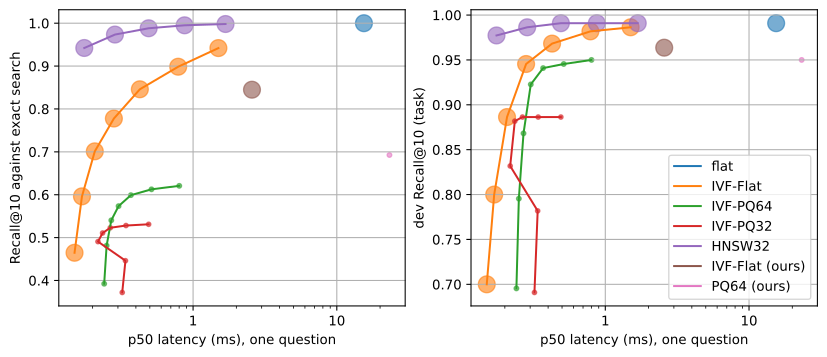
Marker area: bytes per vector. Left: recall against exact search. Right: dev Recall@10 of the book’s questions.
Task Recall Drops Far Less Than Recall Against Exact Search
Which recall
| index, one CPU thread | against exact search | dev Recall@10 |
|---|---|---|
| flat scan | 1.00 | 0.99 |
| IVF-Flat, 16 probes | 0.85 | 0.97 |
| IVF-PQ, 64 bytes, 16 probes | 0.59–0.60 | 0.90–0.94 |
IVF-PQ: ranges over three k-means seeds.
Against exact search counts all ten neighbors; a reader needs one relevant chunk among ten.
Recall against exact search measures the index; task recall measures what a user notices.
BookRetriever Fuses BM25 and the Embedder by Rank; the Reranker Is Optional
The book retriever
- BM25 (k_1 = 1.2, b = 0.9) and an exact scan of the stored Qwen3-Embedding-0.6B vectors, fused by RRF with k = 60.
rerank_kadds Qwen3-Reranker-0.6B;index='hnsw'or'ivfpq'builds a Faiss index for larger collections.- Each
Hitcarries every stage’s score:
“How does load_array decide whether to shuffle?” |
rank of the passage |
|---|---|
| BM25: the name matches, score 25 against at most 15 | 1 |
| embedder: 0.001 ahead of “A Loader for Every Epoch” | 1 |
| fusion, 1/61 + 1/61 = 0.033 | 1 |
Check: A Billion Vectors and 128 GB of Memory. Which Index?
Check
Bytes per vector: float32 4,096; HNSW about 4,370; IVF-PQ64 code 64.
Answer. Float32 needs 4 TB and the graph more, so IVF-PQ: 64 GB of codes plus ids. Rescore the best candidates with exact vectors from disk, since 64-byte codes found only about 0.6 of the exact neighbors here.
Recap
Recap
- BM25 0.96, embedder 0.99 Recall@10; 5% found by only one; both together find all 220.
- BM25 ranks identifier questions higher: nDCG@10 by 0.09. The
load_arrayquestion: BM25 first by a wide margin, the embedder first by 0.001. - RRF: nDCG@10 +0.05 over the embedder, +0.04 over BM25; rerank@20: +0.03 more, about a quarter of a second per question.
- 67,853 vectors: HNSW 0.97 of the exact neighbors, about 50 times faster than one thread’s scan; IVF-PQ 64 bytes per vector at recall about 0.6 against exact search, task recall 0.90 to 0.94 across k-means seeds.
- Offsets coded in more cells: smaller errors (0.41 → 0.30), fewer neighbors found (0.70 → 0.63).
Next: which chunks a language model should read, and which stage failed when its answer is wrong.