class A:
    def __init__(self):
        self.b = 1

a = A()Object-Oriented Design for Implementation
Dive into Deep Learning · §2.4
Object-Oriented Design for Deep Learning
Module · DataModule · Trainer · reusable data loaders · size-weighted epoch means
Why Decouple Models, Datasets, and Training Loops?
Software Architecture Motivation
- Separation of concerns: Factoring every experiment into
DataModule,Module, andTrainerreplaces N \times M duplicated loops with one reusable harness.
The Three Core Abstractions of the d2l Harness
Class Responsibilities & Interfaces
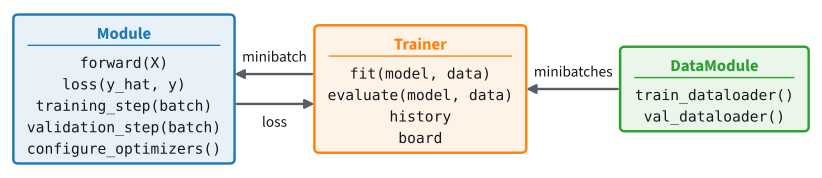
DataModule(data): Owns raw arrays/files and split indices, exposingtrain_dataloader()andval_dataloader().Module(models): Owns trainable parameters and layers, definingforward(X),loss(y_hat, y),training_step(batch), andconfigure_optimizers().Trainer(training loop): Connects anyModuleto anyDataModuleviafit(model, data), drivingfit_epoch(),validate(), andProgressBoard.
Notebook Utilities: add_to_class & HyperParameters
Clean Literate Code
Instance attribute "b" is 1- Incremental methods & auto-binding:
@add_to_class(Class)attaches methods across notebook cells, whileself.save_hyperparameters()binds__init__arguments ontoselfautomatically.
The Module Base Class Contract
Model Abstraction
- Forward & loss (
forward,loss):forward(X)delegates toself.net(X)by default;loss(y_hat, y)computes the per-minibatch scalar objective. - Step hooks (
training_step,validation_step): Unpack*batch[:-1]andbatch[-1]and return a scalar loss or metric dict (normalized viaas_metrics). - Zero trainer coupling: Models never print, plot, or mutate trainer state directly.
Packaging From-Scratch Linear Regression Into a Module
LinearRegressionScratch
- Parameter registration: Registering the raw tensors as module parameters makes them discoverable for gradients and device transfer.
Packaging Our Scratch SGD Update Into an Optimizer
The Optimizer Interface
class SGD(d2l.HyperParameters):
    """Minibatch stochastic gradient descent."""
    def __init__(self, params, lr):
        self.save_hyperparameters()

    def step(self):
        for param in self.params:
            param -= self.lr * param.grad

    def zero_grad(self):
        for param in self.params:
            if param.grad is not None:
param.grad.zero_()DataModule and Reusable Multi-Epoch Data Loaders
Data Pipeline Abstraction
- Why a reusable loader beats a bare generator: A Python
yieldgenerator exhausts after epoch 1, whereas the loader returned byget_tensorloadercreates a fresh reshuffled iterator on every epoch and supportslen(loader)in O(1) time.
Verifying Multi-Epoch Reshuffling on Synthetic Data
Loader Behavior
Calling data.train_dataloader() returns a reusable loader that yields 32 minibatches (ending with the 8-example remainder) on every pass, starting in a fresh random permutation each epoch:
32 minibatches, the last of size 8
second pass: 32 minibatches
a new pass starts with labels [-0.64 -5.75  3.55]
a new pass starts with labels [-3.35 0.07 -0.03]32Pitfall: Unweighted Batch Averages Skew Epoch Means
Size-Weighted Epoch Means
class Averager:
    """Example-weighted means of batch metrics, summed on the device."""
    def __init__(self):
        self.sums, self.n = {}, 0

    def add(self, metrics, n):
        for name, value in metrics.items():
            self.sums[name] = self.sums.get(name, 0) + value * n
        self.n += n

    def mean(self):
        """One host synchronization per metric; the loss comes first."""
        names = sorted(self.sums, key=lambda name: (name != 'loss', name))
return {name: float(self.sums[name]) / self.n for name in names}- Exact example weighting: As 1{,}000 = 31 \times 32 + 8, an unweighted mean overweights the last 8 examples by 4\times;
Averagerweights each batch by its size n_b.
The Trainer Outer Loop and Per-Epoch History
Driving the Training Cycle
def fit(self, model, data):
    self.prepare_data(data)
    self.prepare_model(model)
    self.prepare_optimizer(model)
    self.history = collections.defaultdict(list)
    self.board.clear()
    self.board.xlim = [0, self.max_epochs]
    for self.epoch in range(self.max_epochs):
        # The training mean averages over the epoch, so it sits mid-epoch
        self.record('train', self.fit_epoch(), x=self.epoch + 0.5)
        if self.val_dataloader is not None:
            self.record('val', self.validate(), x=self.epoch + 1)
        self.board.show(final=False)
    self.board.show()

def record(self, split, metrics, x):
    for name in sorted(metrics, key=lambda name: (name != 'loss', name)):
        self.history[f'{split}_{name}'].append(metrics[name])
        self.board.draw(x, metrics[name], f'{split}_{name}')
Where Train and Validation Points Land
Driving the Training Cycle
- Mid-epoch vs. end-of-epoch coordinates:
fit_epoch()averages training loss across updates and plots at x = \text{epoch} + 0.5, whereasvalidate()evaluates end-of-epoch weights at x = \text{epoch} + 1.0.
Inside fit_epoch and validate: The Four-Step Core
Per-Minibatch Execution
- Graph detachment: Calling
.detach()on the logged metrics frees each batch’s autograd graph immediately.
The ProgressBoard Live Plotting Interface
Visualizing Training Progress
ProgressBoard redraws live training and validation curves in place:
class ProgressBoard(d2l.HyperParameters):
    """Curves that grow during training; `show` redraws them."""
    def __init__(self, xlabel=None, ylabel=None, xlim=None, ylim=None,
                 xscale='linear', yscale='linear', figsize=(3.5, 2.5),
                 display=True):
        self.save_hyperparameters()
        self.clear()

    def clear(self):
        """Forget all curves; the next `show` starts a new figure."""
        self.data, self.handle = {}, None

    def draw(self, x, y, label):
        """Append the point (x, y) to the curve called `label`."""
        xs, ys = self.data.setdefault(label, ([], []))
        xs.append(x)
        ys.append(y)

    def show(self, final=True):
        raise NotImplementedError
ProgressBoard: Plot Coordinates and Headless Mode
Visualizing Training Progress
- Mid-epoch training vs. end-of-epoch validation: Drawing
'train_loss'at x = \text{epoch} + 0.5 and'val_loss'at x = \text{epoch} + 1.0 aligns each curve with the average point in time at which its parameters were evaluated. - Headless / sweep mode: Setting
trainer.board.display = Falsedisables figure rendering while still populatingtrainer.historyfor hyperparameter sweeps.
End-to-End Check: Training LinearRegressionScratch
Reproducing the Scratch Benchmark
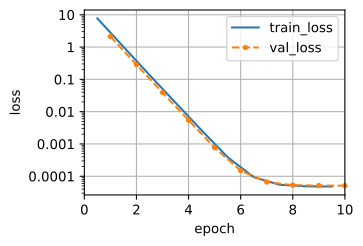
Trainer(max_epochs=10) on LinearRegressionScratch(2, lr=0.03) reproduces the 7\times-per-epoch convergence and 10^{-4} parameter recovery:
validation loss: 5.1e-05
error in w: 4.3e-04, 3.0e-04
error in b: -6.7e-04- Overlapping train and val curves: With only 3 parameters and 1{,}000 examples, memorization is impossible and validation loss tracks training loss down to \sigma^2/2 = 5 \times 10^{-5}.
- Ready for the concise implementation: The next section swaps in built-in layers, losses, and optimizers without touching
SyntheticRegressionDataorTrainer.
Concept Check: Averager Math, Curve Timing & Design
Check Your Understanding
Test your grasp of the object-oriented training harness on these three questions:
- Size-weighted
Averagercalculation: On 1{,}000 validation examples in minibatches of 32 (31 batches of 32 and 1 batch of 8), suppose the 31 full batches each have mean loss 0.010 while the final 8-example batch has mean loss 0.050. What epoch mean doesAveragerreport, and what would an unweighted average of the 32 batch means report? - Why training loss sits above validation loss early on: In epoch 1, why does the plotted training loss often sit higher than the validation loss even when both splits come from the exact same distribution?
- Where to extend: Which class and method do you modify to (a) report classification accuracy alongside loss, (b) switch from SGD to Adam, or (c) add early stopping when validation loss plateaus?
Answers:
Averagerreports (992 \times 0.010 + 8 \times 0.050) / 1000 = 0.01032. Unweighted batch averaging reports (31 \times 0.010 + 1 \times 0.050) / 32 = 0.01125—a 9\% overestimate because the 8 noisy examples receive 4\times their true weight.fit_epoch()averages the training loss over the course of the epoch (starting from high initial loss at step 1, plotted at x = 0.5), whereasvalidate()evaluates the model after all 32 gradient steps of the epoch have already lowered the loss (plotted at x = 1.0).- Override
Module.validation_stepto return{'loss': ..., 'acc': ...}; (b) changeModule.configure_optimizers; (c) subclassTrainer.fitonce to inspectself.history['val_loss']—no model or dataset class needs to change.
- Override
Summary & Key Takeaways
Summary
| Class / Utility | Core Responsibility | Key Pitfall Prevented | Contract with the Rest of the Book |
|---|---|---|---|
@add_to_class & HyperParameters |
Incremental method binding; automatic self.<arg> assignment |
Eliminates 60-line monolithic cells and constructor boilerplate | Inherited by every Module, DataModule, and Trainer |
d2l.Module |
Holds parameters, forward, loss, training_step, optimizer |
Pure return contract (as_metrics) keeps models decoupled from logging |
Base class for all neural networks in the book |
d2l.DataModule |
Encapsulates splits and returns reusable multi-epoch loaders | Prevents silent single-pass generator exhaustion after epoch 1 | Base class for synthetic, tabular, vision, and sequence datasets |
d2l.Averager |
Accumulates \sum_b n_b \bar{L}_b / \sum_b n_b on device | Prevents partial final minibatches (n_B < |\mathcal{B}|) from skewing epoch means | Used inside fit_epoch and validate across all tasks |
d2l.Trainer |
Runs epoch loops, logs history and ProgressBoard |
Keeps logged metrics from holding each batch’s gradient graph | Fits any Module to any DataModule via trainer.fit(model, data) |