Softmax Regression Implementation: From Scratch to LogSumExp rowwise softmax · float32 overflow & underflow · Classifier base class · confusion matrix · templates · fused LogSumExp loss
Why Naive Softmax & Cross-Entropy Break in Float32
The Numerical & Systems Motivation
Building softmax regression on Fashion-MNIST (d = 784,q = 10, 7{,}850 parameters) requires solving two immediate problems:
Float32 overflow & underflow:float32 overflows to inf above \exp(88.7) \approx 3.4 \times 10^{38}(\infty / \infty = \texttt{NaN}) and underflows to 0.0 below \exp(-104)(-\log 0 = +\infty).
Dual-metric model abstraction: Every classifier optimizes smooth cross-entropy during backprop while logging discrete \operatorname{argmax} accuracy across variable-sized validation minibatches.
Rowwise Softmax via Broadcasting
From-Scratch Softmax
Given a minibatch of logits \mathbf{O} = \mathbf{X}\mathbf{W} + \mathbf{b} \in \mathbb{R}^{n \times q}, softmax normalizes each row independently:
Expected outputs: The first row reproduces (0.21, 0.69, 0.10), the second row yields the uniform distribution (1/3, 1/3, 1/3), and every row sum equals 1.0.
Subtracting the Row Maximum Prevents Overflow
Overflow Safeguard
Subtracting the row maximum o_{\max} = \max_k o_k ensures every shifted logit o_j - o_{\max} \le 0 (and the largest is 0):
Why shifting alone is not enough for the loss: Subtracting o_{\max} cures exp overflow, but if o_y - o_{\max} < -104, \exp(o_y - o_{\max}) still underflows to 0.0, causing -\log \hat{y}_y = +\infty.
Two Branches from One Logit Vector: Loss vs. Accuracy
Training vs. Evaluation Metrics
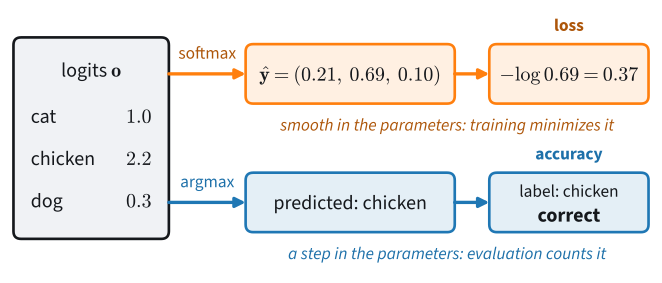
Both training and evaluation consume the exact same logit matrix \mathbf{O} \in \mathbb{R}^{n \times q}, but take different branches:
Training branch (top): Passes logits through softmax to compute the smooth, differentiable cross-entropy loss l(\mathbf{y}, \hat{\mathbf{y}}).
Why track both? If a model becomes overconfident on a few hard validation examples, its validation loss can rise even while validation accuracy is still improving.
The Classifier Base Class and Vectorized Accuracy
Reusable Object-Oriented Abstraction
We package dual-metric validation into Classifier(d2l.Module), the base class for every classification network in the book:
class Classifier(d2l.Module):"""The base class of classification models."""def validation_step(self, batch): Y_hat =self(*batch[:-1])return {'loss': self.loss(Y_hat, batch[-1]),'acc': self.accuracy(Y_hat, batch[-1])}
def accuracy(self, Y_hat, Y, averaged=True):"""Compute the fraction of correct predictions.""" Y_hat = d2l.reshape(Y_hat, (-1, Y_hat.shape[-1])) preds = d2l.astype(d2l.argmax(Y_hat, axis=1), Y.dtype) compare = d2l.astype(preds == d2l.reshape(Y, (-1,)), d2l.float32)return d2l.reduce_mean(compare) if averaged else compare
Type-safe comparison:accuracy flattens batch axes to (-1, q), casts argmax(axis=1) to Y.dtype, and averages the indicator tensor.
Default Minibatch SGD Optimizer on Module
Optimizer Configuration
Because nearly every baseline model trains with minibatch stochastic gradient descent at learning rate self.lr, we attach a default configure_optimizers method directly to d2l.Module:
def cross_entropy(y_hat, y):# Tiny clip to keep log finite when softmax outputs underflow to 0. p = y_hat[list(range(len(y_hat))), y].clamp(min=1e-12)return-d2l.reduce_mean(d2l.log(p))cross_entropy(y_hat, y)
tensor(1.4979)
Gather vs. One-Hot, and the Clamp’s Blind Spot
O(n) Indexing vs. O(nq) One-Hot Products
Linear cost: The gather touches n entries, while a one-hot product multiplies all nq entries, almost all of them zero.
Why the 1e-12 clamp is only a stopgap: Wherever \max(\hat{y}_y, 10^{-12}) triggers, the derivative is zero, killing the gradient on the worst mistakes.
Training Softmax Regression from Scratch
10 Epochs of Minibatch SGD
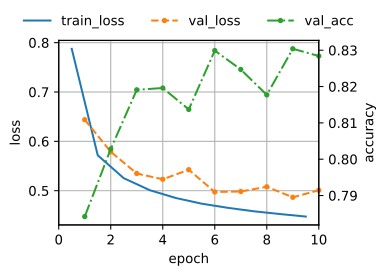
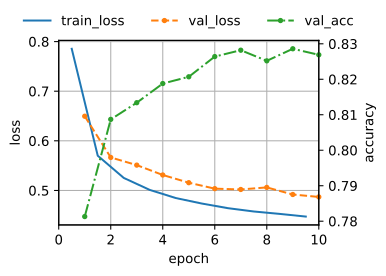
We train SoftmaxRegressionScratch for 10 epochs on Fashion-MNIST with minibatch size n = 256 and learning rate \eta = 0.1:
Rapid convergence: Validation accuracy climbs past 75\% in the first epoch and settles near 83\% by epoch 10, while validation cross-entropy loss drops from \approx 2.30 to \approx 0.50 (and training loss to \approx 0.46).
Evaluation on full splits: Evaluating across all 10{,}000 validation images and 60{,}000 training images shows a tiny \sim 1\% generalization gap:
In the first validation minibatch of 256 images, roughly 40 garments are misclassified. Plotting the first eight mistakes (true → predicted) reveals a clear visual pattern:
35 of 256 wrong
Silhouette confusion: Nearly every error swaps two upper-body tops (shirt, pullover, coat, T-shirt) or two footwear items that share a similar global pixel outline.
Accumulating the 10 × 10 Confusion Matrix
Quantitative Error Breakdown
One-hot matrices \mathbf{P}, \mathbf{Y} \in \{0, 1\}^{n \times 10} tally all predictions via \mathbf{N} \mathrel{+}= \mathbf{P}^\top\mathbf{Y}:
def one_hot(y, q):"""Rows of the q x q identity matrix, one per class index in y."""return d2l.astype(d2l.reshape(y, (-1, 1)) == d2l.arange(q, dtype=y.dtype), d2l.float32)N = d2l.zeros((10, 10))for X, y in data.val_dataloader(): P = one_hot(d2l.argmax(model(X), axis=1), 10) N += d2l.matmul(d2l.transpose(P), one_hot(y, 10))int(d2l.reduce_sum(N))
shirt taken for pullover: 207
coat taken for pullover: 192
shirt taken for T-shirt: 192
shirt taken for coat: 151
pullover taken for coat: 102
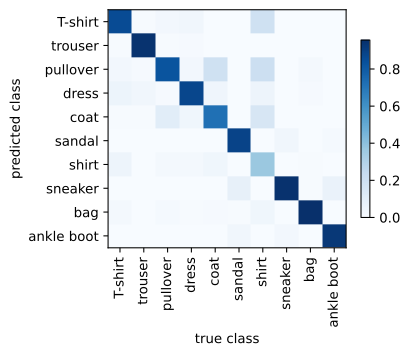
Columns = true class: Normalizing columns gives C_{ij} = P(\hat{c} = i \mid y = j).
Visualizing the Column-Normalized Confusion Matrix
Where the Linear Model Struggles
Plotting C_{ij} = N_{ij} / \sum_{i'} N_{i'j} as a 10 \times 10 heatmap shows exactly where each true garment category lands:
High-accuracy classes (\ge 90\%): Trousers (1), bags (8), sandals (5), sneakers (7), and ankle boots (9) have distinct silhouettes and bright diagonal cells.
The upper-body bottleneck: The five largest off-diagonal confusions all occur among T-shirt (0), pullover (2), coat (4), and shirt (6).
Shirts are recognized only about half the time or less: Their boxy torso overlaps all three rival tops.
Visualizing the Learned Columns of W as Templates
What a Linear Classifier Learns
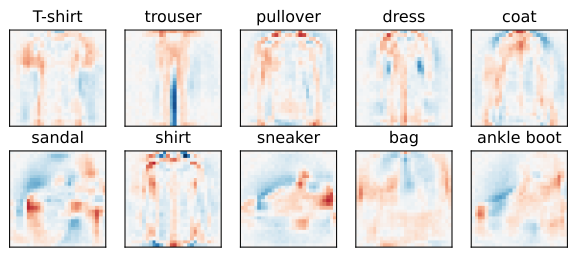
Because o_j = \mathbf{w}_j^\top\mathbf{x} + b_j is an inner product between image \mathbf{x} and column j of \mathbf{W}, reshaping each 784-element column \mathbf{w}_j to 28 \times 28 reveals ten spatial templates (red > 0, blue < 0):
Global template matching: Notice the negative blue channel between the trouser legs that penalizes dresses, and the nearly identical red torso blobs of the four tops. Because a linear layer takes only one global dot product per class, local collar or button details cannot overcome overall silhouette overlap.
Concise Model: Returning Raw Logits
Concise Framework Implementation
In SoftmaxRegression(d2l.Classifier), a flattening layer and a single built-in linear layer replace manual parameter management:
class SoftmaxRegression(d2l.Classifier):"""The softmax regression model."""def__init__(self, num_outputs, lr):super().__init__()self.save_hyperparameters()self.net = nn.Sequential(nn.Flatten(), nn.LazyLinear(num_outputs))def weight_init(self, module):# The Trainer calls this after the lazy layer has learned its shapeifisinstance(module, nn.Linear): nn.init.normal_(module.weight, std=0.01) nn.init.zeros_(module.bias)def forward(self, X):returnself.net(X)
Why forward Stops at the Logits
Concise Framework Implementation
Critical invariant — forward returns raw logits \mathbf{O}: Both Classifier.accuracy(\operatorname{argmax}_j O_{ij}) and fused cross-entropy consume unnormalized logits directly. Putting softmax inside forward would apply softmax twice.
The LogSumExp Trick: Fusing Softmax and Logarithm
Eliminating Both Overflow and Underflow
Fusing \mathrm{softmax}(\mathbf{o})_y and -\log(\cdot) algebraically in log space and shifting by o_{\max} = \max_k o_k:
Overflow impossible: Every o_k - o_{\max} \le 0, so \exp(o_k - o_{\max}) \in (0, 1].
Underflow \log(0) impossible: At k = \operatorname{argmax} o_k, \exp(0) = 1, trapping the sum inside [1, q] and its log inside [0, \log q] with exact gradient \mathrm{softmax}(\mathbf{o}) - \mathbf{y}.
Installing Fused Cross-Entropy on Classifier
Framework Logit Losses
We install the framework’s fused LogSumExp cross-entropy on d2l.Classifier.loss and test it on extreme logits (1000, 0, 0):
def loss(self, Y_hat, Y, averaged=True): Y_hat = d2l.reshape(Y_hat, (-1, Y_hat.shape[-1])) Y = d2l.reshape(Y, (-1,))return F.cross_entropy( Y_hat, Y, reduction='mean'if averaged else'none')
O = d2l.tensor([[1000.0, 0.0, 0.0], [1000.0, 0.0, 0.0]])y = d2l.tensor([0, 1])SoftmaxRegression(num_outputs=3, lr=0.1).loss(O, y, averaged=False)
tensor([ -0., 1000.])
Concise Training Run on Fashion-MNIST
End-to-End Verification
Training SoftmaxRegression with d2l.Trainer takes four lines of code and reproduces \sim 83\% validation accuracy with complete numerical stability across all logit magnitudes:
Identical mathematical trajectory: Because weights start from \mathcal{N}(0, 0.01^2) and biases at 0, the concise model follows the exact same optimization dynamics as SoftmaxRegressionScratch.
Foundation for Chapters 4–8: Replacing the single linear layer inside self.net with multilayer perceptrons or convolutional networks requires zero changes to Classifier, loss, or Trainer.
Test your understanding of numerical stability and implementation pitfalls:
Extreme negative logits: What does our unshifted scratch softmax return on \mathbf{o} = (-1000, -1000, -1000) in float32, and what does the shifted formula return?
The double-softmax bug: Suppose a developer accidentally puts softmax at the end of forward before passing the output to the framework’s cross-entropy loss. For q = 10 classes, what is the lowest loss value the model can ever reach, even when it predicts a deterministic one-hot vector \mathbf{p} = (1, 0, \ldots, 0)?
Vocabulary scaling: In a language model with hidden size d = 1024, batch size n = 256, and vocabulary q = 10^6 tokens, how much float32 memory do the output weight matrix \mathbf{W} \in \mathbb{R}^{d \times q} and logit matrix \mathbf{O} \in \mathbb{R}^{n \times q} occupy?
Answers:(1) Unshifted: \exp(-1000) = 0.0 in all three slots, giving 0.0 / 0.0 = \texttt{NaN}; shifted by o_{\max} = -1000: \mathrm{softmax}(0, 0, 0) = (1/3, 1/3, 1/3). (2) Feeding \mathbf{p} = (1, 0, \ldots, 0) into -\log\mathrm{softmax}(\mathbf{p})_1 gives -\log(e^1 / (e^1 + 9e^0)) = \log(e + 9) - 1 \approx 1.46\text{ nats}, trapping the training loss above 1.46. (3)\mathbf{W} takes 1024 \times 10^6 \times 4\text{ B} \approx 4.10\text{ GB}, and a single batch of logits \mathbf{O} takes 256 \times 10^6 \times 4\text{ B} \approx 1.02\text{ GB}.
Summary: From-Scratch vs. Concise Softmax Regression