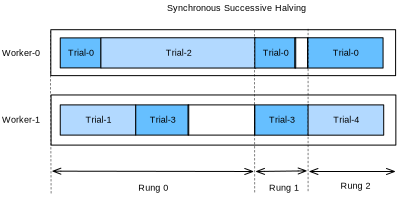
Synchronous successive halving has a problem: at each rung, you wait for all surviving configs to finish before promoting. With multiple workers, fast configs finish first and idle waiting for stragglers.
Synchronous SH: workers idle while waiting for slow trials at the rung boundary.
ASHA: Promote Without Waiting
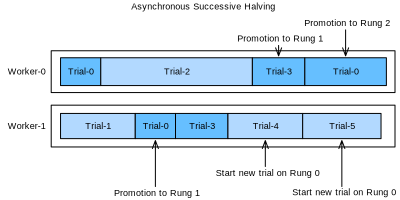
ASHA (Asynchronous Successive Halving) fixes this: promote configs to the next rung the moment they qualify, without waiting for the rest of the cohort. Workers always have something to do.
State-of-the-art-grade HPO performance, with one parallelism mechanism that handles both early stopping and parallel dispatch.
ASHA Setup
Import Syne Tune’s ASHA scheduler and reuse the same objective family as the random-search deck. The only new idea is that max_epochs becomes the resource budget:
Objective with Epochs as Budget
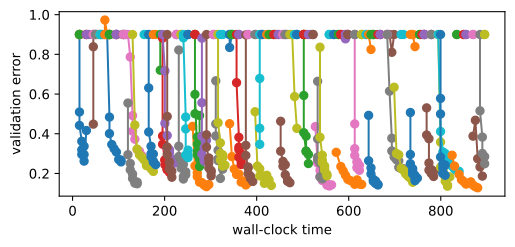
The objective reports validation loss and error after every epoch, so the scheduler can stop, continue, or promote a trial without waiting for full training. ASHA ranks by the loss: an untrained LeNet predicts one class (error exactly 0.9), and when most trials tie there, the median cutoff stops none of them.
def hpo_objective_lenet_synetune(learning_rate, batch_size, max_epochs):from d2l import torch as d2lfrom syne_tune import Reporter model = d2l.LeNet(lr=learning_rate, num_classes=10) trainer = d2l.Trainer(max_epochs=1, num_gpus=1) data = d2l.FashionMNIST(batch_size=batch_size) model.apply_init([next(iter(data.get_dataloader(True)))[0]], d2l.init_cnn) report = Reporter()for epoch inrange(1, max_epochs +1):if epoch ==1:# Initialize the state of Trainer trainer.fit(model=model, data=data)else: trainer.fit_epoch() metrics = trainer.validate() report(epoch=epoch, validation_loss=metrics['loss'], validation_error=1- metrics['acc'])
ASHA Configuration
Rung budgets grow geometrically:
r_i = r_{\min}\eta^i,\quad r_i \le r_{\max}.
With \eta=2, roughly half the trials advance at each rung and survivors receive twice as much training budget:
Per-rung “halving books”: each book holds the configs that have completed up to budget r_i. When a worker frees up, look across all rungs for any config that qualifies for promotion (top 1/\eta at its rung); if none, sample a fresh config:
Promotion rule: after at least \eta trials are observed at rung i, promote a config only if it is in the best \lfloor n_i/\eta \rfloor scores at that rung.
# Each LeNet trial fits in well under 7 GB of GPU memory, so we can pack# multiple trials per device. `PythonBackend(rotate_gpus=True)` (the# default) round-robins trials across detected GPUs and falls back to# sharing when `n_workers > num_gpus`. Allocate 7 GB per slot — this# yields 3 slots on a 24 GB card and 4 slots on a 32 GB card after# driver overhead, e.g. 4×24 GB → 12 slots; 2×32 GB → 8.import torch_GB =1024**3n_workers =sum( torch.cuda.get_device_properties(i).total_memory // (7* _GB)for i inrange(torch.cuda.device_count())) or1max_wallclock_time =15*60# 15 minutes
Configuring the ASHA scheduler
Syne Tune’s ASHA ranks trials by validation loss, starts every trial at grace_period epochs and promotes the top 1/\eta:
max_resource_level = 10, as inferred from config_space
Master random_seed = 4080344572
ASHA scheduler (cont.)
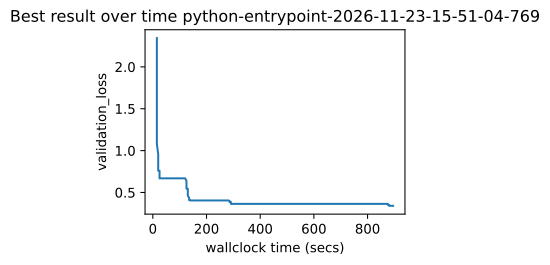
The tuner launch is intentionally omitted from the lecture slide: its console output is backend bookkeeping, not a conceptual step. The relevant result is the incumbent curve loaded from the completed experiment.