def hpo_objective_lenet_synetune(learning_rate, batch_size, max_epochs):
    from d2l import torch as d2l
    from syne_tune import Reporter

    model = d2l.LeNet(lr=learning_rate, num_classes=10)
    trainer = d2l.HPOTrainer(max_epochs=1, num_gpus=1)
    data = d2l.FashionMNIST(batch_size=batch_size)
    model.apply_init([next(iter(data.get_dataloader(True)))[0]], d2l.init_cnn)
    report = Reporter()
    for epoch in range(1, max_epochs + 1):
        if epoch == 1:
            # Initialize the state of Trainer
            trainer.fit(model=model, data=data)
        else:
            trainer.fit_epoch()
        validation_error = trainer.validation_error()
report(epoch=epoch, validation_error=validation_error)Asynchronous Random Search
Random search is embarrassingly parallel — each trial is independent. With K machines, you’d hope for K \times speedup. But synchronous parallelism wastes time on stragglers: every batch of K trials waits for the slowest one.
Asynchronous random search keeps every worker busy: when one finishes, immediately give it a new config. Total wall-clock time scales much better.
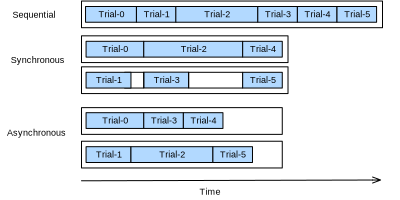
Sync vs async parallel HPO: async avoids idle workers when trials finish at different times.
This deck wires up an async scheduler around the API abstraction from the previous deck.
Loop (cont.)
Run the tuner, then load the experiment results. The raw Syne Tune logs contain local paths and backend commands, so the slide keeps the plot-producing analysis cell instead of the console transcript.
d2l.set_figsize()
tuning_experiment = load_experiment(tuner.name)
tuning_experiment.plot()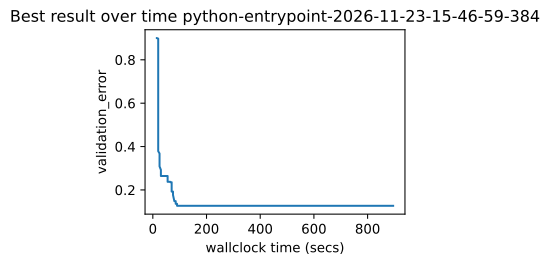
Wall-clock advantage
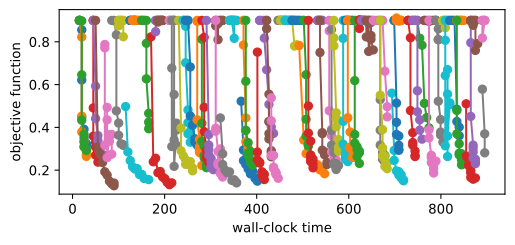
Learning curves of all trials against wall-clock time. A free worker starts the next trial at once, so no worker sits idle waiting for stragglers:
d2l.set_figsize([6, 2.5])
results = tuning_experiment.results

for trial_id in results.trial_id.unique():
    df = results[results["trial_id"] == trial_id]
    d2l.plt.plot(
        df["st_tuner_time"],
        df["validation_error"],
        marker="o"
    )

d2l.plt.xlabel("wall-clock time")
d2l.plt.ylabel("objective function")