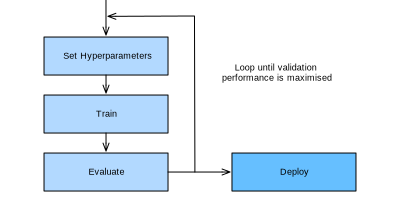
Hyperparameters are the knobs you tune outside gradient descent: learning rate, batch size, depth, dropout rate. Usually 5–20 of them; the validation loss is non-convex, noisy, and expensive — one full training run per setting.
Hyperparameter optimization (HPO) automates the tuning. Simplest variant: random search — sample configurations from a prior, evaluate, keep the best.
The HPO workflow
Train multiple models with different hyperparameters; pick the best.
Random search beats grid search and most hand-tuning. Smarter algorithms (Bayesian opt, Hyperband) come next.
Formalizing HPO
Find \mathbf{x}^* = \arg\min_{\mathbf{x} \in \mathcal{X}} f(\mathbf{x}) where f is the validation error after training with hyperparameters \mathbf{x}, and \mathcal{X} is the configuration space — a structured product of discrete and continuous ranges.
Objective: train + evaluate
The “function” we’re optimizing is “train a model with this config, return validation error”. Wrap that into a clean callable:
class HPOTrainer(d2l.Trainer):def validation_error(self):return1-self.validate()['acc']
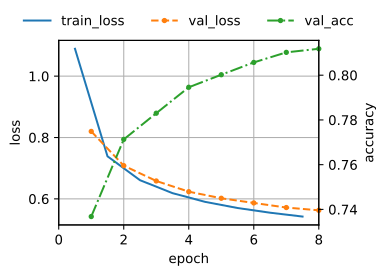
def hpo_objective_softmax_classification(config, max_epochs=8): learning_rate = config["learning_rate"] trainer = d2l.HPOTrainer(max_epochs=max_epochs) data = d2l.FashionMNIST(batch_size=256) model = d2l.SoftmaxRegression(num_outputs=10, lr=learning_rate) trainer.fit(model=model, data=data)return trainer.validation_error()
Configuration space
A structured space — log-uniform for learning rate (spans orders of magnitude), uniform integer for layer counts, categorical for activations: