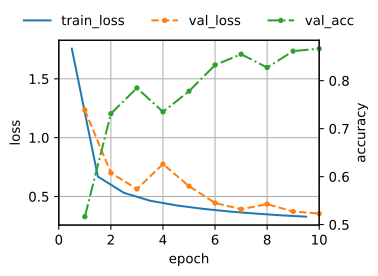
class HPOSearcher(d2l.HyperParameters):
def sample_configuration(self) -> dict:
raise NotImplementedError
def update(self, config: dict, error: float, additional_info=None):
passHPO algorithms have a common structure. The next two decks will swap out pieces (parallel scheduling, multi-fidelity). This deck factors out the common skeleton:
Same shape every modern HPO library uses (Optuna, SyneTune, Vizier, Ray Tune).
class RandomSearcher(HPOSearcher):
def __init__(self, config_space: dict, initial_config=None):
self.save_hyperparameters()
def sample_configuration(self) -> dict:
if self.initial_config is not None:
result = self.initial_config
self.initial_config = None
else:
result = {
name: domain.rvs()
for name, domain in self.config_space.items()
}
return resultConcrete sequential / FIFO scheduler:
Combines searcher + scheduler + objective into a single loop:
class HPOTuner(d2l.HyperParameters):
def __init__(self, scheduler: HPOScheduler, objective: callable):
self.save_hyperparameters()
self.incumbent, self.incumbent_error = None, None # Best so far
self.incumbent_trajectory, self.records = [], []
self.cumulative_runtime, self.current_runtime = [], 0
def run(self, number_of_trials):
for i in range(number_of_trials):
start_time = time.time()
config = self.scheduler.suggest()
print(f"Trial {i}: " + ", ".join( # Floats to 4 significant digits
f"{k} = {v:.4g}" if isinstance(v, float) else f"{k} = {v}"
for k, v in config.items()))
error = float(self.objective(**config))
self.scheduler.update(config, error)
runtime = time.time() - start_time
self.bookkeeping(config, error, runtime)
print(f" error = {error:.4f}, runtime = {runtime:.1f} s")Track wall-clock time and best-seen objective so we can plot any-time performance later:
def bookkeeping(self, config: dict, error: float, runtime: float):
self.records.append({"config": config, "error": error, "runtime": runtime})
# Check if the last hyperparameter configuration performs better
# than the incumbent
if self.incumbent is None or self.incumbent_error > error:
self.incumbent = config
self.incumbent_error = error
# Add current best observed performance to the optimization trajectory
self.incumbent_trajectory.append(self.incumbent_error)
# Update runtime
self.current_runtime += runtime
self.cumulative_runtime.append(self.current_runtime)Run the abstraction on a real model — a small CNN on Fashion-MNIST. Search over learning rate and batch size:
def hpo_objective_lenet(learning_rate, batch_size, max_epochs=10):
model = d2l.LeNet(lr=learning_rate, num_classes=10)
trainer = d2l.HPOTrainer(max_epochs=max_epochs, num_gpus=1)
data = d2l.FashionMNIST(batch_size=batch_size)
model.apply_init([next(iter(data.get_dataloader(True)))[0]], d2l.init_cnn)
trainer.fit(model=model, data=data)
validation_error = trainer.validation_error()
return validation_errorPlug the random searcher into the basic scheduler and let the tuner run five trials of the LeNet objective:
The next slide shows what the run prints: each trial’s sampled configuration, its validation error and its runtime.
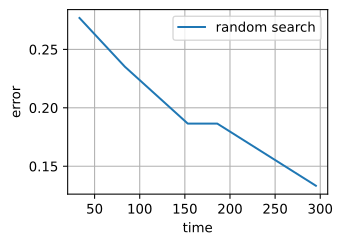
Trial 0: learning_rate = 0.1, batch_size = 128
error = 0.2769, runtime = 33.3 s
Trial 1: learning_rate = 0.1419, batch_size = 65
error = 0.2352, runtime = 50.3 s
Trial 2: learning_rate = 0.1155, batch_size = 52
error = 0.1865, runtime = 69.7 s
Trial 3: learning_rate = 0.04039, batch_size = 96
error = 0.3676, runtime = 32.7 s
Trial 4: learning_rate = 0.3783, batch_size = 33
error = 0.1333, runtime = 109.3 s
The incumbent curve reports the best validation error found so far as the tuner spends more wall-clock time. Downward steps mean a new configuration beat the previous best; flat regions mean the search is still evaluating but has not improved the incumbent.