Why Discrete Tokens Need a Non-Gaussian Corruption
Motivation
No continuous vector addition: Adding 0.3\,\boldsymbol\epsilon to token index 412 (“cat”) is meaningless—categorical IDs have no Euclidean metric structure.
Sequential bottleneck of GPT: Autoregressive decoding of L = 1{,}024 tokens requires 1{,}024 sequential calls, each a cached pass over one new token.
Discrete diffusion (Austin et al., 2021; Sahoo et al., 2024): Corrupt tokens into masks [\textrm{M}] via a Markov chain and train a bidirectional denoiser to unmask tokens in parallel.
Row-stochastic transitions: For one-hot row vector \mathbf{x} \in \{0, 1\}^K, [\mathbf{Q}_t]_{ij} = P(i \to j) corrupts each position independently.
Exact Bayes posterior: Given (\mathbf{x}_0, \mathbf{x}_t), the predecessor distribution is an elementwise product (\odot) of backward and forward probabilities: q(\mathbf{x}_{t-1} \mid \mathbf{x}_t, \mathbf{x}_0) = \mathrm{Cat}\!\left(\frac{\mathbf{x}_t\mathbf{Q}_t^\top \odot \mathbf{x}_0\bar{\mathbf{Q}}_{t-1}}{\mathbf{x}_0\bar{\mathbf{Q}}_t\mathbf{x}_t^\top}\right)
Worked Example: Two-Step Binary Flip Posterior
Evaluating the Discrete Forward Posterior by Hand
Symmetric 10\% binary flip (\mathbf{Q}_1 = \mathbf{Q}_2): Starting at \mathbf{x}_0 = (1, 0) and observing \mathbf{x}_2 = (0, 1) after two steps means exactly one flip occurred.
Forward prior \odot backward likelihood:\mathbf{x}_0\bar{\mathbf{Q}}_1 = (0.9, 0.1) and \mathbf{x}_2\mathbf{Q}_2^\top = (0.1, 0.9) multiply elementwise to (0.09, 0.09) with marginal evidence 0.18.
Normalized posterior (0.50, 0.50): The single flip is equally likely to have occurred at step 1 (\mathbf{x}_1 = 1) or step 2 (\mathbf{x}_1 = 0).
The Absorbing (Masking) Kernel
Noise as Token Erasure
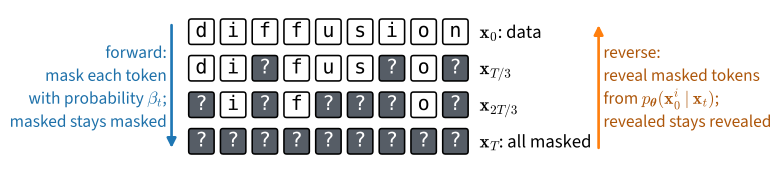
On text and discrete image codes, the absorbing kernel (Austin et al., 2021) augments the vocabulary with a mask token [\textrm{M}] (index K). At step t, each unmasked token is independently replaced by [\textrm{M}] with probability \beta_t, while masked tokens stay masked forever:
If \mathbf{x}_t^i \neq [\textrm{M}] (visible): Never corrupted, so \mathbf{x}_{t-1}^i = \mathbf{x}_t^i with probability 1 (revealed tokens are never revised).
If \mathbf{x}_t^i = [\textrm{M}] (masked): Only two predecessors exist—stay [\textrm{M}] with probability 1 - w_t, or unmask \mathbf{x}_{t-1}^i \sim p_{\boldsymbol\theta}(\cdot \mid \mathbf{x}_t) with probability w_t.
The Masked Diffusion ELBO Is Weighted Cross-Entropy
Simplifying the Variational Bound (Sahoo et al., 2024; Shi et al., 2024)
Exact cancellation inside D_{\textrm{KL}}: Unmasked divergences vanish (0), while (1-w_t)\log\frac{1-w_t}{1-w_t} = 0 leaves -w_t\log p_{\boldsymbol\theta}(\mathbf{x}_0^i \mid \mathbf{x}_t) on masked sites.
Linear schedule (\bar\alpha_t = 1 - t/T): A fraction t/T of tokens are masked with weight w_t = 1/t, giving constant expected weighted mask count L/T at every step.
Schedule invariance: Changing variables to the masking rate u(\tau) = 1 - \bar\alpha(\tau) \in [0, 1] eliminates the schedule \bar\alpha(\tau) completely.
Time-agnostic optimality (Ou et al., 2025): Once \mathbf{x}_t reveals which positions are masked, the step index t carries zero extra information about \mathbf{x}_0, so p^\star(\mathbf{x}_0^i \mid \mathbf{x}_t) does not need t.
Implementing the Masked Diffusion Loss and Sampler
Vectorized Cross-Entropy and Jump Unmasking
Because composing absorbing kernels yields another absorbing kernel, unmask can jump across any coarse grid T = t_0 > t_1 > \cdots > t_S = 0 in S evaluations by revealing each masked token with probability (\bar\alpha_s - \bar\alpha_t)/(1 - \bar\alpha_t):
def masked_loss(model, x0, t, alpha_bar, mask_id):"""One-draw estimate of the masked bound per sequence, in nats.""" T =len(alpha_bar) -1 shape = (-1,) + (1,) * (x0.dim() -1) # broadcast over positions masked = (torch.rand(x0.shape, device=x0.device)< (1- alpha_bar[t]).view(shape)) # with prob. 1 - abar_t logits = model(torch.where(masked, mask_id, x0), t / T) nll =-torch.log_softmax(logits, -1).gather(-1, x0[..., None])[..., 0] w = (alpha_bar[t -1] - alpha_bar[t]) / (1- alpha_bar[t]) # 1/t if linearreturn (T * w.view(shape) * nll * masked).flatten(1).sum(1)
Telescoping reveal probabilities: Across S jumps, each position i is unmasked in jump k with probability \Delta_k = \bar\alpha_{t_{k+1}} - \bar\alpha_{t_k}(1/S on an even linear grid), independently of all other positions.
The Parallel Independence Error on Two Tokens
Analytical Derivation on the Quantized 32×32 Mixture
Sequential reveal (prob 1 - 1/S):X^1 and X^2 unmask in different jumps (marginal then conditional), drawing an exact sample from p.
Simultaneous collision (prob S \cdot (1/S)^2 = 1/S): Both unmask in the same jump from ([\textrm{M}], [\textrm{M}]), drawing independently from p^1 \otimes p^2 and creating phantom modes.
Phantom Modes in the Product of Marginals
Verifying the 0.314 / S Total Variation Law
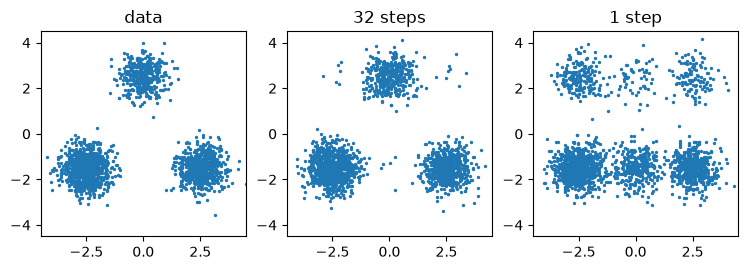
Because two of our three Gaussian modes share the same vertical mean (y = -1.5), the marginal p^1 has 3 peaks while p^2 has 2 peaks—so the independent product p^1 \otimes p^2 creates 3 \times 2 = 6 blobs(3 real modes + 3 phantom modes carrying 0.32 of the mass):
entropy 4.840 nats, mutual information 0.479 nats
 1 steps, exact network: TV 0.314
 2 steps, exact network: TV 0.157
 8 steps, exact network: TV 0.039
32 steps, exact network: TV 0.010
In practice, MaskGIT (Chang et al., 2022) and LLaDA (Nie et al., 2025) draw candidate tokens at all masked sites and keep the most confident draw (highest predicted marginal probability), remasking the rest. Testing this on our exact 2-token table reveals a hidden bias:
           order     TV  entropy  mass near the modes
        one step  0.314    5.319  0.482 0.321 0.197
two random jumps  0.157    5.216  0.491 0.310 0.199
     fixed order  0.000    4.840  0.500 0.300 0.200
      confidence  0.179    4.406  0.606 0.322 0.072
Fixed order (1 token/step): Zero independence error (\mathrm{TV} = 0.000), recovering the exact entropy 4.840 nats and mode weights [0.500, 0.300, 0.200].
Confidence remasking (\mathrm{TV} = 0.179, worse than 2 random jumps at 0.157): Because draws from the lightest mode (\pi_3 = 0.20) have lower marginal probability, they lose the confidence contest and get overwritten—collapsing mode 3’s weight from 0.200 to 0.068 and dropping entropy to 4.41 nats.
The ELBO Floor of Any Factorized Denoiser
Why Finite-T Discrete ELBO Exceeds True Entropy by I / T
We train MaskedMLP(K = 32, T = 32) for 6{,}000 updates on quantized mixture pairs and evaluate the exact discrete ELBO summed over all T = 32 steps and mask patterns:
Analytical derivation of the H(X^1, X^2) + I(X^1; X^2)/T floor:
When X^1 and X^2 are unmasked at different steps (probability 1 - 1/T), their expected cross-entropy is H(X^1) + H(X^2 \mid X^1) = H(X^1, X^2).
When both are unmasked in the same step (probability 1/T), predicting them independently from ([\textrm{M}], [\textrm{M}]) costs H(X^1) + H(X^2) = H(X^1, X^2) + I(X^1; X^2).
Thus no factorized reverse network can score below H + I/T = 4.840 + 0.479/32 = \mathbf{4.855\text{ nats}} (our trained MLP hits 4.856\text{ nats}, within 0.001 nats of the theoretical floor).
Trained vs. Exact Unmasking Across Step Budgets
Separating Parallel Independence Error from Network Error
Summing the exact output distribution of unmask for our trained pair_model vs. the exact table oracle across S \in \{32, 8, 2, 1\} steps separates the 1/S parallel error from the network’s approximation error:
TV to the table: trained and exact network; TV between the two
32 steps: trained 0.020, exact 0.010, between 0.013
 8 steps: trained 0.045, exact 0.039, between 0.013
 2 steps: trained 0.159, exact 0.157, between 0.012
 1 steps: trained 0.316, exact 0.314, between 0.012
1 step (\mathrm{TV} = 0.315): Dominated entirely by the parallel independence error (0.314); the scatter plot visibly populates the three phantom modes where mode columns and rows cross.
32 steps (\mathrm{TV} = 0.020): Parallel error drops 32\times to 0.010, leaving the network’s fixed \approx 0.010 approximation error.
Scaling to 784-Token Binary Fashion-MNIST Garments
Bits-per-Pixel Bound and 100-Step Unmasking
Thresholding Fashion-MNIST to binary pixels \{0, 1\} with mask token [\textrm{M}] = 2 turns each image into L = 784 tokens. We train a 3-channel-in, 2-channel-out MaskedUNet(T = 100) for 6{,}000 updates:
bound 0.170 bits per pixel, independent pixels 0.702 bits per pixel
4\times compression over independent pixels: The variational bound reaches \approx 0.171\text{ bits/pixel}(\approx 134 bits per garment image) vs. 0.697\text{ bits/pixel}(\approx 546 bits) for independent pixel marginals.
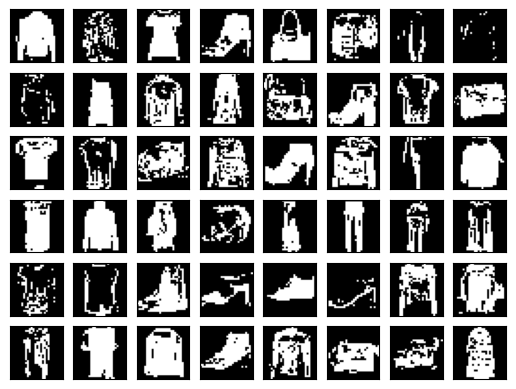
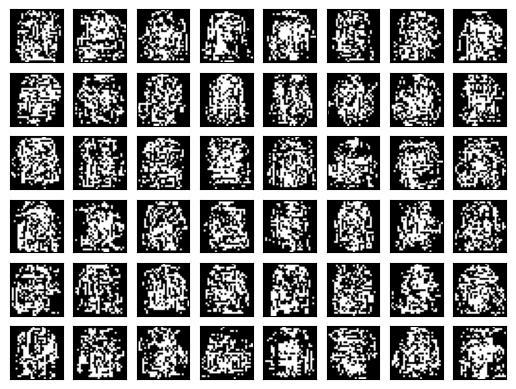
Unmasking L = 784 binary pixels in S = 4 jumps (\approx 196 per jump) vs. S = 100 or 784 jumps (\approx 1 per jump):
     data: speckles 0.0037, standard error over the 1,000 images 0.00016
784 steps: speckles 0.0047, standard error over the 1,000 images 0.00016
100 steps: speckles 0.0075, standard error over the 1,000 images 0.00021
  4 steps: speckles 0.0330, standard error over the 1,000 images 0.00027
4 steps (9\times more speckles than real data): In jump 1, \approx 196 pixels are drawn independently from the all-mask marginal, creating uncorrelated salt-and-pepper noise that subsequent jumps cannot erase.
100 vs. 784 steps (10\,\mathrm{SE} drop in speckles): Refining from 100 to 784 steps eliminates 70\% of the excess speckles using the exact same trained U-Net—proving the 100-step artifacts were parallel independence error.
Unifying GPT, Order-Agnostic AR, and BERT
Sequence Models as Special Cases of Masked Diffusion
Autoregressive (GPT) & Order-Agnostic AR: Unmask 1 token/call (L calls total, \mathrm{TV} = 0) along either a causal left-to-right prefix or a random permutation \sigma trained across u \sim U(0, 1) with weight 1/u.
Masked Diffusion LM (MDLM / LLaDA): Trained across u \sim U(0, 1) with weight 1/u, but reveals \approx L/S tokens/call in parallel—trading \propto 1/S independence error for L/S\times fewer sequential calls (each a full pass over all L positions, with no KV cache).
Masked LM (BERT): Single fixed masking slice u = 0.15; cannot generate from the u = 1.0 all-mask start.
Chapter 17 in Retrospect: Strengths and Open Frontiers
Comparing Diffusion & Flow Models Across the Design Space
Across all nine sections, one principle drove every continuous and discrete generator—regress onto the clean point across all corruption levels, then integrate backward from pure noise/mask:
Test your mastery of discrete and masked diffusion mechanics:
Absorbing vs. uniform kernel visibility: Under a uniform corruption kernel \mathbf{Q}_t = (1 - \beta_t)\mathbf{I} + (\beta_t/K)\mathbf{1}\mathbf{1}^\top, every token value has positive posterior probability even at unmasked positions. What question must a network answer at every visible token under the uniform kernel that it never has to answer under the absorbing kernel?
Linear-schedule ELBO weights: For a pair of tokens (L = 2) under a linear schedule \bar\alpha_t = 1 - t/T with T = 32 steps, what are the step weights w_1 and w_{32}, and what is the expected weighted count of masked tokens at any step t?
Answers:
Under the uniform kernel, the network must infer whether each visible token is genuine clean data or was randomly resampled by noise; under the absorbing kernel, any visible token (\neq [\textrm{M}]) is guaranteed to be 100\% clean.
Since w_t = 1/t, we have w_1 = 1 and w_{32} = 1/32. At step t, the expected number of masked tokens is L(t/T) = 2t/32, so the expected weighted count is (2t/32) \cdot (1/t) = \mathbf{1/16 = L/T} at every step t.
Splitting parallel error from network error: On our quantized mixture pair, an exact oracle sampler has total variation error 0.314 / S, while our trained pair_model has \mathrm{TV} = 0.020 at S = 32 steps. Will increasing the sampler budget to S = 1{,}024 steps push the trained network’s TV error below 0.005?
Answer:
No: At S = 32, the parallel independence error is 0.314/32 \approx 0.010 and the trained network’s own conditional approximation error is \approx 0.010. Taking S = 1{,}024 eliminates the 0.314/S term, but the \approx 0.010 network error remains fixed regardless of step count.