Deep Reinforcement Learning
Dive into Deep Learning · §15
Deep Reinforcement Learning: Sample Efficiency and Function Approximation
bootstrapped critics · trust regions · KL penalties · replay buffers · world models · offline logs · LLM post-training
Why Naive Policy Gradients Waste Interactions
Motivation
- Full-Episode Waiting: Monte Carlo returns \hat{G}_t stall learning until an episode terminates or hits a time limit.
- Single-Use Experience: Every batch of 1{,}600 transitions drives one gradient step and is immediately discarded.
- Unguarded Parameter Steps: Nothing bounds how far one noisy step shifts action probabilities, risking irreversible policy collapse.
Four Mechanisms to Extract More from Every Sample
Core Ideas
- 1. Bootstrap a Critic (§15.1, §15.4–15.5): Replaces episode tail \hat{G}_{t+1} at the cost of young-critic bias e(s').
- 2. Reuse Old Transitions (§15.2, §15.4–15.7): Replaces fresh rollouts at the cost of distribution shift and moving targets.
- 3. Bound Policy Shifts (§15.2–15.3, §15.8): Restrains steps via ratio clipping or a KL leash to \pi_{\textrm{ref}}.
- 4. Plan in a World Model (§15.6): Substitutes test-time imagination for real trials at the cost of compounding rollout error.
The Deadly Triad: When Value Networks Diverge
Fundamental Hazard
- 1. Bootstrapping: Targets y = r + \gamma \hat{V}_w(s') move with the network’s own predictions.
- 2. Function Approximation: Shared parameters w couple all states globally.
- 3. Off-Policy Data: Transitions come from a replay buffer or fixed log rather than the current policy, driving \|\mathbf{w}\|_\infty \to \infty even on Baird’s linear MDP (§15.4).
Taxonomic Roadmap of Deep Reinforcement Learning
Algorithmic Map
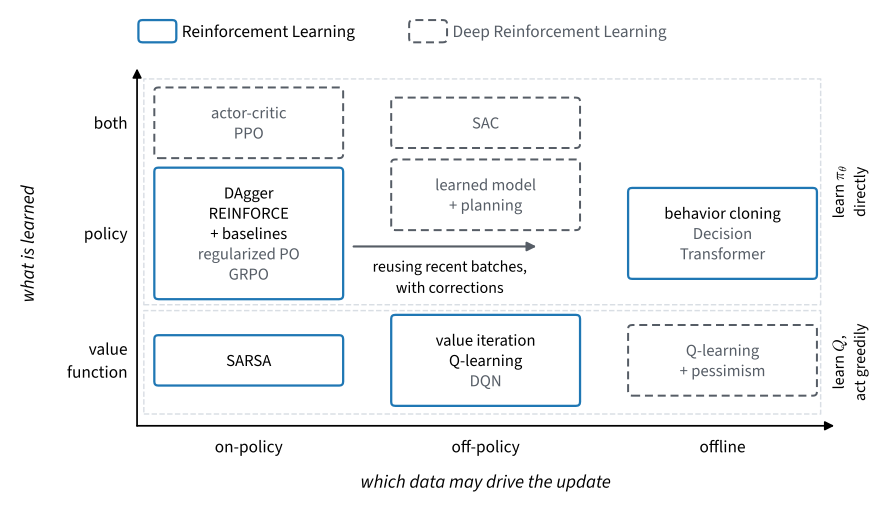
- Two organizing axes: Every method in Chapters 14 and 15 is positioned by what it learns (policy, action-value, or dynamics model) and which data drive the update (on-policy, off-policy replay, or fixed offline logs).
- Left to right progression: We move from strict on-policy rollouts (§15.1) to bounded multi-epoch batch reuse (§15.2), off-policy replay buffers (§15.4–15.6), and purely offline datasets (§15.7–15.8).
Running Benchmarks and Sample-Efficiency Gains
Experimental Suite
- Continuous Pendulum-v1 (\ge -200 goal): Sample cost drops from \sim 300\text{k} steps (REINFORCE) to 2.4\text{k}–11\text{k} (SAC, §15.5) and 200–600 steps (World-Model MPC, §15.6).
- Discrete CartPole-v1 (500 ceiling): Multi-epoch PPO (§15.2) halves the sample cost of 1-step Actor–Critic (\sim 60\text{k} \to \sim 25\text{k} steps), with DQN (§15.4) solving in \sim 40\text{k} steps.
- Exact tabular & verifier audits: Diagnose reward hacking (§15.3, §15.8) and offline overestimation (§15.7) against closed-form optima.
Chapter 15 Roadmap: Eight Core Questions
Study Guide
| Section | Central Question | Core Mathematical Mechanism |
|---|---|---|
| §15.1 Actor-Critic & GAE | Must a policy wait for the episode to end? | TD error \delta_t = r_t + \gamma \hat{V}(s_{t+1}) - \hat{V}(s_t) and backward scan \sum_l (\gamma\lambda)^l \delta_{t+l} |
| §15.2 Trust Regions & PPO | How many updates can one batch safely drive? | Per-step importance ratio \rho_t(\theta) and clipped surrogate \min(\rho_t \hat{A}_t, \textrm{clip}(\rho_t)\hat{A}_t) |
| §15.3 KL-Regularized RL | How far may a policy stray from preference data? | Reference tilt \pi^\star(a) \propto \pi_{\textrm{ref}}(a) e^{r(a)/\beta} and soft backup V_\beta = \beta \log \sum_a \pi_{\textrm{ref}} e^{Q_\beta/\beta} |
| §15.4 Deep Q-Networks | Can a network learn values from any transition? | Uniform experience replay, frozen target network Q_{w^-}, and Double DQN decoupling |
| §15.5 Soft Actor-Critic | How do we learn continuous control in 3{,}000 steps? | Maximum-entropy target -\beta \log \pi, squashed Gaussian Jacobian, twin critics \min_j Q_j |
| §15.6 World Models & MPC | Can a learned physics model plan a swing-up? | State-delta regression \hat{f}_\phi(s,a), warm-started random shooting, policy distillation |
| §15.7 Offline RL | What can be learned when no new trial is allowed? | Empirical MDP stitching and pessimistic penalty -\kappa/\sqrt{n(s,a)} (CQL / TD3+BC) |
| §15.8 RL for Sequences | What survives when actions are tokens? | Token credit decomposition, verifiable rewards, GRPO with k_3 KL loss, and DPO |