d2l.DATA_HUB['dog_tiny'] = (d2l.DATA_URL + 'kaggle_dog_tiny.zip',
                            '0cb91d09b814ecdc07b50f31f8dcad3e81d6a86d')

# If you use the full dataset downloaded for the Kaggle competition, change
# the variable below to `False`
demo = True
if demo:
    data_dir = d2l.download_extract('dog_tiny')
else:
data_dir = os.path.join('..', 'data', 'dog-breed-identification')Dog Breed Identification (ImageNet Dogs) on Kaggle
Kaggle Dog Breed
A second Kaggle capstone: ImageNet Dogs (120 fine-grained breeds). The big difference from CIFAR-10: this is a subset of ImageNet, so a pretrained ResNet already knows almost everything about these classes. Fine-tuning is the right play.
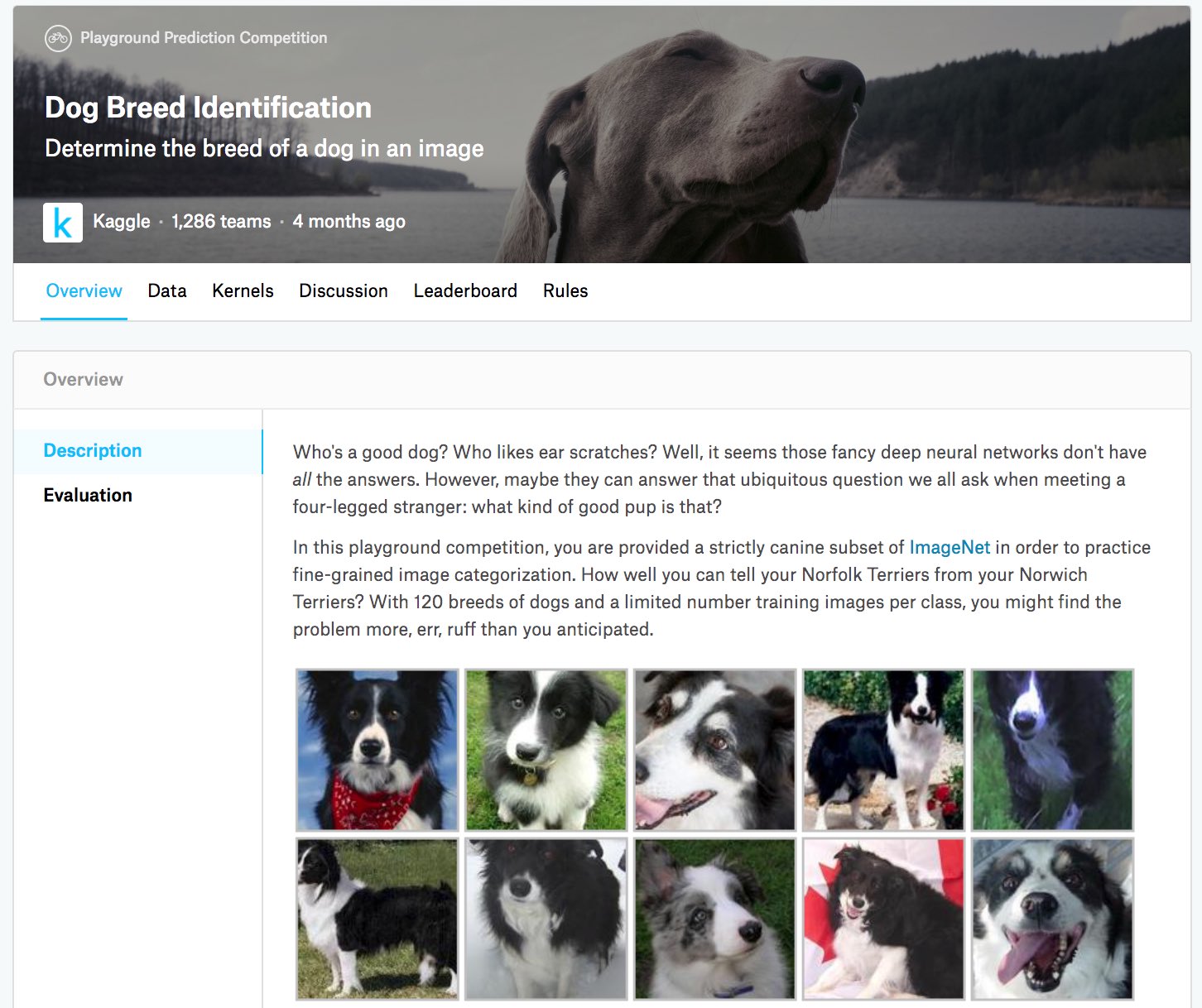
Kaggle “Dog Breed Identification” page.
Downloading
Organizing the dataset
Same idea as CIFAR-10 — reshuffle the Kaggle layout into train/<class>/img.jpg for the standard ImageFolder loader:
Augmentation
ImageNet-scale augmentation: random resized crop, random horizontal flip, color jitter, and the same input preprocessing convention the pretrained backbone expects:
transform_train = torchvision.transforms.Compose([
    # Randomly crop the image to obtain an image with an area of 0.08 to 1 of
    # the original area and height-to-width ratio between 3/4 and 4/3. Then,
    # scale the image to create a new 224 x 224 image
    torchvision.transforms.RandomResizedCrop(224, scale=(0.08, 1.0),
                                             ratio=(3.0/4.0, 4.0/3.0)),
    torchvision.transforms.RandomHorizontalFlip(),
    # Randomly change the brightness, contrast, and saturation
    torchvision.transforms.ColorJitter(brightness=0.4,
                                       contrast=0.4,
                                       saturation=0.4),
    # Add random noise
    torchvision.transforms.ToTensor(),
    # Standardize each channel of the image
    torchvision.transforms.Normalize([0.485, 0.456, 0.406],
                                     [0.229, 0.224, 0.225])])
Augmentation (cont.)
At test time there is no randomness: resize, take the center 224×224 crop, and apply the same normalization:
transform_test = torchvision.transforms.Compose([
    torchvision.transforms.Resize(256),
    # Crop a 224 x 224 square area from the center of the image
    torchvision.transforms.CenterCrop(224),
    torchvision.transforms.ToTensor(),
    torchvision.transforms.Normalize([0.485, 0.456, 0.406],
                                     [0.229, 0.224, 0.225])])
Data loaders
train_ds, train_valid_ds = [torchvision.datasets.ImageFolder(
    os.path.join(data_dir, 'train_valid_test', folder),
    transform=transform_train) for folder in ['train', 'train_valid']]

valid_ds, test_ds = [torchvision.datasets.ImageFolder(
    os.path.join(data_dir, 'train_valid_test', folder),
    transform=transform_test) for folder in ['valid', 'test']]
train_iter, train_valid_iter = [torch.utils.data.DataLoader(
dataset, batch_size, shuffle=True, drop_last=True)
for dataset in (train_ds, train_valid_ds)]
valid_iter = torch.utils.data.DataLoader(valid_ds, batch_size, shuffle=False,
drop_last=True)
test_iter = torch.utils.data.DataLoader(test_ds, batch_size, shuffle=False,
drop_last=False)Frozen ImageNet features
Close to ImageNet: reuse a pretrained ResNet as a frozen feature extractor and train only a small 120-way classifier:
def get_net(devices):
    finetune_net = nn.Sequential()
    finetune_net.features = torchvision.models.resnet34(
        weights=torchvision.models.ResNet34_Weights.DEFAULT)
    # Remove the ImageNet output layer to expose the 512 pooled features
    finetune_net.features.fc = nn.Identity()
    # Define a new output network (there are 120 output categories)
    finetune_net.output_new = nn.Sequential(nn.Linear(512, 256),
                                            nn.ReLU(),
                                            nn.Linear(256, 120))
    # Move the model to devices
    finetune_net = finetune_net.to(devices[0])
    # Freeze parameters of feature layers
    for param in finetune_net.features.parameters():
        param.requires_grad = False
    # Keep the pretrained batch normalization statistics frozen as well
    finetune_net.features.eval()
    return finetune_net
Head loss and validation
Only the new head receives gradients; validation loss runs through the same frozen features, so it measures the head:
loss = nn.CrossEntropyLoss(reduction='none')

def evaluate_loss(data_iter, net, devices):
    l_sum, n = 0.0, 0
    for features, labels in data_iter:
        features, labels = features.to(devices[0]), labels.to(devices[0])
        outputs = net(features)
        l = loss(outputs, labels)
        l_sum += l.sum()
        n += labels.numel()
    return l_sum / n
Training function
The helper is mostly framework bookkeeping. The training structure is:
- precompute frozen ImageNet features;
- train the 120-way head with cross-entropy;
- report validation loss on held-out breeds;
- repeat on all training data before writing the submission file.
That is the practical transfer-learning tradeoff: far less memory and time, while keeping most ImageNet visual knowledge.
Train
Watch validation loss; accuracy on the tiny 120-breed subset is noisy:
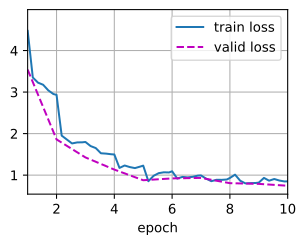
train loss 0.850, valid loss 0.744
3037.8 examples/sec on [device(type='cuda', index=0)]
Submit predictions
Retrain on all labeled data, then write one probability vector per test image:
net = get_net(devices)
train(net, train_valid_iter, None, num_epochs, lr, wd, devices, lr_period,
      lr_decay)

preds = []
for data, label in test_iter:
    output = torch.nn.functional.softmax(net(data.to(devices[0])), dim=1)
    preds.extend(output.cpu().detach().numpy())
ids = sorted(os.listdir(
    os.path.join(data_dir, 'train_valid_test', 'test', 'unknown')))
with open('submission.csv', 'w') as f:
    f.write('id,' + ','.join(train_valid_ds.classes) + '\n')
    for i, output in zip(ids, preds):
        f.write(i.split('.')[0] + ',' + ','.join(
            [str(num) for num in output]) + '\n')
Submit predictions (cont.)
The CSV has image id plus 120 breed probabilities, so the final layer must stay aligned with the competition’s class order. On the full competition data, train longer and tune the head and augmentation strength.
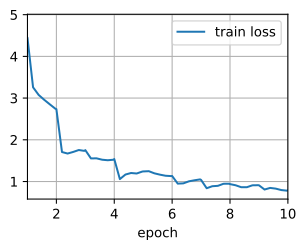
train loss 0.791
3513.6 examples/sec on [device(type='cuda', index=0)]
Recap
- ImageNet Dogs ⊂ ImageNet → fine-tuning a pretrained CNN crushes from-scratch training.
- Standard recipe: pretrained backbone, new 120-way head, ImageNet-scale augmentation, ImageNet-compatible preprocessing.
- Same shape as the CIFAR-10 deck; only the dataset and the choice “train from scratch vs fine-tune” differ.
- The general lesson: when your task is close to the pretraining domain, transfer learning beats everything.