d2l.DATA_HUB['cifar10_tiny'] = (d2l.DATA_URL + 'kaggle_cifar10_tiny.zip',
                                '2068874e4b9a9f0fb07ebe0ad2b29754449ccacd')

# If you use the full dataset downloaded for the Kaggle competition, set
# `demo` to False
demo = True

if demo:
    data_dir = d2l.download_extract('cifar10_tiny')
else:
data_dir = '../data/cifar-10/'Image Classification (CIFAR-10) on Kaggle
Kaggle CIFAR-10
A capstone deck: assemble everything from the chapter (augmentation, fine-tuning, modern CNN architectures) and take a Kaggle competition. CIFAR-10 has been done to death, but it’s the right size for a teaching example — small enough to fit in memory, big enough that augmentation and ensembling matter.
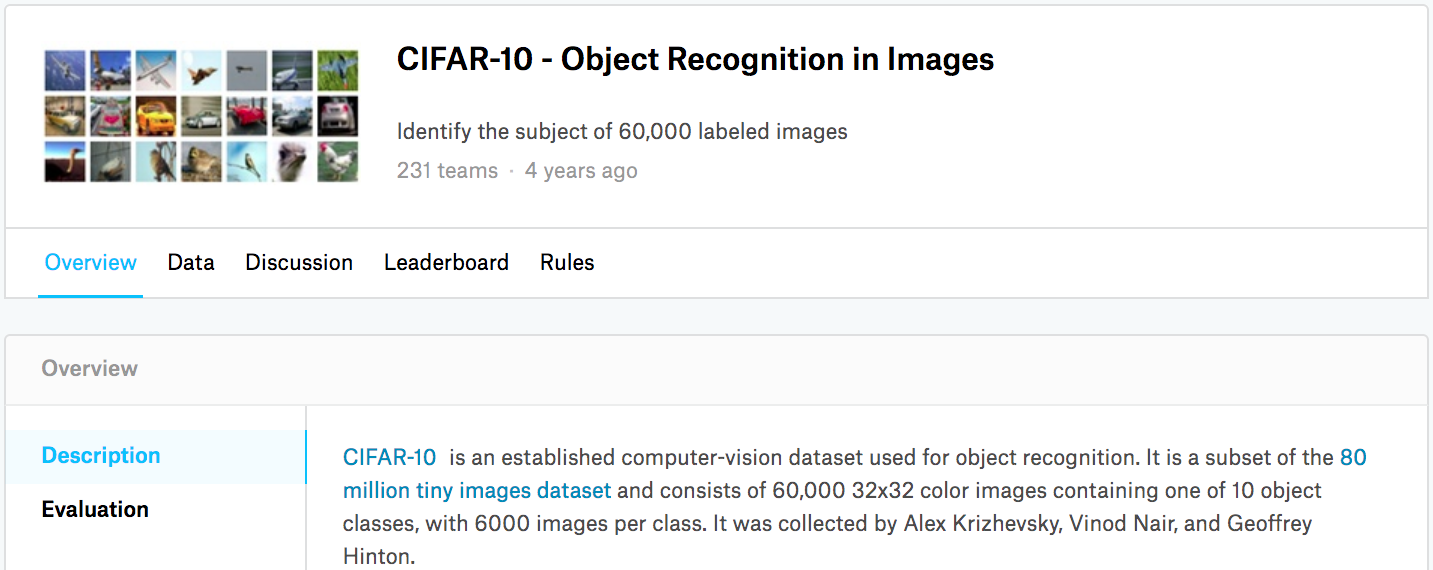
Kaggle CIFAR-10 competition page.
Downloading
Tiny demo subset for the book; swap in the full dataset for the actual competition:
Organizing the dataset
Kaggle ships everything in one folder; most vision toolkits expect the folder-per-class layout (train/<class>/img.png). Build that layout from the labels.csv:
def read_csv_labels(fname):
    """Read `fname` to return a filename to label dictionary."""
    with open(fname, 'r') as f:
        # Skip the file header line (column name)
        lines = f.readlines()[1:]
    tokens = [l.rstrip().split(',') for l in lines]
    return dict(((name, label) for name, label in tokens))

labels = read_csv_labels(os.path.join(data_dir, 'trainLabels.csv'))
print('# training examples:', len(labels))
print('# classes:', len(set(labels.values())))
# training examples: 1000
# classes: 10Organizing the dataset (cont.)
Copy every training image into its class folder; reorg_train_valid first sizes the validation split from the rarest class:
def copyfile(filename, target_dir):
    """Copy a file into a target directory."""
    os.makedirs(target_dir, exist_ok=True)
    shutil.copy(filename, target_dir)


def reorg_train_valid(data_dir, labels, valid_ratio):
    """Split the validation set out of the original training set."""
    # The number of examples of the class that has the fewest examples in the
    # training dataset
    n = collections.Counter(labels.values()).most_common()[-1][1]
    # The number of examples per class for the validation set
    n_valid_per_label = max(1, math.floor(n * valid_ratio))
Splitting off a validation set
Each class contributes the same number of validation images; the rest go to train, and all of them to train_valid:
    label_count = {}
    for train_file in os.listdir(os.path.join(data_dir, 'train')):
        label = labels[train_file.split('.')[0]]
        fname = os.path.join(data_dir, 'train', train_file)
        copyfile(fname, os.path.join(data_dir, 'train_valid_test',
                                     'train_valid', label))
        if label not in label_count or label_count[label] < n_valid_per_label:
            copyfile(fname, os.path.join(data_dir, 'train_valid_test',
                                         'valid', label))
            label_count[label] = label_count.get(label, 0) + 1
        else:
            copyfile(fname, os.path.join(data_dir, 'train_valid_test',
                                         'train', label))
    return n_valid_per_label
Run the reorg
The unlabeled test images go into a single unknown folder:
Augmentation pipelines
Standard recipe — random crop, flip, normalize for train; just normalize for eval:
transform_train = torchvision.transforms.Compose([
    # Scale the image up to a square of 40 pixels in both height and width
    torchvision.transforms.Resize(40),
    # Randomly crop a square image of 40 pixels in both height and width to
    # produce a small square of 0.64 to 1 times the area of the original
    # image, and then scale it to a square of 32 pixels in both height and
    # width
    torchvision.transforms.RandomResizedCrop(32, scale=(0.64, 1.0),
                                                   ratio=(1.0, 1.0)),
    torchvision.transforms.RandomHorizontalFlip(),
    torchvision.transforms.ToTensor(),
    # Standardize each channel of the image
    torchvision.transforms.Normalize([0.4914, 0.4822, 0.4465],
[0.2023, 0.1994, 0.2010])])Data loaders
Folder-based dataset + the augmentation pipelines:
train_ds, train_valid_ds = [torchvision.datasets.ImageFolder(
    os.path.join(data_dir, 'train_valid_test', folder),
    transform=transform_train) for folder in ['train', 'train_valid']]

valid_ds, test_ds = [torchvision.datasets.ImageFolder(
    os.path.join(data_dir, 'train_valid_test', folder),
transform=transform_test) for folder in ['valid', 'test']]ResNet-18, trained from scratch
No transfer learning this time — CIFAR-10 is small enough to train from scratch. The model is the ResNet-18 of the ResNet chapter: four residual stages that halve the resolution and widen the channels, global average pooling, and a dense layer that emits 10 class logits.
Framework model contract
get_net returns a ResNet-18 that maps a minibatch of CIFAR-10 images to logits of shape (batch, 10); cross-entropy is the training loss.
Training function
SGD with momentum + weight decay + LR step decay is the classic small-image vision recipe. The long helper mainly adapts that recipe to each framework, so teach the invariant loop:
- augment and load a minibatch;
- compute logits and cross-entropy;
- backpropagate with momentum and weight decay;
- step the learning-rate schedule;
- log validation accuracy for model selection.
Train
Validation accuracy shows whether augmentation and the schedule help:
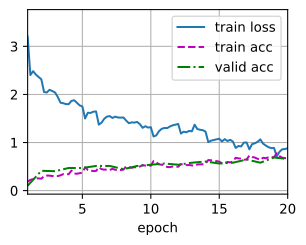
train loss 0.882, train acc 0.672, best valid acc 0.689
2370.6 examples/sec on [device(type='cuda', index=0)]
Submit predictions
Retrain on train + validation data, run on the test set, and write a Kaggle-format CSV:
net, preds = get_net(), []
train(net, train_valid_iter, None, num_epochs, lr, wd, devices, lr_period,
      lr_decay)

for X, _ in test_iter:
    y_hat = net(X.to(devices[0]))
    preds.extend(y_hat.argmax(dim=1).type(torch.int32).cpu().numpy())
sorted_ids = list(range(1, len(test_ds) + 1))
sorted_ids.sort(key=lambda x: str(x))
df = pd.DataFrame({'id': sorted_ids, 'label': preds})
df['label'] = df['label'].apply(lambda x: train_valid_ds.classes[x])
df.to_csv('submission.csv', index=False)
Submit predictions (cont.)
The retraining run on all labeled data:
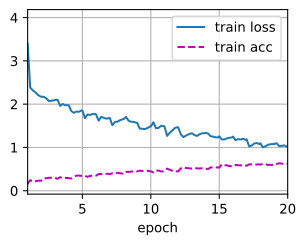
train loss 1.020, train acc 0.623
2684.7 examples/sec on [device(type='cuda', index=0)]
Recap
- Real competition setup: download → reorganize files → augment → train → predict → submit.
- Augmentation matters more than model tweaks at the CIFAR-10 scale.
- ResNet-18 from scratch + standard recipe is a strong baseline; the chapter techniques (mixup, cutmix, cosine schedule, longer training) push it higher.
- This pipeline scales to ImageNet — only the model size and training time change.