pretrained_net = torchvision.models.resnet18(
    weights=torchvision.models.ResNet18_Weights.DEFAULT)
list(pretrained_net.children())[-3:]Fully Convolutional Networks
Fully Convolutional Networks
A fully convolutional network (Long, Shelhamer, Darrell 2015) is the simplest path to per-pixel prediction:
- Start with a pretrained classification CNN (ResNet).
- Strip the global average pool + final dense layer.
- Replace with a 1×1 conv mapping to
num_classes. - Upsample back to input resolution via transposed conv.
No FC layers anywhere — works on any input size, outputs a class-score map at input resolution.
Architecture
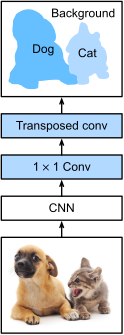
FCN: pretrained CNN body + 1×1 conv → class scores → transposed conv to upsample.
Pretrained backbone
ResNet-18 pretrained on ImageNet. Drop the head (avg pool + dense); keep the conv body that produces a \frac{H}{32} \times \frac{W}{32} feature map:
The last three children are the final residual stage layer4, the global average pool, and the 1000-way fc layer; the FCN drops the last two.
Building the FCN
After removing the classifier head, the backbone produces a low-resolution feature map. The new FCN head must restore the original spatial resolution while changing channels to class logits.
The class & upsampling head
A 1 \times 1 conv maps features to the 21 VOC classes; a transposed conv then upsamples 32× to input resolution:
Bilinear init for transposed conv
A randomly initialized 32× upsampler is hard to train. Initialize it as bilinear interpolation — a sensible starting point that fine-tunes from there:
def bilinear_kernel(in_channels, out_channels, kernel_size):
    factor = (kernel_size + 1) // 2
    if kernel_size % 2 == 1:
        center = factor - 1
    else:
        center = factor - 0.5
    og = (torch.arange(kernel_size).reshape(-1, 1),
          torch.arange(kernel_size).reshape(1, -1))
    filt = (1 - torch.abs(og[0] - center) / factor) * \
           (1 - torch.abs(og[1] - center) / factor)
    weight = torch.zeros((in_channels, out_channels,
                          kernel_size, kernel_size))
    weight[range(in_channels), range(out_channels), :, :] = filt
    return weight
Upsampling sanity check
Apply the initialized transposed convolution to an image. The output should be larger but visually similar, because the kernel starts as bilinear interpolation rather than random noise:
Bilinear init (cont.)
The printed shapes should confirm the spatial scale-up:
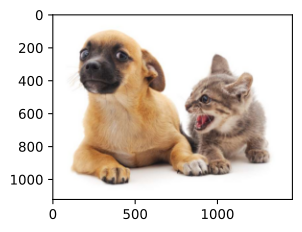
input image shape: torch.Size([561, 728, 3])
output image shape: torch.Size([1122, 1456, 3])
Bilinear init of the FCN head
The same bilinear kernel initializes the FCN’s final upsampling layer:
Loading data
read 1114 examples
read 1078 examples
Training
Pixel-level cross-entropy, averaged over every output pixel:
def loss(inputs, targets):
    return F.cross_entropy(inputs, targets, reduction='none').mean(1).mean(1)

num_epochs, lr, wd, devices = 5, 0.001, 1e-3, d2l.try_all_gpus()
trainer = torch.optim.SGD(net.parameters(), lr=lr, weight_decay=wd)
d2l.train_ch13(net, train_iter, test_iter, loss, trainer, num_epochs, devices)
Training (result)
Common trick: freeze the backbone, train only the new head — gets reasonable results in a few epochs:
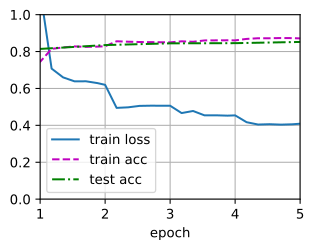
loss 0.409, train acc 0.871, test acc 0.852
377.0 examples/sec on [device(type='cuda', index=0)]
Predict
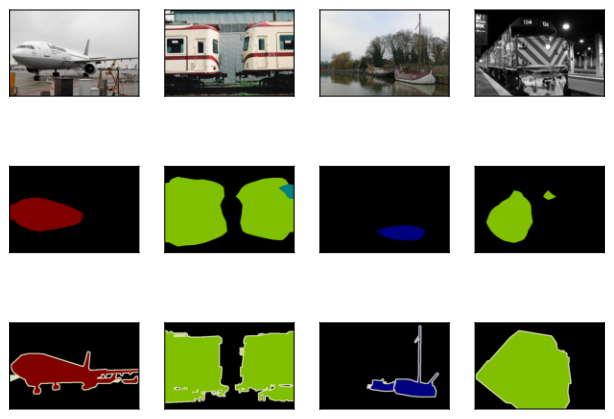
Run the network on test images, take argmax over the class dimension, map class indices back to RGB:
Visualize segmentation masks
The output grid is image, prediction, ground truth. Expect coarse boundaries: this plain FCN upsamples from a 32× downsampled feature map and has no skip connections.
voc_dir = d2l.download_extract('voc2012', 'VOCdevkit/VOC2012')
test_images, test_labels = d2l.read_voc_images(voc_dir, False)
n, imgs = 4, []
for i in range(n):
    crop_rect = (0, 0, 320, 480)
    X = torchvision.transforms.functional.crop(test_images[i], *crop_rect)
    pred = label2image(predict(X))
    imgs += [X.permute(1,2,0), pred.cpu(),
             torchvision.transforms.functional.crop(
                 test_labels[i], *crop_rect).permute(1,2,0)]
d2l.show_images(imgs[::3] + imgs[1::3] + imgs[2::3], 3, n, scale=2);
Visualize segmentation masks (result)
Recap
- FCN = pretrained classification CNN + 1×1 conv + transposed conv upsampler.
- All-conv → input size doesn’t matter.
- Bilinear-initialized transposed conv is the workable starting point; fine-tunes from there.
- The blueprint behind U-Net (skip connections fix the blur), DeepLab (dilated convs avoid the heavy upsampling), and modern segmentation networks.