def multibox_prior(data, sizes, ratios):
    """Generate anchor boxes with different shapes centered on each pixel."""
    in_height, in_width = data.shape[-2:]
    device, num_sizes, num_ratios = data.device, len(sizes), len(ratios)
    boxes_per_pixel = (num_sizes + num_ratios - 1)
    size_tensor = d2l.tensor(sizes, device=device)
    ratio_tensor = d2l.tensor(ratios, device=device)
    # Offsets are required to move the anchor to the center of a pixel. Since
    # a pixel has height=1 and width=1, we choose to offset our centers by 0.5
    offset_h, offset_w = 0.5, 0.5
    steps_h = 1.0 / in_height  # Scaled steps in y axis
steps_w = 1.0 / in_width # Scaled steps in x axisAnchor Boxes
Anchor Boxes
A dense detector should not regress arbitrary boxes from scratch at every location. Anchor boxes turn the problem into residual regression around structured candidate boxes.
- Attach anchors to spatial locations, usually feature-map cells mapped back to image coordinates.
- For each anchor, predict class and box offset.
- After the forward pass, non-maximum suppression prunes overlapping high-confidence predictions.
Core of SSD, RetinaNet, and the region proposal network in Faster R-CNN. Some modern detectors are anchor-free, but the same ideas — dense classification, localization, and NMS — remain central.
Coordinates and feature maps
Keep three coordinate systems separate:
- image coordinates: box corners or centers measured in pixels;
- feature-map cells: locations after CNN downsampling, each with a receptive field in the image;
- normalized anchors: candidate boxes parameterized relative to image width/height or to a feature-map stride.
In toy code we generate anchors at image pixels for clarity. In production detectors, anchors are usually tied to feature-map locations so each prediction uses the local receptive field.
Generating anchors
At each pixel center, generate boxes for n scales and m aspect ratios — but only those involving the smallest scale or smallest ratio, giving n + m - 1 boxes per pixel (not nm):
\text{anchor width} = w s\sqrt{r}, \quad \text{anchor height} = h s / \sqrt{r}.
Generating anchors: centers and sizes
Anchor centers sit at pixel centers in normalized coordinates; widths and heights follow the formula above:
    # Generate all center points for the anchor boxes
    center_h = (torch.arange(in_height, device=device) + offset_h) * steps_h
    center_w = (torch.arange(in_width, device=device) + offset_w) * steps_w
    shift_y, shift_x = torch.meshgrid(center_h, center_w, indexing='ij')
    shift_y, shift_x = shift_y.reshape(-1), shift_x.reshape(-1)

    # Generate `boxes_per_pixel` number of heights and widths that are later
    # used to create anchor box corner coordinates (xmin, xmax, ymin, ymax)
    w = torch.cat((size_tensor * torch.sqrt(ratio_tensor[0]),
                   sizes[0] * torch.sqrt(ratio_tensor[1:])))\
                   * in_height / in_width  # Handle rectangular inputs
    h = torch.cat((size_tensor / torch.sqrt(ratio_tensor[0]),
                   sizes[0] / torch.sqrt(ratio_tensor[1:])))
Generating anchors: corners
Pair every center with each of its n + m - 1 half-widths and half-heights; the sums are the corners (x_1, y_1, x_2, y_2):
    # Divide by 2 to get half height and half width
    anchor_manipulations = torch.stack((-w, -h, w, h)).T.repeat(
                                        in_height * in_width, 1) / 2

    # Each center point will have `boxes_per_pixel` number of anchor boxes, so
    # generate a grid of all anchor box centers with `boxes_per_pixel` repeats
    out_grid = torch.stack([shift_x, shift_y, shift_x, shift_y],
                dim=1).repeat_interleave(boxes_per_pixel, dim=0)
    output = out_grid + anchor_manipulations
    return output.unsqueeze(0)
Anchor tensor shape
For a h \times w feature map, total anchors = hw(n+m-1). Stored as a tensor of shape (1, num_anchors, 4):
561 728
torch.Size([1, 2042040, 4])Drawing boxes
show_bboxes draws a list of boxes, with optional labels, on a matplotlib axis:
def show_bboxes(axes, bboxes, labels=None, colors=None):
    """Show bounding boxes."""

    def make_list(obj, default_values=None):
        if obj is None:
            obj = default_values
        elif not isinstance(obj, (list, tuple)):
            obj = [obj]
        return obj

    labels = make_list(labels)
    colors = make_list(colors, ['b', 'g', 'r', 'm', 'c'])
    for i, bbox in enumerate(bboxes):
        color = colors[i % len(colors)]
        rect = d2l.bbox_to_rect(d2l.numpy(bbox), color)
        axes.add_patch(rect)
        if labels and len(labels) > i:
            text_color = 'k' if color == 'w' else 'w'
            axes.text(rect.xy[0], rect.xy[1], labels[i],
                      va='center', ha='center', fontsize=9, color=text_color,
                      bbox=dict(facecolor=color, lw=0))
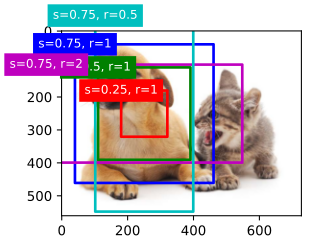
Anchors at one pixel
Visualize the n + m - 1 anchors centered at a single pixel — different scales and ratios:
Intersection over Union
We need a similarity measure between two boxes to know which anchor matches which ground truth.
\text{IoU}(A, B) = \frac{|A \cap B|}{|A \cup B|}.
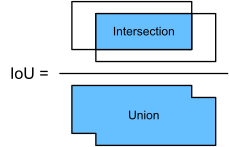
IoU = intersection area / union area.
Intersection over Union (cont.)
box_iou computes all pairwise IoUs between two lists of boxes at once, as an (n_1, n_2) matrix:
def box_iou(boxes1, boxes2):
    """Compute pairwise IoU across two lists of anchor or bounding boxes."""
    box_area = lambda boxes: ((boxes[:, 2] - boxes[:, 0]) *
                              (boxes[:, 3] - boxes[:, 1]))
    # Shape of `boxes1`, `boxes2`, `areas1`, `areas2`: (no. of boxes1, 4),
    # (no. of boxes2, 4), (no. of boxes1,), (no. of boxes2,)
    areas1 = box_area(boxes1)
    areas2 = box_area(boxes2)
    # Shape of `inter_upperlefts`, `inter_lowerrights`, `inters`: (no. of
    # boxes1, no. of boxes2, 2)
    inter_upperlefts = torch.max(boxes1[:, None, :2], boxes2[:, :2])
    inter_lowerrights = torch.min(boxes1[:, None, 2:], boxes2[:, 2:])
    inters = (inter_lowerrights - inter_upperlefts).clamp(min=0)
    # Shape of `inter_areas` and `union_areas`: (no. of boxes1, no. of boxes2)
    inter_areas = inters[:, :, 0] * inters[:, :, 1]
    union_areas = areas1[:, None] + areas2 - inter_areas
    return inter_areas / union_areas
Matching anchors to ground truth
For each anchor box, decide which ground-truth box (if any) it should learn to predict. Common rule: greedy assignment by highest IoU, with a threshold (e.g. 0.5) for “positive” matches:
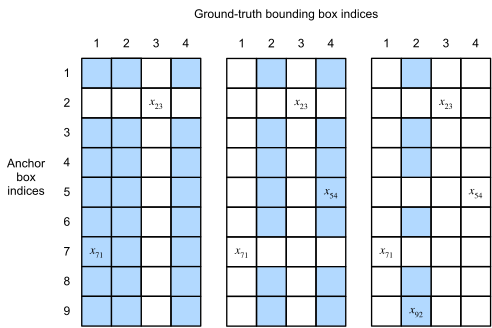
Anchor → GT assignment by IoU.
Matching anchors to ground truth (cont.)
def assign_anchor_to_bbox(ground_truth, anchors, device, iou_threshold=0.5):
    """Assign closest ground-truth bounding boxes to anchor boxes."""
    num_anchors, num_gt_boxes = anchors.shape[0], ground_truth.shape[0]
    # Element x_ij in the i-th row and j-th column is the IoU of the anchor
    # box i and the ground-truth bounding box j
    jaccard = box_iou(anchors, ground_truth)
    # Initialize the tensor to hold the assigned ground-truth bounding box for
    # each anchor
    anchors_bbox_map = torch.full((num_anchors,), -1, dtype=torch.long,
                                  device=device)
    # Assign ground-truth bounding boxes according to the threshold
    max_ious, indices = torch.max(jaccard, dim=1)
    anc_i = torch.nonzero(max_ious >= iou_threshold).reshape(-1)
    box_j = indices[max_ious >= iou_threshold]
    anchors_bbox_map[anc_i] = box_j
    col_discard = torch.full((num_anchors,), -1)
    row_discard = torch.full((num_gt_boxes,), -1)
    for _ in range(num_gt_boxes):
        max_idx = torch.argmax(jaccard)  # Find the largest IoU
        box_idx = (max_idx % num_gt_boxes).long()
        anc_idx = torch.div(max_idx, num_gt_boxes, rounding_mode='floor')
        anchors_bbox_map[anc_idx] = box_idx
        jaccard[:, box_idx] = col_discard
        jaccard[anc_idx, :] = row_discard
    return anchors_bbox_map
Labels and offsets
A matched anchor learns:
- Class = the ground-truth class.
- Offset = the parameterized residual between anchor and ground truth, normalized by per-component mean/std:
\Big(\frac{(x_b{-}x_a)/w_a - \mu_x}{\sigma_x},\; \frac{(y_b{-}y_a)/h_a - \mu_y}{\sigma_y},\; \frac{\log(w_b/w_a) - \mu_w}{\sigma_w},\; \frac{\log(h_b/h_a) - \mu_h}{\sigma_h}\Big).
The log-scale on width/height keeps gradients stable for both small and large boxes.
def offset_boxes(anchors, assigned_bb, eps=1e-6):
    """Transform for anchor box offsets."""
    c_anc = d2l.box_corner_to_center(anchors)
    c_assigned_bb = d2l.box_corner_to_center(assigned_bb)
    offset_xy = 10 * (c_assigned_bb[:, :2] - c_anc[:, :2]) / c_anc[:, 2:]
    offset_wh = 5 * d2l.log(eps + c_assigned_bb[:, 2:] / c_anc[:, 2:])
    offset = d2l.concat([offset_xy, offset_wh], axis=1)
    return offset
Labeling implementation
def multibox_target(anchors, labels):
    """Label anchor boxes using ground-truth bounding boxes."""
    batch_size, anchors = labels.shape[0], anchors.squeeze(0)
    batch_offset, batch_mask, batch_class_labels = [], [], []
    device, num_anchors = anchors.device, anchors.shape[0]
    for i in range(batch_size):
        label = labels[i, :, :]
        anchors_bbox_map = assign_anchor_to_bbox(
            label[:, 1:], anchors, device)
        bbox_mask = ((anchors_bbox_map >= 0).float().unsqueeze(-1)).repeat(
            1, 4)
        # Initialize class labels and assigned bounding box coordinates with
        # zeros
        class_labels = torch.zeros(num_anchors, dtype=torch.long,
                                   device=device)
        assigned_bb = torch.zeros((num_anchors, 4), dtype=torch.float32,
                                  device=device)
        # Label classes of anchor boxes using their assigned ground-truth
        # bounding boxes. If an anchor box is not assigned any, we label its
        # class as background (the value remains zero)
        indices_true = torch.nonzero(anchors_bbox_map >= 0)
        bb_idx = anchors_bbox_map[indices_true]
        class_labels[indices_true] = label[bb_idx, 0].long() + 1
        assigned_bb[indices_true] = label[bb_idx, 1:]
        # Offset transformation
        offset = offset_boxes(anchors, assigned_bb) * bbox_mask
        batch_offset.append(offset.reshape(-1))
        batch_mask.append(bbox_mask.reshape(-1))
        batch_class_labels.append(class_labels)
    bbox_offset = torch.stack(batch_offset)
    bbox_mask = torch.stack(batch_mask)
    class_labels = torch.stack(batch_class_labels)
    return (bbox_offset, bbox_mask, class_labels)
Worked example
Hand-pick ground truth (dog, cat) and a few anchors; plot them:
ground_truth = d2l.tensor([[0, 0.1, 0.08, 0.52, 0.92],
                         [1, 0.55, 0.2, 0.9, 0.88]])
anchors = d2l.tensor([[0, 0.1, 0.2, 0.3], [0.15, 0.2, 0.4, 0.4],
                    [0.63, 0.05, 0.88, 0.98], [0.66, 0.45, 0.8, 0.8],
                    [0.57, 0.3, 0.92, 0.9]])

fig = d2l.plt.imshow(img)
show_bboxes(fig.axes, ground_truth[:, 1:] * bbox_scale, ['dog', 'cat'], 'k')
show_bboxes(fig.axes, anchors * bbox_scale, ['0', '1', '2', '3', '4']);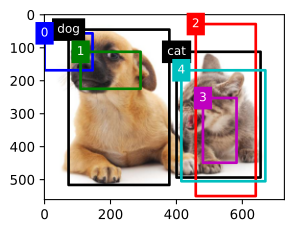
Worked example: run the labeler
Run the labeler. It returns offsets, an offset mask, and class labels; class label 0 means background, and positive labels are shifted by one:
Worked example: masks and offsets
The offset mask zeros out anchors that should not contribute to the localization loss; background anchors get zero offsets.
tensor([[0., 0., 0., 0., 1., 1., 1., 1., 1., 1., 1., 1., 0., 0., 0., 0., 1., 1.,
1., 1.]])Inverse: offset → predicted box
At inference, the network spits out class scores and offset deltas; invert the offset to recover predicted boxes:
def offset_inverse(anchors, offset_preds):
    """Predict bounding boxes based on anchor boxes with predicted offsets."""
    anc = d2l.box_corner_to_center(anchors)
    pred_bbox_xy = (offset_preds[:, :2] * anc[:, 2:] / 10) + anc[:, :2]
    pred_bbox_wh = d2l.exp(offset_preds[:, 2:] / 5) * anc[:, 2:]
    pred_bbox = d2l.concat((pred_bbox_xy, pred_bbox_wh), axis=1)
    predicted_bbox = d2l.box_center_to_corner(pred_bbox)
    return predicted_bbox
Non-maximum suppression (NMS)
A single object generates many high-confidence anchors. NMS keeps the highest-scoring one and suppresses any with \text{IoU} > \tau to it:
- Sort boxes by confidence.
- Keep the current top box.
- Remove lower-scoring boxes whose IoU with it exceeds \tau.
- Repeat until no candidates remain.
NMS in code
nms returns the indices of the kept boxes, highest score first:
def nms(boxes, scores, iou_threshold):
    """Sort confidence scores of predicted bounding boxes."""
    B = torch.argsort(scores, dim=-1, descending=True)
    keep = []  # Indices of predicted bounding boxes that will be kept
    while B.numel() > 0:
        i = B[0]
        keep.append(i)
        if B.numel() == 1: break
        iou = box_iou(boxes[i, :].reshape(-1, 4),
                      boxes[B[1:], :].reshape(-1, 4)).reshape(-1)
        inds = torch.nonzero(iou <= iou_threshold).reshape(-1)
        B = B[inds + 1]
    return d2l.tensor(keep, device=boxes.device)
Detection with NMS
multibox_detection: invert offsets, run NMS, mark dropped boxes -1:
def multibox_detection(cls_probs, offset_preds, anchors, nms_threshold=0.5,
                       pos_threshold=0.009999999):
    """Predict bounding boxes using non-maximum suppression."""
    device, batch_size = cls_probs.device, cls_probs.shape[0]
    anchors = anchors.squeeze(0)
    num_classes, num_anchors = cls_probs.shape[1], cls_probs.shape[2]
    out = []
    for i in range(batch_size):
        cls_prob, offset_pred = cls_probs[i], offset_preds[i].reshape(-1, 4)
        conf, class_id = torch.max(cls_prob[1:], 0)
        predicted_bb = offset_inverse(anchors, offset_pred)
        keep = nms(predicted_bb, conf, nms_threshold)
        # Find all non-`keep` indices and set the class to background
        all_idx = torch.arange(num_anchors, dtype=torch.long, device=device)
        combined = torch.cat((keep, all_idx))
        uniques, counts = combined.unique(return_counts=True)
        non_keep = uniques[counts == 1]
        all_id_sorted = torch.cat((keep, non_keep))
        class_id[non_keep] = -1
        class_id = class_id[all_id_sorted]
        conf, predicted_bb = conf[all_id_sorted], predicted_bb[all_id_sorted]
        # Here `pos_threshold` is a threshold for positive (non-background)
        # predictions
        below_min_idx = (conf < pos_threshold)
        class_id[below_min_idx] = -1
        conf[below_min_idx] = 1 - conf[below_min_idx]
        pred_info = torch.cat((class_id.unsqueeze(1),
                               conf.unsqueeze(1),
                               predicted_bb), dim=1)
        out.append(pred_info)
    return d2l.stack(out)
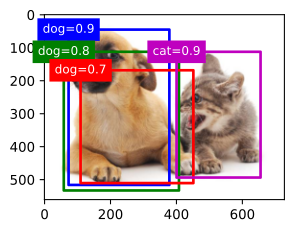
NMS demo
Four overlapping predictions. A lower-score box on the same object should disappear; one on a different object survives:
anchors = d2l.tensor([[0.1, 0.08, 0.52, 0.92], [0.08, 0.2, 0.56, 0.95],
                      [0.15, 0.3, 0.62, 0.91], [0.55, 0.2, 0.9, 0.88]])
offset_preds = d2l.tensor([0] * d2l.size(anchors))
cls_probs = d2l.tensor([[0] * 4,  # Predicted background likelihood
                      [0.9, 0.8, 0.7, 0.1],  # Predicted dog likelihood
                      [0.1, 0.2, 0.3, 0.9]])  # Predicted cat likelihood
NMS demo (cont.)
All four predictions before NMS: three dog boxes and one cat box.
End-to-end output
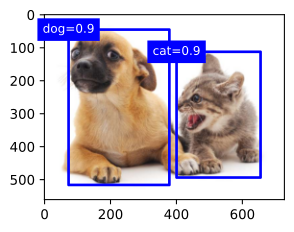
Each output row is (class_id, confidence, x1, y1, x2, y2). Rows with class -1 have been suppressed or filtered out; the remaining rows are the detector’s final boxes.
tensor([[[ 0.00,  0.90,  0.10,  0.08,  0.52,  0.92],
         [ 1.00,  0.90,  0.55,  0.20,  0.90,  0.88],
         [-1.00,  0.80,  0.08,  0.20,  0.56,  0.95],
         [-1.00,  0.70,  0.15,  0.30,  0.62,  0.91]]])
End-to-end output (cont.)
Drawing only the surviving boxes leaves one box per object:
Recap
- Anchor boxes = densely tiled candidate rectangles; the network predicts class + offset per anchor.
- IoU drives ground-truth assignment.
- Offset parameterization (center delta normalized by width, log-scale for size) is what makes regression stable.
- NMS at inference time prunes redundant high-scoring predictions to one box per object.
- This whole pipeline is the substrate for SSD (next deck) and the RPN inside Faster R-CNN.