class MLP(nn.Module):
    def __init__(self):
        super().__init__()
        self.hidden = nn.Linear(20, 256)
        self.output = nn.Linear(256, 10)

    def forward(self, x):
        return self.output(F.relu(self.hidden(x)))

net = MLP()
X = torch.randn(2, 20)
Y = net(X)
{name: tuple(t.shape) for name, t in net.state_dict().items()}Saving, Loading, and Pretrained Weights
Dive into Deep Learning · §5.6
File I/O, Checkpoints, and Serialization
state dictionaries · pickle RCE vs. safetensors · 5-part atomic checkpoints · pretrained key auditing
Why Checkpointing and Safe Files Are Mission-Critical
Fault Tolerance & Security
- Hardware failures are routine: During 54 days of pre-training Llama 3 405B on 16{,}384 GPUs, Meta recorded 419 unexpected interruptions (~1 crash every 3 hours).
- Resuming requires more than weights: Restarting Adam from saved weights alone causes the very first update step to blow up the loss by >100\times.
- Arbitrary code execution on load: Downloading a third-party
picklecheckpoint can execute malicious shell commands the momentloadis called.
We Serialize the State Tree, Never the Python Class Code
State vs. Architecture
- The state dictionary stores only
(path, shape, dtype, raw_bytes), with no trace of theMLPclass:
{'hidden.weight': (256, 20),
 'hidden.bias': (256,),
 'output.weight': (10, 256),
 'output.bias': (10,)}
Security Hazard: Python Pickle Executes Code on Load
Why Pickle Is Unsafe for Sharing
- Python’s
pickleformat is a stack-based virtual machine that executes arbitrary callables returned by__reduce__:
*** payload executed while loading ***Hardened Loaders Refuse Arbitrary Objects by Default
Allowlist Unpicklers
The safetensors Format: Zero Code, Zero-Copy mmap
Safe Weight Interchange
A safetensors file holds passive metadata and raw tensor bytes in three flat segments:
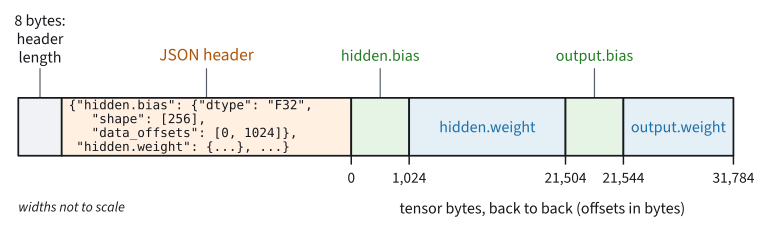
- 8-byte unsigned little-endian integer (
<Q): Exact byte length n of the JSON header. - UTF-8 JSON header (n bytes): Maps each tensor’s path name to its
dtype,shape, and[begin, end]byte offsets relative to the data segment. - Packed raw tensor bytes: Contiguous array buffers aligned back to back, enabling instant zero-copy memory mapping (
mmap) and single-tensor random access without reading the whole file.
Saving and Auditing a safetensors File Byte by Byte
safetensors Round-Trip & Header Inspection
- We save our MLP to
mlp.safetensors, verify bit-for-bit restoration, and parse its header using standardstructandjson.
Saving and Restoring a safetensors File
safetensors Round-Trip & Header Inspection
Parsing the safetensors Header by Hand
safetensors Round-Trip & Header Inspection
with open('mlp.safetensors', 'rb') as f:
    n = struct.unpack('<Q', f.read(8))[0]  # header length, little-endian
    header = json.loads(f.read(n))
print('header length:', n, 'bytes')
for name, entry in sorted(header.items(), key=lambda e: e[1]['data_offsets']):
    print(f"{name:18s} {entry['dtype']} {str(entry['shape']):10s} "
          f"bytes {entry['data_offsets']}")
header length: 296 bytes
hidden.bias F32 [256] bytes [0, 1024]
hidden.weight F32 [256, 20] bytes [1024, 21504]
output.bias F32 [10] bytes [21504, 21544]
output.weight F32 [10, 256] bytes [21544, 31784]Why Resuming Training Requires Optimizer State
Stateful Optimization with Adam
\mathbf{w} \leftarrow \mathbf{w} - \eta \, \frac{\hat{\mathbf{m}}}{\sqrt{\hat{\mathbf{v}}} + \epsilon}
- Why a fresh Adam spikes the loss: Discarding \mathbf{m} and \mathbf{v} on resume (\mathbf{m}_0 = \mathbf{v}_0 = \mathbf{0}) forces step-1 bias correction to set \hat{\mathbf{m}}_1 = \mathbf{g} and \hat{\mathbf{v}}_1 = \mathbf{g} \odot \mathbf{g}.
- Full-step shock: Every parameter steps by \Delta w_i = -\eta \, \frac{g_i}{|g_i| + \epsilon} \approx \pm \eta, jumping out of the converged basin.
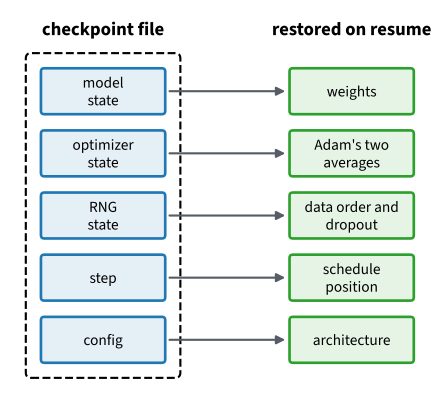
The Five Compartments of a Resumable Training Checkpoint
Complete Checkpoint Anatomy
- Five required states: Model state (parameters + buffers), optimizer state (\mathbf{m}, \mathbf{v}), PRNG states (CPU, GPU, data loader), step counter t, and architecture config.
- Crash-safe atomic writes: Always write to a temporary file (
path + '.tmp') and callos.replace(tmp, path)so a crash mid-write never corrupts the previous checkpoint.
Sizing an 8B-Parameter Checkpoint: 96 GB on Disk
Checkpoint Storage Arithmetic
- Inference file (
16 GBinbf16): Stores only the 2\text{ B/param} model weights \mathbf{w}. - Resumable training checkpoint (
96 GBinfp32): Stores weights \mathbf{w} (32 GB) + Adam \mathbf{m} (32 GB) + Adam \mathbf{v} (32 GB) = 12\text{ B/param} (6\times larger than inference; gradients \mathbf{g} are not saved to disk).
Implementing Atomic Save and Load Helpers
Crash-Safe Checkpointing in Code
- Our
save_checkpointhelper bundles all five compartments and commits them atomically viaos.replace.
Atomic Save and Load Helpers in Code
Crash-Safe Checkpointing in Code
def save_checkpoint(path, model, optimizer, step, cfg=None, rng=None):
    """Atomically write a resumable training checkpoint."""
    ckpt = {'model': model.state_dict(),
            'optimizer': optimizer.state_dict(),
            'step': step,
            'cpu_rng': torch.get_rng_state()}
    if cfg is not None:
        ckpt['cfg'] = asdict(cfg)
    if rng is not None:                        # a torch.Generator
        ckpt['rng'] = rng.get_state()
    if torch.cuda.is_available():
        ckpt['cuda_rng'] = torch.cuda.get_rng_state_all()
    tmp = path + '.tmp'
    torch.save(ckpt, tmp)
    os.replace(tmp, path)

def load_checkpoint(path, model, optimizer=None, rng=None):
    """Restore the state written by save_checkpoint; return the raw dict."""
    ckpt = torch.load(path, weights_only=True)
    model.load_state_dict(ckpt['model'])
    if optimizer is not None:
        optimizer.load_state_dict(ckpt['optimizer'])
    if rng is not None:
        rng.set_state(ckpt['rng'])
    torch.set_rng_state(ckpt['cpu_rng'])
    if torch.cuda.is_available() and 'cuda_rng' in ckpt:
        torch.cuda.set_rng_state_all(ckpt['cuda_rng'])
    return ckpt
Testing Bit-for-Bit Resumption After 200 Steps
Experimental Verification
- Restoring all five compartments reproduces steps 201–205 down to the last bit (
0.0difference), whereas omitting RNG state replays early minibatches:
full checkpoint        max |difference| 0
without the generator  max |difference| 0.00397
Dropping Optimizer State Wrecks Near-Converged Models
The Fresh-Adam Loss Spike
- Resuming from step 200 with saved weights and RNG state—but a freshly initialized Adam optimizer—makes the loss jump by roughly three orders of magnitude right after its first update:
saved optimizer: [0.0009, 0.0017, 0.0022, 0.001, 0.0019]
fresh optimizer: [0.0009, 2.1294, 0.6979, 0.7146, 0.9511]
Loading Pretrained Backbone Weights Under a New Head
Transfer Learning Setup
When adapting an ImageNet-pretrained ResNet-50 (\sim 25\text{M} parameters, 1{,}000 classes) to a 10-class dataset, we keep the pretrained backbone and replace the final linear head (2048 -> 10):
Linear(in_features=2048, out_features=10, bias=True)Auditing Missing and Unexpected Keys on Partial Loads
Catching Silent Checkpoint Mismatches
- When loading external weights into a modified architecture non-strictly, always inspect the missing and unexpected keys.
Reading the Key Audit of a Partial Load
Catching Silent Checkpoint Mismatches
damaged = {k: v for k, v in net.state_dict().items()
           if not k.startswith(('fc.', 'layer4.'))}
target = resnet50(weights=None)
target.fc = nn.Linear(target.fc.in_features, 10)
report = target.load_state_dict(damaged, strict=False)
print('missing by block:', dict(Counter(
    k.split('.')[0] for k in report.missing_keys)))
print('unexpected:', report.unexpected_keys)
missing by block: {'layer4': 50, 'fc': 2}
unexpected: []Concept Check: Serialization & Checkpoint Resumption
Concept Check
Work out these three checkpointing questions:
- An MLP (20 \to 256 \to 10,
float32) is saved tomlp.safetensorswith a JSON header of n = 280 bytes. What is the exact total file size in bytes? - Our 20 \to 64 \to 1 regressor has 20 \times 64 + 64 + 64 \times 1 + 1 = 1{,}409 parameters. If we resume at \eta = 0.05 with a fresh Adam optimizer (\mathbf{m}=\mathbf{v}=\mathbf{0}) and every gradient entry is nonzero, what is the Euclidean norm \|\Delta \mathbf{w}\|_2 of the very first parameter update?
- You rename
self.fctoself.classifierin ResNet-50 and load an original pretrained checkpoint withstrict=False. What appears inmissing_keysandunexpected_keys?
Answers:
- 8 + 280 + 4 \times 7{,}946 = 32{,}072 bytes: 8-byte length prefix + 280-byte JSON header + 31{,}784 bytes for the 7{,}946
float32parameters. - \|\Delta \mathbf{w}\|_2 \approx 0.05 \sqrt{1{,}409} \approx 1.88: Every coordinate steps by \pm \eta = \pm 0.05 regardless of how small \|\mathbf{g}\|_2 is.
missing_keyslistsclassifier.weight, classifier.bias(left random);unexpected_keyslistsfc.weight, fc.bias(ignored from file).
Summary: Saving, Loading, and Pretrained Weights
Key Takeaways
- State dicts &
safetensors: Save tensor data keyed by tree path; usesafetensors(8-byte length + JSON + raw bytes) for zero-RCE, zero-copymmapsharing. - 5-part atomic checkpoints: Save model state, optimizer \mathbf{m}, \mathbf{v}, PRNG states, step t, and config (12\text{ B/param} = 96\text{ GB} for 8B) via
.tmp+os.replace. - Pretrained key auditing: Assert
missing_keysandunexpected_keysmatch only intentionally replaced layers.