g = torch.Generator().manual_seed(42)
split = torch.randperm(10, generator=g)
_ = torch.randn(1000) # unrelated draws from the global generator
split_again = torch.randperm(10, generator=g.manual_seed(42))
print(torch.equal(split, split_again), split)Reproducibility and Inspection
Dive into Deep Learning · §5.8
Reproducibility, Debugging, and Model Inspection
PRNG seeds & keys · data-loader workers · non-associative GPU atomics · forward & backward hooks
Why Reproducibility and Model Inspection Belong Together
Scientific Validity vs. Bug Hunting
- Is a 0.3-point accuracy gain real or random noise? Five runs of the exact same Fashion-MNIST training script differing only in their random seed span 1\text{--}4 percentage points.
- Why did the loss turn
NaNat step 40,000? Debugging late-stage crashes requires reproducing the exact trajectory and inspecting layer activations/gradients via non-invasive hooks.
Where Randomness Enters a Deep Learning Pipeline
Five Stochastic Entry Points
- Model & layer randomness: Weight initialization (\mathbf{W}_0) and stochastic forward masks (Dropout \boldsymbol{\xi}_j).
- Data & worker randomness: Epoch minibatch shuffling, random data augmentations, and forked multi-process data-loader workers (which clone identical NumPy RNG state unless re-seeded per worker).
Seeding Repeats a Training Trajectory Bit for Bit
Global Seeds vs. Explicit Keys
When we seed every PRNG the loop touches, two runs with seed=0 produce identical losses and weights down to the last bit:
same seed, identical loss and weights: True True
different seed: 0.8643209338188171 vs 0.9312677383422852- Coverage caveat: A framework seed does not seed Python’s
randomor NumPy’snp.random—if your dataset uses NumPy, seed it explicitly too.
Private Generator Objects Prevent Stream Coupling
Isolating Stochastic Streams
- A private generator object (or a split key) isolates a random stream so adding a debug call never shifts downstream weights or batches:
True tensor([2, 6, 1, 8, 4, 5, 0, 9, 3, 7])The Multi-Worker DataLoader Fork Bug
Why Forked Workers Duplicate Random Draws
When a DataLoader spawns num_workers=2 processes via OS fork, each worker inherits an identical clone of any np.random.default_rng() attribute on the dataset:
[[0.61, 0.817, 0.884, 0.742], [0.61, 0.817, 0.884, 0.742]]
[[0.777, 0.641, 0.352, 0.467], [0.653, 0.267, 0.932, 0.823]]- Identical batches across workers (Row 1): Without per-worker re-seeding, Worker 0 and Worker 1 generate the exact same “random” numbers, so the two batches in the first line are identical.
- The fix (Row 2): Re-seed each worker’s generator inside
worker_init_fnusingget_worker_info().seed(or seed per example index[base_seed, i]).
Measuring Seed-to-Seed Variance Across Five Runs
Statistical Reproducibility
Training softmax regression on Fashion-MNIST for 3 epochs across five seeds (0..4) with identical code and hyperparameters reveals the natural variance of stochastic optimization:
validation accuracy (%): 79.8 81.8 81.9 78.3 82.1
mean 80.8, max - min 3.7 points
same accuracy: True | same weights: True | largest difference 0- Never trust a single-seed delta: Final validation accuracies span 1\text{--}4 percentage points across seeds; always report mean \pm standard deviation across multiple seeds.
Why Floating-Point Addition Is Not Associative
The Arithmetic Wrinkle
- Because every float addition rounds to the nearest representable value, (a + b) + c \neq a + (b + c):
1.0 0.0- Swamping at 10^8: Near 10^8, adjacent
float32numbers sit 8.0 apart, so 10^8 + (-10^8 + 1.0) = 0.0 while (10^8 - 10^8) + 1.0 = 1.0.
GPU Atomic Reductions and Deterministic Kernel Switches
Why Seeded GPU Runs Diverge
On a GPU, thousands of threads accumulate partial sums into shared bins (in scatter_add, index_add_, embedding backward passes, and convolutions) via atomic additions that land in whatever order threads finish:
deterministic False: bitwise equal False, largest difference 0.0051
deterministic True : bitwise equal True, largest difference 0- Enabling bitwise GPU determinism: Turning on deterministic kernels enforces a fixed reduction tree so consecutive GPU runs match bit for bit.
Bitwise Determinism vs. Scientific Reproducibility
Scope of Bitwise Repeatability
- Bitwise determinism is a local debugging tool: Guarantees identical bits on one machine, one GPU architecture, and one library version to bisect the exact step where a bug or
NaNappears. - Scientific reproducibility is statistical: Real modeling improvements must hold across multiple random seeds (N \ge 5) and survive minor floating-point reassociation across hardware.
Non-Invasive Model Inspection with Execution Hooks
Observing Layers From Outside
When debugging a deep network or a locked third-party library model, editing every layer’s forward method to insert print statements is clumsy. Hooks wrap __call__ around each submodule’s execution from the outside:
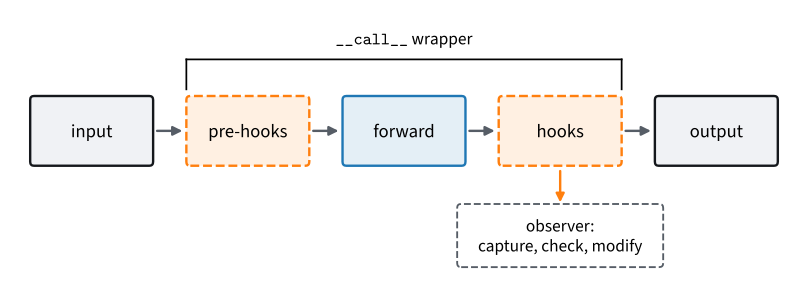
- Pipeline around
forward: Invokingnet(X)runs registered pre-hooks, executesforward(X), and passes(module, inputs, output)to registered forward hooks.
Building an 8-Block Residual Stack for Inspection
Unscaled Xavier Residual Stack
- We construct an 8-block residual MLP (20 \to 64 \to 8\text{ blocks of width } 64 \to 10) initialized with Xavier uniform weights and zero biases.
The 8-Block Residual Stack in Code
Unscaled Xavier Residual Stack
torch.seed()  # a fresh seed from the operating system

class ResidualBlock(nn.Module):
    def __init__(self, num_hiddens):
        super().__init__()
        self.body = nn.Sequential(nn.Linear(num_hiddens, num_hiddens),
                                  nn.ReLU(),
                                  nn.Linear(num_hiddens, num_hiddens))

    def forward(self, X):
        return X + self.body(X)

net = nn.Sequential(nn.Linear(20, 64),
                    *[ResidualBlock(64) for _ in range(8)],
                    nn.Linear(64, 10))
for m in net.modules():
    if isinstance(m, nn.Linear):  # Xavier weights, zero biases
        nn.init.xavier_uniform_(m.weight)
        nn.init.zeros_(m.bias)
Profiling Activation Standard Deviations Across Depth
Forward-Hook Diagnostic
Attaching a forward hook to every top-level module captures the activation growth profile across all 10 layers in a single forward pass on 256 standard normal inputs:
Linear          std 0.72
ResidualBlock   std 0.88
ResidualBlock   std 1.09
ResidualBlock   std 1.31
ResidualBlock   std 1.62
ResidualBlock   std 1.98
ResidualBlock   std 2.28
ResidualBlock   std 2.93
ResidualBlock   std 3.58
Linear std 3.51- Steady growth across blocks: The output standard deviation starts at \approx 0.7 after the 20 \to 64 input layer and climbs steadily to \approx 3.2\text{--}4.5 after the eighth residual block.
- Zero model edits: Capturing intermediate outputs from outside records each block’s output scale cleanly without modifying layer definitions.
Why Xavier Residual Blocks Grow by √1.5 ≈ 1.22 per Block
Analytical Verification of Hook Measurements
\text{Var}[\mathbf{h}_k] \approx \text{Var}[\mathbf{x}_k] + \frac{1}{2}\text{Var}[\mathbf{x}_k] = 1.5\,\text{Var}[\mathbf{x}_k]
- Why the body contributes \frac{1}{2}\text{Var}[\mathbf{x}_k]: The first 64 \to 64 Xavier layer preserves variance (1\times), ReLU halves the mean square (\frac{1}{2}\times), and the second Xavier layer preserves that half (\frac{1}{2}\times).
- Exact match with hooks: Starting from \approx 0.69, multiplying by \sqrt{1.5} \approx 1.225 across 8 blocks predicts 0.69 \times 1.5^4 \approx 3.5.
Two Golden Rules for Leak-Free Hooks
Preventing Autograd Memory Leaks
- Always
.detach()stored tensors (or extract scalars via.item()): Appending a live activation tensoroutputdirectly to a Python list retains the entire backward computation graph in GPU memory across steps. - Always remove hook handles when finished (
h.remove()/h.detach()): Unregister callbacks inside afinallyblock so they do not persist across future forward passes.
Pinpointing the First NaN Layer in One Forward Pass
Automated NaN Traps
Because forward hooks fire in exact execution order, attaching a finiteness check (isfinite(output).all()) to every leaf layer immediately halts and names the first layer that emits inf or NaN:
first non-finite output in 3.body.0Monitoring Backward Gradient Norms Across Depth
Backward Hooks & Gradient Flow
Inspecting gradient norms at each residual block’s output during backpropagation reveals the exact mirror image of forward activation growth:
block output gradients: 1.04 0.83 0.659 0.489 0.396 0.317 0.257 0.194
weight 12.9, bias 2.52- Backward amplification (\times 1.2\text{--}1.4 per block): Because each residual block’s backward pass adds the branch Jacobian back onto the skip connection, output gradient norms grow 5\text{--}6\times as they travel backward from block 8 to block 1.
Concept Check: Determinism, Variance Growth & Hooks
Concept Check
Test your diagnostic skills on these three questions:
- A training script seeds the framework PRNG with
0at the top. Inside the dataset’s__getitem__, it adds Gaussian noise usingself.rng = np.random.default_rng()created in its__init__. Will two single-process runs match? What happens with 4 data-loader workers underfork? - In our Xavier-initialized residual stack, activation standard deviation grows by \sqrt{1.5} \approx 1.225 per block. After how many blocks k does the activation standard deviation exceed 100\times its post-input value?
- What happens to GPU memory during training if a forward hook executes
history.append(output)on every step without calling.detach()?
Answers:
- Single-process runs differ because
np.random.default_rng()draws fresh OS entropy ignoring the framework seed. With 4 forked workers, all 4 inherit identical clones ofself.rngand apply identical noise. - 1.5^{k/2} \ge 100 \implies k \ge \frac{2 \ln 100}{\ln 1.5} \approx 22.7 (23 blocks).
- Out-of-memory (OOM) crash: Each
outputkeeps its entire autograd graph and intermediate activations alive inhistoryforever.
Summary: Reproducibility, Debugging, and Inspection
Key Takeaways
- PRNG seeding & statistics: Seed framework, NumPy, Python
random, and data-loader workers; report mean \pm std across N \ge 5 seeds. - Bitwise determinism: Enable deterministic GPU kernels to replace non-associative parallel atomic adds with fixed-order reductions during bug bisection.
- Execution hooks: Capture forward activations and backward gradients from outside (detaching stored tensors and removing handles when done) to profile scales and trap the first
NaNlayer.