class ResidualBlock(nn.Module):
    def __init__(self, num_hiddens):
        super().__init__()
        self.body = nn.Sequential(
            nn.Linear(num_hiddens, num_hiddens), nn.ReLU(),
            nn.Linear(num_hiddens, num_hiddens))

    def forward(self, X):
        return X + self.body(X)

net = nn.Sequential(nn.Linear(20, 64), ResidualBlock(64),
                    ResidualBlock(64), nn.Linear(64, 10))
X = torch.randn(2, 20)
net(X).shapeParameters, State, and Memory
Dive into Deep Learning · §5.2
Parameters, State, and Memory
the state tree · trainable parameters vs. buffers · 16 B/param Adam floor · weight tying · freezing
Why an 8B Model Needs 128 GB Before Batch Size 1
The Systems Memory Budget
- Four full-precision copies (16\text{ B/param}):
fp32Adam stores weights \mathbf{w} (4\text{ B}), gradients \mathbf{g} (4\text{ B}), first moment \mathbf{m} (4\text{ B}), and second moment \mathbf{v} (4\text{ B}). - 8B parameter static floor: 8 \times 10^9 \times 16\text{ B} = 128\text{ GB}, exceeding an
80 GBGPU before loading a single input batch. - Why state tree literacy matters: Budgeting memory, saving checkpoints, and freezing layers require tracking every tensor in the state tree.
Running Example: A Two-Block Residual MLP
Constructing the State Tree
- We inspect state traversal on a compact residual MLP (20 \to 64 \to \text{ two } 64\text{-wide residual blocks } \to 10) containing 6 linear layers and 12 parameter tensors:
Accessing Parameters by Their Path in the State Tree
Tree Traversal
- A full-tree iterator yields every leaf alongside its path in the tree:
(12,
 [('1.body.0.weight', torch.Size([64, 64])),
  ('1.body.0.bias', torch.Size([64])),
  ('1.body.2.weight', torch.Size([64, 64])),
('1.body.2.bias', torch.Size([64]))])TrueThe Three-Way Classification of Tensors in a Layer
Parameters vs. Buffers
- Parameters: Updated by optimizer, saved in checkpoints, and moved to GPUs (\mathbf{W}, \mathbf{b}, \mathbf{g}).
- Registered buffers: Skipped by optimizer, but saved in checkpoints and moved/cast with the model (feature \boldsymbol{\mu}, \boldsymbol{\sigma}, BatchNorm running stats).
- Plain attributes: Invisible to checkpoints and device moves; never store persistent tensors as plain Python attributes.
Registering Non-Trainable Buffers in a Standardizer
Buffers in Code
- A
Standardizerlayer registers training-set statistics \boldsymbol{\mu} and \boldsymbol{\sigma} as non-trainable buffers.
A Standardizer Layer with Two Buffers
Buffers in Code
class Standardizer(nn.Module):
    def __init__(self, mean, std):
        super().__init__()
        self.register_buffer('mean', mean)
        self.register_buffer('std', std)
        self.out = nn.Linear(4, 2)

    def forward(self, X):
        return self.out((X - self.mean) / self.std)

sample = torch.randn(100, 4) * torch.arange(1., 5.)
standardizer = Standardizer(sample.mean(0), sample.std(0, correction=0))
list(standardizer.state_dict())
['mean', 'std', 'out.weight', 'out.bias']Checkpoints Include Buffers; Optimizers Skip Them
Filtering the State Tree
Accounting for Parameters and Bytes in the Residual MLP
Memory Arithmetic
We can verify the parameter count of our residual MLP analytically and convert it to bytes under the 16-byte-per-parameter fp32 Adam rule:
| Layer Group | Parameter Formula (W + b) | Parameter Count | fp32 Adam State (16\text{ B/param}) |
|---|---|---|---|
Input layer (0) |
20 \times 64 + 64 | 1{,}344 | 21{,}504\text{ B} |
Residual blocks (1, 2) |
2 \times [2 \times (64 \times 64 + 64)] | 16{,}640 | 266{,}240\text{ B} |
Output head (3) |
64 \times 10 + 10 | 650 | 10{,}400\text{ B} |
| Total network | 12 parameter tensors | 18{,}634 | 298{,}144\text{ B} (0.28\text{ MiB}) |
18634 parameters: 0.28 MiB for weights + gradients + Adam stateVerifying That Adam Allocates Two Full Model Copies
Optimizer State Allocation
- Adam keeps running first and second moments (\mathbf{m} and \mathbf{v}) for every parameter, adding 2 \times 18{,}634 = 37{,}268 floats (8\text{ B/param}):
TrueCounting Parameters Abstractly Without Allocating RAM
Meta Devices & Shape Tracing
- Frameworks trace constructors abstractly using shapes and dtypes alone—auditing Llama 3 8B’s 525.3\text{M}-parameter (
2.1 GB) output head with zero bytes allocated:
meta 525,336,576 parameters, 2.1 GB in fp32Materializing a Meta-Device Model on Target Hardware
Zero-Waste Checkpoint Loading
- Constructing on
torch.device('meta')and callingto_empty(device=...)beforeload_state_dictskips wasted CPU random initialization:
TrueWeight Tying: One Parameter Tensor in Multiple Roles
Shared Parameters
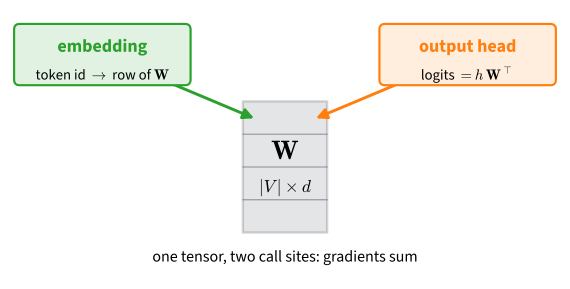
Language models map input token IDs to d-vectors via a |V| \times d embedding table and project final d-vectors back to |V| token logits via a |V| \times d output head:
- Shared semantic geometry: Tying both layers to the exact same |V| \times d tensor enforces a unified token representation and eliminates |V| \times d parameters.
- Massive memory savings: In GPT-2 small (|V|=50{,}257, d=768), the tied table is 38.6\text{M} of 124\text{M} parameters (31\% of the entire network).
Implementing Weight Tying in a Miniature Language Model
Tying in Code
class ToyLM(nn.Module):
    def __init__(self, vocab_size, d, tied=True):
        super().__init__()
        self.emb = nn.Embedding(vocab_size, d)
        self.body = nn.Linear(d, d)
        self.head = nn.Linear(d, vocab_size, bias=False)
        if tied:
            self.head.weight = self.emb.weight   # one tensor, two roles

    def forward(self, tokens):
        return self.head(torch.relu(self.body(self.emb(tokens))))

lm = ToyLM(vocab_size=100, d=16)
lm.head.weight is lm.emb.weight- In
ToyLM(|V| = 100, d = 16), the output projection is an alias of the input embedding table, so the table is stored once:
TrueTied Tensors Are Deduplicated and Counted Once
Parameter Deduplication
Gradients from All Call Sites Sum Into a Tied Tensor
Multivariable Chain Rule
\frac{\partial L}{\partial \mathbf{W}} = \frac{\partial L}{\partial \mathbf{W}_{\text{emb}}} + \frac{\partial L}{\partial \mathbf{W}_{\text{head}}}
TrueFreezing Parameters for Transfer Learning
Selective Optimization
When fine-tuning a pretrained backbone on a small dataset, we freeze the backbone weights and train only the output head (650 of 18{,}634 parameters in our residual MLP):
(650, 18634)After Freezing, Only the Head Trains
Selective Optimization
[False,
 False,
 False,
 False,
 False,
 False,
 False,
 False,
 False,
 False,
 True,
 True]
Two Silent Pitfalls of Freezing Parameters
Systems Hazards of Freezing
False- Pitfall 1: Adam moments (8\text{ B/param}) stay in memory unless the optimizer covers only unfrozen parameters.
- Pitfall 2: In training mode, BatchNorm layers can still update running mean/variance buffers during the forward pass unless switched to evaluation mode.
Concept Check: Memory Budgets & Parameter Sharing
Concept Check
Test your understanding on the 8-billion-parameter language model (fp32, Adam, output head 4096 \times 128{,}256 \approx 525\text{M} parameters):
- Suppose you freeze the entire 8B backbone except the 525\text{M}-parameter output head and construct Adam over the head alone. How much persistent state memory is required in
fp32, and does it fit on a single80 GBGPU? - What if you instead constructed Adam over all 8B parameters, ran 1 warmup step, and then froze the backbone without recreating the optimizer?
- If two layers share a weight matrix \mathbf{W} and you freeze \mathbf{W} through the embedding layer, can
self.headstill adapt?
Answers:
- \approx 38.3\text{ GB} (fits on one 80 GB GPU): All 8B weights require 32\text{ GB}, while gradients and Adam moments for the 525\text{M} head require only 12 \times 0.525\text{B} = 6.3\text{ GB}.
- \approx 98.1\text{ GB} (OOM on 80 GB): Adam keeps the 64\text{ GB} of moments allocated on step 1 (32\text{ GB weights} + 64\text{ GB moments} + 2.1\text{ GB head grad}).
- No: Because
self.emb.weightandself.head.weightalias the exact same parameter tensor, freezing one freezes both roles.
Summary: Parameters, State, and Memory
Key Takeaways
- Parameters vs. buffers: Both travel to checkpoints and GPUs, while optimizers update only trainable parameters.
- Static memory & meta counting:
fp32Adam costs 16\text{ B/param} (128 GBfor 8B); meta devices audit exact byte budgets with zero physical allocation. - Weight tying & freezing: Shared tensors are counted once and sum gradients across call sites; freezing requires filtering the optimizer and switching BatchNorm to evaluation mode.