Numerical Precision and Mixed-Precision Training fp32 vs. bf16 vs. fp16 · update rounding · fp32 master weights · dynamic loss scaling · numerical hazards
16-Bit Formats Halve Memory but Bring Two Hazards
The Low-Precision Trade-Off
x = torch.tensor(300.0)x.to(torch.float16)**2, x.to(torch.bfloat16)**2
Range overflow in fp16: Squaring 300.0 overflows to inf(\max = 65{,}504).
Precision rounding in bf16:bf16 keeps 300^2 finite (90{,}112), yet 1.0 + 10^{-3} rounds back to 1.0, freezing direct 16-bit weight updates.
Anatomy of a Floating-Point Number: Range vs. Precision
Exponent vs. Mantissa Bits
x = (-1)^s \cdot 2^e \cdot (1 + f)
Exponent bits govern dynamic range: 8 exponent bits give fp32 and bf16 the same \sim 10^{\pm 38} range, whereas 5 exponent bits cap fp16 at 65{,}504.
Mantissa bits (t) govern relative precision: Within any octave [2^e, 2^{e+1}), adjacent numbers sit 2^{e-t} apart (\text{eps} = 2^{-t}).
Bit Layouts of fp32, bf16, and fp16 Compared
Opposite 16-Bit Partitions
bf16 truncates fp32: Preserving all 8 exponent bits gives bf16 the exact dynamic range of fp32, making overflow and underflow nearly as rare as in 32-bit training.
fp16 prioritizes mantissa over range: Its 10 mantissa bits resolve 8\times finer steps than bf16, but its 5-bit exponent overflows above 65{,}504 and drops into subnormals below 6.1 \times 10^{-5}.
Querying Machine Limits with finfo
Exact Format Boundaries
We can inspect max (largest finite value), tiny (smallest positive normal number), and eps(2^{-t} gap at 1.0) directly in code:
for dtype in (torch.float32, torch.bfloat16, torch.float16): fi = torch.finfo(dtype)print(f'{str(dtype):15} max {fi.max:10.3e} tiny {fi.tiny:9.3e}'f' eps {fi.eps:8.3e}')
torch.float32   max  3.403e+38  tiny 1.175e-38  eps 1.192e-07
torch.bfloat16  max  3.390e+38  tiny 1.175e-38  eps 7.812e-03
torch.float16   max  6.550e+04  tiny 6.104e-05  eps 9.766e-04
Why range beats precision in deep learning: Activations and gradients span many orders of magnitude across layers; running out of range turns values into inf or 0, whereas a coarser mantissa merely adds mild quantization noise.
Master weights rule: Near w = 1.0, bf16 spacing is 2^{-7} \approx 0.0078, so any update |\Delta w| < 0.0039 snaps back to 1.0 unless accumulated in fp32.
Dtype Promotion Rules for Mixed Operands
Mixed-Operand Arithmetic
Combining different float widths promotes to the wider format (fp16 + fp32 -> fp32,fp16 + bf16 -> fp32), so a single stray fp32 buffer contaminates a 16-bit pass:
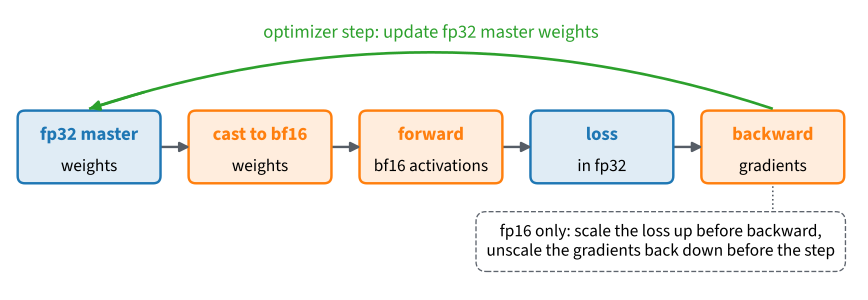
Mixed-precision training (Micikevicius et al., 2018) decouples compute precision from storage precision:
Cast for compute: Cast fp32 master weights to bf16 (or fp16) for forward and backward matrix multiplications and activation storage.
Reduce in fp32: Compute loss functions, softmaxes, and layer normalizations in fp32.
Update in fp32: Apply gradients (and Adam’s fp32 moments \mathbf{m}, \mathbf{v}) directly to the fp32 master weights.
Enabling Mixed Precision in Four Lines of Code
Framework Autocast & Policies
A precision policy or context manager keeps weights in fp32 while outputting 16-bit activations:
net = mlp()with torch.autocast('cpu', dtype=torch.bfloat16): Y = net(X)Y.dtype, net[1].weight.dtype
(torch.bfloat16, torch.float32)
Pure bf16 Weights Stall; Mixed Precision Matches fp32
Fashion-MNIST Training Comparison
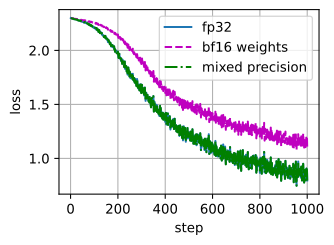
Training identical Fashion-MNIST MLPs for 1{,}000 SGD steps at \eta = 0.01 across three precision modes shows why fp32 master weights are non-negotiable:
90% of bf16 updates vanish: With pure bf16 weights, roughly 90\% of first-layer updates fall below half the local bf16 spacing, leaving the loss at \sim 1.15 after 1{,}000 steps while mixed precision tracks fp32(\sim 0.85) virtually on top of each other.
Why Mixed Precision Keeps the 128 GB Static Floor
Training vs. Inference Memory
Static training floor stays 128 GB: Mixed precision must retain fp32 master weights (32 GB),fp32 gradients (32 GB) and fp32 Adam moments \mathbf{m}, \mathbf{v}(64 GB); the 16-bit values of the forward pass are cast from them.
Where mixed precision wins: It halves dynamic forward activation memory and doubles Tensor Core matrix-multiply throughput.
Measuring Gradient Underflow in fp16
Why fp16 Needs Loss Scaling
net = mlp()X, y = batches[0]F.cross_entropy(net(X), y).backward()g = net[1].weight.grad.flatten()g = g[g !=0]for scale in (1, 2**16):print(f'scale {scale:5}: 'f'{((g * scale).abs() <2**-14).float().mean():.1%} subnormal, 'f'{((g * scale).half() ==0).float().mean():.2%} zero')
Gradient Underflow in fp16 and Dynamic Loss Scaling
Why fp16 Needs Loss Scaling
scale     1: 32.5% subnormal, 0.21% zero
scale 65536: 0.0% subnormal, 0.00% zero
One-third of gradients drop into subnormals: Unscaled (scale 1), roughly a third of nonzero first-layer gradients fall below 2^{-14} and \sim 0.1\text{--}0.2\% round to zero.
Loss scaling (S = 2^{16}): Multiplying the loss by S before backpropagation lifts all of them safely into normal fp16 range.
Automatic Dynamic Loss Scaling in Practice
GradScaler & LossScaleOptimizer
net = mlp()optimizer = torch.optim.SGD(net.parameters(), lr=0.1)scaler = torch.amp.GradScaler('cpu')for X, y in batches[:20]:with torch.autocast('cpu', dtype=torch.float16): loss = F.cross_entropy(net(X), y) optimizer.zero_grad() scaler.scale(loss).backward() # Gradients of S * loss scaler.step(optimizer) # Divide by S, skip the step on inf/NaN scaler.update() # Adjust Sprint(f'loss {loss.item():.3f}, loss scale {scaler.get_scale():.0f}')
Dynamic loss scaling starts with a large scale factor S, skips the optimizer step and halves S whenever an inf/NaN gradient appears, and doubles S after a clean streak:
loss 2.030, loss scale 65536
When to Use bf16 vs. fp16 vs. TF32
Hardware Precision Selection Guide
bfloat16 mixed precision (Ampere/Hopper/TPU default):fp32 master weights + bf16 compute with no loss scaling needed.
Work out these three numerical precision questions by hand:
In bfloat16 (7 mantissa bits), what is the grid spacing between adjacent representable numbers in the interval [512, 1024), and what does bf16(1000.0) + bf16(1.0) evaluate to?
A gradient entry has magnitude g = 2 \times 10^{-6}. In unscaled fp16(tiny= 6.1 \times 10^{-5}, min subnormal = 6.0 \times 10^{-8}), is g normal, subnormal, or zero? What happens when scaled by S = 2^{16}?
When dynamic loss scaling encounters an inf gradient on step t, why must it skip updating Adam’s moments \mathbf{m} and \mathbf{v} rather than zeroing out the inf entry?
Answers:
Spacing is 2^{9 - 7} = 4.0, so 1000.0 + 1.0 = 1000.0: Since 512 = 2^9, adjacent bf16 values sit 4 apart; an increment of 1 is less than half a grid step (2.0) and vanishes.
Subnormal unscaled (\sim 5 bits of precision left); normal when scaled:S \cdot g = 65{,}536 \times 2 \times 10^{-6} \approx 0.131, restoring full 10-bit fp16 precision.
Updating \mathbf{m}, \mathbf{v} with inf permanently poisons Adam with NaNs, while replacing inf with 0 corrupts the running moment history for the largest-gradient parameters.
Summary: Numerical Formats and Mixed Precision
Key Takeaways
Format trade-offs:fp32(1+8+23) holds master weights, Adam moments, and reductions; bf16(1+8+7) matches fp32 range without loss scaling; fp16(1+5+10) requires dynamic loss scaling S \cdot L.
Mixed precision (AMP): Casts fp32 master weights to 16 bits for matmuls and activations, matching fp32 convergence while halving activation memory.
Stable reductions: Use shifted logsumexp and fp32 accumulators to prevent overflow and running-sum stagnation.