net = nn.Sequential(nn.Linear(20, 256), nn.ReLU(), nn.Linear(256, 10))

X = torch.rand(2, 20)
net(X).shapeModules and Model Construction
Dive into Deep Learning · §5.1
Modules and Model Construction
module trees · child registration · containers · residual blocks · lazy shapes · configs
Why Models Need a Recursive Bookkeeping Abstraction
Motivation & Scale
- Hundreds of distributed weight tensors: Llama 3 8B stacks 32 transformer blocks of 9 parameter arrays each plus 3 outer arrays, totaling 32 \times 9 + 3 = 291 distinct tensors.
- All-or-nothing lifecycle: Every tensor must be discovered by the optimizer, serialized into checkpoints, initialized, and transferred to GPU memory.
- Silent failure hazard: Omitting a weight array from the module registry raises no error during a CPU forward pass—those weights simply stay frozen at initialization.
A Model Is a Tree of Modules Addressed by Path
The Module Tree
- Modules all the way down: Every layer, composite block, and complete network is a module that owns parameters, registers child modules, and defines a forward pass.
- Hierarchical paths: Each edge carries the attribute or index name under which the parent registered the child, so every leaf parameter is uniquely named by its path from the root (e.g., block 1, layer 0, weight).
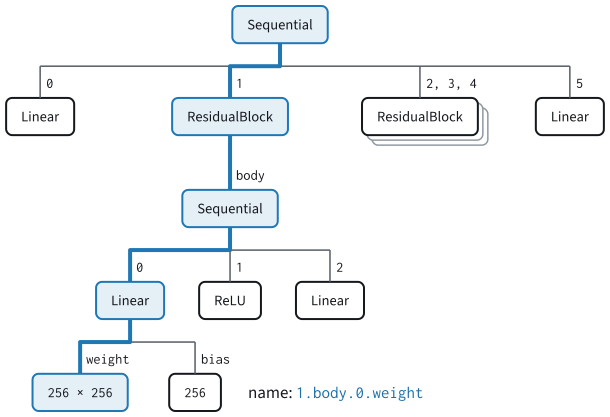
Sequential Containers Chain Registered Children
The Module Abstraction
When layers form a straight pipeline, a sequential container registers each child by integer index and passes activations through them in insertion order:
torch.Size([2, 10]){'0': Linear(in_features=20, out_features=256, bias=True),
'1': ReLU(),
'2': Linear(in_features=256, out_features=10, bias=True)}Custom Module Subclasses Register Attributes
Subclassing the Base Module
torch.Size([2, 10])- Automatic registration via
__setattr__: Assigningself.hidden = ...inserts the child into the module’s child registry; always callnet(X)to run hooks and builders.
Every Whole-Model Operation Walks the Module Registry
Why Registration Matters
- Five recursive tree walks: Optimizer setup, checkpointing, device transfer, initialization, and mode/hook toggling all walk registered children.
- Consequence of an unregistered layer: Its weights never update, are omitted from checkpoints, stay behind when the model moves to the GPU, and keep training-mode Dropout/BatchNorm during evaluation.
Inside a Sequential Container: Registration + Loop
Building a Container
- A sequential container only registers children in
__init__and loops over them inforward:
torch.Size([2, 10])Pitfall: Plain Python Lists Hide Layers from PyTorch
The Plain-List Trap
- Storing layers inside an ordinary Python
list(self.layers = [...]) allowsforwardto run, butnet.parameters()is empty (0parameters instead of7,946):
(torch.Size([2, 10]), 0)A Partly Registered Model Silently Freezes Inner Layers
The Silent Training Bug
Outer layers as attributes, middle layers in a plain list: the optimizer accepts the model silently.
class PartlyRegisteredMLP(nn.Module):
    def __init__(self):
        super().__init__()
        self.first = nn.Linear(20, 256)
        self.blocks = [nn.Linear(256, 256), nn.Linear(256, 256)]  # Plain list
        self.last = nn.Linear(256, 10)

    def forward(self, X):
        X = F.relu(self.first(X))
        for block in self.blocks:
            X = F.relu(block(X))
        return self.last(X)
[True, False, False, True]- Gradients flow, weights stay frozen:
self.firstupdates (True), but the optimizer never receivedself.blocks, so their weights never change (False, False).
Fixing List Registration with Module Containers
Registered Collection Containers
- Wrap dynamic collections of layers in
nn.ModuleList(ornn.ModuleDict) so all 7{,}946 parameters register in the module tree:
(torch.Size([2, 10]), 7946)Custom Forward Passes: The Residual Connection
Non-Sequential Wiring
A module’s forward method can express arbitrary branching and skip paths, such as a residual block that adds its input directly to a two-layer transformation f(\mathbf{x}):
\mathbf{y} = \mathbf{x} + f(\mathbf{x})
- Identity baseline: When f(\mathbf{x}) = \mathbf{0}, the block acts as the identity map \mathbf{y} = \mathbf{x}, letting deep stacks learn incremental refinements.
- Shape invariant: Elementwise addition requires \mathbf{x} and f(\mathbf{x}) to share the exact same feature width
num_hiddens.
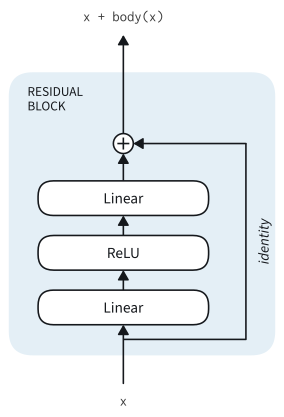
Implementing a Reusable ResidualBlock Module
Forward Is Just Python
No special framework primitive is needed for a skip connection—the forward method simply returns X + self.body(X):
torch.Size([2, 24])Eager Execution vs. Graph Tracing
Forward Execution Modes
- Eager execution (default): Runs line-by-line on concrete values so data-dependent
if/whileloops andprintdebugging work directly. - Compiled graph tracing: Static loops over registered modules (
for block in self.blocks:) unroll cleanly, whereas data-dependent branches require symbolic control flow.
Lazy Layers Infer Input Shapes on the First Batch
Deferred Shape Inference
Initializing Lazy Models After a Dry Run
Materializing Shapes Before Training
- Because variance-scaling initializers depend on n_{\text{in}} and n_{\text{out}}, lazy layers must run a dummy forward pass (dry run) before custom initialization:
class TinyMLP(d2l.Module):
    def __init__(self):
        super().__init__()
        self.net = nn.Sequential(nn.LazyLinear(256), nn.ReLU(),
                                 nn.LazyLinear(10))

def init_xavier(module):
    if isinstance(module, nn.Linear):
        nn.init.xavier_uniform_(module.weight)

model = TinyMLP()
model.apply_init([X], init_xavier)
model.net[0].weight.shape
torch.Size([256, 20])Separating Architecture Configs from Builder Code
Dataclass Configurations
- Production code factors hyperparameters into a serializable
@dataclasspaired with abuildfunction.
Building a Model from a Config
Dataclass Configurations
@dataclass
class MLPConfig:
    num_inputs: int = 784
    num_hiddens: int = 256
    num_blocks: int = 4
    num_outputs: int = 10

def build(cfg: MLPConfig) -> nn.Module:
    blocks = [ResidualBlock(cfg.num_hiddens) for _ in range(cfg.num_blocks)]
    return nn.Sequential(nn.Linear(cfg.num_inputs, cfg.num_hiddens),
*blocks, nn.Linear(cfg.num_hiddens, cfg.num_outputs))Exact Parameter Accounting From the Config
Analytical vs. Tree-Walk Counts
With explicit widths in MLPConfig(num_inputs=784, num_hiddens=256, num_blocks=4, num_outputs=10), we can compute the exact parameter count on paper and verify it across the module tree:
| Module Component | Shape Formula (W + b) | Parameter Count |
|---|---|---|
Input projection (0) |
784 \times 256 + 256 | 200{,}960 |
4 Residual blocks (1..4) |
4 \times 2 \times (256 \times 256 + 256) | 526{,}336 |
Output head (5) |
256 \times 10 + 10 | 2{,}570 |
| Total network | 10 Linear layers (20 parameter tensors) | 729{,}866 |
num_hiddens=256, num_blocks=4: 729,866 parameters
num_hiddens=512, num_blocks=8: 4,609,546 parameters
Concept Check: Module Trees & Parameter Scaling
Concept Check
Work out both questions from the MLPConfig architecture (d_{\text{in}}=784, K residual blocks of width d, d_{\text{out}}=10):
- Suppose a programmer stores the 4 residual blocks (
d = 256) in a plain Pythonlist(in a framework that does not scan lists) while assigning the input and output layers toself.firstandself.last. How many parameters does the optimizer receive, and what happens on a GPU? - Why does doubling both
num_hiddens(256 \to 512) andnum_blocks(4 \to 8) increase the total parameter count by more than 6\times (729{,}866 \to 4{,}609{,}546)?
Answers:
- Only 200{,}960 + 2{,}570 = 203{,}530 parameters reach the optimizer; the 526{,}336 block parameters remain frozen. Calling
.to(gpu)moves only the outer layers, crashing the first forward pass on a CPU/GPU device mismatch. - Each residual block’s weights scale quadratically with width (2 d^2) and linearly with depth (K), multiplying block parameters by 2^2 \times 2 = 8\times (526{,}336 \to 4{,}202{,}496).
Summary: Modules and Model Construction
Key Takeaways
| Concept | Mechanism / Rule | Practical Systems Implication |
|---|---|---|
| Module tree | Recursive hierarchy of layers/blocks; leaves hold parameters | Every parameter is uniquely addressed by its dotted root-to-leaf path |
| Registration | __setattr__ and registered module containers |
Unregistered plain lists hide layers from optimizers, checkpoints, and GPUs |
Custom forward |
Arbitrary Python tensor code (e.g., \mathbf{x} + f(\mathbf{x})); call via net(X) |
Compiled steps forbid branching on tensor values |
| Lazy layers | Infer n_{\text{in}} on the first minibatch; initialize after a dry run | Handy for quick prototypes; explicit widths are preferred for production |
| Config + builder | Serializable @dataclass hyperparameters + build(cfg) factory |
Reconstructing a model requires weights + config + builder code |