terms_gib = {"parameters": 14.0, "gradients": 14.0, "optimizer": 56.0,
"activations": 18.0, "temporary": 5.0}
def per_device_gib(world_size=1, shard_state=False, ckpt_activations=False):
divisor = world_size if shard_state else 1
state = sum(terms_gib[k] / divisor
for k in ("parameters", "gradients", "optimizer"))
activations = terms_gib["activations"] * (0.35 if ckpt_activations else 1)
return state + activations + terms_gib["temporary"]
for label, cfg in [("1 GPU, plain", (1, False, False)),
("8 GPU DDP + ckpt", (8, False, True)),
("8 GPU FSDP + ckpt", (8, True, True))]:
print(f"{label:>20s}: {per_device_gib(*cfg):6.1f} GiB/device")Distributed Model Training
Dive into Deep Learning · §39.6
Distributed Model Training: DDP, FSDP/ZeRO, 3D Parallelism, and Fault Tolerance
scaling ladder · DDP vs. FSDP2 · tensor & pipeline parallelism · global batch invariant · memory sharding · ZeRO-Offload · atomic checkpoints
Why Single-Accelerator Training Hits a Wall
Motivation
- The 7B single-GPU memory wall (112\text{ GB}): Mixed-precision Adam holds BF16 weights (14\text{ GB}), BF16 grads (14\text{ GB}), FP32 master weights (28\text{ GB}), and FP32 Adam m, v (56\text{ GB})—exceeding an 80\text{ GB} H100 before any activations.
- Four partitioning axes: Split the batch (DDP), training state (FSDP/ZeRO), layer matrices/stages (TP/PP), or sequence/experts (CP/EP).
- Golden rule: Start from a verified 1-GPU baseline and climb one rung at a time.
The Distributed Scaling Ladder
Progressive Scaling
Climb the scaling ladder in strict order of increasing communication volume and engineering complexity:
- Single Accelerator Baseline: Verify loss convergence, tok/s throughput, peak memory, and checkpoint restore.
- Data Parallelism (DDP): Replicate the model on every GPU, split the batch, and
all_reducegradients once per step. Always use DDP while state fits on one GPU. - Fully Sharded Data Parallelism (FSDP / ZeRO-3): Shard parameters, gradients, and optimizer states across W GPUs;
all_gatherlayers on the fly (\sim 1.5\times DDP traffic). - Composed 3D/4D Parallelism (TP / PP / CP / EP): Split individual layers, layer stages, sequences, or experts when a single layer or activation exceeds device capacity.
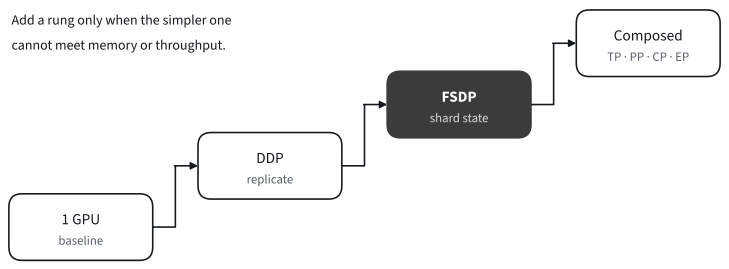
Data Parallelism (DDP) vs. FSDP2 / NamedSharding
Rungs 2 and 3
- Rung 2: DDP (
DistributedDataParallel): Replicates all 16N state on every GPU and averages bucketed gradients viaall_reduce(\approx 2S traffic); best choice whenever state fits. - Rung 3: FSDP2 (
fully_shard/DTensor& JAXNamedSharding): Divides parameters, gradients, and Adam moments by W (16N/W), overlapping per-layerall_gatherandreduce_scatter(\approx 3S = 1.5\times DDP traffic).
Tensor, Pipeline, Context, and Expert Parallelism
Rung 4: Model & Sequence Axes
- Intra-layer vs. inter-layer splits: Tensor Parallelism (TP) splits matrices inside every block (2 collectives/layer on the critical path), whereas Pipeline Parallelism (PP) passes activations point-to-point at stage boundaries.
- Hardware topology rule (Ultra-Scale Playbook): Keep high-frequency TP inside an 8-GPU NVLink node (450\text{--}900\text{ GB/s}; stretching TP across nodes costs -43\%), and scale PP + FSDP/DDP across nodes.
Pipeline Schedules: GPipe vs. 1F1B Bubble and Memory
Pipeline Mechanics
\text{Bubble Fraction} = \frac{p - 1}{m}
- GPipe (all m forwards, then all m backwards): Needs m \gg p to shrink the bubble, forcing stage 1 to hold all m microbatch activations at once (O(m) memory).
- 1F1B Schedule: Alternates 1 Forward and 1 Backward after warmup, achieving the same (p-1)/m bubble while capping live activations at \le p microbatches.
The Global Batch Size Invariant Across Every Rung
Optimization Semantics
B_{\text{global}} = B_{\text{device}} \cdot N_{\text{ranks}} \cdot N_{\text{accumulation}}
- Preserving optimization dynamics: Doubling N_{\text{ranks}} from 64 \to 128 without halving N_{\text{accumulation}} silently doubles B_{\text{global}} and halves optimizer steps.
- When B_{\text{global}} increases: Scale Adam learning rate by \sqrt{B/B_0} and define warmup in tokens rather than steps.
Distributed Samplers and Exact Metric Aggregation
Correctness Pitfalls
\text{Acc}_{\text{exact}} = \frac{\sum_{r=0}^{W-1} c_r}{\sum_{r=0}^{W-1} n_r} \neq \frac{1}{W} \sum_{r=0}^{W-1} \frac{c_r}{n_r}
- Padded
DistributedSamplerbug: Default padding repeats leading examples so every rank gets \lceil N/W \rceil items, skewing validation metrics. - Exact distributed evaluation: Split examples without padding, tally local
(correct_r, count_r)integers, andall_reduce(SUM)numerator and denominator once.
Anatomy of Peak Training Memory
Memory Budget
Peak per-GPU memory is the sum of model state, saved activations, temporary communication buffers, and allocator fragmentation:
- Mixed-precision Adam state for a 7B model (16\text{ B/param} = 112\text{ GB}):
- BF16 parameters: 2N = 14\text{ GB}
- BF16 gradients: 2N = 14\text{ GB}
- FP32 master parameters: 4N = 28\text{ GB}
- FP32 Adam first & second moments (m, v): 8N = 56\text{ GB}
- Dynamic terms: Activations grow linearly with B_{\text{device}} \times T, while collective staging buffers add 4\text{--}8\text{ GiB}.
Modeling Per-Device Memory: DDP vs. FSDP
Executable Memory Model
Even leaving out the 28\text{ GB} master-weight copy (84\text{ GiB} state + 18\text{ GiB} activations + 5\text{ GiB} temporary buffers), our sizing script shows why DDP cannot fit a 7B full fine-tune on 80 GB GPUs:
- 1 GPU plain (107.0\text{ GiB}): Exceeds an 80\text{ GB} H100.
- 8-GPU DDP + activation checkpointing (95.3\text{ GiB/GPU}): Checkpointing shrinks activations from 18\text{ GiB} to 6.3\text{ GiB}, but DDP replicates all 84\text{ GiB} of model state on every GPU—still OOM.
- 8-GPU FSDP + activation checkpointing (21.8\text{ GiB/GPU}): Sharding state by 8 cuts per-GPU state to 10.5\text{ GiB}, leaving nearly 60\text{ GiB} of headroom for larger microbatches.
        1 GPU, plain:  107.0 GiB/device
    8 GPU DDP + ckpt:   95.3 GiB/device
   8 GPU FSDP + ckpt:   21.8 GiB/device
Modeling Per-Device Memory: DDP vs. FSDP (Code)
Executable Memory Model
Five Orthogonal Memory-Reduction Techniques
Memory Optimization Trade-Offs
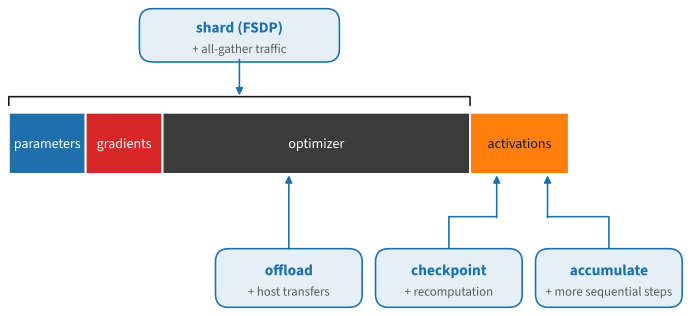
- Sharding & Checkpointing: FSDP2/ZeRO divides 16N state by W (\sim 1.5\times comm), while activation checkpointing trades +25\text{--}33\% FLOPs to shrink saved activations from O(L) \to O(1).
- Accumulation, Offload & Adapters: Gradient accumulation shrinks microbatch B_{\text{device}}, CPU offload moves master weights/Adam across PCIe, and LoRA/QLoRA freezes base weights to drop >98\% of gradient/optimizer state.
Arithmetic of CPU Optimizer Offload (ZeRO-Offload)
Host-Device Roofline
- Per-step offload cost (1.54\text{ s} for 7B): Sending 14\text{ GB} BF16 grads and receiving 14\text{ GB} BF16 weights over 50\text{ GB/s} PCIe takes 0.56\text{ s}, plus 0.98\text{ s} to stream 196\text{ GB} (28\text{ B/param}) through 200\text{ GB/s} CPU DDR.
- Amortization & delayed update: Keeping offload < 20\% of step time at 400\text{ TFLOP/s} requires \ge 58{,}700\text{ tok/step} (or a 1-step delayed CPU update).
Selecting the Simplest Tool for Your Scale (Nov 2026)
Software Ecosystem
- 1 GPU to 1 Node (2–8 GPUs): Use Unsloth or HF PEFT for single-GPU LoRA/QLoRA, and HF Accelerate, Axolotl, or LLaMA-Factory for single-node DDP/FSDP2.
- Multi-Node & RL Post-Training: Use PyTorch FSDP2 (
fully_shard) or DeepSpeed across a few nodes, TorchTitan / Megatron Core / MaxText at 64–512+ GPUs, and TRL / veRL / OpenRLHF for DPO/GRPO.
Fault Tolerance: Complete and Atomic Checkpointing
Surviving Hardware Failures
- Bitwise-complete checkpoint bundle: Save sharded model weights, Adam moments, LR scheduler state, step/token counters, deterministic data cursor, and per-rank PRNG states.
- Crash-safe atomic rename: Never overwrite
ckptin place; write tockpt.tmp, callf.flush()+os.fsync(), swap viaos.replace("ckpt.tmp", "ckpt"), andfsyncthe directory.
Operational Discipline for Long Distributed Runs
Production Operations
Four operational habits separate multi-week training runs that finish from runs that stall or silently diverge:
- 1. Drill the recovery before day one:
- Deliberately kill the training job at step 40, restore on fresh workers, and verify that step 41’s loss, gradient norm, and data batch match an uninterrupted run bitwise.
- Design data ordering globally by example index so elastic resumption works even if you must resume on 48 GPUs after losing two 8-GPU nodes.
- 2. Profile input pipelines separately from GPU compute:
- Measure storage reads, image/text decoding, and host-to-device copy rates independently; adding GPUs to an I/O-bound job only increases storage contention.
- 3. Monitor convergence alongside systems throughput:
- Log
(step, loss, grad_norm, tok/s, collective_ms, ckpt_ms)with rank and hostname on every log line; isolate bugs on 1\text{ process} \to 1\text{ node} \to N\text{ nodes}.
- Log
Concept Check: Sharding, Batch Invariants, and Recovery
Check Your Understanding
Work through these three distributed training scenarios:
- A pretraining job maintains a fixed global batch of B_{\text{global}} = 1{,}024 sequences (4,096 tokens each \approx 4.2\text{M} tokens), and each GPU holds at most B_{\text{device}} = 4 sequences per microbatch. What is the minimum gradient accumulation N_{\text{accumulation}} on N_{\text{ranks}} = 64 GPUs, and what is the largest world size that can train this global batch with data parallelism alone?
- During checkpoint restore, a colleague restores the model weights, Adam moments, and data-loader position, but forgets to restore the
LambdaLRscheduler state. What happens to the training run, and will it raise an exception? - Why does FSDP2 communicate roughly 1.5\times as much data per step as DDP?
Concept Check: Sharding, Batch Invariants, and Recovery (cont.)
Check Your Understanding
Answers:
- On 64 GPUs with B_{\text{device}} = 4, N_{\text{accumulation}} = 1024 / (64 \times 4) = \mathbf{4}. The largest pure data-parallel world size (at B_{\text{device}} = 1, N_{\text{accumulation}} = 1) is N_{\text{ranks}} = 1{,}024 GPUs (or 256 GPUs if keeping B_{\text{device}} = 4).
- It never raises an exception, but the learning rate resets to step 0 (re-running warmup or jumping back to peak \eta_{\max}), causing a sudden loss spike or silent accuracy degradation.
- For N parameters of size S = 2N bytes, DDP runs one
all_reduceof gradients (\approx 2S bytes sent/received per GPU). FSDP runs anall_gatherof weights in forward (S), anotherall_gatherof weights in backward (S), and areduce_scatterof gradients (S)—totaling 3S bytes (1.5\times DDP).
Summary: Multi-GPU and Distributed Training Systems
Key Takeaways
| System Dimension | Core Rule / Equation | Practical Engineering Guideline |
|---|---|---|
| Scaling ladder | 1 GPU \to DDP \to FSDP2 \to TP + PP + CP/EP | Use DDP while state fits; shard state with FSDP2 next; keep TP inside an NVLink node |
| Global batch size | B_{\text{global}} = B_{\text{device}} \cdot N_{\text{ranks}} \cdot N_{\text{accumulation}} | Adjust N_{\text{accumulation}} or \eta(B) whenever changing GPU count so optimization dynamics stay invariant |
| Memory accounting | M_{\text{state}} = 16N\text{ B} (BF16 weights/grads + FP32 master/Adam) | Combine FSDP (\div W), activation checkpointing, and LoRA/QLoRA deliberately to fit target VRAM |
| Pipeline scheduling | Bubble fraction = (p - 1)/m | Use 1F1B instead of GPipe to bound in-flight activation memory to p microbatches |
| Distributed evaluation | \text{Acc} = (\sum_r c_r) / (\sum_r n_r) | Avoid padded sampler duplicates on eval sets; all_reduce numerator and denominator counts separately |
| Fault tolerance | Atomic write: tmp \to fsync \to os.replace |
Save model, optimizer, scheduler, data cursor, and RNG state; drill recovery before long or spot runs |