from dataclasses import asdict, dataclass
import json
@dataclass(frozen=True)
class Artifact:
repository: str
revision: str
task: str
license: str
parent: str | None = None
artifact = Artifact(repository="organization/model-name",
revision="0123456789abcdef",
task="text-generation", license="apache-2.0")
print(json.dumps(asdict(artifact), indent=2))Ecosystem
Dive into Deep Learning · §39.5
Ecosystem: Pretrained Models, Datasets, Leaderboards, and Supply-Chain Safety
model hubs · FineWeb & DataComp · benchmark contamination · Arena Elo · commit pinning · safetensors vs. pickle · licensing
External Artifacts Are Supply-Chain Dependencies
Motivation
- 1. Discovery & domain selection: Out of 3M+ public checkpoints, shortlist candidates and verify whether leaderboard scores hold on your domain data.
- 2. Bitwise identity & reproducibility: Lock the exact 40-character Git commit SHA of weights, config, and tokenizer so runs stay identical six months later.
- 3. Security & legal compliance: Use
safetensorsto prevent pickle RCE exploits and verify the commit’s license terms before deployment.
Where the Community Hosts Models and Weights
Model Repositories
- Foundation & global hubs: Hugging Face Hub (3\text{M+} Git-backed repos with
safetensorsand model cards) and ModelScope (280\text{K+} models). - Hosted & local inference catalogs: Kaggle Models mount directly at
/kaggle/inputwithout download, while Ollama bundles quantized GGUF weights + chat templates. - Domain collections:
timmstandardizes PyTorch vision backbones and Civitai hosts diffusion adapters.
Open Datasets and Web-Scale Pretraining Lineage
Data Repositories
- Web-scale text pretraining lineage: Raw Common Crawl WARC archives \to filtered C4 (T5, 2019) \to FineWeb (15\text{T}\to 18.5\text{T+} deduplicated tokens) and FineWeb2 (1{,}000+ languages).
- Supervised & multimodal corpora: HF/Kaggle Datasets provide Arrow streaming, DataComp curates auditable image–text pairs, and Academic Torrents distributes multi-TB archives.
Tracking Papers, Code, and Replications
Research Discovery
- Primary discovery channels: arXiv (
cs.LG,cs.CL,cs.CV), Hugging Face Papers (linking preprints directly to weights, datasets, and GitHub code), and Semantic Scholar / alphaXiv. - Lesson of Papers with Code (closed July 2025): Central benchmark indexes can shut down—never make your build or evaluation pipeline depend on a single external site staying online.
Why Static Leaderboards Age and Saturate
Benchmark Decay
- Three decay mechanisms (Goodhart’s Law): Test-set contamination in web scrapes, selection overfitting across thousands of checkpoint merges, and ceiling saturation on flawed unit tests.
- Landmark retirements: The static Open LLM Leaderboard retired in 2025 after task saturation, and SWE-bench Verified was superseded by contamination-resistant SWE-bench Pro (Feb 2026).
Five Complementary Types of Model Evidence
Evaluating Candidates
- Human preference & dynamic tests: Arena (
arena.ai) measures blind pairwise human preference (Elo), while LiveBench rotates withheld objective questions to defeat contamination. - Capabilities, economics & volume: Combine domain capability suites (SWE-bench Pro), Artificial Analysis (Quality vs. tok/s and \$/\text{M} tokens), and OpenRouter production token volume.
Statistical Resolution of Pairwise Arena Ratings
Bradley-Terry Elo Math
P(A \succ B) = \frac{1}{1 + 10^{-\Delta R/400}}, \qquad \text{SE} \approx \frac{347}{\sqrt{v}}
- Sample size requirement: A +20 Elo gap (52.9\% win rate) requires v \ge (347/10)^2 \approx 1{,}204 head-to-head votes just to reach 2\,\text{SE}.
- Domain mixture reversal: A model leading by +20 Elo globally can still lose 40\%\text{--}60\% on the 10\% of prompts matching your domain task.
Task-Specific Evaluation Discipline
Selecting for Your Domain
- 1. Shortlist 3–4 candidates: Filter public leaderboards by license, parameter count, and VRAM/latency ceiling.
- 2. Size a paired domain eval set: Sample real workflow inputs, size n via paired standard error \text{SE} = \sqrt{(p_{10} + p_{01})/n}, and include trivial + fast heuristic baselines.
- 3. Inspect discordant pairs: Audit examples where Model A \neq Model B before shipping.
Anatomy of a Reproducible Model Artifact
Artifact Identity
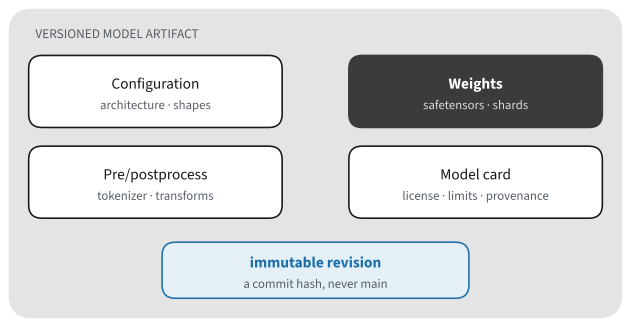
A “model” is never just a weight tensor file—reproducing its predictions requires locking five coupled components at an immutable revision:
- 1. Configuration (
config.json,generation_config.json): Architecture hyperparameters, RoPE scaling, and default sampling/stop tokens. - 2. Weights (
*.safetensors): Tensor parameters in an exact numerical dtype or quantization format. - 3. Preprocessing & Tokenizer (
tokenizer.json, chat template): Vocabulary merges, special-token IDs, and system/user role formatting. - 4. Documentation & License (
README.md,LICENSE): Intended use, evaluation results, and legal terms at that revision. - 5. Immutable Revision (40-char Git SHA): Locks all four components at one point in time.
Pinning Immutable Revisions and Recording a Manifest
Dependency Locking
Hub repositories are Git repositories: the main branch, a version tag (v1.0), or a pull-request ref (refs/pr/3) can all be moved or force-pushed by the repository owner tomorrow.
Pin the 40-character commit SHA:
Track lineage with
parent: A LoRA adapter or a quantized GGUF/AWQ export is incomplete without recording the exactparentcommit SHA of the base model it was derived from.
{
  "repository": "organization/model-name",
...
  "license": "apache-2.0",
  "parent": null
}
Pinning Immutable Revisions and Recording a Manifest (Code)
Dependency Locking
Checkpoint Security: Pickle Exploits vs. Safetensors
Safe Deserialization
- Why legacy
picklecheckpoints (.bin/.pt) are dangerous:pickleis a stack VM whose__reduce__opcode invokes arbitrary Python callables on load, so loading one (e.g.torch.load(..., weights_only=False)) runs arbitrary code; even theweights_only=Trueallowlist was bypassed (CVE-2025-32434). - Why
safetensorsis secure by construction: Stores an 8-byte header size, a pure UTF-8 JSON header (dtype,shape,[begin, end)offsets), and flat tensor bytes—zero executable opcodes and instant zero-copymmap.
Auditing Remote Code, Licenses, and Local Cache Bloat
Supply-Chain Operations
- 1.
trust_remote_code=True&auto_map: Executes repository.pyfiles; ifconfig.jsonreferences an external code repo, pin both commit SHAs. - 2. License at the pinned SHA: Distinguish Apache-2.0/MIT from custom acceptable-use caps (MAU limits) or non-commercial CC-BY-NC weights.
- 3. Cache disk hygiene: Inspect and purge stale blobs in
~/.cache/huggingfacewithhf cache ls,hf cache rm, andhf cache prune.
Curating a High-Signal Information Diet
Staying Current
With hundreds of preprints and model uploads every day, replace continuous social-media scrolling with a small, verifiable set of primary sources:
- Daily & weekly research curation:
- Hugging Face Papers: Daily community-curated preprints linked directly to code and weights.
- One technical newsletter: e.g., Sebastian Raschka’s Ahead of AI, Jack Clark’s Import AI, or Andrew Ng’s The Batch.
- Systems, kernels, and empirical verification:
r/LocalLLaMA&llama.cppdiscussions: Real-world quantization tests, throughput numbers, and reproduction reports.- GPU MODE & EleutherAI: Deep-dive kernel lectures, distributed training post-mortems, and open pretraining research.
- Citation rule: Use announcements for discovery, but always verify and cite the primary paper, datasheet, or model card.
Concept Check: Leaderboards, Pinning, and Safety
Check Your Understanding
Test your supply-chain and evaluation judgment on these three questions:
- Two models sit 15 Elo points apart on the Arena leaderboard after v = 400 head-to-head votes. Is this difference statistically significant?
- Every repository in your pipeline is pinned to a 40-character commit SHA and loads
model.safetensors. Name three factors outside the Hub repositories that can still change the model’s outputs across machines. - You inspect the
safetensorsheader ofopenai-community/gpt2(GPT-2 small, 124\text{M} parameters) and sum the tensor shapes in the file, getting \sim 163\text{M} values. Why does the file header sum exceed 124\text{M}?
Answers:
- No. With v = 400 votes, the standard error is \text{SE} \approx 347 / \sqrt{400} = 17.35 Elo points. A 15-point gap is less than 1\,\text{SE} from zero (well within sampling noise).
- Inference engine / kernel versions & hardware float associativity (CUDA/cuBLAS/vLLM version, GPU architecture, batch size changing reduction order); (ii) system prompt / chat-template wrapper or runtime clock/tool outputs; (iii) unseeded or hardware-dependent PRNG sampling (
temperature > 0).
- Inference engine / kernel versions & hardware float associativity (CUDA/cuBLAS/vLLM version, GPU architecture, batch size changing reduction order); (ii) system prompt / chat-template wrapper or runtime clock/tool outputs; (iii) unseeded or hardware-dependent PRNG sampling (
- Legacy checkpoints of GPT-2 store non-parameter buffers (such as causal attention bias masks
attn.biasof shape 1 \times 1 \times 1024 \times 1024 across layers) or duplicated tied embedding weights inside the tensor file.
Summary: Navigating the Open-Source Ecosystem
Key Takeaways
| Ecosystem Layer | Common Failure Mode | Engineering Best Practice |
|---|---|---|
| Model & dataset discovery | Picking by total download count or social-media hype | Filter by task, license, recency, and architecture fit; read the model and dataset cards |
| Leaderboard interpretation | Treating a single static leaderboard as ground truth | Triangulate Arena, LiveBench, capability suites, Artificial Analysis, and OpenRouter volume |
| Model selection | Deploying a leaderboard winner without domain testing | Build a task-specific eval set sized via paired standard errors and compare against simple baselines |
| Version reproducibility | Loading revision="main" or floating version tags |
Pin immutable 40-character Git commit SHAs and record parent lineage in a frozen manifest |
| Checkpoint security | Loading untrusted pickle .bin / .pt files or uninspected remote code |
Require safetensors, audit and pin any trust_remote_code=True modules across all referenced repos |
| Licensing & disk hygiene | Assuming “open weights” means Apache-2.0; filling disks with cached blobs | Record the license of the exact pinned commit and prune ~/.cache/huggingface with hf cache prune |