import os
import sys
from pathlib import Path

resource = {
    "cpu_count_visible": os.cpu_count(),
    "colab": "google.colab" in sys.modules,
    "kaggle": Path("/kaggle/working").exists(),
}
resourceColab and Kaggle
Dive into Deep Learning · §39.2
Colab and Kaggle: Ephemeral Hosted Runtimes, Quotas, and Portable Setup
ephemeral VMs · GitHub launch pipeline · Colab compute units · Kaggle versioned I/O · idempotent setup · Young’s checkpoint law
Borrowed Machines and the Ephemeral Runtime Problem
Motivation
- Zero-install browser GPUs: Colab and Kaggle lend preconfigured containers with free GPUs, ideal for running notebooks from any laptop.
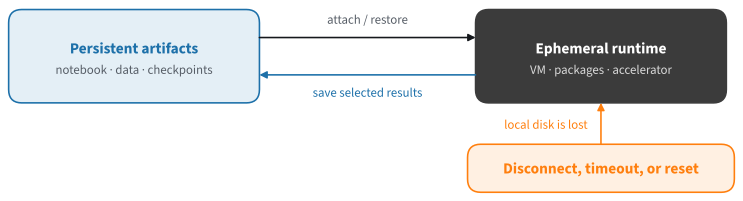
- What vanishes on timeout: Idle timeouts or 12-hour session limits destroy the VM and wipe local scratch disks (
/content), installed packages, and kernel RAM. - Engineering remedy: Treat every hosted VM as disposable—reconstruct setup in cell 1 and write checkpoints directly to durable storage.
The Hosted Runtime Lifecycle
Mental Model
A portable hosted workflow separates ephemeral execution state from durable storage at every stage of the session:
- 1. Allocate & reconstruct: A new VM boots from the provider’s current container image; an idempotent setup cell pins and installs only missing packages.
- 2. Compute on scratch disk: Fast local SSD space (
/contentor scratch) holds temporary intermediate files during training. - 3. Persist explicitly: Checkpoints, metrics, and edited notebooks must be synced to durable storage before idle timeout or preemption reclaims the VM.
How D2L’s ‘Run Notebook’ Launch Pipeline Works
Book Infrastructure
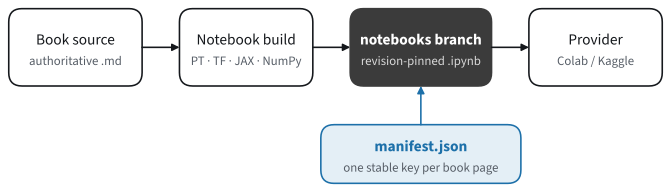
Every code-bearing page in D2L provides a Run notebook menu (Colab, Kaggle, Download) synchronized with the active framework tab:
- Generated
notebooksbranch: The build publishes self-contained.ipynbfiles with a generated setup cell that verifies framework versions and downloads matchingd2lhelpers. - Colab opens a live GitHub pointer: Fetches the current published notebook from GitHub on each open—edits are not saved back unless you choose File \to Save a copy in Drive.
- Kaggle imports an independent copy: Creates a private snapshot inside your Kaggle account that persists across your saved versions.
Security Audit Before Running Any Hosted Badge
Supply-Chain Safety
- Audit setup cells before pressing Run: Unpinned
pip install git+https://...orcurl ... | bashexecutes arbitrary remote code, anddrive.mountgrants full read/write access to your Google Drive. - Pin immutable commit SHAs: Replace floating branch URLs with 40-character Git commit hashes and inspect scripts before executing.
- Never attach untrusted notebooks to a local runtime: Local runtime mode executes with your personal machine’s full user permissions.
Google Colab: Variable Quotas and Compute Units
Colab Platform
- Free tier (Nov 2026): Typically allocates an NVIDIA T4 (16 GB VRAM) with a 12-hour max session and aggressive idle disconnects; exact availability fluctuates with demand.
- Paid tiers (Pay As You Go, Pro, Pro+): Sell compute units for priority access to L4 or A100 GPUs and background execution, though allocations remain best-effort.
Verifying Assigned Runtime Resources in Code
Runtime Inspection
Because a notebook menu shows the accelerator you requested rather than what the scheduler allocated, always verify the environment programmatically:
- Detecting the host platform:
- Colab preloads
"google.colab" in sys.modulesat kernel startup. - Kaggle mounts
/kaggle/workingas the writable output directory.
- Colab preloads
- Checking the accelerator: Query
torch.cuda.get_device_properties(0),tf.config.list_physical_devices("GPU"), orjax.devices()to confirm device model and total VRAM before starting a run.
{'cpu_count_visible': 64, 'colab': False, 'kaggle': False}Pinning Colab Runtime Versions and the Colab CLI
Image Stability & Automation
- Dated runtime versions: Pinning a dated container image in Runtime \to Change runtime type freezes Python/CUDA/library versions for one year—ideal for course assignments.
- Terminal automation (Colab CLI):
colab new,colab exec, andcolab stoplet local scripts and coding agents drive hosted GPUs without leaving a browser tab open.
Kaggle Notebooks: Directory Semantics and Versioning
Kaggle Platform
- Three filesystem zones: Read-only
/kaggle/input/mounts datasets/models instantly;/kaggle/working/(20 GB) persists into saved versions; all other paths are ephemeral scratch. - Immutable batch runs (
Save & Run All): Replays the entire notebook top-to-bottom in a fresh background container and snapshots code, logs, and/kaggle/working/outputs.
Kaggle Quotas and Free-Tier Pretraining Arithmetic
Quota Sizing
C \approx 6 N D \approx 2.8 \times 10^{19}\text{ FLOPs (BERT-base)}
- Why full pretraining outgrows free tiers: At 30\% of a T4’s 65\text{ TFLOP/s} peak (19.5\text{ TFLOP/s}), BERT-base takes \sim 400\text{ T4 hours}—over 33 twelve-hour sessions or 13+ weeks of Kaggle’s 30 h/week quota.
- What fits in one 12-hour T4 session (8.4 \times 10^{17}\text{ FLOPs}): All D2L chapter notebooks, 7B–8B LoRA fine-tuning, or training an \sim 85\text{M} model.
Colab vs. Kaggle: Side-by-Side Trade-Offs
Choosing a Provider
- Google Colab: Opens live pointers from GitHub (must Save a copy in Drive to keep edits), persists files via
drive.mount, and sells compute units for L4/A100 access. - Kaggle Notebooks: Imports an independent copy, publishes a 30 h/week quota (1\times\text{P100} or 2\times\text{T4}), mounts versioned datasets at
/kaggle/input, and captures immutable Save & Run All versions.
Writing Idempotent Setup Cells
Portable Notebooks
Because a hosted VM is replaceable, the notebook must carry its own setup without breaking the provider’s pretested environment:
- Check before installing: Use
importlib.util.find_spec(orimportlib.metadata.version) to install only what is missing at a pinned version. - Never run unconditional
pip install --upgrade: It overwrites tested provider wheels, slows startup, and causes Friday’s run to resolve different dependencies than Monday’s. - Restart after upgrading an imported package: If a module is already in
sys.modules,pip installupdates disk metadata (importlib.metadata.version) while the live kernel keeps running the old code in RAM (module.__version__) until a kernel restart.
{'python': '3.12.3', 'missing': [], 'reconstructible': True}Recording an Environment Fingerprint
Diagnosing Image Drift
When a notebook that worked last week suddenly fails on a hosted runtime, a logged environment fingerprint distinguishes code bugs from provider image updates:
- What to record in the output log:
- Python version, CPU/machine architecture, and core library versions (
numpy, framework metadata versions). - Assigned GPU model and VRAM (
nvidia-smi) plus provider image variables (COLAB_*,KAGGLE_*).
- Python version, CPU/machine architecture, and core library versions (
- Query metadata without importing: Reading
importlib.metadata.version("torch")records installed frameworks without paying the multi-second overhead or GPU initialization side effects of importing unused backends.
Portable Paths, Secrets, and Optimal Checkpointing
Durability & Security
- Path adapter & secrets: Route outputs to
/kaggle/working,/content/drive, orPath.cwd()automatically, and keep API tokens in the provider secret store. - Young’s checkpoint law (\tau^* = \sqrt{2\delta M}): If saving takes \delta = 30\text{ s} and disconnects arrive every M = 3\text{ h}, checkpoint every \tau^* \approx 13.4\text{ min}.
Concept Check: Ephemeral Runtimes and Portability
Check Your Understanding
Test your intuition on three practical hosted-notebook scenarios:
- You open a D2L notebook in Colab via the book’s launch button, spend two hours solving the exercises, and close the browser tab. Where are your edits?
- On Colab, you save model checkpoints to
/content/checkpoints/every 15 minutes without mounting Google Drive. The session hits the 12-hour limit. Which checkpoints survive? - In a kernel where
import transformersalready ran, a cell executes!pip install transformers==4.57.0. Why doestransformers.__version__still print4.56.1?
Answers:
- Nowhere—they are lost. Colab opens a read-only pointer to GitHub. To keep edits, you must explicitly run File \to Save a copy in Drive or download the
.ipynbbefore the session expires. - None.
/contentis ephemeral VM scratch disk that is deleted with the container. On Colab, a checkpoint writer should verify/content/driveis mounted (or sync to external storage) before starting a long run. - Python caches imported modules in
sys.modules; modifying files insite-packageson disk does not reload objects already resident in kernel RAM. The kernel must be restarted after package changes.
Summary: Portable Hosted Notebook Engineering
Key Takeaways
- Save Edits & Verify Hardware: Copy GitHub-opened Colab notebooks to Drive immediately, and verify assigned GPU properties in code.
- Idempotent Setup & Drift Logs: Check
find_specbefore installing pinned packages (restarting if already imported) and log a JSON environment fingerprint. - Durable Checkpoints & Secrets: Write checkpoints to mounted Drive or
/kaggle/workingat interval \tau^* = \sqrt{2\delta M}, and keep API keys in the provider secret store.